
SBI 4 U Electrochemical Impulse How are signals
SBI 4 U Electrochemical Impulse How are signals conducted through the nervous system?
Electrochemical Impulse • Electrical current is generated in our bodies (in nerves and muscles) • Nerve impulses are electrochemical signals created by movement of ions through the neuron membrane • When nerves are excited (for example, when you react to a pinprick or sight of someone’s face), a rapid change in electrical potential difference is detected (commonly called potential)
How do they know? • In the early 1900’s, a Scientist, Julius Bernstein suggested that nerve impulses were electrochemical in nature • Two researchers at Columbia University (Cole & Curtis) placed a tiny electrode inside the large neuron of a squid – They detected a rapid change in electrical potential difference
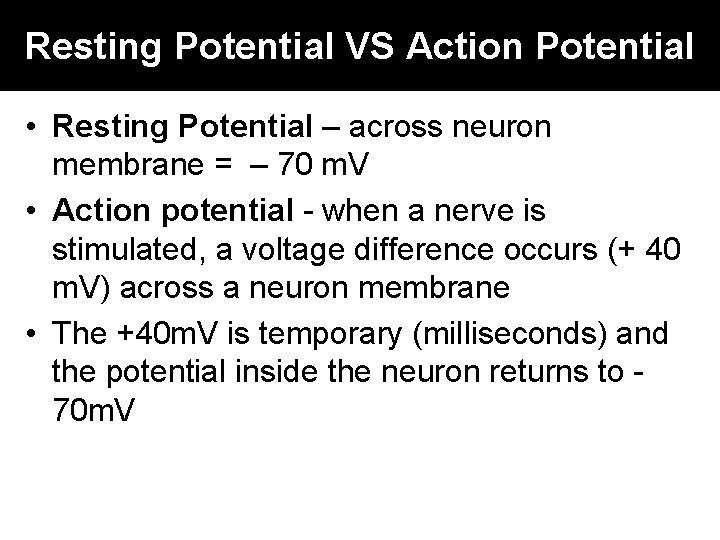
Resting Potential VS Action Potential • Resting Potential – across neuron membrane = – 70 m. V • Action potential when a nerve is stimulated, a voltage difference occurs (+ 40 m. V) across a neuron membrane • The +40 m. V is temporary (milliseconds) and the potential inside the neuron returns to 70 m. V
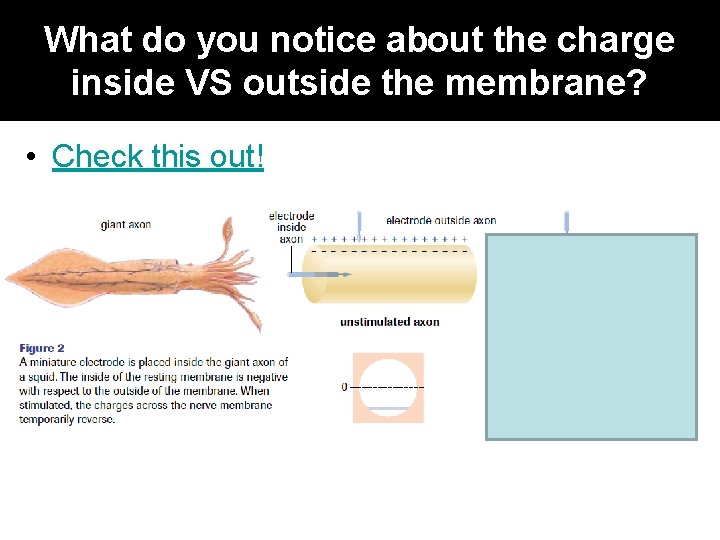
What do you notice about the charge inside VS outside the membrane? • Check this out!
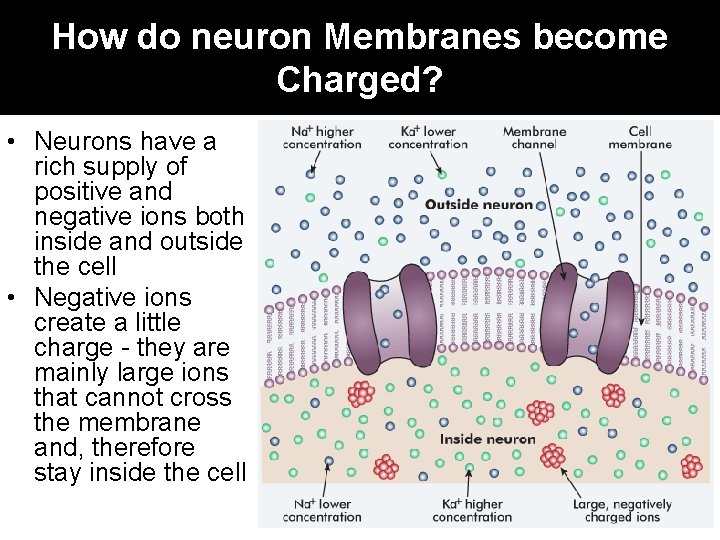
How do neuron Membranes become Charged? • Neurons have a rich supply of positive and negative ions both inside and outside the cell • Negative ions create a little charge they are mainly large ions that cannot cross the membrane and, therefore stay inside the cell
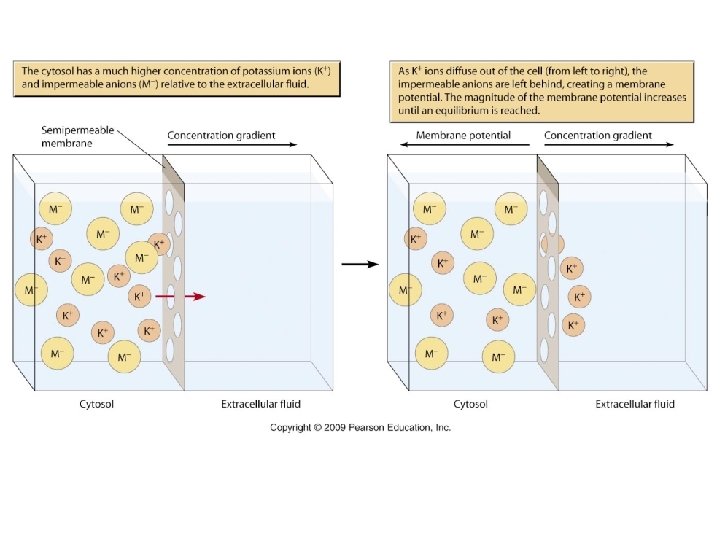
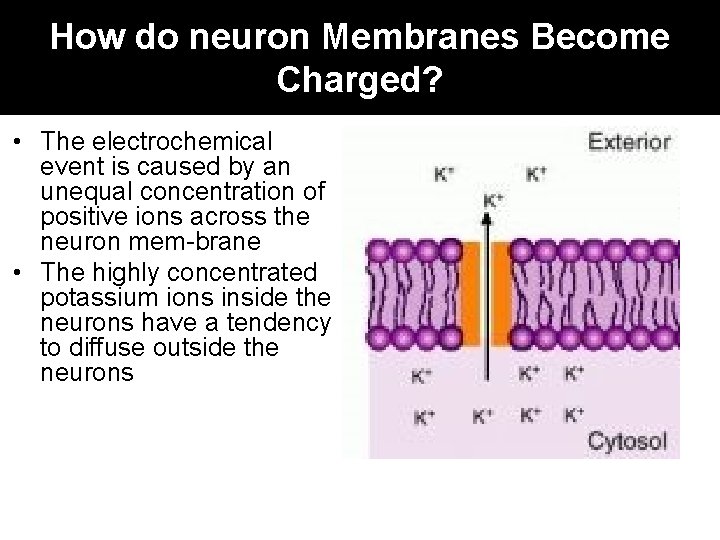
How do neuron Membranes Become Charged? • The electrochemical event is caused by an unequal concentration of positive ions across the neuron mem brane • The highly concentrated potassium ions inside the neurons have a tendency to diffuse outside the neurons
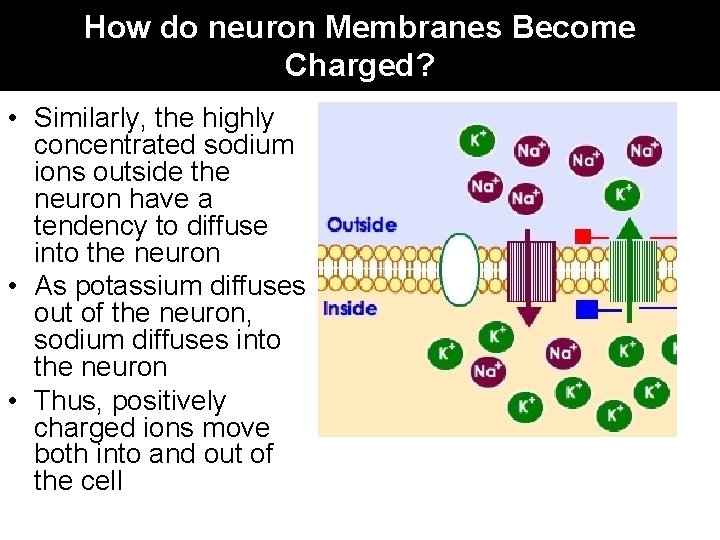
How do neuron Membranes Become Charged? • Similarly, the highly concentrated sodium ions outside the neuron have a tendency to diffuse into the neuron • As potassium diffuses out of the neuron, sodium diffuses into the neuron • Thus, positively charged ions move both into and out of the cell
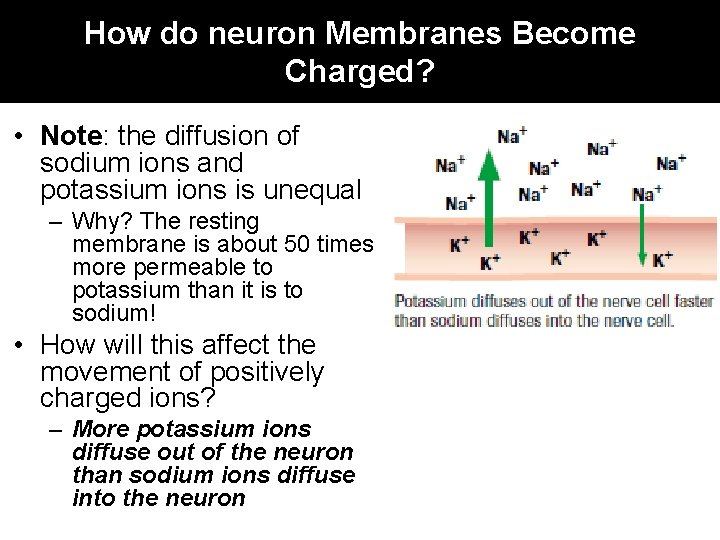
How do neuron Membranes Become Charged? • Note: the diffusion of sodium ions and potassium ions is unequal – Why? The resting membrane is about 50 times more permeable to potassium than it is to sodium! • How will this affect the movement of positively charged ions? – More potassium ions diffuse out of the neuron than sodium ions diffuse into the neuron
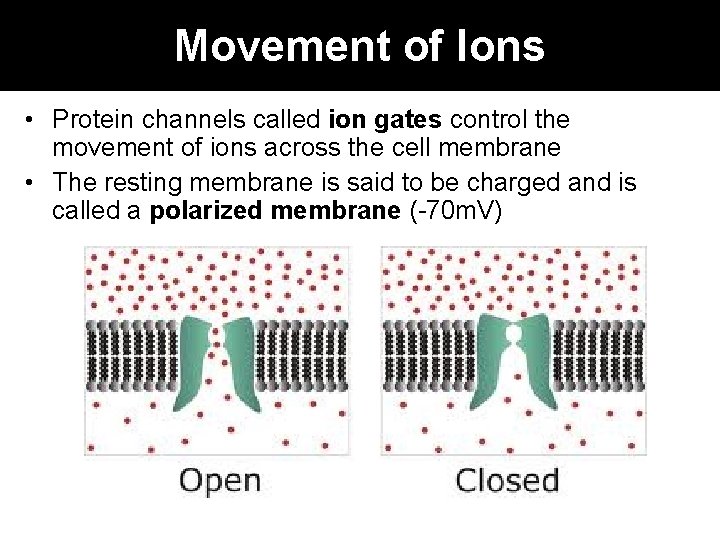
Movement of Ions • Protein channels called ion gates control the movement of ions across the cell membrane • The resting membrane is said to be charged and is called a polarized membrane ( 70 m. V)
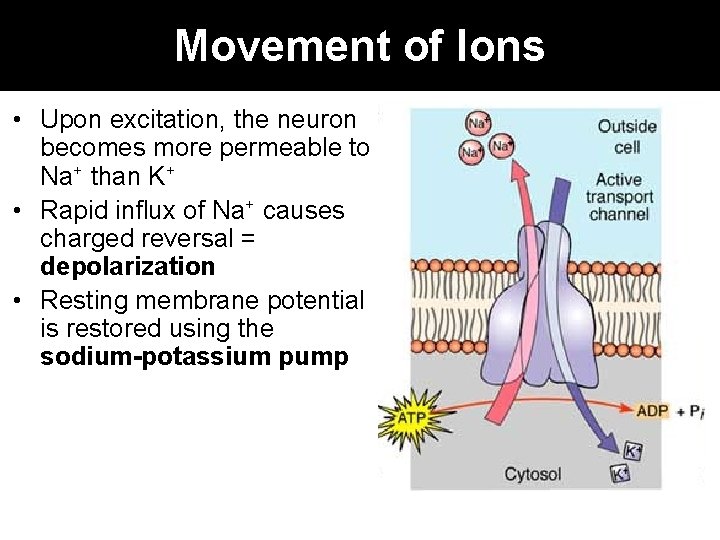
Movement of Ions • Upon excitation, the neuron becomes more permeable to Na+ than K+ • Rapid influx of Na+ causes charged reversal = depolarization • Resting membrane potential is restored using the sodium-potassium pump
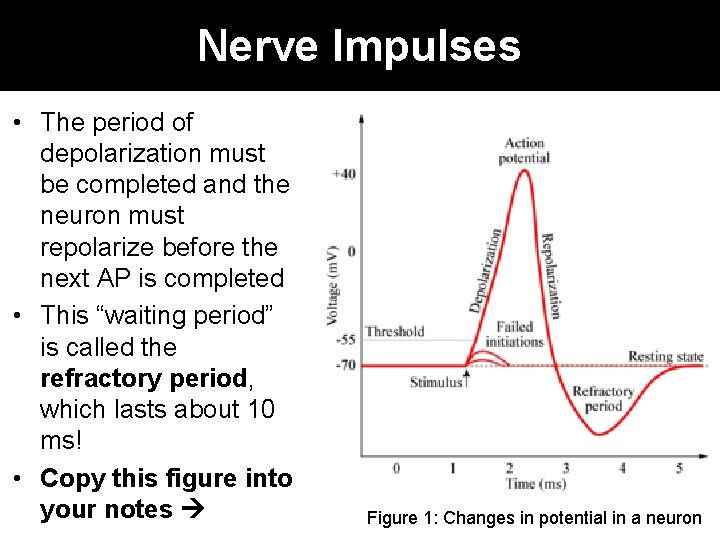
Nerve Impulses • The period of depolarization must be completed and the neuron must repolarize before the next AP is completed • This “waiting period” is called the refractory period, which lasts about 10 ms! • Copy this figure into your notes Figure 1: Changes in potential in a neuron
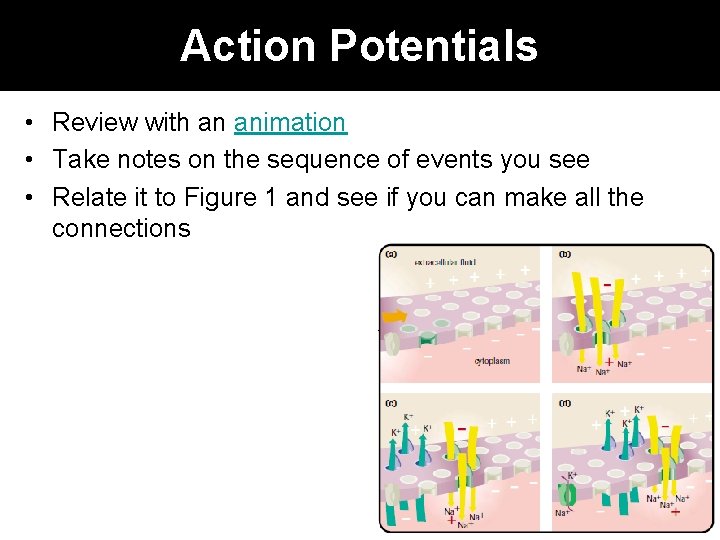
Action Potentials • Review with an animation • Take notes on the sequence of events you see • Relate it to Figure 1 and see if you can make all the connections
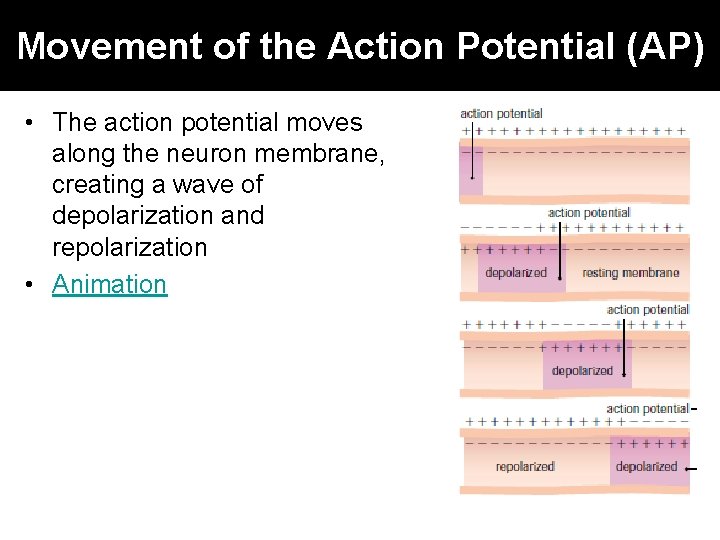
Movement of the Action Potential (AP) • The action potential moves along the neuron membrane, creating a wave of depolarization and repolarization • Animation
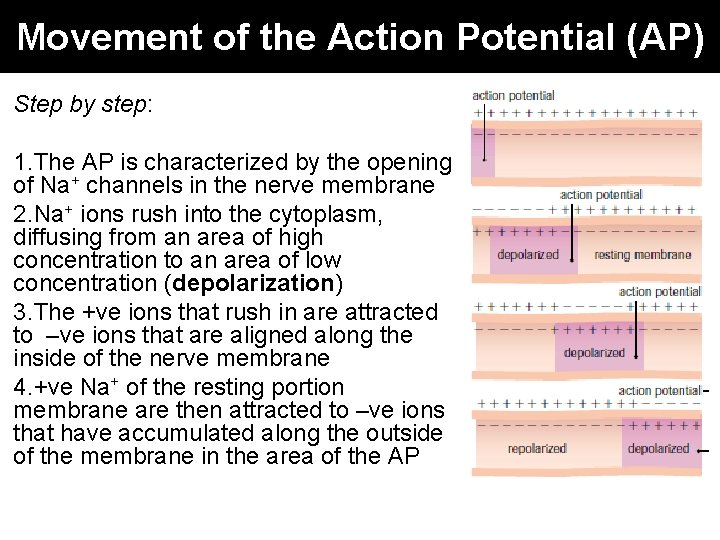
Movement of the Action Potential (AP) Step by step: 1. The AP is characterized by the opening of Na+ channels in the nerve membrane 2. Na+ ions rush into the cytoplasm, diffusing from an area of high concentration to an area of low concentration (depolarization) 3. The +ve ions that rush in are attracted to –ve ions that are aligned along the inside of the nerve membrane 4. +ve Na+ of the resting portion membrane are then attracted to –ve ions that have accumulated along the outside of the membrane in the area of the AP
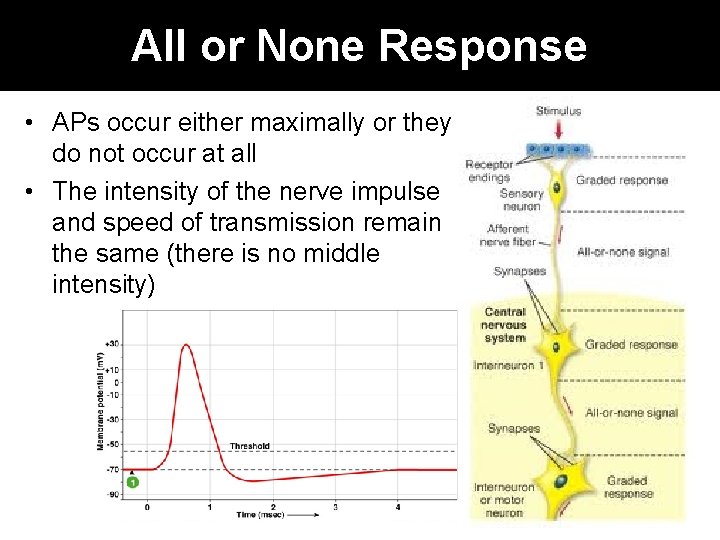
All or None Response • APs occur either maximally or they do not occur at all • The intensity of the nerve impulse and speed of transmission remain the same (there is no middle intensity)
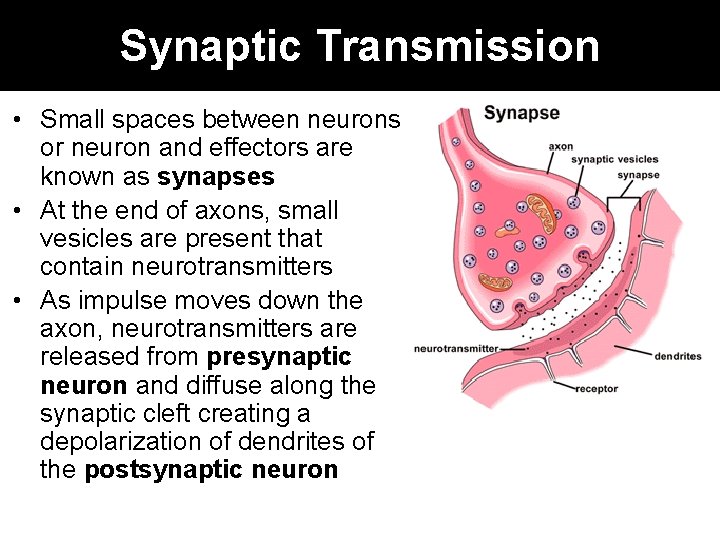
Synaptic Transmission • Small spaces between neurons or neuron and effectors are known as synapses • At the end of axons, small vesicles are present that contain neurotransmitters • As impulse moves down the axon, neurotransmitters are released from presynaptic neuron and diffuse along the synaptic cleft creating a depolarization of dendrites of the postsynaptic neuron
Examples of Neurotransmitters (NT) • Acetylcholine is an example of a NT found in presynaptic neurons acts as a excitatory NT on post synaptic neurons by opening up Na+ ion channels • Cholinesterase is released from the postsynaptic membrane destroys acetylcholine so that the AP does not continue Summation is the effect produced by the accumulation of NTs from two or more neurons
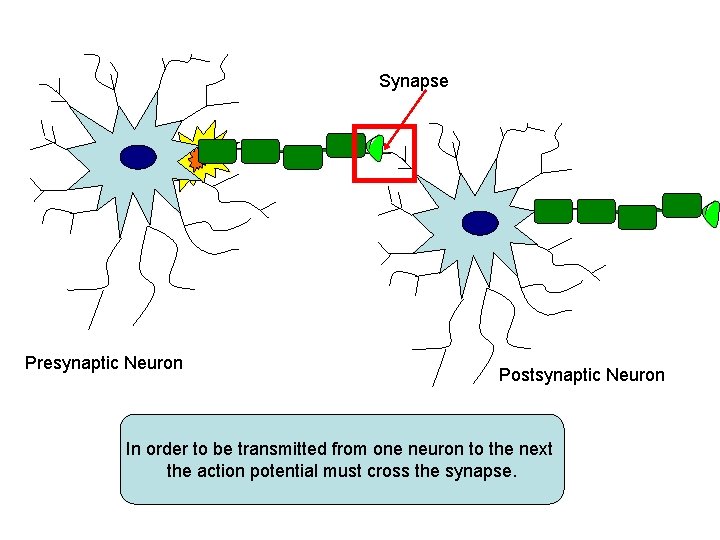
Synapse Presynaptic Neuron Postsynaptic Neuron An action potential travels down the axon In order to be transmitted from one neuron to the next of one neuron to the dendrites of the next. the action potential must cross the synapse.
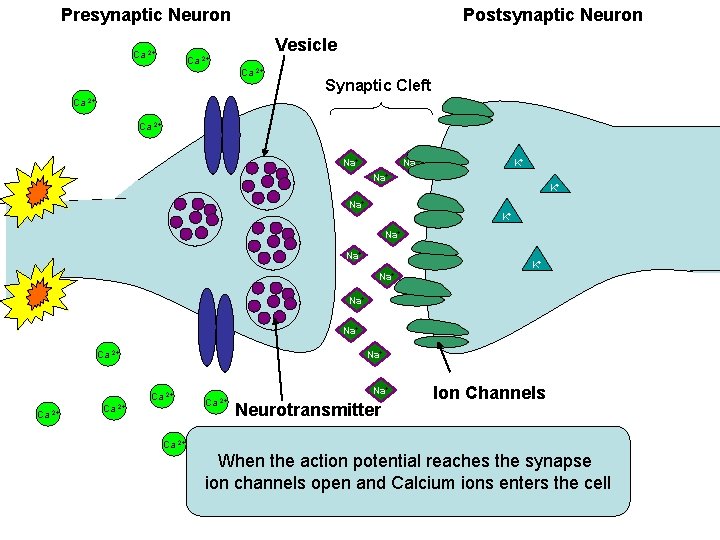
Presynaptic Neuron Ca 2+ Postsynaptic Neuron Vesicle Ca 2+ Ca Synaptic Cleft 2+ Ca 2+ Na+ K+ Na+ Na+ Ca 2+ Na+ Ca 2+ Neurotransmitter Ion Channels Ca 2+ Neurotransmitters When the action potential are contained reaches inside thevesicles synapsein ion channels open the Presynaptic and Calcium neuron. ions enters the cell
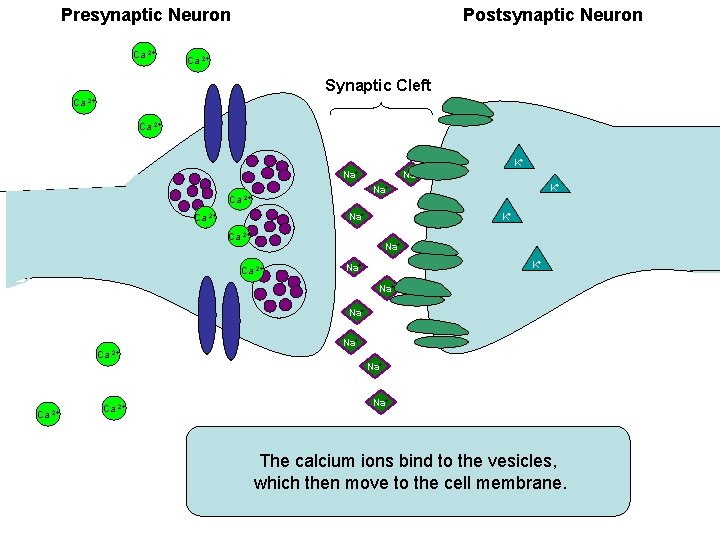
Presynaptic Neuron Ca 2+ Postsynaptic Neuron Ca 2+ Synaptic Cleft Ca 2+ K+ Na+ Ca 2+ K+ Ca 2+ Na+ Ca 2+ K+ Na+ Na+ Ca 2+ Na+ The calcium ions bind to the vesicles, which then move to the cell membrane.
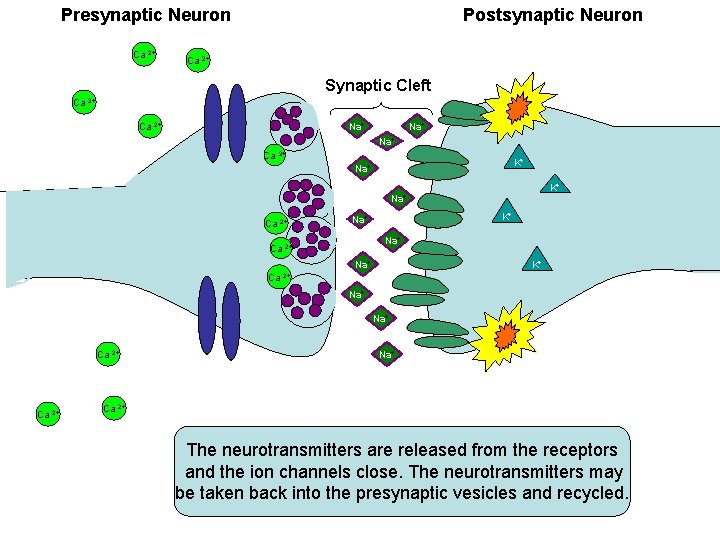
Presynaptic Neuron Ca 2+ Postsynaptic Neuron Ca 2+ Synaptic Cleft Ca 2+ Na+ Na+ Ca 2+ K+ Na+ Ca 2+ Na+ Ca K+ 2+ Na+ Ca 2+ Binding Afterofthe thevesicles neurotransmitters dock at thecauses membrane ion channels the The neurotransmitters are released from the receptors neurotransmitters to open, allowing Sodium released ions into the enter synaptic the cell. cleft. Movement of ionsare into and out of to the cell causes an and the ion channels close. The neurotransmitters may The As neurotransmitters Sodium ionsinenter, then Potassium bind to receptors ions action potential to start the postsynaptic membrane. be taken back into the presynaptic vesicles and recycled. on the diffuse postsynaptic out of the membrane. cell.

Homework • Read over relevant sections in your text
- Slides: 25