
SBAC Next Generation Assessment Roosevelt Complex PC Day
SBAC Next Generation Assessment Roosevelt Complex PC Day August 29, 2014 Holly M. Polk – CCSS RT

SBAC Administration Doe Memo 2/21/14
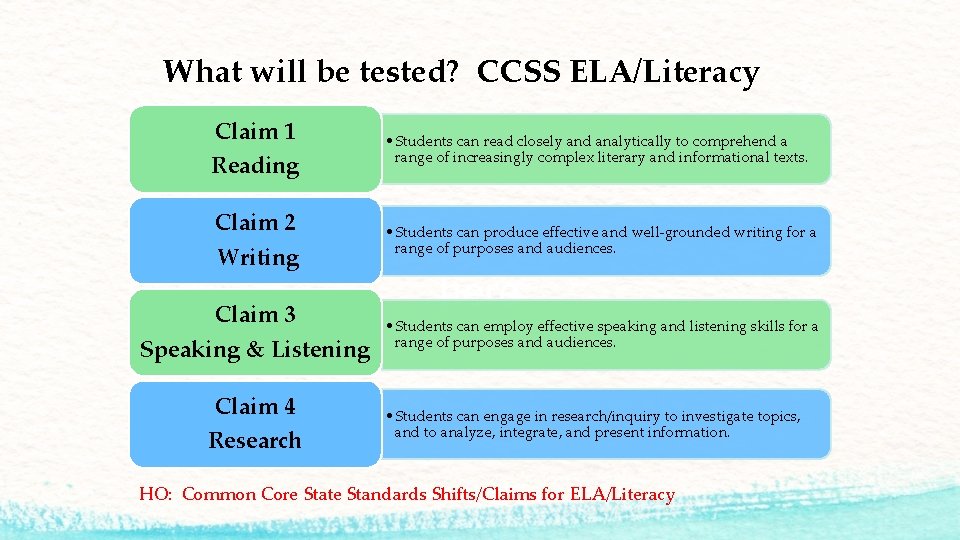
What will be tested? CCSS ELA/Literacy Claim 1 Reading Claim 2 Writing Claim 3 Speaking & Listening Claim 4 Research • Students can read closely and analytically to comprehend a range of increasingly complex literary and informational texts. • Students can produce effective and well-grounded writing for a range of purposes and audiences. Place text here • Students can employ effective speaking and listening skills for a range of purposes and audiences. • Students can engage in research/inquiry to investigate topics, and to analyze, integrate, and present information. HO: Common Core State Standards Shifts/Claims for ELA/Literacy
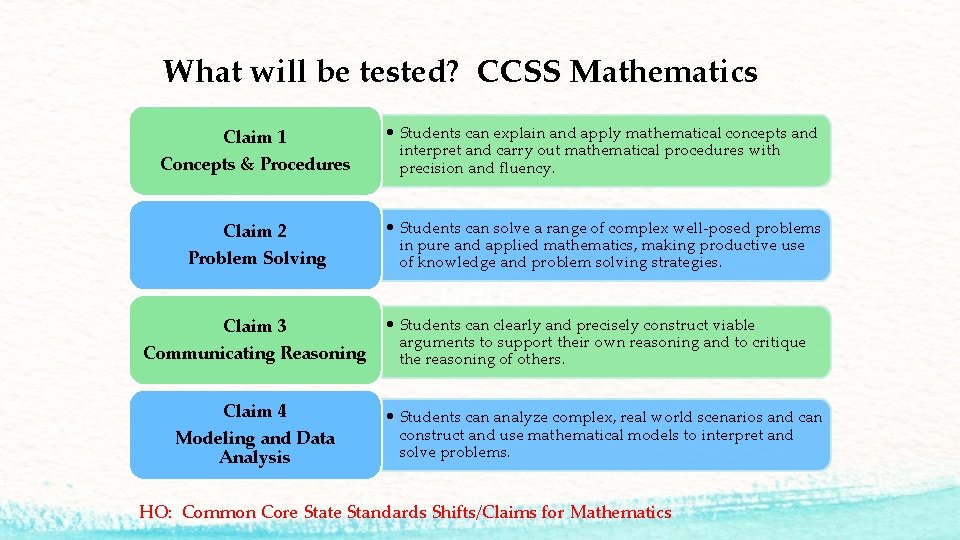
What will be tested? CCSS Mathematics Claim 1 Concepts & Procedures • Students can explain and apply mathematical concepts and interpret and carry out mathematical procedures with precision and fluency. Claim 2 Problem Solving • Students can solve a range of complex well-posed problems in pure and applied mathematics, making productive use of knowledge and problem solving strategies. Claim 3 Communicating Reasoning Claim 4 Modeling and Data Analysis Place text here • Students can clearly and precisely construct viable arguments to support their own reasoning and to critique the reasoning of others. • Students can analyze complex, real world scenarios and can construct and use mathematical models to interpret and solve problems. HO: Common Core State Standards Shifts/Claims for Mathematics
Webb’s Depth of Knowledge • Analyze the cognitive demand (complexity) intended by the standards, curricular activities, and assessment tasks. • A process and criteria for systematically analyzing alignment between standards and test items in standardized assessments. • The model categorizes assessment tasks by different levels of cognitive expectations or depth of knowledge, required to successfully complete the task. • A model with content specific descriptions (ELA, History & Social Studies and Math & Science Alignment) for use by classroom teachers. HO: A guide for using Webb’s Depth of Knowledge with CCSS

Components of the SBAC Assessment PERFORMANCE TASKS + NON PERFORMANCE TASK ITEMS • Measure the ability to integrate knowledge and skills, as required in CCSS • A computer adaptive assessment given during final 12 weeks of the school year* • Computer-delivered, during final 12 weeks of the school year* • Multiple item types, scored by computer: 45 -60 items per test
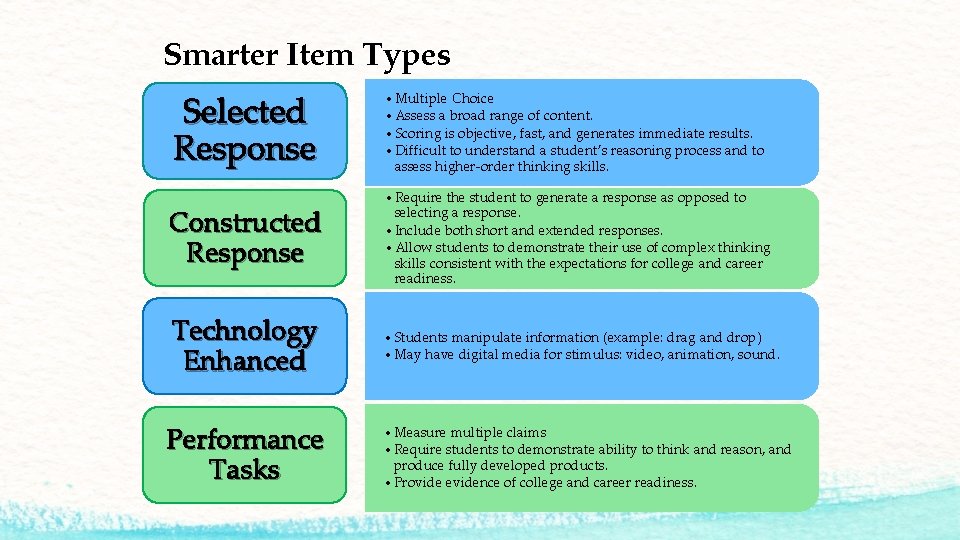
Smarter Item Types Selected Response • Multiple Choice • Assess a broad range of content. • Scoring is objective, fast, and generates immediate results. • Difficult to understand a student’s reasoning process and to assess higher-order thinking skills. Constructed Response • Require the student to generate a response as opposed to selecting a response. • Include both short and extended responses. • Allow students to demonstrate their use of complex thinking skills consistent with the expectations for college and career readiness. Technology Enhanced • Students manipulate information (example: drag and drop) • May have digital media for stimulus: video, animation, sound. Performance Tasks • Measure multiple claims • Require students to demonstrate ability to think and reason, and produce fully developed products. • Provide evidence of college and career readiness.
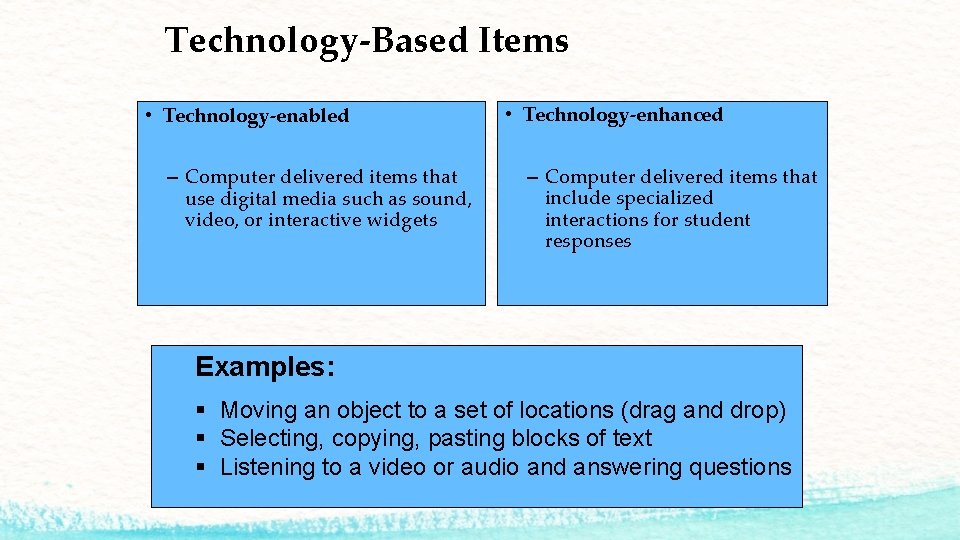
Technology-Based Items • Technology-enabled – Computer delivered items that use digital media such as sound, video, or interactive widgets • Technology-enhanced – Computer delivered items that include specialized interactions for student responses Examples: § Moving an object to a set of locations (drag and drop) § Selecting, copying, pasting blocks of text § Listening to a video or audio and answering questions
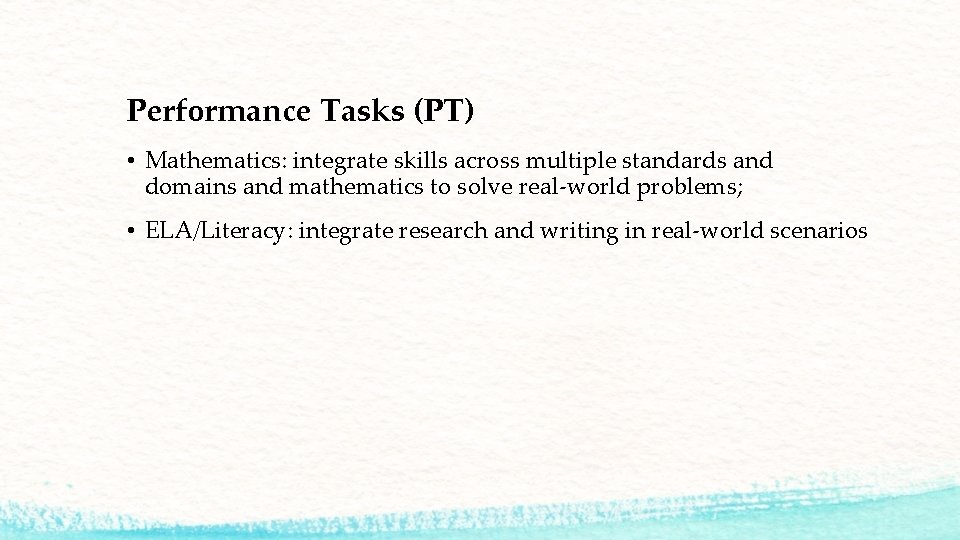
Performance Tasks (PT) • Mathematics: integrate skills across multiple standards and domains and mathematics to solve real-world problems; • ELA/Literacy: integrate research and writing in real-world scenarios
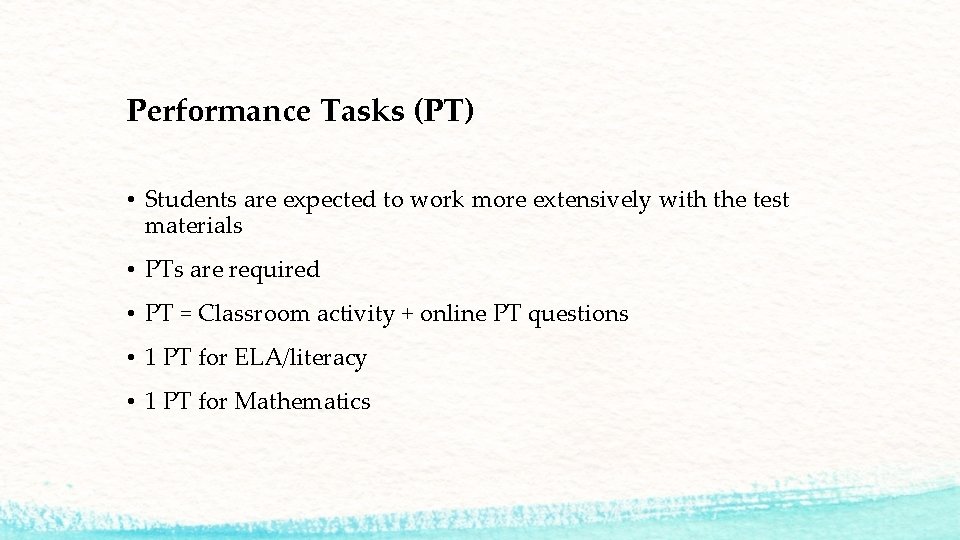
Performance Tasks (PT) • Students are expected to work more extensively with the test materials • PTs are required • PT = Classroom activity + online PT questions • 1 PT for ELA/literacy • 1 PT for Mathematics
Performance Tasks (PT) • Extended projects demonstrate real world writing and analytical skills • May include online research, group projects, and presentations • Require 1 -3 class periods to complete • Applicable in all grades being assessed • Evaluated by SBAC scorers using consistent scoring rubrics
We must prepare students for a very different type of performance assessment that may include: -Taking notes while watching a video/audio -Taking notes when reading an article, short story, etc. -Use evidence when answering questions -Participating in small group discussions -Analyzing, synthesizing, evaluating, and integrating information read in order to write a complete essay - Writing/answering questions within a specific time frame

Department Exploration of SBAC HO: Practice Test Site Information Sheet – – Purpose Grade Level Type of Items Universal Tools, Designated Supports, and Accommodations HO: SBAC Practice Test Site Navigation Sheet • Instructions on how to navigate to your specific grade level: • Practice Test • Training Test • Performance Task
Focus Performance Task Analysis • Type of Items • Shifts/Claims • Webb’s Depth of Knowledge • Assessment Targets • Performance Tasks • Computer Navigation • Guiding Questions for Team Discussions HO: SBAC Components for Gr. _____ ELA/Literacy or Math Performance Task

Resources to support CCSS/SBAC • SBAC Performance Task Writing Rubric – 4 -Point Narrative Rubric for Grades 3 -8 – 4 -Point Informative-Explanatory Rubric for Grades 6 -11 – 4 -Point Argumentative Rubric for Grades 6 -11 • SBAC Estimated Testing Times • SBAC Accommodations • 3 Tiers of Vocabulary • Common Core Online Resources • Common Core Digital Library
- Slides: 15