
SBA Certifications for Selling to the Federal Government

SBA Certifications for Selling to the Federal Government Presented by: John Dicus SBA Seattle District Office
What Programs are available to Small Businesses in Federal Contracting? The SBA provides several programs to help small businesses win federal contracts. Participating in these programs helps small businesses: • Win a fair share of federal contracts • Qualify for exclusive set-aside and sole-source contracts • Partner with established contractors to win contracts • Get business mentoring and education to learn how federal contracting works 3
What Programs are available to Small Businesses in the Federal Contracting Arena? To promote maximum participation by small, disadvantaged, veteran-owned, or woman-owned businesses in federal government contract awards and large prime subcontract awards, The SBA assists Small Businesses through: • Self Certifications • Women-Owned Small Business Contracting Program • Service Disabled Veteran-Owned Small Business Program • 8(a) Business Development Program • HUBZone Program • All Small Mentor-Protégé Program • Natural Resource Sales Assistance Program 4
SBA Federal Contracting Certifications: Self Certifications: • Small Business (determined by NAICS Codes) • https: //www. sba. gov/federal-contracting/contracting-guide/size-standards • Woman-Owned Small Business Federal Contracting Program * • https: //www. sba. gov/federal-contracting/contracting-assistance-programs/womenowned-small-business-federal-contracting-program • Service-Disabled Veteran-Owned Small Businesses Program • https: //www. sba. gov/federal-contracting/contracting-assistance-programs/servicedisabled-veteran-owned-small-businesses-program SBA Certifications: • 8(a) Business Development Program • https: //www. sba. gov/federal-contracting/contracting-assistance-programs/8 abusiness-development-program • HUBZone • https: //www. sba. gov/federal-contracting/contracting-assistance-programs/hubzone -program 5

Prime Contracting Government-wide Procurement Goals Small Business (SB) - 23% Small Disadvantaged Business (SDB) - 5% Women-Owned Small Business - (WOSB)- 5% HUBZone Small Business – 3% Veteran-Owned Small Business (VOSB) - 3% 6
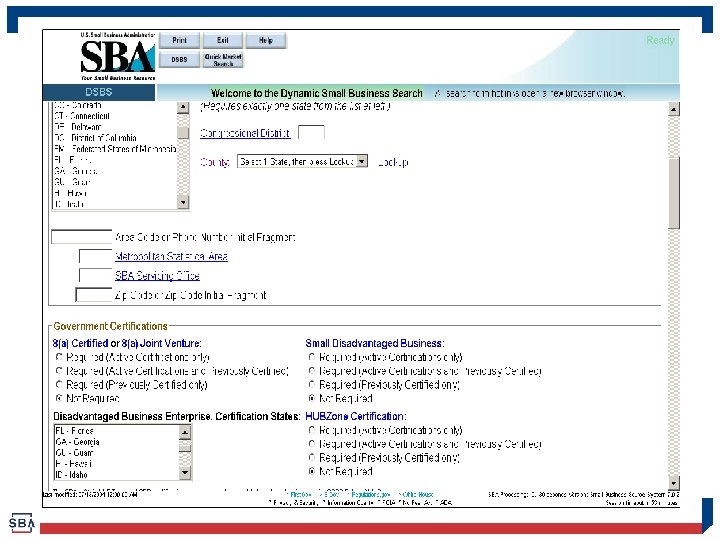
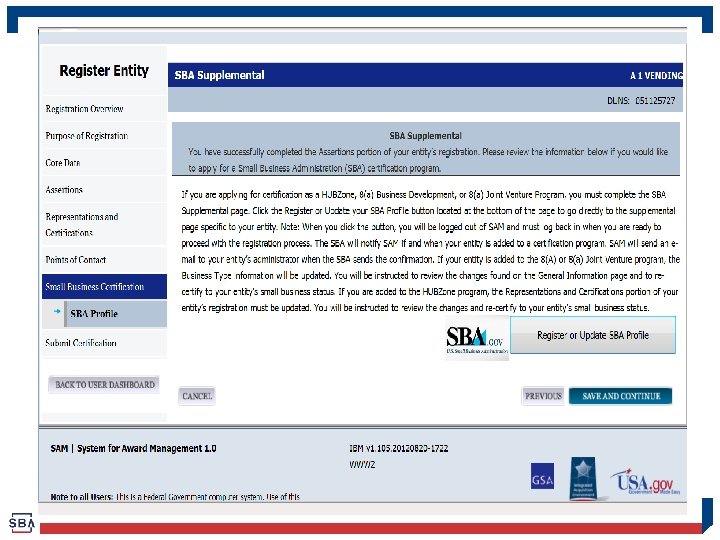
What are “Size Standards” The SBA’s size standards determine whether or not your business qualifies as small and are: • Based on NAICS codes (North American Industry Classification System) • Primary code is the one that represents largest portion of business. • Currently over 1, 000 NAICS codes in many different Industries • Firm may be capable of performing in several NAICS code areas. • http: //www. census. gov/eos/www/naics/ 9
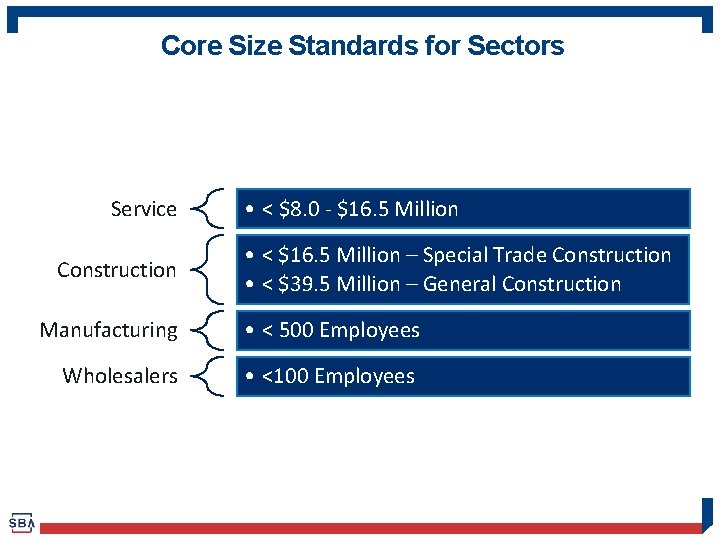
Core Size Standards for Sectors Service Construction • < $8. 0 - $16. 5 Million • < $16. 5 Million – Special Trade Construction • < $39. 5 Million – General Construction Manufacturing • < 500 Employees Wholesalers • <100 Employees
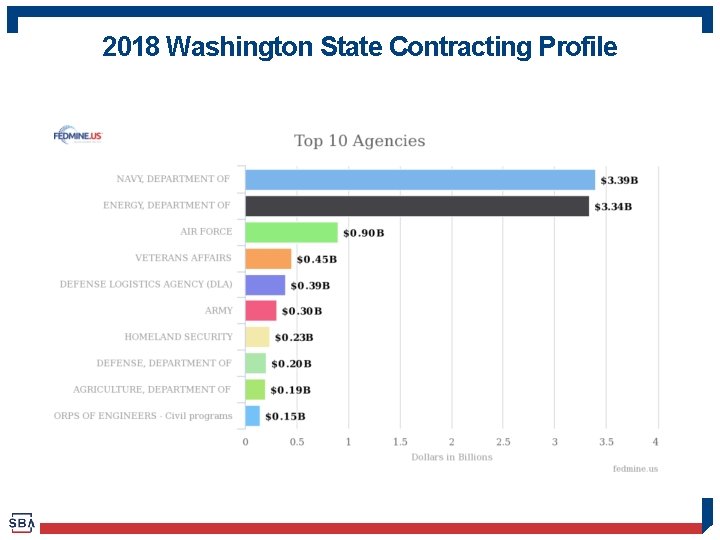
2018 Washington State Contracting Profile
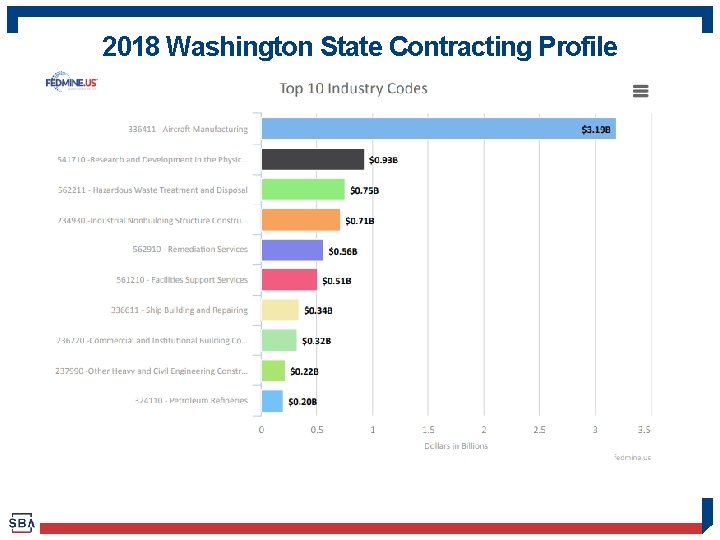
2018 Washington State Contracting Profile
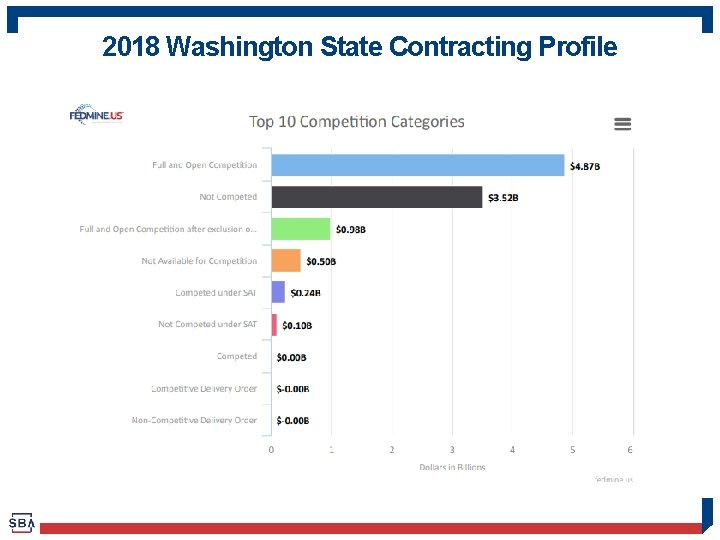
2018 Washington State Contracting Profile
Women-Owned Small Business Contracting Program • To help provide a level playing field for women business owners, the government limits competition for certain contracts to businesses that participate in the women’s contracting program. • These set-aside contracts are for industries where womenowned small businesses (WOSB) are underrepresented. Some contracts are restricted further to economically disadvantaged women-owned small businesses (EDWOSB). The SBA maintains a list of those eligible industries and their corresponding NAICS codes. 15
Women’s Contracting Program Eligibility Requirements To be eligible for the women’s contracting program, your business must: • Be a small business • Be at least 51% owned and controlled by women who are U. S. citizens • Have women manage day-to-day operations and also make long-term decisions To qualify as an economically disadvantaged business within the women’s contracting program, your business must: • Meet all the requirements of the women’s contracting program • Be owned and controlled by one or more women, each with a personal net worth less than $750, 000 • Be owned and controlled by one or more women, each whose average adjusted gross income for three years is $350, 000 or less • Have $6 million or less in business assets You can also get a preliminary assessment of whether you qualify at the SBA’s Certify website. 16
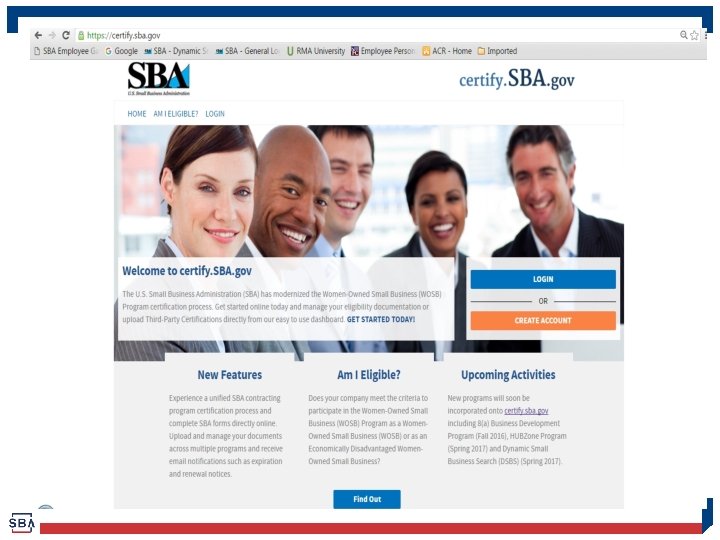
Get Certified as a Women-Owned Small Business Self-certification • You can self-certify directly at certify. SBA. gov by answering questions and uploading documents. The information you’ll need to provide will vary based on your business structure and whether you’re already participating in other SBA programs. Review the preparation checklist at the certify website. Third-party certification • There are four organizations approved by the SBA to provide thirdparty certification. Contact them to find out about their certification process. They are: • • El Paso Hispanic Chamber of Commerce National Women Business Owners Corporation US Women’s Chamber of Commerce Women’s Business Enterprise National Council • You’ll need to provide proof of your third-party certification through certify. SBA. gov. Read the instructions carefully to make sure you provide all the necessary information. 17
The 8(a) Business Development Program Created to help small disadvantaged businesses compete in the federal procurement market. • Provide viable contracts, financial, technical and management assistance to promote their competitive growth. • The 8(a) Program is a “Business Development” program, not a contracting program. There are “no guarantees of contracts. ” 18
The 8(a) Business Development Program Eligibility Requirements To qualify for the 8(a) program, a firm must: • Be a small business • Not already have participated in the 8(a) program • Be at least 51 percent owned and controlled by U. S. citizens who are economically and socially disadvantaged • Be owned by someone whose average adjusted gross income for three years is $250, 000 or less • Be owned by someone with $4 million or less in assets • Have the owner manage day-to-day operations and also make long-term decisions • Have all its principals demonstrate good character • Show potential for success and be able to perform successfully on contracts 19
What is Social Disadvantaged? Who are presumed socially disadvantaged individuals? • Black Americans • Hispanic Americans • Native Americans (American Indians, Eskimos, Aleuts, and Native Hawaiians) • Asian Pacific Americans Members of non-designated groups An individual who is not a member of a designated group may establish social disadvantage by a contributing factor such as race, ethnic origin, gender or physical handicap. 20
What is Economically Disadvantaged? Who are economically disadvantaged individuals? Individuals whose ability to compete in free enterprise has been impaired due to diminished capital and credit opportunities. Determining factors include the applicant’s: • Adjusted net worth < $250, 000 • Average three year income < $250, 000 • Market value of assets < $4 million • Overall financial condition 21
Get Certified as an 8(a) Small Business To get certified as an 8(a) business, simply use the certify. SBA. gov website. You’ll need to have a profile at SAM. gov before you can use the certification website. • Submit on-line application with paper supporting documentation uploaded to certify. sba. gov • You will have the opportunity to provide supplementary documentation • Application is at least 120 days • 9 year program • One-time eligibility 22
The HUBZone Program (Historically Underutilized Business Zone) What is it? • Economic Development Program • Purpose is to create new jobs by awarding contracts to small businesses • Areas of high unemployment or low per capita income What are the Benefits? • Joining the HUBZone program makes your business eligible to compete for the program’s set-aside contracts. • HUBZone-certified businesses also get a 10 percent price evaluation preference in full and open contract competition 23
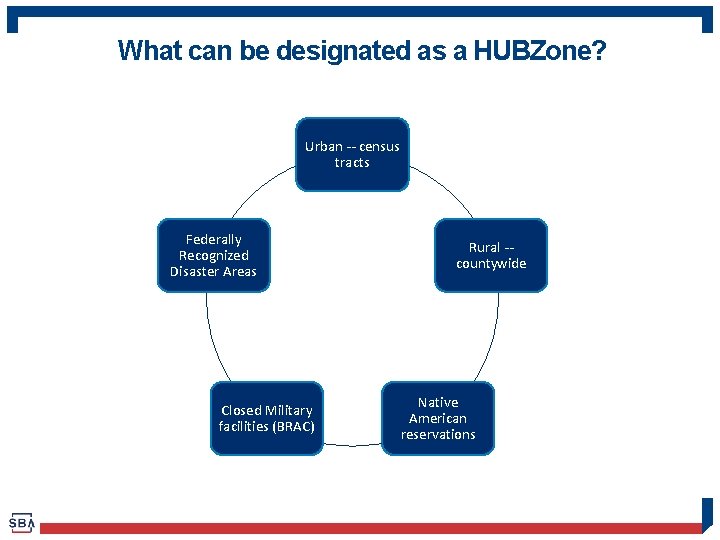
What can be designated as a HUBZone? Urban -- census tracts Federally Recognized Disaster Areas Closed Military facilities (BRAC) Rural -countywide Native American reservations
The HUBZone Program Eligibility Requirements To qualify for the HUBZone Program, your business must: • Be a small business • Be at least 51 percent owned and controlled by U. S. citizens, a Community Development Corporation, an agricultural cooperative, a Native Hawaiian organization, or an Indian tribe • Have its principal office located in a HUBZone • Have at least 35 percent of its employees live in a HUBZone You can also get a preliminary assessment of whether you qualify at the SBA’s Certify website. 25
Get Certified as a HUBZone Business 1. Make sure you have a SAM. gov account 2. Make sure you have a General Login System account 3. Apply for HUBZone certification using the General Login System. Log in, select “Access” and then “HUBZone” before completing the prompts 4. Check your email for time-sensitive instructions to electronically verify your application within 10 business days 5. Submit any requested supporting documentation within 10 business days 6. Update your SAM. gov profile to indicate you are a HUBZone business after you get an email confirmation from the SBA 26
The All-Small Mentor Protégé Program Your small business can learn from an experienced government contractor through the mentor-protégé program. 27
All Small Mentor Program Benefits Protégés can get valuable business development help from their mentors in several areas, including: • Guidance on internal business management systems, accounting, marketing, manufacturing, and strategic planning • Financial assistance in the form of equity investments, loans, and bonding • Assistance navigating federal contract bidding, acquisition, and performance process • Education about international trade, strategic planning, and finding markets • Business development, including strategy and identifying contracting and partnership opportunities • General and administrative assistance, like human resource sharing or security clearance support Mentors and protégés in the All Small program can form joint ventures. These joint ventures would qualify for set-aside contracts that the small business is eligible for
All Small Mentor Program Qualifications To qualify as a protégé, your business must: • Be a small business with industry experience • Have a proposed mentor prior to applying for the program • Be organized for profit or as an agricultural cooperative • Have no more than two mentors in the business’ lifetime To qualify as a mentor, your business must: • Be organized for profit or as an agricultural cooperative • Have no more than three protégés at a time For the SBA to approve the mentor-protégé agreement: • The SBA must determine that the mentor-provided assistance will promote real developmental gains for the protégé, not just act as a vehicle to receive federal small business set-asides • An SBA “determination of affiliation” must not exist between the mentor and the protégé
Apply to the All Small Program You must be approved by the SBA to participate in the All Small program. You’re required to use the certify. SBA. gov website to apply. You’ll need to have a profile at SAM. gov before you can use the certification website. Before you apply: • Make sure both businesses are registered at SAM. gov • Have your NAICS code on hand • Both businesses must complete the SBA’s online All Small tutorial (save your completion certificates) • Prepare your business plan • Create and agree to a Mentor-Protégé Agreement When you’re ready to apply, go to certify. SBA. gov and apply to join the All Small Mentor-Protégé program. 30
Questions Seattle District Office 2401 4 th Ave, Suite 450 Seattle, WA 98121 https: //www. sba. gov/offices/district/wa/seattle (206) 553 -7310 infosdo@sba. gov 31
- Slides: 31