
SB 2 The learner will analyze how biological
SB 2. The learner will analyze how biological traits are passed on to successive generations. d. Describe the relationships between changes in DNA and potential appearance of new traits
LEQ 3: What relationship exists between changes in DNA and the potential appearance of new traits?
Mutations • Mutations are changes in DNA that may or may not affect the phenotype of an organism. – Physical appearance • Change in an organisms DNA • Some mutations affect a single gene, while others affect an entire chromosome.
MUTATIONS • Two main types: – Gene • Mutation that causes a change in a single gene – Chromosomal • Mutation that involves the entire chromosome • Both can be caused by nature, random events, or environmental factors
Gene Mutations • A gene mutation is a change in the DNA of a single gene in an organism. • Many kinds of mutations can occur, especially during replication. – Point mutation – Frameshift mutations

Gene Mutations • A point mutation substitutes on nucleotide for another. Mutated Base
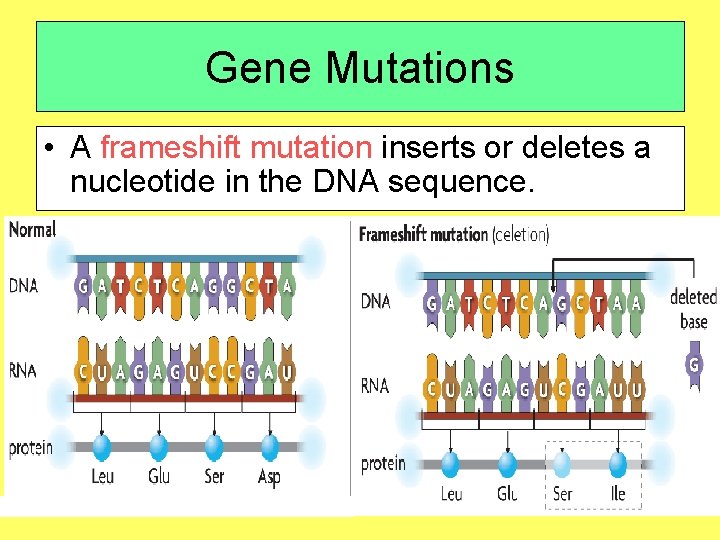
Gene Mutations • A frameshift mutation inserts or deletes a nucleotide in the DNA sequence.
Chromosomal Mutations • A chromosomal mutation affects an entire chromosome. – Affect many genes. • Occurs when chromosomes fail to separate correctly during gamete production ( Meiosis) – Nondisjunction • May lead to abnormalities in offspring
Chromosomal Mutations • Types of Chromosomal Mutations: – Gene deletion – Gene duplication – Gene inversion – Gene Translocation
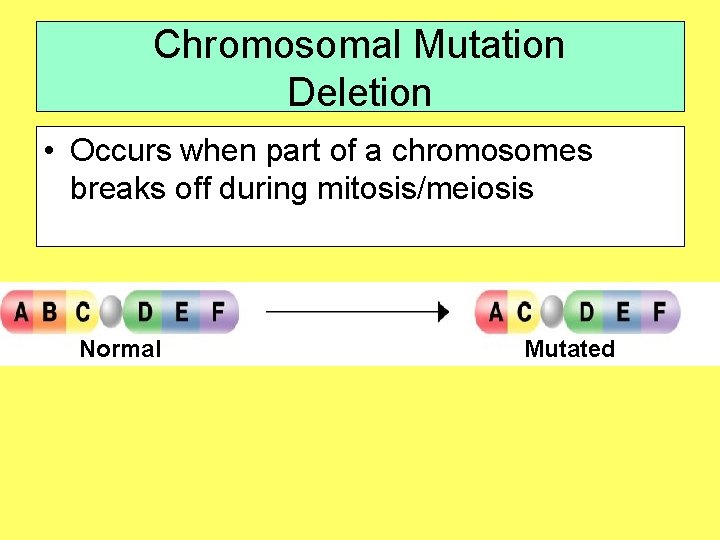
Chromosomal Mutation Deletion • Occurs when part of a chromosomes breaks off during mitosis/meiosis Normal Mutated
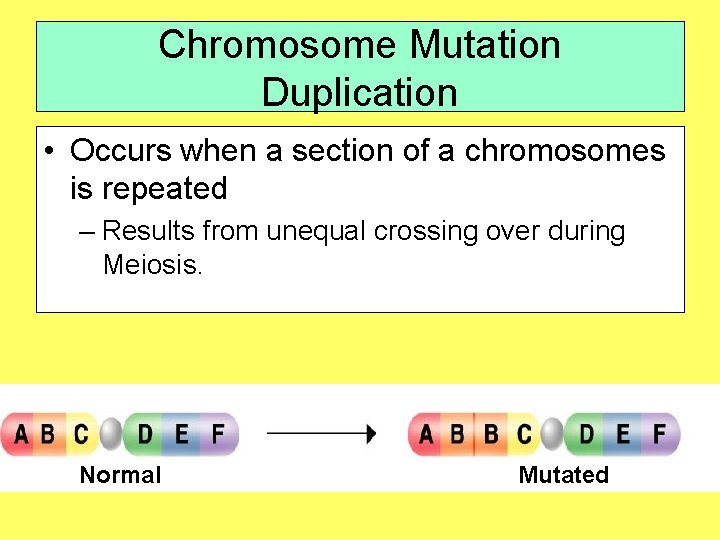
Chromosome Mutation Duplication • Occurs when a section of a chromosomes is repeated – Results from unequal crossing over during Meiosis. Normal Mutated
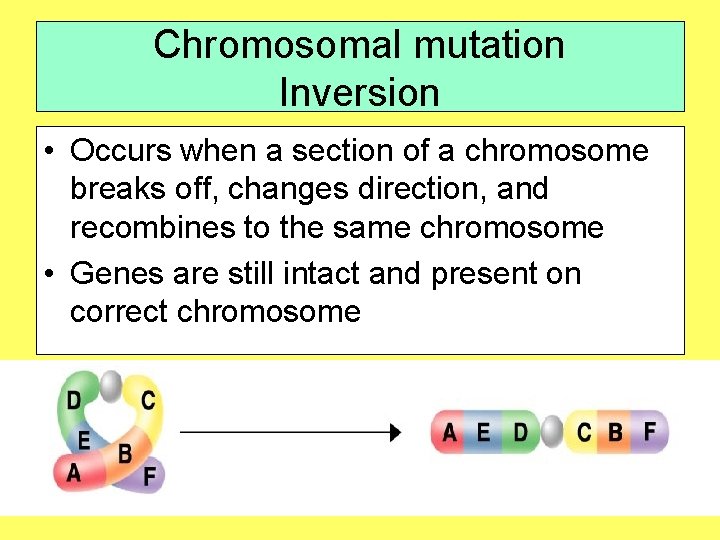
Chromosomal mutation Inversion • Occurs when a section of a chromosome breaks off, changes direction, and recombines to the same chromosome • Genes are still intact and present on correct chromosome
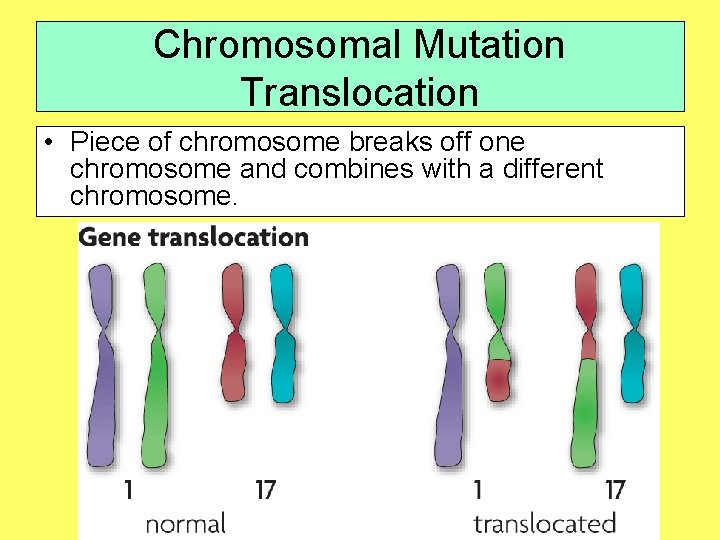
Chromosomal Mutation Translocation • Piece of chromosome breaks off one chromosome and combines with a different chromosome.
Consequences of Mutations • Mutations my or may not affect phenotype. • Chromosomal mutations tend to have a big effect. – Death of the organism – Severe mental or physical disabilities – Genetic Disorders: • Down syndrome
Consequences of Mutations • Some gene mutations change phenotype. – A mutation may cause a premature stop codon. – A mutation may change protein shape or active site. – A mutation may change gene regulation • Some gene mutation do not affect phenotype. – A mutation may be silent. – A mutation may occur in a noncoding region. – A mutation may not affect protein folding or the active site.
Consequences of Mutations • Also, depend on the type of cell the DNA mutation occurs in • Can occur in two types of cells – Somatic (body cell) – Germ line (gametes: sperm/egg)
Somatic Mutation • Are NOT passed down to offspring • Causes: – Random natural causes – Environmental factors: radiation, x-rays, sunlight – Chemical: cigarettes, cleaners • Often lead to cancer
Germ Line Cells • Mutations can be passed down to offspring (inherited) • May be harmful or beneficial to offspring. • Usually occur during Meiosis • Natural selection often removes mutant alleles from a population when they are less adaptive.
Causes • Mutations can be caused by several factors. • Replication errors can cause mutations • Mutagens, such as UV rays and chemicals, can cause mutations. – Some cancer drugs use mutagenic properties to kill cancer cells.
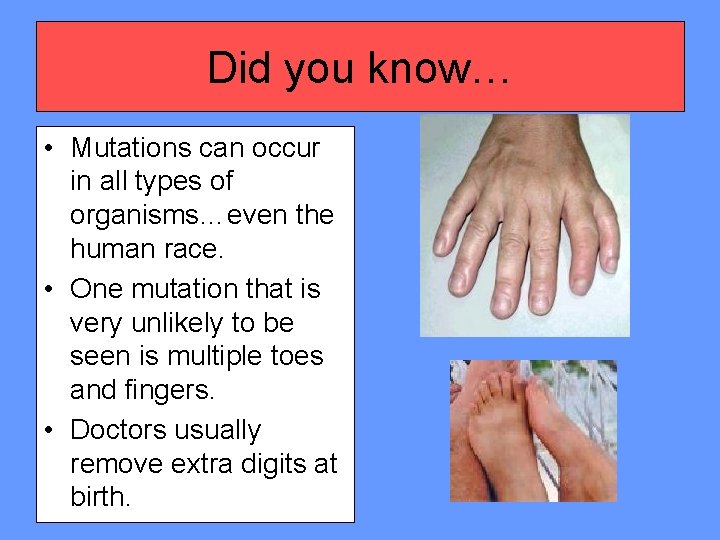
Did you know… • Mutations can occur in all types of organisms…even the human race. • One mutation that is very unlikely to be seen is multiple toes and fingers. • Doctors usually remove extra digits at birth.
- Slides: 20