
SB 01 Understanding and Treating Obsessive Compulsive Disorder
SB 01 Understanding and Treating Obsessive Compulsive Disorder Dr. David A Russ Licensed Psychologist www. turnaroundanxiety. comwww. carolinas-counseling. com

Notes and Powerpoint can be downloaded from: www. turnaroundanxiety. com/docume nts

1. 2. 3. 4. 5. 6. Definition How OCD Functions Variations Components of Treatment Example of Treatment Question and Answer Outline for this Workshop
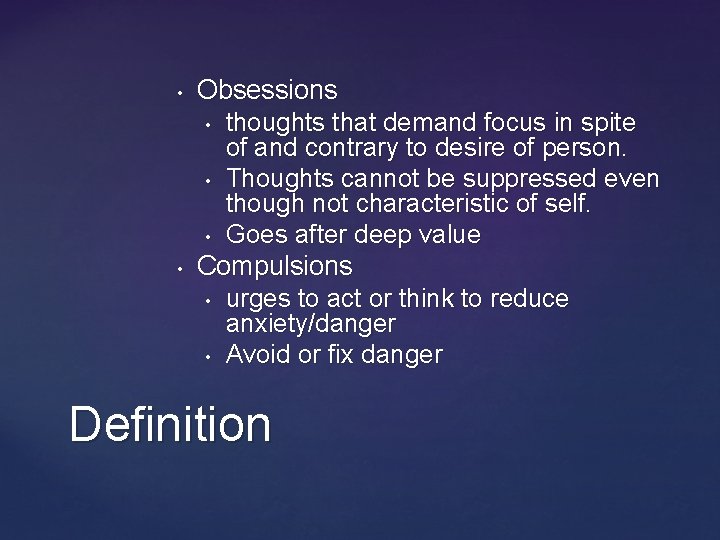
• • Obsessions • thoughts that demand focus in spite of and contrary to desire of person. • Thoughts cannot be suppressed even though not characteristic of self. • Goes after deep value Compulsions • urges to act or think to reduce anxiety/danger • Avoid or fix danger Definition

Functional Description • • Obsessions cause anxiety/distress to rise Compulsions cause anxiety/distress to decrease How it works - Function

Two Parts of Obsessions • Triggers (actually present “What is”) • • Ex. red stain on table Core Fear (imagined consequence “What if? ”) • Ex. I will be contaminated by virus and die How it works - Obsession
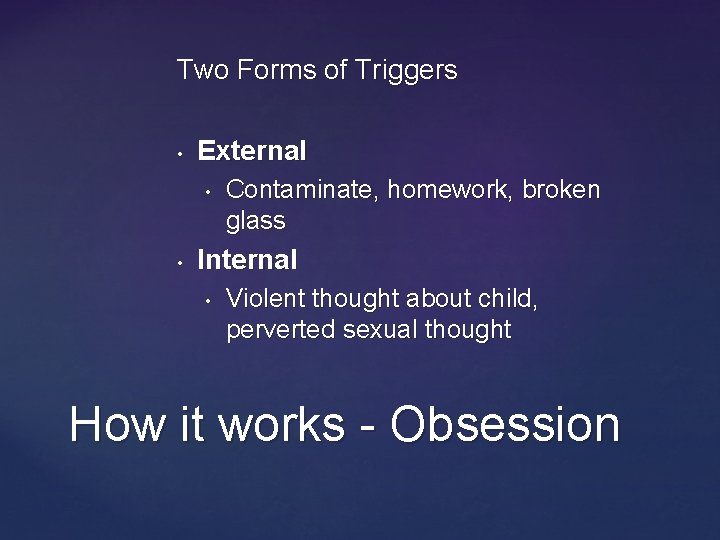
Two Forms of Triggers • External • • Contaminate, homework, broken glass Internal • Violent thought about child, perverted sexual thought How it works - Obsession
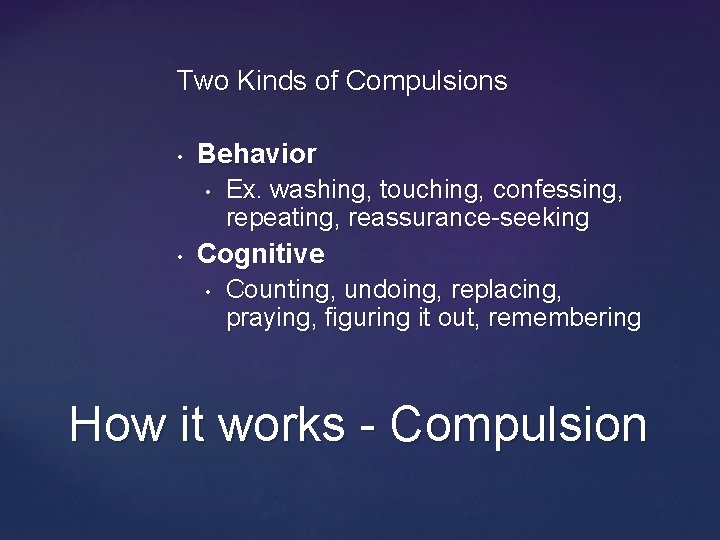
Two Kinds of Compulsions • Behavior • • Ex. washing, touching, confessing, repeating, reassurance-seeking Cognitive • Counting, undoing, replacing, praying, figuring it out, remembering How it works - Compulsion
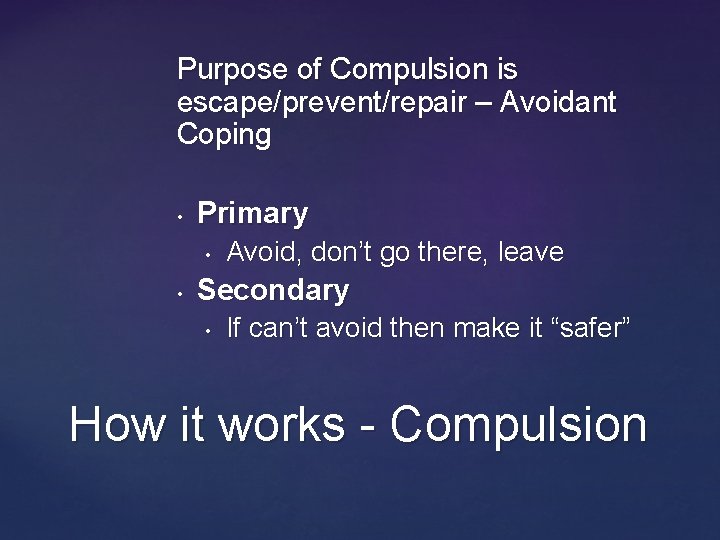
Purpose of Compulsion is escape/prevent/repair – Avoidant Coping • Primary • • Avoid, don’t go there, leave Secondary • If can’t avoid then make it “safer” How it works - Compulsion
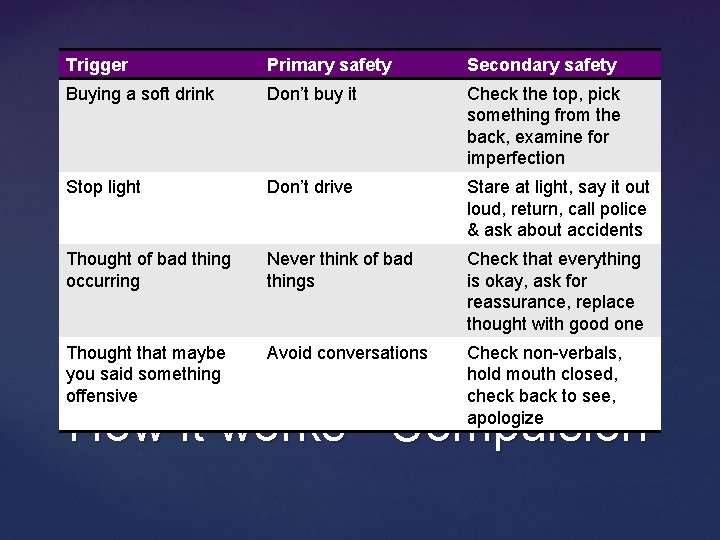
Trigger Primary safety Secondary safety Buying a soft drink Don’t buy it Check the top, pick something from the back, examine for imperfection Stop light Don’t drive Stare at light, say it out loud, return, call police & ask about accidents Thought of bad thing occurring Never think of bad things Check that everything is okay, ask for reassurance, replace thought with good one Thought that maybe you said something offensive Avoid conversations Check non-verbals, hold mouth closed, check back to see, apologize How it works - Compulsion
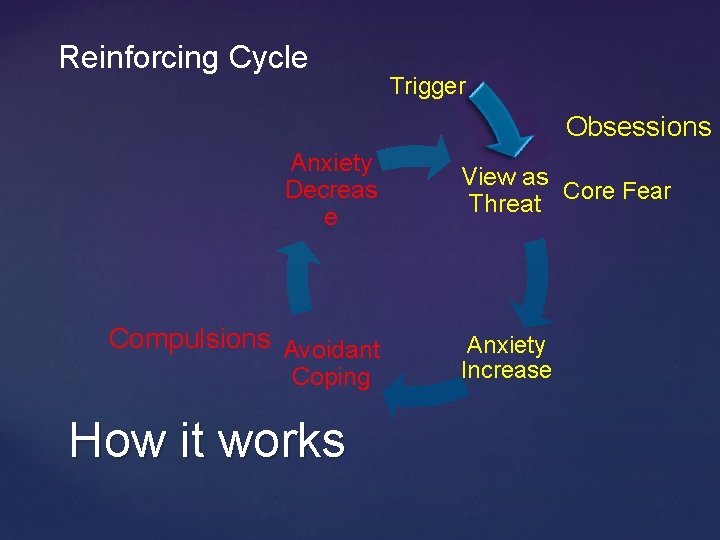
Reinforcing Cycle Trigger Obsessions Anxiety Decreas e Compulsions Avoidant Coping How it works View as Core Fear Threat Anxiety Increase
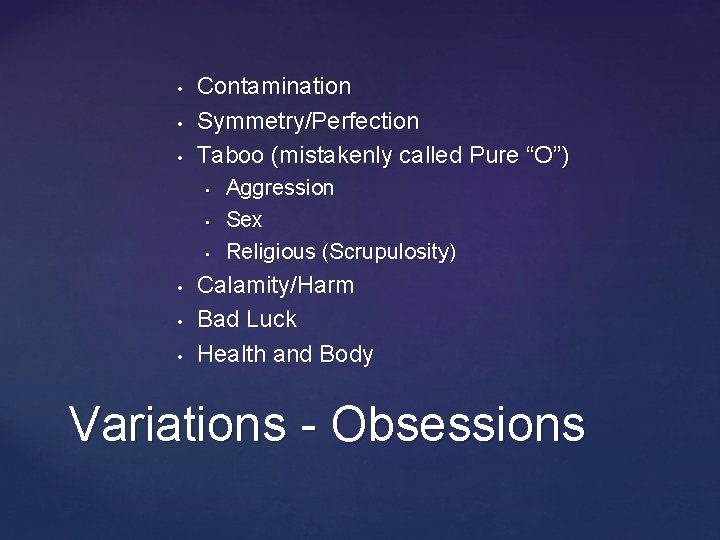
• • • Contamination Symmetry/Perfection Taboo (mistakenly called Pure “O”) • • • Aggression Sex Religious (Scrupulosity) Calamity/Harm Bad Luck Health and Body Variations - Obsessions
• • • Decontaminate/Clean Checking Counting Undoing Perfection Touching or movement Mental Prevention/Protect Body Focused Variations - Compulsions
• • Medical CBT • • Cognitive (C part of CBT) Exposure and Response Prevention (ERP) (B part of CBT) Treatment

• • Educate about Disorder Motivation Assess and Personalize Develop process to disprove fear • • • Cognitive Restructuring ERP Maintain, Prevent relapse Treatment Process
Common Cognitive Distortions • • Intolerance of Uncertainty Over-estimate responsibility Believe thoughts are too significant Intolerance of distress Things have to be just right Fear of positive or relief Martyrdom Treatment - Cognitive
ERP • Exposure • • • Deliberately evoking anxiety Remaining in distress Response Prevention • • • Prevent normal coping response Not doing anything to reduce distress before, during and after exposure Don’t employ Safety Behaviors Treatment - ERP
Exposure • Types • • • Thought Interoceptive Virtual In situation Create Hierarchy • • SUDs List of triggers and core fears Put in 3 categories - Easy, Medium, Hard Create an exposure for them Treatment - Exposure
Exposure Process 1. 2. 3. 4. 5. 6. 7. 8. 9. 10. Planned and structured Gradual Prepare to be anxious Don’t fight the feelings No safety behaviors Test negative predictions Keep Track of Fear Level Make it last until level drops Repeat frequently Practice by yourself Treatment - Exposure Abramowitz, Jonathan S. (2012 -06 -25). Obsessive Compulsive Disorder (Advances in Psychotherapy; Evidence. Based Practice) (Kindle Locations 2630 -2652). Hogrefe Publishing (com). Kindle Edition.
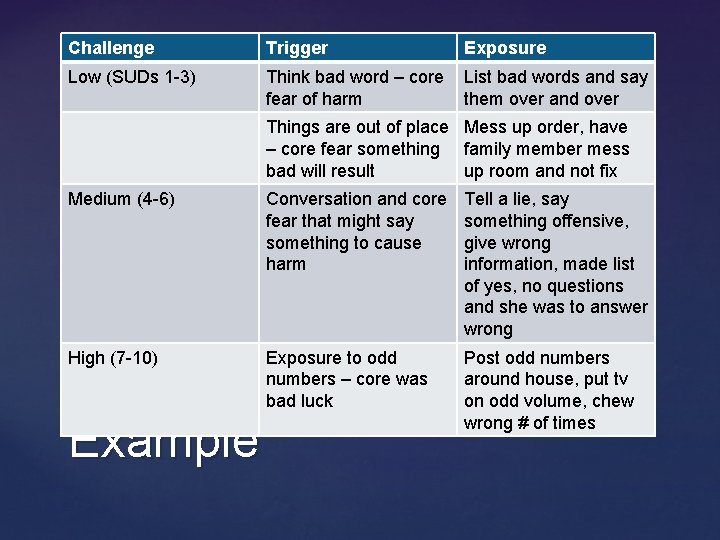
Challenge Trigger Exposure Low (SUDs 1 -3) Think bad word – core fear of harm List bad words and say them over and over Things are out of place Mess up order, have – core fear something family member mess bad will result up room and not fix Medium (4 -6) Conversation and core fear that might say something to cause harm Tell a lie, say something offensive, give wrong information, made list of yes, no questions and she was to answer wrong High (7 -10) Exposure to odd numbers – core was bad luck Post odd numbers around house, put tv on odd volume, chew wrong # of times Example
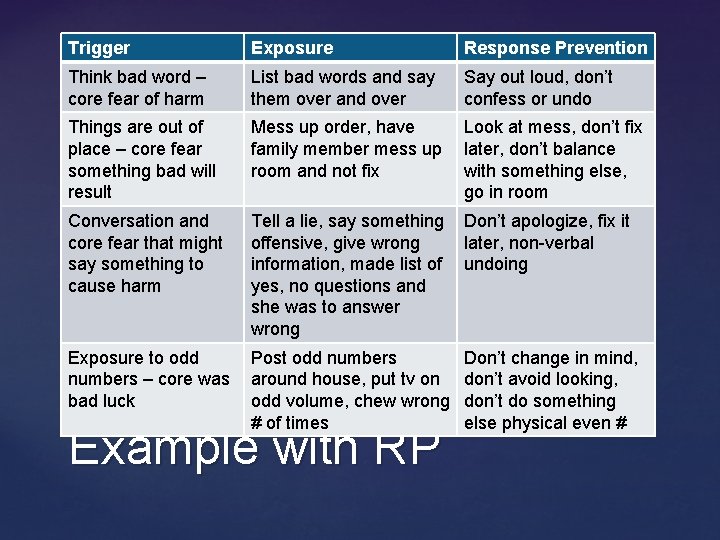
Trigger Exposure Response Prevention Think bad word – core fear of harm List bad words and say them over and over Say out loud, don’t confess or undo Things are out of place – core fear something bad will result Mess up order, have family member mess up room and not fix Look at mess, don’t fix later, don’t balance with something else, go in room Conversation and core fear that might say something to cause harm Tell a lie, say something offensive, give wrong information, made list of yes, no questions and she was to answer wrong Don’t apologize, fix it later, non-verbal undoing Exposure to odd numbers – core was bad luck Post odd numbers around house, put tv on odd volume, chew wrong # of times Don’t change in mind, don’t avoid looking, don’t do something else physical even # Example with RP
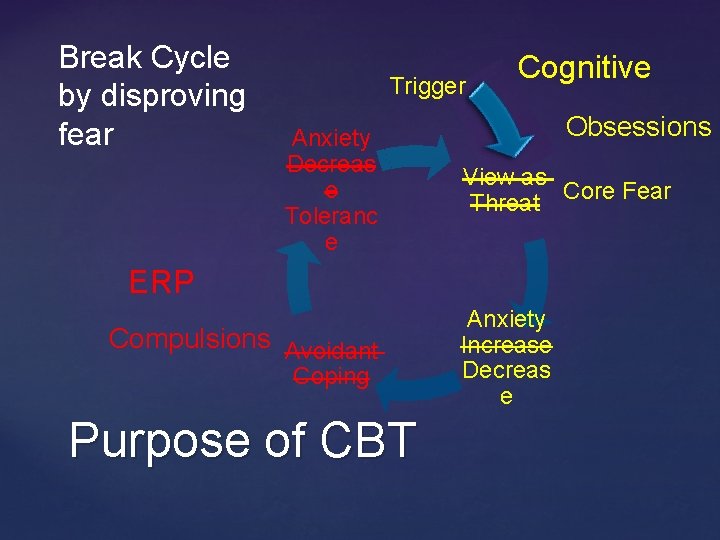
Break Cycle by disproving fear Trigger Anxiety Decreas e Toleranc e Cognitive Obsessions View as Core Fear Threat ERP Compulsions Avoidant Coping Purpose of CBT Anxiety Increase Decreas e

Turnaround www. turnaroundanxiety. com
- Slides: 23