
Save the Data How to Protect Data Wherever
- Slides: 36
Save the Data: How to Protect Data Wherever It Lives 16 November 2016 Robert Thibadeau Drive Trust Alliance and Trusted Computing Group © 2016 Trusted Computing Group 1
Webcast Logistics 2
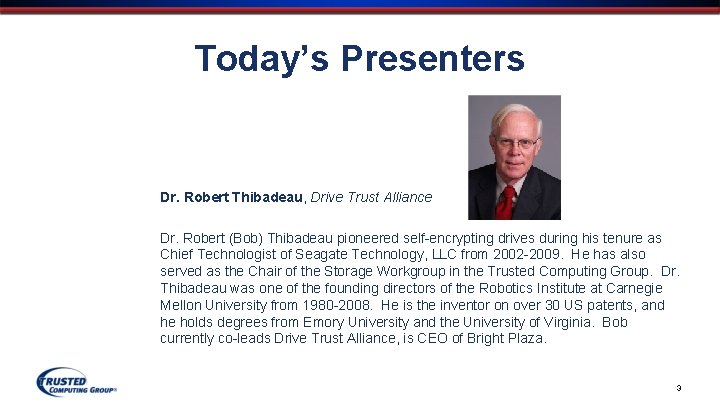
Today’s Presenters Dr. Robert Thibadeau, Drive Trust Alliance Dr. Robert (Bob) Thibadeau pioneered self-encrypting drives during his tenure as Chief Technologist of Seagate Technology, LLC from 2002 -2009. He has also served as the Chair of the Storage Workgroup in the Trusted Computing Group. Dr. Thibadeau was one of the founding directors of the Robotics Institute at Carnegie Mellon University from 1980 -2008. He is the inventor on over 30 US patents, and he holds degrees from Emory University and the University of Virginia. Bob currently co-leads Drive Trust Alliance, is CEO of Bright Plaza. 3
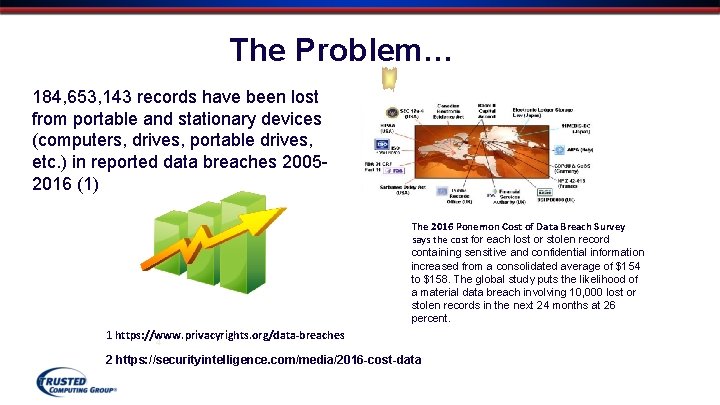
The Problem… 184, 653, 143 records have been lost from portable and stationary devices (computers, drives, portable drives, etc. ) in reported data breaches 20052016 (1) The 2016 Ponemon Cost of Data Breach Survey says the cost for each lost or stolen record containing sensitive and confidential information increased from a consolidated average of $154 to $158. The global study puts the likelihood of a material data breach involving 10, 000 lost or stolen records in the next 24 months at 26 percent. 1 https: //www. privacyrights. org/data-breaches 4 2 https: //securityintelligence. com/media/2016 -cost-data-breach-study/ Drive Trust Alliance
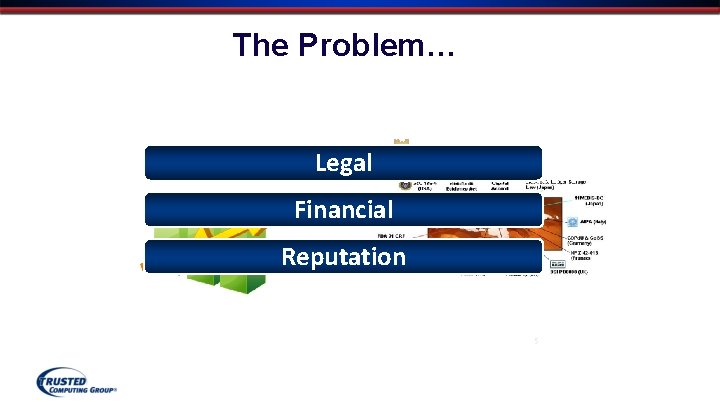
The Problem… 2005 -2013: over 864, 108, 052 records containing sensitive personal information have been involved in security breaches Legal In 2013, U. S. businesses paid an average cost of $5. 4 million per data breach; that’s $188 per record $5. 4 Million Per Incident Financial Reputation 5 5 Drive Trust Alliance
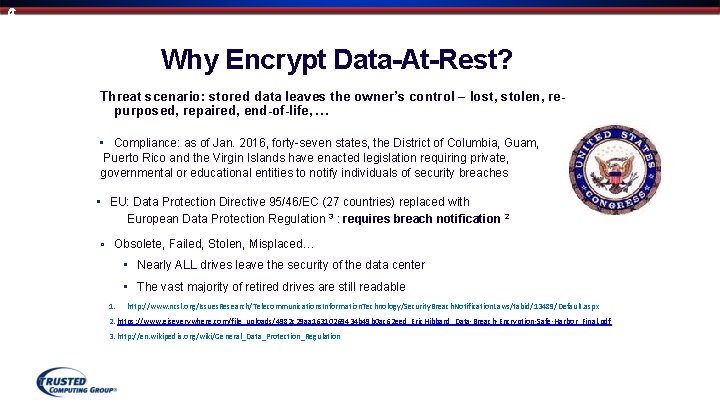
6 1 1 / 2 3 / 2 0 Why Encrypt Data-At-Rest? Threat scenario: stored data leaves the owner’s control – lost, stolen, repurposed, repaired, end-of-life, … • Compliance: as of Jan. 2016, forty-seven states, the District of Columbia, Guam, Puerto Rico and the Virgin Islands have enacted legislation requiring private, governmental or educational entities to notify individuals of security breaches of information involving personally identifiable information. • EU: Data Protection Directive 95/46/EC (27 countries) replaced with European Data Protection Regulation 3 : requires breach notification 2 ◦ Obsolete, Failed, Stolen, Misplaced… • Nearly ALL drives leave the security of the data center • The vast majority of retired drives are still readable 1. http: //www. ncsl. org/Issues. Research/Telecommunications. Information. Technology/Security. Breach. Notification. Laws/tabid/13489/Default. aspx 2. https: //www. eiseverywhere. com/file_uploads/4982 c 29 aa 16310269434 b 49 b 0 ac 62 eed_Eric. Hibbard_Data-Breach-Encryption-Safe-Harbor_Final. pdf 3. http: //en. wikipedia. org/wiki/General_Data_Protection_Regulation
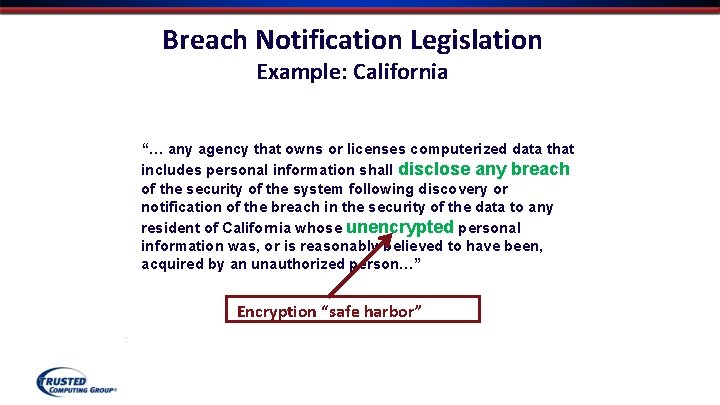
Breach Notification Legislation Example: California “… any agency that owns or licenses computerized data that includes personal information shall disclose any breach of the security of the system following discovery or notification of the breach in the security of the data to any resident of California whose unencrypted personal information was, or is reasonably believed to have been, acquired by an unauthorized person…” Encryption “safe harbor” 7 Drive Trust Alliance
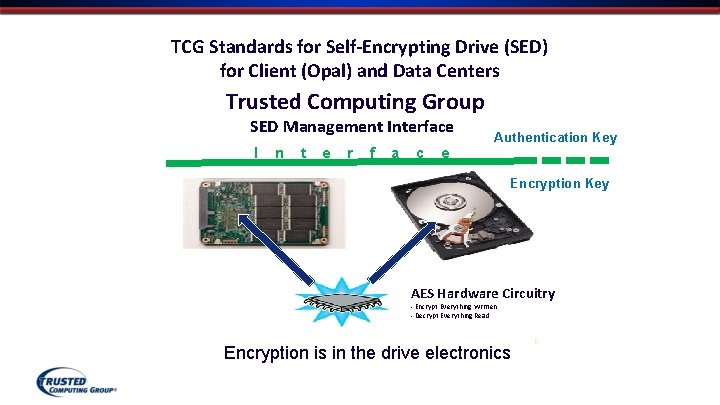
TCG Standards for Self-Encrypting Drive (SED) for Client (Opal) and Data Centers Trusted Computing Group SED Management Interface I n t e r f a c e Authentication Key Encryption Key AES Hardware Circuitry - Encrypt Everything Written - Decrypt Everything Read Encryption is in the drive electronics Drive Trust Alliance 8
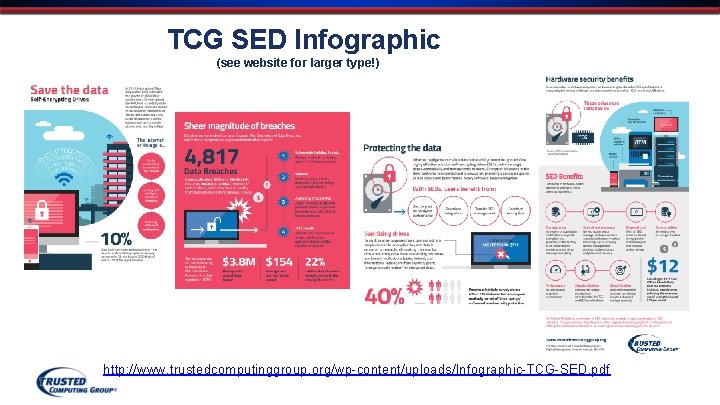
TCG SED Infographic (see website for larger type!) http: //www. trustedcomputinggroup. org/wp-content/uploads/Infographic-TCG-SED. pdf
Benefits of TCG Standards-based SEDs • • Simplified management Always-on security Support WW compliance regulations Breach notification exemption with ”safe harbor” Reduction of drive disposal costs Scalable Interoperable Built-in security, not added-on later (“Built in, not on”) © 2016 Trusted Computing Group 10
How Do SEDs Compare to Software Encryption? • Transparency: encryption key is generated in factory for SEDs • Easy to manage: Encryption key never external to drive • Lifecycle costs: SED costs are in initial drive acquisition, at parity with non-SEDs. SW requires licensing and other lifecycle costs • Disposal and re-purposing costs: SEDs require NO re-encryption of data, saving time and money • Performance: SEDs do not impact performance of drives, whereas SW encryption often slows drives • Standardization: users benefit from widely vetted standards and best practices © 2016 Trusted Computing Group 11
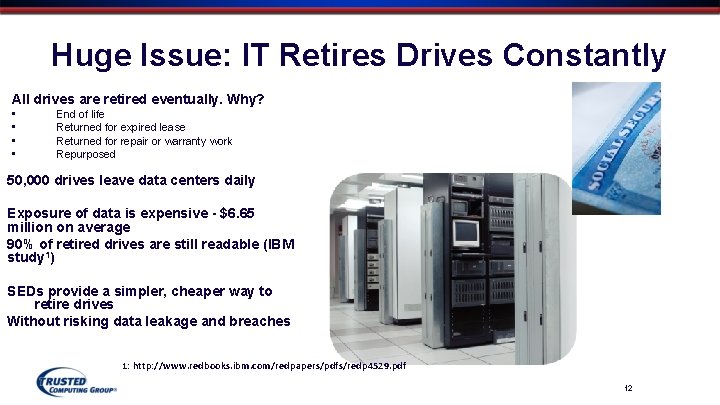
Huge Issue: IT Retires Drives Constantly All drives are retired eventually. Why? • • End of life Returned for expired lease Returned for repair or warranty work Repurposed 50, 000 drives leave data centers daily Exposure of data is expensive - $6. 65 million on average 90% of retired drives are still readable (IBM study 1) SEDs provide a simpler, cheaper way to retire drives Without risking data leakage and breaches 1: http: //www. redbooks. ibm. com/redpapers/pdfs/redp 4529. pdf Drive Trust Alliance 12
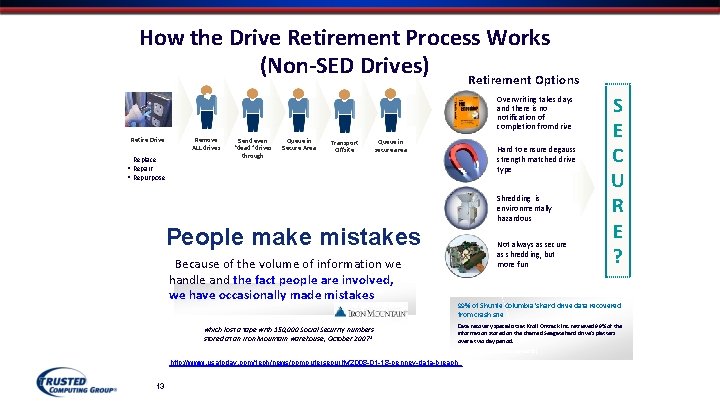
How the Drive Retirement Process Works (Non-SED Drives) Retirement Options Overwriting takes days and there is no notification of completion from drive Remove ALL drives Retire Drive • Replace • Repair • Repurpose Send even “dead" drives through Queue in Secure Area Transport Offsite Queue in secure area Hard to ensure degauss strength matched drive type Shredding is environmentally hazardous People make mistakes “Because of the volume of information we handle and the fact people are involved, we have occasionally made mistakes. ” which lost a tape with 150, 000 Social Security numbers stored at an Iron Mountain warehouse, October 2007 1 Not always as secure as shredding, but more fun 99% of Shuttle Columbia's hard drive data recovered from crash site Data recovery specialists at Kroll Ontrack Inc. retrieved 99% of the information stored on the charred Seagate hard drive's platters over a two day period. - May 7, 2008 (Computerworld) 1. http: //www. usatoday. com/tech/news/computersecurity/2008 -01 -18 -penney-data-breach_ 13 Drive Trust Alliance S E C U R E ?
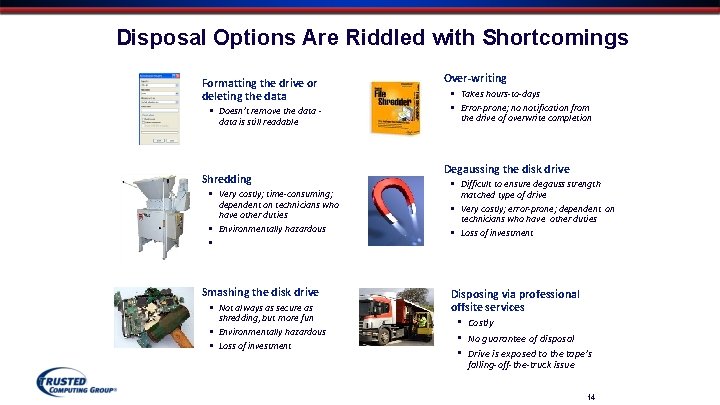
Disposal Options Are Riddled with Shortcomings Formatting the drive or deleting the data • Doesn’t remove the data is still readable Over-writing • Takes hours-to-days • Error-prone; no notification from the drive of overwrite completion Degaussing the disk drive Shredding • Very costly; time-consuming; dependent on technicians who have other duties • Environmentally hazardous • Loss of investment Smashing the disk drive • Not always as secure as shredding, but more fun • Environmentally hazardous • Loss of investment Drive Trust • Difficult to ensure degauss strength matched type of drive • Very costly; error-prone; dependent on technicians who have other duties • Loss of investment Disposing via professional offsite services • Costly • No guarantee of disposal • Drive is exposed to the tape’s falling-off-the-truck issue 14
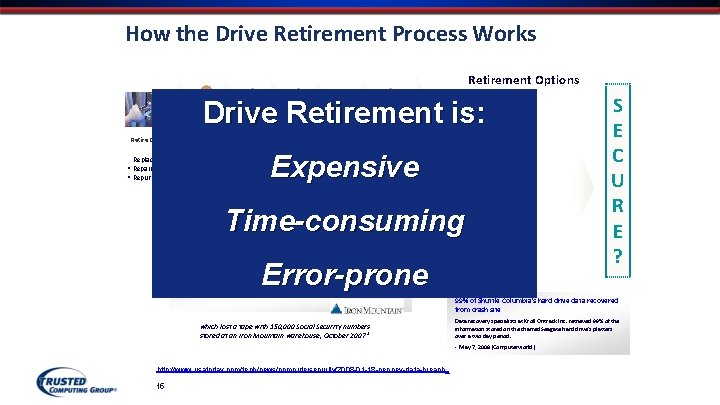
How the Drive Retirement Process Works Retirement Options Drive Retirement is: Retire Drive • Replace • Repair • Repurpose Remove ALL drives Send even “dead" drives through Queue in Secure Area Transport Offsite Queue in secure area Hard to ensure degauss strength matched drive type Expensive Time-consuming People make mistakes “Because of the volume of information we handle and the fact people are involved, we have occasionally made mistakes. ” Error-prone which lost a tape with 150, 000 Social Security numbers stored at an Iron Mountain warehouse, October 2007 1 Overwriting takes days and there is no notification of completion from drive Shredding is environmentally hazardous Not always as secure as shredding, but more fun 99% of Shuttle Columbia's hard drive data recovered from crash site Data recovery specialists at Kroll Ontrack Inc. retrieved 99% of the information stored on the charred Seagate hard drive's platters over a two day period. - May 7, 2008 (Computerworld) 1. http: //www. usatoday. com/tech/news/computersecurity/2008 -01 -18 -penney-data-breach_ 15 Drive Trust Alliance S E C U R E ?
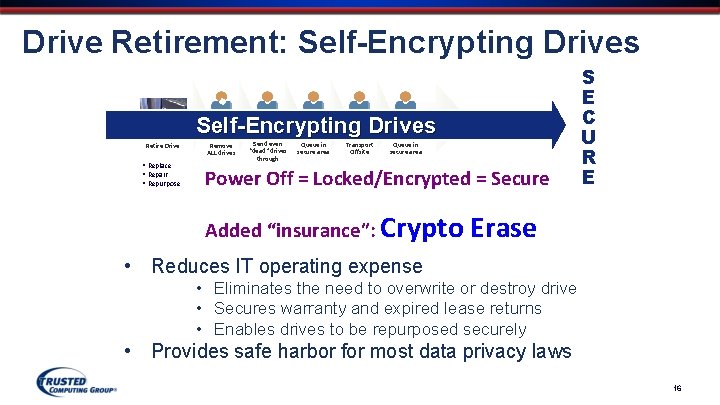
Drive Retirement: Self-Encrypting Drives Retire Drive • Replace • Repair • Repurpose Remove ALL drives Send even “dead" drives through Queue in secure area Transport Offsite Queue in secure area Power Off = Locked/Encrypted = Secure Added “insurance”: Crypto S E C U R E Erase • Reduces IT operating expense • Eliminates the need to overwrite or destroy drive • Secures warranty and expired lease returns • Enables drives to be repurposed securely • Provides safe harbor for most data privacy laws Drive Trust Alliance 16
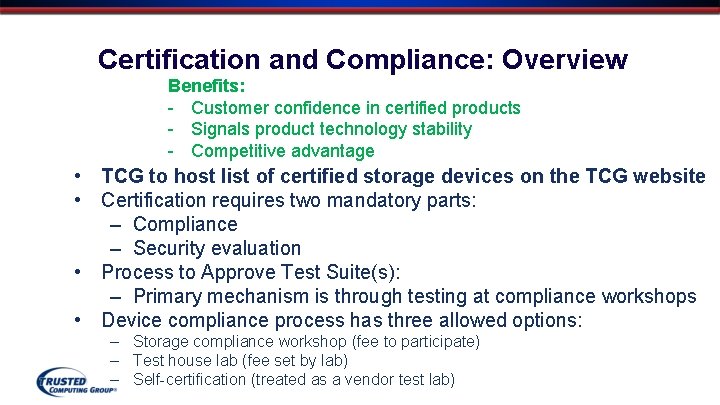
Certification and Compliance: Overview Benefits: - Customer confidence in certified products - Signals product technology stability - Competitive advantage • TCG to host list of certified storage devices on the TCG website • Certification requires two mandatory parts: – Compliance – Security evaluation • Process to Approve Test Suite(s): – Primary mechanism is through testing at compliance workshops • Device compliance process has three allowed options: – Storage compliance workshop (fee to participate) – Test house lab (fee set by lab) – Self-certification (treated as a vendor test lab)
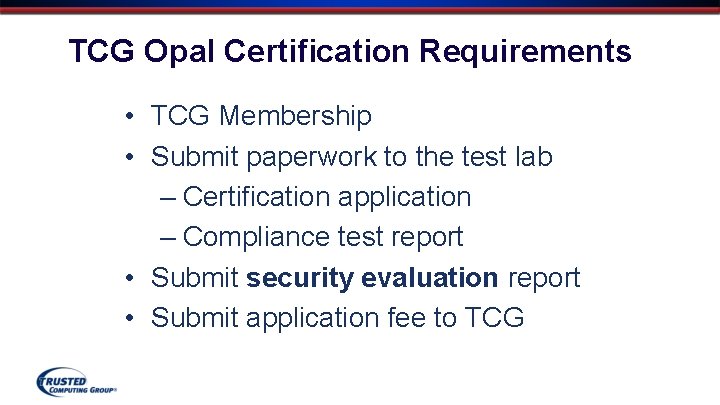
TCG Opal Certification Requirements • TCG Membership • Submit paperwork to the test lab – Certification application – Compliance test report • Submit security evaluation report • Submit application fee to TCG
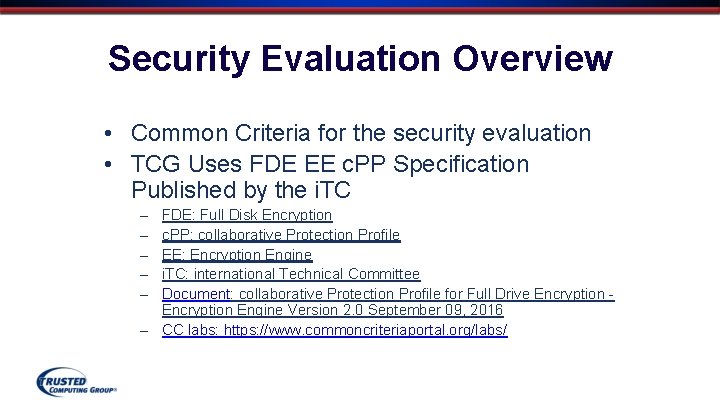
Security Evaluation Overview • Common Criteria for the security evaluation • TCG Uses FDE EE c. PP Specification Published by the i. TC – – – FDE: Full Disk Encryption c. PP: collaborative Protection Profile EE: Encryption Engine i. TC: international Technical Committee Document: collaborative Protection Profile for Full Drive Encryption - Encryption Engine Version 2. 0 September 09, 2016 – CC labs: https: //www. commoncriteriaportal. org/labs/
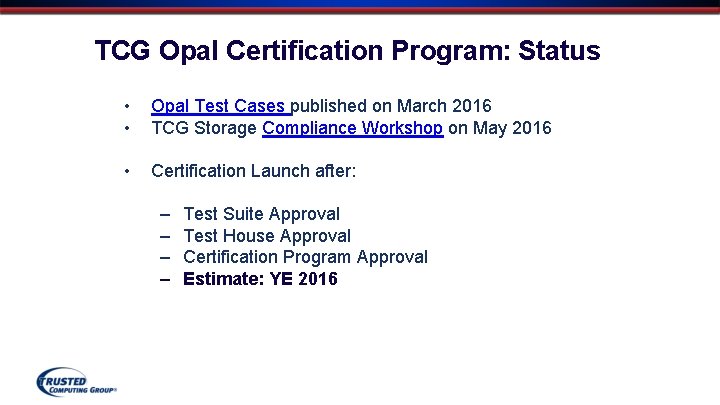
TCG Opal Certification Program: Status • • Opal Test Cases published on March 2016 TCG Storage Compliance Workshop on May 2016 • Certification Launch after: – – Test Suite Approval Test House Approval Certification Program Approval Estimate: YE 2016
References to TCG SEDs • NVMe, UFS • NIST SP 800 -88 R 1 • ISO/IEC 27040 © 2016 Trusted Computing Group 21
TCG and NVMe(xpress) Liaison: Joint White Paper The Opal “Family” of specifications published by the Trusted Computing Group provides a scalable infrastructure for managing encryption of user data in a Storage Device, as well as extensibility to enable features beyond “data at rest protection”. The protocols associated with management of encryption capabilities provided by Opal and its subset specs, Opalite and Pyrite, range from light to thorough, with further scalability up to meet even fuller featured levels of capability; and further scaling down possible to enable even more use cases than those already being addressed. The scalability of the architecture and solutions embodied in the TCG Storage specifications provides an ideal match for the scalability provided by the NVMe specification and aligns with the Opal Family of specifications as the security management interface for both NVMe client and data center Storage Devices. >>> Result: Joint and detailed technical specifications between the two organizations http: //www. trustedcomputinggroup. org/wp-content/uploads/TCGand. NVMe_Joint_White_Paper. TCG_Storage_Opal_and_NVMe_FINAL. pdf
NIST SP 800 -88 R 1 Summary: Guidelines for Media Sanitization Media sanitization and information disposition activity is usually most intense during the disposal phase of the system life cycle. However, throughout the life of an information system, many types of media, containing data, will be transferred outside the positive control of the organization. This activity may be for maintenance reasons, system upgrades, or during a configuration update. Media sanitization is one key element in assuring confidentiality. Cryptographic Erase (CE) is an emerging sanitization technique that can be used in some situations when data is encrypted as it is stored on media. With CE, media sanitization is performed by sanitizing the cryptographic keys used to encrypt the data, as opposed to sanitizing the storage locations on media containing the encrypted data itself. CE techniques are typically capable of sanitizing media very quickly and could support partial sanitization, a technique where a subset of storage media is sanitization. Partial sanitization, sometimes referred to as selective sanitization, has potential applications in cloud computing and mobile devices. Crypto Erase: Sanitization Standard http: //nvlpubs. nist. gov/nistpubs/Special. Publications/NIST. SP. 800 -88 r 1. pdf
2 4 INTERNATIONAL STANDARD ISO/IEC 27040 Reference number ISO/IEC 27040: 2015(E) First edition 2015 -01 -15 Information technology — Security techniques — Storage security Technologie de l’information — Techniques de sécurité — Sécurité de stockage http: //www. iso. org/iso/catalogue_detail? csnumber=44404
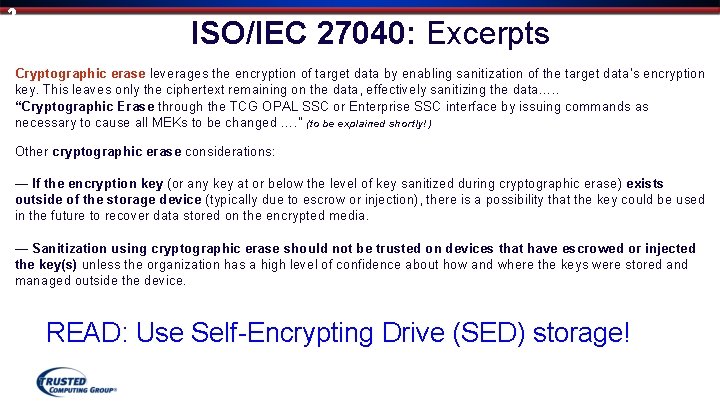
2 1 1 5 / 2 Cryptographic erase leverages the encryption of target data by enabling sanitization of the target data’s encryption key. This leaves only the ciphertext remaining on the data, effectively sanitizing the data…. . 3“Cryptographic Erase through the TCG OPAL SSC or Enterprise SSC interface by issuing commands as / necessary to cause all MEKs to be changed …. ” (to be explained shortly!) 2 Other cryptographic erase considerations: 0 2— If the encryption key (or any key at or below the level of key sanitized during cryptographic erase) exists outside of the storage device (typically due to escrow or injection), there is a possibility that the key could be used 0 in the future to recover data stored on the encrypted media. ISO/IEC 27040: Excerpts — Sanitization using cryptographic erase should not be trusted on devices that have escrowed or injected the key(s) unless the organization has a high level of confidence about how and where the keys were stored and managed outside the device. READ: Use Self-Encrypting Drive (SED) storage!
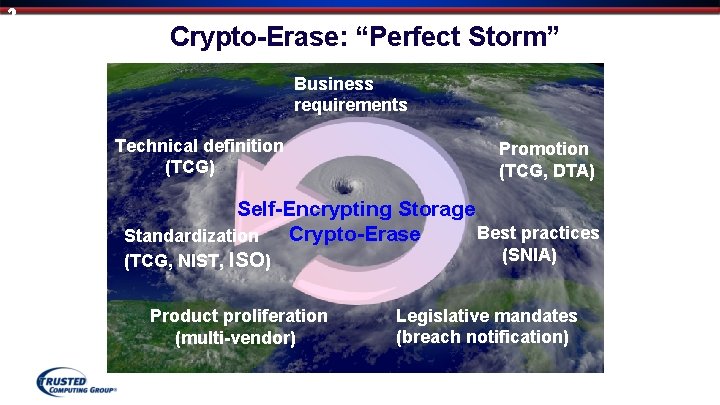
2 1 1 6 / 2 3 / 2 0 Crypto-Erase: “Perfect Storm” Business requirements Technical definition (TCG) Promotion (TCG, DTA) Self-Encrypting Storage Best practices Crypto-Erase Standardization (SNIA) (TCG, NIST, ISO) Product proliferation (multi-vendor) Legislative mandates (breach notification)
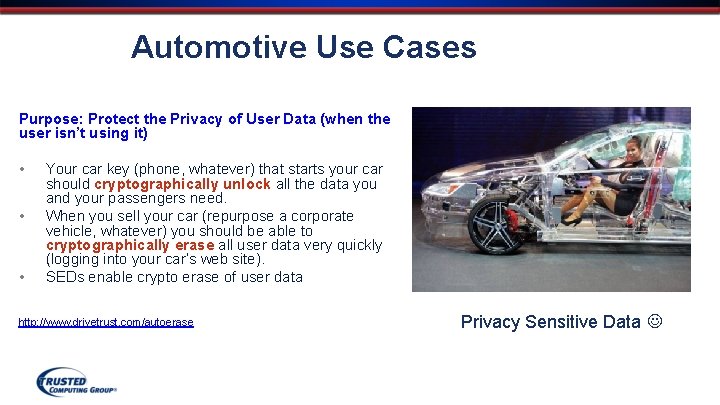
Automotive Use Cases Purpose: Protect the Privacy of User Data (when the user isn’t using it) • • • Your car key (phone, whatever) that starts your car should cryptographically unlock all the data you and your passengers need. When you sell your car (repurpose a corporate vehicle, whatever) you should be able to cryptographically erase all user data very quickly (logging into your car’s web site). SEDs enable crypto erase of user data Privacy Sensitive Data http: //www. drivetrust. com/autoerase Drive Trust Alliance
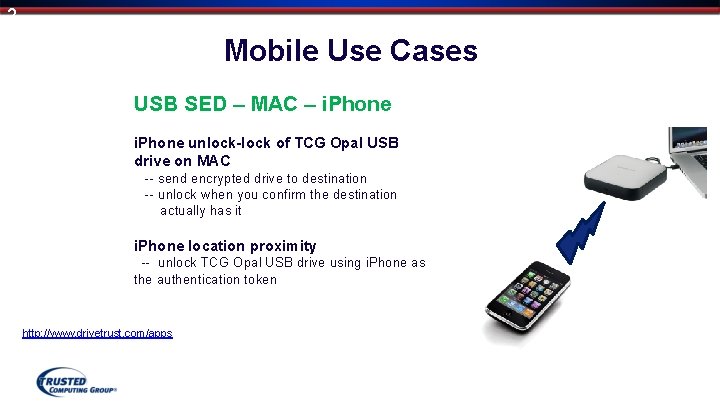
2 8 Mobile Use Cases USB SED – MAC – i. Phone unlock-lock of TCG Opal USB drive on MAC -- send encrypted drive to destination -- unlock when you confirm the destination actually has it i. Phone location proximity -- unlock TCG Opal USB drive using i. Phone as the authentication token http: //www. drivetrust. com/apps
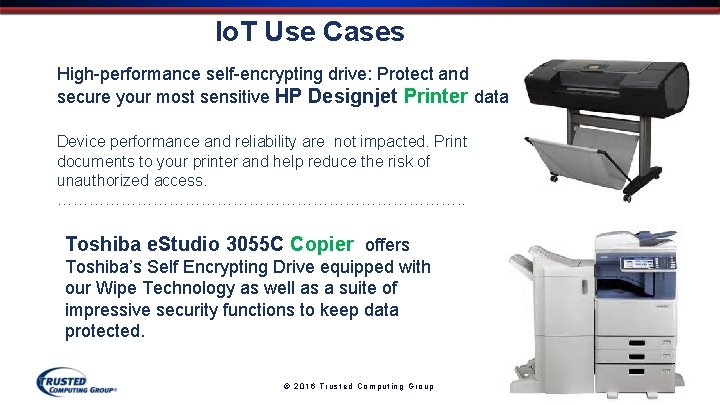
Io. T Use Cases High-performance self-encrypting drive: Protect and secure your most sensitive HP Designjet Printer data Device performance and reliability are not impacted. Print documents to your printer and help reduce the risk of unauthorized access. …………………………………. . Toshiba e. Studio 3055 C Copier offers Toshiba’s Self Encrypting Drive equipped with our Wipe Technology as well as a suite of impressive security functions to keep data protected. © 2016 Trusted Computing Group 29
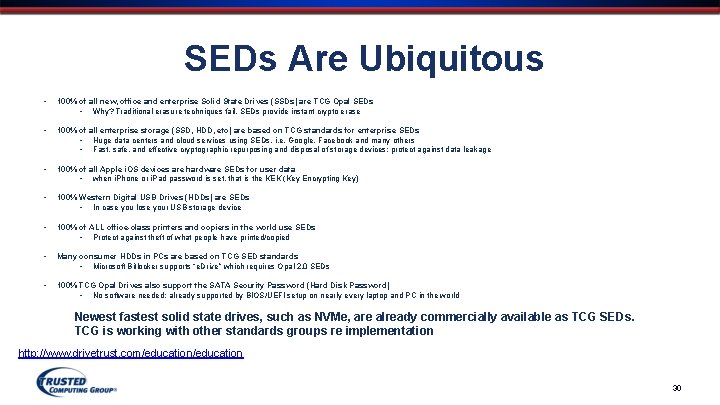
SEDs Are Ubiquitous • 100% of all new, office and enterprise Solid State Drives (SSDs) are TCG Opal SEDs • Why? Traditional erasure techniques fail. SEDs provide instant crypto erase • 100% of all enterprise storage (SSD, HDD, etc) are based on TCG standards for enterprise SEDs • Huge data centers and cloud services using SEDs, i. e. Google, Facebook and many others • Fast, safe, and effective cryptographic repurposing and disposal of storage devices; protect against data leakage • 100% of all Apple i. OS devices are hardware SEDs for user data • when i. Phone or i. Pad password is set, that is the KEK (Key Encrypting Key) • 100% Western Digital USB Drives (HDDs) are SEDs • In case you lose your USB storage device • 100% of ALL office-class printers and copiers in the world use SEDs • Protect against theft of what people have printed/copied • Many consumer HDDs in PCs are based on TCG SED standards • Microsoft Bitlocker supports “e. Drive” which requires Opal 2. 0 SEDs • 100% TCG Opal Drives also support the SATA Security Password (Hard Disk Password) • No software needed: already supported by BIOS/UEFI setup on nearly every laptop and PC in the world Newest fastest solid state drives, such as NVMe, are already commercially available as TCG SEDs. TCG is working with other standards groups re implementation http: //www. drivetrust. com/education Drive Trust Alliance 30
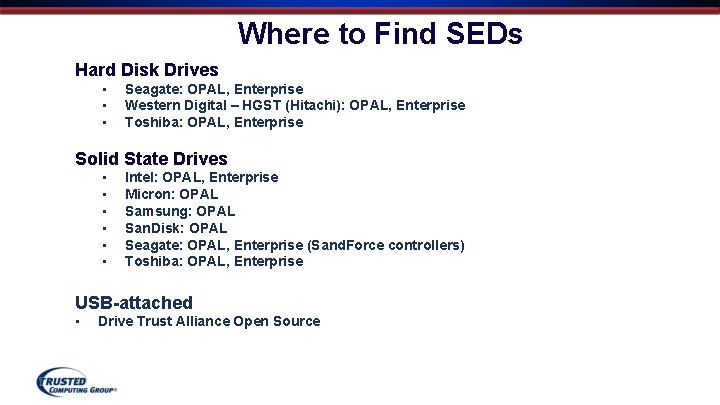
Where to Find SEDs Hard Disk Drives • • • Seagate: OPAL, Enterprise Western Digital – HGST (Hitachi): OPAL, Enterprise Toshiba: OPAL, Enterprise Solid State Drives • • • Intel: OPAL, Enterprise Micron: OPAL Samsung: OPAL San. Disk: OPAL Seagate: OPAL, Enterprise (Sand. Force controllers) Toshiba: OPAL, Enterprise USB-attached • Drive Trust Alliance Open Source
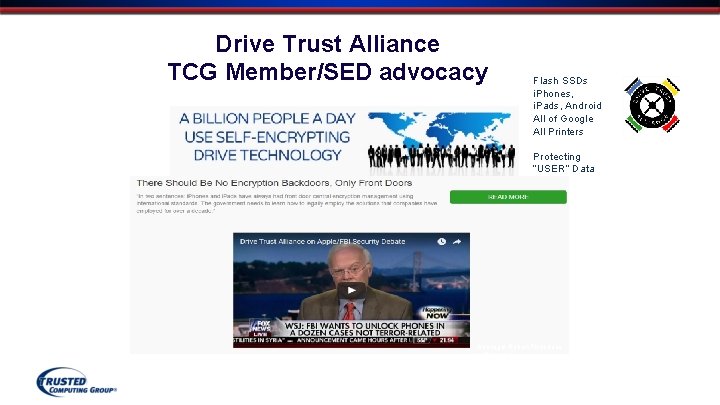
Drive Trust Alliance TCG Member/SED advocacy Flash SSDs i. Phones, i. Pads, Android All of Google All Printers Protecting “USER” Data Copyright Robert Thibadeau rht@brightplaza. com Drive Trust Alliance
• • • Case Study: Barnabas Health New Jersey’s largest integrated health delivery system Implemented SEDs in 2380 laptops used by doctors, nurses, administrators and executives across 25 facilities Will be encrypting 13, 000 desktops used in the hospitals, via the asset lifecycle process, in 4 years; 400 units initially. Key Findings: • • 24 hours faster deployment on average per user over previous softwarebased encryption Negligible boot time versus up to 30 minutes to boot a PC with software encryption © 2016 Trusted Computing Group 33
Summary • • • SEDs are widely available (client/data center) & add little to no cost to IT operations SEDs provide always-on encryption with no performance impact to users SEDs offer instant erasure of drives SEDs support current and emerging data protection and safe harbor laws worldwide SEDs are available in many form factors and can be used in not only PCs/servers but in any device that needs storage (industrial systems, office equipment, network gear, automobiles, kiosks/ATMs, mobile devices and any other with memory) © 2016 Trusted Computing Group 34
Resources • http: //www. trustedcomputinggroup. org/workgroups/storage/ • https: //www. drivetrust. com • http: //www. embedded. com/electronicsblogs/max-unleashed-andunfettered/4442291/Secure-your-data-with-selfencrypting-drives--SEDs© 2016 Trusted Computing Group 35
QUESTIONS? © 2016 Trusted Computing Group 36