
Saudi Space Activities National Satellite Technology Program KACST
- Slides: 18
Saudi Space Activities National Satellite Technology Program KACST April 2010 Haithem Altwaijry Deputy Director National Satellite Technology Program King Abdulaziz City for Science and Technology
Overview § Space Technology Strategy under Saudi National Science, Technology and Innovation Plan § Saudi Arabian Space Program at KACST: § National Satellite Technology Program § 12 Satellites in 10 years § 150+ Saudi Satellite specialists § World-Class AIT Facility § Scientific Missions : GP-B, STAR, STEP § Space Research Institute § Saudi Center for Remote Sensing § GIS Center
National Science and Technology Policy: Origins and Achievements KACST was directed by its charter: – to “propose a national policy for the development of science and technology and to devise the strategy and necessary plans to implement them. ” – to coordinate with government agencies, scientific institutions and research centers in the Kingdom to enhance research; exchange information and expertise; and avoid duplication of effort.
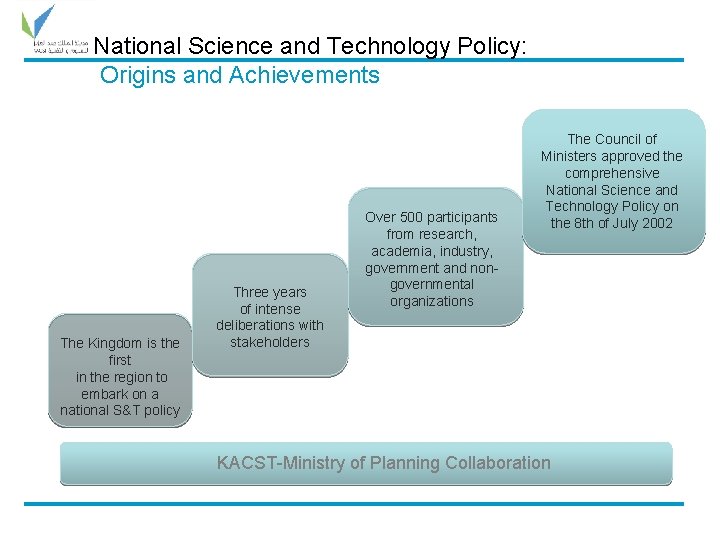
National Science and Technology Policy: Origins and Achievements The Kingdom is the first in the region to embark on a national S&T policy Three years of intense deliberations with stakeholders Over 500 participants from research, academia, industry, government and nongovernmental organizations The Council of Ministers approved the comprehensive National Science and Technology Policy on the 8 th of July 2002 KACST-Ministry of Planning Collaboration
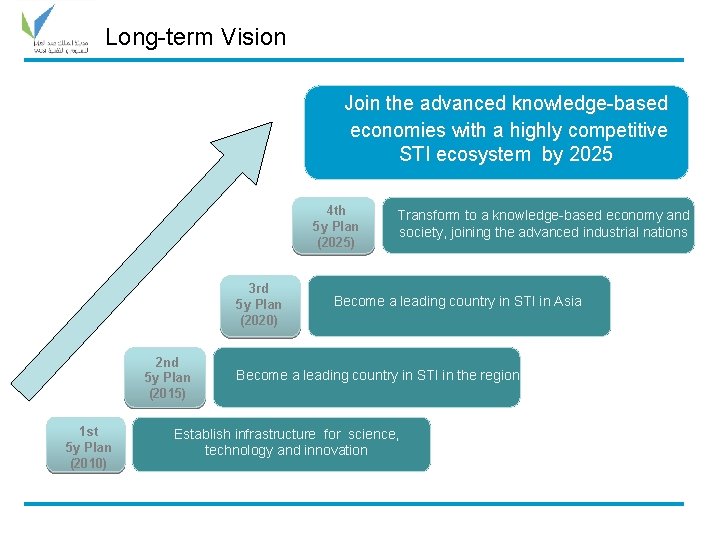
Long-term Vision Join the advanced knowledge-based economies with a highly competitive STI ecosystem by 2025 4 th 5 y Plan (2025) 3 rd 5 y Plan (2020) 2 nd 5 y Plan (2015) 1 st 5 y Plan (2010) Transform to a knowledge-based economy and society, joining the advanced industrial nations Become a leading country in STI in Asia Become a leading country in STI in the region Establish infrastructure for science, technology and innovation
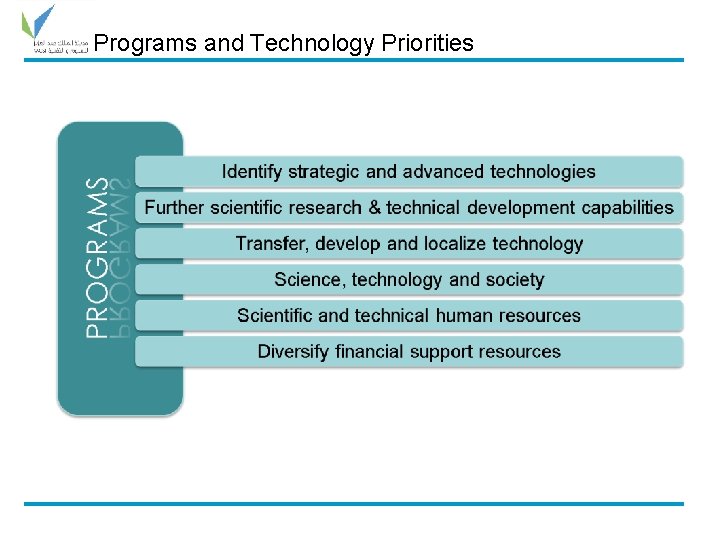
Programs and Technology Priorities
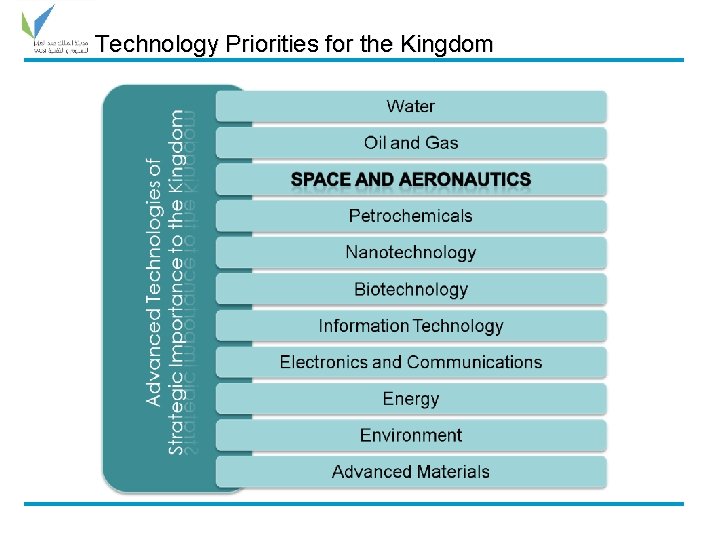
Technology Priorities for the Kingdom
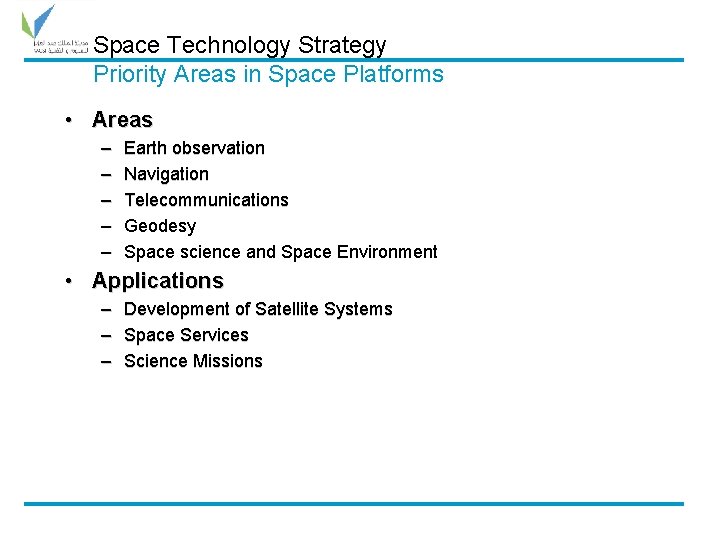
Space Technology Strategy Priority Areas in Space Platforms • Areas – – – Earth observation Navigation Telecommunications Geodesy Space science and Space Environment • Applications – Development of Satellite Systems – Space Services – Science Missions
Space Technology Strategy Priority Areas in Remote Sensing and GIS • Areas – Change detection and monitoring – Natural hazards – National spatial data infrastructure • Applications – – – – Urban development Vegetation Pattern recognition Dust storms Flood Fires (forest, brush-fires) Regulations and standards Intelligent transport systems
Saudi Space Program Overview – The Saudi satellite program started in 1998 – Satellite Technology Center established within Space Research Institute at KACST – Saudi. Sat 1 A &1 B launched September 2000, later designated Saudi-Oscar 41 and 42 by AMSAT – Goal to build Saudi human capital and the infrastructure needed for a commercial satellite program – Saudi. Sat 1 C launched December 2002, transmitted live images via its on-board camera, later designated Saudi-Oscar 50 – First experimental earth observation satellite; Saudi. Sat 2 launched June 2004 – Saudi satellite program began commercial activities in 2004 with launch of Saudi-Com. Sat – First Saudi remote sensing satellite; Saudi. Sat 3 launched 2007 – Establishment of the National Satellite Technology Program (NSTP) in 2007
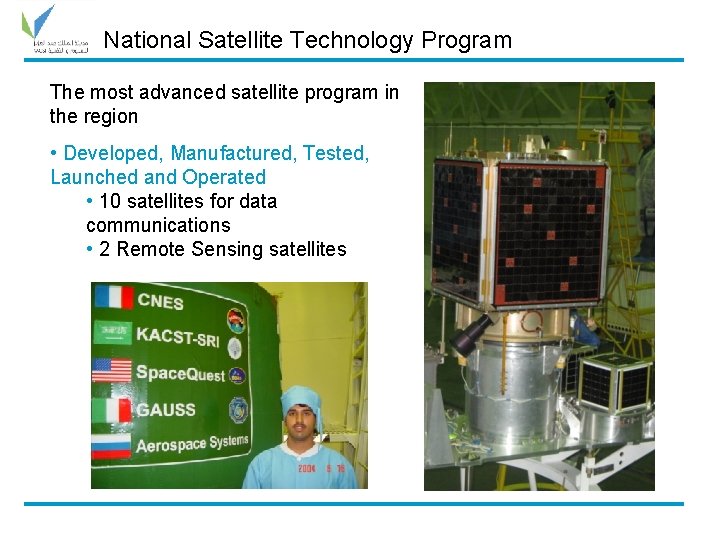
National Satellite Technology Program The most advanced satellite program in the region • Developed, Manufactured, Tested, Launched and Operated • 10 satellites for data communications • 2 Remote Sensing satellites
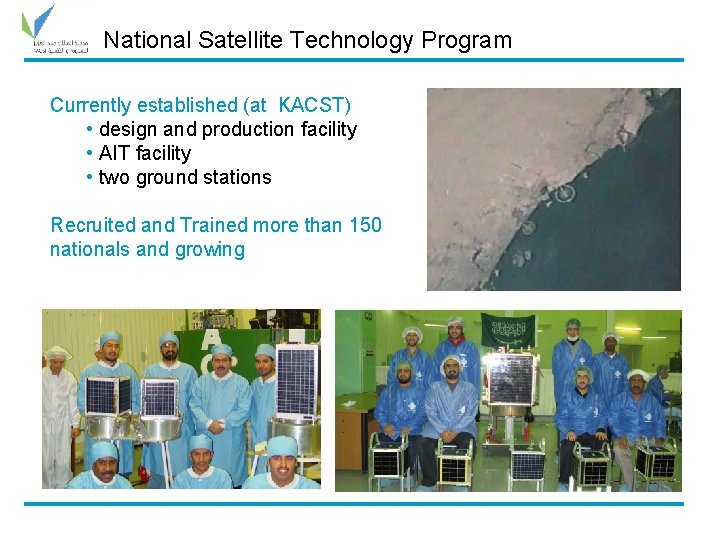
National Satellite Technology Program Currently established (at KACST) • design and production facility • AIT facility • two ground stations Recruited and Trained more than 150 nationals and growing
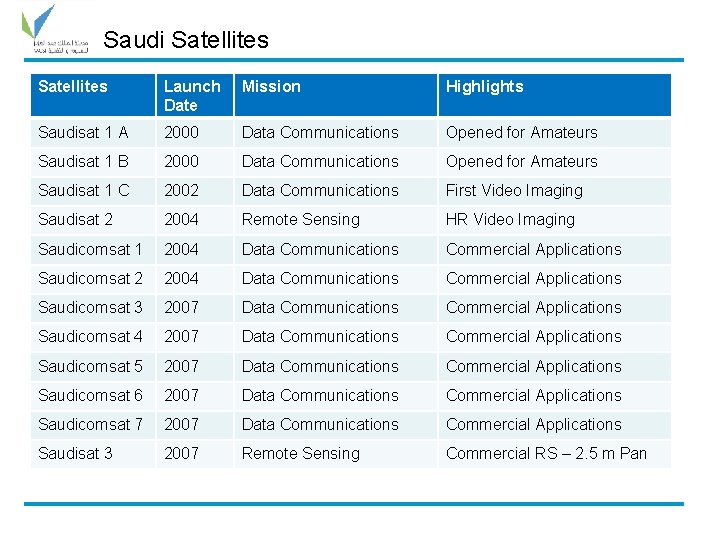
Saudi Satellites Launch Date Mission Highlights Saudisat 1 A 2000 Data Communications Opened for Amateurs Saudisat 1 B 2000 Data Communications Opened for Amateurs Saudisat 1 C 2002 Data Communications First Video Imaging Saudisat 2 2004 Remote Sensing HR Video Imaging Saudicomsat 1 2004 Data Communications Commercial Applications Saudicomsat 2 2004 Data Communications Commercial Applications Saudicomsat 3 2007 Data Communications Commercial Applications Saudicomsat 4 2007 Data Communications Commercial Applications Saudicomsat 5 2007 Data Communications Commercial Applications Saudicomsat 6 2007 Data Communications Commercial Applications Saudicomsat 7 2007 Data Communications Commercial Applications Saudisat 3 2007 Remote Sensing Commercial RS – 2. 5 m Pan
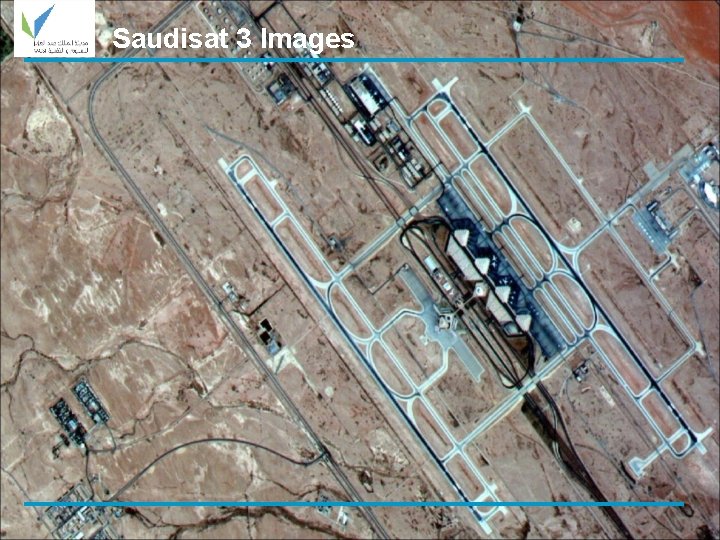
Saudisat 3 Images
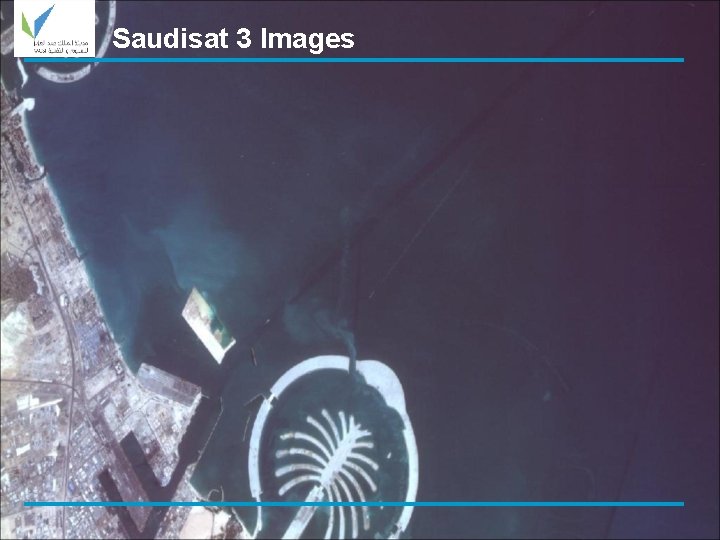
Saudisat 3 Images
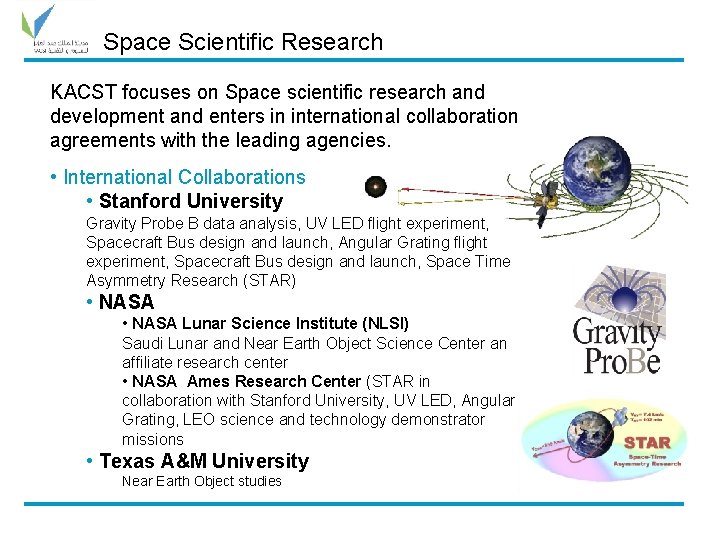
Space Scientific Research KACST focuses on Space scientific research and development and enters in international collaboration agreements with the leading agencies. • International Collaborations • Stanford University Gravity Probe B data analysis, UV LED flight experiment, Spacecraft Bus design and launch, Angular Grating flight experiment, Spacecraft Bus design and launch, Space Time Asymmetry Research (STAR) • NASA Lunar Science Institute (NLSI) Saudi Lunar and Near Earth Object Science Center an affiliate research center • NASA Ames Research Center (STAR in collaboration with Stanford University, UV LED, Angular Grating, LEO science and technology demonstrator missions • Texas A&M University Near Earth Object studies
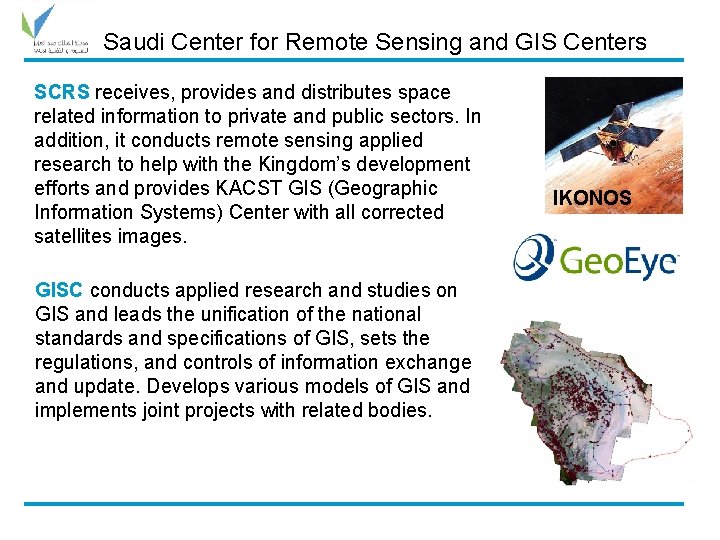
Saudi Center for Remote Sensing and GIS Centers SCRS receives, provides and distributes space related information to private and public sectors. In addition, it conducts remote sensing applied research to help with the Kingdom’s development efforts and provides KACST GIS (Geographic Information Systems) Center with all corrected satellites images. GISC conducts applied research and studies on GIS and leads the unification of the national standards and specifications of GIS, sets the regulations, and controls of information exchange and update. Develops various models of GIS and implements joint projects with related bodies. IKONOS
Thank you. .