
Saudi Arabia Introduction Saudi Arabia is famous locally
Saudi Arabia
Introduction • Saudi Arabia is famous locally & internationally • Blessed with the natural resources like petroleum • Largest Economy in the Middle East • generates 90% revenue approximately $231. 2 billion • Islamic Hub
Main Sectors Real Estate Agriculture Petroleum Sector Non-petroleum Sector
Real Estate • Barren, unoccupied land in the beginning of Saudi Kingdom. • Need for Residential Houses. • Foreigners can own houses in Saudi • No Foreign Investment.
Agriculture • The rural part of Saudi Arabia isn't that substantial because of its high temperature and desert zone, where its yearly precipitation is additionally low. • Consequently, dates are sent out by Saudi dealers, as well as innumerable individuals buy vast amounts of dates in the entire year while their visit to the Holy places • In this way, this aides in age of incomes of Saudi Arabia to some degree. Be that as it may, with regards to the domesticated animals in the nation, the nation isn’t self suuficient in it because of the less precipitation in the nation.
Petroleum Sector • The oil division's incomes makes about 42% out of the nation's GDP; while 40% GDP is created from the private sector • Sector largely involves the export of petroleum goods • Supply petroleum and gasoline to the entire world. • Biggest oil exporter. • More than half of the revenue is generated by Oil.
Non-Petroleum Sector • Earning through other metals such as gold, silver, copper, manganese. • Purest Gold in the world • Small in quantity in comparison to Petroleum resources.
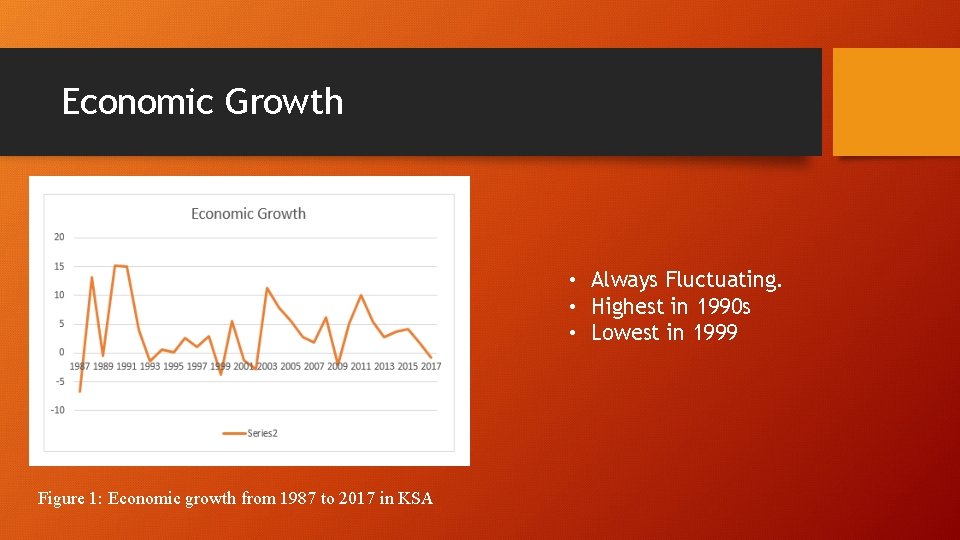
Economic Growth • Always Fluctuating. • Highest in 1990 s • Lowest in 1999 Figure 1: Economic growth from 1987 to 2017 in KSA
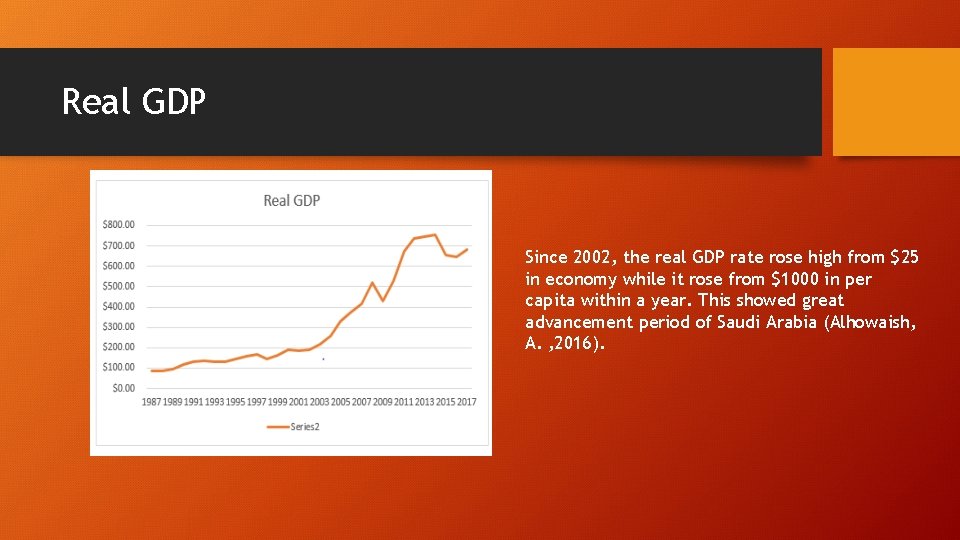
Real GDP Since 2002, the real GDP rate rose high from $25 in economy while it rose from $1000 in per capita within a year. This showed great advancement period of Saudi Arabia (Alhowaish, A. , 2016).
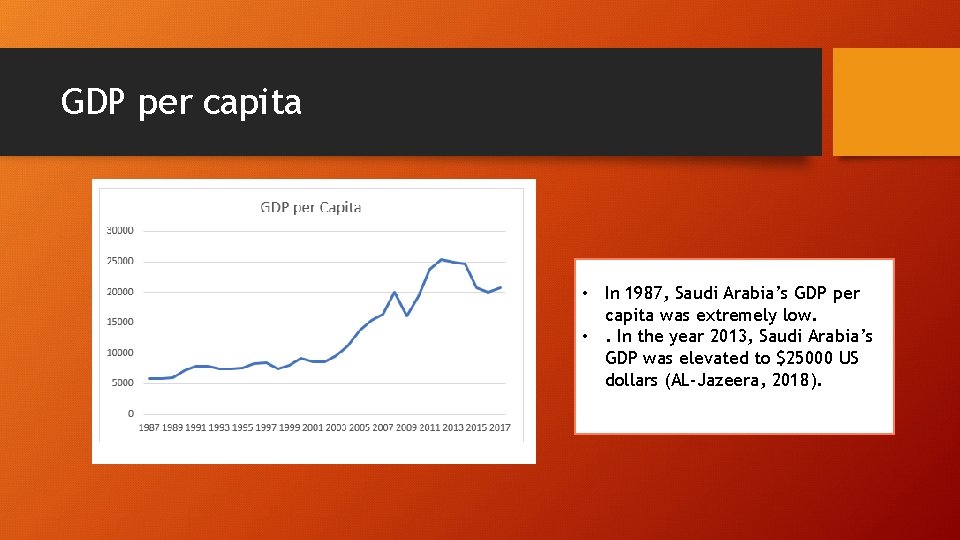
GDP per capita • In 1987, Saudi Arabia’s GDP per capita was extremely low. • . In the year 2013, Saudi Arabia’s GDP was elevated to $25000 US dollars (AL-Jazeera, 2018).
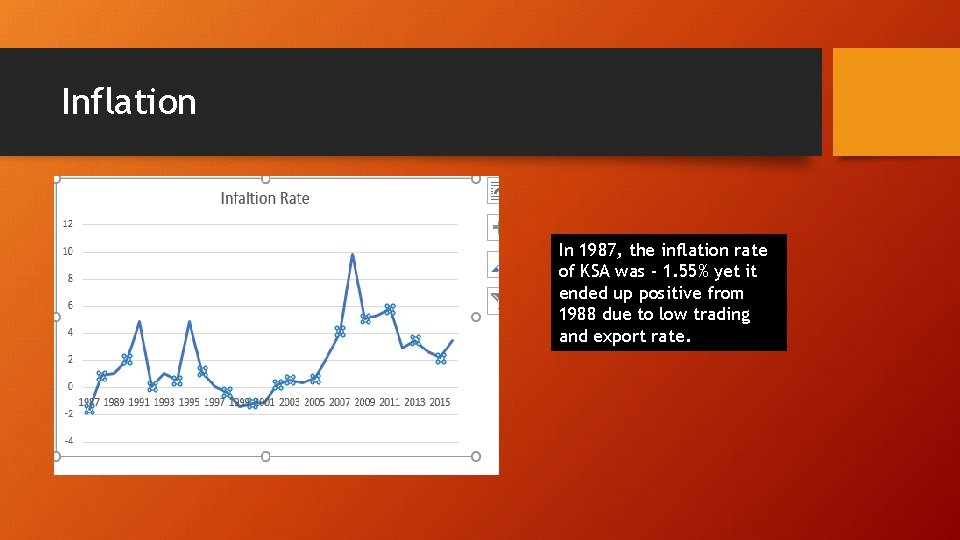
Inflation In 1987, the inflation rate of KSA was - 1. 55% yet it ended up positive from 1988 due to low trading and export rate.

Conclusion • In the whole Arab world, Saudi Arabia is the most ground-breaking and most grounded nation as far as its economy, the biggest oil exporter of the world, and acquires the second position in oil holds. • . The Growth Economic Rate, Real GDP per capita, and others are appeared differently in relation to the previous three years. • It has been seen that Saudi Arabia has steady advanced in all areas which impacts its Economic Growth rate and the Real GDP; • The Saudi government has empowered the movement and filled it up with the Saudi Vision 2030. In this manner, it is relied upon to advance more in coming years.
References • AL-Jazeera. (2018). Saudi Economic Outlook. Retrieved from http: //www. aljaziracapital. com. sa/report_file/ess/ECO-524. pdf • Alhowaish, A. (2016). Is Tourism Development a Sustainable Economic Growth Strategy in the Long Run? Evidence from GCC Countries. Sustainability, 8(7), 605. https: //doi. org/10. 3390/su 8070605 • Baig, M. B. , & Straquadine, G. S. (2014). Sustainable Agriculture and Rural Development in the Kingdom of Saudi Arabia: Implications for Agricultural Extension and Education. In Vulnerability of Agriculture, Water and Fisheries to Climate Change (pp. 101– 116). Dordrecht: Springer Netherlands. https: //doi. org/10. 1007/978 -94 -017 -8962 -2_7 • Cappelen, Å. , & Choudhury, R. (2007). Reports Rapporter The Future of the Saudi Arabian Economy Possible Effects on the World Oil Market Statistisk sentralbyrå • Statistics Norway Oslo-Kongsvinger. Retrieved from https: //www. ssb. no/a/english/publikasjoner/pdf/rapp_200007_en. pdf • Elhadj, E. (2004). Camels Don’t Fly, Deserts Don’t Bloom: an Assessment of Saudi Arabia’s Experiment in Desert Agriculture. Retrieved from https: //www. soas. ac. uk/water/publications/papers/file 38391. pdf • Kingdom of Saudi Arabia. (2017). KSA Vision 2030: Strategic Objectives and Vision Realization Programs, 78.
- Slides: 13