
SATYASPEAK BROADBAND INDIA FORUM World WiFi Day Presentation
SATYASPEAK BROADBAND INDIA FORUM World Wi-Fi Day Presentation 20 th June 2019, New Delhi Bridging the Digital Access Deficit through Wi-Fi – An Implementable Business Model SATYA N. GUPTA Co-Chair – Rural Digital Initiative & Infrastructure Committees, BIF Chairman - BLUETOWN, India & BIMSTEC
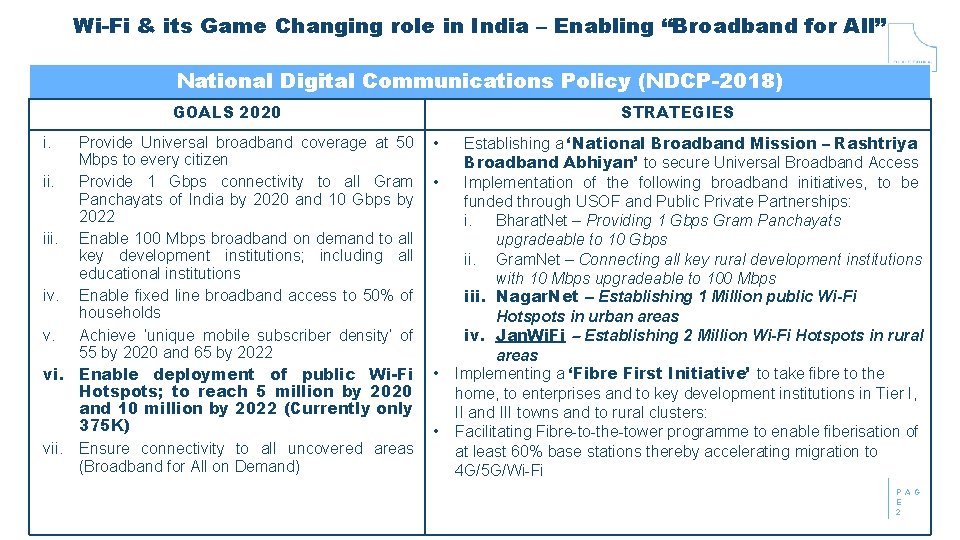
Wi-Fi & its Game Changing role in India – Enabling “Broadband for All” National Digital Communications Policy (NDCP-2018) GOALS 2020 i. Provide Universal broadband coverage at 50 Mbps to every citizen ii. Provide 1 Gbps connectivity to all Gram Panchayats of India by 2020 and 10 Gbps by 2022 iii. Enable 100 Mbps broadband on demand to all key development institutions; including all educational institutions iv. Enable fixed line broadband access to 50% of households v. Achieve ‘unique mobile subscriber density’ of 55 by 2020 and 65 by 2022 vi. Enable deployment of public Wi-Fi Hotspots; to reach 5 million by 2020 and 10 million by 2022 (Currently only 375 K) vii. Ensure connectivity to all uncovered areas (Broadband for All on Demand) STRATEGIES • • Establishing a ‘National Broadband Mission – Rashtriya Broadband Abhiyan’ to secure Universal Broadband Access Implementation of the following broadband initiatives, to be funded through USOF and Public Private Partnerships: i. Bharat. Net – Providing 1 Gbps Gram Panchayats upgradeable to 10 Gbps ii. Gram. Net – Connecting all key rural development institutions with 10 Mbps upgradeable to 100 Mbps iii. Nagar. Net – Establishing 1 Million public Wi-Fi Hotspots in urban areas iv. Jan. Wi. Fi – Establishing 2 Million Wi-Fi Hotspots in rural areas Implementing a ‘Fibre First Initiative’ to take fibre to the home, to enterprises and to key development institutions in Tier I, II and III towns and to rural clusters: Facilitating Fibre-to-the-tower programme to enable fiberisation of at least 60% base stations thereby accelerating migration to 4 G/5 G/Wi-Fi P A G E 2
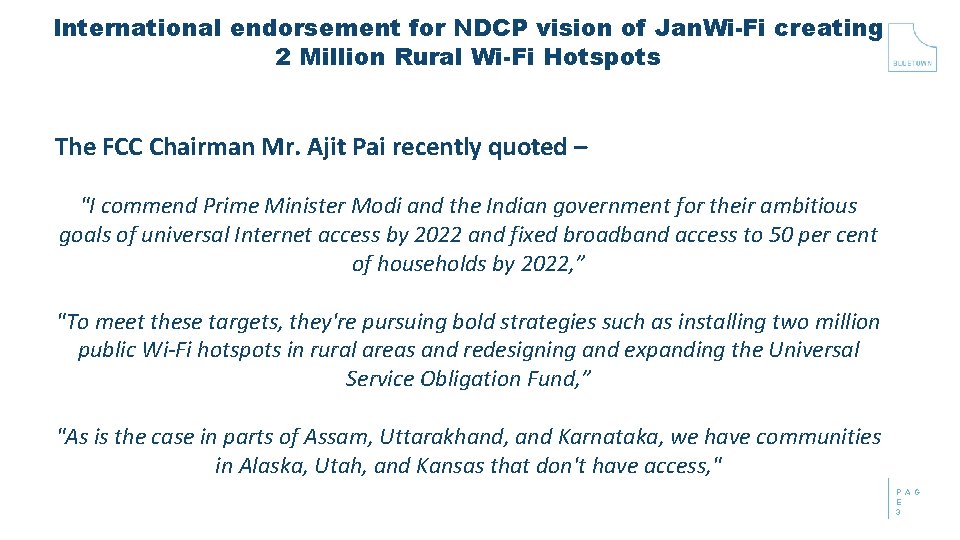
International endorsement for NDCP vision of Jan. Wi-Fi creating 2 Million Rural Wi-Fi Hotspots The FCC Chairman Mr. Ajit Pai recently quoted – "I commend Prime Minister Modi and the Indian government for their ambitious goals of universal Internet access by 2022 and fixed broadband access to 50 per cent of households by 2022, ” "To meet these targets, they're pursuing bold strategies such as installing two million public Wi-Fi hotspots in rural areas and redesigning and expanding the Universal Service Obligation Fund, ” "As is the case in parts of Assam, Uttarakhand, and Karnataka, we have communities in Alaska, Utah, and Kansas that don't have access, " P A G E 3
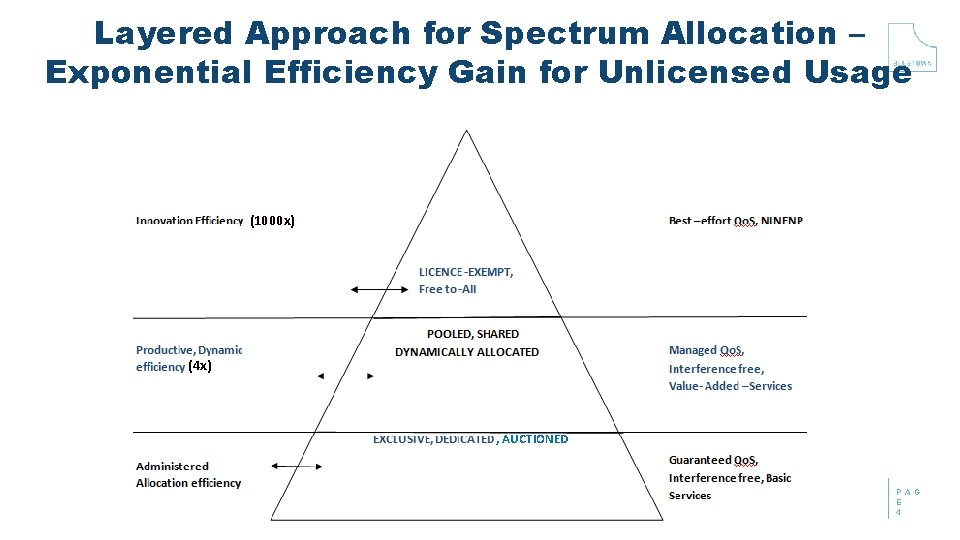
Layered Approach for Spectrum Allocation – Exponential Efficiency Gain for Unlicensed Usage (1000 x) (4 x) , AUCTIONED 4 4 P A G E 4

Unlicensed Band for Wi-Fi usage in India In India the following bands are unlicensed for Low Power Communication usage with some restrictions: • 2400 -2485 MHz; • 5150 -5250 MHz, • 5250 -5350 MHz; • 5470 -5725 MHz; • 5725 -5875 MHz The move is to push setting up of Wi-Fi services in the country and complement development of 5 G ecosystem in Rural Areas. Now, in total 690 MHz is unlicensed to be used for Wi-Fi or other innovative technologies. P A G E 5
Why Wifi? -Bridging ‘Digital Access Deficit’ Efficiently 1. Ubiquitous – Each smart device (including Mobile Phones) is Wi-Fi enabled. 2. Uses unlicensed spectrum (ISM Band) which is free (690 MHz in 2. 4 GHz and 5 GHz Band). 3. All IP Technology which is very efficient and future proof which is based on open and ever evolving standards of IEEE (802. 11 x). 4. Plug-n-Play ecosystem. 5. Low Power consuming and Low Cost – overall infra cost about 10% of licensed mobile infrastructure. 6. Potential to conserve scarce licensed spectrum through Mobile Data Offload (MDO), Fixed Mobile Convergence (FMC). 7. NINENP (Non- Interfering, Non-Exclusive, Non-Protected) – Free for All. 8. Current Hotspots in India – 3. 75 Lakhs (mushrooming everywhere). 9. Potential to deliver 4 G and 5 G type services through upgradation (802. 11 ac - Wave 2, 802. 11 ax – Wi-Fi 6) 10. Ideal futuristic platform for Io. T, M 2 M and E-health, E-farming, Eeducation. 11. Wi-Fi to become a part of the 5 G ecosystem through Release 16 & 17 of 3 GPP IMT Standardisation process. P A G E 6
Fixed Mobile Convergence (FMC) – A Killer Wi-Fi Application to Reduce Call Drops FMC is convergence of access for telephony wherein as per the convenience of the users and mobile call can be delivered on fixed phone or can be terminated through Fixed/ Wi-Fi Access Network on mobile phone. 1. 2. 3. 4. 5. Main motivation for this is : Spectrum shortage leading to congestion, reduced Qo. S and Call Drops. (It is believed that 70% of the time a mobile call recipient is on a Fixed location/ Wi-Fi Hotspot Zone) Mobile subscriber saturation, Fixed lines decline (Battle for in-building minutes) Broadband becoming ubiquitous and cost effective The “Mobile Handset” is becoming a multi-purpose, multi-band, multi-mode Hand-Held Computer NGN Technologies enabling PSTN-IP interconnection leading to FMC (IMS, UMA, Femtocells) P A G E 7
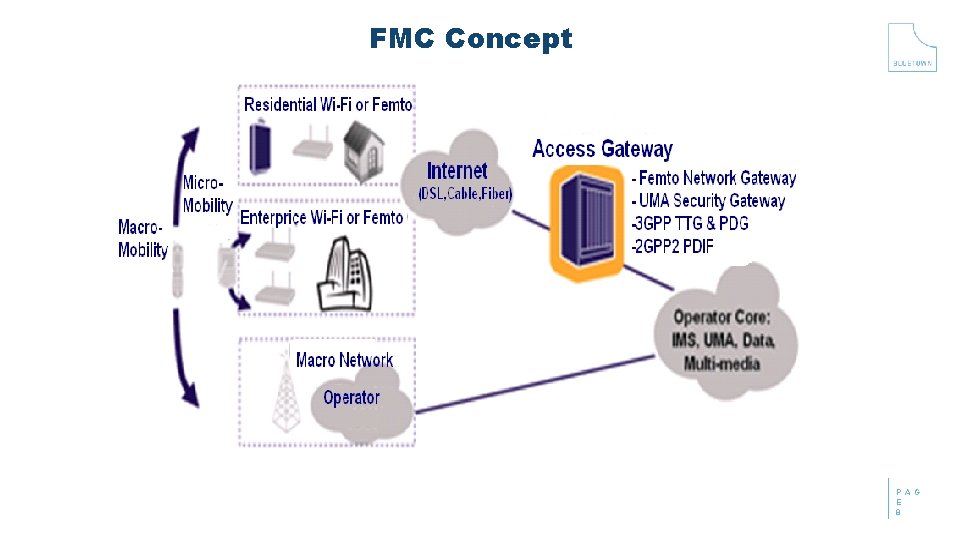
FMC Concept 8 P A G E 8
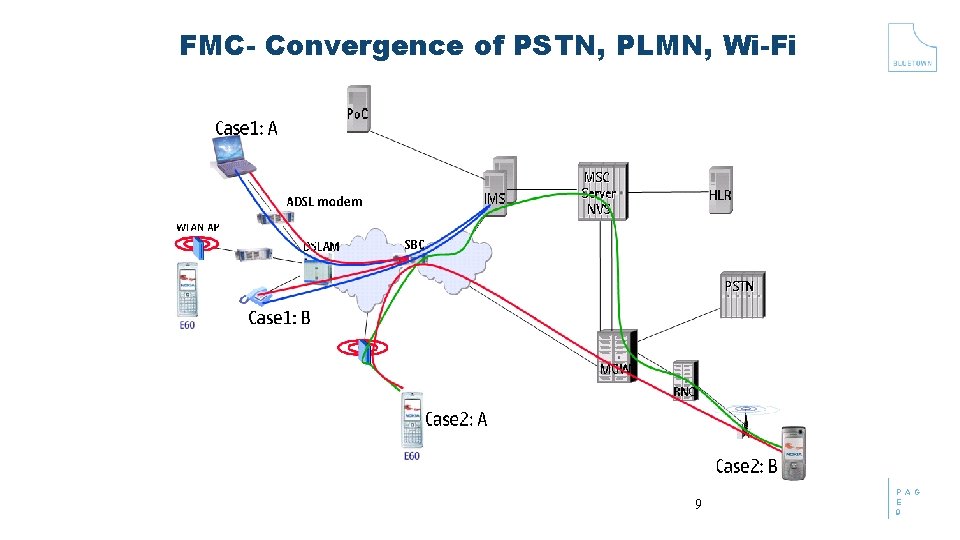
FMC- Convergence of PSTN, PLMN, Wi-Fi 9 P A G E 9
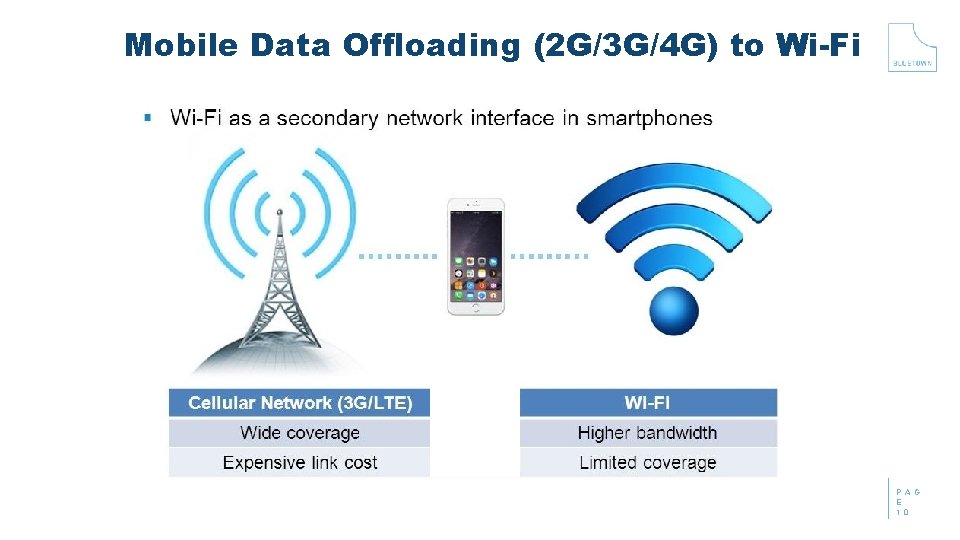
Mobile Data Offloading (2 G/3 G/4 G) to Wi-Fi P A G E 1 0
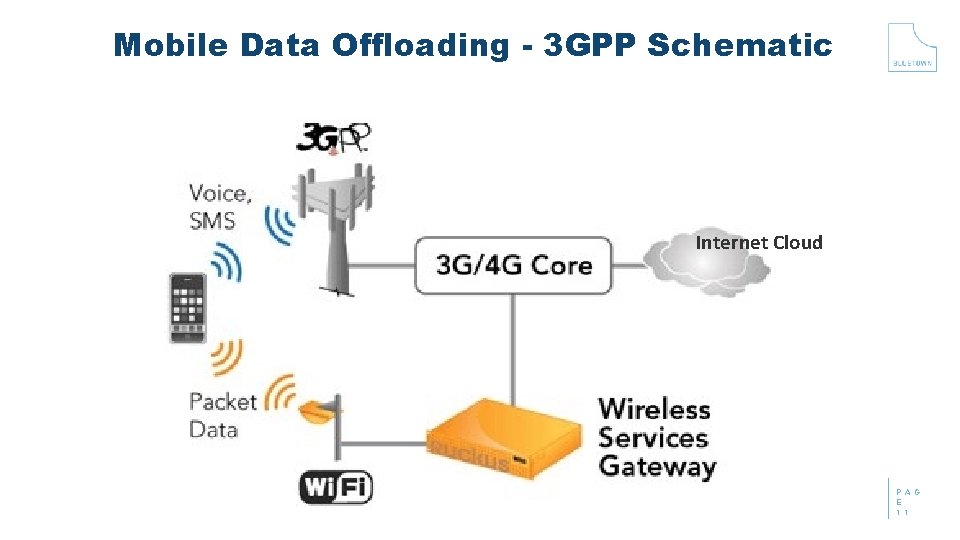
Mobile Data Offloading - 3 GPP Schematic Internet Cloud P A G E 1 1
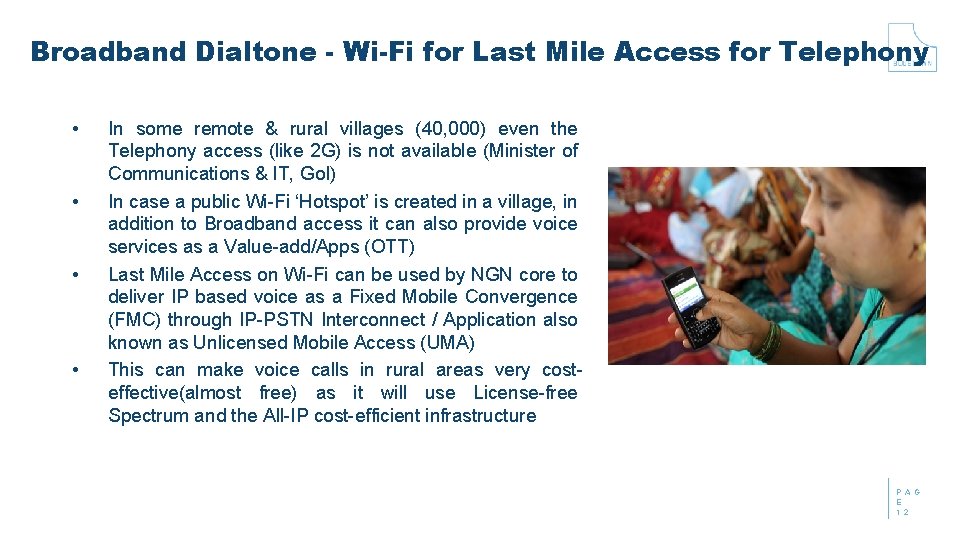
Broadband Dialtone - Wi-Fi for Last Mile Access for Telephony • • In some remote & rural villages (40, 000) even the Telephony access (like 2 G) is not available (Minister of Communications & IT, Go. I) In case a public Wi-Fi ‘Hotspot’ is created in a village, in addition to Broadband access it can also provide voice services as a Value-add/Apps (OTT) Last Mile Access on Wi-Fi can be used by NGN core to deliver IP based voice as a Fixed Mobile Convergence (FMC) through IP-PSTN Interconnect / Application also known as Unlicensed Mobile Access (UMA) This can make voice calls in rural areas very costeffective(almost free) as it will use License-free Spectrum and the All-IP cost-efficient infrastructure P A G E 1 2
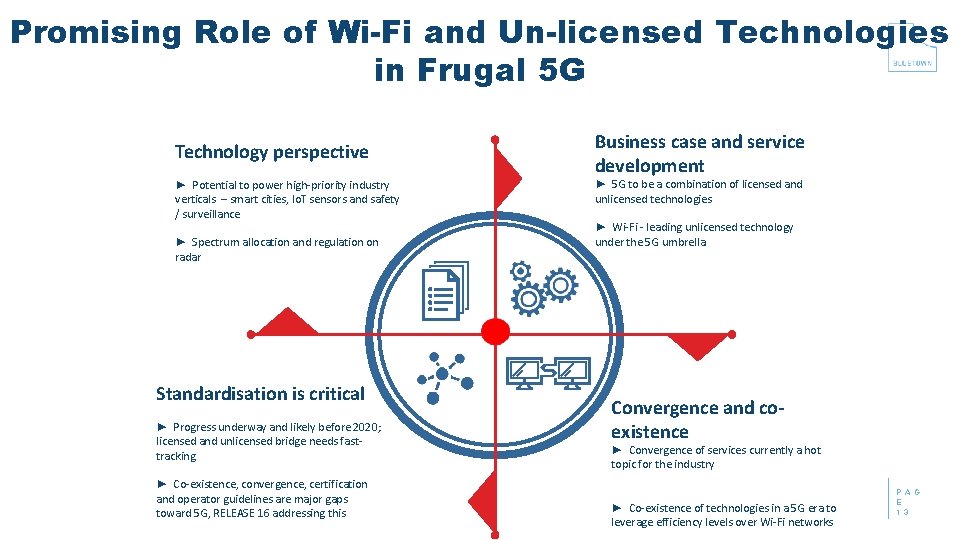
Promising Role of Wi-Fi and Un-licensed Technologies in Frugal 5 G Technology perspective ► Potential to power high-priority industry verticals – smart cities, Io. T sensors and safety / surveillance ► Spectrum allocation and regulation on radar Standardisation is critical ► Progress underway and likely before 2020; licensed and unlicensed bridge needs fasttracking ► Co-existence, convergence, certification and operator guidelines are major gaps toward 5 G, RELEASE 16 addressing this Business case and service development ► 5 G to be a combination of licensed and unlicensed technologies ► Wi-Fi - leading unlicensed technology under the 5 G umbrella Convergence and coexistence ► Convergence of services currently a hot topic for the industry ► Co-existence of technologies in a 5 G era to leverage efficiency levels over Wi-Fi networks P A G E 1 3
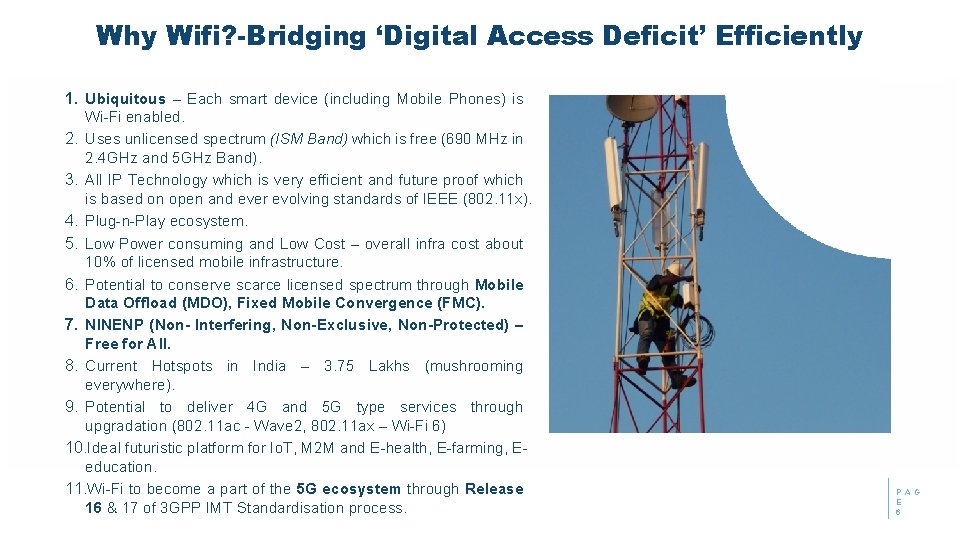
Managed Hotspot Service Provider (MHSP) Business Model – An Innovative Approach for Broadband Access in Rural Areas • For provisioning of Broadband in such rural areas a MHSP in partnership with Telco/ISP, installs a 5 -meterhigh pole/mast mounted 5 GHz Wi-Fi backhaul radio and 2. 4 GHz Wi-Fi hotspot with solar panel and Li. Ion/SMF batteries along with BTS all in a box mounted on this mast/pole. • MHSP appoints a VLE from Local folks for managing Hotspot. • This VLE will be given basic training by the MHSP for regular maintenance and operation of Hotspot and to provide Wi-Fi based Broadband services to the villagers. • The VLE working as franchisee of MHSP, acts as single point of contact for all Broadband related products and services. • VLE also takes the responsibility of digital literacy and assisted Broadband services (such as e-governance) to the rural masses. • VLE can also use this Wi-Fi infrastructure for generating revenue through other activities (such as mobile charging providing rail-road ticketing, getting market prices of crops and assisting in doing business transactions, rural e-banking, help in getting medical facilities from urban health centers etc. to name a few).
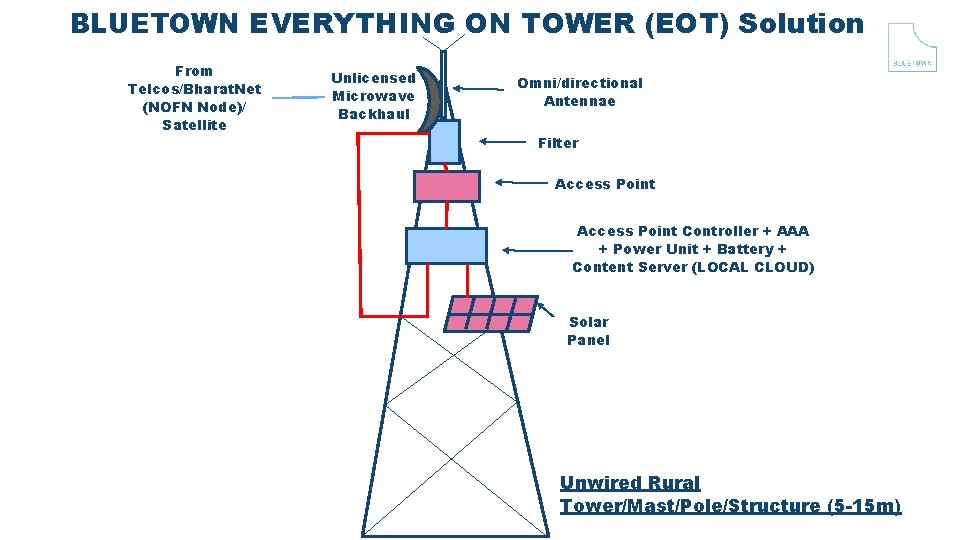
BLUETOWN EVERYTHING ON TOWER (EOT) Solution From Telcos/Bharat. Net (NOFN Node)/ Satellite Unlicensed Microwave Backhaul Omni/directional Antennae Filter Access Point Controller + AAA + Power Unit + Battery + Content Server (LOCAL CLOUD) Solar Panel Unwired Rural Tower/Mast/Pole/Structure (5 -15 m)
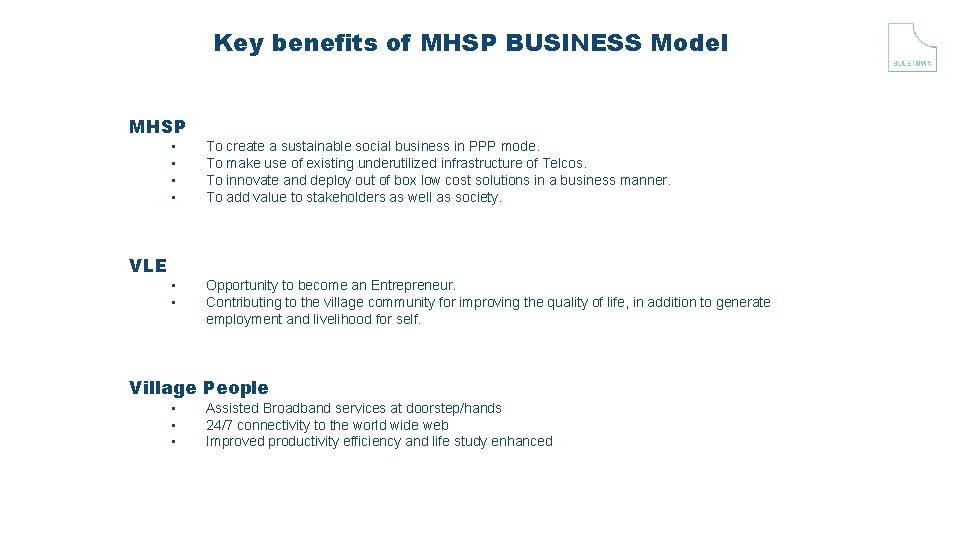
Key benefits of MHSP BUSINESS Model MHSP VLE • • To create a sustainable social business in PPP mode. To make use of existing underutilized infrastructure of Telcos. To innovate and deploy out of box low cost solutions in a business manner. To add value to stakeholders as well as society. • • Opportunity to become an Entrepreneur. Contributing to the village community for improving the quality of life, in addition to generate employment and livelihood for self. Village People • • • Assisted Broadband services at doorstep/hands 24/7 connectivity to the world wide web Improved productivity efficiency and life study enhanced
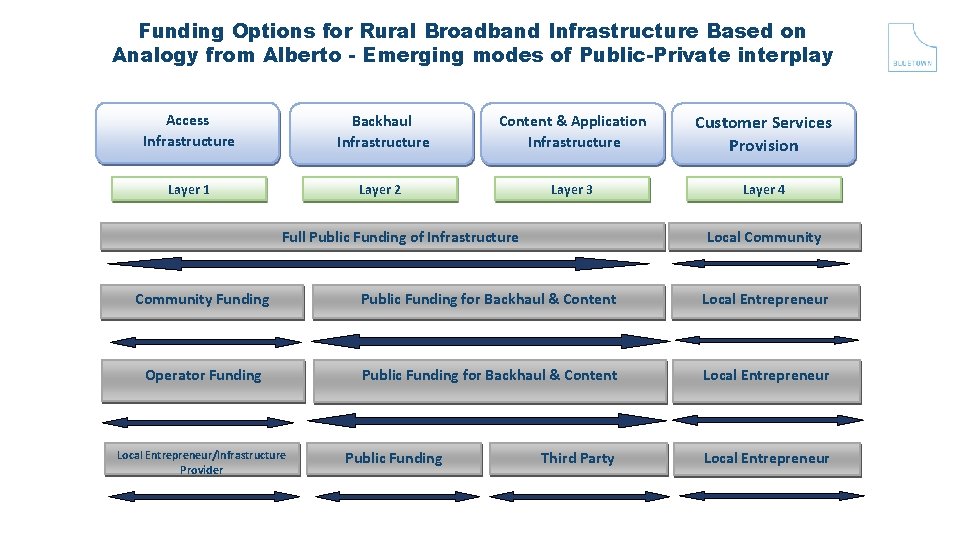
Funding Options for Rural Broadband Infrastructure Based on Analogy from Alberto - Emerging modes of Public-Private interplay Access Infrastructure Backhaul Infrastructure Content & Application Infrastructure Customer Services Provision Layer 1 Layer 2 Layer 3 Layer 4 Full Public Funding of Infrastructure Local Community Funding Public Funding for Backhaul & Content Local Entrepreneur Operator Funding Public Funding for Backhaul & Content Local Entrepreneur/Infrastructure Provider Public Funding Third Party Local Entrepreneur
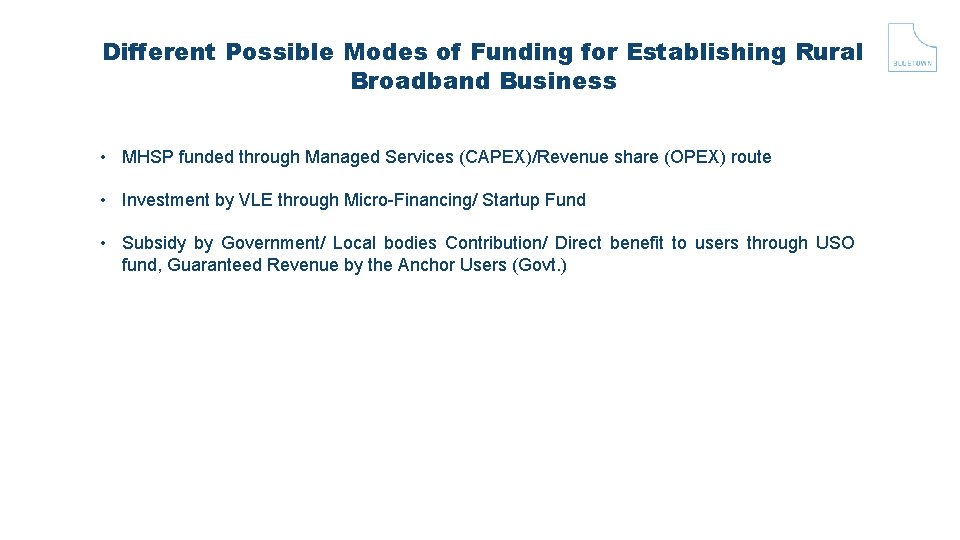
Different Possible Modes of Funding for Establishing Rural Broadband Business • MHSP funded through Managed Services (CAPEX)/Revenue share (OPEX) route • Investment by VLE through Micro-Financing/ Startup Fund • Subsidy by Government/ Local bodies Contribution/ Direct benefit to users through USO fund, Guaranteed Revenue by the Anchor Users (Govt. )
PDOA - INNOVATIVE ENABLER REGIME
Public Data Office Aggregator (PDOA) & Public Data Offices (PDOs) PDOA is bandwidth aggregator which buys spectrum from multiple ISPs and provide them to PDO owners at cheaper proportions. PDOs will be venue owners. These may not own or deploy any infrastructure This is where the role of a PDOA comes in…PDOAs will be registered with the Do. T and there should be no limit on the number of PDOs (venues) that such a PDOA can register The PDOAs can also aggregate Internet bandwidth from existing Wi-Fi hotspots in a locality and sell them to customers at a retail level.
Role of PDOA A PDOA as an aggregator will ensure that subscribers have a seamless experience when it comes to authentication and payments. Such PDOA will be responsible for maintaining electronic records (authentication and payment) of all users that end up using the Wi-Fi service provided by a PDO linked with such PDOA.
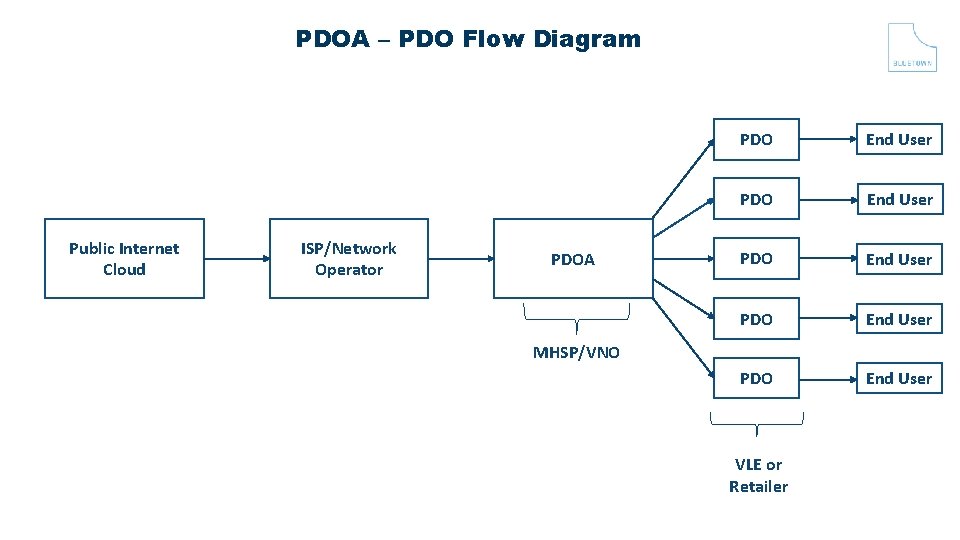
PDOA – PDO Flow Diagram Public Internet Cloud ISP/Network Operator PDOA PDO End User PDO End User MHSP/VNO VLE or Retailer
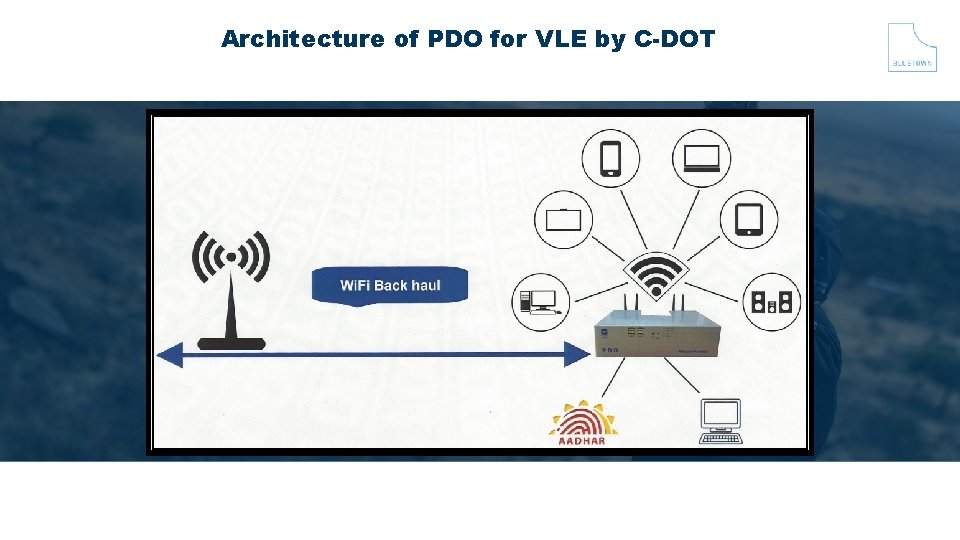
Architecture of PDO for VLE by C-DOT
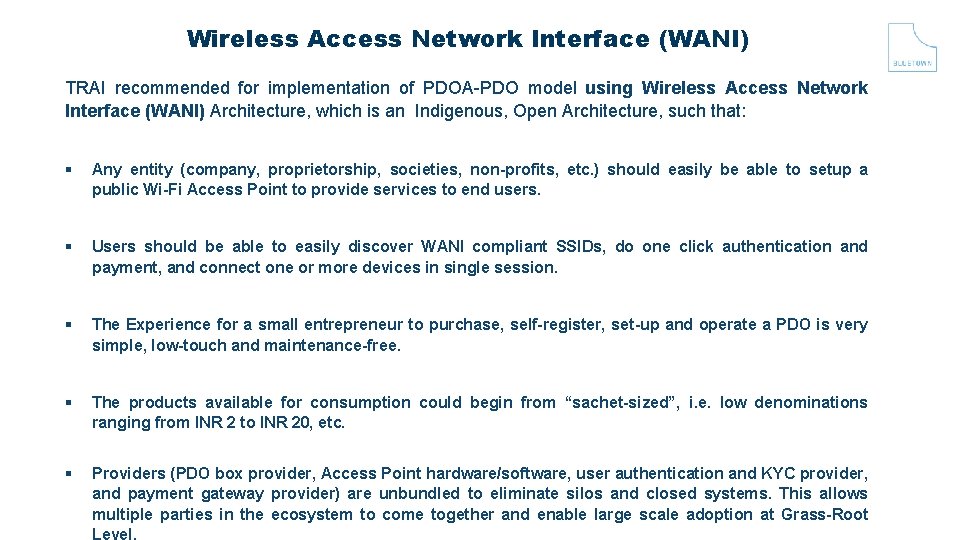
Wireless Access Network Interface (WANI) TRAI recommended for implementation of PDOA-PDO model using Wireless Access Network Interface (WANI) Architecture, which is an Indigenous, Open Architecture, such that: Any entity (company, proprietorship, societies, non-profits, etc. ) should easily be able to setup a public Wi-Fi Access Point to provide services to end users. Users should be able to easily discover WANI compliant SSIDs, do one click authentication and payment, and connect one or more devices in single session. The Experience for a small entrepreneur to purchase, self-register, set-up and operate a PDO is very simple, low-touch and maintenance-free. The products available for consumption could begin from “sachet-sized”, i. e. low denominations ranging from INR 2 to INR 20, etc. Providers (PDO box provider, Access Point hardware/software, user authentication and KYC provider, and payment gateway provider) are unbundled to eliminate silos and closed systems. This allows multiple parties in the ecosystem to come together and enable large scale adoption at Grass-Root
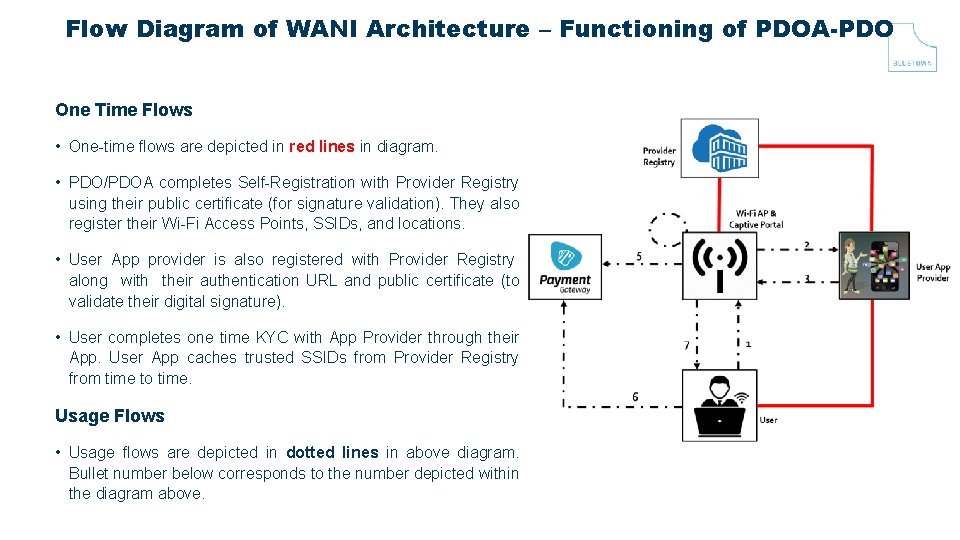
Flow Diagram of WANI Architecture – Functioning of PDOA-PDO One Time Flows • One-time flows are depicted in red lines in diagram. • PDO/PDOA completes Self-Registration with Provider Registry using their public certificate (for signature validation). They also register their Wi-Fi Access Points, SSIDs, and locations. • User App provider is also registered with Provider Registry along with their authentication URL and public certificate (to validate their digital signature). • User completes one time KYC with App Provider through their App. User App caches trusted SSIDs from Provider Registry from time to time. Usage Flows • Usage flows are depicted in dotted lines in above diagram. Bullet number below corresponds to the number depicted within the diagram above.
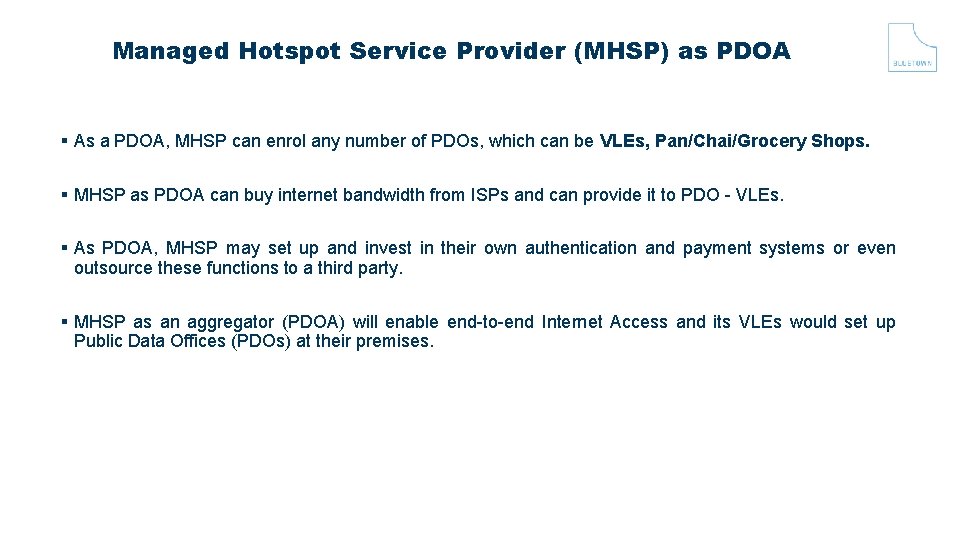
Managed Hotspot Service Provider (MHSP) as PDOA As a PDOA, MHSP can enrol any number of PDOs, which can be VLEs, Pan/Chai/Grocery Shops. MHSP as PDOA can buy internet bandwidth from ISPs and can provide it to PDO - VLEs. As PDOA, MHSP may set up and invest in their own authentication and payment systems or even outsource these functions to a third party. MHSP as an aggregator (PDOA) will enable end-to-end Internet Access and its VLEs would set up Public Data Offices (PDOs) at their premises.
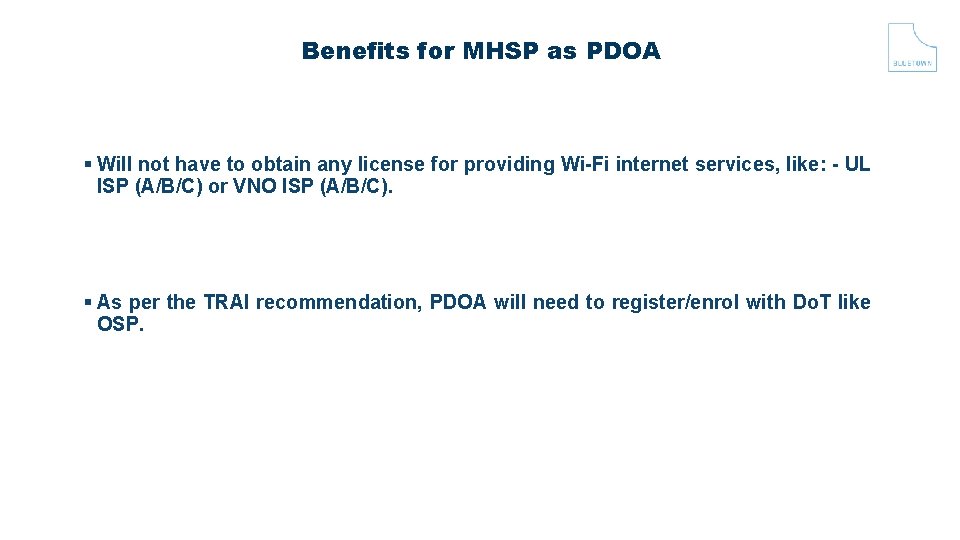
Benefits for MHSP as PDOA Will not have to obtain any license for providing Wi-Fi internet services, like: - UL ISP (A/B/C) or VNO ISP (A/B/C). As per the TRAI recommendation, PDOA will need to register/enrol with Do. T like OSP.
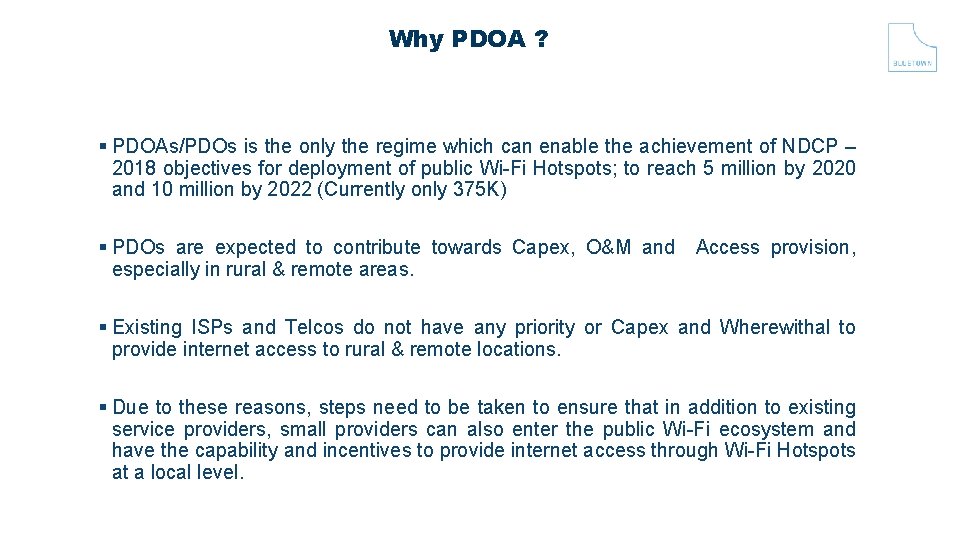
Why PDOA ? PDOAs/PDOs is the only the regime which can enable the achievement of NDCP – 2018 objectives for deployment of public Wi-Fi Hotspots; to reach 5 million by 2020 and 10 million by 2022 (Currently only 375 K) PDOs are expected to contribute towards Capex, O&M and especially in rural & remote areas. Access provision, Existing ISPs and Telcos do not have any priority or Capex and Wherewithal to provide internet access to rural & remote locations. Due to these reasons, steps need to be taken to ensure that in addition to existing service providers, small providers can also enter the public Wi-Fi ecosystem and have the capability and incentives to provide internet access through Wi-Fi Hotspots at a local level.
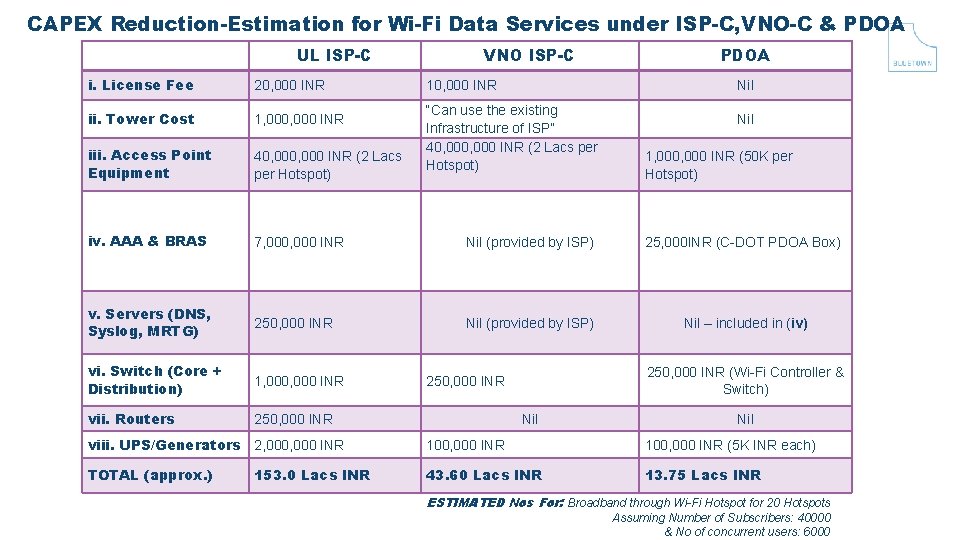
CAPEX Reduction-Estimation for Wi-Fi Data Services under ISP-C, VNO-C & PDOA UL ISP-C VNO ISP-C PDOA i. License Fee 20, 000 INR ii. Tower Cost 1, 000 INR iii. Access Point Equipment 40, 000 INR (2 Lacs per Hotspot) iv. AAA & BRAS 7, 000 INR Nil (provided by ISP) 25, 000 INR (C-DOT PDOA Box) v. Servers (DNS, Syslog, MRTG) 250, 000 INR Nil (provided by ISP) Nil – included in (iv) vi. Switch (Core + Distribution) 1, 000 INR vii. Routers 250, 000 INR 10, 000 INR Nil “Can use the existing Infrastructure of ISP” 40, 000 INR (2 Lacs per Hotspot) Nil 1, 000 INR (50 K per Hotspot) 250, 000 INR (Wi-Fi Controller & Switch) 250, 000 INR Nil viii. UPS/Generators 2, 000 INR 100, 000 INR (5 K INR each) TOTAL (approx. ) 43. 60 Lacs INR 13. 75 Lacs INR 153. 0 Lacs INR ESTIMATED Nos For: Broadband through Wi-Fi Hotspot for 20 Hotspots Assuming Number of Subscribers: 40000 & No of concurrent users: 6000
CDOT – PDO VIDEO
BLUETOWN USE CASE IN INDIA - VIDEO
THANK YOU sg@bluetown. com Download various publications/presentations of SATYASPEAK from www. saamcorpadvisors. com
- Slides: 32