
SaturnGod of Agriculture Saturn Son of Uranus and
- Slides: 66
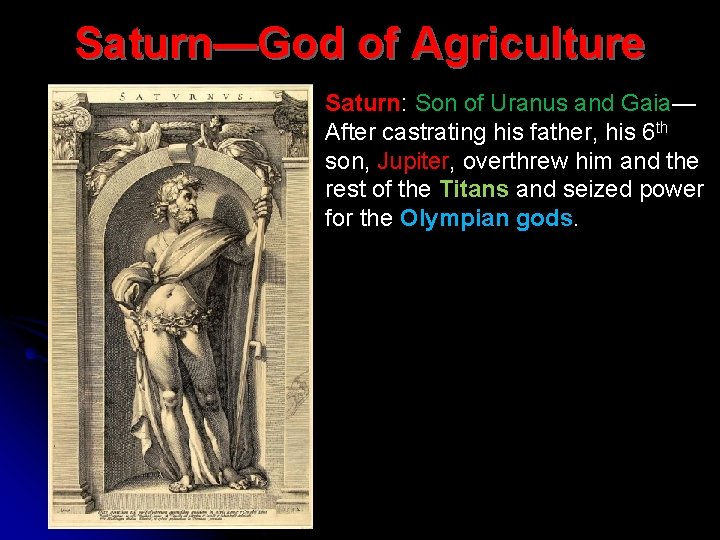
Saturn—God of Agriculture Saturn: Son of Uranus and Gaia— After castrating his father, his 6 th son, Jupiter, overthrew him and the rest of the Titans and seized power for the Olympian gods.
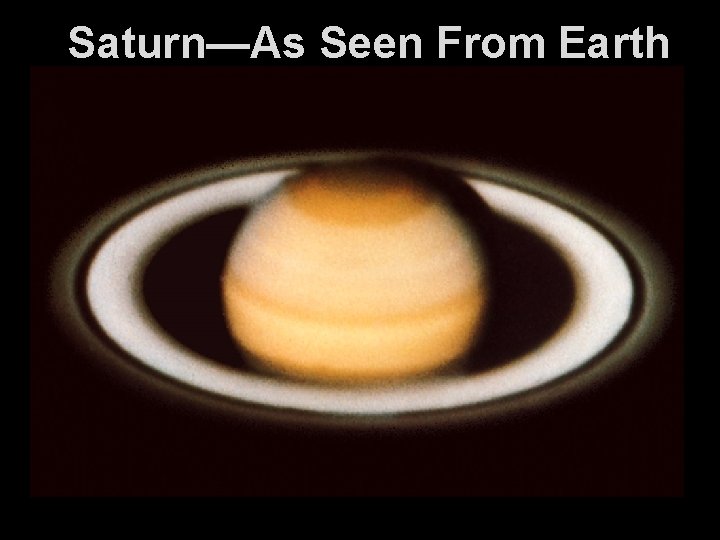
Saturn—As Seen From Earth
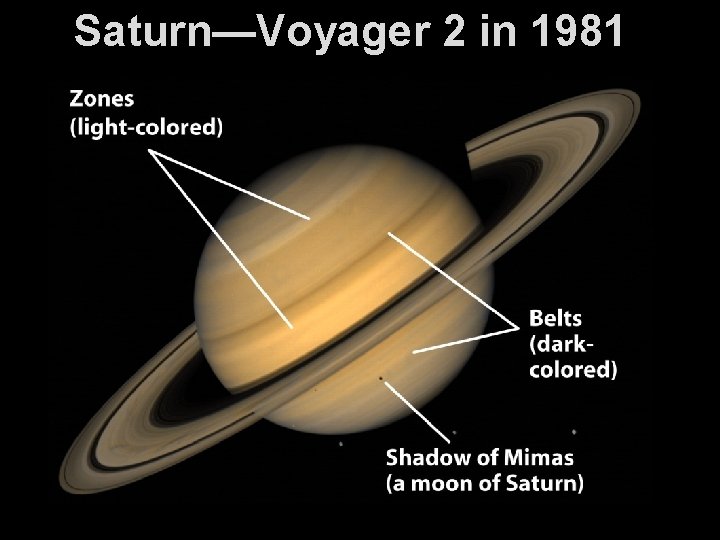
Saturn—Voyager 2 in 1981
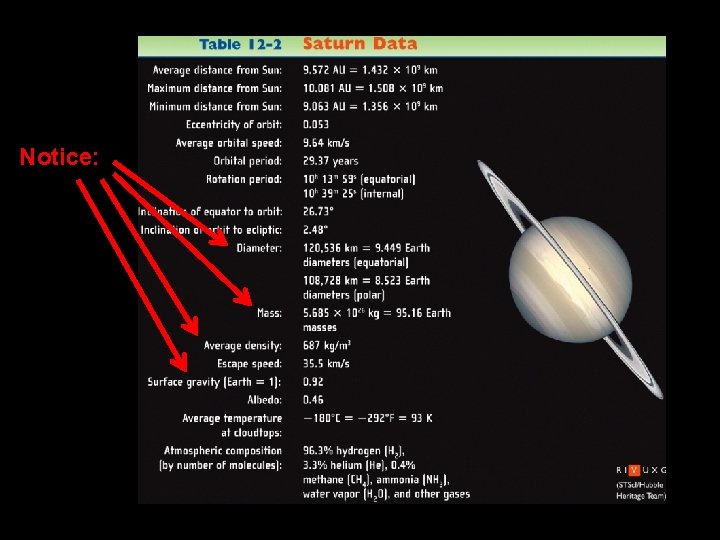
Notice:
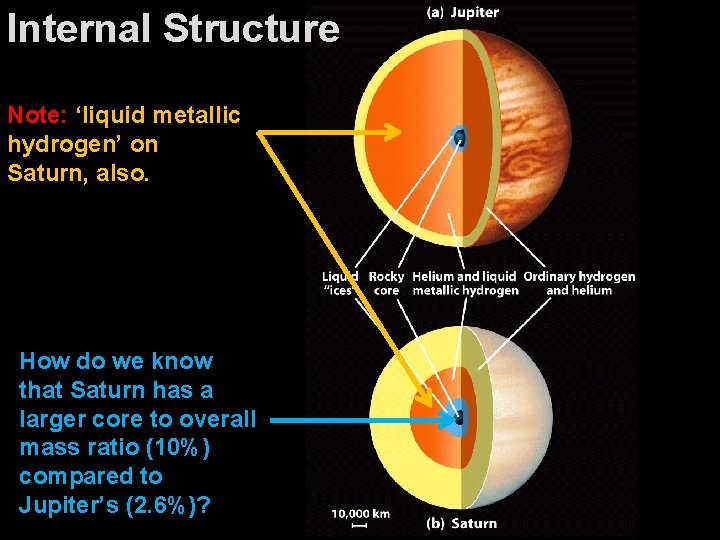
Internal Structure Note: ‘liquid metallic hydrogen’ on Saturn, also. How do we know that Saturn has a larger core to overall mass ratio (10%) compared to Jupiter’s (2. 6%)?
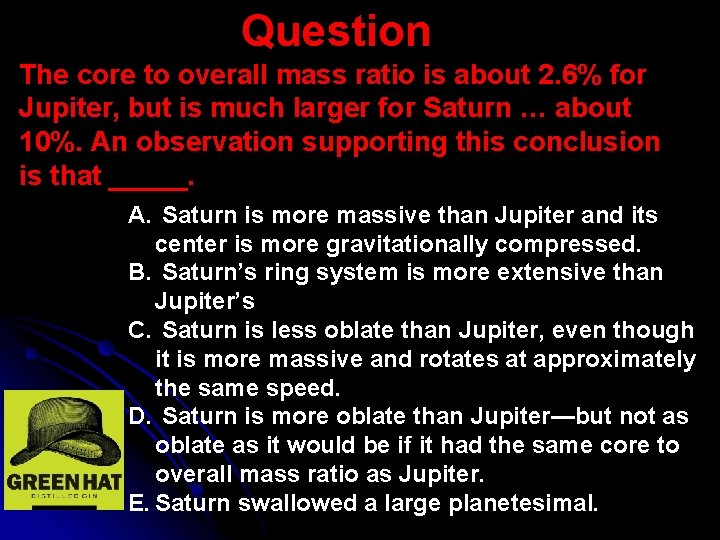
Question The core to overall mass ratio is about 2. 6% for Jupiter, but is much larger for Saturn … about 10%. An observation supporting this conclusion is that _____. A. Saturn is more massive than Jupiter and its center is more gravitationally compressed. B. Saturn’s ring system is more extensive than Jupiter’s C. Saturn is less oblate than Jupiter, even though it is more massive and rotates at approximately the same speed. D. Saturn is more oblate than Jupiter—but not as oblate as it would be if it had the same core to overall mass ratio as Jupiter. E. Saturn swallowed a large planetesimal.
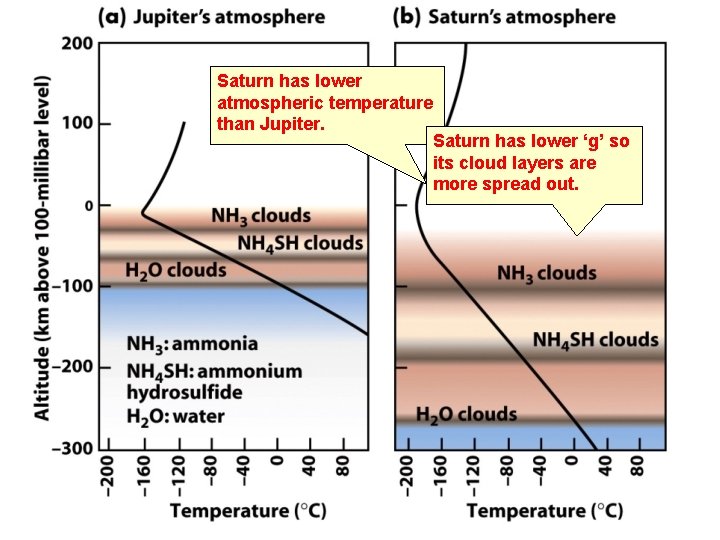
Saturn has lower atmospheric temperature than Jupiter. Saturn has lower ‘g’ so its cloud layers are more spread out.
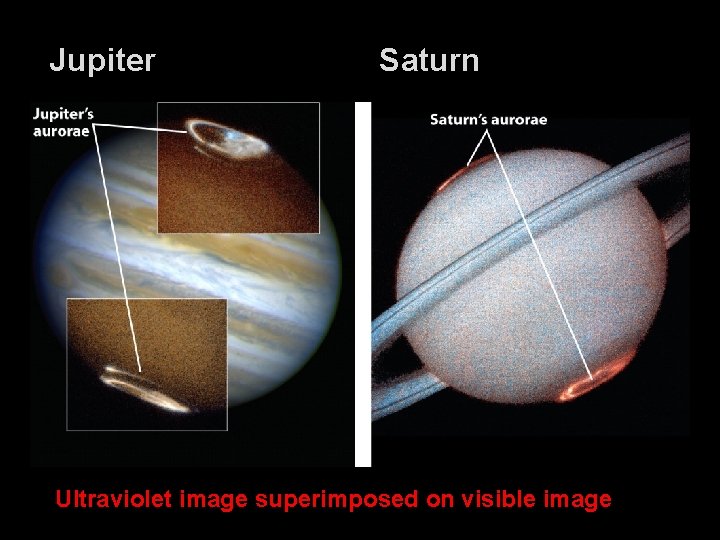
Jupiter Saturn Ultraviolet image superimposed on visible image
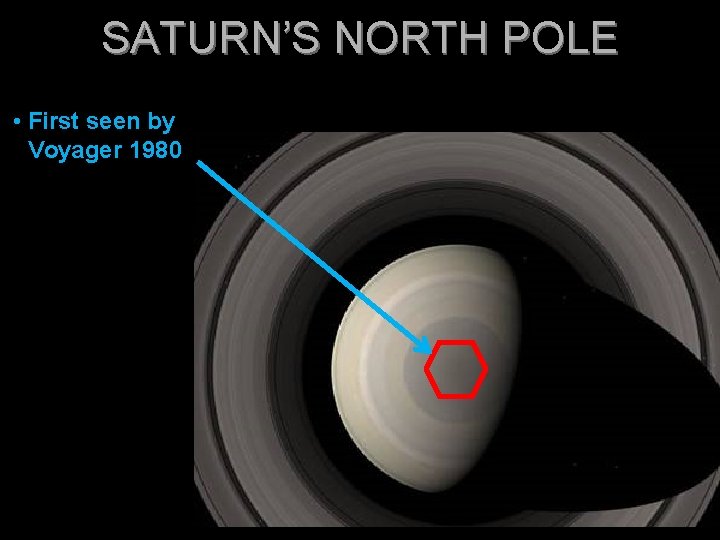
SATURN’S NORTH POLE • First seen by Voyager 1980
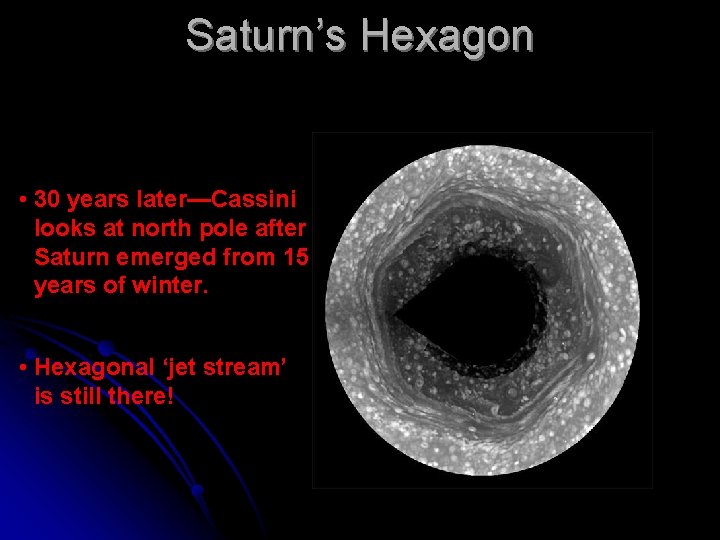
Saturn’s Hexagon • 30 years later—Cassini looks at north pole after Saturn emerged from 15 years of winter. • Hexagonal ‘jet stream’ is still there!
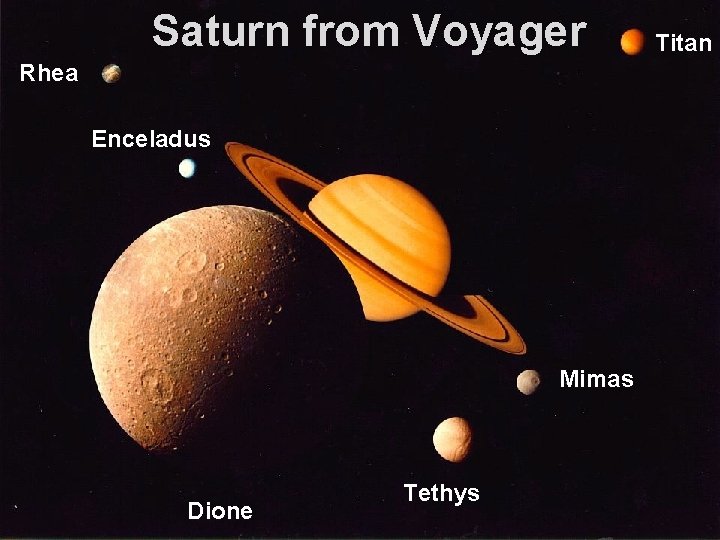
Saturn from Voyager Rhea Enceladus Mimas Dione Tethys Titan
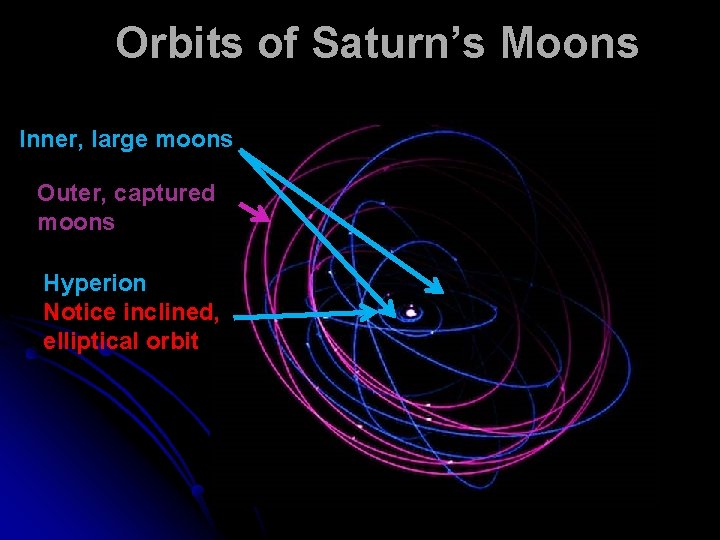
Orbits of Saturn’s Moons Inner, large moons Outer, captured moons Hyperion Notice inclined, elliptical orbit
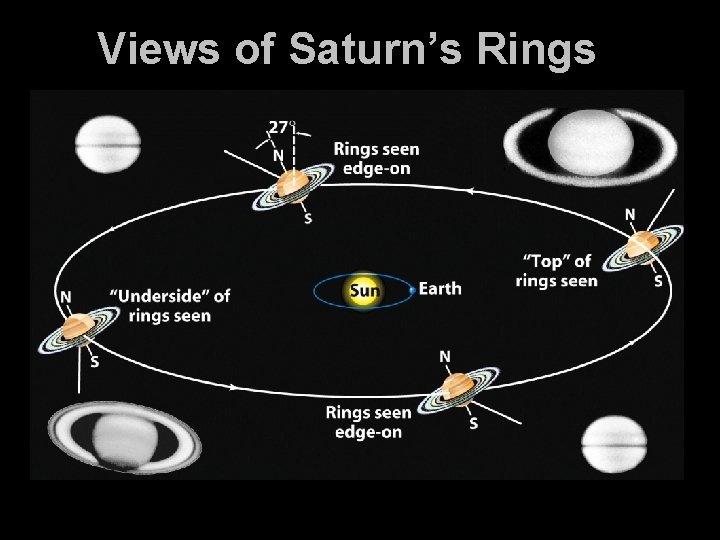
Views of Saturn’s Rings
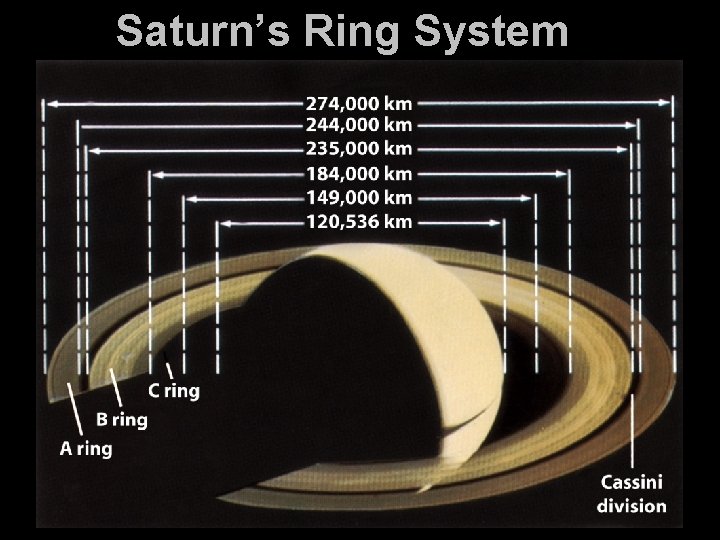
Saturn’s Ring System
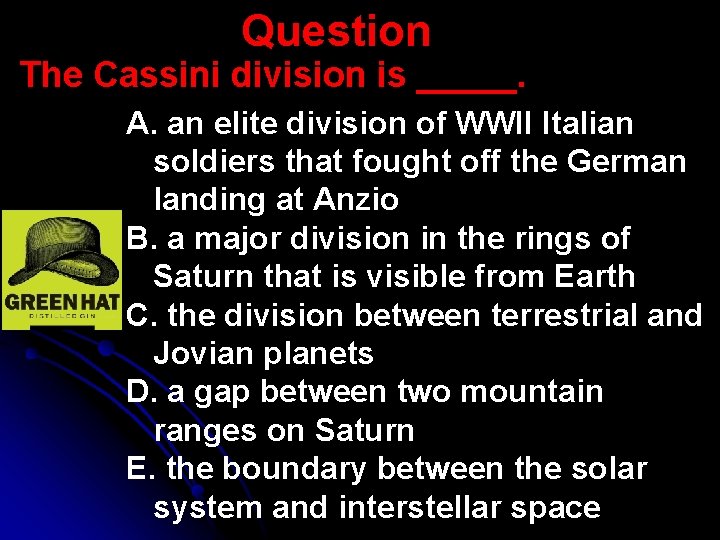
Question The Cassini division is _____. A. an elite division of WWII Italian soldiers that fought off the German landing at Anzio B. a major division in the rings of Saturn that is visible from Earth C. the division between terrestrial and Jovian planets D. a gap between two mountain ranges on Saturn E. the boundary between the solar system and interstellar space
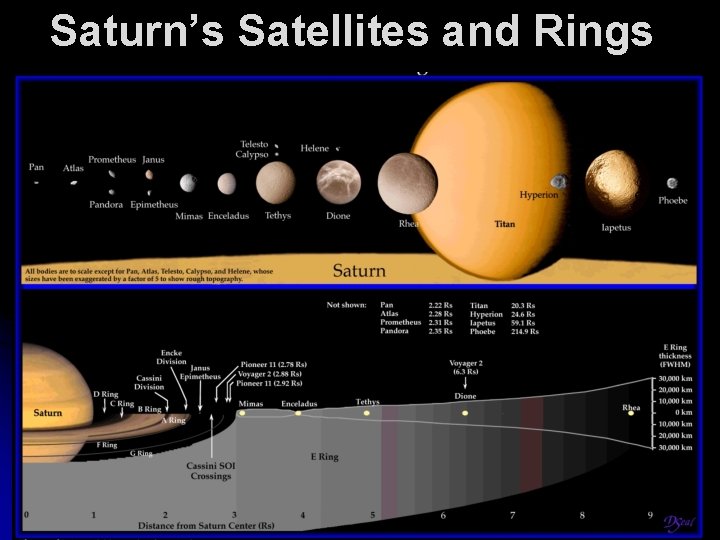
Saturn’s Satellites and Rings
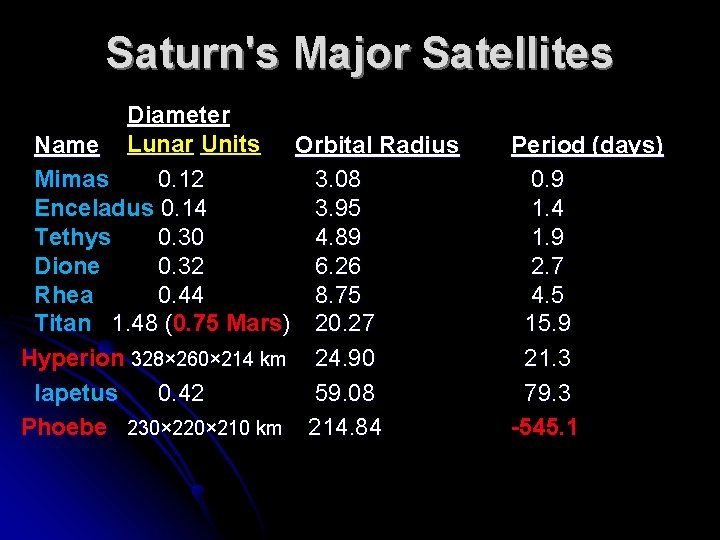
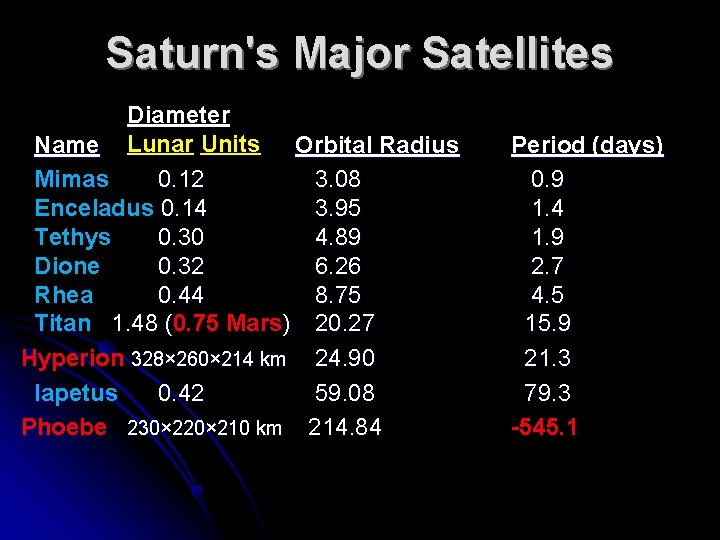
Saturn's Major Satellites Diameter Name Lunar Units Orbital Radius Mimas 0. 12 3. 08 Enceladus 0. 14 3. 95 Tethys 0. 30 4. 89 Dione 0. 32 6. 26 Rhea 0. 44 8. 75 Titan 1. 48 (0. 75 Mars) 20. 27 Hyperion 328× 260× 214 km 24. 90 Iapetus 0. 42 59. 08 Phoebe 230× 220× 210 km 214. 84 Period (days) 0. 9 1. 4 1. 9 2. 7 4. 5 15. 9 21. 3 79. 3 -545. 1
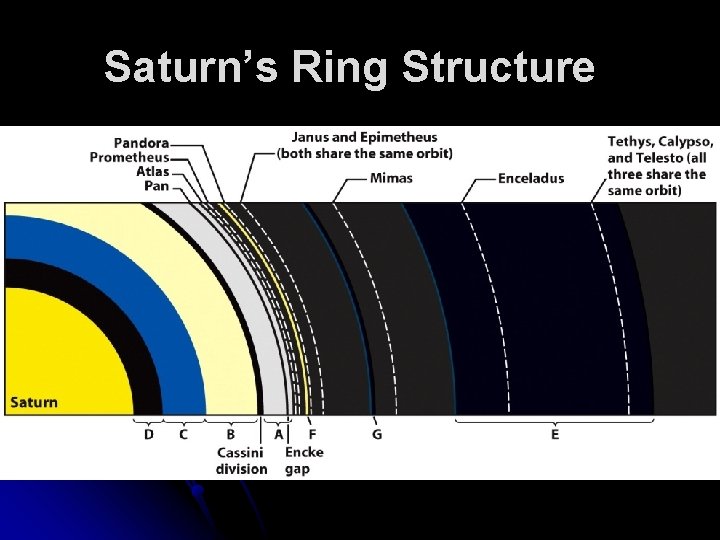
Saturn’s Ring Structure
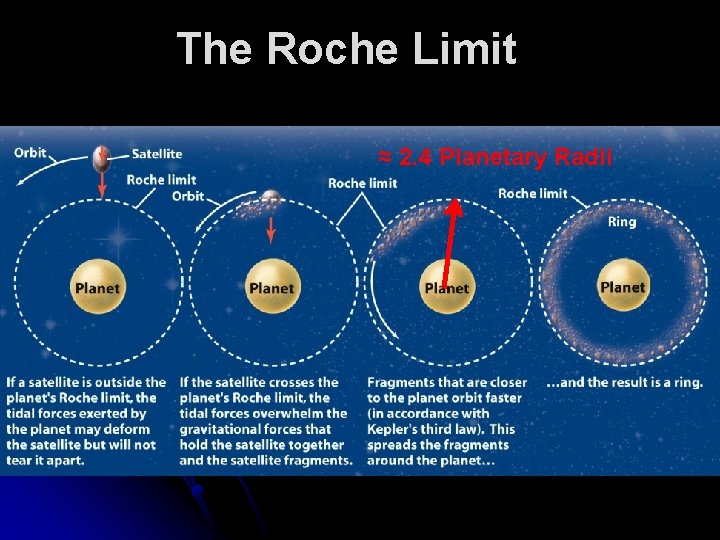
The Roche Limit ≈ 2. 4 Planetary Radii
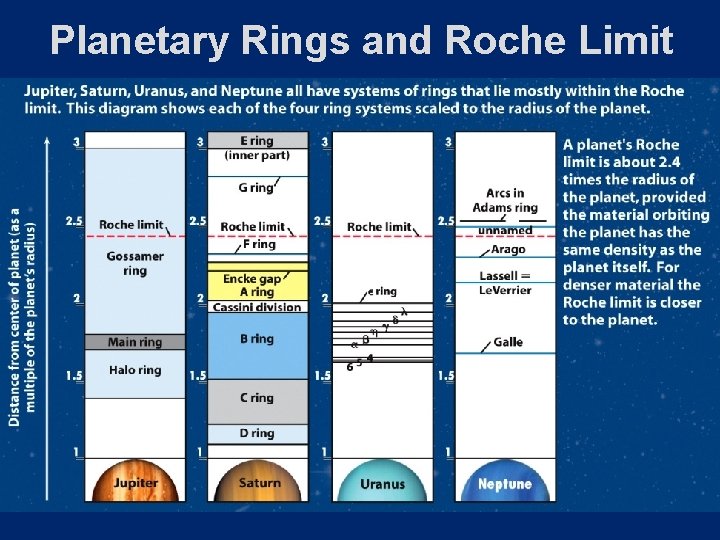
Planetary Rings and Roche Limit
Question A planet’s Roche limit is ______. A. the distance beyond which matter cannot be captured by the planet B. the distance within which any solid satellite (e. g. , a fragment of rock) will be pulled apart by tidal forces C. the outer extent of the magnetic field of the planet, or the magnetospheric boundary D. the distance within which tidal forces will overcome the mutual gravitational forces that hold a large object together in a spherical shape and pull it apart into small, irregularly fragments held together primarily by molecular forces E. the maximum size a planet can attain if it is not to collapse and turn into a black hole
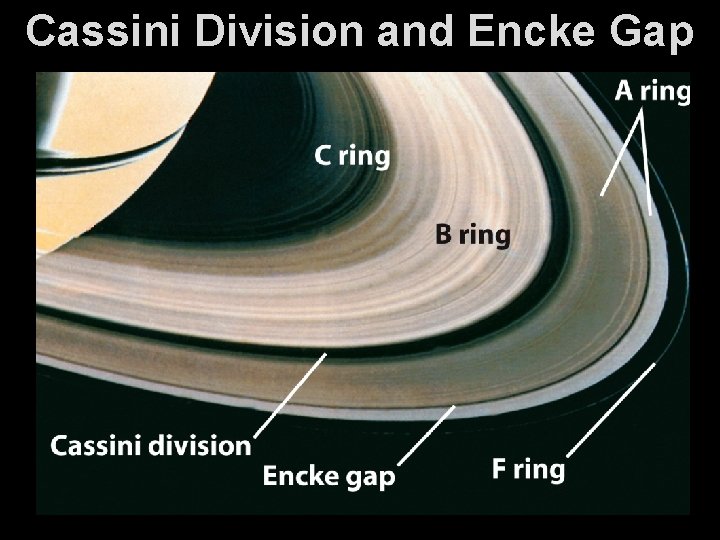
Cassini Division and Encke Gap
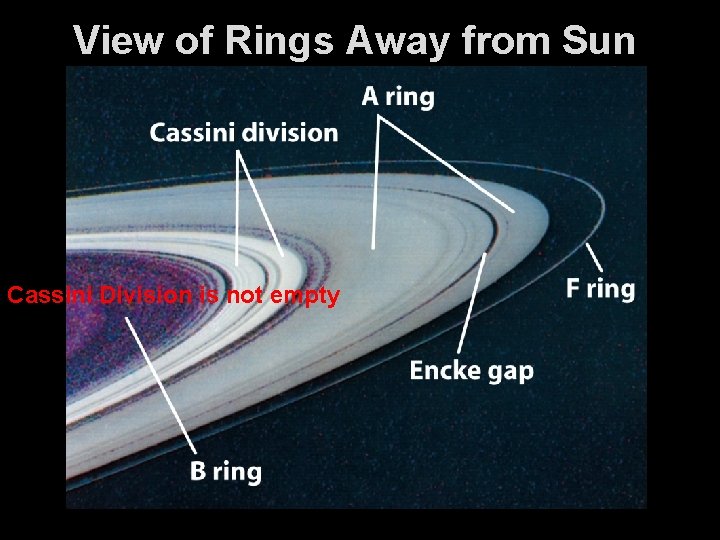
View of Rings Away from Sun Cassini Division is not empty
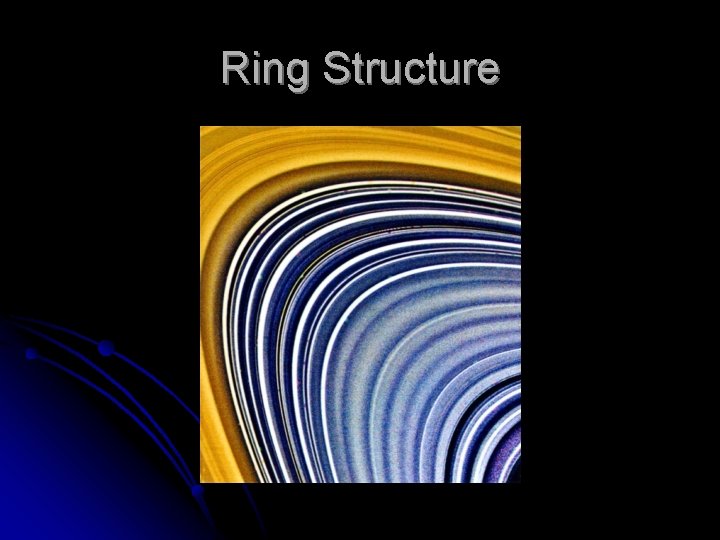
Ring Structure
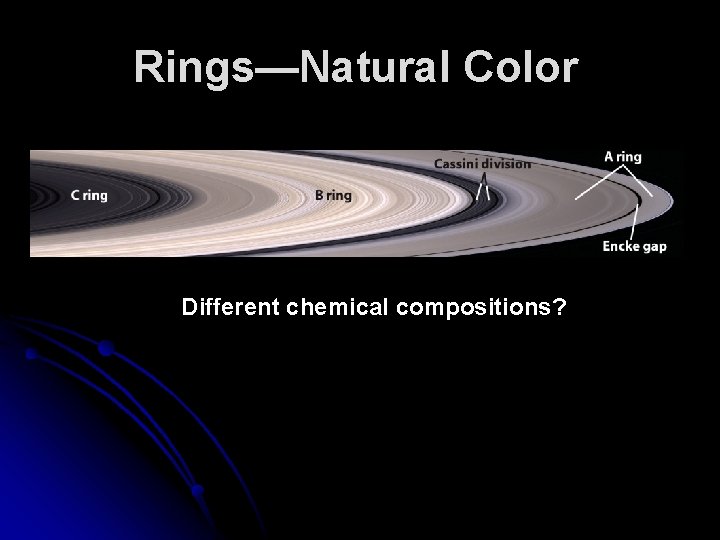
Rings—Natural Color Different chemical compositions?
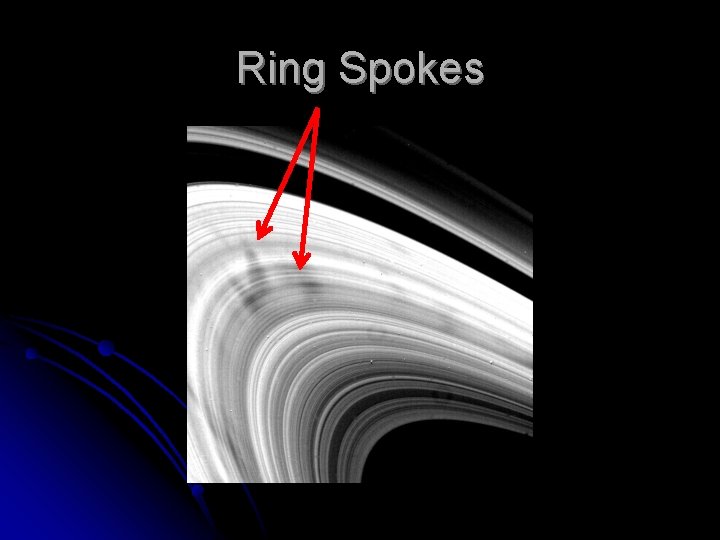
Ring Spokes
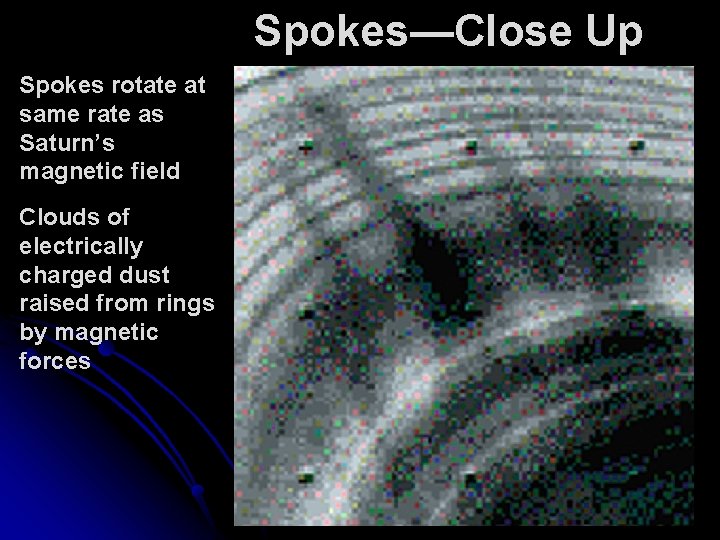
Spokes—Close Up Spokes rotate at same rate as Saturn’s magnetic field Clouds of electrically charged dust raised from rings by magnetic forces
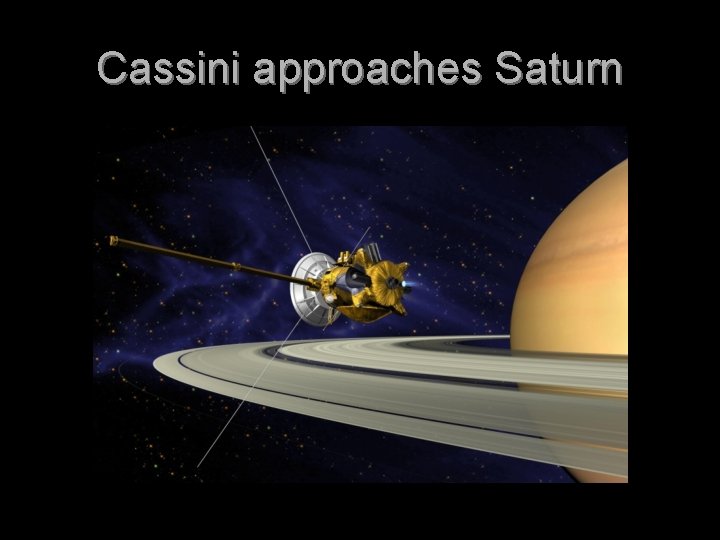
Cassini approaches Saturn
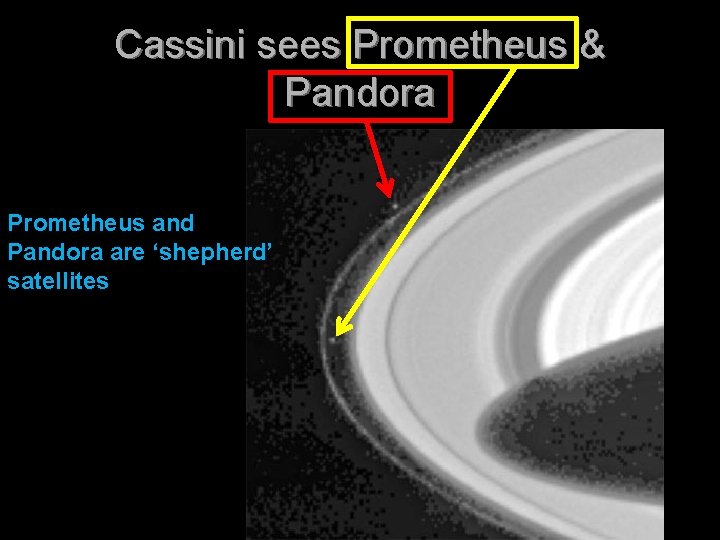
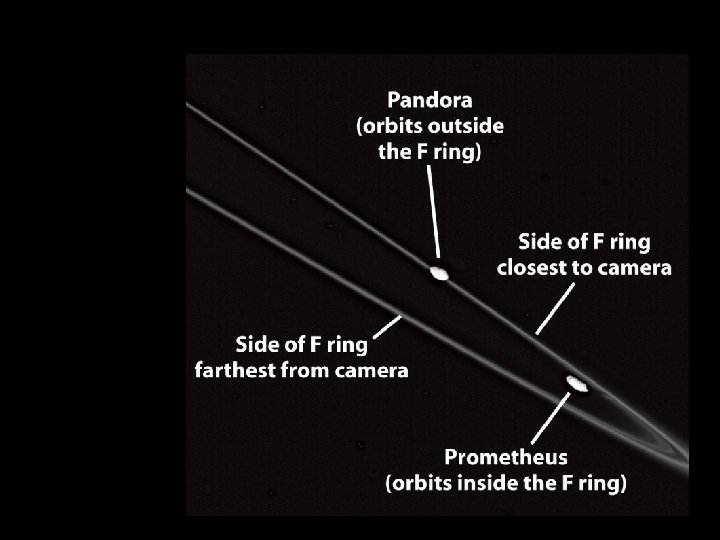
Cassini sees Prometheus & Pandora Prometheus and Pandora are ‘shepherd’ satellites
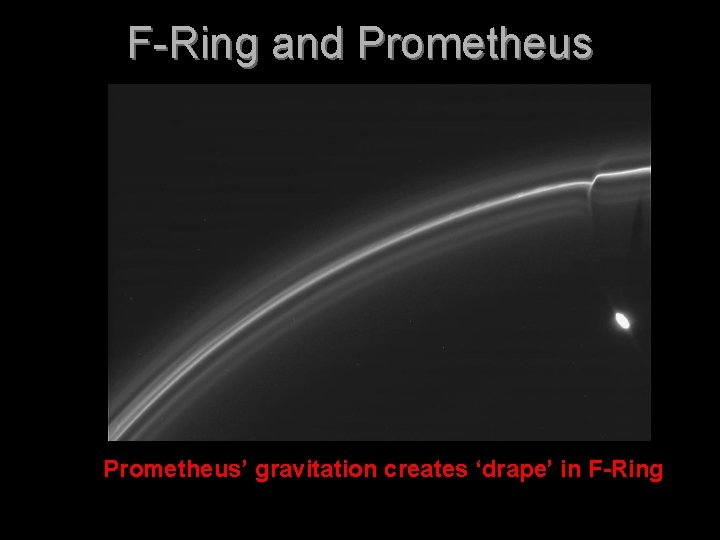
F-Ring and Prometheus’ gravitation creates ‘drape’ in F-Ring
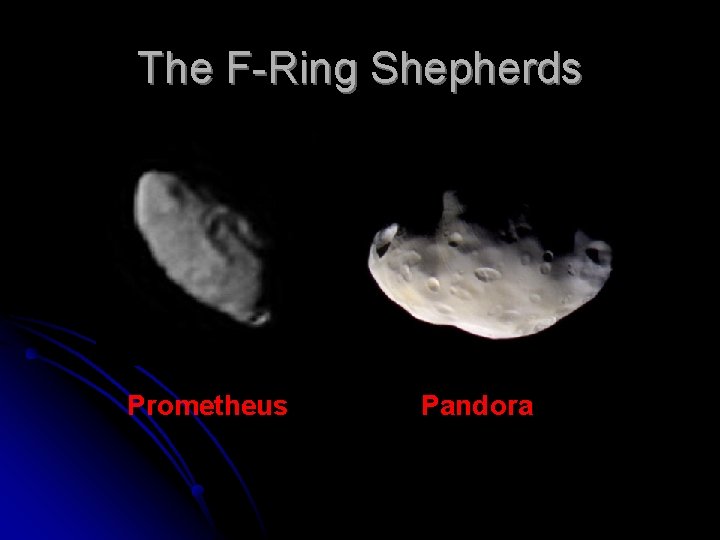
The F-Ring Shepherds Prometheus Pandora
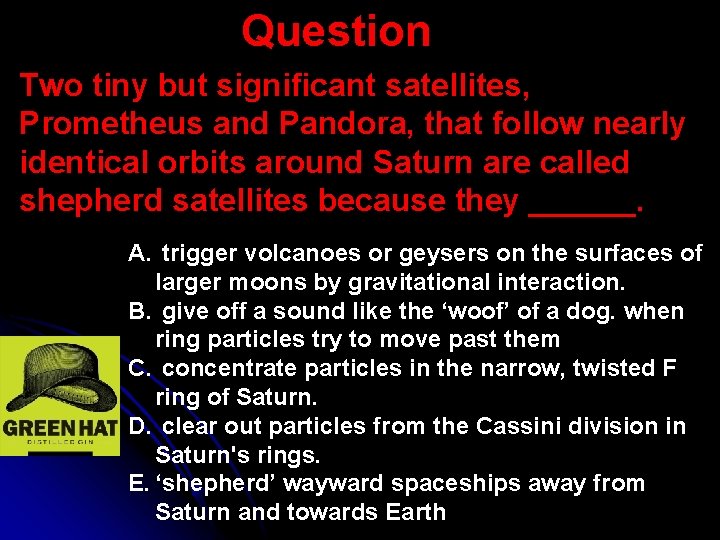
Question Two tiny but significant satellites, Prometheus and Pandora, that follow nearly identical orbits around Saturn are called shepherd satellites because they ______. A. trigger volcanoes or geysers on the surfaces of larger moons by gravitational interaction. B. give off a sound like the ‘woof’ of a dog. when ring particles try to move past them C. concentrate particles in the narrow, twisted F ring of Saturn. D. clear out particles from the Cassini division in Saturn's rings. E. ‘shepherd’ wayward spaceships away from Saturn and towards Earth
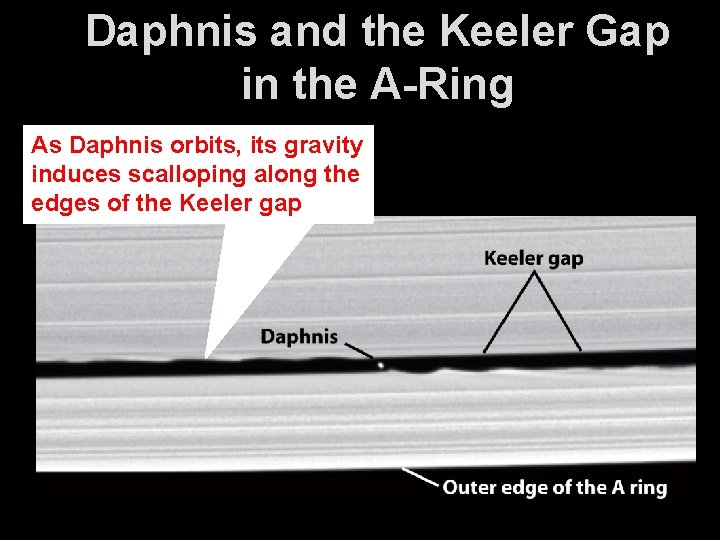
Daphnis and the Keeler Gap in the A-Ring As Daphnis orbits, its gravity induces scalloping along the edges of the Keeler gap
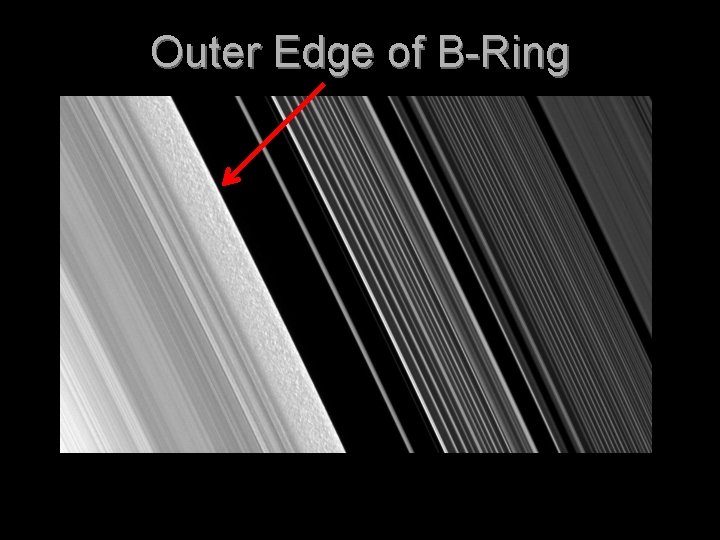
Outer Edge of B-Ring
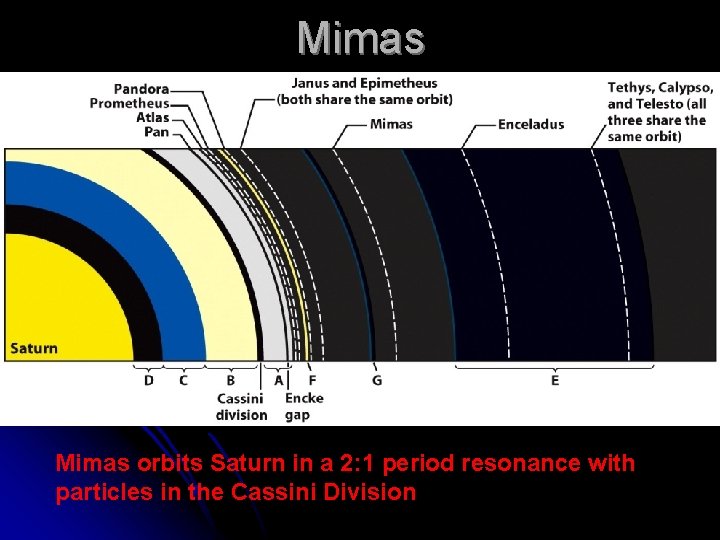
Mimas orbits Saturn in a 2: 1 period resonance with particles in the Cassini Division
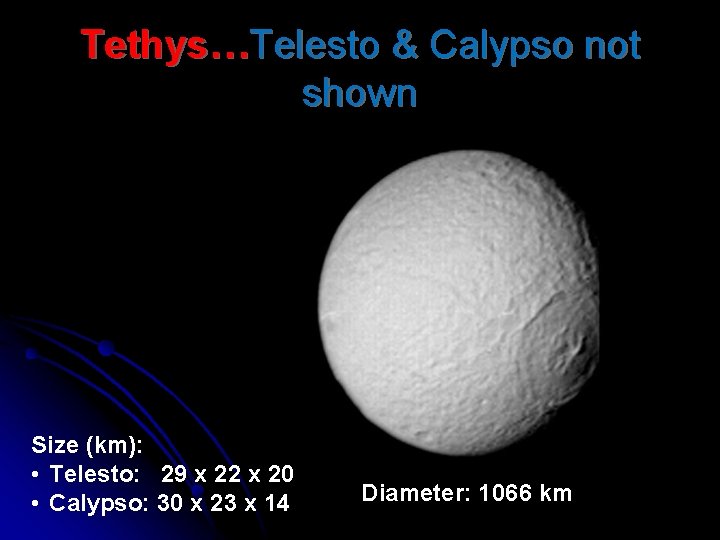
Tethys…Telesto & Calypso not shown Size (km): • Telesto: 29 x 22 x 20 • Calypso: 30 x 23 x 14 Diameter: 1066 km
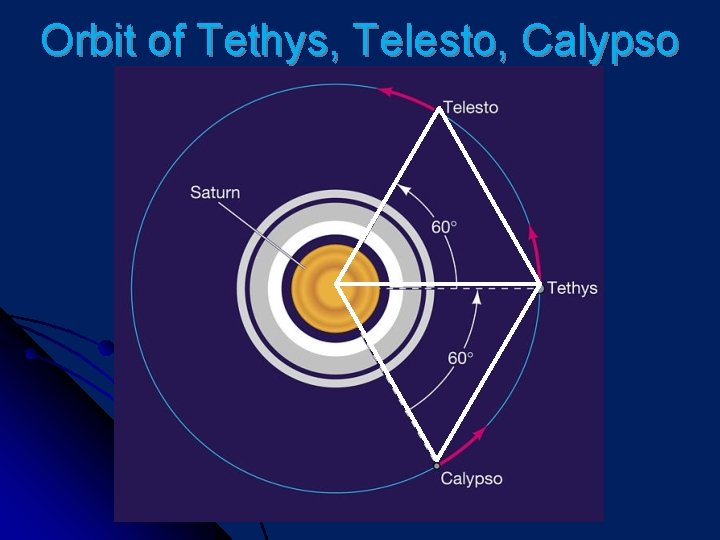
Orbit of Tethys, Telesto, Calypso
Saturn's Major Satellites Diameter Name Lunar Units Orbital Radius Mimas 0. 12 3. 08 Enceladus 0. 14 3. 95 Tethys 0. 30 4. 89 Dione 0. 32 6. 26 Rhea 0. 44 8. 75 Titan 1. 48 (0. 75 Mars) 20. 27 Hyperion 328× 260× 214 km 24. 90 Iapetus 0. 42 59. 08 Phoebe 230× 220× 210 km 214. 84 Period (days) 0. 9 1. 4 1. 9 2. 7 4. 5 15. 9 21. 3 79. 3 -545. 1
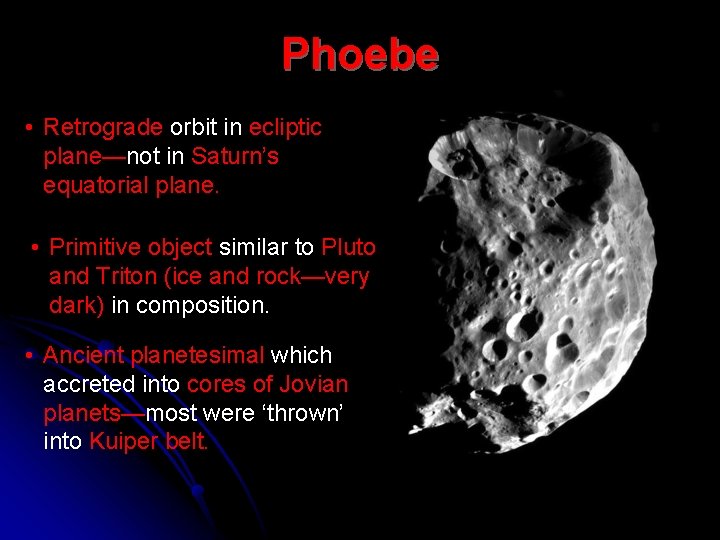
Phoebe • Retrograde orbit in ecliptic plane—not in Saturn’s equatorial plane. • Primitive object similar to Pluto and Triton (ice and rock—very dark) in composition. • Ancient planetesimal which accreted into cores of Jovian planets—most were ‘thrown’ into Kuiper belt.
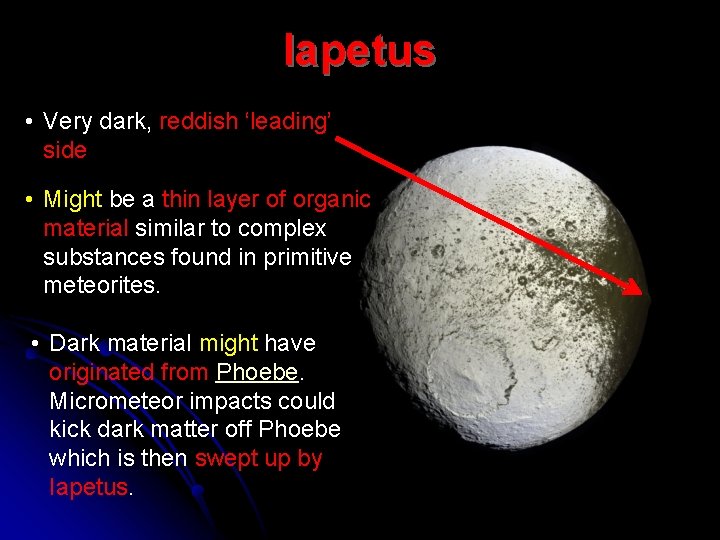
Iapetus • Very dark, reddish ‘leading’ side • Might be a thin layer of organic material similar to complex substances found in primitive meteorites. • Dark material might have originated from Phoebe. Micrometeor impacts could kick dark matter off Phoebe which is then swept up by Iapetus.
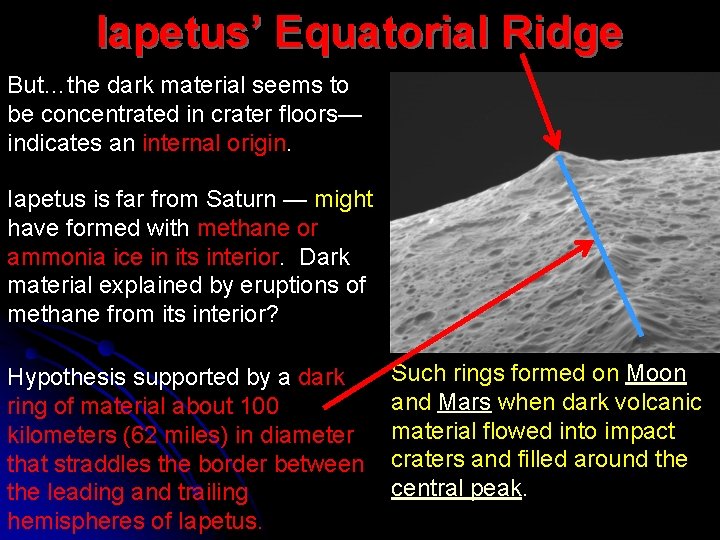
Iapetus’ Equatorial Ridge But…the dark material seems to be concentrated in crater floors— indicates an internal origin. Iapetus is far from Saturn — might have formed with methane or ammonia ice in its interior. Dark material explained by eruptions of methane from its interior? Hypothesis supported by a dark ring of material about 100 kilometers (62 miles) in diameter that straddles the border between the leading and trailing hemispheres of Iapetus. Such rings formed on Moon and Mars when dark volcanic material flowed into impact craters and filled around the central peak.
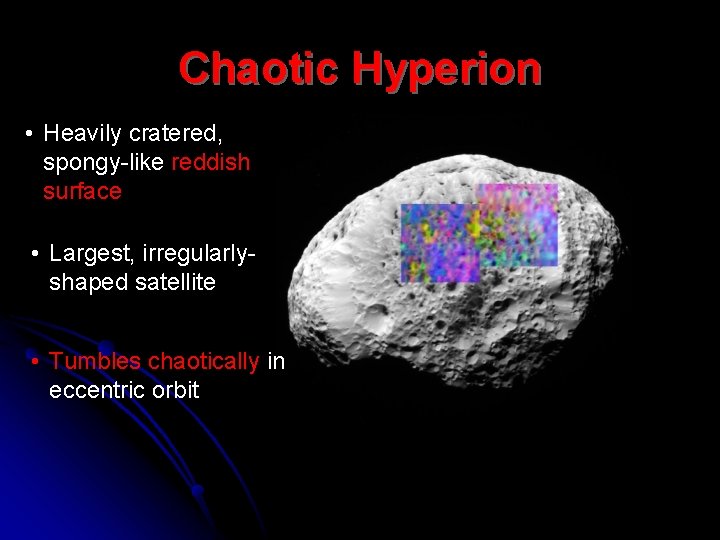
Chaotic Hyperion • Heavily cratered, spongy-like reddish surface • Largest, irregularlyshaped satellite • Tumbles chaotically in eccentric orbit
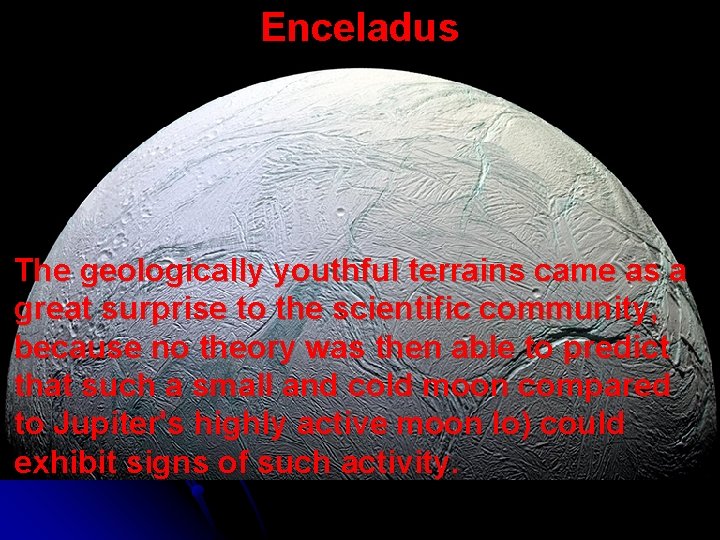
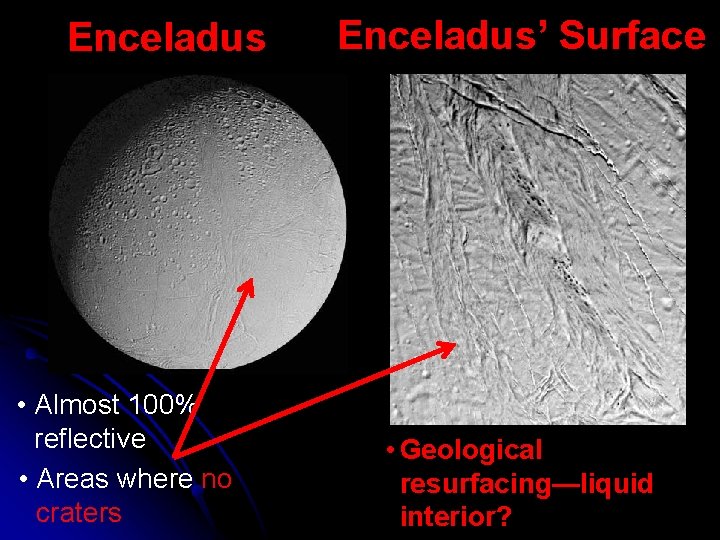
Enceladus The geologically youthful terrains came as a great surprise to the scientific community, because no theory was then able to predict that such a small and cold moon compared to Jupiter's highly active moon Io) could exhibit signs of such activity.
Enceladus • Almost 100% reflective • Areas where no craters Enceladus’ Surface • Geological resurfacing—liquid interior?
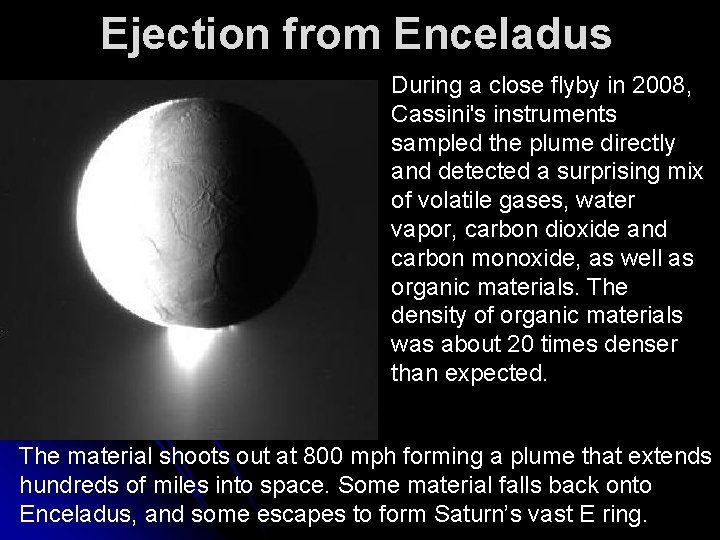
Ejection from Enceladus During a close flyby in 2008, Cassini's instruments sampled the plume directly and detected a surprising mix of volatile gases, water vapor, carbon dioxide and carbon monoxide, as well as organic materials. The density of organic materials was about 20 times denser than expected. The material shoots out at 800 mph forming a plume that extends hundreds of miles into space. Some material falls back onto Enceladus, and some escapes to form Saturn’s vast E ring.
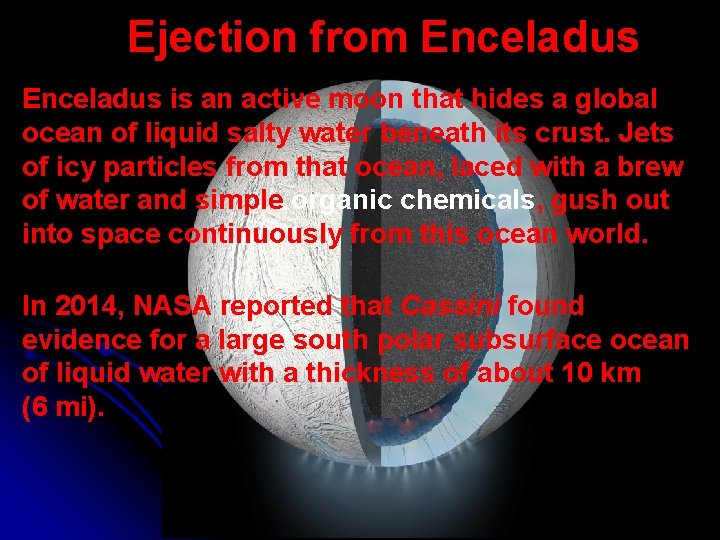
Ejection from Enceladus is an active moon that hides a global ocean of liquid salty water beneath its crust. Jets of icy particles from that ocean, laced with a brew of water and simple organic chemicals, gush out into space continuously from this ocean world. In 2014, NASA reported that Cassini found evidence for a large south polar subsurface ocean of liquid water with a thickness of about 10 km (6 mi).
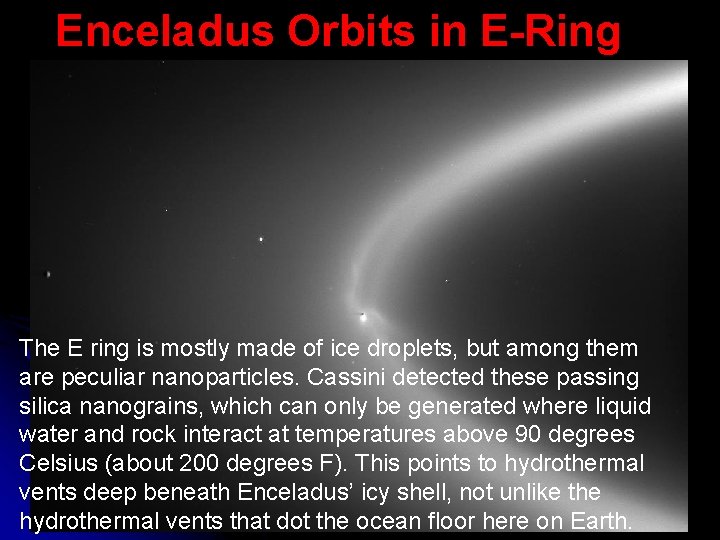
Enceladus Orbits in E-Ring The E ring is mostly made of ice droplets, but among them are peculiar nanoparticles. Cassini detected these passing silica nanograins, which can only be generated where liquid water and rock interact at temperatures above 90 degrees Celsius (about 200 degrees F). This points to hydrothermal vents deep beneath Enceladus’ icy shell, not unlike the hydrothermal vents that dot the ocean floor here on Earth.
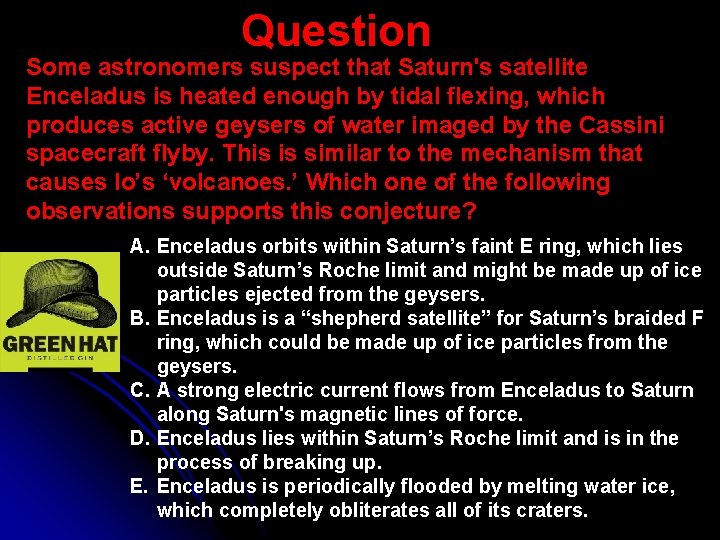
Question Some astronomers suspect that Saturn's satellite Enceladus is heated enough by tidal flexing, which produces active geysers of water imaged by the Cassini spacecraft flyby. This is similar to the mechanism that causes Io’s ‘volcanoes. ’ Which one of the following observations supports this conjecture? A. Enceladus orbits within Saturn’s faint E ring, which lies outside Saturn’s Roche limit and might be made up of ice particles ejected from the geysers. B. Enceladus is a “shepherd satellite” for Saturn’s braided F ring, which could be made up of ice particles from the geysers. C. A strong electric current flows from Enceladus to Saturn along Saturn's magnetic lines of force. D. Enceladus lies within Saturn’s Roche limit and is in the process of breaking up. E. Enceladus is periodically flooded by melting water ice, which completely obliterates all of its craters.
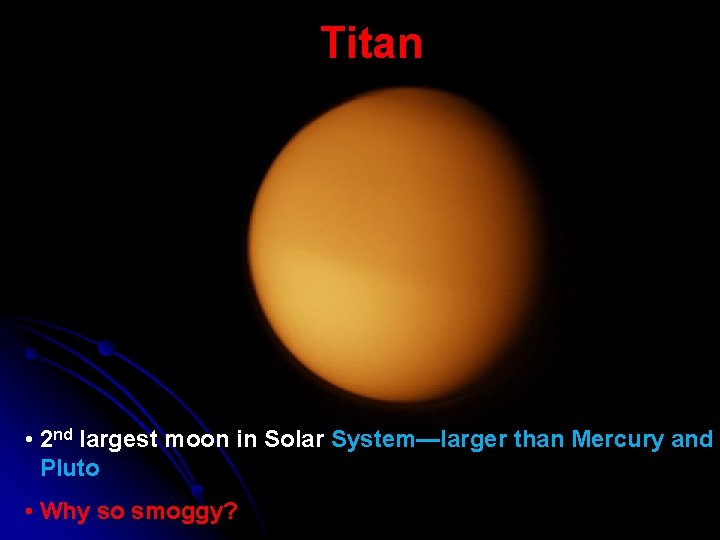
Titan • 2 nd largest moon in Solar System—larger than Mercury and Pluto • Why so smoggy?
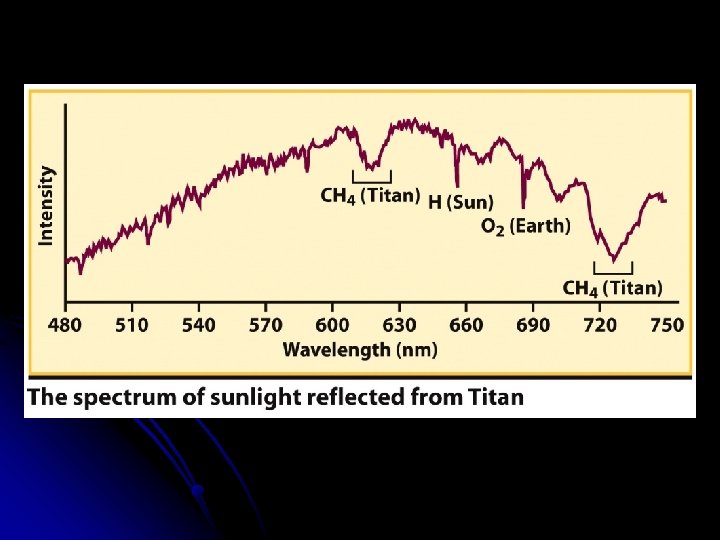
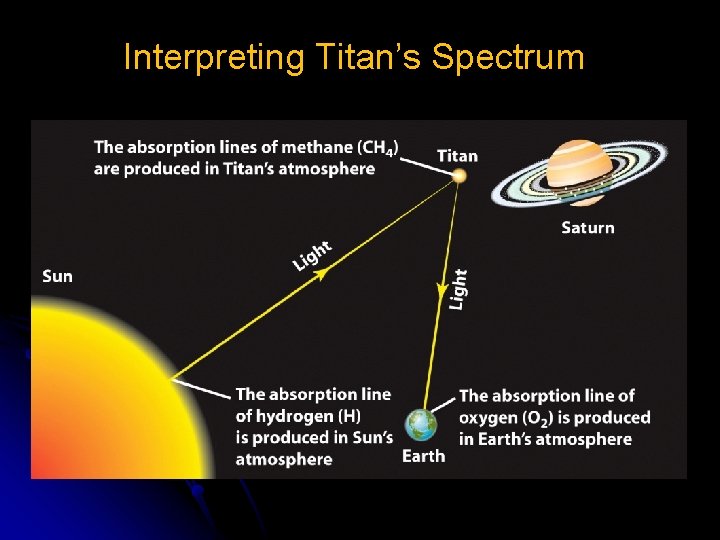
Interpreting Titan’s Spectrum
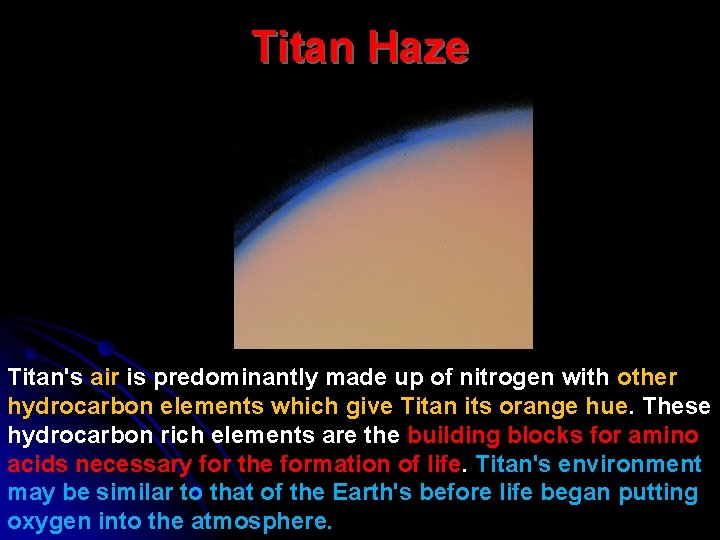
Titan Haze Titan's air is predominantly made up of nitrogen with other hydrocarbon elements which give Titan its orange hue. These hydrocarbon rich elements are the building blocks for amino acids necessary for the formation of life. Titan's environment may be similar to that of the Earth's before life began putting oxygen into the atmosphere.
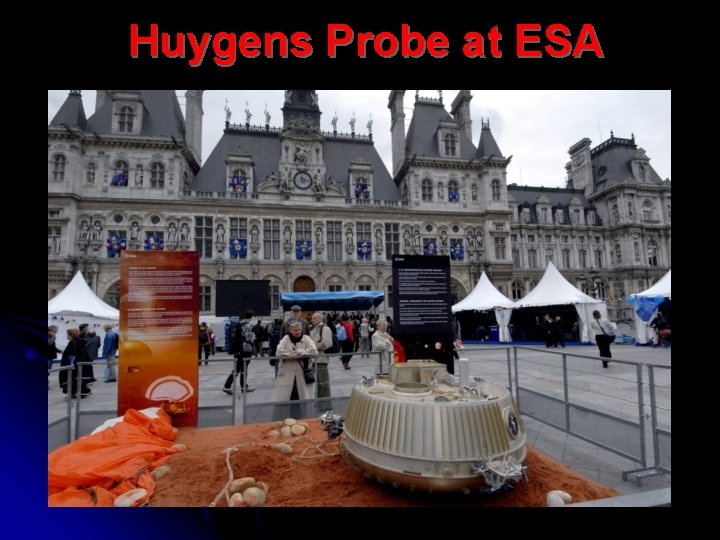
Huygens Probe at ESA
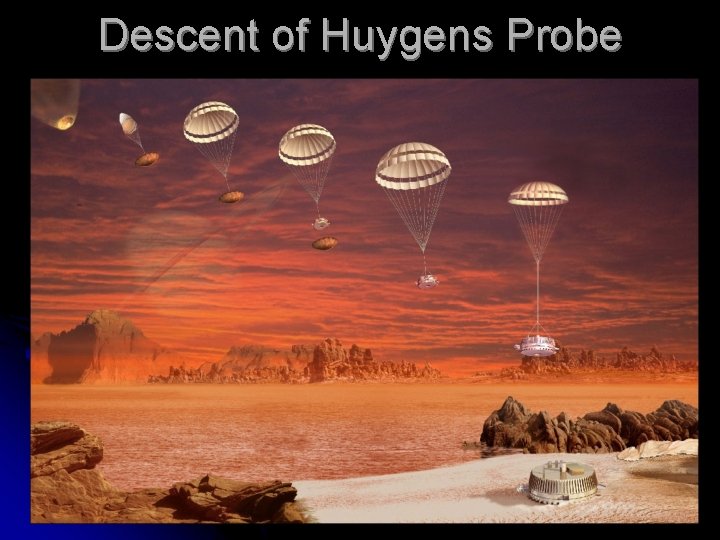
Descent of Huygens Probe
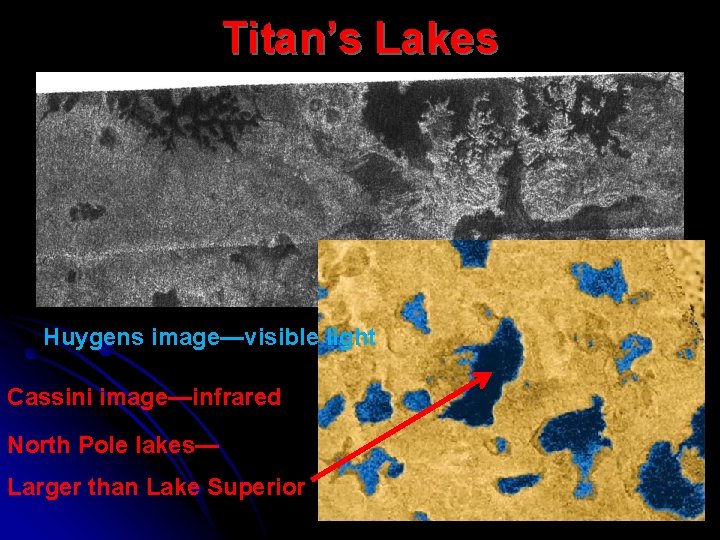
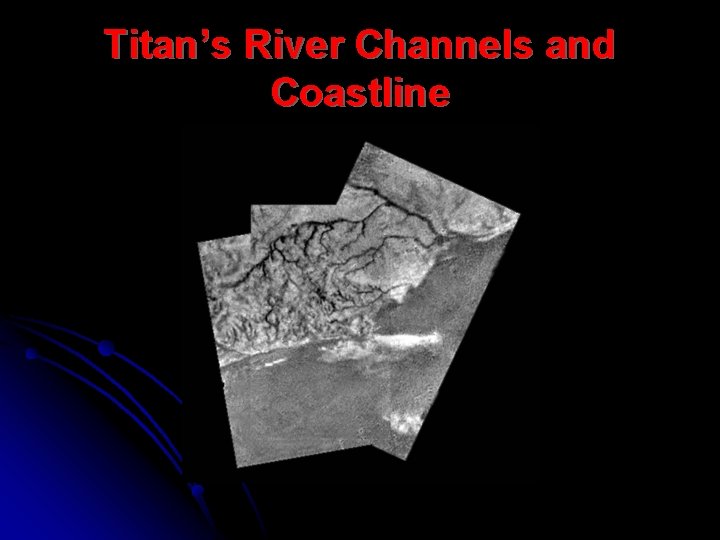
Titan’s Lakes Huygens image—visible light Cassini image—infrared North Pole lakes— Larger than Lake Superior
Titan’s River Channels and Coastline
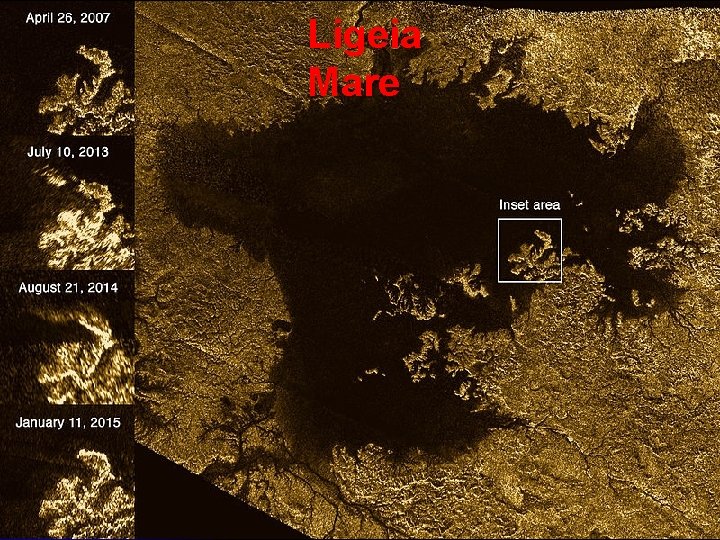
Ligeia Mare
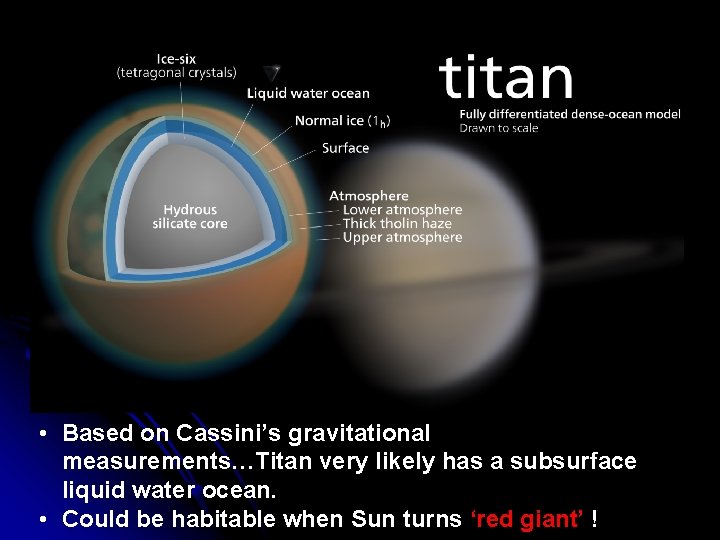
• Based on Cassini’s gravitational measurements…Titan very likely has a subsurface liquid water ocean. • Could be habitable when Sun turns ‘red giant’ !
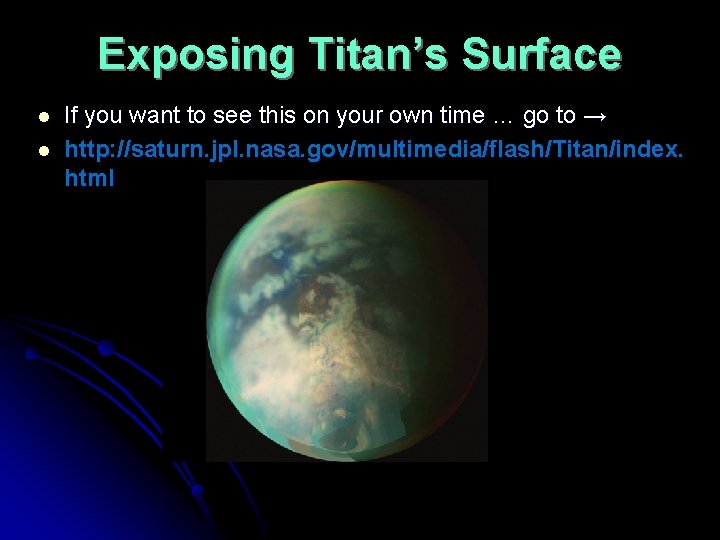
Exposing Titan’s Surface l l If you want to see this on your own time … go to → http: //saturn. jpl. nasa. gov/multimedia/flash/Titan/index. html
QUESTION If interplanetary travel were possible, how would a company in the business advertise a holiday on Titan? A. The largest number of volcanoes for your travel dollar anywhere in the solar system! B. Exquisite methane/ethane lakes, hydrocarbons beyond your wildest dreams! C. Glaciers galore for your hiking pleasure under star-studded skies! D. Hot and dry—never rains—beautiful crystal clear skies! E. Dense rain forests—loaded with brilliant birds that glide through the humid atmosphere
Key Ideas l l Composition and Structure: Saturn much larger than Earth. Saturn’s internal structure is similar to that of Jupiter (composed of 71% hydrogen, 24% helium, and 5% all other elements by mass), but its core makes up a other elements by mass), but larger fraction of its volume and its liquid metallic hydrogen mantle is shallower than that of Jupiter. Saturn rotates so rapidly that it is noticeably flattened, more so than Jupiter. Rotation of interior revealed by variations in radio emission. Saturn emits more energy than it receives from the Sun. Planet is still cooling and helium rain contributes.
Key Ideas l l l Atmosphere: Visible “surface” of Saturn actually the tops of clouds. Rapid rotation twists the clouds into dark belts and light zones that run parallel to the equator. Strong zonal winds run along the belts and zones. The outer layers show differential rotation: The equatorial regions rotate slightly faster than the polar regions. Polar rotation rate is nearly the same as the internal rotation rate. The colored ovals visible in the Saturnian atmosphere represent gigantic storms. Storms in Saturn’s atmosphere seem to be shorter-lived than Jupiter’s.
Key Ideas l l There are three cloud layers in the atmosphere. There are cloud layers in Saturn’s atmosphere are spread out over a greater range of altitude than those of Jupiter, giving Saturn a more washed-out appearance. Saturn’s atmosphere contains less helium than Jupiter’s atmosphere. This lower abundance may be the result of helium raining downward into the planet. Helium helium raining downward into the planet. “rainfall” may also account for Saturn’s surprisingly strong heat output.
Key Ideas l l l Magnetic Field and Magnetosphere: Saturn’s magnetic field and magnetosphere are much less extensive than Jupiter’s. Rings: Saturn is circled by a system of thin, broad rings lying in the plane of the planet’s equator. This system is tilted away from the plane of Saturn’s orbit, which causes the rings to be seen at various angles by an Earth-based observer over the course of a Saturnian year. Structure of the Rings: Saturn has three major, broad rings (A, B, and C) that can be seen from Earth. Other, fainter rings were found by the Voyager spacecraft.
Key Ideas l l l Principal rings of Saturn composed of particles of ice and ice-coated rock ranging in size from a few micrometers to about 10 m. Most rings exist inside micrometers to about 10 m. the Roche limit of Saturn, where disruptive tidal forces are stronger than the gravitational forces attracting the ring particles to each other. Each of Saturn’s major rings composed of a great many narrow ringlets. The faint F ring, which is just many narrow ringlets. outside the A ring, is kept narrow by the gravitational pull of shepherd satellites. Jupiter’s faint rings are composed of a relatively small amount of small, dark, rocky particles that reflect very little light.