
SATLevel Maths Coordinate geometry 1 of 33 Boardworks
SAT-Level Maths: Coordinate geometry. . 1 of 33 © Boardworks Ltd 2005
The distance between two points Contents The distance between two points The mid-point of a line segment Calculating the gradient of a straight line The equation of a straight line Parallel and perpendicular lines Examination-style questions 2 of 33 © Boardworks Ltd 2005
The Cartesian coordinate system is named after the French mathematician René Descartes (1596 – 1650). Points in the (x, y) plane are defined by their perpendicular distance from the x- and y-axes relative to the origin, O. The coordinates of a point P are written in the form P(x, y). The x-coordinate, or abscissa, tells us the horizontal distance from the y-axis to the point. The y-coordinate, or ordinate, tells us the vertical distance from the x-axis to the point. 3 of 33 © Boardworks Ltd 2005
The distance between two points Given the coordinates of two points, A and B, we can find the distance between them by adding a third point, C, to form a right-angled triangle. We then use Pythagoras’ theorem. 4 of 33 © Boardworks Ltd 2005
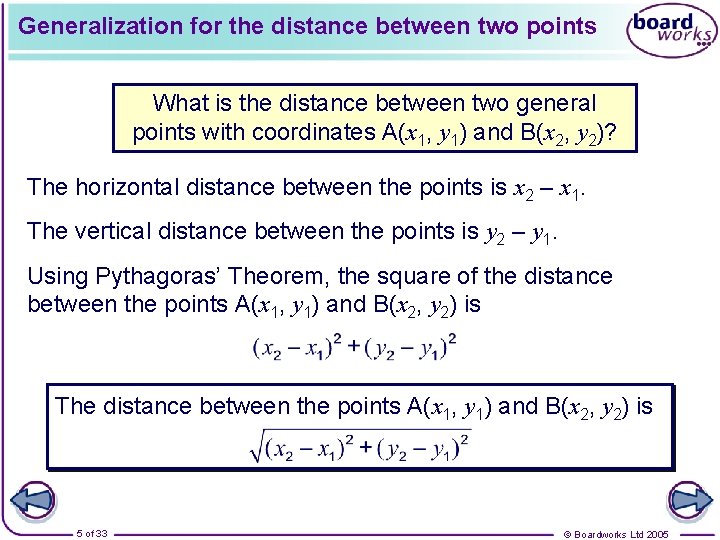
Generalization for the distance between two points What is the distance between two general points with coordinates A(x 1, y 1) and B(x 2, y 2)? The horizontal distance between the points is x 2 – x 1. The vertical distance between the points is y 2 – y 1. Using Pythagoras’ Theorem, the square of the distance between the points A(x 1, y 1) and B(x 2, y 2) is The distance between the points A(x 1, y 1) and B(x 2, y 2) is 5 of 33 © Boardworks Ltd 2005
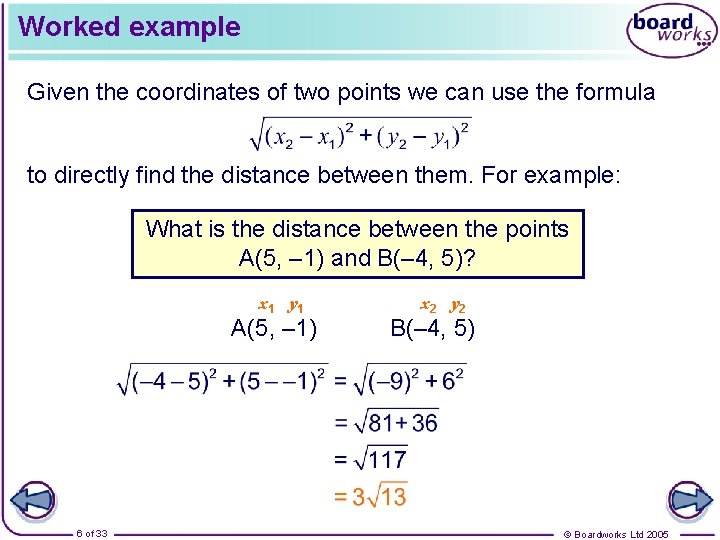
Worked example Given the coordinates of two points we can use the formula to directly find the distance between them. For example: What is the distance between the points A(5, – 1) and B(– 4, 5)? x 1 y 1 A(5, – 1) 6 of 33 x 2 y 2 B(– 4, 5) © Boardworks Ltd 2005
The mid-point of a line segment Contents The distance between two points The mid-point of a line segment Calculating the gradient of a straight line The equation of a straight line Parallel and perpendicular lines Examination-style questions 7 of 33 © Boardworks Ltd 2005
Finding the mid-point of a line segment 8 of 33 © Boardworks Ltd 2005
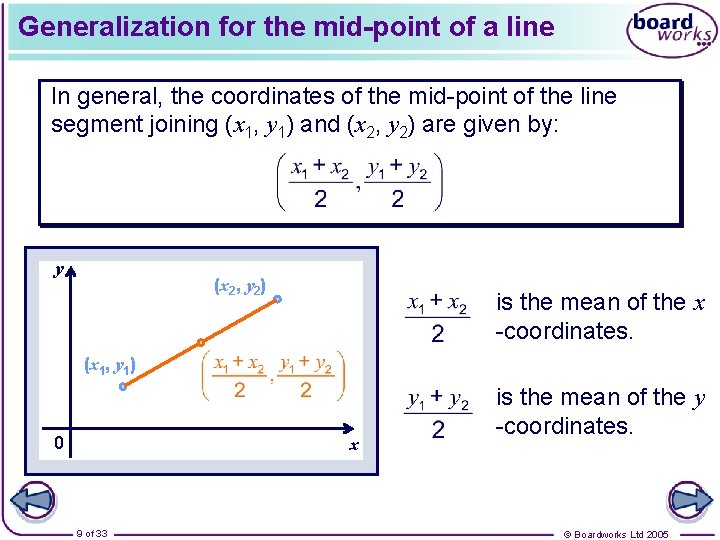
Generalization for the mid-point of a line In general, the coordinates of the mid-point of the line segment joining (x 1, y 1) and (x 2, y 2) are given by: y (x 2, y 2) is the mean of the x -coordinates. (x 1, y 1) 0 x 9 of 33 is the mean of the y -coordinates. © Boardworks Ltd 2005
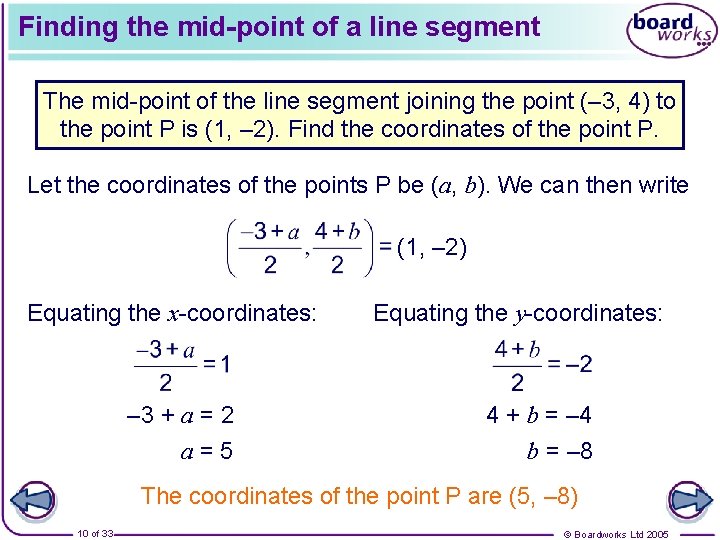
Finding the mid-point of a line segment The mid-point of the line segment joining the point (– 3, 4) to the point P is (1, – 2). Find the coordinates of the point P. Let the coordinates of the points P be (a, b). We can then write (1, – 2) Equating the x-coordinates: – 3 + a = 2 a=5 Equating the y-coordinates: 4 + b = – 4 b = – 8 The coordinates of the point P are (5, – 8) 10 of 33 © Boardworks Ltd 2005
Calculating the gradient of a straight line Contents The distance between two points The mid-point of a line segment Calculating the gradient of a straight line The equation of a straight line Parallel and perpendicular lines Examination-style questions 11 of 33 © Boardworks Ltd 2005
Calculating gradients 12 of 33 © Boardworks Ltd 2005
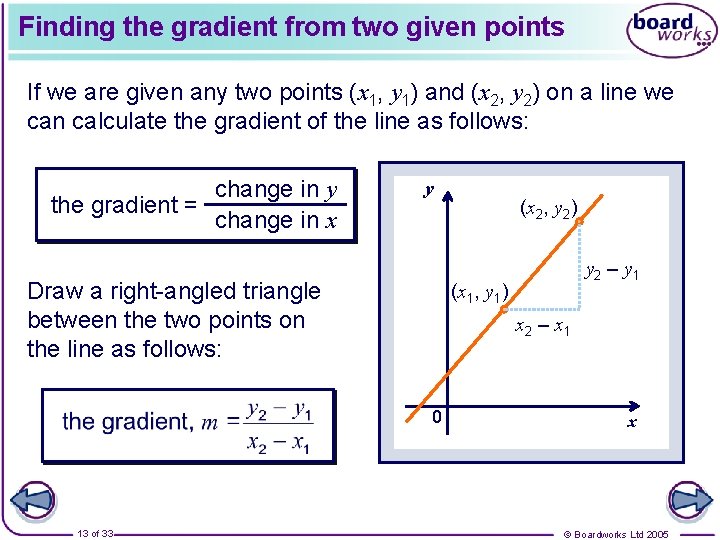
Finding the gradient from two given points If we are given any two points (x 1, y 1) and (x 2, y 2) on a line we can calculate the gradient of the line as follows: change in y the gradient = change in x y Draw a right-angled triangle between the two points on the line as follows: y 2 – y 1 (x 1, y 1) x 2 – x 1 0 13 of 33 (x 2, y 2) x © Boardworks Ltd 2005
The equation of a straight line Contents The distance between two points The mid-point of a line segment Calculating the gradient of a straight line The equation of a straight line Parallel and perpendicular lines Examination-style questions 14 of 33 © Boardworks Ltd 2005
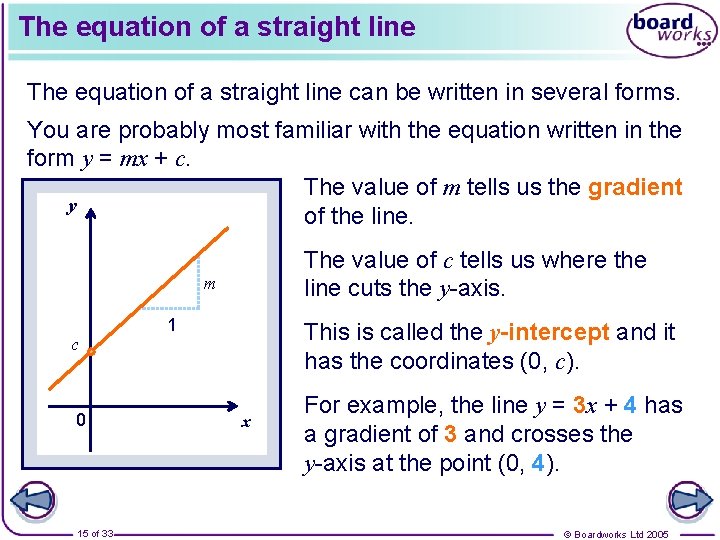
The equation of a straight line can be written in several forms. You are probably most familiar with the equation written in the form y = mx + c. The value of m tells us the gradient y of the line. The value of c tells us where the line cuts the y-axis. m c 0 15 of 33 1 This is called the y-intercept and it has the coordinates (0, c). x For example, the line y = 3 x + 4 has a gradient of 3 and crosses the y-axis at the point (0, 4). © Boardworks Ltd 2005
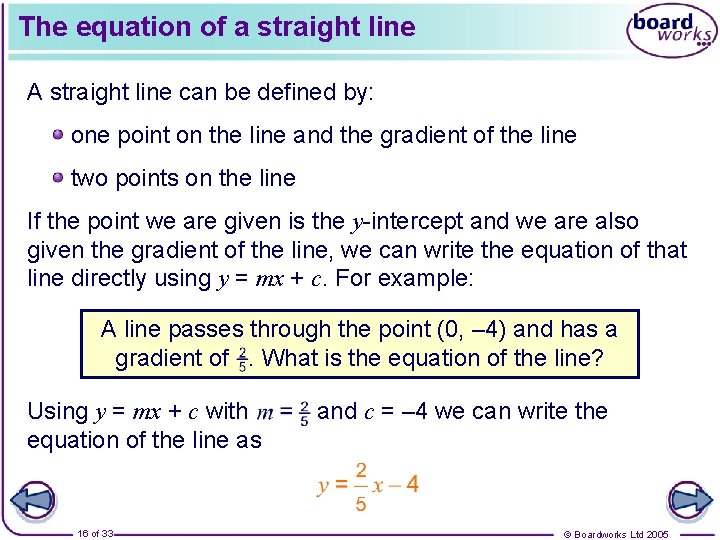
The equation of a straight line A straight line can be defined by: one point on the line and the gradient of the line two points on the line If the point we are given is the y-intercept and we are also given the gradient of the line, we can write the equation of that line directly using y = mx + c. For example: A line passes through the point (0, – 4) and has a gradient of. What is the equation of the line? Using y = mx + c with equation of the line as 16 of 33 and c = – 4 we can write the © Boardworks Ltd 2005
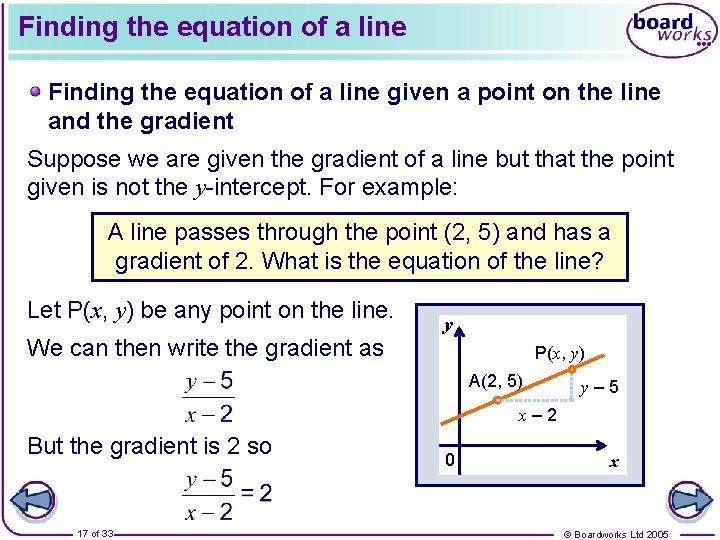
Finding the equation of a line given a point on the line and the gradient Suppose we are given the gradient of a line but that the point given is not the y-intercept. For example: A line passes through the point (2, 5) and has a gradient of 2. What is the equation of the line? Let P(x, y) be any point on the line. y We can then write the gradient as P(x, y) A(2, 5) y– 5 x– 2 But the gradient is 2 so 17 of 33 0 x © Boardworks Ltd 2005
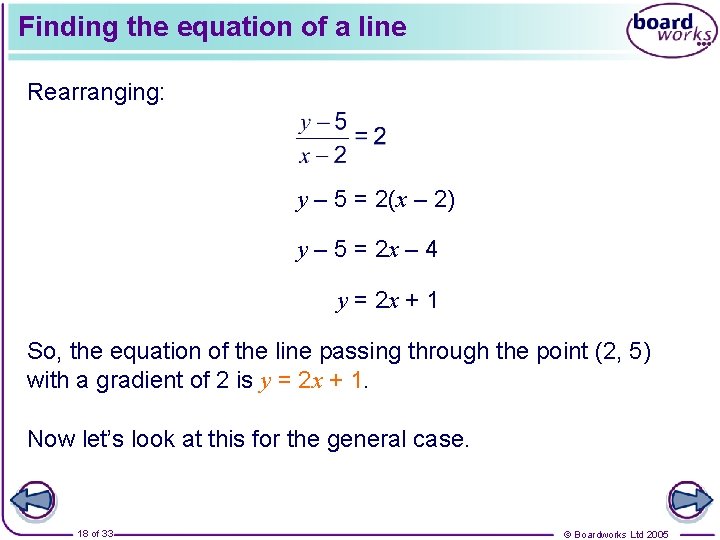
Finding the equation of a line Rearranging: y – 5 = 2(x – 2) y – 5 = 2 x – 4 y = 2 x + 1 So, the equation of the line passing through the point (2, 5) with a gradient of 2 is y = 2 x + 1. Now let’s look at this for the general case. 18 of 33 © Boardworks Ltd 2005
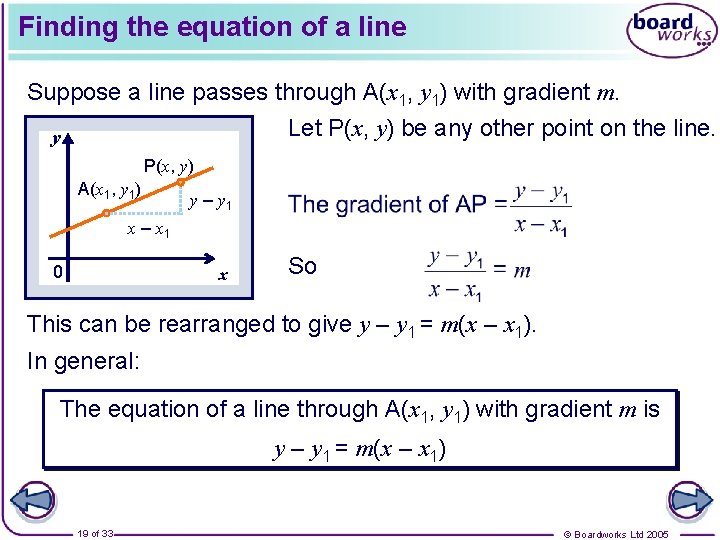
Finding the equation of a line Suppose a line passes through A(x 1, y 1) with gradient m. Let P(x, y) be any other point on the line. y P(x, y) A(x 1, y 1) y – y 1 x – x 1 0 x So This can be rearranged to give y – y 1 = m(x – x 1). In general: The equation of a line through A(x 1, y 1) with gradient m is y – y 1 = m(x – x 1) 19 of 33 © Boardworks Ltd 2005
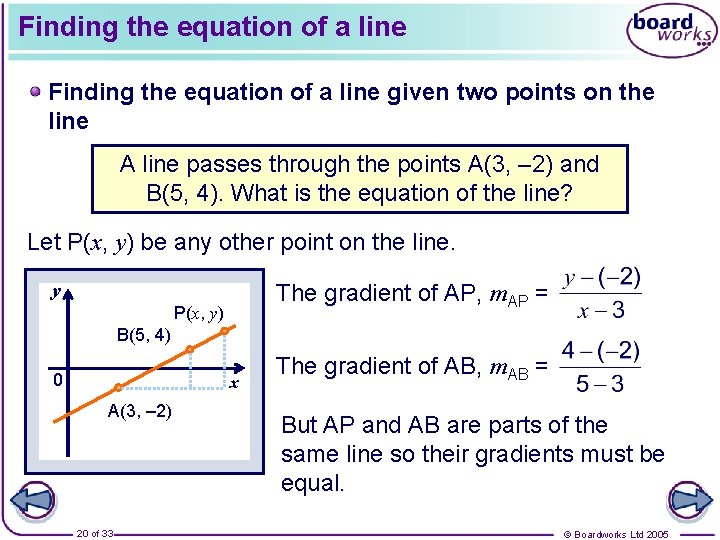
Finding the equation of a line given two points on the line A line passes through the points A(3, – 2) and B(5, 4). What is the equation of the line? Let P(x, y) be any other point on the line. The gradient of AP, m. AP = y P(x, y) B(5, 4) 0 x A(3, – 2) 20 of 33 The gradient of AB, m. AB = But AP and AB are parts of the same line so their gradients must be equal. © Boardworks Ltd 2005
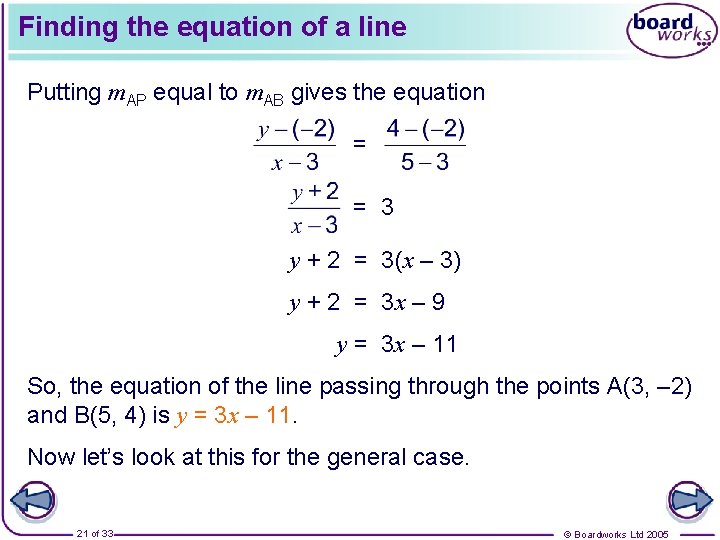
Finding the equation of a line Putting m. AP equal to m. AB gives the equation = = 3 y + 2 = 3(x – 3) y + 2 = 3 x – 9 y = 3 x – 11 So, the equation of the line passing through the points A(3, – 2) and B(5, 4) is y = 3 x – 11. Now let’s look at this for the general case. 21 of 33 © Boardworks Ltd 2005
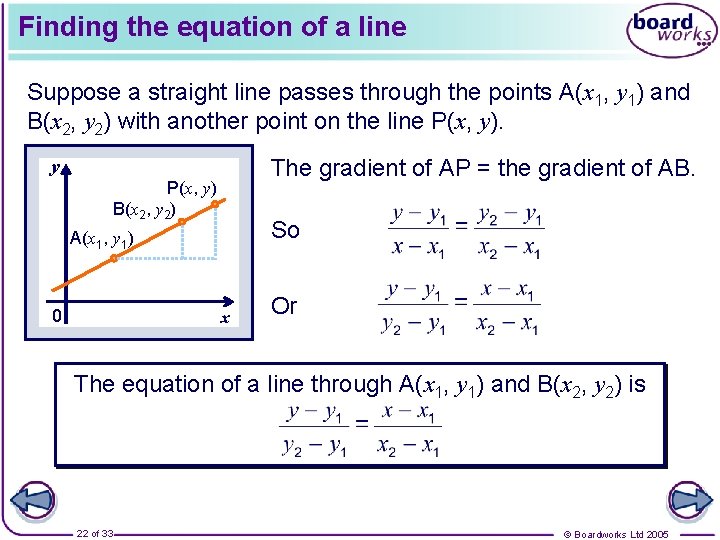
Finding the equation of a line Suppose a straight line passes through the points A(x 1, y 1) and B(x 2, y 2) with another point on the line P(x, y). The gradient of AP = the gradient of AB. y P(x, y) B(x 2, y 2) So A(x 1, y 1) 0 x Or The equation of a line through A(x 1, y 1) and B(x 2, y 2) is 22 of 33 © Boardworks Ltd 2005
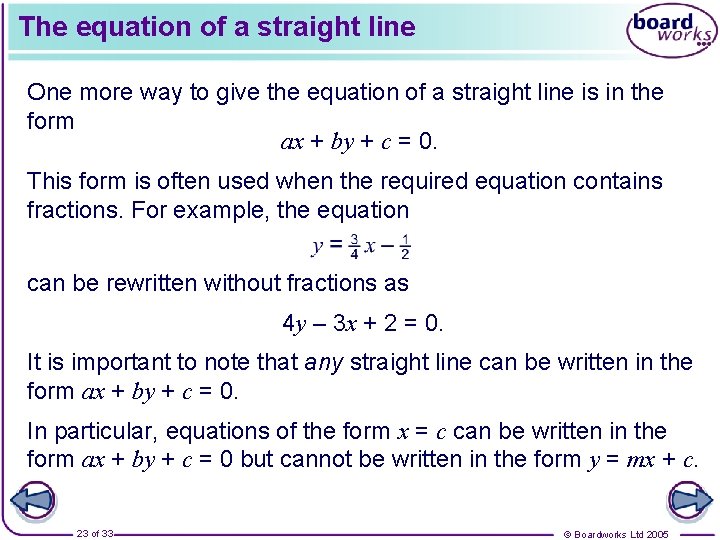
The equation of a straight line One more way to give the equation of a straight line is in the form ax + by + c = 0. This form is often used when the required equation contains fractions. For example, the equation can be rewritten without fractions as 4 y – 3 x + 2 = 0. It is important to note that any straight line can be written in the form ax + by + c = 0. In particular, equations of the form x = c can be written in the form ax + by + c = 0 but cannot be written in the form y = mx + c. 23 of 33 © Boardworks Ltd 2005
Parallel and perpendicular lines Contents The distance between two points The mid-point of a line segment Calculating the gradient of a straight line The equation of a straight line Parallel and perpendicular lines Examination-style questions 24 of 33 © Boardworks Ltd 2005
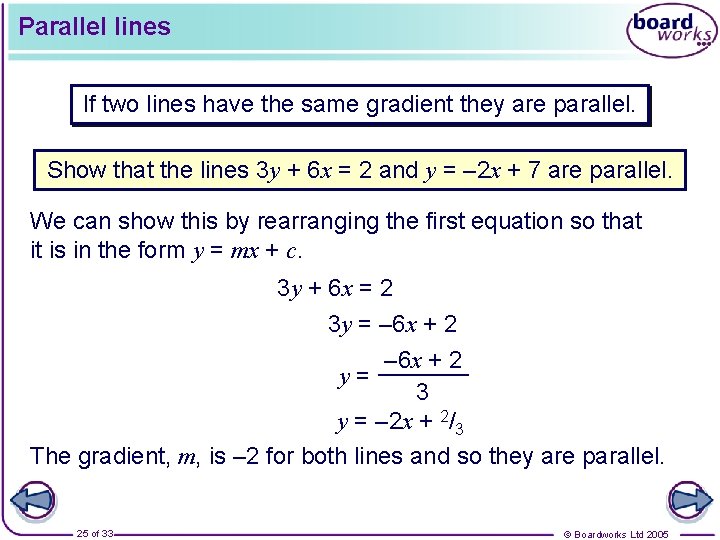
Parallel lines If two lines have the same gradient they are parallel. Show that the lines 3 y + 6 x = 2 and y = – 2 x + 7 are parallel. We can show this by rearranging the first equation so that it is in the form y = mx + c. 3 y + 6 x = 2 3 y = – 6 x + 2 y= 3 y = – 2 x + 2/3 The gradient, m, is – 2 for both lines and so they are parallel. 25 of 33 © Boardworks Ltd 2005

Exploring perpendicular lines 26 of 33 © Boardworks Ltd 2005
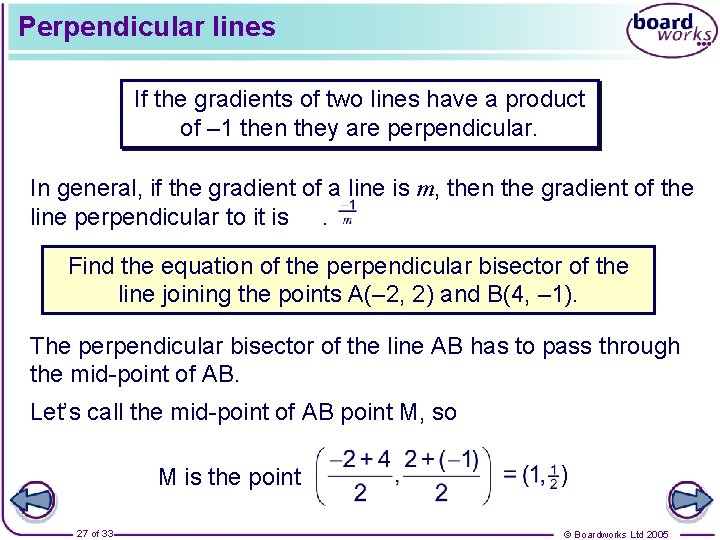
Perpendicular lines If the gradients of two lines have a product of – 1 then they are perpendicular. In general, if the gradient of a line is m, then the gradient of the line perpendicular to it is. Find the equation of the perpendicular bisector of the line joining the points A(– 2, 2) and B(4, – 1). The perpendicular bisector of the line AB has to pass through the mid-point of AB. Let’s call the mid-point of AB point M, so M is the point 27 of 33 © Boardworks Ltd 2005
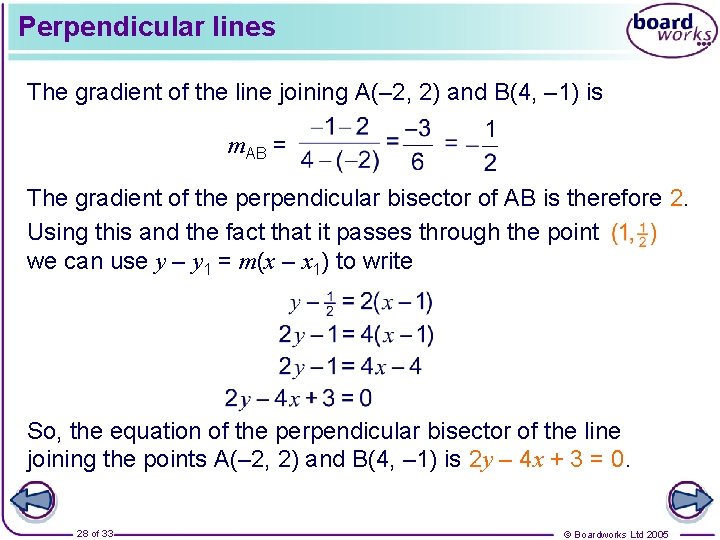
Perpendicular lines The gradient of the line joining A(– 2, 2) and B(4, – 1) is m. AB = The gradient of the perpendicular bisector of AB is therefore 2. Using this and the fact that it passes through the point we can use y – y 1 = m(x – x 1) to write So, the equation of the perpendicular bisector of the line joining the points A(– 2, 2) and B(4, – 1) is 2 y – 4 x + 3 = 0. 28 of 33 © Boardworks Ltd 2005
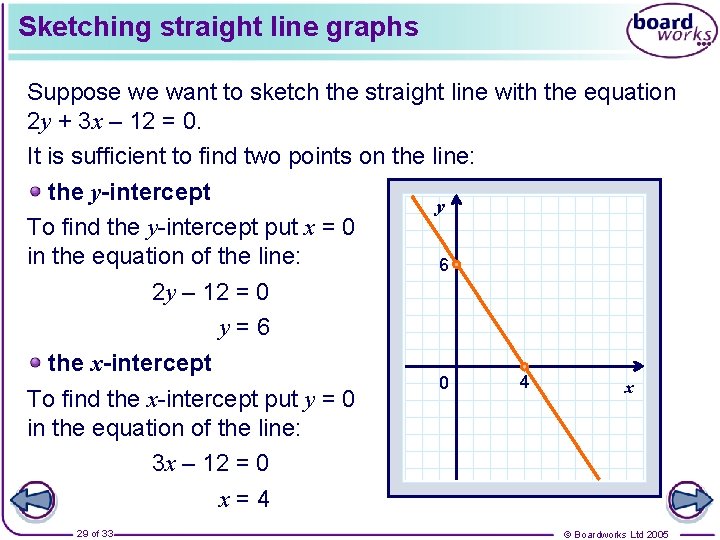
Sketching straight line graphs Suppose we want to sketch the straight line with the equation 2 y + 3 x – 12 = 0. It is sufficient to find two points on the line: the y-intercept y To find the y-intercept put x = 0 in the equation of the line: 6 2 y – 12 = 0 y=6 the x-intercept 4 0 x To find the x-intercept put y = 0 in the equation of the line: 3 x – 12 = 0 x=4 29 of 33 © Boardworks Ltd 2005
Examination-style questions Contents The distance between two points The mid-point of a line segment Calculating the gradient of a straight line The equation of a straight line Parallel and perpendicular lines Examination-style questions 30 of 33 © Boardworks Ltd 2005
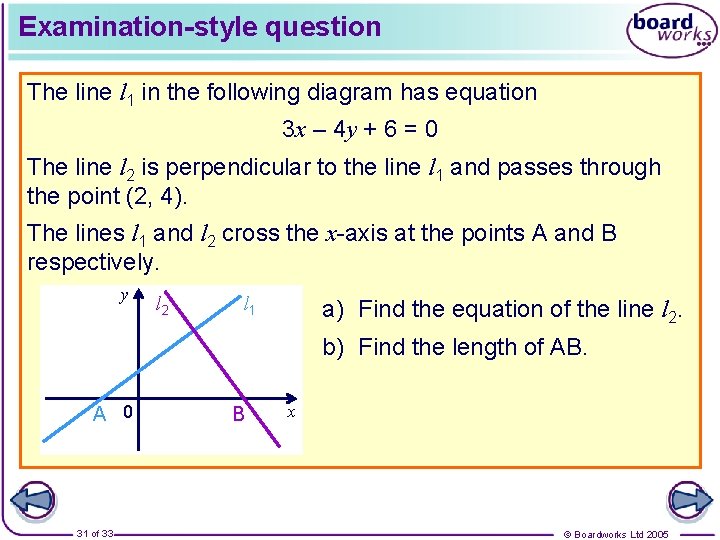
Examination-style question The line l 1 in the following diagram has equation 3 x – 4 y + 6 = 0 The line l 2 is perpendicular to the line l 1 and passes through the point (2, 4). The lines l 1 and l 2 cross the x-axis at the points A and B respectively. y l 2 l 1 a) Find the equation of the line l 2. b) Find the length of AB. A 0 31 of 33 B x © Boardworks Ltd 2005
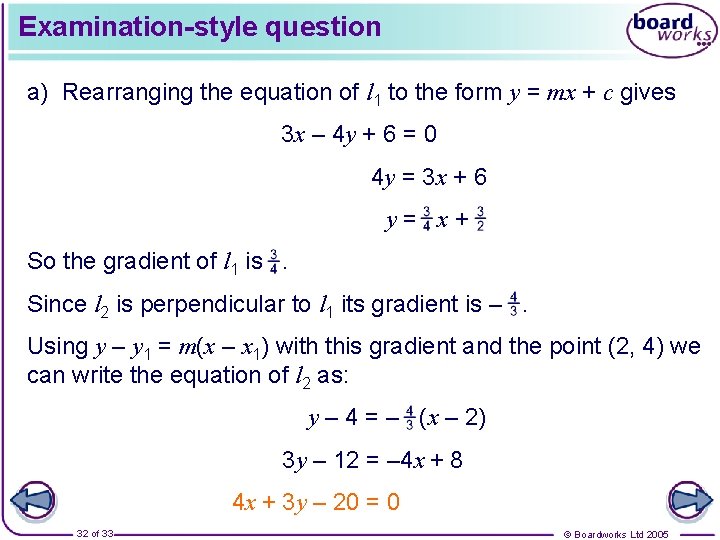
Examination-style question a) Rearranging the equation of l 1 to the form y = mx + c gives 3 x – 4 y + 6 = 0 4 y = 3 x + 6 y= x+ So the gradient of l 1 is. Since l 2 is perpendicular to l 1 its gradient is –. Using y – y 1 = m(x – x 1) with this gradient and the point (2, 4) we can write the equation of l 2 as: y – 4 = – (x – 2) 3 y – 12 = – 4 x + 8 4 x + 3 y – 20 = 0 32 of 33 © Boardworks Ltd 2005
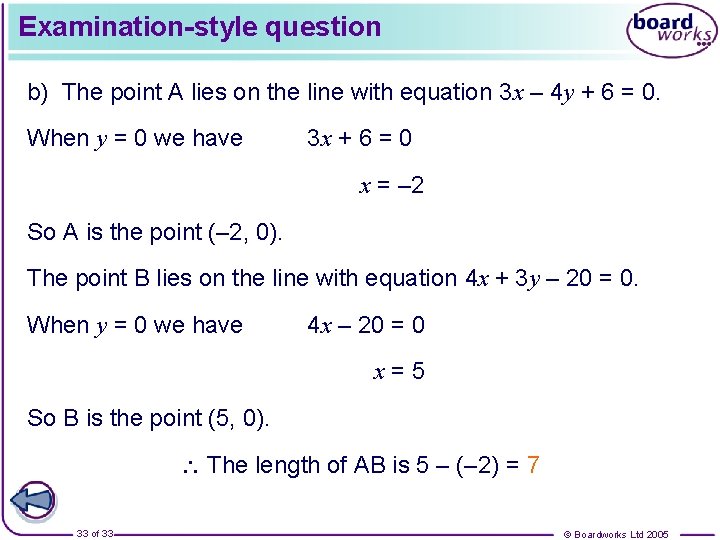
Examination-style question b) The point A lies on the line with equation 3 x – 4 y + 6 = 0. When y = 0 we have 3 x + 6 = 0 x = – 2 So A is the point (– 2, 0). The point B lies on the line with equation 4 x + 3 y – 20 = 0. When y = 0 we have 4 x – 20 = 0 x=5 So B is the point (5, 0). The length of AB is 5 – (– 2) = 7 33 of 33 © Boardworks Ltd 2005
- Slides: 33