
Satellite Systems and Design Architecture of OnBoard Systems
Satellite Systems and Design Architecture of On-Board Systems Presentation Structure - Who am I? - On-Board Systems, Tasks and Architecture - Focus on On-Board Computer - Interfaces - Timing Concept - Redundancy Philosophy - Hardware Design Flow - Ørsted Case - Rømer Case - Cube. Sat Case
Architecture of On-Board Systems Who am I? Name: Peter Davidsen Age: 32 Education: Civilingeniør E, 1993, DTU Experience: 8 years in the Space Industry - Ørsted subsystem designer (CPD) - Ørsted systems engineer - Test and validation - Launch and Operation - Rømer lead systems engineer (Platform) - Terma Star Tracker lead systems engineer Contact, and don’t hesitate to do so!!!! pd@terma. com
Architecture of On-Board Systems, Tasks and Architecture Satellite on-board systems - Functions indicated - How shall these functions be implemented? - How shall they be linked together? (Interfaces) - What kind of tasks are assigned to each function?
Architecture of On-Board Systems, Tasks and Architecture Electrical Power Subsystem (EPS) - Power Control and Distribution Unit (PCDU) - Solar panel(s) - Battery (peak power, orbit eclipse) PCDU - Solar panel(s) and battery management (BCR or MPPT) - Centralized or de-centralized DC/DC converters - User switches and protection - Housekeeping and protection - Control and OBC interface - AUX converter (internal power supply)
Architecture of On-Board Systems, Tasks and Architecture On-Board Computer - Command Data Handling (CDH) - Receive, process and distribute telecommands from ground - Collect science data - Collect housekeeping and report telemetry - Telemetry storage in mass memory - Forward telemetry to ground - Satellite autonomous control and monitoring (e. g. safe mode, time tagged commands. . . ) - Timing reference and correlation - Autonomous attitude control - etc. e. g. Star tracker data processing, Payload data processing…. .
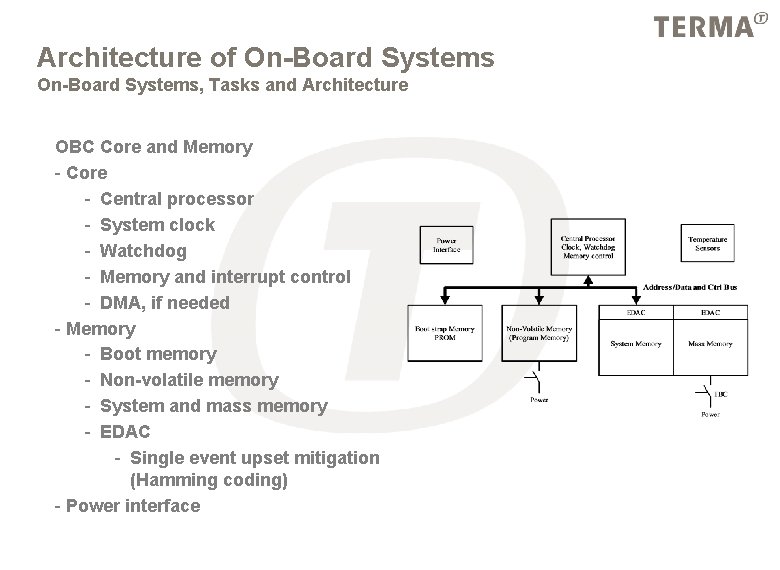
Architecture of On-Board Systems, Tasks and Architecture OBC Core and Memory - Core - Central processor - System clock - Watchdog - Memory and interrupt control - DMA, if needed - Memory - Boot memory - Non-volatile memory - System and mass memory - EDAC - Single event upset mitigation (Hamming coding) - Power interface
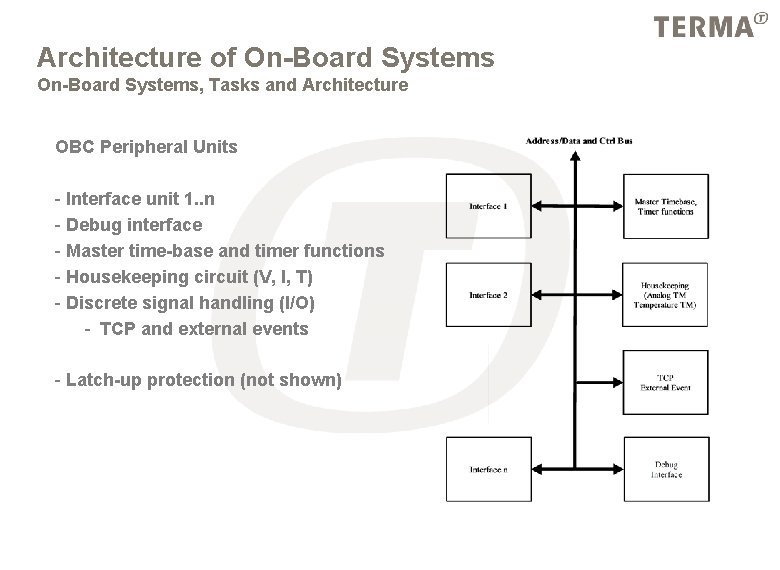
Architecture of On-Board Systems, Tasks and Architecture OBC Peripheral Units - Interface unit 1. . n - Debug interface - Master time-base and timer functions - Housekeeping circuit (V, I, T) - Discrete signal handling (I/O) - TCP and external events - Latch-up protection (not shown)
Architecture of On-Board Systems, Tasks and Architecture
Architecture of On-Board Systems, Tasks and Architecture OBC Key Problem Areas Processor selection - Performance (MIPS and FLOPS) - Power consumption - Space environment - Tools Memory - Technology (e. g. EEPROM/FLASH, SRAM/DRAM…) - Power consumption - Size (bytes) - Space environment - Protection Interface implementation - UART or FPGA - FPGA selection (for space) - Timing and peak load - Protocol selection (high and low level) - Test Exercise: identify possible processors for the use in Cube. Sat OBC
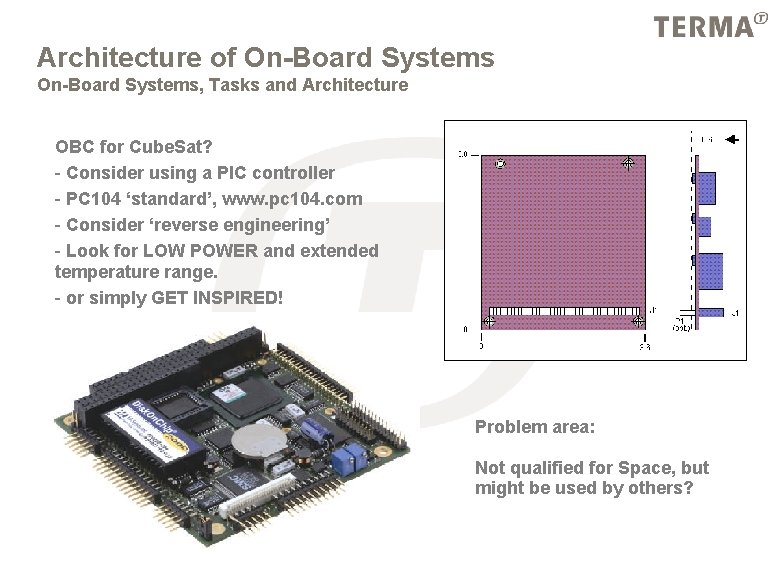
Architecture of On-Board Systems, Tasks and Architecture OBC for Cube. Sat? - Consider using a PIC controller - PC 104 ‘standard’, www. pc 104. com - Consider ‘reverse engineering’ - Look for LOW POWER and extended temperature range. - or simply GET INSPIRED! Problem area: Not qualified for Space, but might be used by others?
Architecture of On-Board Systems, Tasks and Architecture Attitude Control Subsystem (ACS) -ACS SW part of OBC -Sensors - Star tracker - Rate sensors - Magnetometer - Sun sensors - Earth horizon sensors -Actuators - Momentum/Reaction wheels - Magnetorquer coils/rods - Permanent magnet - Thruster - Libration Damper - Determine sensor configuration - Select I/F to OBC - HW - Low and high level protocols -Determine actuator configuration - Select I/F to OBC - HW - Low and high level protocols

Architecture of On-Board Systems, Tasks and Architecture Communication subsystem (COM) - Receiver (Rx) - LNA - Down converter, IF amplifier - Demodulator - Transmitter (Tx) - Modulator - Solid state power amplifier (SSPA) - Duplex filter (one Rx/Tx antenna) - Antenna (S-band, VHF, UHF) - Controller - OBC interface - Rx/Tx mode control - Up/down link protocol handling - either in COM or OBC - Coding and decoding - Housekeeping - Essential V, I, T and Rx/Tx status -Power control and interface
Architecture of On-Board Systems Interface Types - Electrical (HW) Functional (SW) Mechanical Thermal all this MUST BE SPECIFIED FOR ALL SUBSYSTEMS
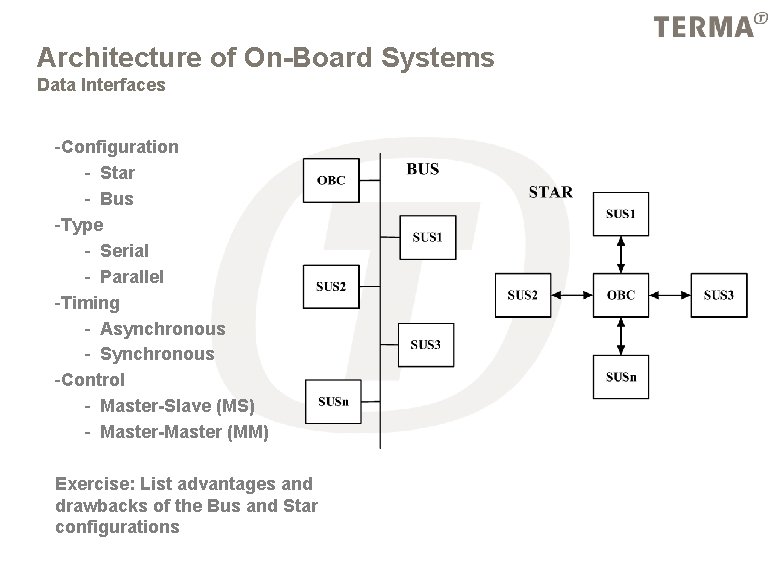
Architecture of On-Board Systems Data Interfaces -Configuration - Star - Bus -Type - Serial - Parallel -Timing - Asynchronous - Synchronous -Control - Master-Slave (MS) - Master-Master (MM) Exercise: List advantages and drawbacks of the Bus and Star configurations
Architecture of On-Board Systems Data Interfaces - Typical interfaces - RS 422 (Star, serial, async/sync, MS/MM) - RS 485 (Bus, serial, async, MS/MM) - PASTE (Star/Bus, parallel, sync, MS) - CAN (Bus, serial, async, MM) - Mil-Std-1553 (Bus, serial, async, MM) - …. . - Avoid using to many I/F configurations and types !!!!! Exercise: Cube. Sat interface brainstorming
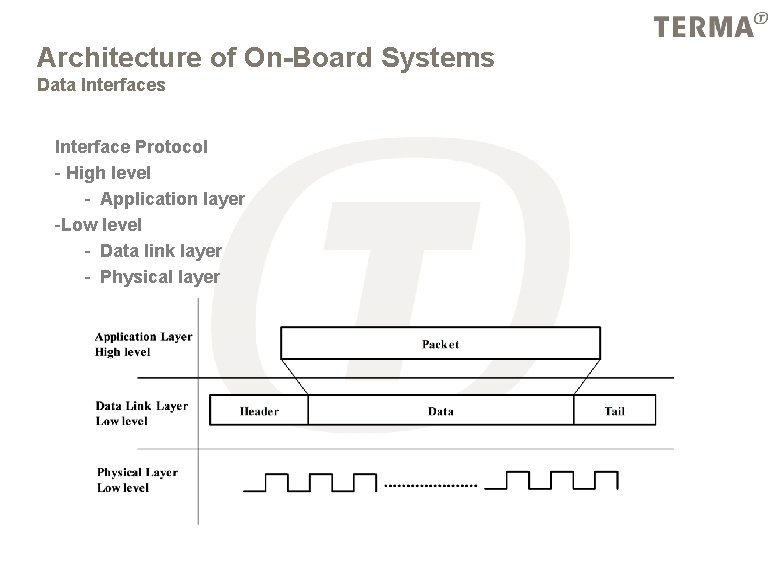
Architecture of On-Board Systems Data Interfaces Interface Protocol - High level - Application layer -Low level - Data link layer - Physical layer
Architecture of On-Board Systems Data Interfaces - High level, e. g. Packet Utilization Standard - Low level, e. g. CAN, radio link - Note, some I/F standards include only electrical properties (e. g. RS 422 and RS 485), other also low level protocol (e. g. CAN and 1553). Protocol standards - Use a standard low level protocol on the up/down link - Re-use ground station - Use standard or non-standard between OBC and SUS
Architecture of On-Board Systems Data Interfaces Data Flow Analysis - Inter Satellite (OBC to subsystems) - Ground/Satellite link - Ground data distribution - Interface bandwidth requirements including up/down link - Interface peak loads - OBC mass storage (if implemented)
Architecture of On-Board Systems Interface Control Document
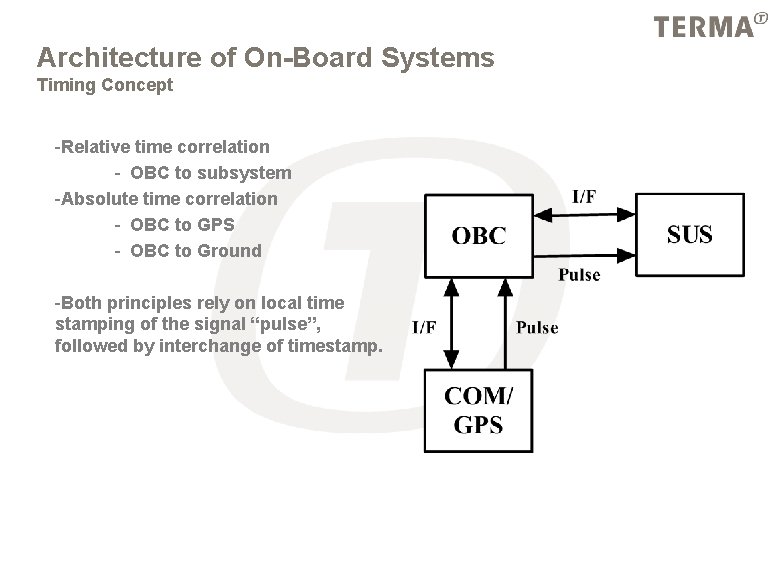
Architecture of On-Board Systems Timing Concept -Relative time correlation - OBC to subsystem -Absolute time correlation - OBC to GPS - OBC to Ground -Both principles rely on local time stamping of the signal “pulse”, followed by interchange of timestamp.
Architecture of On-Board Systems Redundancy Philosophy Introduction to Redundancy - Redundancy is used to increase satellite/subsystem reliability - Redundancy can be applied on: - system level - subsystem level (e. g. two OBCs, interface cross-coupling) - subsystem internal (e. g. double boot PROMs) - Redundancy can be implemented as ‘hot or cold’ - Typical problems when introducing redundancy - increase in system complexity + mass, power and volume - will the reliability be increased at all? - test - cost
Architecture of On-Board Systems Redundancy Philosophy Redundancy Roadmap - Baseline minimum configuration that satisfies the mission requirements - Evaluate reliability of each subsystem for a give lifetime and orbit - Evaluate complexity of making a subsystem redundant - Evaluate cost of making a subsystem redundant - Then decide - Hot or Cold? - Interface cross strapping? - Other constraints: mass, volume, power etc. decide on redundancy concept Exercise: Cube. Sat = Single String why?
Architecture of On-Board Systems Hardware Design Flow HW design, step-by-step - Input - High level tasks - Radiation environment (given the orbit, lifetime and epoch) - Max power, mass, envelope etc. - External interface requirements - Power and data - Output - Specification - Component selection - Architectural design - Detailed design
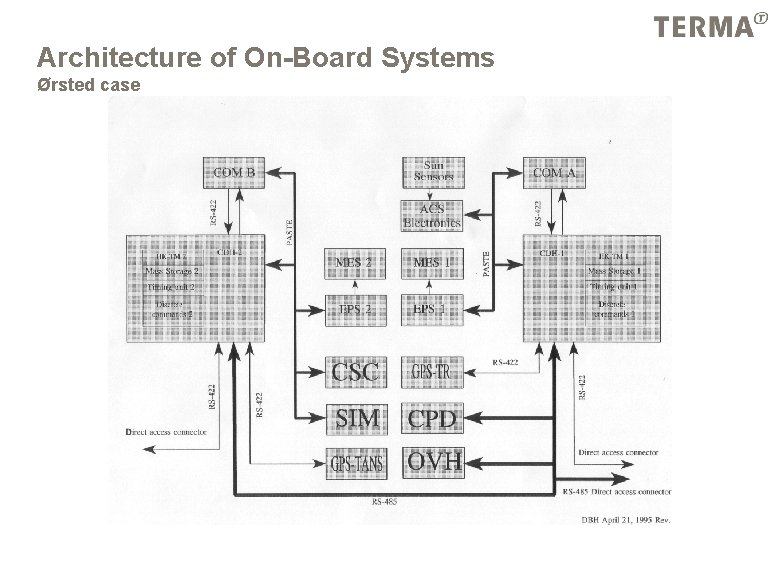
Architecture of On-Board Systems Ørsted case
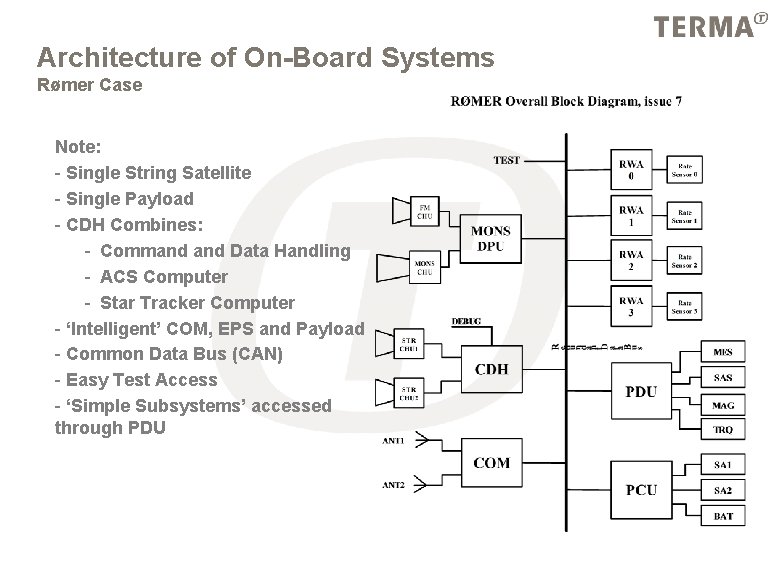
Architecture of On-Board Systems Rømer Case Note: - Single String Satellite - Single Payload - CDH Combines: - Command Data Handling - ACS Computer - Star Tracker Computer - ‘Intelligent’ COM, EPS and Payload - Common Data Bus (CAN) - Easy Test Access - ‘Simple Subsystems’ accessed through PDU
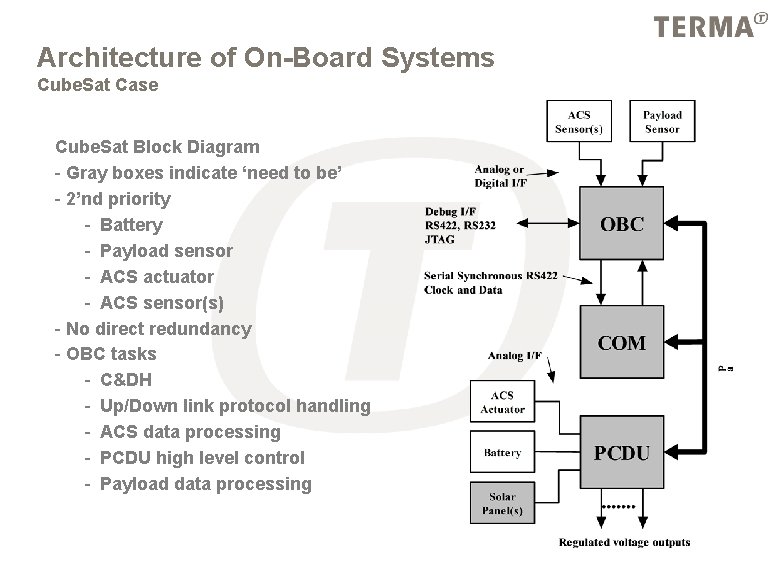
Architecture of On-Board Systems Cube. Sat Case Cube. Sat Block Diagram - Gray boxes indicate ‘need to be’ - 2’nd priority - Battery - Payload sensor - ACS actuator - ACS sensor(s) - No direct redundancy - OBC tasks - C&DH - Up/Down link protocol handling - ACS data processing - PCDU high level control - Payload data processing
Architecture of On-Board Systems Cube. Sat Case Cube. Sat, recommendation - Limit you ambitions! - 1 Payload - Keep it simple! - Is ACS necessary? -Keep constant track of engineering budgets (mass, power, volume) - Implement a simple satellite safe mode: - Radio beacon - Non essential loads OFF - Make it possible to change OBSW - Use simple COM (amateur radio) - UHF/VHF, COTS unit - Standard protocol - Use a centralized DC/DC converter - Include battery (peak power) - Consider deployable solar panels - Due to the tight engineering budgets COTs components/subsystems (e. g. PC 104 as OBC) - Pay attention to thermal design - Use simple interfaces AND simple protocols. - Implement a direct access debug interface to the OBC used during ground tests - Test, Test and Test
- Slides: 27