
Satellite Remote Sensing of Tropospheric Composition Principles results
![CO total column [1018 moelc cm-2] MOPITT: CO column • • MOPITT CO column](https://slidetodoc.com/presentation_image/6c92c4cd7ba0de37c60a356bfdc906e1/image-34.jpg "CO total column [1018 moelc cm-2] MOPITT: CO column • • MOPITT CO column")

- Slides: 51
Satellite Remote Sensing of Tropospheric Composition Principles, results, and challenges Lecture at the ERCA 2018 Grenoble, January 18, 2018 Andreas Richter Institute of Environmental Physics University of Bremen, Germany ( richter@iup. physik. uni-bremen. de ) Satellite Remote Sensing of Tropospheric Composition, Andreas Richter, ERCA 2018 1
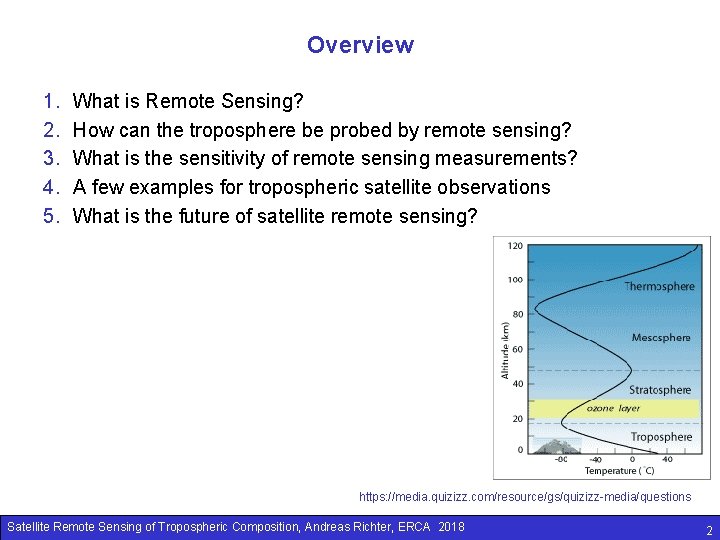
Overview 1. 2. 3. 4. 5. What is Remote Sensing? How can the troposphere be probed by remote sensing? What is the sensitivity of remote sensing measurements? A few examples for tropospheric satellite observations What is the future of satellite remote sensing? https: //media. quizizz. com/resource/gs/quizizz-media/questions Satellite Remote Sensing of Tropospheric Composition, Andreas Richter, ERCA 2018 2
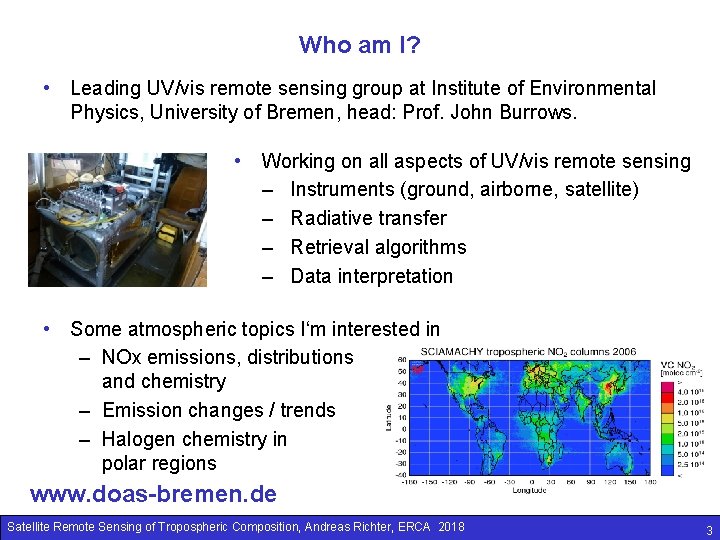
Who am I? • Leading UV/vis remote sensing group at Institute of Environmental Physics, University of Bremen, head: Prof. John Burrows. • Working on all aspects of UV/vis remote sensing – Instruments (ground, airborne, satellite) – Radiative transfer – Retrieval algorithms – Data interpretation • Some atmospheric topics I‘m interested in – NOx emissions, distributions and chemistry – Emission changes / trends – Halogen chemistry in polar regions www. doas-bremen. de Satellite Remote Sensing of Tropospheric Composition, Andreas Richter, ERCA 2018 3
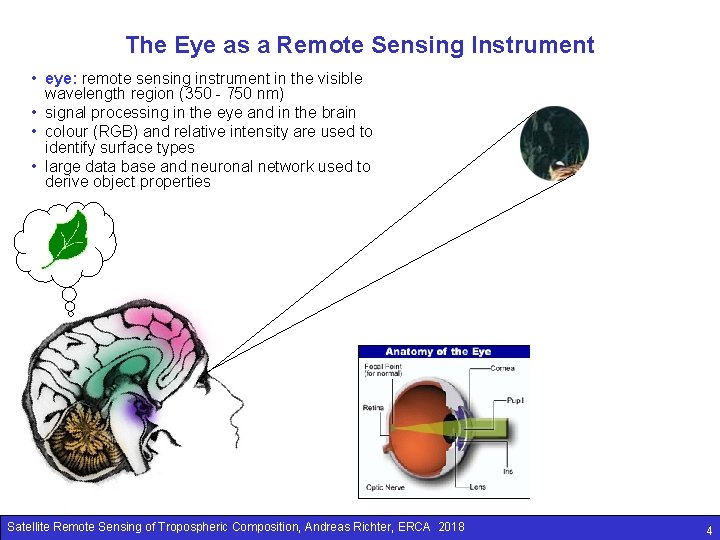
The Eye as a Remote Sensing Instrument • eye: remote sensing instrument in the visible wavelength region (350 - 750 nm) • signal processing in the eye and in the brain • colour (RGB) and relative intensity are used to identify surface types • large data base and neuronal network used to derive object properties Satellite Remote Sensing of Tropospheric Composition, Andreas Richter, ERCA 2018 4
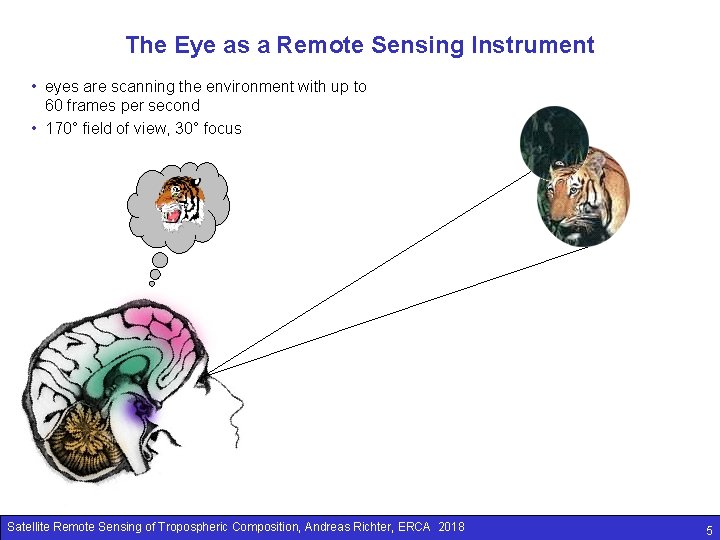
The Eye as a Remote Sensing Instrument • eyes are scanning the environment with up to 60 frames per second • 170° field of view, 30° focus Satellite Remote Sensing of Tropospheric Composition, Andreas Richter, ERCA 2018 5
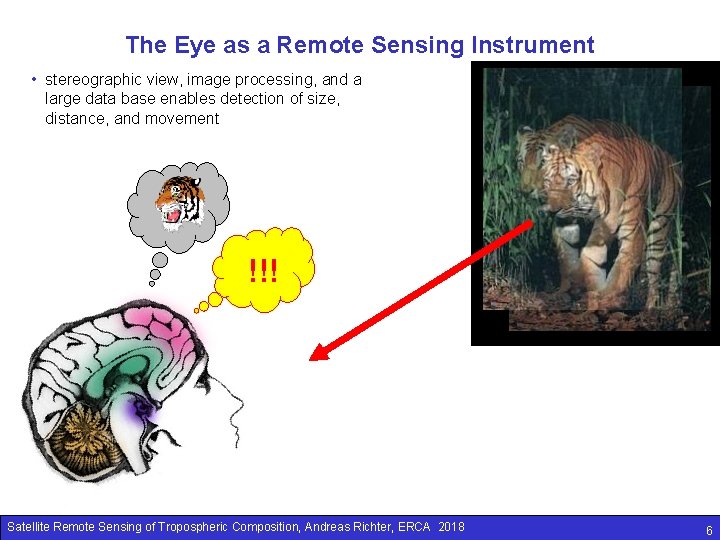
The Eye as a Remote Sensing Instrument • stereographic view, image processing, and a large data base enables detection of size, distance, and movement !!! Satellite Remote Sensing of Tropospheric Composition, Andreas Richter, ERCA 2018 6
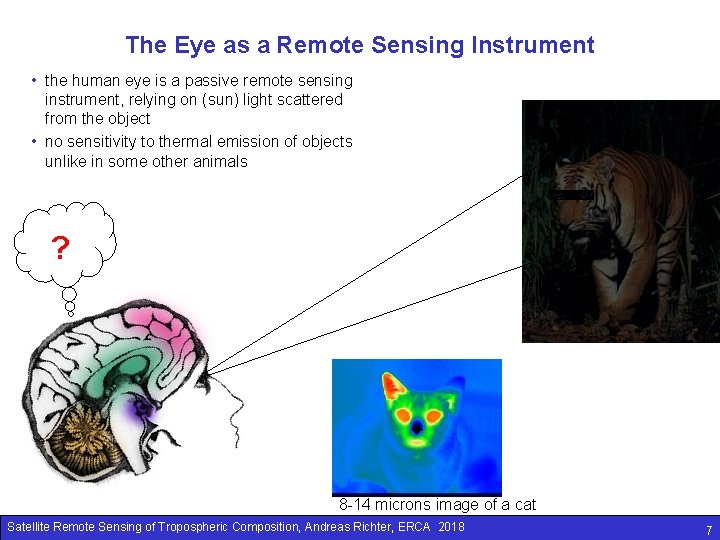
The Eye as a Remote Sensing Instrument • the human eye is a passive remote sensing instrument, relying on (sun) light scattered from the object • no sensitivity to thermal emission of objects unlike in some other animals ? 8 -14 microns image of a cat Satellite Remote Sensing of Tropospheric Composition, Andreas Richter, ERCA 2018 7
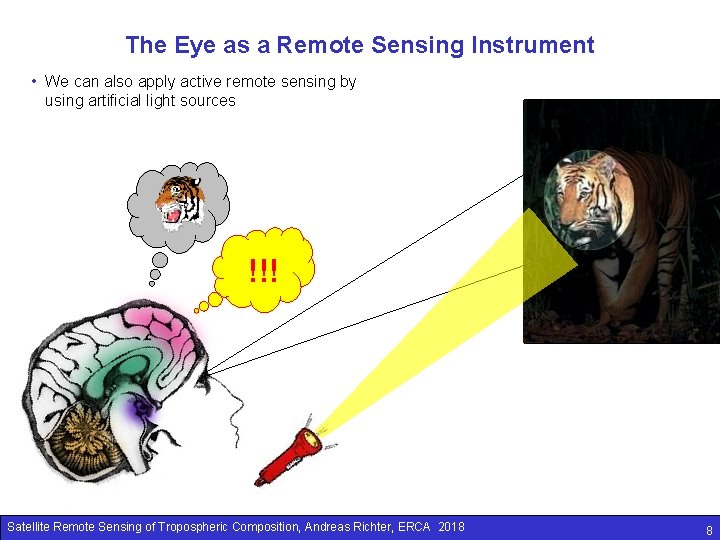
The Eye as a Remote Sensing Instrument • We can also apply active remote sensing by using artificial light sources !!! Satellite Remote Sensing of Tropospheric Composition, Andreas Richter, ERCA 2018 8
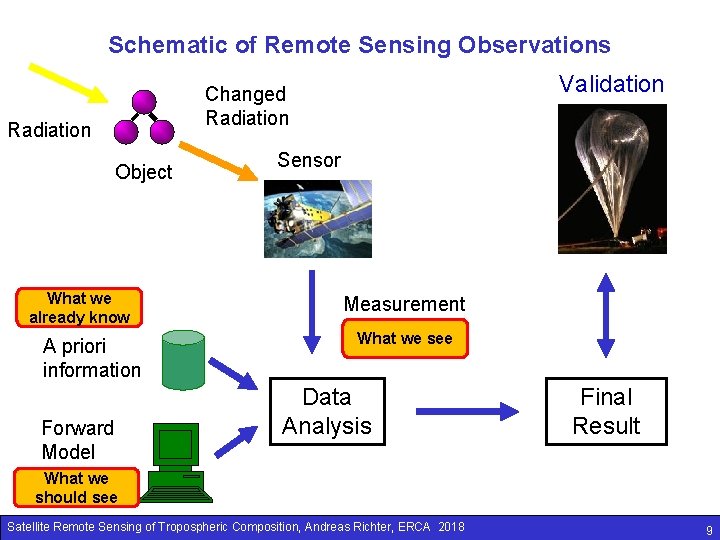
Schematic of Remote Sensing Observations Validation Changed Radiation Object What we already know A priori information Forward Model Sensor Measurement What we see Data Analysis Final Result What we should see Satellite Remote Sensing of Tropospheric Composition, Andreas Richter, ERCA 2018 9
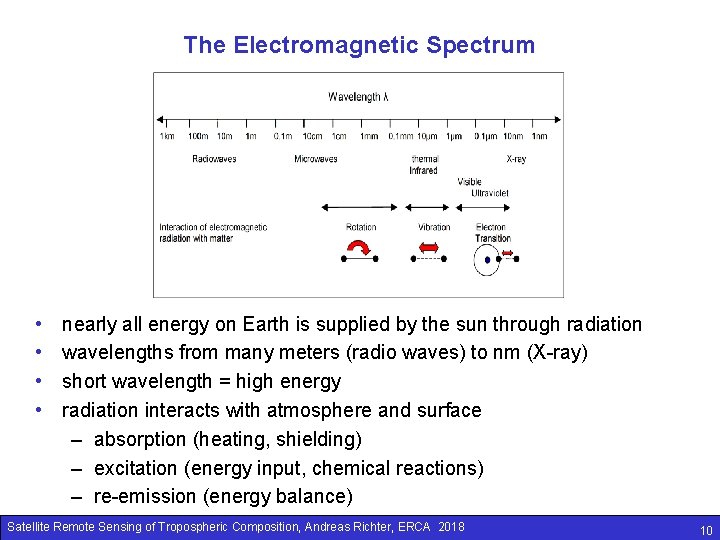
The Electromagnetic Spectrum • • nearly all energy on Earth is supplied by the sun through radiation wavelengths from many meters (radio waves) to nm (X-ray) short wavelength = high energy radiation interacts with atmosphere and surface – absorption (heating, shielding) – excitation (energy input, chemical reactions) – re-emission (energy balance) Satellite Remote Sensing of Tropospheric Composition, Andreas Richter, ERCA 2018 10
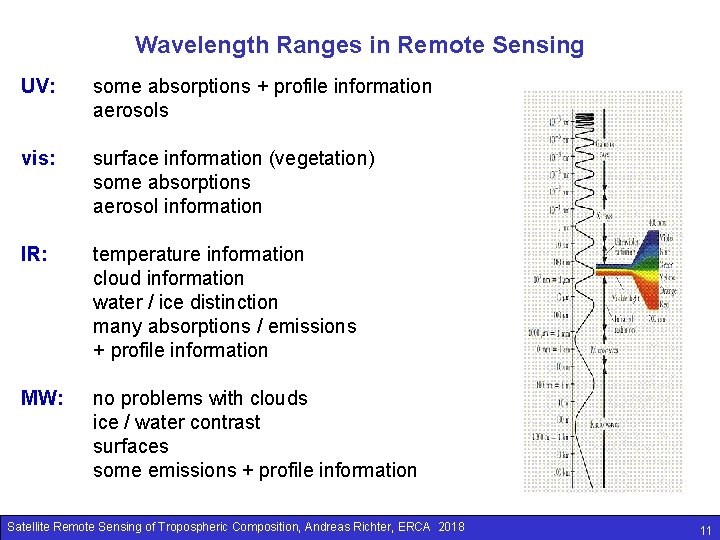
Wavelength Ranges in Remote Sensing UV: some absorptions + profile information aerosols vis: surface information (vegetation) some absorptions aerosol information IR: temperature information cloud information water / ice distinction many absorptions / emissions + profile information MW: no problems with clouds ice / water contrast surfaces some emissions + profile information Satellite Remote Sensing of Tropospheric Composition, Andreas Richter, ERCA 2018 11
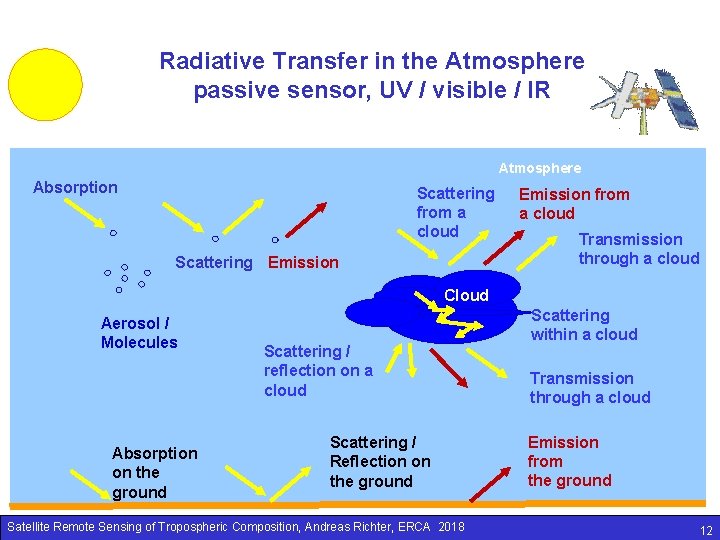
Radiative Transfer in the Atmosphere passive sensor, UV / visible / IR Atmosphere Absorption Scattering from a cloud Scattering Emission from a cloud Transmission through a cloud Cloud Aerosol / Molecules Absorption on the ground Scattering / reflection on a cloud Scattering / Reflection on the ground Satellite Remote Sensing of Tropospheric Composition, Andreas Richter, ERCA 2018 Scattering within a cloud Transmission through a cloud Emission from the ground 12
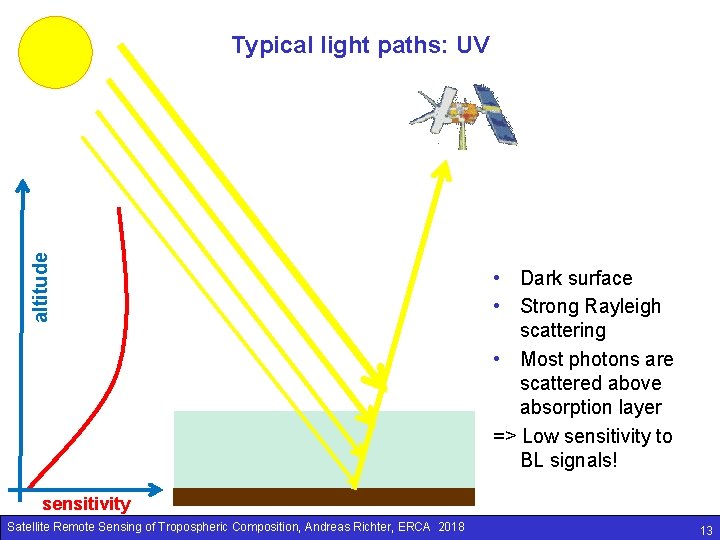
altitude Typical light paths: UV • Dark surface • Strong Rayleigh scattering • Most photons are scattered above absorption layer => Low sensitivity to BL signals! sensitivity Satellite Remote Sensing of Tropospheric Composition, Andreas Richter, ERCA 2018 13
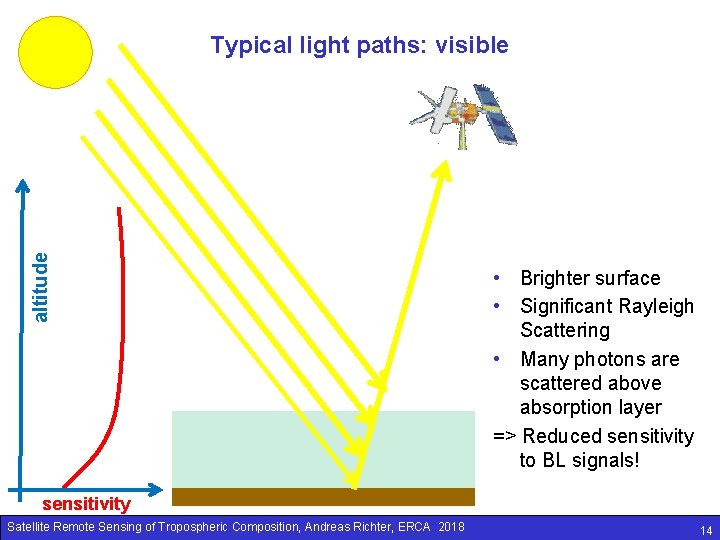
altitude Typical light paths: visible • Brighter surface • Significant Rayleigh Scattering • Many photons are scattered above absorption layer => Reduced sensitivity to BL signals! sensitivity Satellite Remote Sensing of Tropospheric Composition, Andreas Richter, ERCA 2018 14
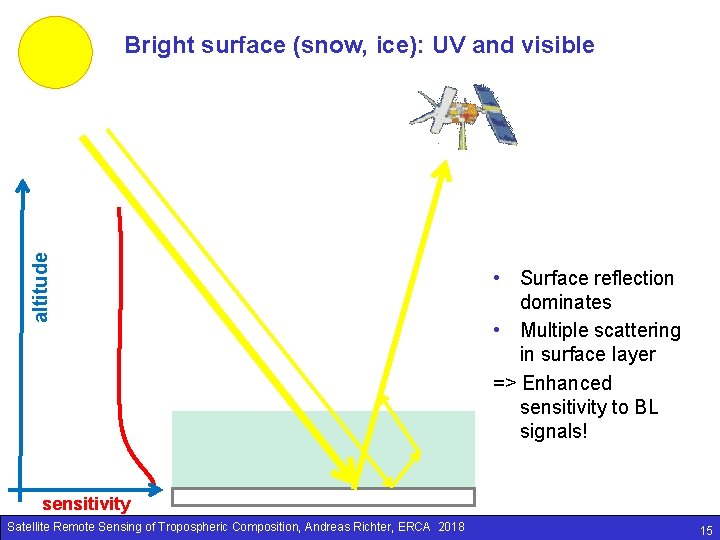
altitude Bright surface (snow, ice): UV and visible • Surface reflection dominates • Multiple scattering in surface layer => Enhanced sensitivity to BL signals! sensitivity Satellite Remote Sensing of Tropospheric Composition, Andreas Richter, ERCA 2018 15
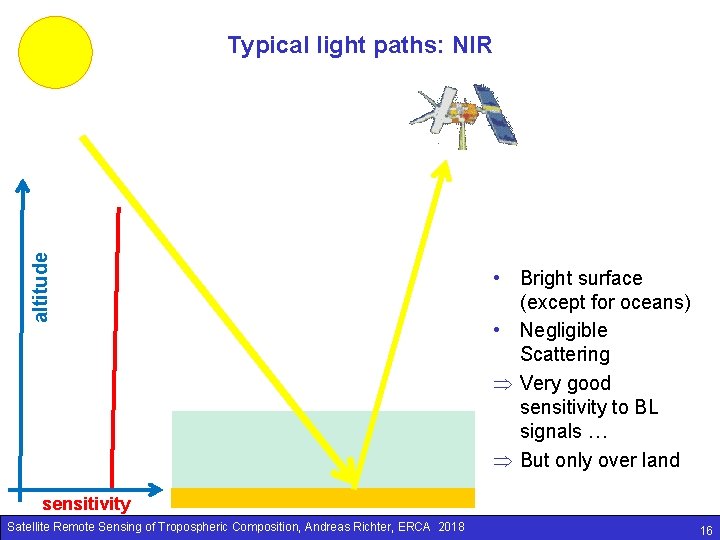
altitude Typical light paths: NIR • Bright surface (except for oceans) • Negligible Scattering Þ Very good sensitivity to BL signals … Þ But only over land sensitivity Satellite Remote Sensing of Tropospheric Composition, Andreas Richter, ERCA 2018 16
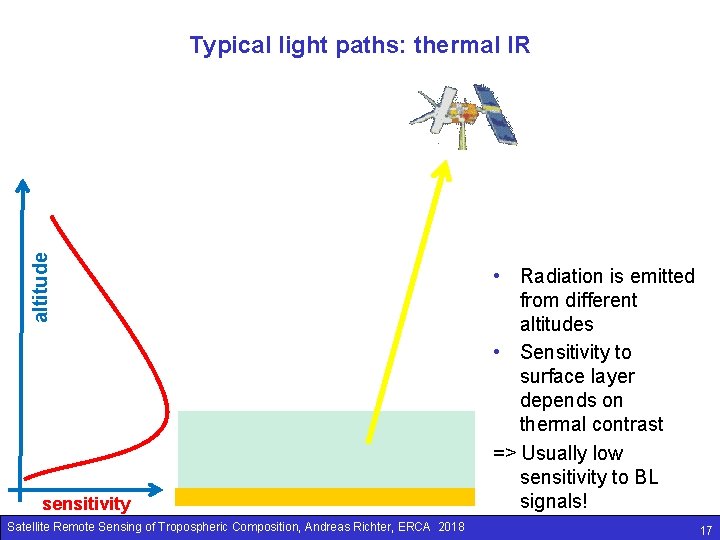
altitude Typical light paths: thermal IR sensitivity Satellite Remote Sensing of Tropospheric Composition, Andreas Richter, ERCA 2018 • Radiation is emitted from different altitudes • Sensitivity to surface layer depends on thermal contrast => Usually low sensitivity to BL signals! 17
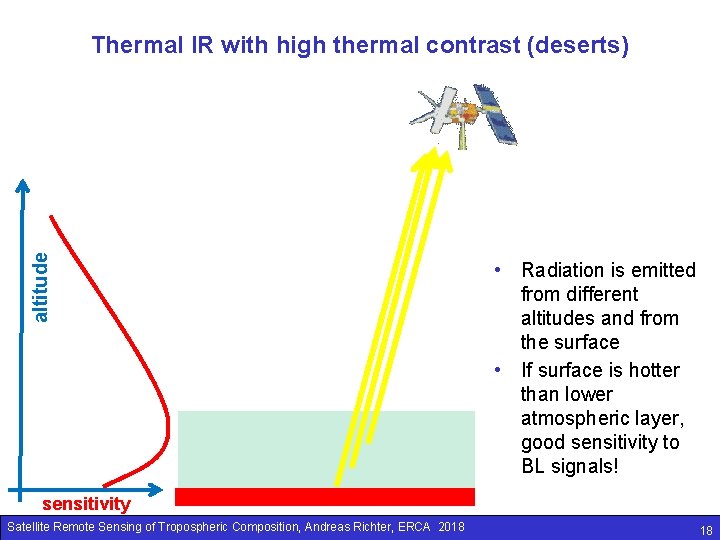
altitude Thermal IR with high thermal contrast (deserts) • Radiation is emitted from different altitudes and from the surface • If surface is hotter than lower atmospheric layer, good sensitivity to BL signals! sensitivity Satellite Remote Sensing of Tropospheric Composition, Andreas Richter, ERCA 2018 18
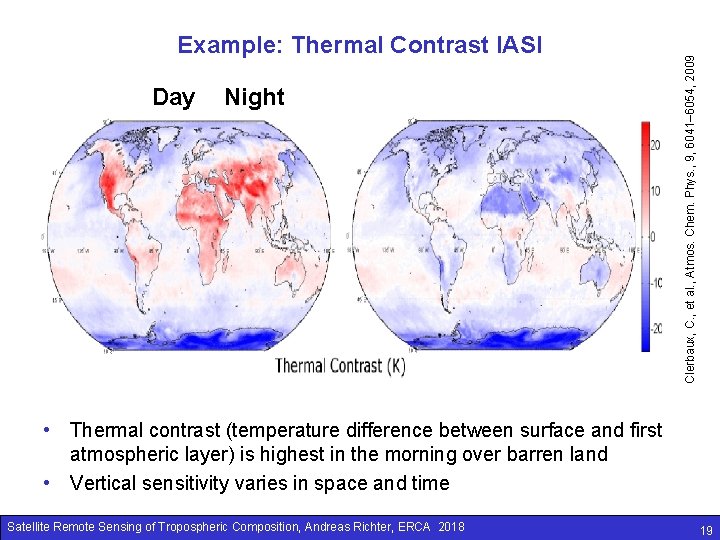
Day Night Clerbaux, C. , et al. , Atmos. Chem. Phys. , 9, 6041– 6054, 2009 Example: Thermal Contrast IASI • Thermal contrast (temperature difference between surface and first atmospheric layer) is highest in the morning over barren land • Vertical sensitivity varies in space and time Satellite Remote Sensing of Tropospheric Composition, Andreas Richter, ERCA 2018 19
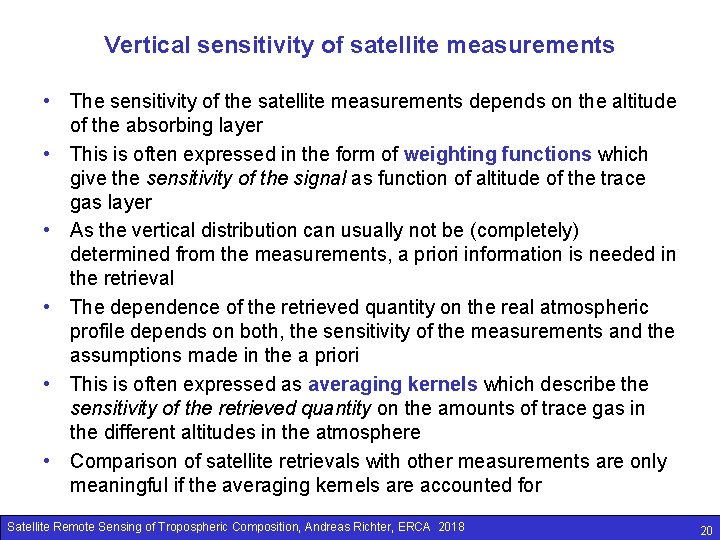
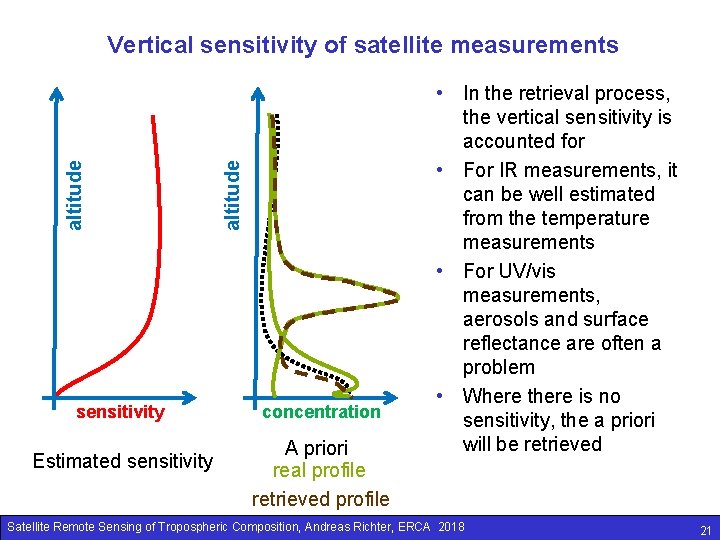
Vertical sensitivity of satellite measurements • The sensitivity of the satellite measurements depends on the altitude of the absorbing layer • This is often expressed in the form of weighting functions which give the sensitivity of the signal as function of altitude of the trace gas layer • As the vertical distribution can usually not be (completely) determined from the measurements, a priori information is needed in the retrieval • The dependence of the retrieved quantity on the real atmospheric profile depends on both, the sensitivity of the measurements and the assumptions made in the a priori • This is often expressed as averaging kernels which describe the sensitivity of the retrieved quantity on the amounts of trace gas in the different altitudes in the atmosphere • Comparison of satellite retrievals with other measurements are only meaningful if the averaging kernels are accounted for Satellite Remote Sensing of Tropospheric Composition, Andreas Richter, ERCA 2018 20
sensitivity Estimated sensitivity altitude Vertical sensitivity of satellite measurements concentration A priori real profile retrieved profile • In the retrieval process, the vertical sensitivity is accounted for • For IR measurements, it can be well estimated from the temperature measurements • For UV/vis measurements, aerosols and surface reflectance are often a problem • Where there is no sensitivity, the a priori will be retrieved Satellite Remote Sensing of Tropospheric Composition, Andreas Richter, ERCA 2018 21
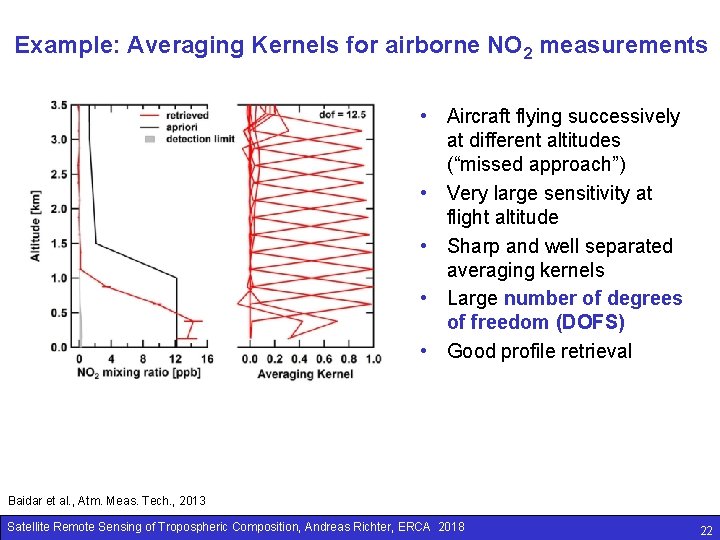
Example: Averaging Kernels for airborne NO 2 measurements • Aircraft flying successively at different altitudes (“missed approach”) • Very large sensitivity at flight altitude • Sharp and well separated averaging kernels • Large number of degrees of freedom (DOFS) • Good profile retrieval Baidar et al. , Atm. Meas. Tech. , 2013 Satellite Remote Sensing of Tropospheric Composition, Andreas Richter, ERCA 2018 22
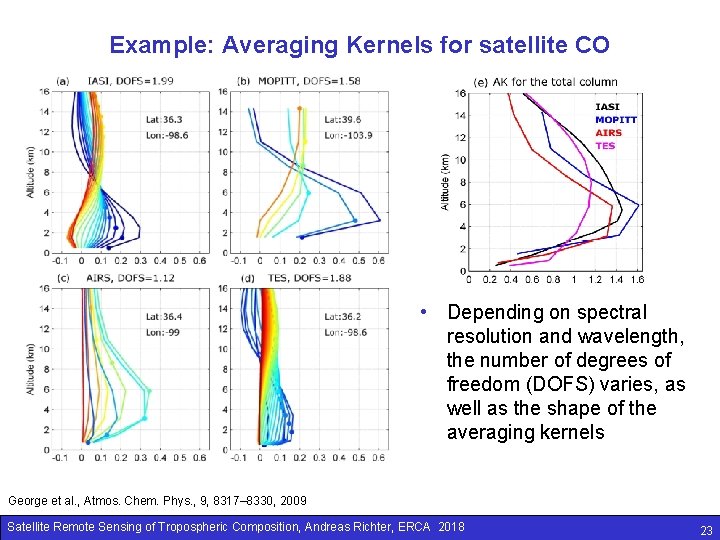
Example: Averaging Kernels for satellite CO • Depending on spectral resolution and wavelength, the number of degrees of freedom (DOFS) varies, as well as the shape of the averaging kernels George et al. , Atmos. Chem. Phys. , 9, 8317– 8330, 2009 Satellite Remote Sensing of Tropospheric Composition, Andreas Richter, ERCA 2018 23
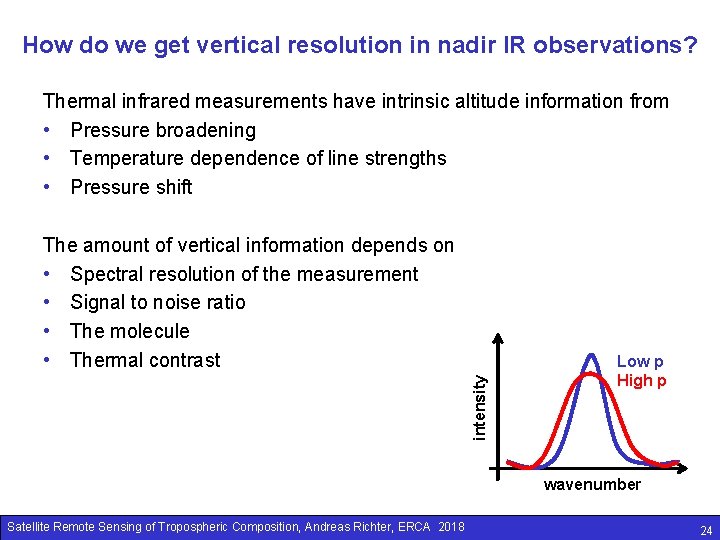
How do we get vertical resolution in nadir IR observations? Thermal infrared measurements have intrinsic altitude information from • Pressure broadening • Temperature dependence of line strengths • Pressure shift intensity The amount of vertical information depends on • Spectral resolution of the measurement • Signal to noise ratio • The molecule • Thermal contrast Low p High p wavenumber Satellite Remote Sensing of Tropospheric Composition, Andreas Richter, ERCA 2018 24
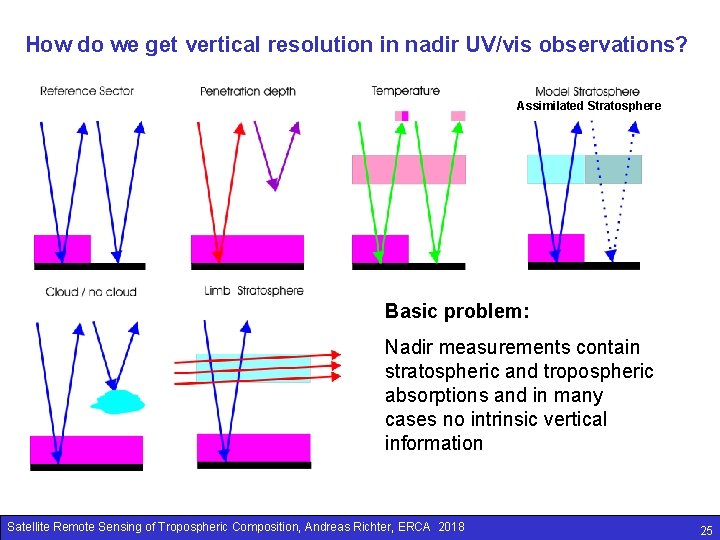
How do we get vertical resolution in nadir UV/vis observations? Assimilated Stratosphere Basic problem: Nadir measurements contain stratospheric and tropospheric absorptions and in many cases no intrinsic vertical information Satellite Remote Sensing of Tropospheric Composition, Andreas Richter, ERCA 2018 25
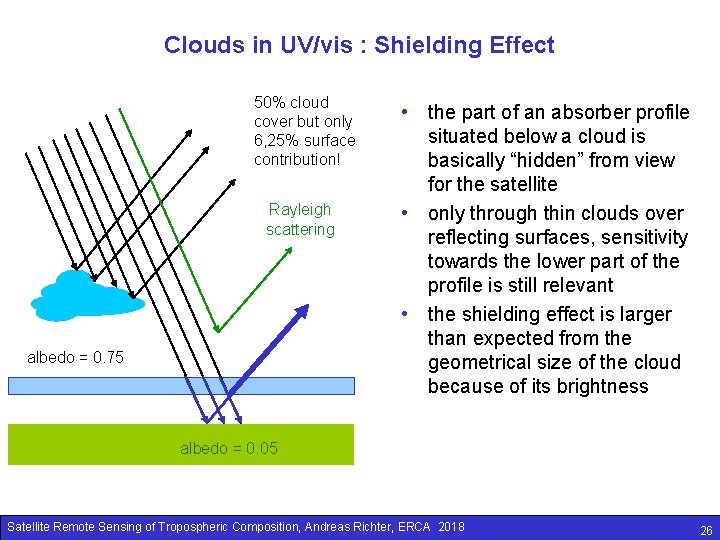
Clouds in UV/vis : Shielding Effect 50% cloud cover but only 6, 25% surface contribution! Rayleigh scattering albedo = 0. 75 • the part of an absorber profile situated below a cloud is basically “hidden” from view for the satellite • only through thin clouds over reflecting surfaces, sensitivity towards the lower part of the profile is still relevant • the shielding effect is larger than expected from the geometrical size of the cloud because of its brightness albedo = 0. 05 Satellite Remote Sensing of Tropospheric Composition, Andreas Richter, ERCA 2018 26
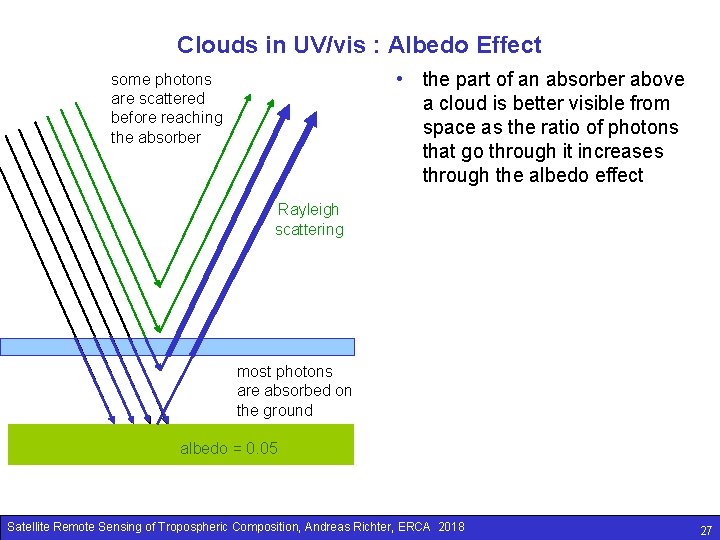
Clouds in UV/vis : Albedo Effect • the part of an absorber above a cloud is better visible from space as the ratio of photons that go through it increases through the albedo effect some photons are scattered before reaching the absorber Rayleigh scattering most photons are absorbed on the ground albedo = 0. 05 Satellite Remote Sensing of Tropospheric Composition, Andreas Richter, ERCA 2018 27
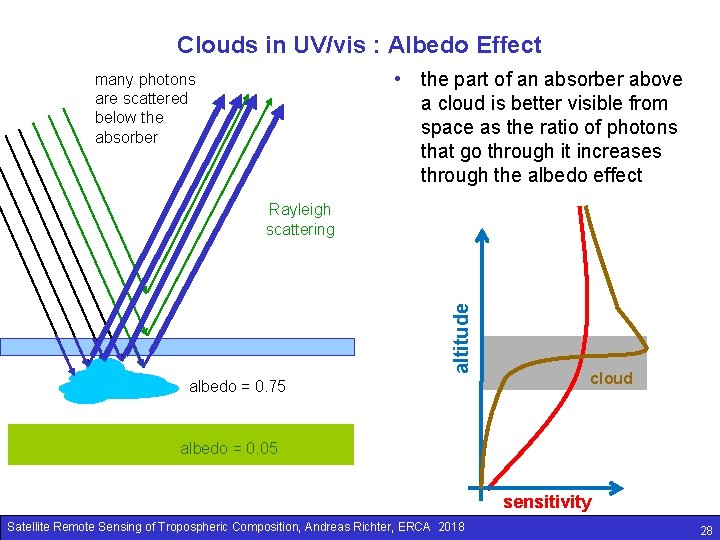
Clouds in UV/vis : Albedo Effect • the part of an absorber above a cloud is better visible from space as the ratio of photons that go through it increases through the albedo effect many photons are scattered below the absorber altitude Rayleigh scattering albedo = 0. 75 cloud albedo = 0. 05 sensitivity Satellite Remote Sensing of Tropospheric Composition, Andreas Richter, ERCA 2018 28
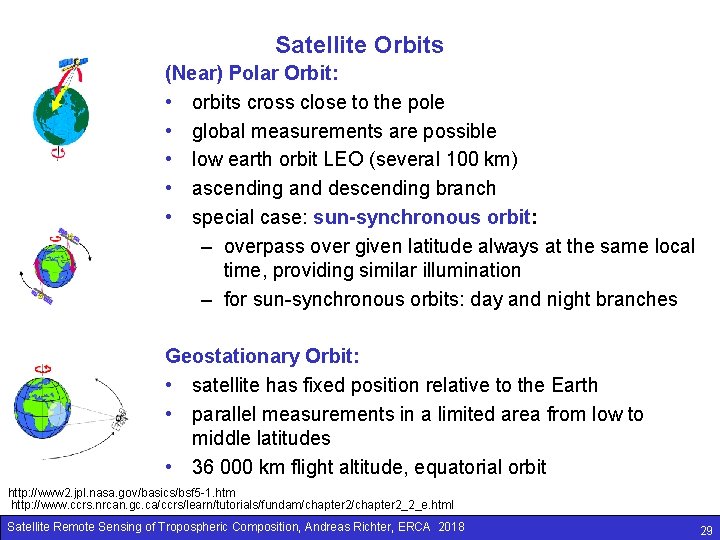
Satellite Orbits (Near) Polar Orbit: • orbits cross close to the pole • global measurements are possible • low earth orbit LEO (several 100 km) • ascending and descending branch • special case: sun-synchronous orbit: – overpass over given latitude always at the same local time, providing similar illumination – for sun-synchronous orbits: day and night branches Geostationary Orbit: • satellite has fixed position relative to the Earth • parallel measurements in a limited area from low to middle latitudes • 36 000 km flight altitude, equatorial orbit http: //www 2. jpl. nasa. gov/basics/bsf 5 -1. htm http: //www. ccrs. nrcan. gc. ca/ccrs/learn/tutorials/fundam/chapter 2_2_e. html Satellite Remote Sensing of Tropospheric Composition, Andreas Richter, ERCA 2018 29
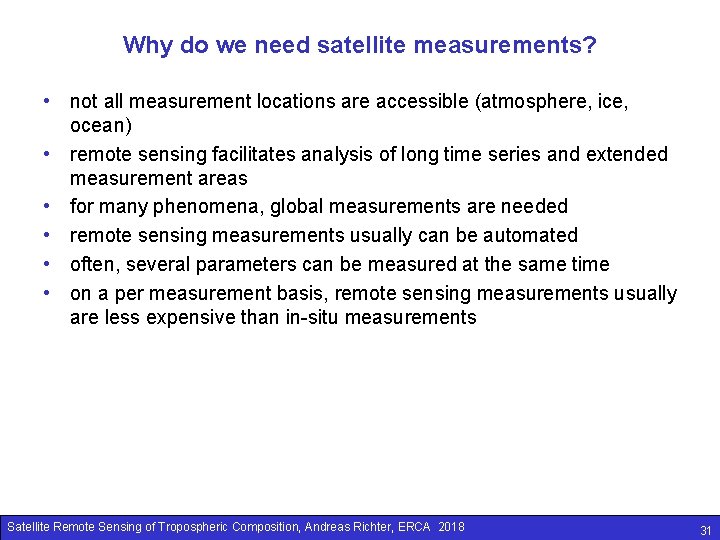
Why do we need satellite measurements? • not all measurement locations are accessible (atmosphere, ice, ocean) • remote sensing facilitates analysis of long time series and extended measurement areas • for many phenomena, global measurements are needed • remote sensing measurements usually can be automated • often, several parameters can be measured at the same time • on a per measurement basis, remote sensing measurements usually are less expensive than in-situ measurements Satellite Remote Sensing of Tropospheric Composition, Andreas Richter, ERCA 2018 31
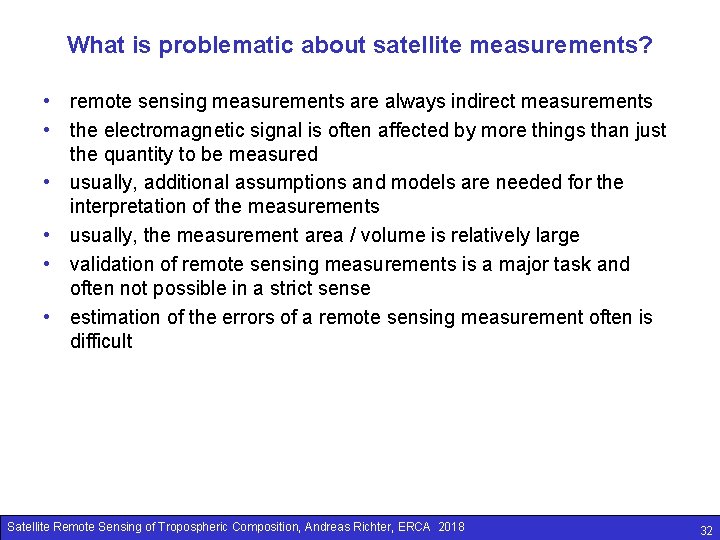
What is problematic about satellite measurements? • remote sensing measurements are always indirect measurements • the electromagnetic signal is often affected by more things than just the quantity to be measured • usually, additional assumptions and models are needed for the interpretation of the measurements • usually, the measurement area / volume is relatively large • validation of remote sensing measurements is a major task and often not possible in a strict sense • estimation of the errors of a remote sensing measurement often is difficult Satellite Remote Sensing of Tropospheric Composition, Andreas Richter, ERCA 2018 32
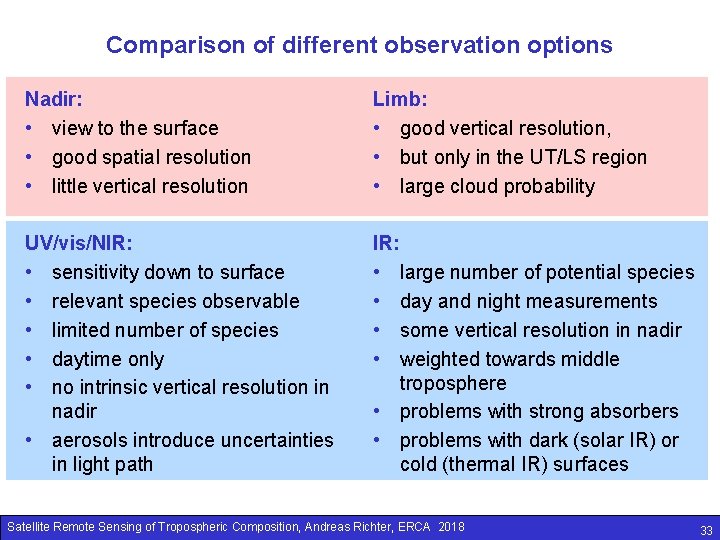
Comparison of different observation options Nadir: • view to the surface • good spatial resolution • little vertical resolution Limb: • good vertical resolution, • but only in the UT/LS region • large cloud probability UV/vis/NIR: • sensitivity down to surface • relevant species observable • limited number of species • daytime only • no intrinsic vertical resolution in nadir • aerosols introduce uncertainties in light path IR: • large number of potential species • day and night measurements • some vertical resolution in nadir • weighted towards middle troposphere • problems with strong absorbers • problems with dark (solar IR) or cold (thermal IR) surfaces Satellite Remote Sensing of Tropospheric Composition, Andreas Richter, ERCA 2018 33
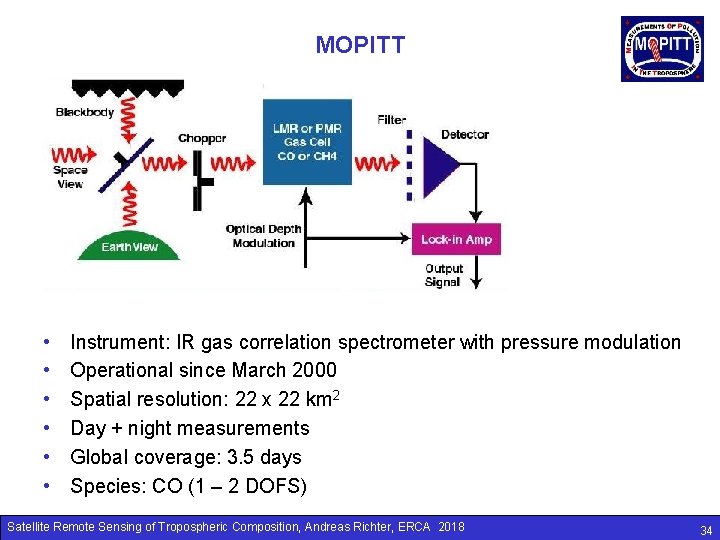
MOPITT • • • Instrument: IR gas correlation spectrometer with pressure modulation Operational since March 2000 Spatial resolution: 22 x 22 km 2 Day + night measurements Global coverage: 3. 5 days Species: CO (1 – 2 DOFS) Satellite Remote Sensing of Tropospheric Composition, Andreas Richter, ERCA 2018 34
CO total column [1018 moelc cm-2] MOPITT: CO column • • MOPITT CO column January 2009 Hemispheric gradient Topography Pollution in Asia Biomass burning in Africa http: //www. acd. ucar. edu/mopitt/ Satellite Remote Sensing of Tropospheric Composition, Andreas Richter, ERCA 2018 35
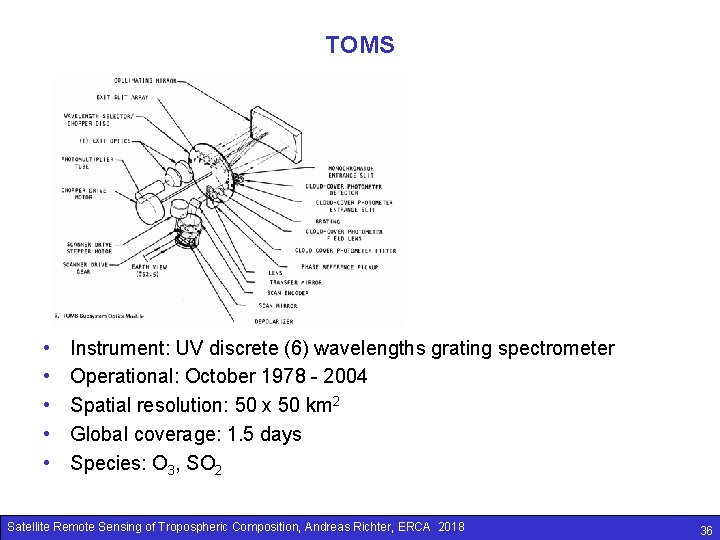
TOMS • • • Instrument: UV discrete (6) wavelengths grating spectrometer Operational: October 1978 - 2004 Spatial resolution: 50 x 50 km 2 Global coverage: 1. 5 days Species: O 3, SO 2 Satellite Remote Sensing of Tropospheric Composition, Andreas Richter, ERCA 2018 36
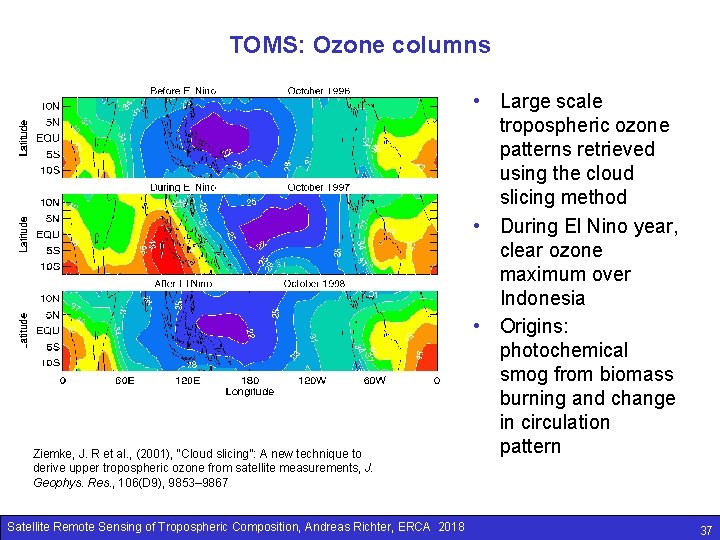
TOMS: Ozone columns Ziemke, J. R et al. , (2001), “Cloud slicing”: A new technique to derive upper tropospheric ozone from satellite measurements, J. Geophys. Res. , 106(D 9), 9853– 9867 Satellite Remote Sensing of Tropospheric Composition, Andreas Richter, ERCA 2018 • Large scale tropospheric ozone patterns retrieved using the cloud slicing method • During El Nino year, clear ozone maximum over Indonesia • Origins: photochemical smog from biomass burning and change in circulation pattern 37
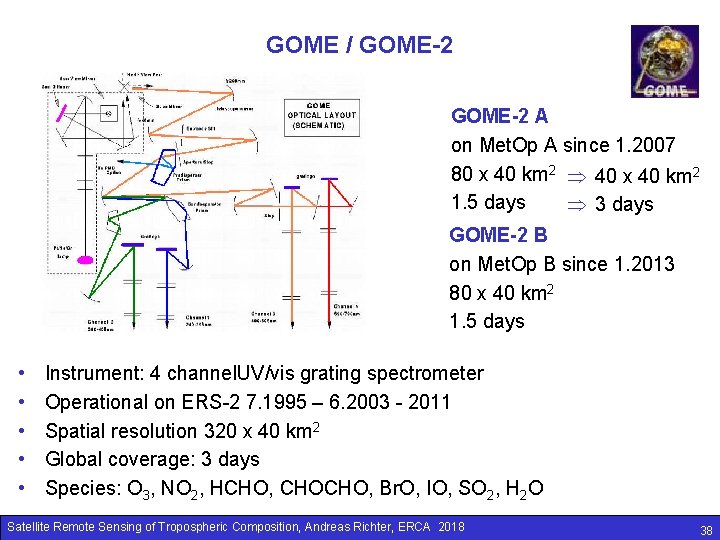
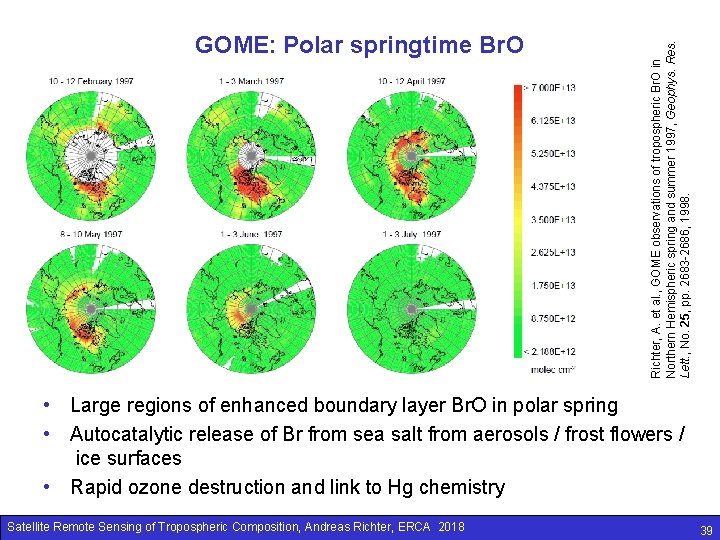
GOME / GOME-2 A on Met. Op A since 1. 2007 80 x 40 km 2 Þ 40 x 40 km 2 1. 5 days Þ 3 days GOME-2 B on Met. Op B since 1. 2013 80 x 40 km 2 1. 5 days • • • Instrument: 4 channel. UV/vis grating spectrometer Operational on ERS-2 7. 1995 – 6. 2003 - 2011 Spatial resolution 320 x 40 km 2 Global coverage: 3 days Species: O 3, NO 2, HCHO, CHOCHO, Br. O, IO, SO 2, H 2 O Satellite Remote Sensing of Tropospheric Composition, Andreas Richter, ERCA 2018 38
Richter, A. et al. , GOME observations of tropospheric Br. O in Northern Hemispheric spring and summer 1997, Geophys. Res. Lett. , No. 25, pp. 2683 -2686, 1998. GOME: Polar springtime Br. O • Large regions of enhanced boundary layer Br. O in polar spring • Autocatalytic release of Br from sea salt from aerosols / frost flowers / ice surfaces • Rapid ozone destruction and link to Hg chemistry Satellite Remote Sensing of Tropospheric Composition, Andreas Richter, ERCA 2018 39
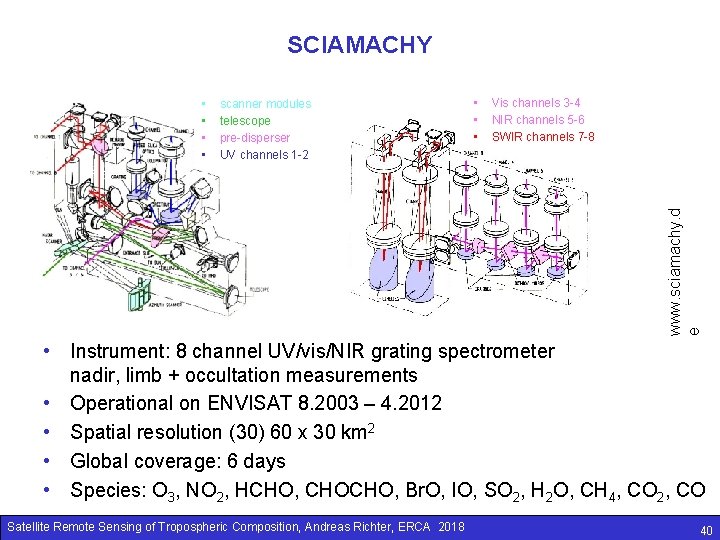
SCIAMACHY scanner modules telescope pre-disperser UV channels 1 -2 • • • Vis channels 3 -4 NIR channels 5 -6 SWIR channels 7 -8 www. sciamachy. d e • • • Instrument: 8 channel UV/vis/NIR grating spectrometer nadir, limb + occultation measurements • Operational on ENVISAT 8. 2003 – 4. 2012 • Spatial resolution (30) 60 x 30 km 2 • Global coverage: 6 days • Species: O 3, NO 2, HCHO, CHOCHO, Br. O, IO, SO 2, H 2 O, CH 4, CO 2, CO Satellite Remote Sensing of Tropospheric Composition, Andreas Richter, ERCA 2018 40
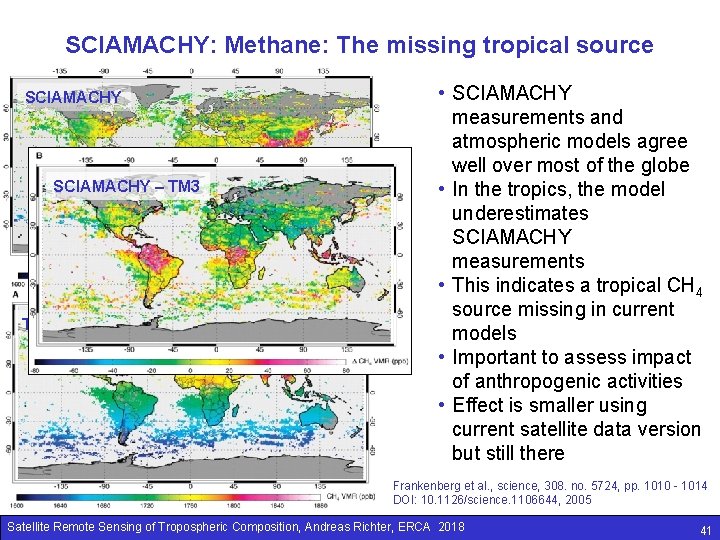
SCIAMACHY: Methane: The missing tropical source SCIAMACHY – TM 3 (model) • SCIAMACHY measurements and atmospheric models agree well over most of the globe • In the tropics, the model underestimates SCIAMACHY measurements • This indicates a tropical CH 4 source missing in current models • Important to assess impact of anthropogenic activities • Effect is smaller using current satellite data version but still there Frankenberg et al. , science, 308. no. 5724, pp. 1010 - 1014 DOI: 10. 1126/science. 1106644, 2005 Satellite Remote Sensing of Tropospheric Composition, Andreas Richter, ERCA 2018 41
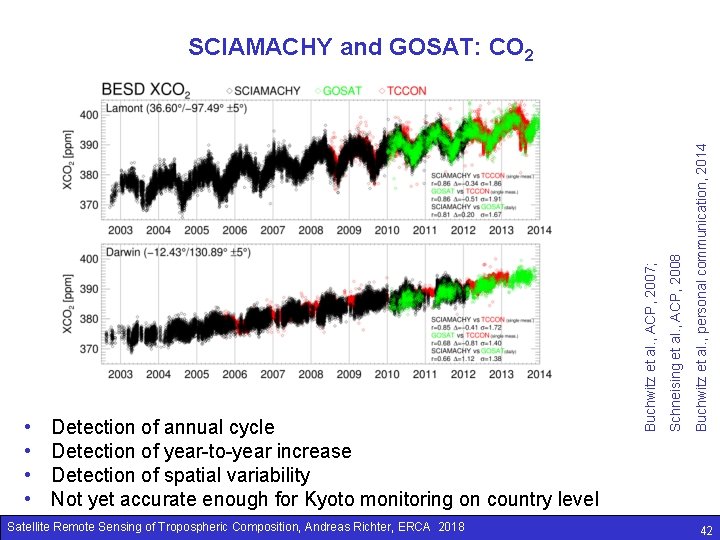
Satellite Remote Sensing of Tropospheric Composition, Andreas Richter, ERCA 2018 Buchwitz et al. , personal communication, 2014 Detection of annual cycle Detection of year-to-year increase Detection of spatial variability Not yet accurate enough for Kyoto monitoring on country level Schneising et al. , ACP, 2008 • • Buchwitz et al. , ACP, 2007; SCIAMACHY: CO 2 in the SCIAMACHY and. Northern GOSAT: Hemisphere CO 2 42
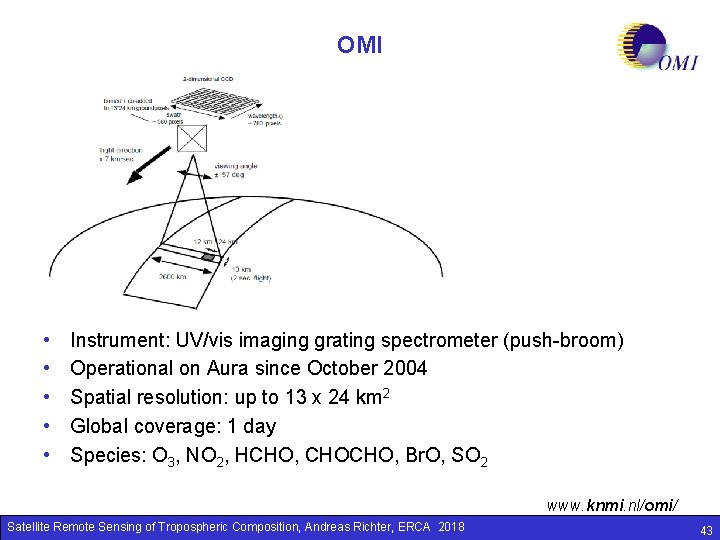
OMI • • • Instrument: UV/vis imaging grating spectrometer (push-broom) Operational on Aura since October 2004 Spatial resolution: up to 13 x 24 km 2 Global coverage: 1 day Species: O 3, NO 2, HCHO, CHOCHO, Br. O, SO 2 www. knmi. nl/omi/ Satellite Remote Sensing of Tropospheric Composition, Andreas Richter, ERCA 2018 43
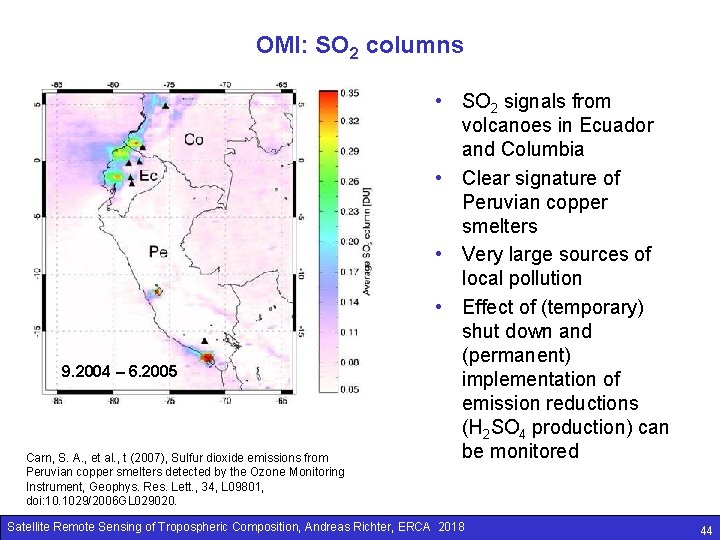
OMI: SO 2 columns 9. 2004 – 6. 2005 Carn, S. A. , et al. , t (2007), Sulfur dioxide emissions from Peruvian copper smelters detected by the Ozone Monitoring Instrument, Geophys. Res. Lett. , 34, L 09801, doi: 10. 1029/2006 GL 029020. • SO 2 signals from volcanoes in Ecuador and Columbia • Clear signature of Peruvian copper smelters • Very large sources of local pollution • Effect of (temporary) shut down and (permanent) implementation of emission reductions (H 2 SO 4 production) can be monitored Satellite Remote Sensing of Tropospheric Composition, Andreas Richter, ERCA 2018 44
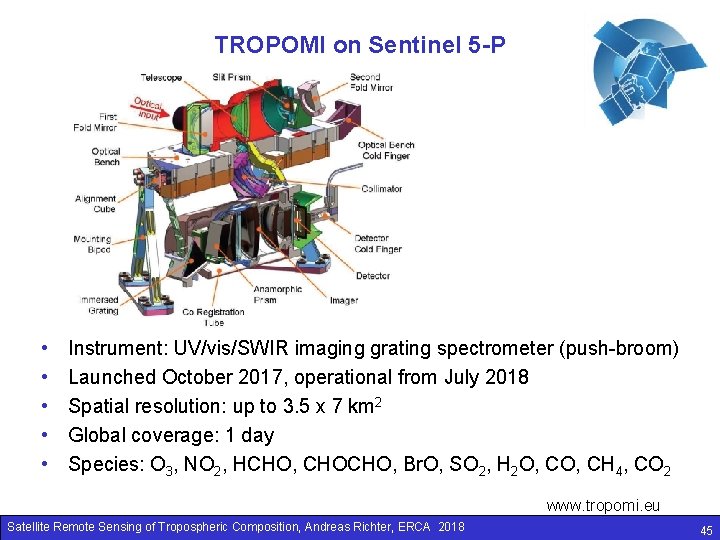
TROPOMI on Sentinel 5 -P • • • Instrument: UV/vis/SWIR imaging grating spectrometer (push-broom) Launched October 2017, operational from July 2018 Spatial resolution: up to 3. 5 x 7 km 2 Global coverage: 1 day Species: O 3, NO 2, HCHO, CHOCHO, Br. O, SO 2, H 2 O, CH 4, CO 2 www. tropomi. eu Satellite Remote Sensing of Tropospheric Composition, Andreas Richter, ERCA 2018 45
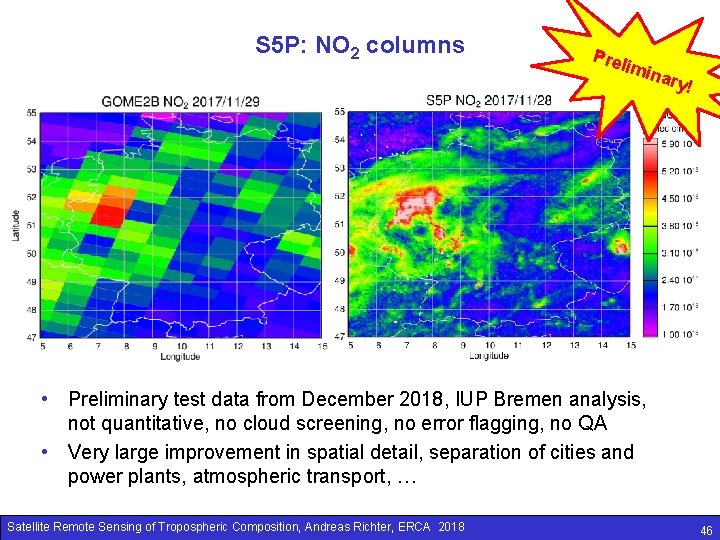
S 5 P: NO 2 columns Pre limi nary ! • Preliminary test data from December 2018, IUP Bremen analysis, not quantitative, no cloud screening, no error flagging, no QA • Very large improvement in spatial detail, separation of cities and power plants, atmospheric transport, … Satellite Remote Sensing of Tropospheric Composition, Andreas Richter, ERCA 2018 46
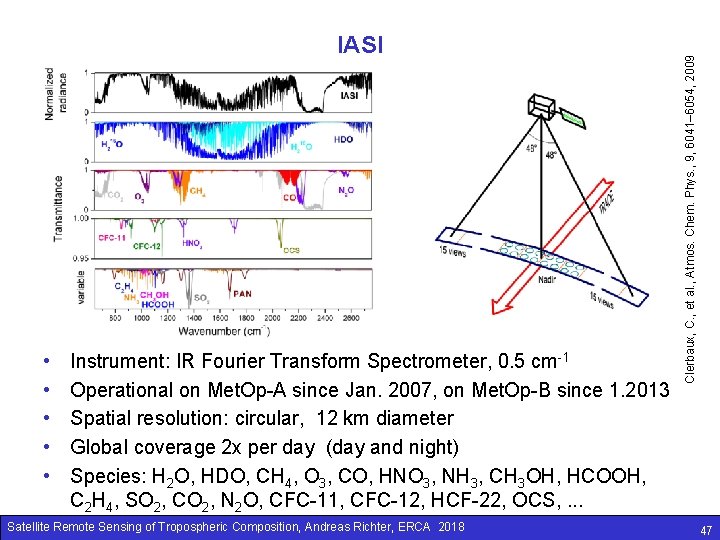
• • • Instrument: IR Fourier Transform Spectrometer, 0. 5 cm-1 Operational on Met. Op-A since Jan. 2007, on Met. Op-B since 1. 2013 Spatial resolution: circular, 12 km diameter Global coverage 2 x per day (day and night) Species: H 2 O, HDO, CH 4, O 3, CO, HNO 3, NH 3, CH 3 OH, HCOOH, C 2 H 4, SO 2, CO 2, N 2 O, CFC-11, CFC-12, HCF-22, OCS, . . . Satellite Remote Sensing of Tropospheric Composition, Andreas Richter, ERCA 2018 Clerbaux, C. , et al. , Atmos. Chem. Phys. , 9, 6041– 6054, 2009 IASI 47
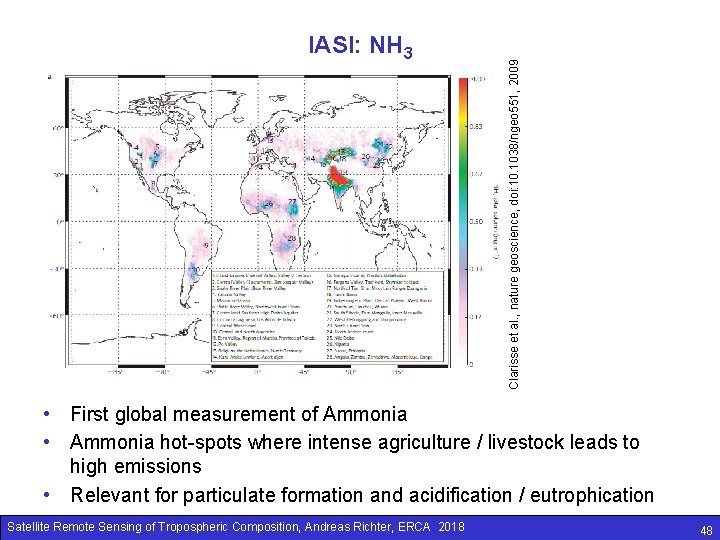
Clarisse et al. , nature geoscience, doi: 10. 1038/ngeo 551, 2009 IASI: NH 3 • First global measurement of Ammonia • Ammonia hot-spots where intense agriculture / livestock leads to high emissions • Relevant for particulate formation and acidification / eutrophication Satellite Remote Sensing of Tropospheric Composition, Andreas Richter, ERCA 2018 48
Summary and Conclusions • Satellite observations of tropospheric composition in the UV/vis, NIR and thermal IR provide consistent global datasets for many species including major air pollutants such as O 3, CO, NO 2, and HCHO • The measurements are averaged horizontally and vertically which makes them difficult to compare to point measurements • Remote sensing in an indirect method that necessitates use of a priori information in the data retrieval which has an impact on the results • Visible and NIR measurements provide good sensitivity to the boundary layer, thermal IR has intrinsic vertical information • In spite of the relative large uncertainties involved in satellite remote sensing, they provide a unique source of information on the composition of the troposphere Satellite Remote Sensing of Tropospheric Composition, Andreas Richter, ERCA 2018 49
What is the future of satellite measurements of tropospheric trace gases? • Satellite measurements will be improved by – Better spatial resolution (Sentinel 5 P, Sentinel 5, CARBONSAT) – Better temporal resolution (geostationary observations Sentinel 4) – Better coverage of species and vertical resolution (extension of the wavelengths covered (from UV to IR) – Better precision (higher spectral resolution in the IR) – High vertical resolution (active systems) • The usefulness of satellite data will be improved by better integration with other measurements • Satellite data will be strongly integrated in atmospheric models Satellite Remote Sensing of Tropospheric Composition, Andreas Richter, ERCA 2018 50
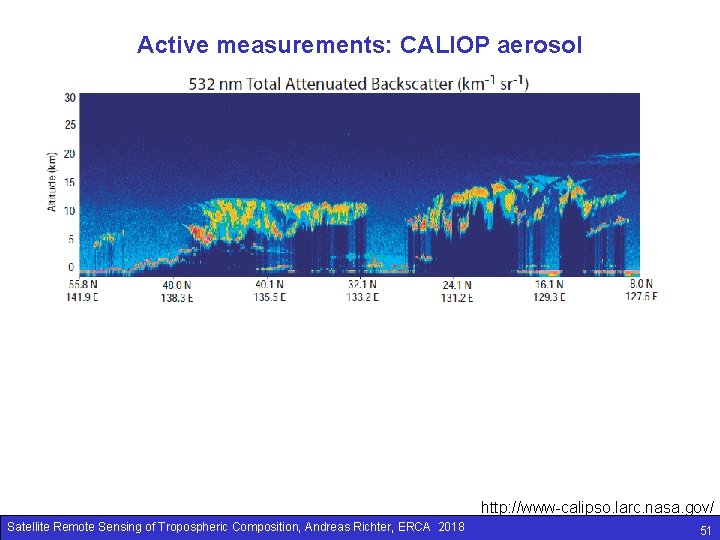
Active measurements: CALIOP aerosol http: //www-calipso. larc. nasa. gov/ Satellite Remote Sensing of Tropospheric Composition, Andreas Richter, ERCA 2018 51
Thank you for your attention and questions please! www. doas-bremen. de http: //www. animationlibrary. com/animation/25494/Alarm_jumps/ Satellite Remote Sensing of Tropospheric Composition, Andreas Richter, ERCA 2018 52