
Satellite Electrical Power System EPS Design Review Hayden

- Slides: 15
Satellite Electrical Power System (EPS) Design Review Hayden Waddle Joshua Stogsdill Stephen Maloney Travis Mc. Cullar
Abstract • The EPS system will be responsible for several functions including – Boosting input voltages from panels – Regulating battery charging and bus voltages – Sending telemetry to main controller • Commercially available systems - Clyde Space – More features, greater protection – Include same major functions (Voltage regulation, battery charge routines, temperature monitoring)
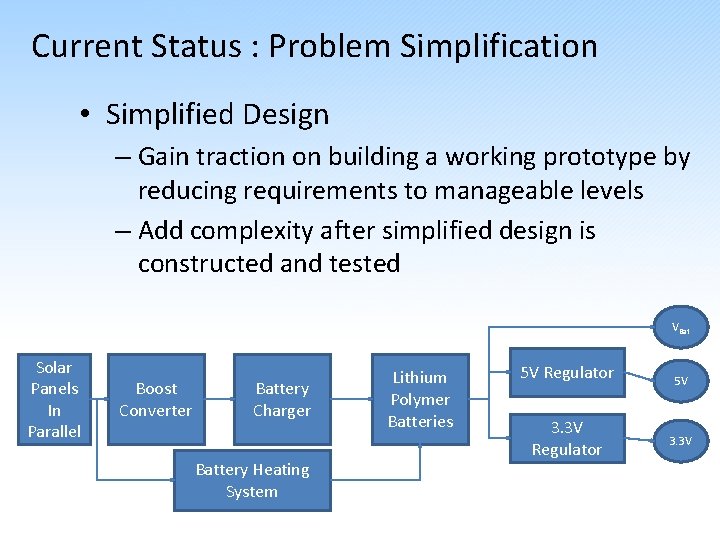
Current Status : Problem Simplification • Simplified Design – Gain traction on building a working prototype by reducing requirements to manageable levels – Add complexity after simplified design is constructed and tested VBat Solar Panels In Parallel Boost Converter Battery Charger Battery Heating System Lithium Polymer Batteries 5 V Regulator 3. 3 V Regulator 5 V 3. 3 V
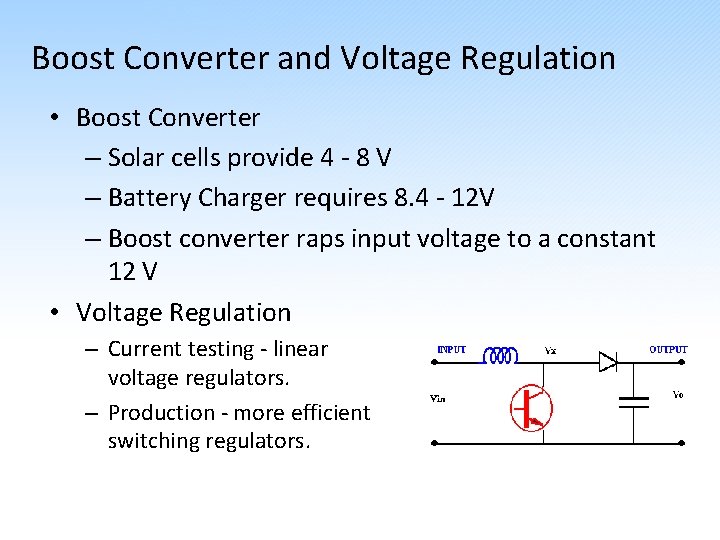
Boost Converter and Voltage Regulation • Boost Converter – Solar cells provide 4 - 8 V – Battery Charger requires 8. 4 - 12 V – Boost converter raps input voltage to a constant 12 V • Voltage Regulation – Current testing - linear voltage regulators. – Production - more efficient switching regulators.
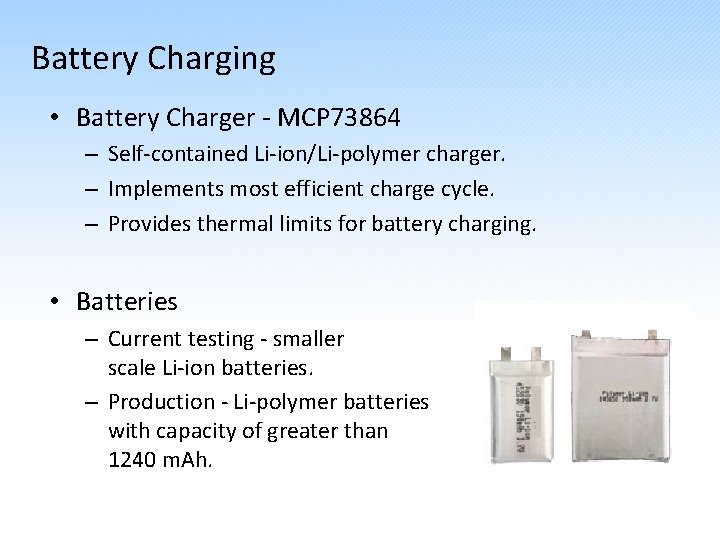
Battery Charging • Battery Charger - MCP 73864 – Self-contained Li-ion/Li-polymer charger. – Implements most efficient charge cycle. – Provides thermal limits for battery charging. • Batteries – Current testing - smaller scale Li-ion batteries. – Production - Li-polymer batteries with capacity of greater than 1240 m. Ah.
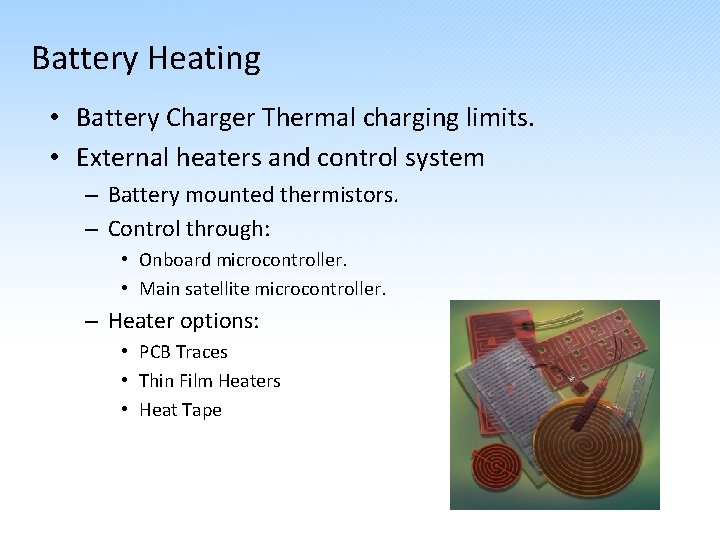
Battery Heating • Battery Charger Thermal charging limits. • External heaters and control system – Battery mounted thermistors. – Control through: • Onboard microcontroller. • Main satellite microcontroller. – Heater options: • PCB Traces • Thin Film Heaters • Heat Tape
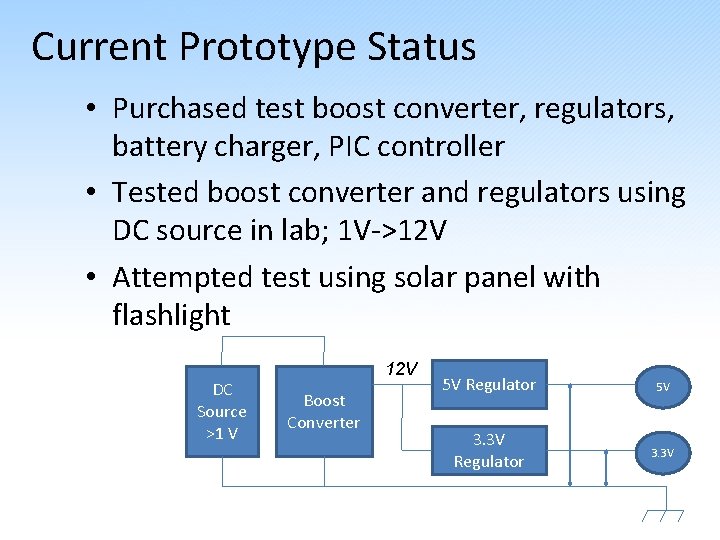
Current Prototype Status • Purchased test boost converter, regulators, battery charger, PIC controller • Tested boost converter and regulators using DC source in lab; 1 V->12 V • Attempted test using solar panel with flashlight DC Source >1 V 12 V Boost Converter 5 V Regulator 5 V 3. 3 V Regulator 3. 3 V
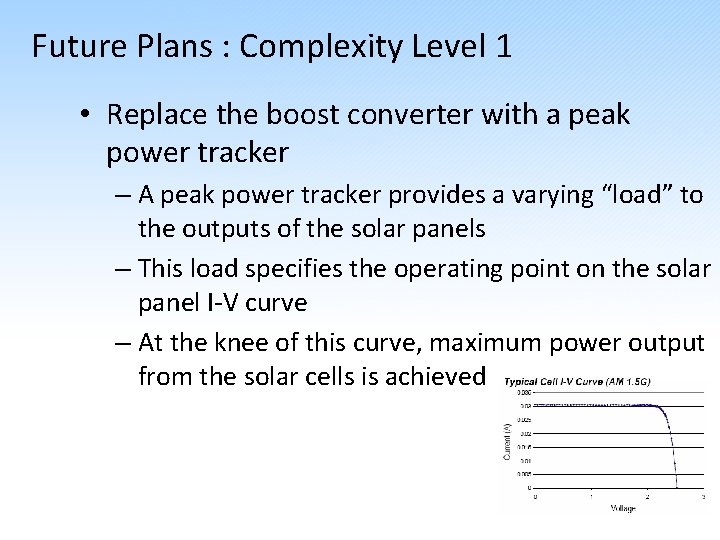
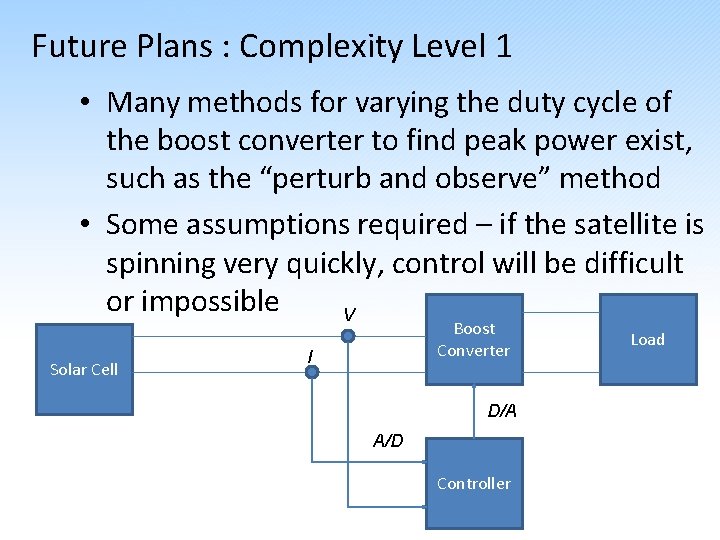
Future Plans : Complexity Level 1 • Replace the boost converter with a peak power tracker – A peak power tracker provides a varying “load” to the outputs of the solar panels – This load specifies the operating point on the solar panel I-V curve – At the knee of this curve, maximum power output from the solar cells is achieved
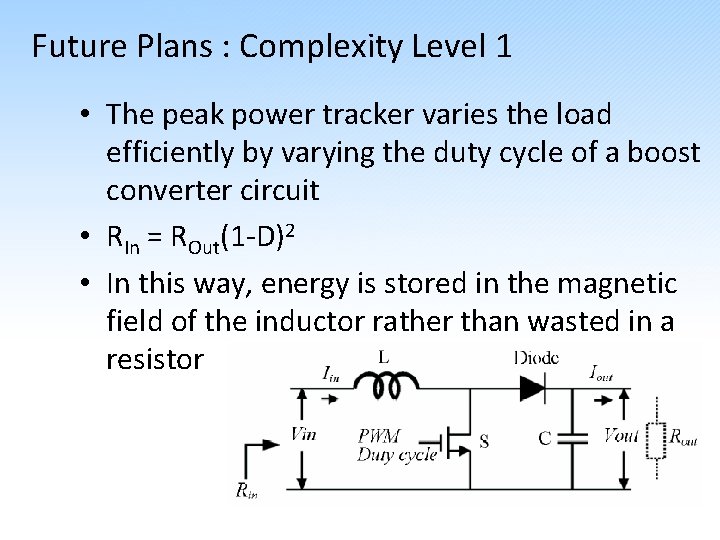
Future Plans : Complexity Level 1 • The peak power tracker varies the load efficiently by varying the duty cycle of a boost converter circuit • RIn = ROut(1 -D)2 • In this way, energy is stored in the magnetic field of the inductor rather than wasted in a resistor
Future Plans : Complexity Level 1 • Many methods for varying the duty cycle of the boost converter to find peak power exist, such as the “perturb and observe” method • Some assumptions required – if the satellite is spinning very quickly, control will be difficult or impossible V Solar Cell Boost Converter I D/A A/D Controller Load
Future Plans : Complexity Level 2 • Separate the solar cell panels from their parallel configuration and use a peak power tracker for each panel • This will allow telemetry output of individual panel voltage/current (useful for determining orientation and spin rate) • Telemetry output for battery voltage and charge status • Over-current protection for VBatt
Future Plans : Complexity Level 3 • Flight pin / footswitch integration • Temperature testing using a NASA weather balloon / Cryo-chamber • Battery coatings to prevent ballooning effect in space – Kapton coating • Design for satellites with more powerful solar panels to continue limited operation after battery death
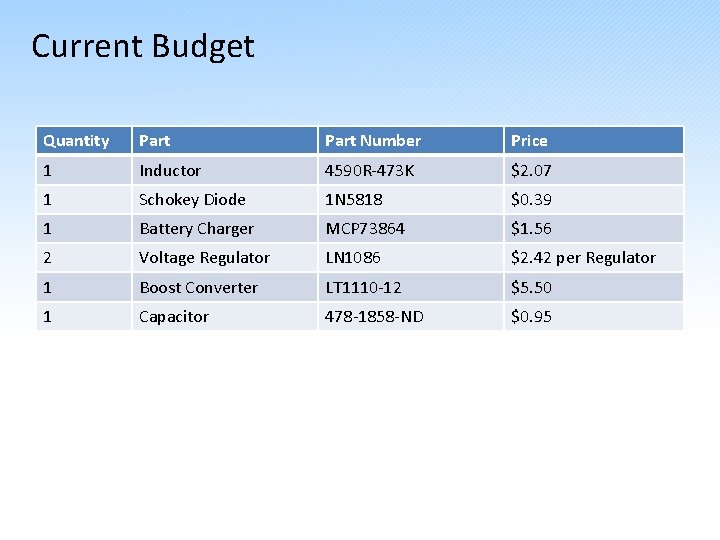
Current Budget Quantity Part Number Price 1 Inductor 4590 R-473 K $2. 07 1 Schokey Diode 1 N 5818 $0. 39 1 Battery Charger MCP 73864 $1. 56 2 Voltage Regulator LN 1086 $2. 42 per Regulator 1 Boost Converter LT 1110 -12 $5. 50 1 Capacitor 478 -1858 -ND $0. 95
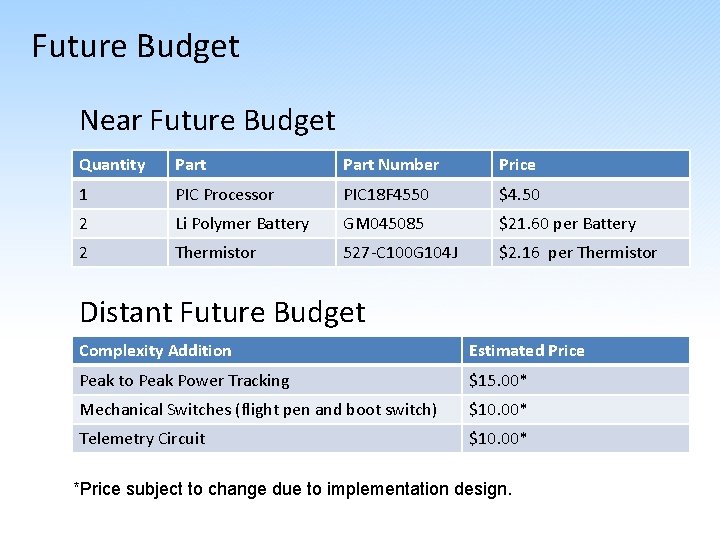
Future Budget Near Future Budget Quantity Part Number Price 1 PIC Processor PIC 18 F 4550 $4. 50 2 Li Polymer Battery GM 045085 $21. 60 per Battery 2 Thermistor 527 -C 100 G 104 J $2. 16 per Thermistor Distant Future Budget Complexity Addition Estimated Price Peak to Peak Power Tracking $15. 00* Mechanical Switches (flight pen and boot switch) $10. 00* Telemetry Circuit $10. 00* *Price subject to change due to implementation design.
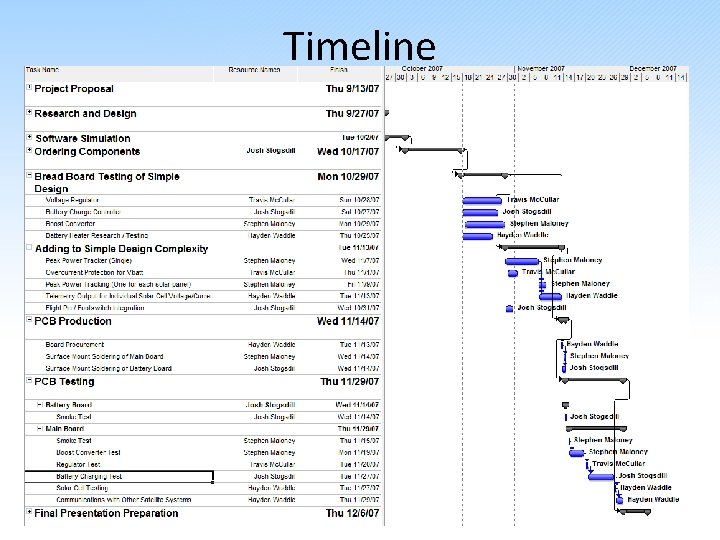
Timeline