
Satellite Design Lab Aerospace Engineering Cube SatSized GNSS
Satellite Design Lab Aerospace Engineering Cube. Sat-Sized GNSS Radio Occultation Experiments Todd Humphreys, UT Austin Aerospace Dept. MIT Enrichment Lecture | December 1, 2011
Acknowledgements § Radionavigation Lab graduate students Daniel Shepard § § and Jahshan Bhatti: FOTON receiver development Glenn Lightsey (UT): Director of UT Satellite Design Lab, FOTON collaborator Steve Powell, Brady O’Hanlon, Mark Psiaki (Cornell): FOTON collaborators Oliver Montenbruck (DLR): Shared latest results and thinking on COTS GPSRO/POD Rebecca Bishop (Aerospace Corp. ): Shared performance results of CTECS instrument Satellite Design Lab Aerospace Engineering
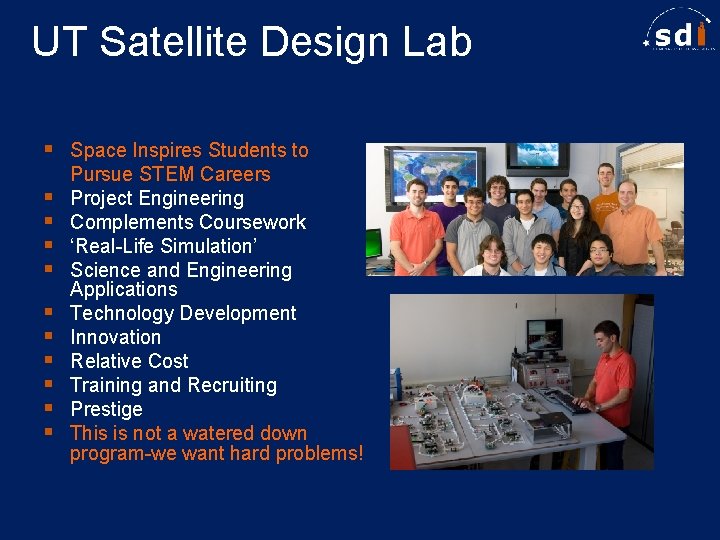
UT Satellite Design Lab § Space Inspires Students to § § § § § Pursue STEM Careers Project Engineering Complements Coursework ‘Real-Life Simulation’ Science and Engineering Applications Technology Development Innovation Relative Cost Training and Recruiting Prestige This is not a watered down program-we want hard problems!
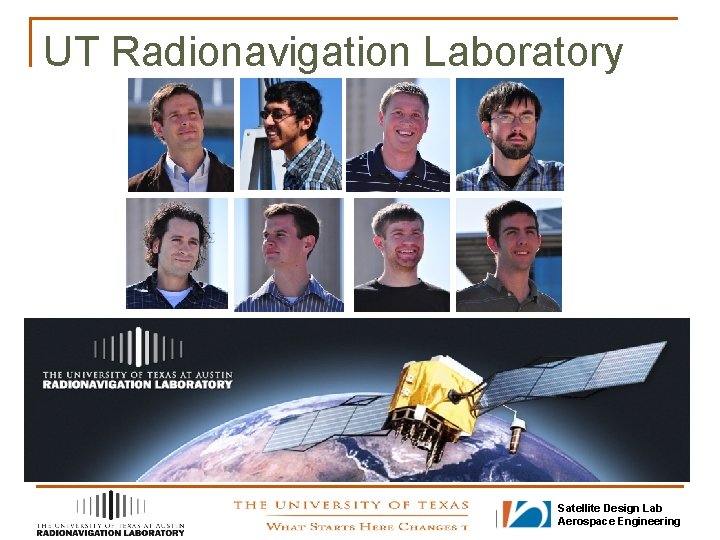
UT Radionavigation Laboratory Satellite Design Lab Aerospace Engineering
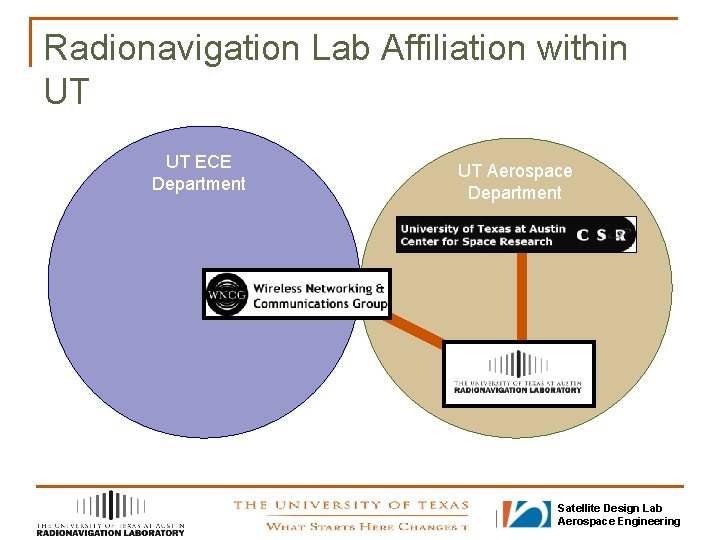
Radionavigation Lab Affiliation within UT UT ECE Department UT Aerospace Department Satellite Design Lab Aerospace Engineering
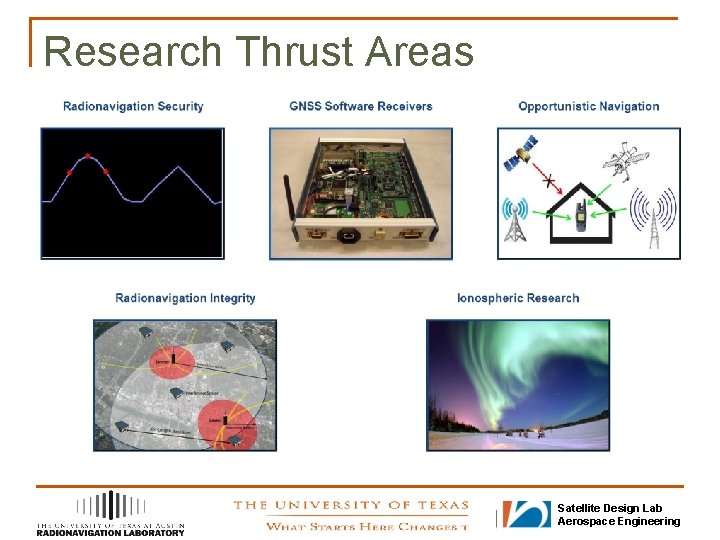
Research Thrust Areas Satellite Design Lab Aerospace Engineering
A Literary Experiment Q: What GPS applications have caught the attention of the broader science community? A: Not many. Consider a search of Science article titles for “Global Positioning System”: Global Positioning System Measurements for Crustal Deformation: Precision and Accuracy Prescott et al. , Science 16 June 1989: 1337 -1340. Initial Results of Radio Occultation Observations of Earth's Atmosphere Using the Global Positioning System Kursinski et al. , Science 23 February 1996: 1107 -1110. Present-Day Crustal Deformation in China Constrained by Global Positioning System Measurements Wang et al. , Science 19 October 2001: 574 -577. Satellite Design Lab Aerospace Engineering
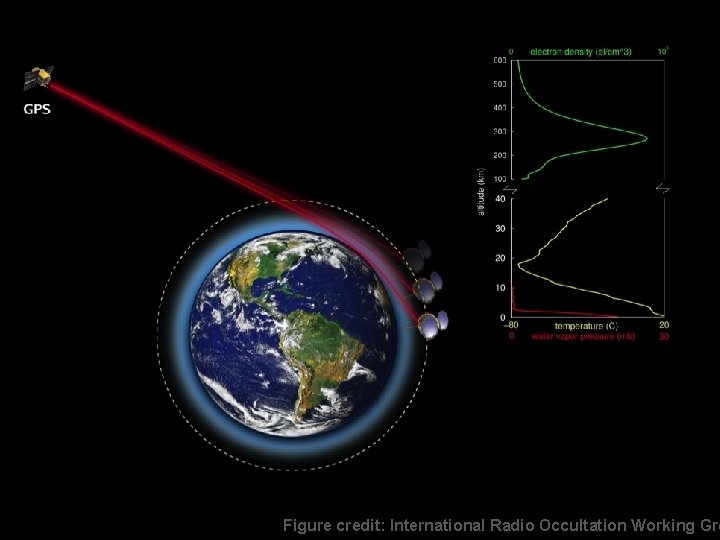
Figure credit: International Radio Occultation Working Gro
Scientific advance is often driven by instrumentation Q: How can GNSSRO deliver better science? A: • Deeper soundings (to surface if possible) • More soundings • Lower latency • Richer measurements (e. g. , finer time resolution, finer resolution of correlation function)

Miniaturization Proliferation Modernization Estimation Smaller, cheaper, less power-hungry GPSRO devices enable small-satellite deployment Blackjack/IGOR Receiver 4 kg, 16 -22 W, 24 x 10 x 20 cm ~$1 M SACC, GRACE, CHAMP, COSMIC, TERRA SAR-X Pyxis Receiver <2 kg, 12 -18 W 12 x 8 x 20 cm ~$500 k Under development COTS Receiver <200 g, < 1. 5 W 120 cm^3 $10 -80 k CANX-2 (2008) PSSC 2 (2011)
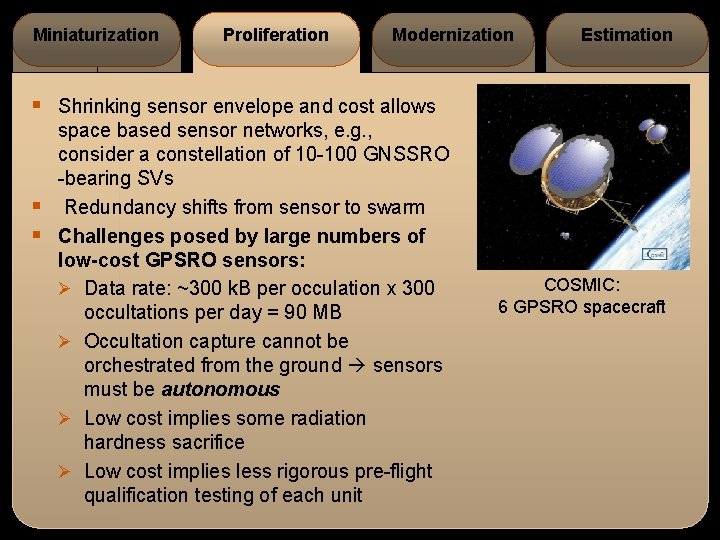
Miniaturization Proliferation Modernization Estimation § Shrinking sensor envelope and cost allows § § space based sensor networks, e. g. , consider a constellation of 10 -100 GNSSRO -bearing SVs Redundancy shifts from sensor to swarm Challenges posed by large numbers of low-cost GPSRO sensors: Ø Data rate: ~300 k. B per occulation x 300 occultations per day = 90 MB Ø Occultation capture cannot be orchestrated from the ground sensors must be autonomous Ø Low cost implies some radiation hardness sacrifice Ø Low cost implies less rigorous pre-flight qualification testing of each unit COSMIC: 6 GPSRO spacecraft
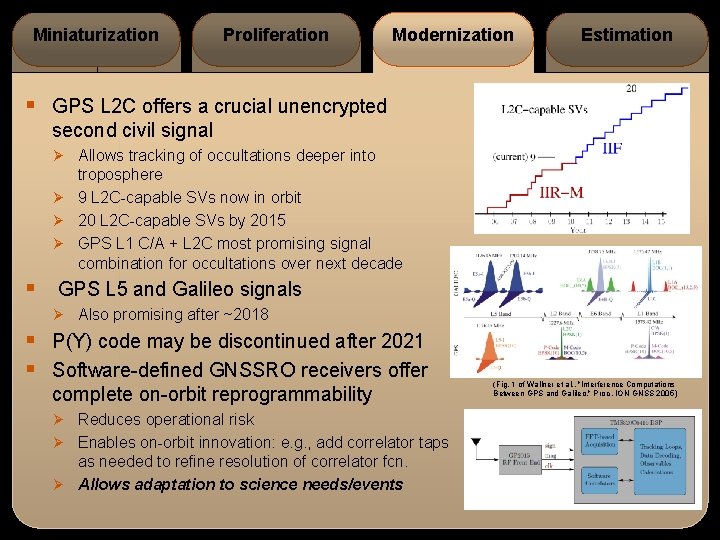
Miniaturization Proliferation Modernization Estimation § GPS L 2 C offers a crucial unencrypted second civil signal Ø Allows tracking of occultations deeper into troposphere Ø 9 L 2 C-capable SVs now in orbit Ø 20 L 2 C-capable SVs by 2015 Ø GPS L 1 C/A + L 2 C most promising signal combination for occultations over next decade § GPS L 5 and Galileo signals Ø Also promising after ~2018 § P(Y) code may be discontinued after 2021 § Software-defined GNSSRO receivers offer complete on-orbit reprogrammability Ø Reduces operational risk Ø Enables on-orbit innovation: e. g. , add correlator taps as needed to refine resolution of correlator fcn. Ø Allows adaptation to science needs/events (Fig. 1 of Wallner et al. , "Interference Computations Between GPS and Galileo, " Proc. ION GNSS 2005)
Miniaturization Proliferation Modernization § Challenge: Need good measurement quality despite low-cost and small size of GNSSRO sensors Ø Climate science requires accurate, consistent measurements Ø If large, high-gain antennas can’t be accommodated, can sensitivity loss be compensated in signal processing? Ø Specialized open-loop tracking required to push deep into troposphere Ø Phase measurements must be CDGPS-ready to enable precise orbit determination (Topstar receiver by Alcatel fails this req’t) § Challenge: Atmospheric assimilative models should be modified to ingest raw carrier phase and TEC measurements from occultations Ø Abel transform an unnecessary step? § Challenge: To ease data downlink burden, ionospheric science parameters such as TEC, S 4, tau 0, sigma. Phi should be estimated on-orbit Estimation
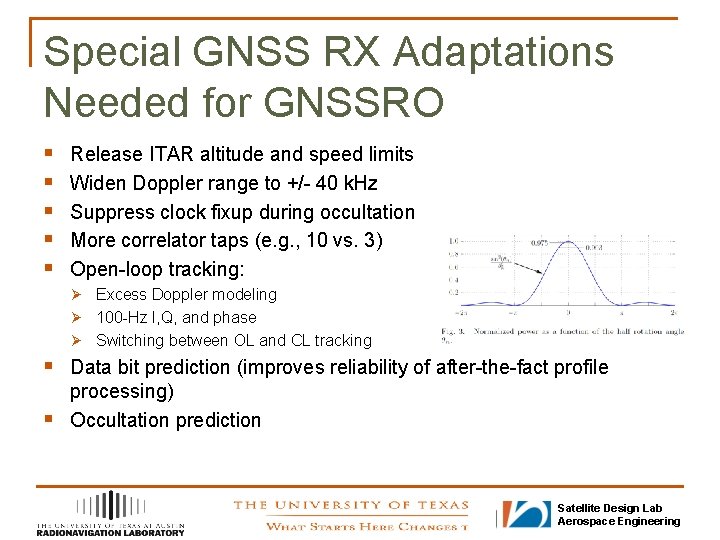
Special GNSS RX Adaptations Needed for GNSSRO § § § Release ITAR altitude and speed limits Widen Doppler range to +/- 40 k. Hz Suppress clock fixup during occultation More correlator taps (e. g. , 10 vs. 3) Open-loop tracking: Ø Excess Doppler modeling Ø 100 -Hz I, Q, and phase Ø Switching between OL and CL tracking § Data bit prediction (improves reliability of after-the-fact profile § processing) Occultation prediction Satellite Design Lab Aerospace Engineering
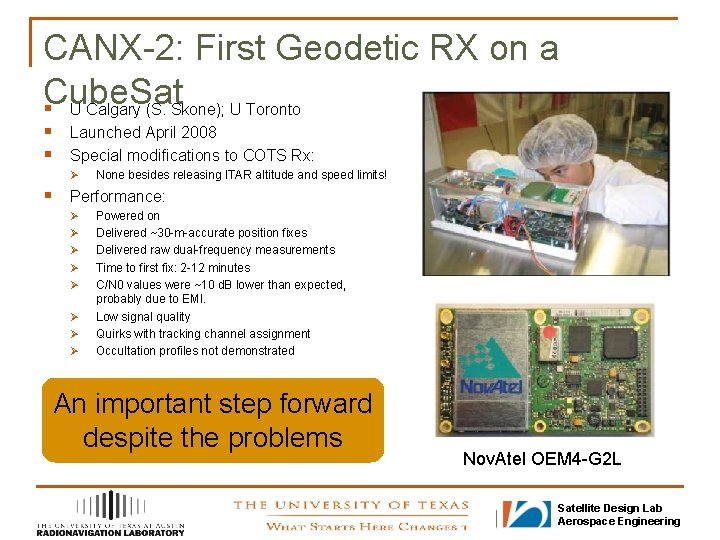
CANX-2: First Geodetic RX on a Cube. Sat § U Calgary (S. Skone); U Toronto § Launched April 2008 § Special modifications to COTS Rx: Ø None besides releasing ITAR altitude and speed limits! § Performance: Ø Ø Ø Ø Powered on Delivered ~30 -m-accurate position fixes Delivered raw dual-frequency measurements Time to first fix: 2 -12 minutes C/N 0 values were ~10 d. B lower than expected, probably due to EMI. Low signal quality Quirks with tracking channel assignment Occultation profiles not demonstrated An important step forward despite the problems Nov. Atel OEM 4 -G 2 L Satellite Design Lab Aerospace Engineering
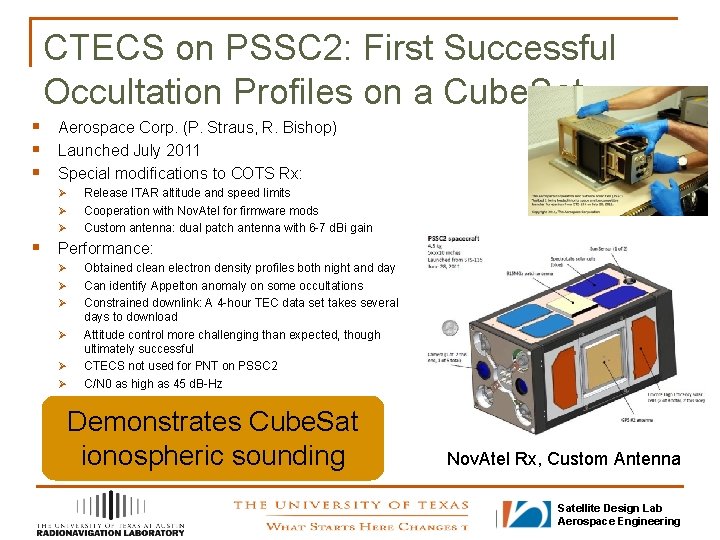
CTECS on PSSC 2: First Successful Occultation Profiles on a Cube. Sat § Aerospace Corp. (P. Straus, R. Bishop) § Launched July 2011 § Special modifications to COTS Rx: Ø Ø Ø Release ITAR altitude and speed limits Cooperation with Nov. Atel for firmware mods Custom antenna: dual patch antenna with 6 -7 d. Bi gain § Performance: Ø Ø Ø Obtained clean electron density profiles both night and day Can identify Appelton anomaly on some occultations Constrained downlink: A 4 -hour TEC data set takes several days to download Attitude control more challenging than expected, though ultimately successful CTECS not used for PNT on PSSC 2 C/N 0 as high as 45 d. B-Hz Demonstrates Cube. Sat ionospheric sounding Nov. Atel Rx, Custom Antenna Satellite Design Lab Aerospace Engineering
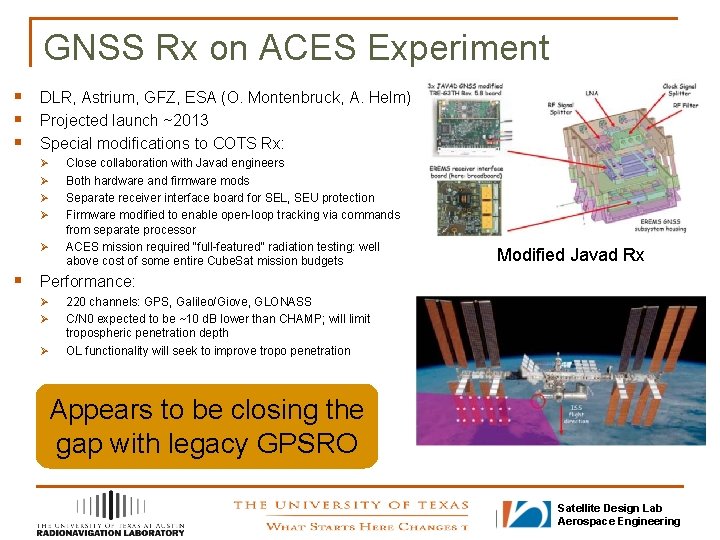
GNSS Rx on ACES Experiment § DLR, Astrium, GFZ, ESA (O. Montenbruck, A. Helm) § Projected launch ~2013 § Special modifications to COTS Rx: Ø Ø Ø Close collaboration with Javad engineers Both hardware and firmware mods Separate receiver interface board for SEL, SEU protection Firmware modified to enable open-loop tracking via commands from separate processor ACES mission required “full-featured” radiation testing: well above cost of some entire Cube. Sat mission budgets Modified Javad Rx § Performance: Ø Ø Ø 220 channels: GPS, Galileo/Giove, GLONASS C/N 0 expected to be ~10 d. B lower than CHAMP; will limit tropospheric penetration depth OL functionality will seek to improve tropo penetration Appears to be closing the gap with legacy GPSRO Satellite Design Lab Aerospace Engineering
Since 2008, The University of Texas, Cornell, and ASTRA LLC have been developing a dual-frequency, softwaredefined, embeddable GPS-based spaceweather sensor. Satellite Design Lab Aerospace Engineering
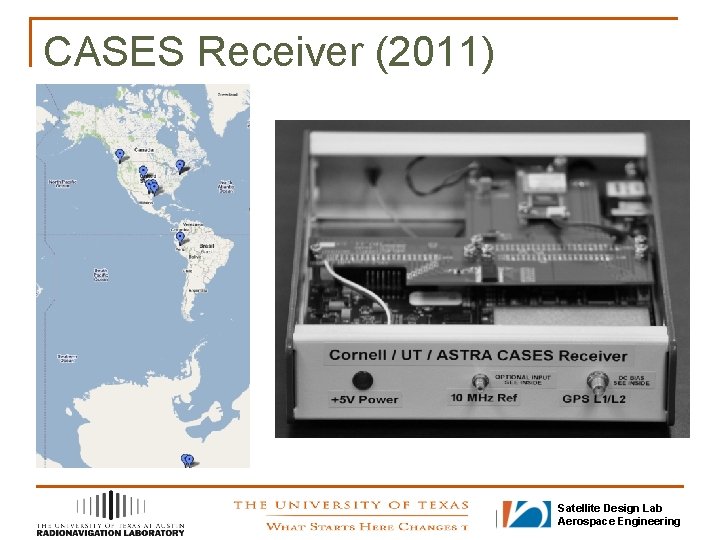
CASES Receiver (2011) Satellite Design Lab Aerospace Engineering
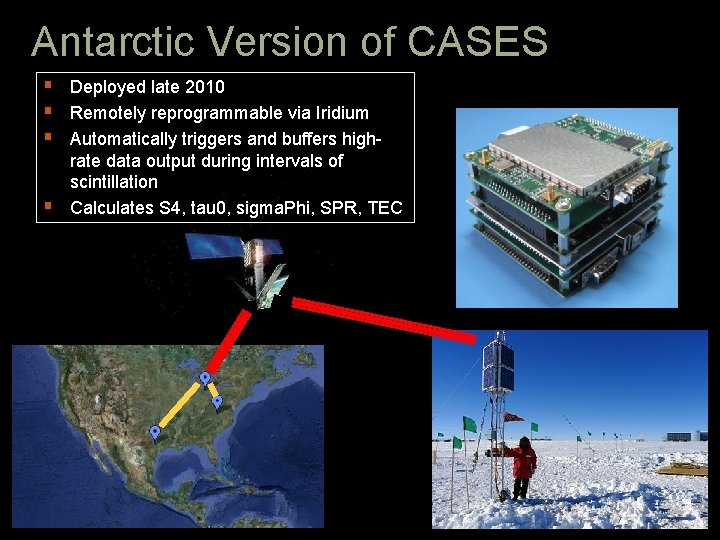
Antarctic Version of CASES § Deployed late 2010 § Remotely reprogrammable via Iridium § Automatically triggers and buffers high§ rate data output during intervals of scintillation Calculates S 4, tau 0, sigma. Phi, SPR, TEC
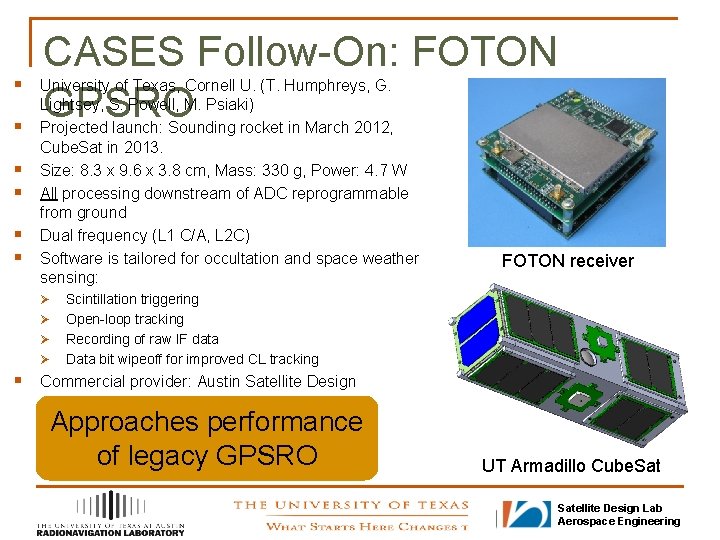
CASES Follow-On: FOTON GPSRO § University of Texas, Cornell U. (T. Humphreys, G. § § § Lightsey, S. Powell, M. Psiaki) Projected launch: Sounding rocket in March 2012, Cube. Sat in 2013. Size: 8. 3 x 9. 6 x 3. 8 cm, Mass: 330 g, Power: 4. 7 W All processing downstream of ADC reprogrammable from ground Dual frequency (L 1 C/A, L 2 C) Software is tailored for occultation and space weather sensing: Ø Ø FOTON receiver Scintillation triggering Open-loop tracking Recording of raw IF data Data bit wipeoff for improved CL tracking § Commercial provider: Austin Satellite Design Approaches performance of legacy GPSRO UT Armadillo Cube. Satellite Design Lab Aerospace Engineering
Cube. Sat enthusiast’s view: We’ll launch hundreds of Cube. Sats with low-cost but high-performance GNSSRO sensors! This will usher in a revolution in tropospheric and ionospheric situational awareness and forecasting! But those who know most about occultations (e. g. , JPL, UCAR, GFZ, DLR) aren’t targeting Cube. Sat platforms. Why? Satellite Design Lab Aerospace Engineering
Primary challenge in moving to smaller platforms: less space for high-gain antennas and multiple antennas • Cube. Sat surface area economy suggests single, wide FOV antenna for both occultations and POD • Loss of 5 -10 d. B C/N 0 for occulting SV compared to CHAMP helical antenna & Terra. SAR-X phased array antenna Satellite Design Lab Aerospace Engineering
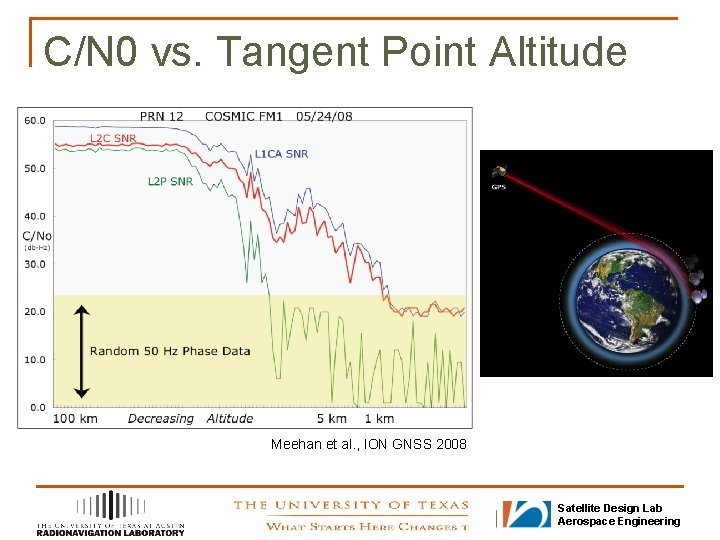
C/N 0 vs. Tangent Point Altitude Meehan et al. , ION GNSS 2008 Satellite Design Lab Aerospace Engineering
The challenge of improving occultation C/N 0 on Cube. Sats can be overcome if there is enough of an incentive. But incentive is linked to economics. We may never need enough Cube. Satsized occultation experiments to make it worthwhile economically to develop a high-performance, low-cost, low SWa. P GNSSRO sensor. Satellite Design Lab Aerospace Engineering
Key question for Cube. Sat GNSSRO: Do we really need continually-replenished swarms of 100 s of GNSSRO sensors? • Climate science: 6 COSMIC and 12 COSMIC II will be plenty • Tropospheric weather: Utility beyond 12 COSMIC II is questionable except for monitoring cyclones • Space weather: Continuous, lowlatency coverage with 100 SVs would be useful Satellite Design Lab Aerospace Engineering
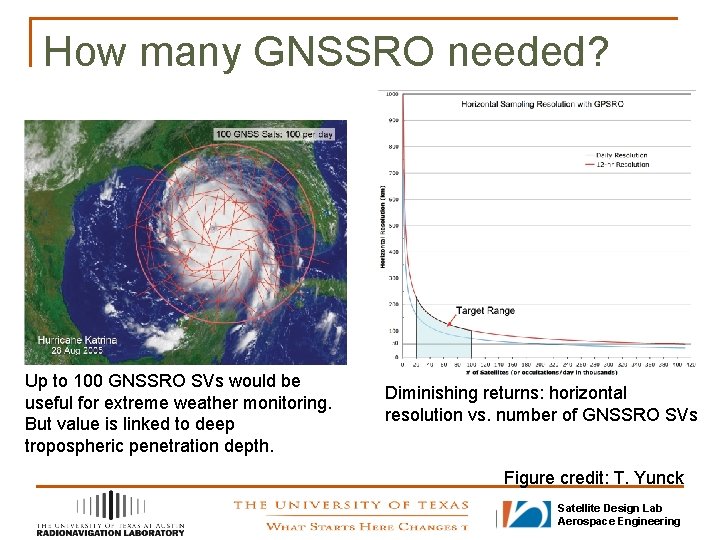
How many GNSSRO needed? Up to 100 GNSSRO SVs would be useful for extreme weather monitoring. But value is linked to deep tropospheric penetration depth. Diminishing returns: horizontal resolution vs. number of GNSSRO SVs Figure credit: T. Yunck Satellite Design Lab Aerospace Engineering
Whereas it is clear that more occultations will benefit space weather observation and prediction (because of the rapid variability of the ionosphere), it is less clear that more “deep troposphere” occultations than those that will be provided by the proposed COSMIC II mission (12 SVs) would significantly improve tropospheric weather forecasting, except possibly in the case of cyclones. Thus, perhaps the emphasis of Cube. Sat GNSSRO should be limited to ionospheric sounding. Satellite Design Lab Aerospace Engineering
More Information http: //radionavlab. ae. utexas. edu Satellite Design Lab Aerospace Engineering
- Slides: 29