
SAT Suite of Assessments EvidenceBased Reading and Writing
SAT® Suite of Assessments: Evidence-Based Reading and Writing Section Self-guided Course 2
Self-Guided Courses for Educators for the SAT® Suite of Assessments Course 1 Key Features Course 2 Evidence-Based Reading and Writing Course 3 Math That Matters Most Course 4 The SAT Suite of Assessments: Using Scores and Reporting to Inform Instruction Course 5 Connecting History/Social Studies Instruction with the SAT Suite of Assessments Course 6 Connecting Science Instruction with the SAT Suite of Assessments Course 7 The SAT Essay Course 8 Supporting Students with Official SAT Practice on Khan Academy TM 4
What Do Students Need to Know for Post-High School Success? The College Board has identified a critical set of knowledge, skills, and understandings that predict student success in college and workforce training programs: • • • Comprehend challenging literary and informational texts Revise and edit extended texts Show command of math, especially algebra and data analysis Use evidence in reading and writing Analyze data Use and understand words in context 6
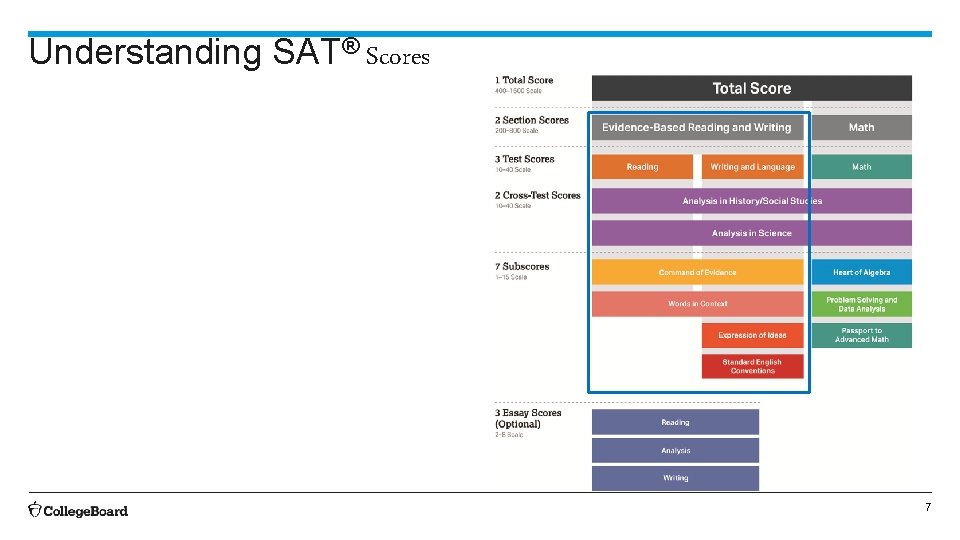
Understanding SAT® Scores 7
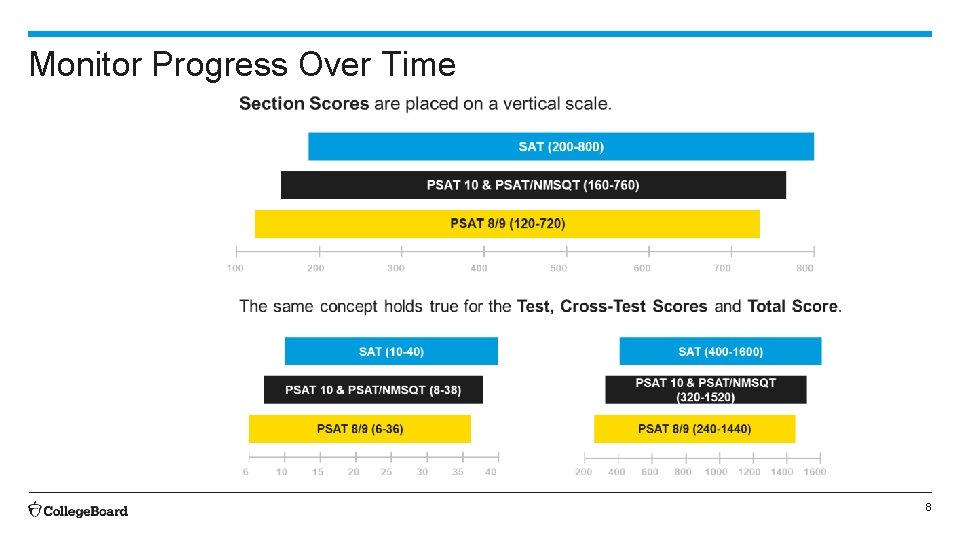
Monitor Progress Over Time 8
The SAT Suite of Assessments: Reading Test and Writing and Language Test
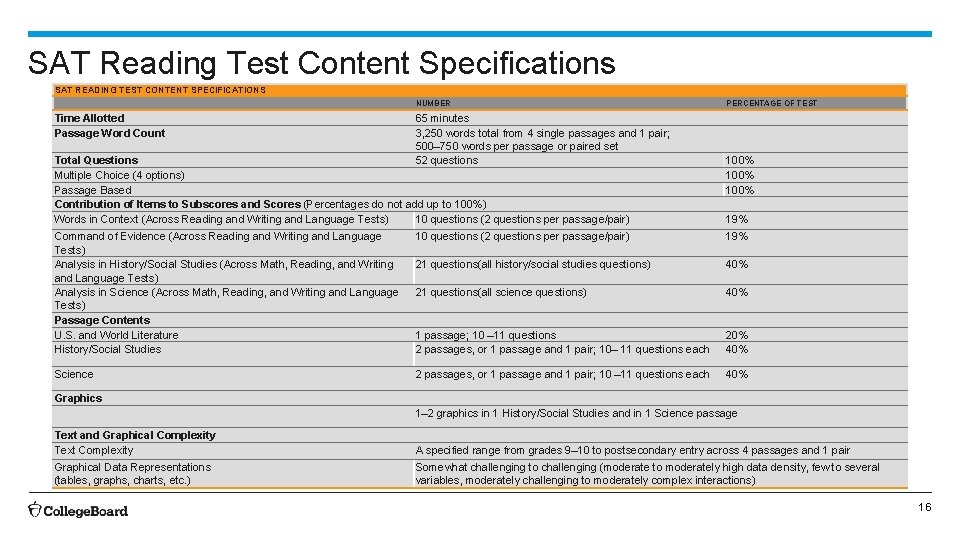
SAT Reading Test Content Specifications SAT READING TEST CONTENT SPECIFICATIONS Time Allotted Passage Word Count NUMBER 65 minutes 3, 250 words total from 4 single passages and 1 pair; 500– 750 words per passage or paired set 52 questions PERCENTAGE OF TEST Total Questions Multiple Choice (4 options) Passage Based Contribution of Items to Subscores and Scores (Percentages do not add up to 100%) Words in Context (Across Reading and Writing and Language Tests) 10 questions (2 questions per passage/pair) 100% Command of Evidence (Across Reading and Writing and Language Tests) Analysis in History/Social Studies (Across Math, Reading, and Writing and Language Tests) Analysis in Science (Across Math, Reading, and Writing and Language Tests) Passage Contents U. S. and World Literature History/Social Studies 10 questions (2 questions per passage/pair) 19% 21 questions(all history/social studies questions) 40% 21 questions(all science questions) 40% 1 passage; 10 – 11 questions 2 passages, or 1 passage and 1 pair; 10– 11 questions each 20% 40% Science 2 passages, or 1 passage and 1 pair; 10 – 11 questions each 40% 19% Graphics 1– 2 graphics in 1 History/Social Studies and in 1 Science passage Text and Graphical Complexity Text Complexity A specified range from grades 9– 10 to postsecondary entry across 4 passages and 1 pair Graphical Data Representations (tables, graphs, charts, etc. ) Somewhat challenging to challenging (moderate to moderately high data density, few to several variables, moderately challenging to moderately complex interactions) 16
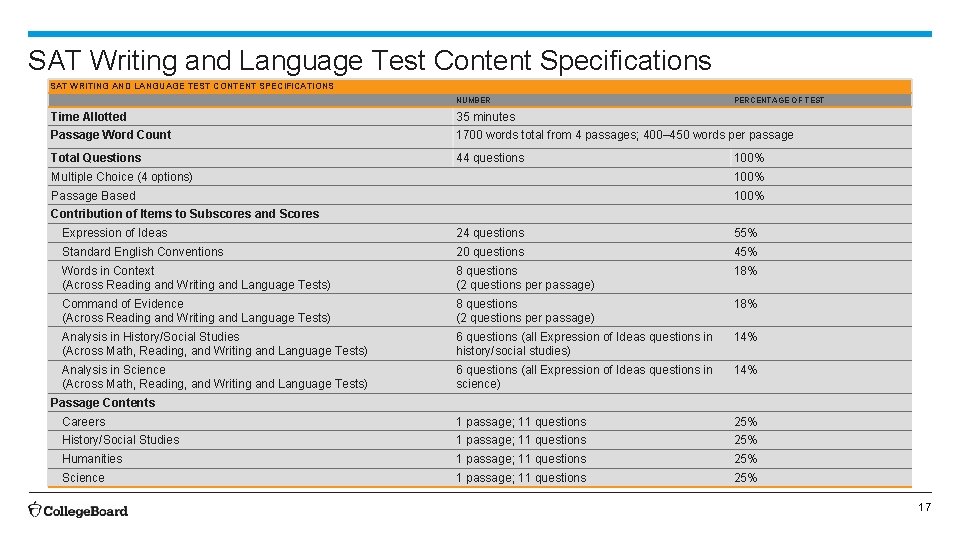
SAT Writing and Language Test Content Specifications SAT WRITING AND LANGUAGE TEST CONTENT SPECIFICATIONS NUMBER PERCENTAGE OF TEST Time Allotted 35 minutes Passage Word Count 1700 words total from 4 passages; 400– 450 words per passage Total Questions 44 questions 100% Multiple Choice (4 options) 100% Passage Based 100% Contribution of Items to Subscores and Scores Expression of Ideas 24 questions 55% Standard English Conventions 20 questions 45% Words in Context (Across Reading and Writing and Language Tests) 8 questions (2 questions per passage) 18% Command of Evidence (Across Reading and Writing and Language Tests) 8 questions (2 questions per passage) 18% Analysis in History/Social Studies (Across Math, Reading, and Writing and Language Tests) 6 questions (all Expression of Ideas questions in history/social studies) 14% Analysis in Science (Across Math, Reading, and Writing and Language Tests) 6 questions (all Expression of Ideas questions in science) 14% Careers 1 passage; 11 questions 25% History/Social Studies 1 passage; 11 questions 25% Humanities 1 passage; 11 questions 25% Science 1 passage; 11 questions 25% Passage Contents 17
SAT® Reading Test Features Single and paired passages Cross disciplinary contexts - US and world literature, History/social studies, Science. Informational graphics Focus on: § Words in context § Command of evidence 18
SAT® Writing and Language Test Features Passage based Multiple text types: argument, informative, nonfiction narrative Informational graphics Focus on: § § Expression of ideas Standard English conventions Words in context Command of evidence 19
Words in Context Students are asked to: • Master relevant vocabulary • Engage in close reading Reading Test: • Students will determine the meaning of vocabulary in context • Students will analyze word choice rhetorically Writing and Language Test • Students will improve the precision, concision, and context appropriateness of expression. 20
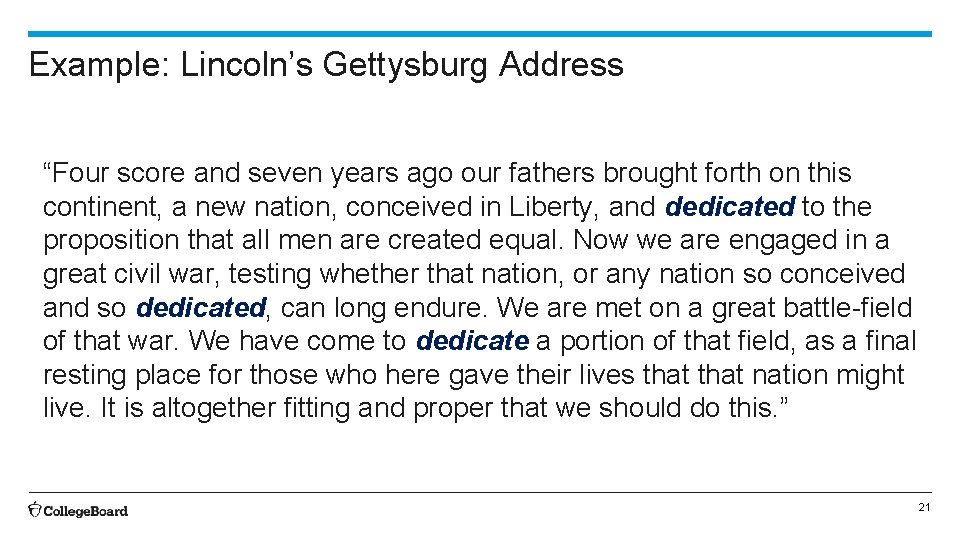
Example: Lincoln’s Gettysburg Address “Four score and seven years ago our fathers brought forth on this continent, a new nation, conceived in Liberty, and dedicated to the proposition that all men are created equal. Now we are engaged in a great civil war, testing whether that nation, or any nation so conceived and so dedicated, can long endure. We are met on a great battle-field of that war. We have come to dedicate a portion of that field, as a final resting place for those who here gave their lives that nation might live. It is altogether fitting and proper that we should do this. ” 21
Command of Evidence Students are asked to: • Interpret, synthesize, and use evidence found in a wide range of sources • Integrate information conveyed through both reading passages and informational graphics Reading Test: • Understand use evidence in a broad array of contexts • Determine the best textual support for the answer to another question Writing and Language Test: • Retain, add, revise, or delete information and ideas in a text • Interpret graphics and correct errors in the accompanying passages 22
Expression of Ideas Students are asked to • Revise and edit extended texts • Focus on • topic development • accuracy (consistency between text and graphic[s]) • logic • cohesion • rhetorically effective use of language 23
Standard English Conventions • Students are asked to make corrections in a passage related to: • Sentence Structure • Conventions of Usage • Conventions of Punctuation 24
Sample SAT Questions Chapter 3
Words in Context Sample Question [. . . ] The coming decades will likely see more intense clustering of jobs, innovation, and productivity in a smaller number of bigger cities and city regions. Some regions could end up bloated beyond the capacity of their infrastructure, while others struggle, their promise stymied by inadequate human or other resources. Adapted from Richard Florida, The Great Reset. © 2010 by Richard Florida. (Note that the tested word is in bold here only for convenience; in an actual test, the word would be noted with the question number. ) As used in line 1, “intense” most nearly means A) emotional. B) concentrated. C) brilliant. D) determined. CONTENT: Information and Ideas/Interpreting Words and Phrases in Context 26
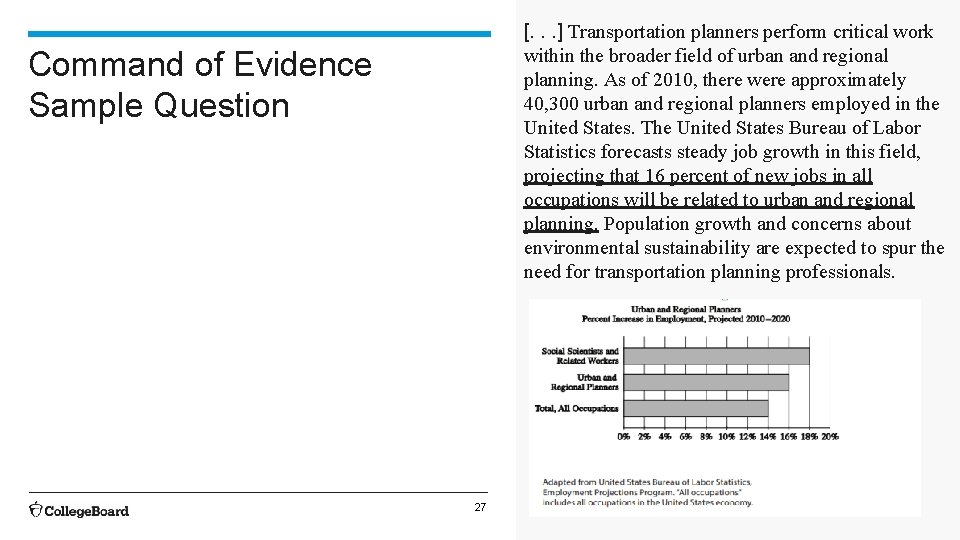
[. . . ] Transportation planners perform critical work within the broader field of urban and regional planning. As of 2010, there were approximately 40, 300 urban and regional planners employed in the United States. The United States Bureau of Labor Statistics forecasts steady job growth in this field, projecting that 16 percent of new jobs in all occupations will be related to urban and regional planning. Population growth and concerns about environmental sustainability are expected to spur the need for transportation planning professionals. Command of Evidence Sample Question 27
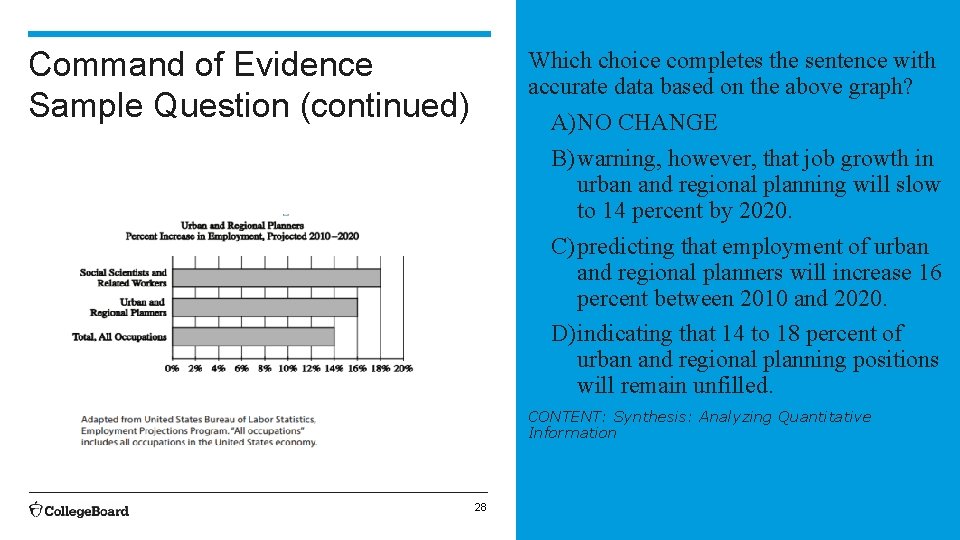
Command of Evidence Sample Question (continued) Which choice completes the sentence with accurate data based on the above graph? A)NO CHANGE B) warning, however, that job growth in urban and regional planning will slow to 14 percent by 2020. C) predicting that employment of urban and regional planners will increase 16 percent between 2010 and 2020. D)indicating that 14 to 18 percent of urban and regional planning positions will remain unfilled. CONTENT: Synthesis: Analyzing Quantitative Information 28
Standard English Conventions Sample Question Note there is no question stem for this question. Students are to find the number in the text and choose the best correction. Please read Dong Kingman: Painter of Cities to answer the following question: His fine brushwork conveys detailed street level activity: a peanut vendor pushing his cart on the sidewalk, a pigeon pecking for crumbs around a fire [ 2 ] hydrant, an old man tending to a baby outside a doorway. 2. A) NO CHANGE B) hydrant— C) hydrant: D) hydrant CONTENT: Standard English Conventions: Conventions of Punctuation/Items in a series 29
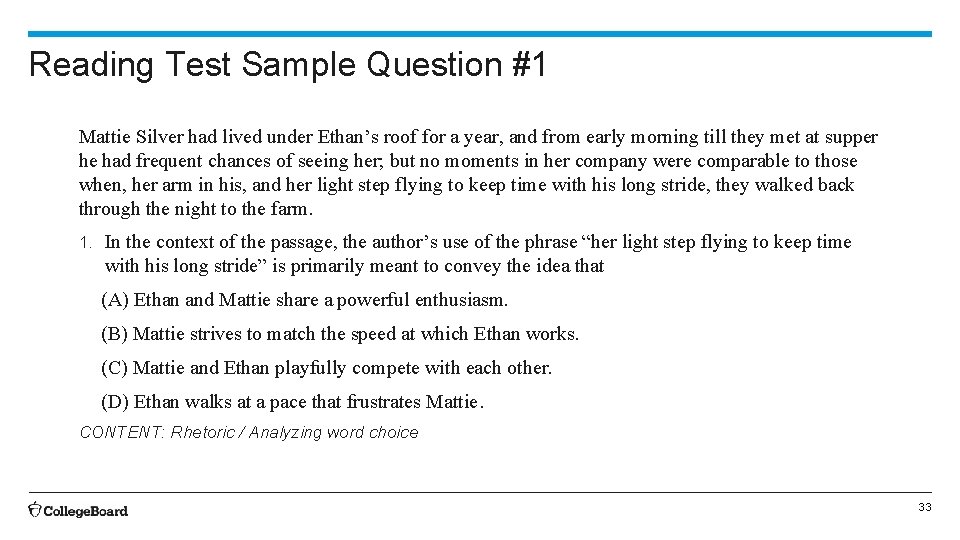
Reading Test Sample Question #1 Mattie Silver had lived under Ethan’s roof for a year, and from early morning till they met at supper he had frequent chances of seeing her; but no moments in her company were comparable to those when, her arm in his, and her light step flying to keep time with his long stride, they walked back through the night to the farm. 1. In the context of the passage, the author’s use of the phrase “her light step flying to keep time with his long stride” is primarily meant to convey the idea that (A) Ethan and Mattie share a powerful enthusiasm. (B) Mattie strives to match the speed at which Ethan works. (C) Mattie and Ethan playfully compete with each other. (D) Ethan walks at a pace that frustrates Mattie. CONTENT: Rhetoric / Analyzing word choice 33
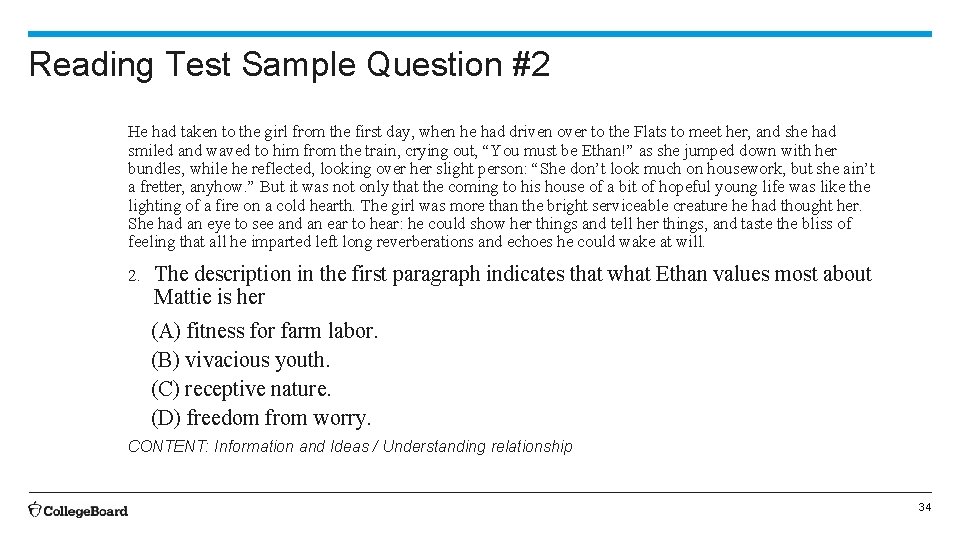
Reading Test Sample Question #2 He had taken to the girl from the first day, when he had driven over to the Flats to meet her, and she had smiled and waved to him from the train, crying out, “You must be Ethan!” as she jumped down with her bundles, while he reflected, looking over her slight person: “She don’t look much on housework, but she ain’t a fretter, anyhow. ” But it was not only that the coming to his house of a bit of hopeful young life was like the lighting of a fire on a cold hearth. The girl was more than the bright serviceable creature he had thought her. She had an eye to see and an ear to hear: he could show her things and tell her things, and taste the bliss of feeling that all he imparted left long reverberations and echoes he could wake at will. 2. The description in the first paragraph indicates that what Ethan values most about Mattie is her (A) fitness for farm labor. (B) vivacious youth. (C) receptive nature. (D) freedom from worry. CONTENT: Information and Ideas / Understanding relationship 34
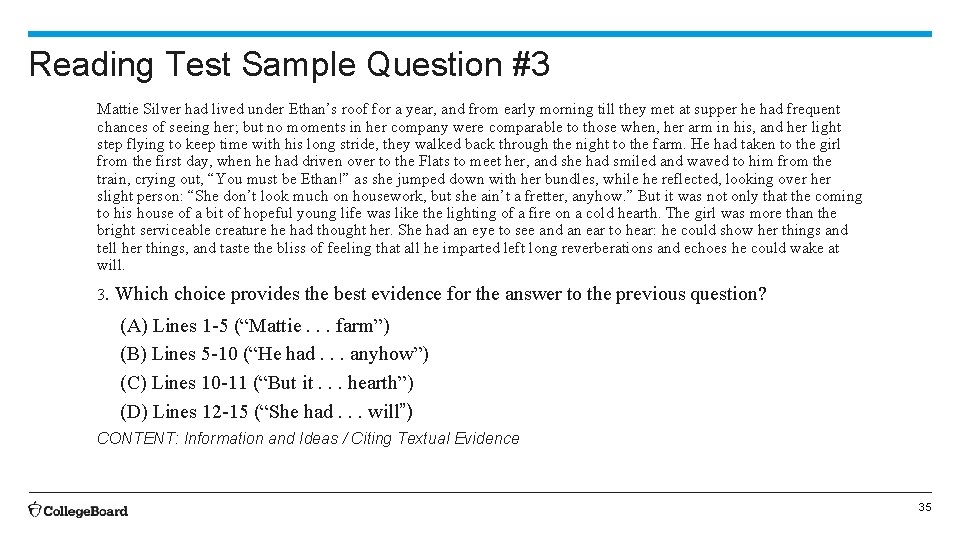
Reading Test Sample Question #3 Mattie Silver had lived under Ethan’s roof for a year, and from early morning till they met at supper he had frequent chances of seeing her; but no moments in her company were comparable to those when, her arm in his, and her light step flying to keep time with his long stride, they walked back through the night to the farm. He had taken to the girl from the first day, when he had driven over to the Flats to meet her, and she had smiled and waved to him from the train, crying out, “You must be Ethan!” as she jumped down with her bundles, while he reflected, looking over her slight person: “She don’t look much on housework, but she ain’t a fretter, anyhow. ” But it was not only that the coming to his house of a bit of hopeful young life was like the lighting of a fire on a cold hearth. The girl was more than the bright serviceable creature he had thought her. She had an eye to see and an ear to hear: he could show her things and tell her things, and taste the bliss of feeling that all he imparted left long reverberations and echoes he could wake at will. 3. Which choice provides the best evidence for the answer to the previous question? (A) Lines 1 5 (“Mattie. . . farm”) (B) Lines 5 10 (“He had. . . anyhow”) (C) Lines 10 11 (“But it. . . hearth”) (D) Lines 12 15 (“She had. . . will”) CONTENT: Information and Ideas / Citing Textual Evidence 35
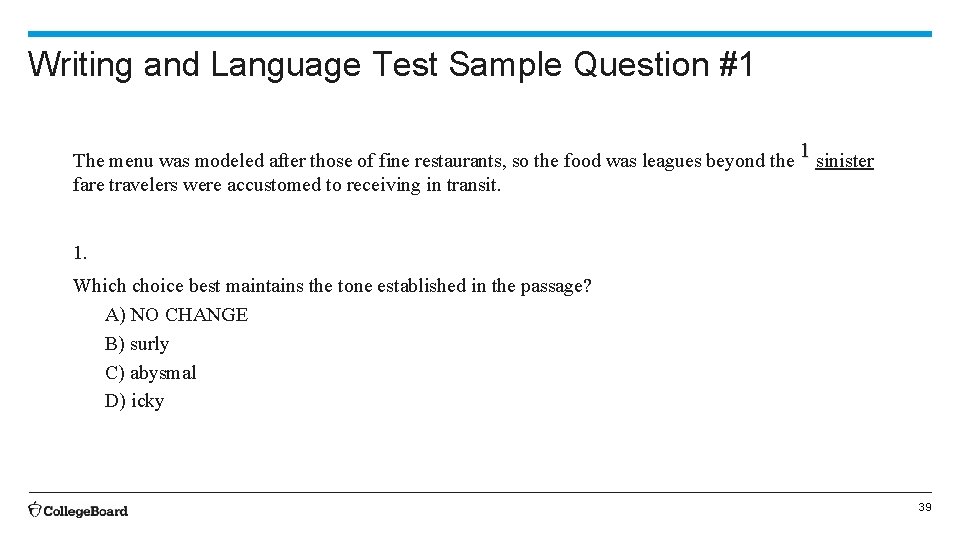
Writing and Language Test Sample Question #1 The menu was modeled after those of fine restaurants, so the food was leagues beyond the 1 sinister fare travelers were accustomed to receiving in transit. 1. Which choice best maintains the tone established in the passage? A) NO CHANGE B) surly C) abysmal D) icky 39
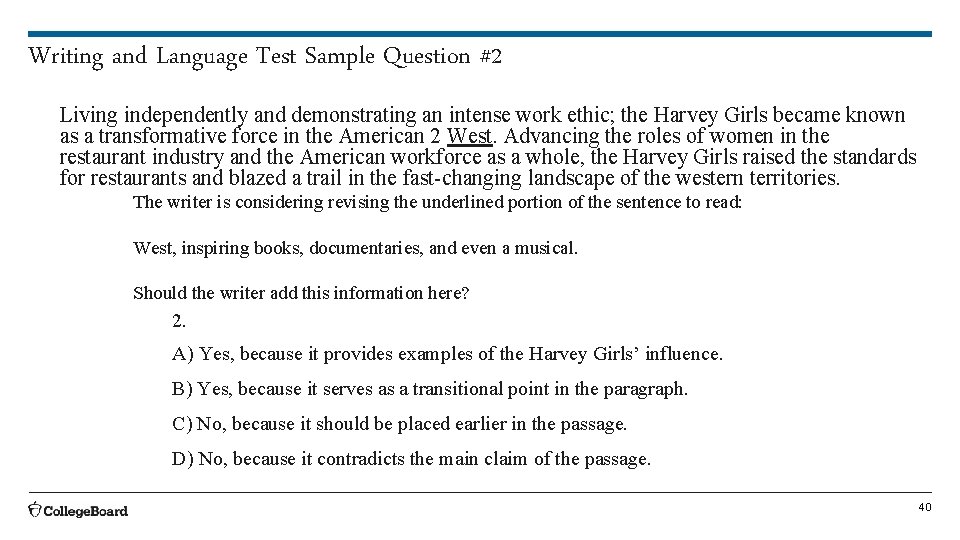
Writing and Language Test Sample Question #2 Living independently and demonstrating an intense work ethic; the Harvey Girls became known as a transformative force in the American 2 West. Advancing the roles of women in the restaurant industry and the American workforce as a whole, the Harvey Girls raised the standards for restaurants and blazed a trail in the fast changing landscape of the western territories. The writer is considering revising the underlined portion of the sentence to read: West, inspiring books, documentaries, and even a musical. Should the writer add this information here? 2. A) Yes, because it provides examples of the Harvey Girls’ influence. B) Yes, because it serves as a transitional point in the paragraph. C) No, because it should be placed earlier in the passage. D) No, because it contradicts the main claim of the passage. 40
How Does the SAT Suite Relate to Instruction in Science and History/ Social Studies Courses? Cross-test scores include scores for Analysis in Science and Analysis in History/Social Studies, derived from questions on all three tests. - Some passages used for analysis on the Reading Test and the Writing and Language Test have foundations in science and history/social studies. - One passage used on the Reading Test will be a U. S. founding document or from the great global conversation, contributing to the Analysis in History/Social Studies score. - Tables, graphs, and data accompanying some passages relate to topics science and/or history/social studies. - Some math questions will have science or social science contexts. 41
Brainstorming Instructional Strategies Activity Brainstorm ways to instruct and assess: Words in Context Command of Evidence Expression of Ideas Standard English Conventions
• Select a particularly meaningful or powerful word or phrase Words in Context – Instructional Strategies - Substitute for it another word or phrase of similar meaning. Discuss how the new word choice impacts the tone and style of the passage. • Practice revising and editing during class - https: //collegereadiness. collegeboard. org/pdf/redesignedsat-k 12 -teacher-implementation-guide. pdf 43 Allow students to refine their own work, as well as the work of their peers. Build analysis skills related to grammatical conventions, word choice, and sentence structure in extended contexts. • Revisit previous writing assignments - Allow students to alter their word choices, or otherwise edit their work to strengthen their skills.
• Command of Evidence – Instructional Strategies • https: //collegereadiness. collegeboard. org/pdf/redesignedsat-k 12 -teacher-implementation-guide. pdf 44 Present additional texts that support an author’s conclusion - Defend choices by citing textual evidence (e. g. , quotations) from the additional texts. - Practice both synthesizing and supporting ideas with evidence. Provide students with a reading passage containing several sentences in need of correction - Introduce such issues as dangling and other misplaced modifiers, inappropriate shifts in verb tense, lack of agreement between pronouns and antecedents, and illogical comparisons between unlike terms. - Ask students to improve the sentences. - After students make corrections, ask them to explain their reasoning. Students are thus simultaneously practicing using language conventions and supporting their answers with evidence.
Command of Evidence – Instructional Strategies (continued) • Ask students to write questions that investigate understanding of a lesson or unit. - Students practice identifying meaningful and relevant information in order to create high quality questions. - When students answer their peers’ questions, require them to provide the evidence that supports their selection. https: //collegereadiness. collegeboard. org/pdf/redesignedsat-k 12 -teacher-implementation-guide. pdf 45
Expression of Ideas Instructional Strategies • Practice writing and language analysis skills to develop student analyses of social studies, science, and career-related passages. Ask them to focus on: - effective language use - expression of ideas - properly utilizing Standard English Conventions https: //collegereadiness. collegeboard. org/pdf/redesignedsat-k 12 -teacher-implementation-guide. pdf 46 • Using the informational graphics in a textbook or a periodical, provide students with inaccurate interpretations of data and ask them to correct the error(s). Have them explicitly describe the data they used to make each correction. • Revisit and edit previous writing assignments.
Standard English Conventions—Instructional Strategies https: //collegereadiness. collegeboard. org/pdf/redesignedsat-k 12 -teacher-implementation-guide. pdf 47 • Practice revising and editing during class by asking students to refine their own work, as well as the work of their peers. Consider: grammatical conventions word choice sentence structure in extended contexts • Give students the opportunity to correct mistakes, both in your carefully constructed errors and in their own work. Focus on: word choice conventions of usage and punctuation organization analysis of graphical data • Ask students to review text messages and make corrections based on Standard English Conventions. Discuss how this impacts the tone and meaning of the messages.
Scores and Reporting
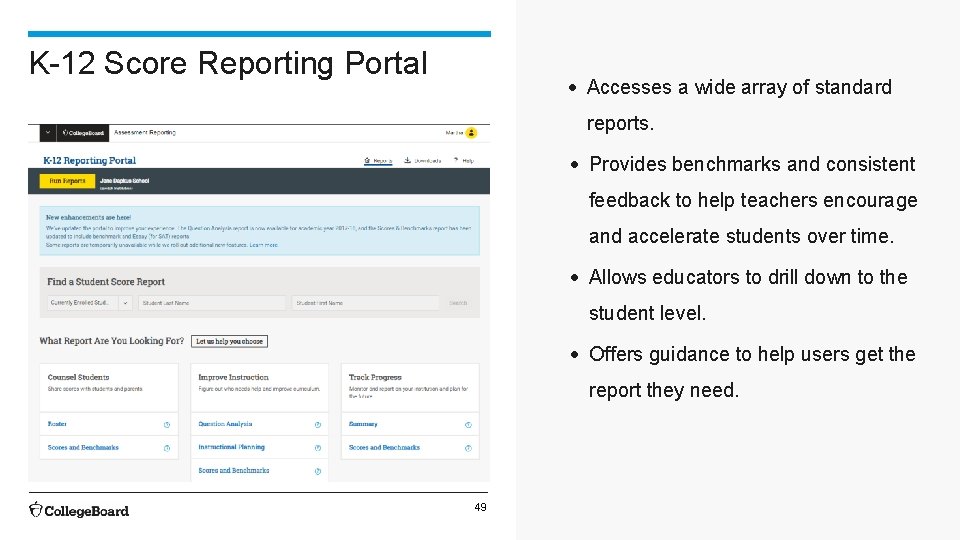
K-12 Score Reporting Portal • Accesses a wide array of standard reports. • Provides benchmarks and consistent feedback to help teachers encourage and accelerate students over time. • Allows educators to drill down to the student level. • Offers guidance to help users get the report they need. 49
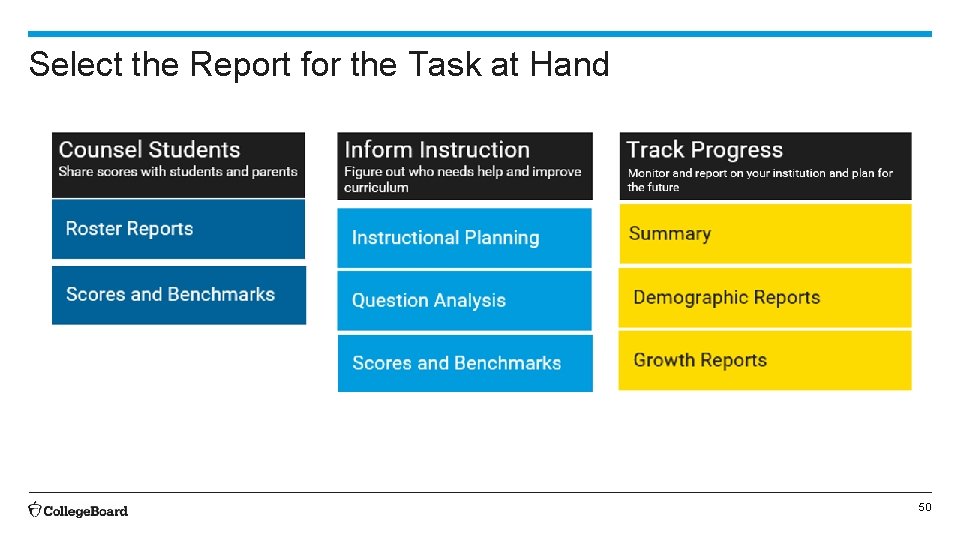
Select the Report for the Task at Hand 50
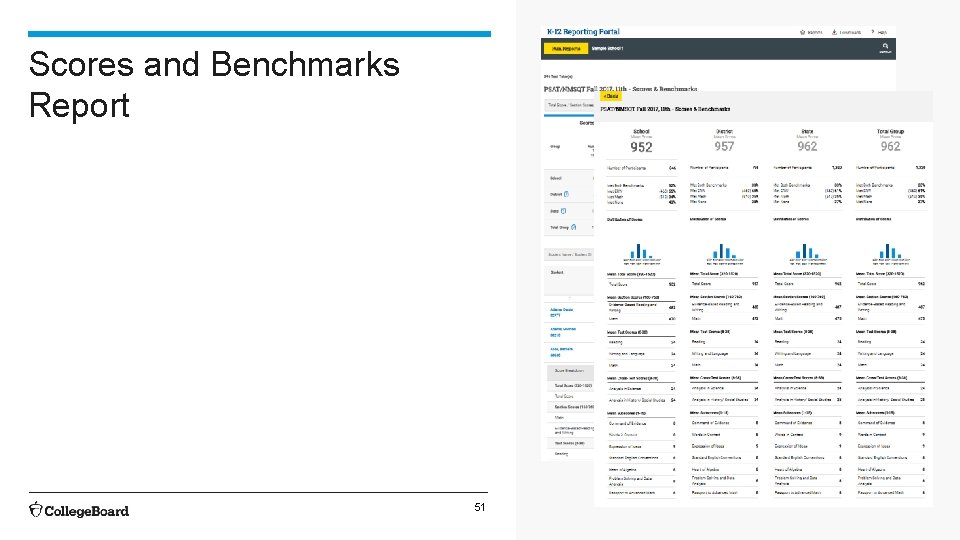
Scores and Benchmarks Report 51
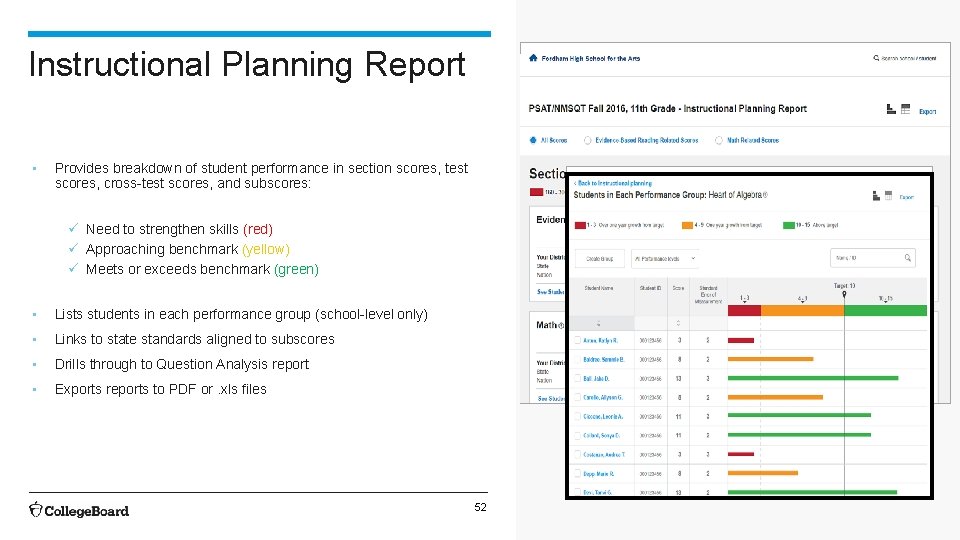
Instructional Planning Report • Provides breakdown of student performance in section scores, test scores, cross-test scores, and subscores: ü Need to strengthen skills (red) ü Approaching benchmark (yellow) ü Meets or exceeds benchmark (green) • Lists students in each performance group (school-level only) • Links to state standards aligned to subscores • Drills through to Question Analysis report • Exports reports to PDF or. xls files 52
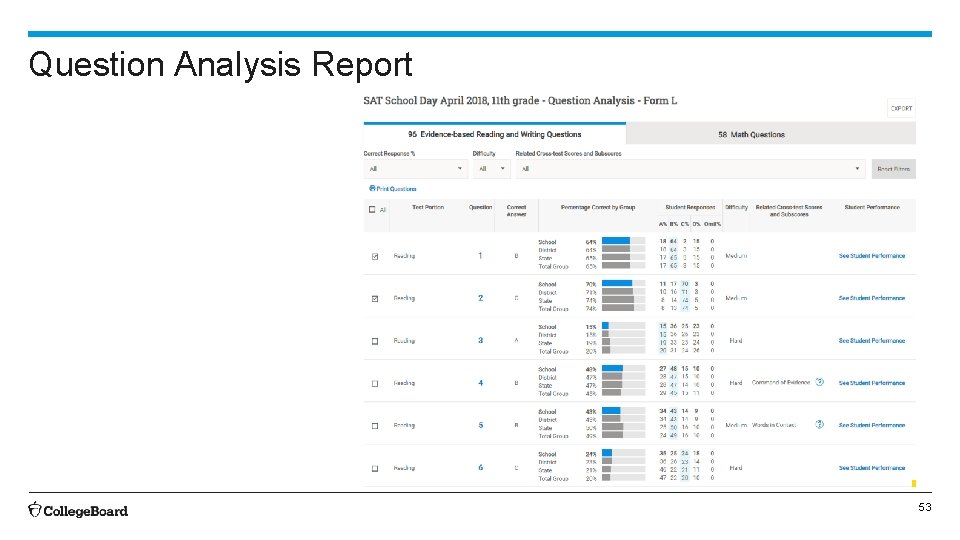
Question Analysis Report 53
Self Assessment/Reflection • • What do your students know about the skills related to Words in Context? How can you check their command of the skills? How familiar are your students with the skills related to Command of Evidence? How do you assess what they know to prepare them for the SAT/PSAT? • Which immediate steps can/will you take in your class to help students understand what they will see on the assessment in the SAT Suite? • Which long-term adjustments can you make to support students in developing their mastery of Words in Context and Command of Evidence? • Which additional resources do you need to gather in order to support students in becoming college and career ready? • Which strategies can you teach your students to keep track of their own progress toward meeting the college and career ready benchmark? 54
Questions or comments about this presentation or the SAT Suite of Assessments? Email: SATinstructionalsuppor t@collegeboard. org 55

Thank You
- Slides: 41