
SAT Method for Reading Comprehension Skills Steps 1

- Slides: 20
SAT Method for Reading Comprehension Skills Steps: 1. Reading Actively 2. Examine the Question Stem 3. Predict the Answer
What is the Format of the SAT? • Total Testing time: Session Type of Test Time Number of Questions 1 Reading Test 65 minutes 52 questions 2 Writing and Language Test 35 minutes 44 questions 3 Math test - no calculator 25 minutes 20 questions 4 Math Test – calculator 55 minutes 38 questions 5 Analytical Essay 50 minutes 1 question – 3 hours (plus 50 minutes for optional essay) Analytical Essay is NOT on the School administered SAT. You will have to take another version of the test if the college you are applying to requires it. Optional Some schools ask for this section… some don’t. Students Need to check when applying TALK TO YOUR GUIDANCE Counselor!!!!
SAT Reading and Writing Skills = Connections to History Skills • Analyze and use reasoning to Analyze comprehend literary and informational texts • Command of evidence • Words in context (how word in context choice affects meaning and tone) • Analyze data (including data represented graphically) • Expression of ideas xpression • Revise and Improve expression of ideas/ sentence mechanics Argumentative Writing Assignments Include: 1. Ability to identify argument 2. Ability to identify and judge the validity of supporting evidence 3. Ability to identify the development of ideas and connections between claims and evidence 4. Ability to identify stylistic or persuasive elements (word persuasive elements choice, appeals to emotions, structure, etc. )
Why are we doing this? Familiarity with Test • Know the Format – Students familiarity with the test reduces student test anxiety/ stress and has been proven to improve scores • Types of SAT questions – This test is VERY logical, knowing the types of questions gives you a Huge advantage – The SAT especially organizes their reading questions Other reasons? • Most Colleges require SAT Scores • Some Scholarship are based on SAT scores • Some JOBS require SAT scores – Banks, Teachers, scores can be a resume builder… • SAT is the new standardized test for the high schools in the State of Connecticut – The state is Paying for you to take this test ONCE – make the most of the opportunity
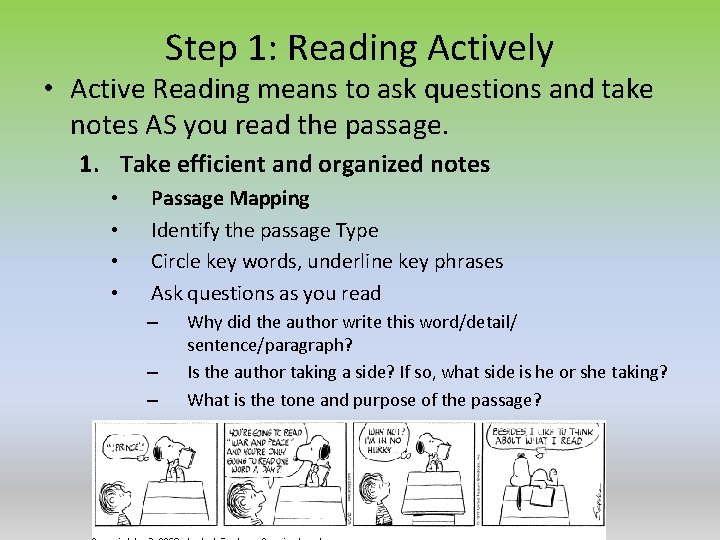
Step 1: Reading Actively • Active Reading means to ask questions and take notes AS you read the passage. 1. Take efficient and organized notes • • Passage Mapping Identify the passage Type Circle key words, underline key phrases Ask questions as you read – – – Why did the author write this word/detail/ sentence/paragraph? Is the author taking a side? If so, what side is he or she taking? What is the tone and purpose of the passage?
Passage Types • There are three types of passages for the SAT reading test: 1. US and World Literature 2. History/ Social Studies 3. Science
Notes Skills Model ‘Passage Mapping’ • Note the following in a passage: – The ‘why’ or the main idea of the passage • The THESIS STATEMENT – Transitions or changes in direction in a passage’s logic – The author’s opinions and other options the author cities • SUPPORTING DETAIL – The author’s tone and purpose This may seem time consuming at first but you can get faster with practice & it will help you improve your timing because you will spend less time searching through the passages for the answers.
Notes Skills Model ‘Passage Mapping’ Passage Excerpt 1: Many people today do not enjoy grocery shopping, but the experience we have is still many times better than that of the past. Supermarkets have done much to alleviate the problems that plagued traditional grocery stores. Gone are the days when consumers paid higher prices for the ‘privilege’ of an excruciatingly slow shopping experience. In addition to lower prices, supermarket Strategic Thinking • Step 1: Read actively Read the passage and notes provided • Step 2: Examine the question stem What are the keywords in the question stem? MAIN PURPOSE Where will you find the answer? In the whole passage or thesis • Step 3: Predict the answer If the correct answer will be similar to thesis, what can you predict for this question? Benefits of the supermarket in relation to the grocery store. What answer matches this prediction? Choice B
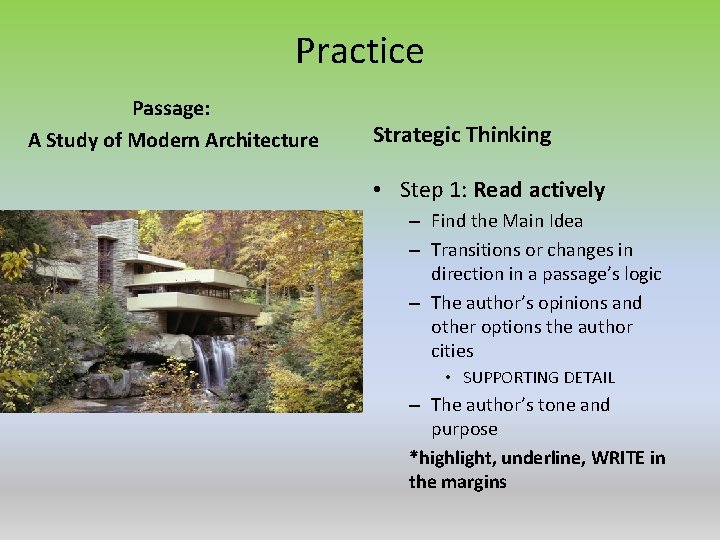
Practice Passage: A Study of Modern Architecture Strategic Thinking • Step 1: Read actively – Find the Main Idea – Transitions or changes in direction in a passage’s logic – The author’s opinions and other options the author cities • SUPPORTING DETAIL – The author’s tone and purpose *highlight, underline, WRITE in the margins
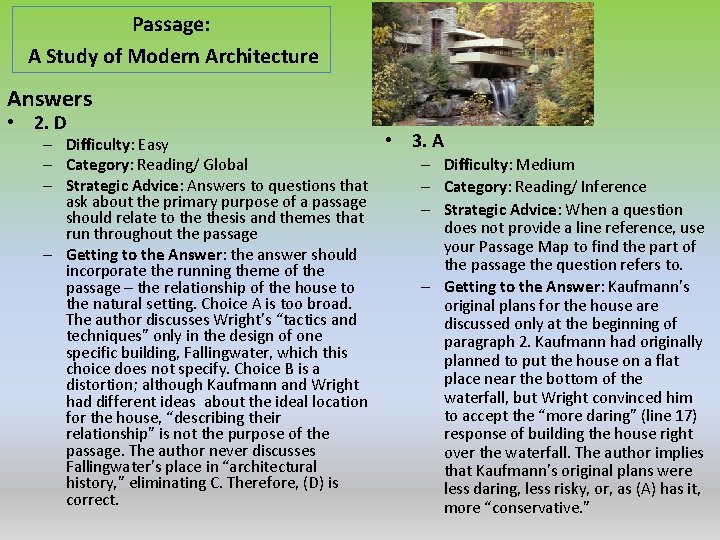
Passage: A Study of Modern Architecture Answers • 2. D • – Difficulty: Easy – Category: Reading/ Global – Strategic Advice: Answers to questions that ask about the primary purpose of a passage should relate to thesis and themes that run throughout the passage – Getting to the Answer: the answer should incorporate the running theme of the passage – the relationship of the house to the natural setting. Choice A is too broad. The author discusses Wright’s “tactics and techniques” only in the design of one specific building, Fallingwater, which this choice does not specify. Choice B is a distortion; although Kaufmann and Wright had different ideas about the ideal location for the house, “describing their relationship” is not the purpose of the passage. The author never discusses Fallingwater’s place in “architectural history, ” eliminating C. Therefore, (D) is correct. 3. A – Difficulty: Medium – Category: Reading/ Inference – Strategic Advice: When a question does not provide a line reference, use your Passage Map to find the part of the passage the question refers to. – Getting to the Answer: Kaufmann’s original plans for the house are discussed only at the beginning of paragraph 2. Kaufmann had originally planned to put the house on a flat place near the bottom of the waterfall, but Wright convinced him to accept the “more daring” (line 17) response of building the house right over the waterfall. The author implies that Kaufmann’s original plans were less daring, less risky, or, as (A) has it, more “conservative. ”
Practice Instructions • Now, try a test-like Reading Test passage on your own. • You will have 5 minutes to read, map the passage and answer the questions. Questions 4 and 5 4. C Difficulty: Medium Category: Reading/ Rhetoric Strategic Advice: Read around the cited lines and make a prediction Getting to the Answer: The engineers though the bridge would “stand the test of time, ” but in reality the bridge was so bad that it had to be closed. The author’s reason for including the engineers’ opinion must have been to show wrong it was. That’s C. 5. A Difficulty: Easy Category: Reading/ Detail Strategic Advice: Even though there are no line referenced, the answer is still in the passage. Getting to the answer: Figure out which paragraph alludes to the bridge’s nickname: paragraph 1 and the beginning of paragraph 4. The fourth paragraph says in lines 38 -39 that the bridge ‘galloped’ because of the wind. Find an answer that matches this. Choice (A) is correct.
Step 2: Examine the Question Stem • Identify keywords and line references in the question stem 1. 2. 3. 4. 5. 6. 7. Detail Global Command of Evidence Synthesis Inference Vocab-In-Context Rhetoric • Apply question type strategies as necessary
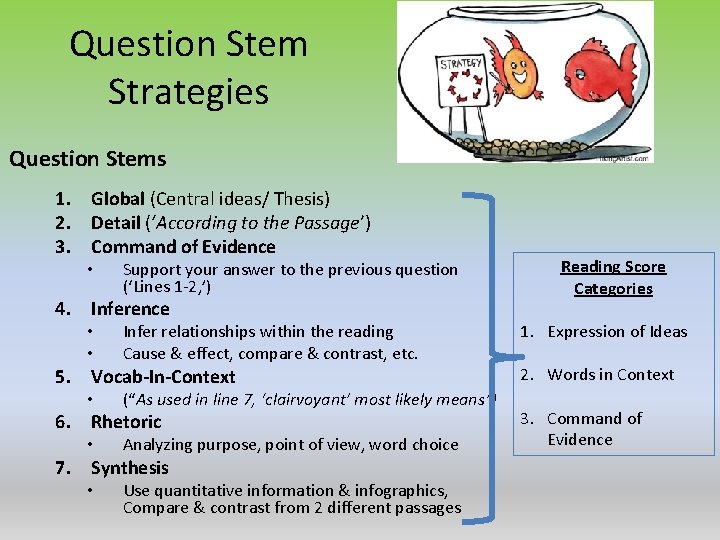
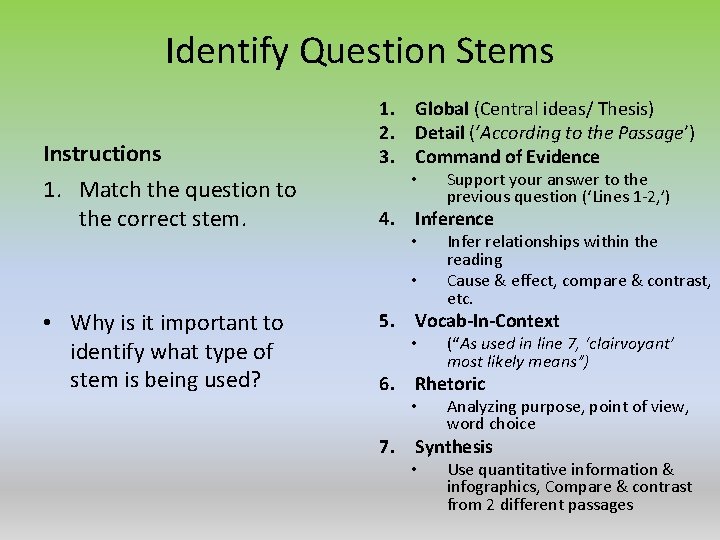
Question Stem Strategies Question Stems 1. Global (Central ideas/ Thesis) 2. Detail (‘According to the Passage’) 3. Command of Evidence • Support your answer to the previous question (‘Lines 1 -2, ’) 4. Inference • • Infer relationships within the reading Cause & effect, compare & contrast, etc. Reading Score Categories 1. Expression of Ideas 5. Vocab-In-Context 2. Words in Context 6. Rhetoric 3. Command of Evidence • • (“As used in line 7, ‘clairvoyant’ most likely means”) Analyzing purpose, point of view, word choice 7. Synthesis • Use quantitative information & infographics, Compare & contrast from 2 different passages
Identify Question Stems Instructions 1. Match the question to the correct stem. 1. Global (Central ideas/ Thesis) 2. Detail (‘According to the Passage’) 3. Command of Evidence • 4. Inference • • • Why is it important to identify what type of stem is being used? Support your answer to the previous question (‘Lines 1 -2, ’) Infer relationships within the reading Cause & effect, compare & contrast, etc. 5. Vocab-In-Context • (“As used in line 7, ‘clairvoyant’ most likely means”) 6. Rhetoric • Analyzing purpose, point of view, word choice 7. Synthesis • Use quantitative information & infographics, Compare & contrast from 2 different passages
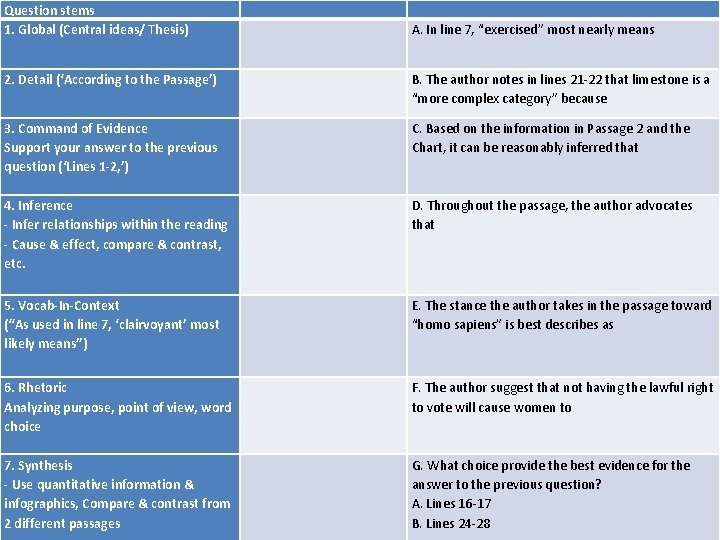
Question stems 1. Global (Central ideas/ Thesis) A. In line 7, “exercised” most nearly means 2. Detail (‘According to the Passage’) B. The author notes in lines 21 -22 that limestone is a “more complex category” because 3. Command of Evidence Support your answer to the previous question (‘Lines 1 -2, ’) 4. Inference - Infer relationships within the reading - Cause & effect, compare & contrast, etc. C. Based on the information in Passage 2 and the Chart, it can be reasonably inferred that D. Throughout the passage, the author advocates that 5. Vocab-In-Context (“As used in line 7, ‘clairvoyant’ most likely means”) E. The stance the author takes in the passage toward “homo sapiens” is best describes as 6. Rhetoric Analyzing purpose, point of view, word choice 7. Synthesis - Use quantitative information & infographics, Compare & contrast from 2 different passages F. The author suggest that not having the lawful right to vote will cause women to G. What choice provide the best evidence for the answer to the previous question? A. Lines 16 -17 B. Lines 24 -28
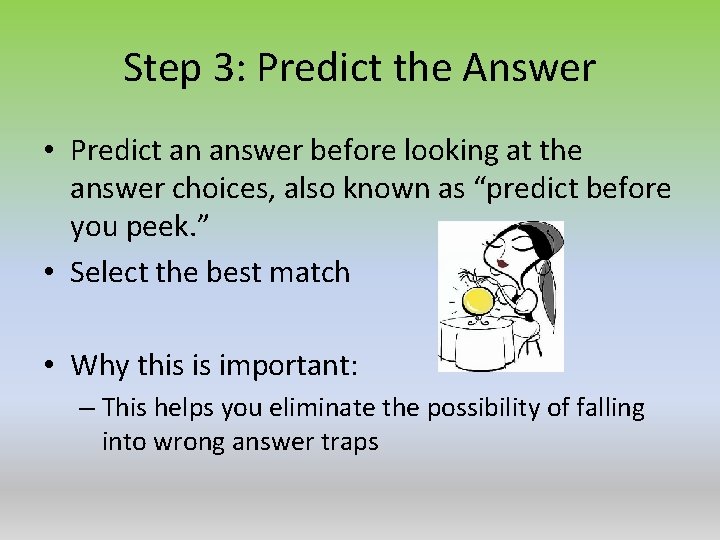
Step 3: Predict the Answer • Predict an answer before looking at the answer choices, also known as “predict before you peek. ” • Select the best match • Why this is important: – This helps you eliminate the possibility of falling into wrong answer traps
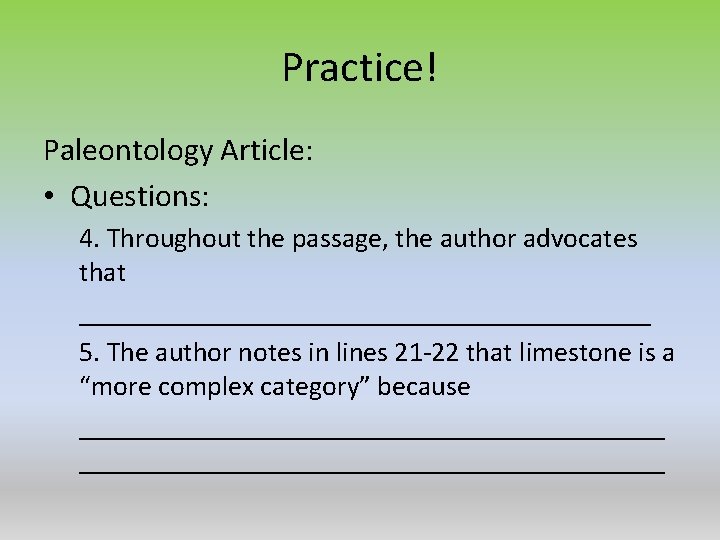
Practice! Paleontology Article: • Questions: 4. Throughout the passage, the author advocates that _____________________ 5. The author notes in lines 21 -22 that limestone is a “more complex category” because __________________________________________
Create Your OWN SAT Questions • Create 3 Questions for the last SAT Reading Activity (on Paleontology). • Make sure your questions reflect one of the types of Questions Stems • Switch with the person next to you and see if they can answer your questions correctly
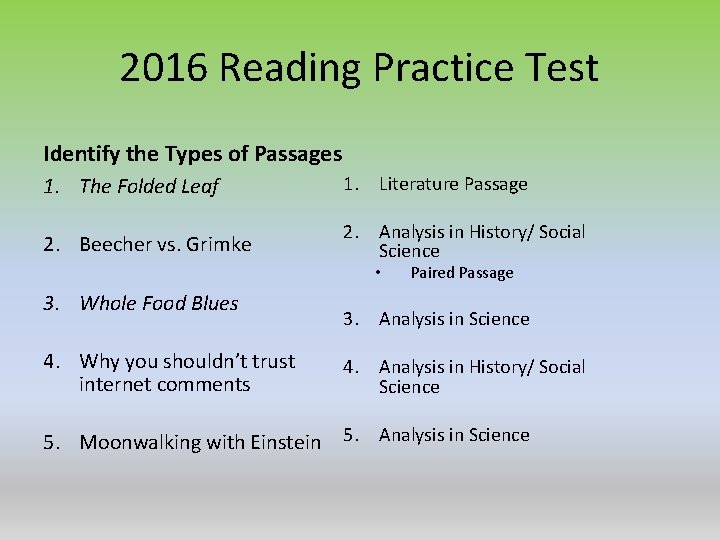
2016 Reading Practice Test Identify the Types of Passages 1. The Folded Leaf 1. Literature Passage 2. Beecher vs. Grimke 2. Analysis in History/ Social Science • 3. Whole Food Blues 4. Why you shouldn’t trust internet comments Paired Passage 3. Analysis in Science 4. Analysis in History/ Social Science 5. Moonwalking with Einstein 5. Analysis in Science
2016 Reading Practice Test Identify the Types of Passages 1. The Folded Leaf