
SAs nascent EV market Key opportunities drivers barriers
SA’s nascent EV market Key opportunities, drivers & barriers RFA Convention 2019 | 1
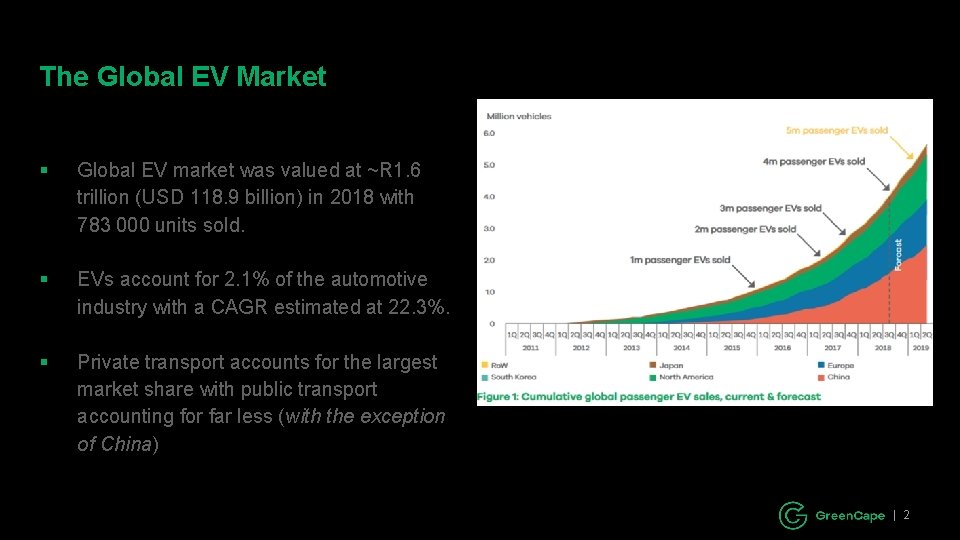
The Global EV Market § Global EV market was valued at ~R 1. 6 trillion (USD 118. 9 billion) in 2018 with 783 000 units sold. § EVs account for 2. 1% of the automotive industry with a CAGR estimated at 22. 3%. § Private transport accounts for the largest market share with public transport accounting for far less (with the exception of China) | 2
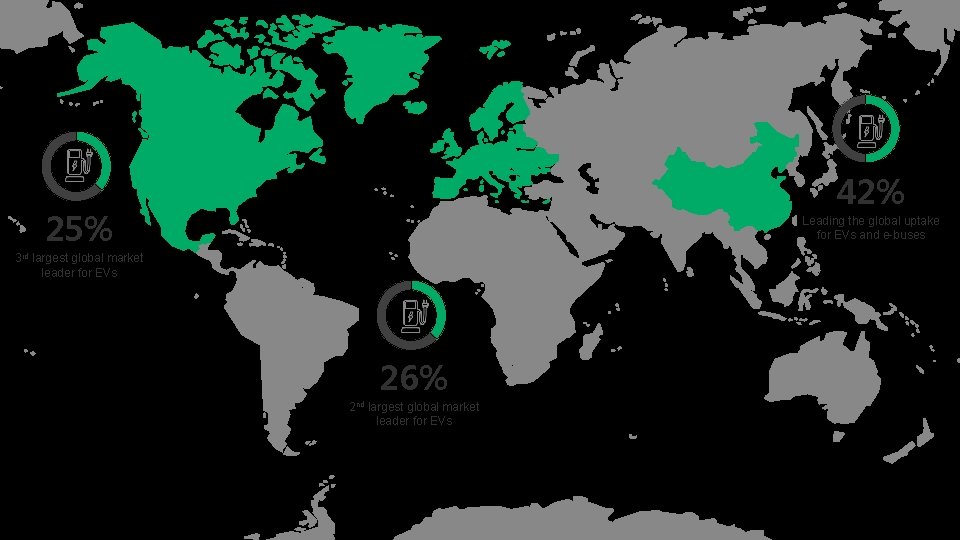
42% 25% Leading the global uptake for EVs and e-buses 3 rd largest global market leader for EVs 26% 2 nd largest global market leader for EVs
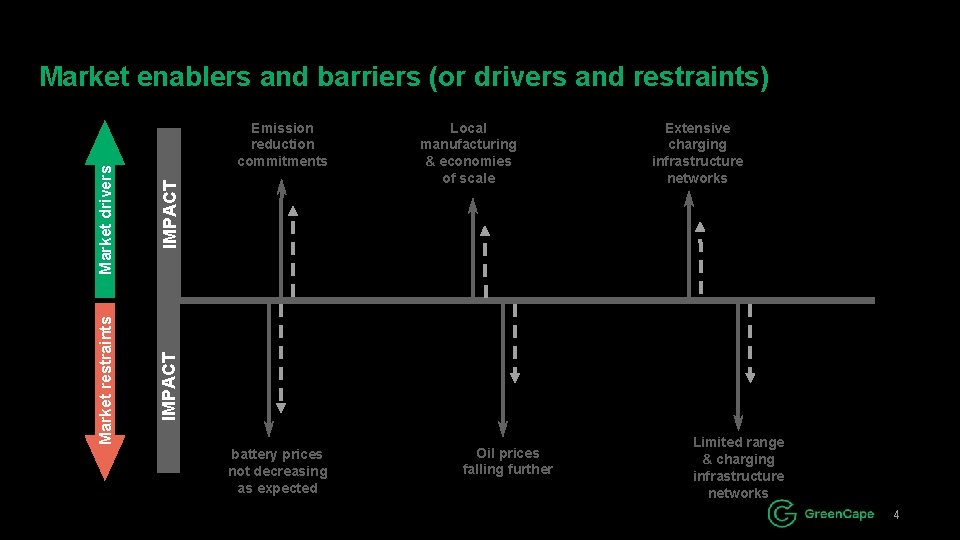
Market enablers and barriers (or drivers and restraints) Market drivers IMPACT Market restraints IMPACT Emission reduction commitments battery prices not decreasing as expected Local manufacturing & economies of scale Oil prices falling further Extensive charging infrastructure networks Limited range & charging infrastructure networks 4
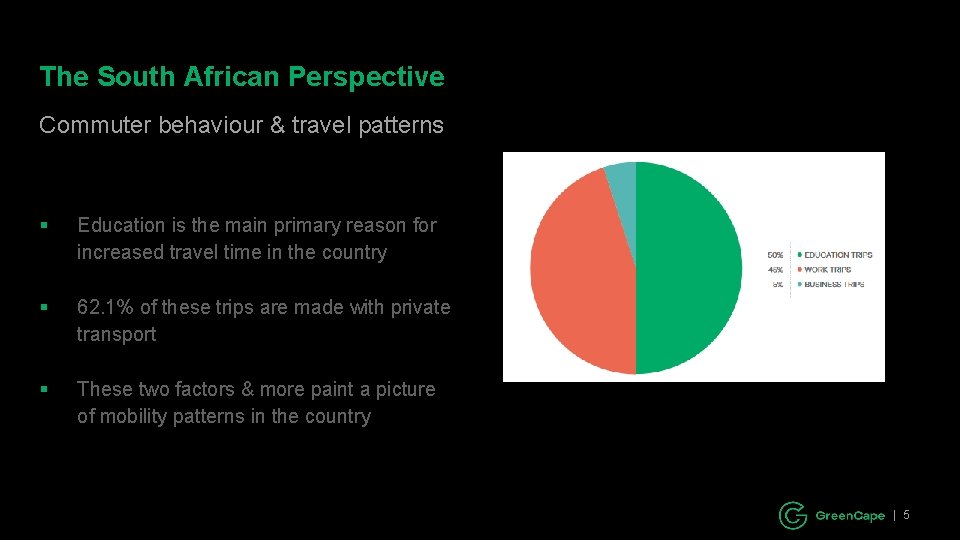
The South African Perspective Commuter behaviour & travel patterns § Education is the main primary reason for increased travel time in the country § 62. 1% of these trips are made with private transport § These two factors & more paint a picture of mobility patterns in the country | 5
The case for public transport | 6
EV sales in the country | 7
SA market drivers Macroeconomic drivers: Local demand drivers: § GHG emission reduction commitment § Climate conscious consumers § The potential loss of automotive trade markets § Rising fuel costs § Falling EV costs § Reduced range anxiety | 8
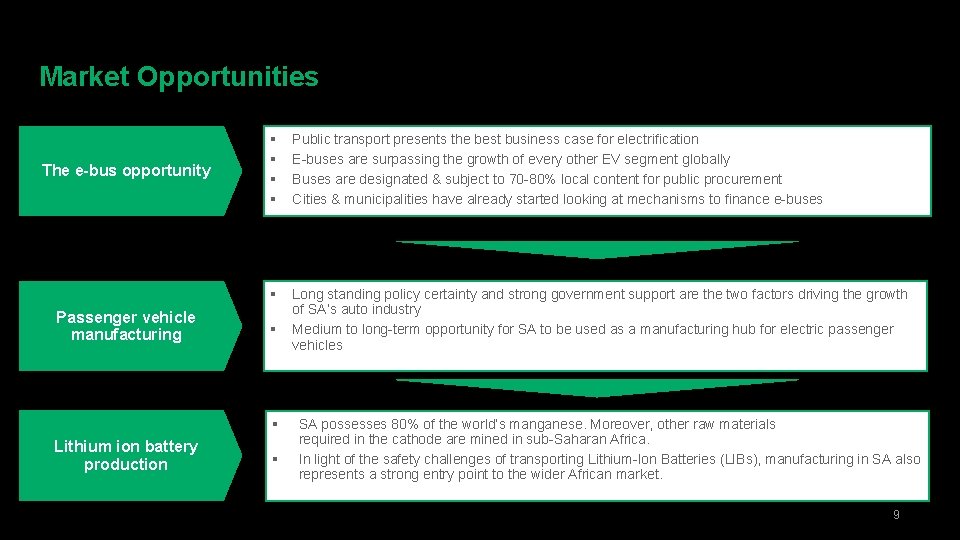
Market Opportunities The e-bus opportunity Passenger vehicle manufacturing § § Public transport presents the best business case for electrification E-buses are surpassing the growth of every other EV segment globally Buses are designated & subject to 70 -80% local content for public procurement Cities & municipalities have already started looking at mechanisms to finance e-buses § Long standing policy certainty and strong government support are the two factors driving the growth of SA’s auto industry Medium to long-term opportunity for SA to be used as a manufacturing hub for electric passenger vehicles § § Lithium ion battery production § SA possesses 80% of the world’s manganese. Moreover, other raw materials required in the cathode are mined in sub-Saharan Africa. In light of the safety challenges of transporting Lithium-Ion Batteries (LIBs), manufacturing in SA also represents a strong entry point to the wider African market. 9
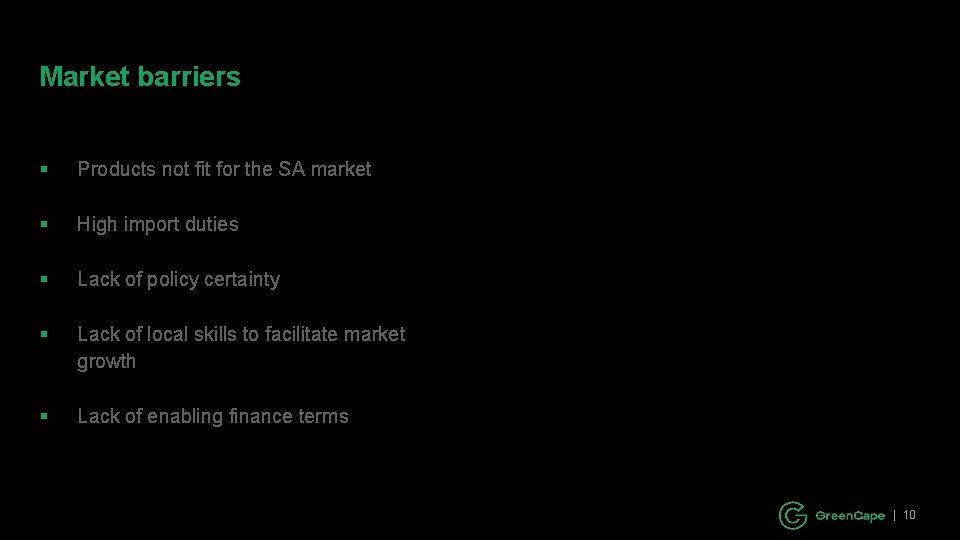
Market barriers § Products not fit for the SA market § High import duties § Lack of policy certainty § Lack of local skills to facilitate market growth § Lack of enabling finance terms | 10
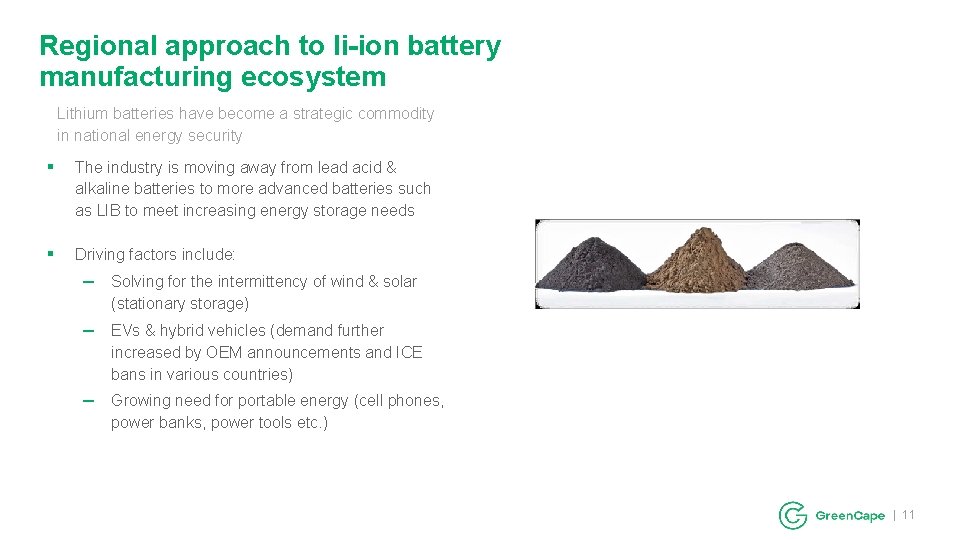
Regional approach to li-ion battery manufacturing ecosystem Lithium batteries have become a strategic commodity in national energy security ▪ The industry is moving away from lead acid & alkaline batteries to more advanced batteries such as LIB to meet increasing energy storage needs ▪ Driving factors include: ‒ Solving for the intermittency of wind & solar (stationary storage) ‒ EVs & hybrid vehicles (demand further increased by OEM announcements and ICE bans in various countries) ‒ Growing need for portable energy (cell phones, power banks, power tools etc. ) | 11
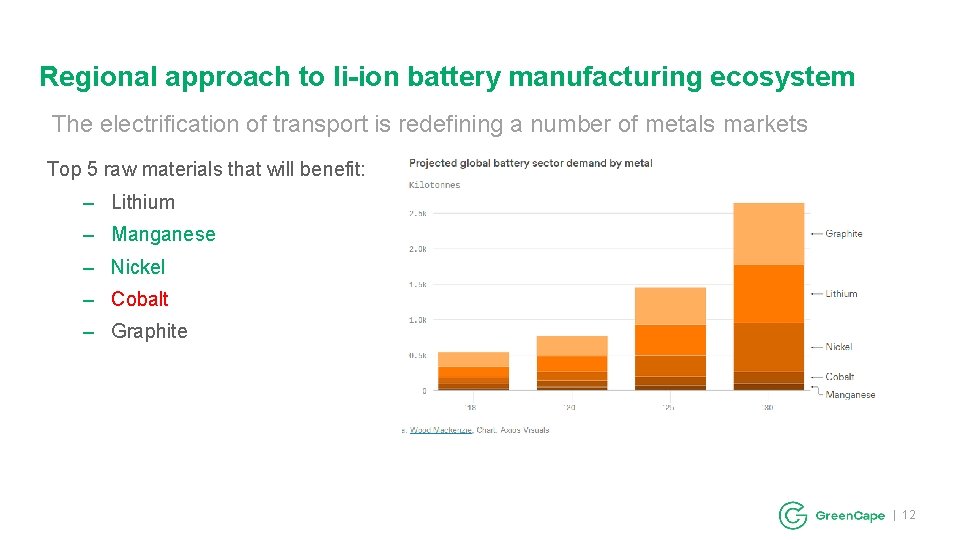
Regional approach to li-ion battery manufacturing ecosystem The electrification of transport is redefining a number of metals markets Top 5 raw materials that will benefit: ‒ Lithium ‒ Manganese ‒ Nickel ‒ Cobalt ‒ Graphite | 12
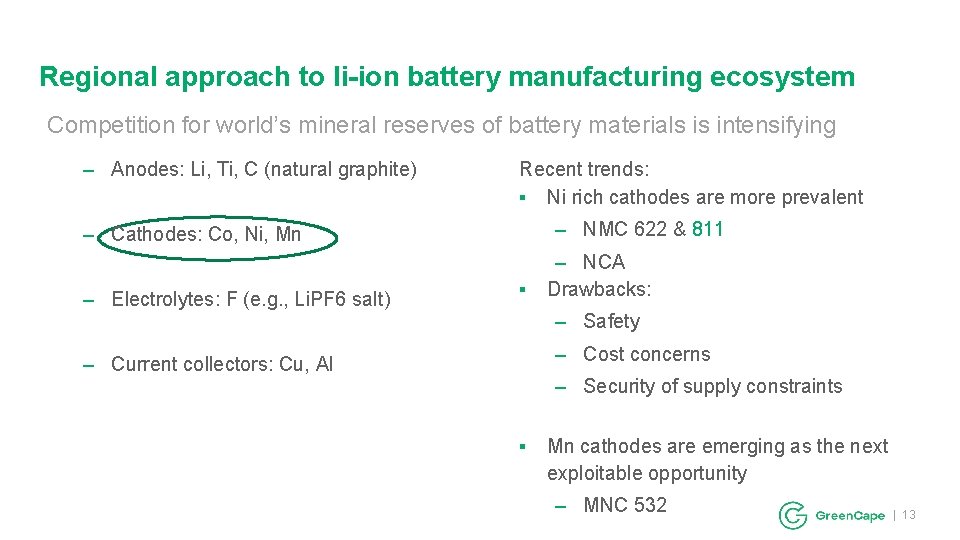
Regional approach to li-ion battery manufacturing ecosystem Competition for world’s mineral reserves of battery materials is intensifying ‒ Anodes: Li, Ti, C (natural graphite) Recent trends: ▪ Ni rich cathodes are more prevalent ‒ NMC 622 & 811 ‒ Cathodes: Co, Ni, Mn ‒ Electrolytes: F (e. g. , Li. PF 6 salt) ▪ ‒ NCA Drawbacks: ‒ Safety ‒ Cost concerns ‒ Current collectors: Cu, Al ‒ Security of supply constraints ▪ Mn cathodes are emerging as the next exploitable opportunity ‒ MNC 532 | 13
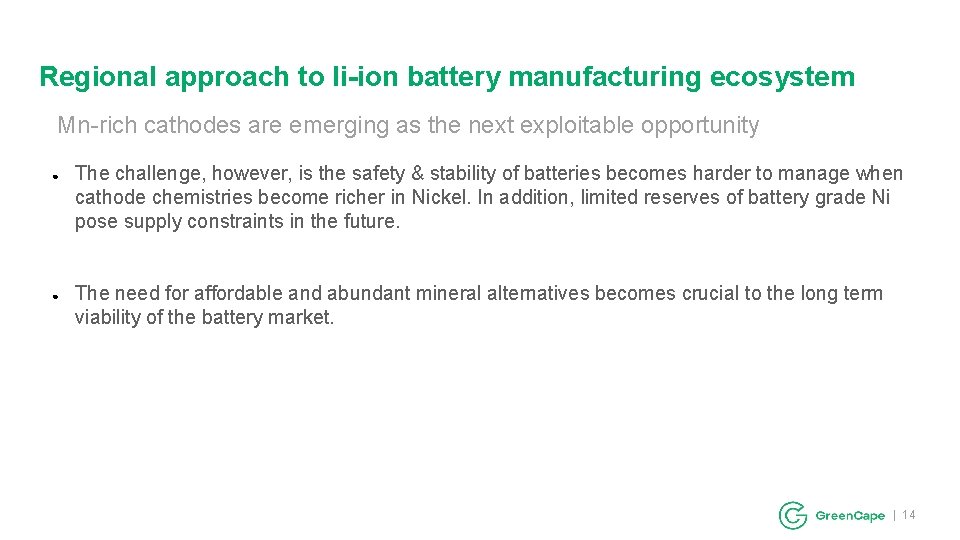
Regional approach to li-ion battery manufacturing ecosystem Mn-rich cathodes are emerging as the next exploitable opportunity ● ● The challenge, however, is the safety & stability of batteries becomes harder to manage when cathode chemistries become richer in Nickel. In addition, limited reserves of battery grade Ni pose supply constraints in the future. The need for affordable and abundant mineral alternatives becomes crucial to the long term viability of the battery market. | 14
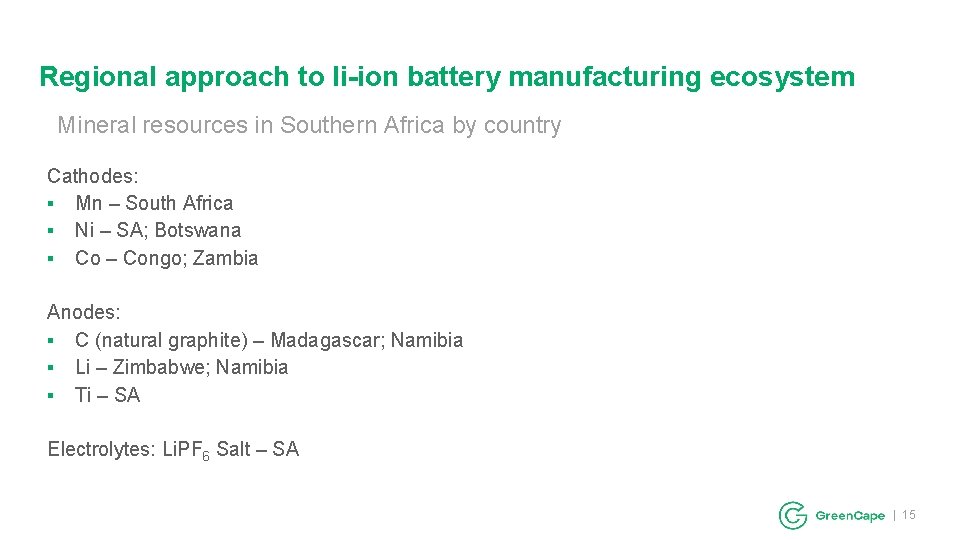
Regional approach to li-ion battery manufacturing ecosystem Mineral resources in Southern Africa by country Cathodes: ▪ Mn – South Africa ▪ Ni – SA; Botswana ▪ Co – Congo; Zambia Anodes: ▪ C (natural graphite) – Madagascar; Namibia ▪ Li – Zimbabwe; Namibia ▪ Ti – SA Electrolytes: Li. PF 6 Salt – SA | 15
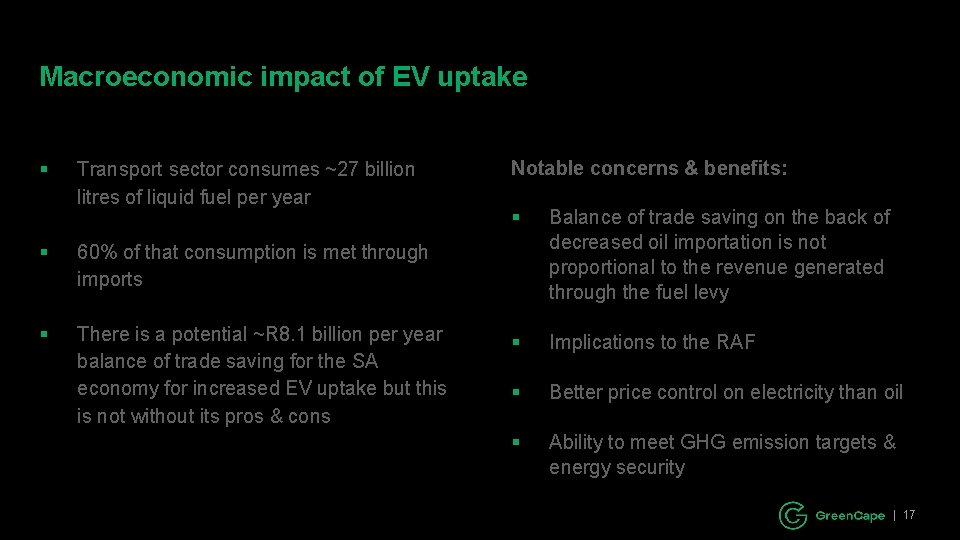
Macroeconomic impact of EV uptake § Transport sector consumes ~27 billion litres of liquid fuel per year § 60% of that consumption is met through imports § There is a potential ~R 8. 1 billion per year balance of trade saving for the SA economy for increased EV uptake but this is not without its pros & cons Notable concerns & benefits: § Balance of trade saving on the back of decreased oil importation is not proportional to the revenue generated through the fuel levy § Implications to the RAF § Better price control on electricity than oil § Ability to meet GHG emission targets & energy security | 17

Thank You Khanyiselo Kumalo Khanyi@greencape. co. za 021 811 0250 | 18
- Slides: 17