
SAS KPMG Alliance Risk Management Copyright SAS Inst
- Slides: 16
SAS KPMG Alliance Risk Management Copyright © SAS Inst itute Inc. All rig hts reserved.
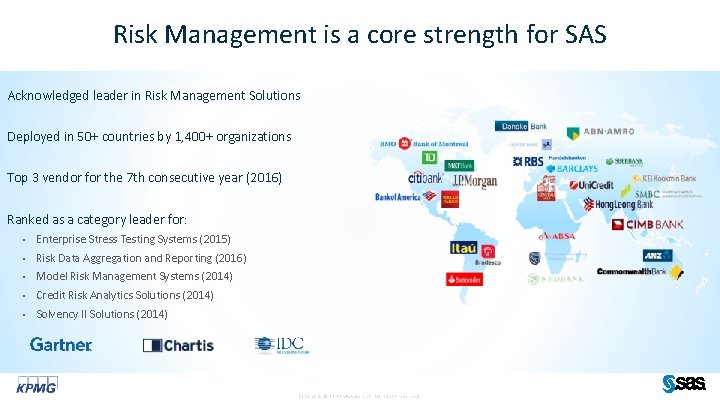
Risk Management is a core strength for SAS Acknowledged leader in Risk Management Solutions Deployed in 50+ countries by 1, 400+ organizations Top 3 vendor for the 7 th consecutive year (2016) Ranked as a category leader for: • Enterprise Stress Testing Systems (2015) • Risk Data Aggregation and Reporting (2016) • Model Risk Management Systems (2014) • Credit Risk Analytics Solutions (2014) • Solvency II Solutions (2014) Copyright © SAS Inst itute Inc. All rig hts reserved.
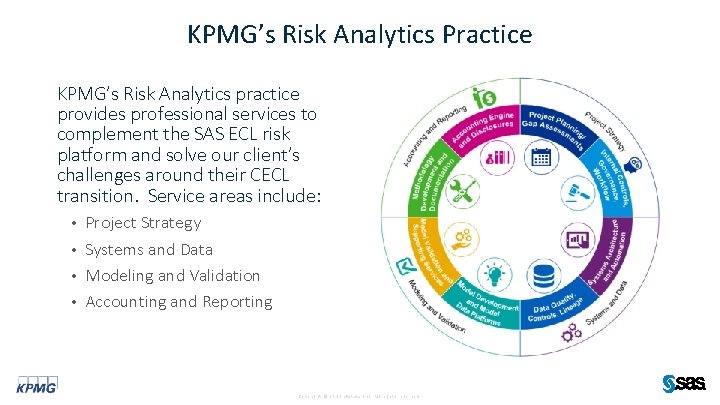
KPMG’s Risk Analytics Practice KPMG’s Risk Analytics practice provides professional services to complement the SAS ECL risk platform and solve our client’s challenges around their CECL transition. Service areas include: Project Strategy • Systems and Data • Modeling and Validation • Accounting and Reporting • Copyright © SAS Inst itute Inc. All rig hts reserved.
SAS – KPMG Alliance • KPMG is a SAS Gold Partner working together in the area of Risk Management • KPMG is the exclusive risk services partner for the SAS ECL platform • SAS works with KPMG together globally to solve ECL challenges related to US GAAP CECL, IFRS 9, and other regulatory and risk challenges • KPMG and SAS have been jointly working on CECL since 2017 and share numerous joint wins in the marketplace Copyright © SAS Inst itute Inc. All rig hts reserved.
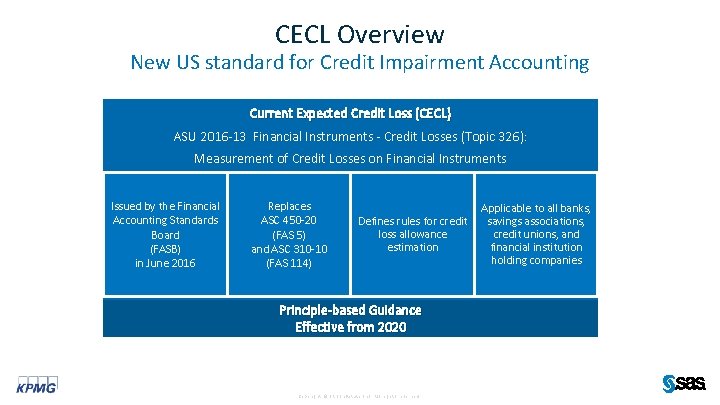
CECL Overview New US standard for Credit Impairment Accounting Current Expected Credit Loss (CECL) ASU 2016 -13 Financial Instruments - Credit Losses (Topic 326): Measurement of Credit Losses on Financial Instruments Issued by the Financial Accounting Standards Board (FASB) in June 2016 Replaces ASC 450 -20 (FAS 5) and ASC 310 -10 (FAS 114) Defines rules for credit loss allowance estimation Principle-based Guidance Effective from 2020 Copyright © SAS Inst itute Inc. All rig hts reserved. Applicable to all banks, savings associations, credit unions, and financial institution holding companies
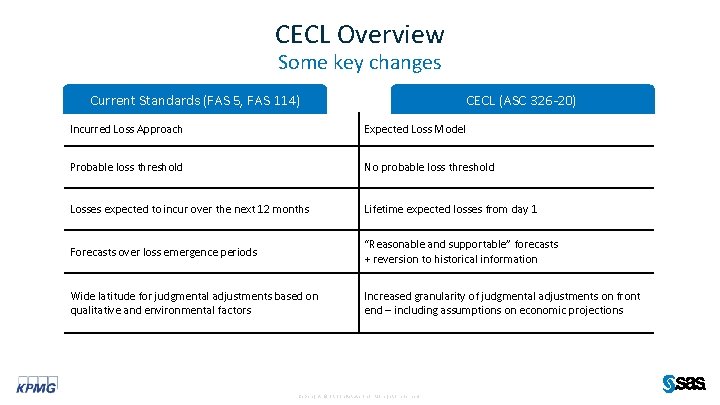
CECL Overview Some key changes CECL (ASC 326 -20) Current Standards (FAS 5, FAS 114) Incurred Loss Approach Expected Loss Model Probable loss threshold No probable loss threshold Losses expected to incur over the next 12 months Lifetime expected losses from day 1 Forecasts over loss emergence periods “Reasonable and supportable” forecasts + reversion to historical information Wide latitude for judgmental adjustments based on qualitative and environmental factors Increased granularity of judgmental adjustments on front end – including assumptions on economic projections Copyright © SAS Inst itute Inc. All rig hts reserved.
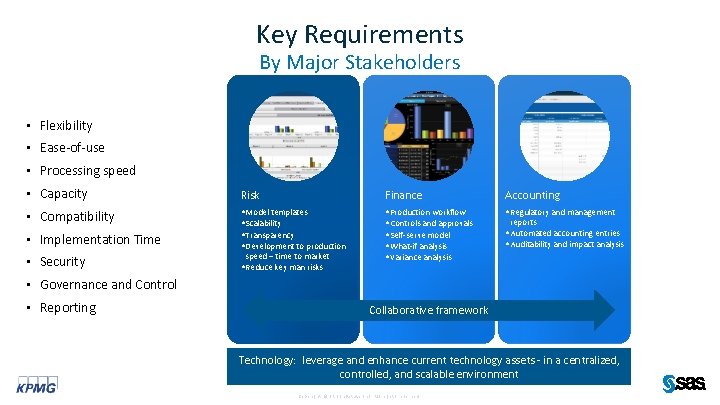
Key Requirements By Major Stakeholders • Flexibility • Ease-of-use • Processing speed • Capacity Risk Finance Accounting • Compatibility • Security • Reduce key man risks • Production workflow • Controls and approvals • Self-serve model • What-if analysis • Variance analysis • Regulatory and management • Implementation Time • Model templates • Scalability • Transparency • Development to production speed – time to market reports • Automated accounting entries • Auditability and impact analysis • Governance and Control • Reporting Collaborative framework Technology: leverage and enhance current technology assets - in a centralized, controlled, and scalable environment Copyright © SAS Inst itute Inc. All rig hts reserved.
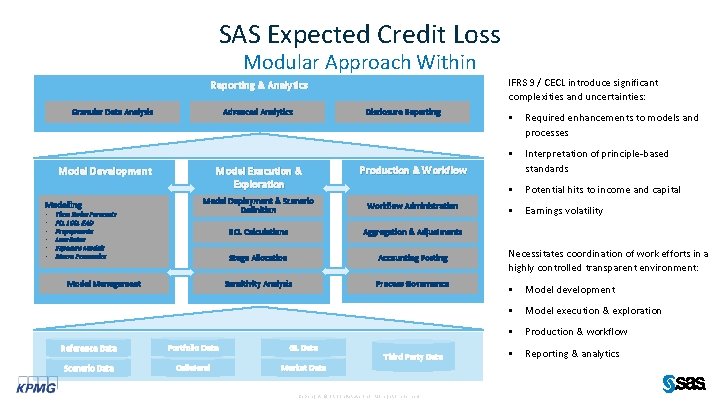
SAS Expected Credit Loss Modular Approach Within IFRS 9 / CECL introduce significant complexities and uncertainties: Reporting & Analytics Granular Data Analysis Advanced Analytics Model Execution & Exploration Model Development Modelling • • • Time Series Forecasts PD, LGD, EAD Prepayments Loss Rates Exposure Models Macro Economics Disclosure Reporting Workflow Administration ECL Calculations Aggregation & Adjustments Stage Allocation Accounting Posting Sensitivity Analysis Process Governance Reference Data Portfolio Data GL Data Scenario Data Collateral Market Data Required enhancements to models and processes § Interpretation of principle-based standards § Potential hits to income and capital § Earnings volatility Production & Workflow Model Deployment & Scenario Definition Model Management § Third Party Data Copyright © SAS Inst itute Inc. All rig hts reserved. Necessitates coordination of work efforts in a highly controlled transparent environment: § Model development § Model execution & exploration § Production & workflow § Reporting & analytics
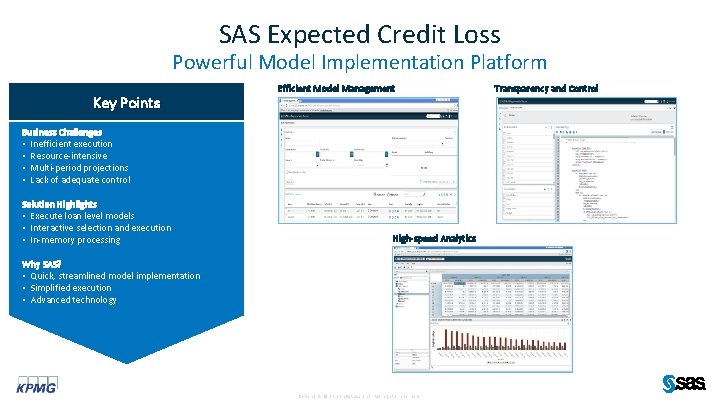
SAS Expected Credit Loss Powerful Model Implementation Platform Key Points Efficient Model Management Business Challenges • Inefficient execution • Resource-intensive • Multi-period projections • Lack of adequate control Solution Highlights • Execute loan level models • Interactive selection and execution • In-memory processing High-speed Analytics Why SAS? • Quick, streamlined model implementation • Simplified execution • Advanced technology Copyright © SAS Inst itute Inc. All rig hts reserved. Transparency and Control
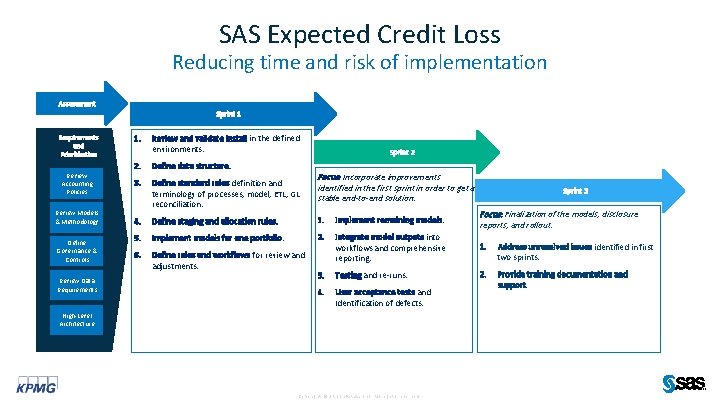
SAS Expected Credit Loss Reducing time and risk of implementation Assessment Sprint 1 Requirements and Prioritization Review Accounting Policies Review Models & Methodology Define Governance & Controls Review Data Requirements 1. Review and validate install in the defined environments. Sprint 2 2. Define data structure. 3. Define standard rules definition and terminology of processes, model, ETL, GL reconciliation. 4. Define staging and allocation rules. 1. Implement remaining models. Focus: Finalization of the models, disclosure reports, and rollout. 5. Implement models for one portfolio. 2. 6. Define roles and workflows for review and adjustments. Integrate model outputs into workflows and comprehensive reporting. 1. Address unresolved issues identified in first two sprints. 3. Testing and re-runs. 2. 4. User acceptance tests and Identification of defects. Provide training documentation and support. Focus: Incorporate improvements identified in the first sprint in order to get a stable end-to-end solution. Sprint 3 High-Level Architecture Copyright © SAS Inst itute Inc. All rig hts reserved. 10
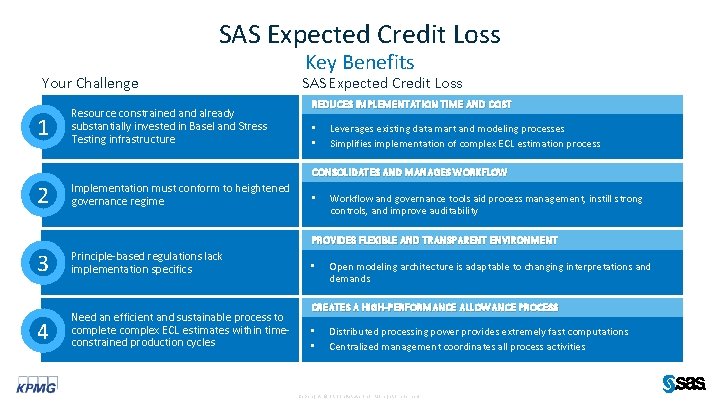
SAS Expected Credit Loss Your Challenge 1 Resource constrained and already substantially invested in Basel and Stress Testing infrastructure Key Benefits SAS Expected Credit Loss REDUCES IMPLEMENTATION TIME AND COST • • Leverages existing data mart and modeling processes Simplifies implementation of complex ECL estimation process CONSOLIDATES AND MANAGES WORKFLOW 2 Implementation must conform to heightened governance regime • Workflow and governance tools aid process management, instill strong controls, and improve auditability PROVIDES FLEXIBLE AND TRANSPARENT ENVIRONMENT 3 Principle-based regulations lack implementation specifics 4 Need an efficient and sustainable process to complete complex ECL estimates within timeconstrained production cycles • Open modeling architecture is adaptable to changing interpretations and demands CREATES A HIGH-PERFORMANCE ALLOWANCE PROCESS • • Distributed processing power provides extremely fast computations Centralized management coordinates all process activities Copyright © SAS Inst itute Inc. All rig hts reserved.
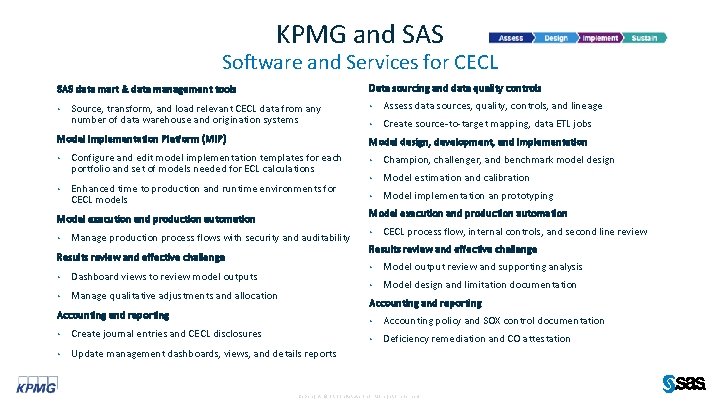
KPMG and SAS Software and Services for CECL Data sourcing and data quality controls SAS data mart & data management tools • Source, transform, and load relevant CECL data from any number of data warehouse and origination systems Model Implementation Platform (MIP) • Assess data sources, quality, controls, and lineage • Create source-to-target mapping, data ETL jobs Model design, development, and implementation • Configure and edit model implementation templates for each portfolio and set of models needed for ECL calculations • Champion, challenger, and benchmark model design Enhanced time to production and runtime environments for CECL models • • Model estimation and calibration • Model implementation an prototyping Model execution and production automation • Manage production process flows with security and auditability Results review and effective challenge • Dashboard views to review model outputs • Manage qualitative adjustments and allocation • CECL process flow, internal controls, and second line review Results review and effective challenge • Model output review and supporting analysis • Model design and limitation documentation Accounting and reporting • Create journal entries and CECL disclosures • Update management dashboards, views, and details reports • Accounting policy and SOX control documentation • Deficiency remediation and CO attestation Copyright © SAS Inst itute Inc. All rig hts reserved.
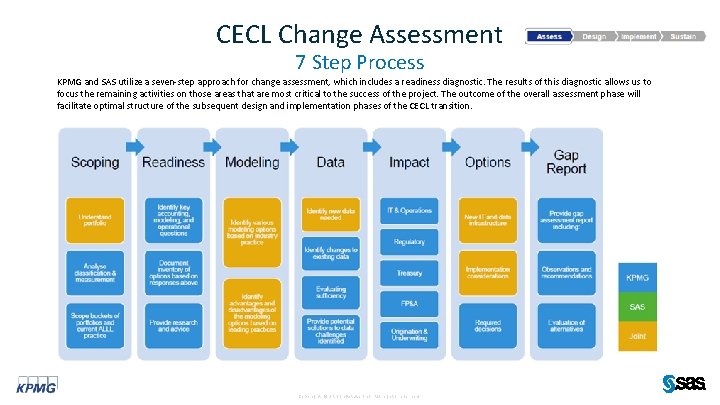
CECL Change Assessment 7 Step Process KPMG and SAS utilize a seven-step approach for change assessment, which includes a readiness diagnostic. The results of this diagnostic allows us to focus the remaining activities on those areas that are most critical to the success of the project. The outcome of the overall assessment phase will facilitate optimal structure of the subsequent design and implementation phases of the CECL transition. Copyright © SAS Inst itute Inc. All rig hts reserved.
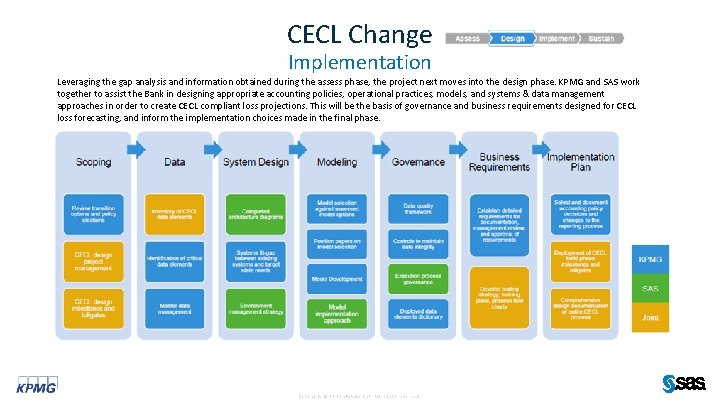
CECL Change Implementation Leveraging the gap analysis and information obtained during the assess phase, the project next moves into the design phase. KPMG and SAS work together to assist the Bank in designing appropriate accounting policies, operational practices, models, and systems & data management approaches in order to create CECL compliant loss projections. This will be the basis of governance and business requirements designed for CECL loss forecasting, and inform the implementation choices made in the final phase. Copyright © SAS Inst itute Inc. All rig hts reserved.
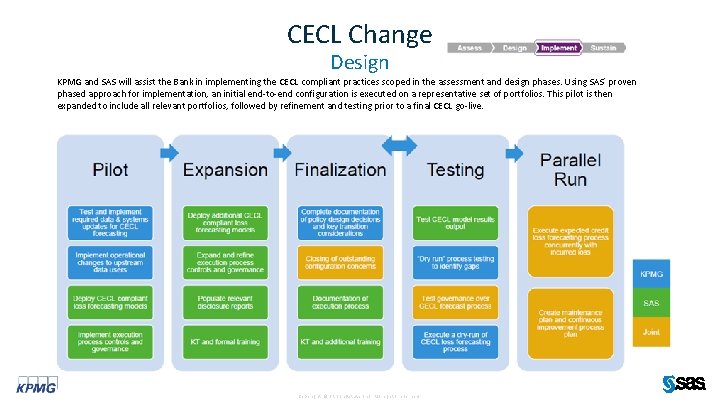
CECL Change Design KPMG and SAS will assist the Bank in implementing the CECL compliant practices scoped in the assessment and design phases. Using SAS’ proven phased approach for implementation, an initial end-to-end configuration is executed on a representative set of portfolios. This pilot is then expanded to include all relevant portfolios, followed by refinement and testing prior to a final CECL go-live. Copyright © SAS Inst itute Inc. All rig hts reserved.
Copyright © SAS Inst itute Inc. All rig hts reserved.