
SAS And Sudoku Richard A De Venezia Independent







- Slides: 98
SAS® And Sudoku Richard A. De. Venezia, Independent Consultant John R. Gerlach, Maxis. IT, Inc. Larry Hoyle, Institute for Policy and Social Research, Univ. of Kansas Talbot M. Katz, Analytic Data Information Technologies Rick Langston, SAS Institute Inc. Copyright © 2007, SAS Institute Inc. All rights reserved. SAS and all other SAS Institute Inc. product or service names are registered trademarks or trademarks of SAS Institute Inc. in the USA and other countries. ® indicates USA registration.
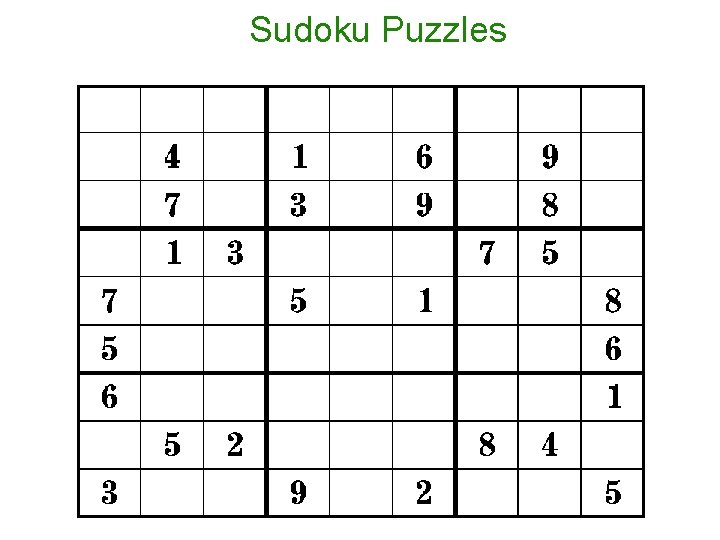
Sudoku Puzzles
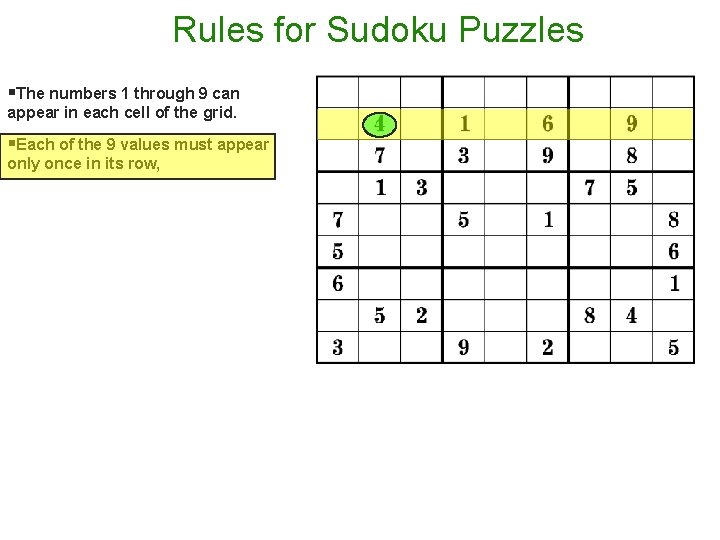
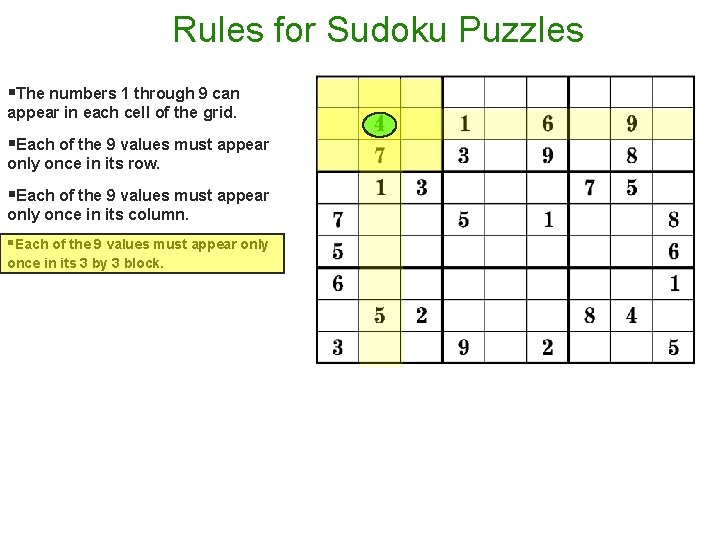
Rules for Sudoku Puzzles §The numbers 1 through 9 can appear in each cell of the grid.
Rules for Sudoku Puzzles §The numbers 1 through 9 can appear in each cell of the grid. §Each of the 9 values must appear only once in its row,
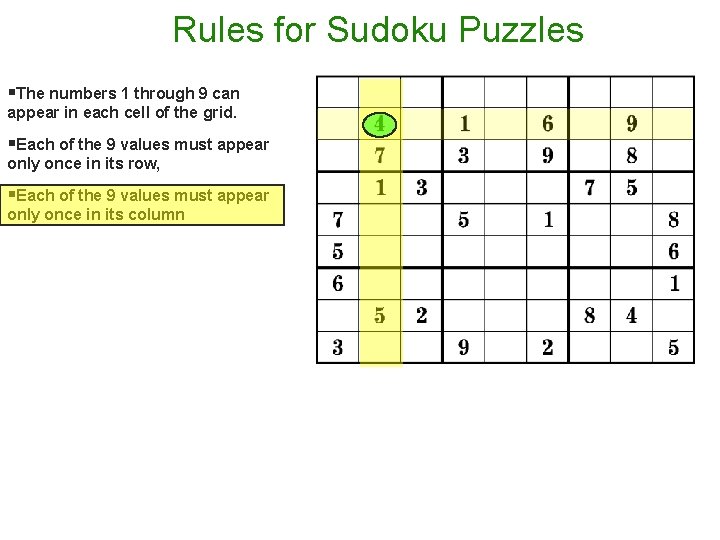
Rules for Sudoku Puzzles §The numbers 1 through 9 can appear in each cell of the grid. §Each of the 9 values must appear only once in its row, §Each of the 9 values must appear only once in its column
Rules for Sudoku Puzzles §The numbers 1 through 9 can appear in each cell of the grid. §Each of the 9 values must appear only once in its row. §Each of the 9 values must appear only once in its column. §Each of the 9 values must appear only once in its 3 by 3 block.
Rules for Sudoku Puzzles §The numbers 1 through 9 can appear in each cell of the grid. §Each of the 9 values must appear only once in its row. §Each of the 9 values must appear only once in its column. §Each of the 9 values must appear only once in its 3 by 3 block. §A valid puzzle should have a unique solution.
Sudoku Puzzle Statistics 6, 670, 903, 752, 021, 070, 000 5, 472, 730, 538 1 0. 016666667 91, 212, 176 1, 520, 203 63, 342 174 estimated number of puzzles "unique" puzzles (reduced to equivalents) mean seconds per unique puzzle mean minutes per puzzle total minutes for all unique puzzles total hours for all unique puzzles total days for all unique puzzles total years for all unique puzzles Estimates of number of puzzles from Delahaye, Jean-Paul 2006. “The Science Behind Sudoku. ” Scientific American 294 (6): 80 -87.
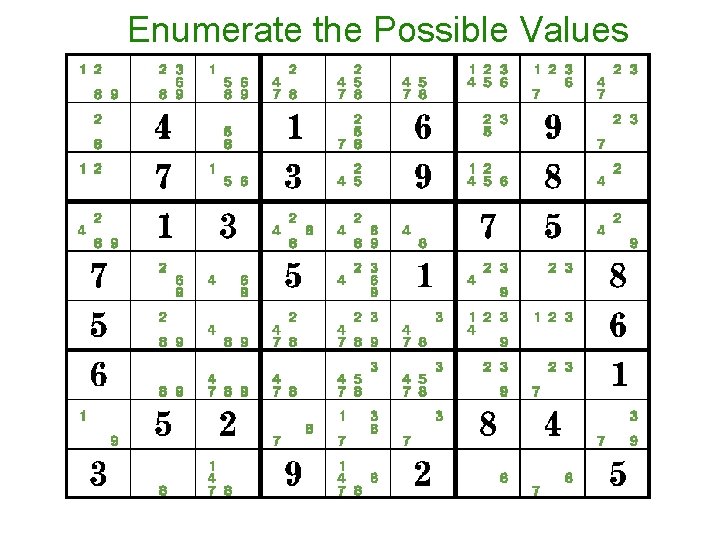
Enumerate the Possible Values
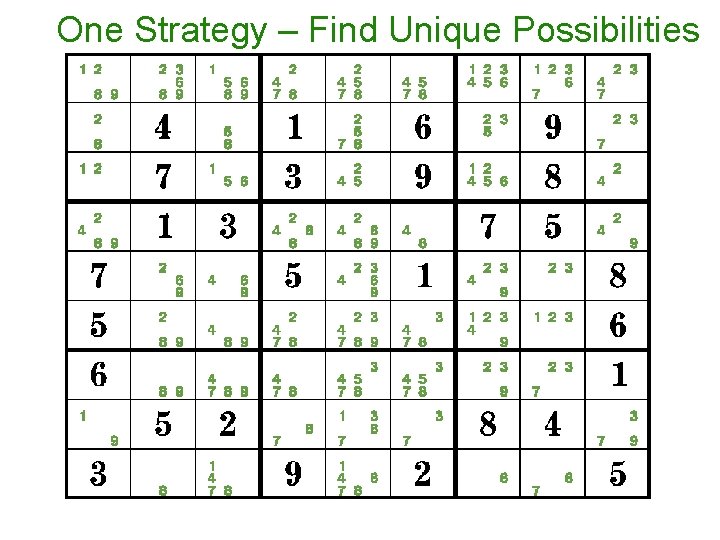
One Strategy – Find Unique Possibilities
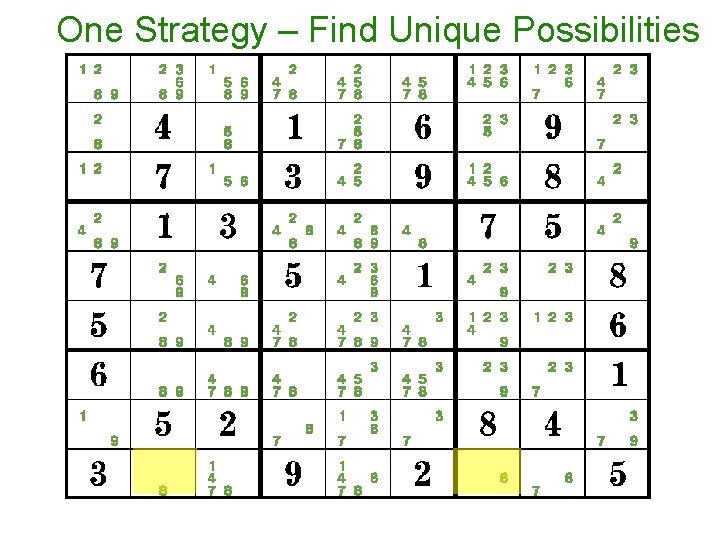
One Strategy – Find Unique Possibilities
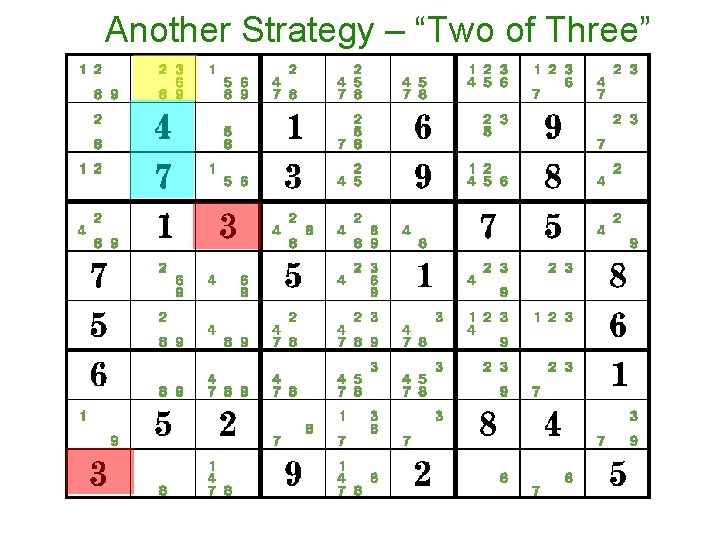
Another Strategy – “Two of Three”
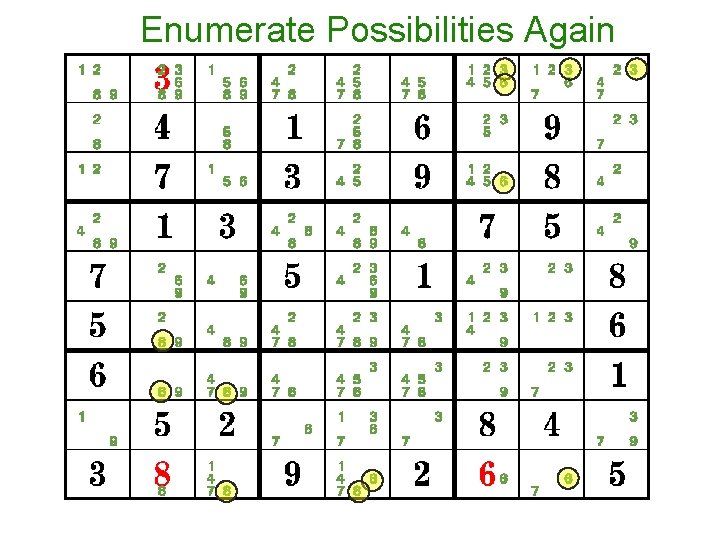
Enumerate Possibilities Again
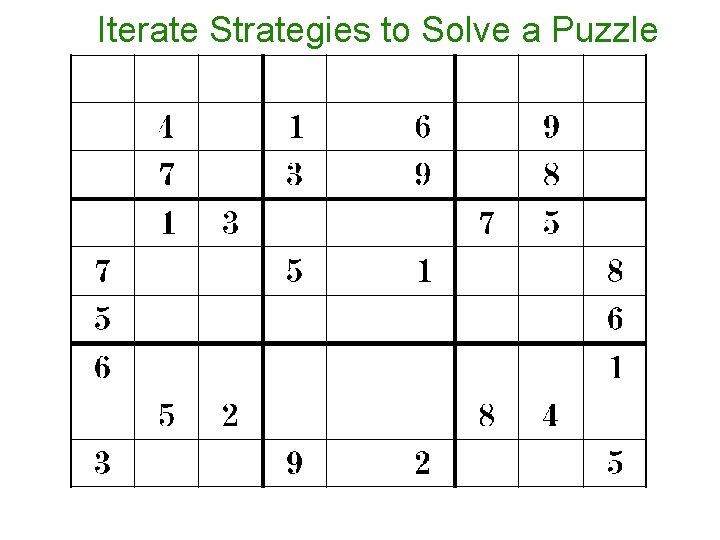
Iterate Strategies to Solve a Puzzle
Difficult Puzzles May Require Guessing and Backtracking § Pick a value for an empty cell § Continue trying to solve § If the value turns out to have been wrong – • Back up • Try another value
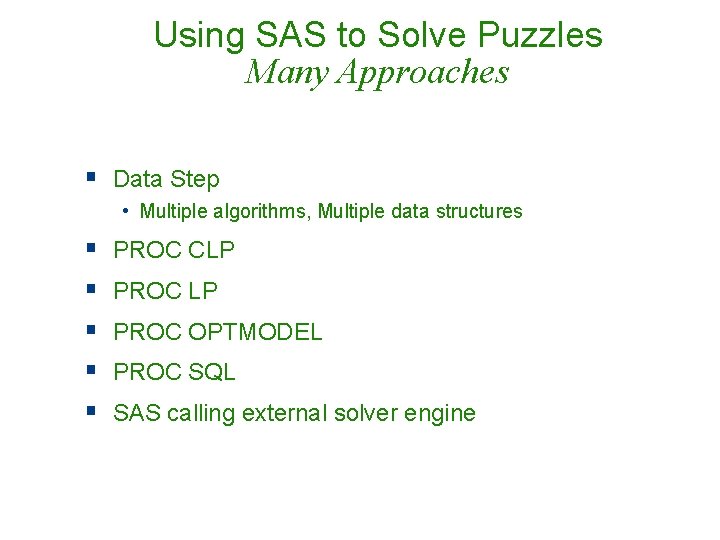
Using SAS to Solve Puzzles Many Approaches § Data Step • Multiple algorithms, Multiple data structures § § § PROC CLP PROC OPTMODEL PROC SQL SAS calling external solver engine
Richard De. Venezia
DATA Step Sudoku Search Richard A. De. Venezia Independent Consultant contact@devenezia. com
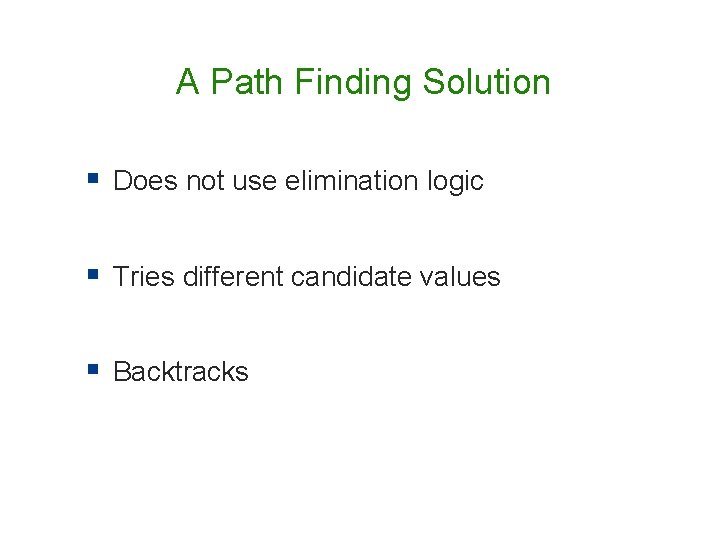
A Path Finding Solution § Does not use elimination logic § Tries different candidate values § Backtracks
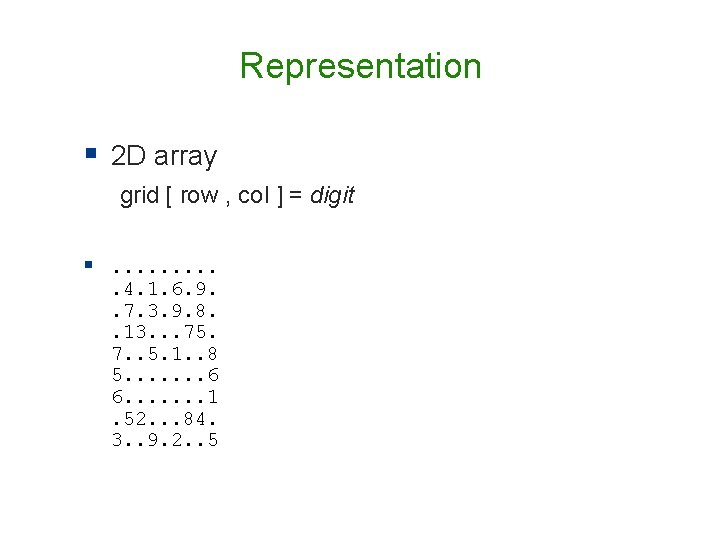
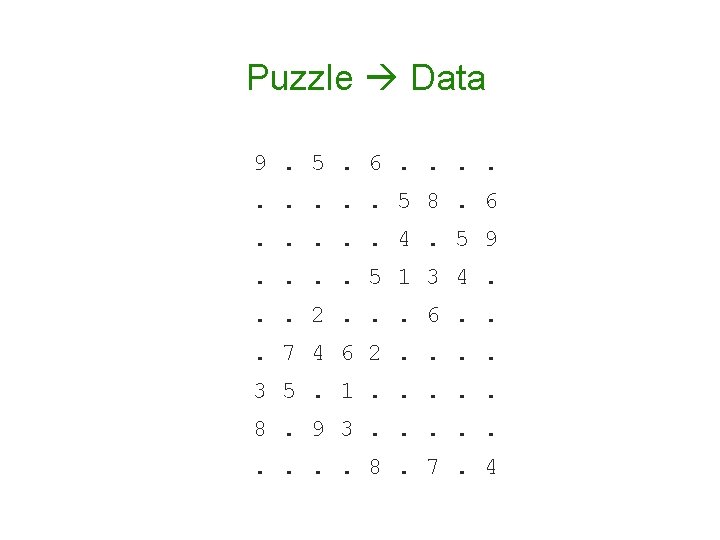
Representation § 2 D array grid [ row , col ] = digit §. . 4. 1. 6. 9. . 7. 3. 9. 8. . 13. . . 75. 7. . 5. 1. . 8 5. . . . 6 6. . . . 1. 52. . . 84. 3. . 9. 2. . 5
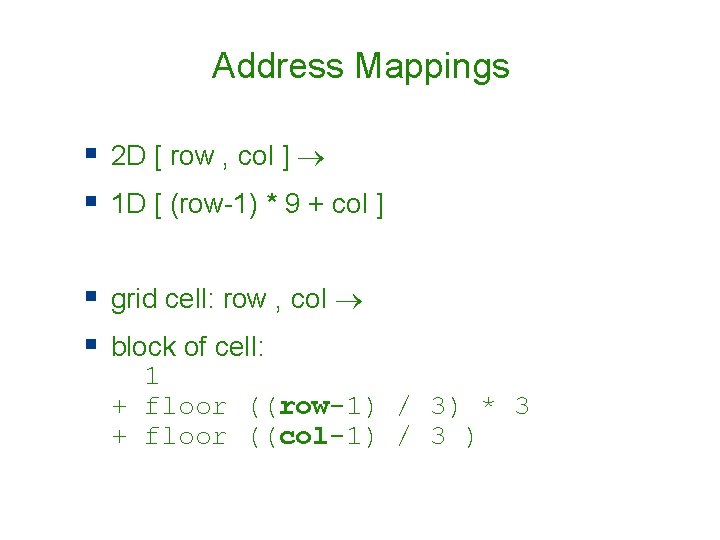
Address Mappings § 2 D [ row , col ] § 1 D [ (row-1) * 9 + col ] § grid cell: row , col § block of cell: 1 + floor ((row-1) / 3) * 3 + floor ((col-1) / 3 )
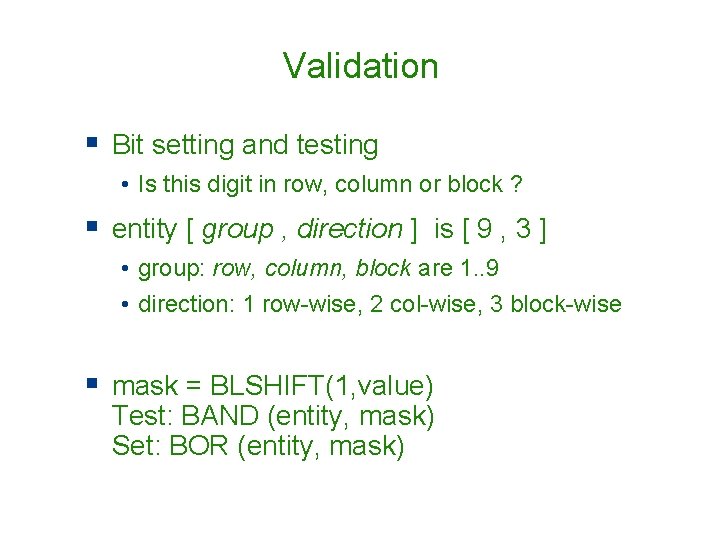
Validation § Bit setting and testing • Is this digit in row, column or block ? § entity [ group , direction ] is [ 9 , 3 ] • group: row, column, block are 1. . 9 • direction: 1 row-wise, 2 col-wise, 3 block-wise § mask = BLSHIFT(1, value) Test: BAND (entity, mask) Set: BOR (entity, mask)
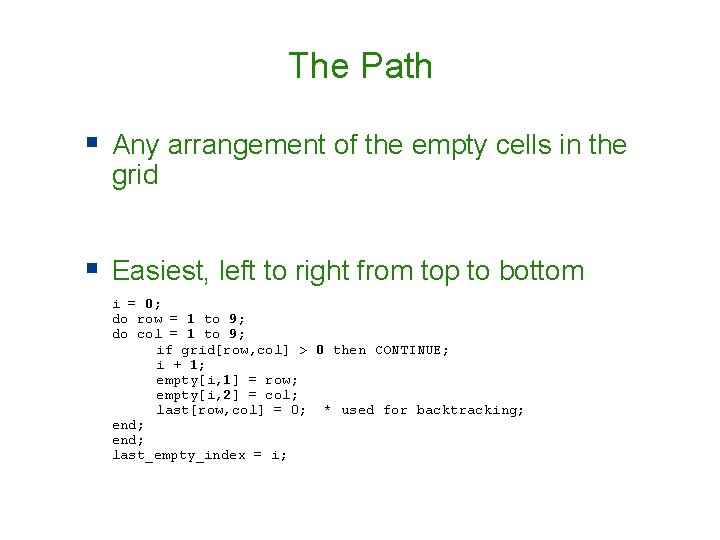
The Path § Any arrangement of the empty cells in the grid § Easiest, left to right from top to bottom i = 0; do row = 1 to 9; do col = 1 to 9; if grid[row, col] > 0 then CONTINUE; i + 1; empty[i, 1] = row; empty[i, 2] = col; last[row, col] = 0; * used for backtracking; end; last_empty_index = i;
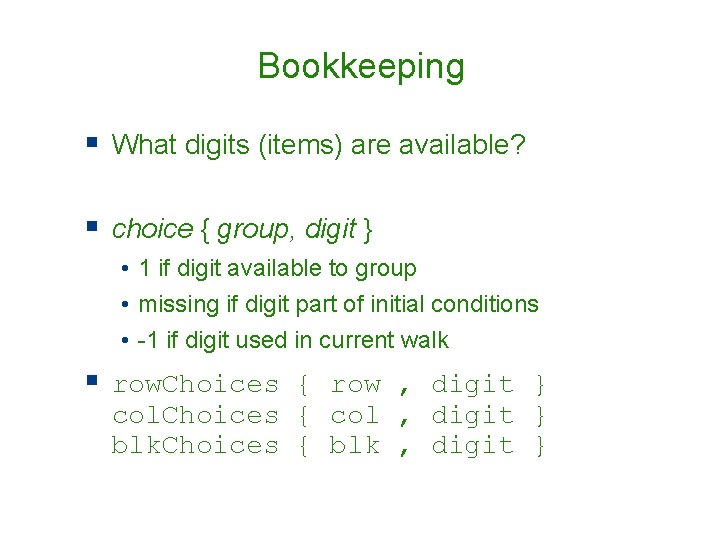
Bookkeeping § What digits (items) are available? § choice { group, digit } • 1 if digit available to group • missing if digit part of initial conditions • -1 if digit used in current walk § row. Choices { row , digit } col. Choices { col , digit } blk. Choices { blk , digit }
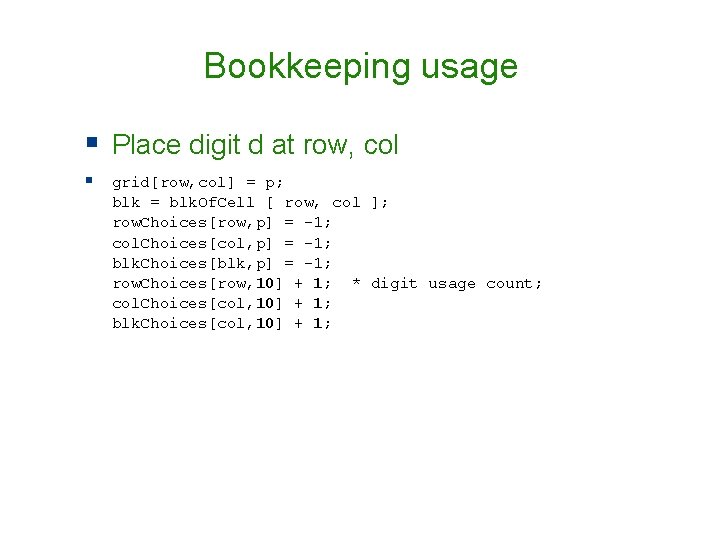
Bookkeeping usage § Place digit d at row, col § grid[row, col] = p; blk = blk. Of. Cell [ row, col ]; row. Choices[row, p] = -1; col. Choices[col, p] = -1; blk. Choices[blk, p] = -1; row. Choices[row, 10] + 1; * digit usage count; col. Choices[col, 10] + 1; blk. Choices[col, 10] + 1;
Step Along the Path § Place a digit, or § Backup
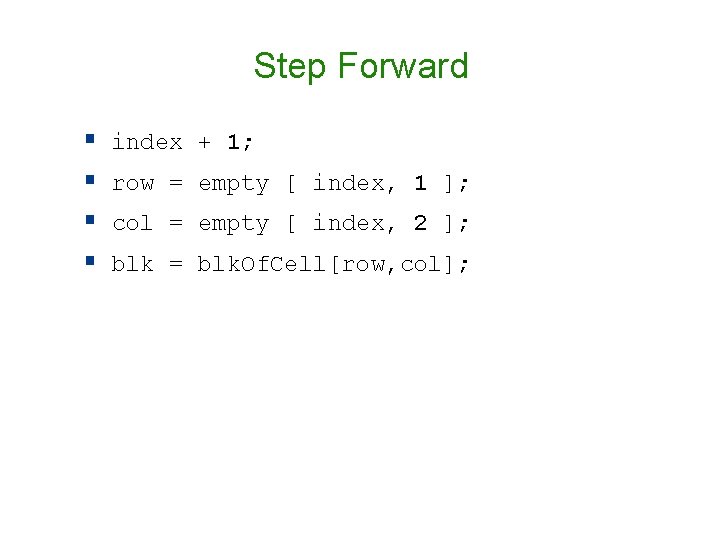
Step Forward § § index + 1; row = empty [ index, 1 ]; col = empty [ index, 2 ]; blk = blk. Of. Cell[row, col];
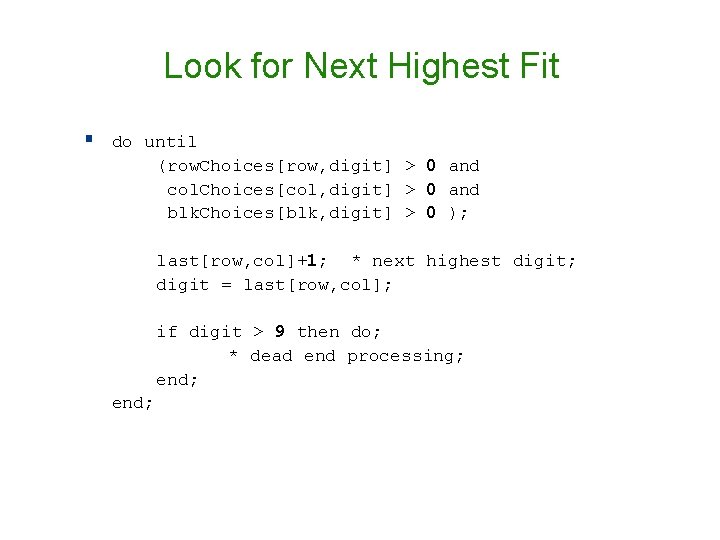
Look for Next Highest Fit § do until (row. Choices[row, digit] > 0 and col. Choices[col, digit] > 0 and blk. Choices[blk, digit] > 0 ); last[row, col]+1; * next highest digit; digit = last[row, col]; if digit > 9 then do; * dead end processing; end;
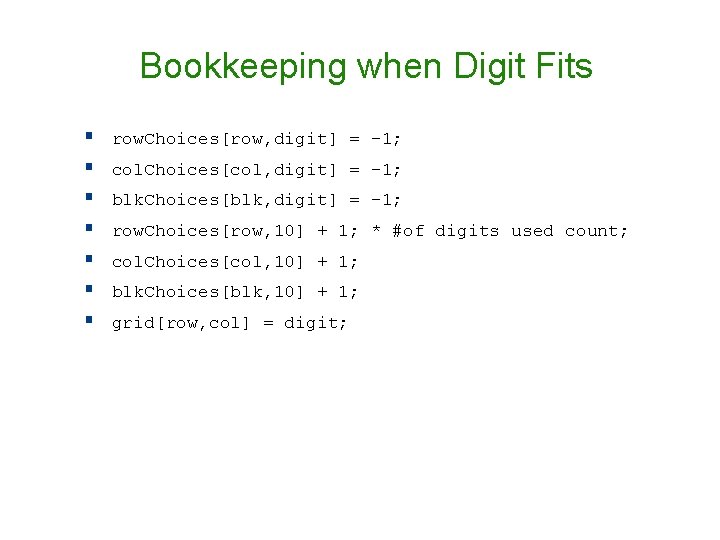
Bookkeeping when Digit Fits § § § § row. Choices[row, digit] = -1; col. Choices[col, digit] = -1; blk. Choices[blk, digit] = -1; row. Choices[row, 10] + 1; * #of digits used count; col. Choices[col, 10] + 1; blk. Choices[blk, 10] + 1; grid[row, col] = digit;
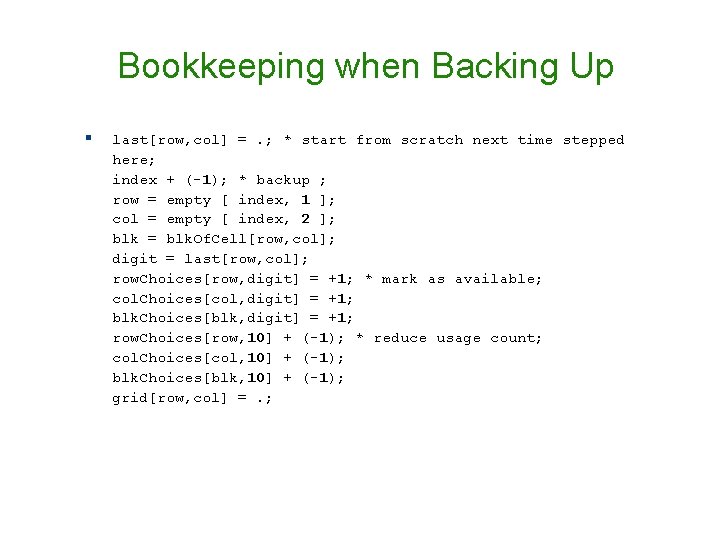
Bookkeeping when Backing Up § last[row, col] =. ; * start from scratch next time stepped here; index + (-1); * backup ; row = empty [ index, 1 ]; col = empty [ index, 2 ]; blk = blk. Of. Cell[row, col]; digit = last[row, col]; row. Choices[row, digit] = +1; * mark as available; col. Choices[col, digit] = +1; blk. Choices[blk, digit] = +1; row. Choices[row, 10] + (-1); * reduce usage count; col. Choices[col, 10] + (-1); blk. Choices[blk, 10] + (-1); grid[row, col] =. ;
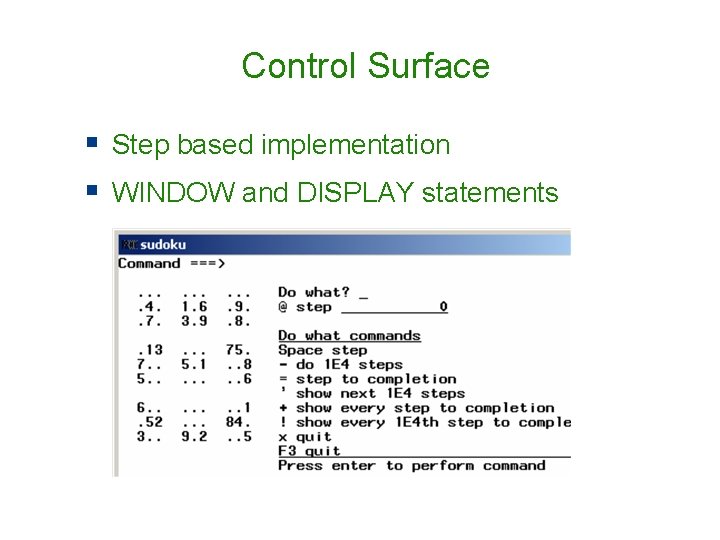
Control Surface § Step based implementation § WINDOW and DISPLAY statements
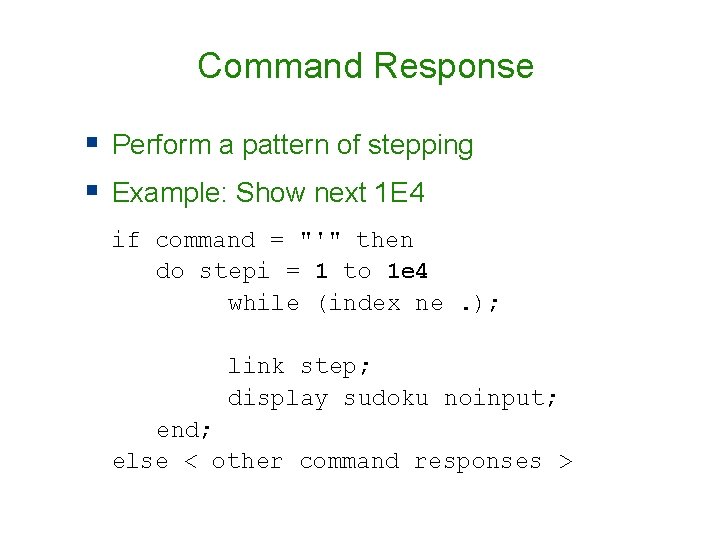
Command Response § Perform a pattern of stepping § Example: Show next 1 E 4 if command = "'" then do stepi = 1 to 1 e 4 while (index ne. ); link step; display sudoku noinput; end; else < other command responses >
Conclusion § DATA Step is fast § Puzzle solving for training Richard A. De. Venezia contact@devenezia. com
John Gerlach
Using a Cube to Solve the Square John R. Gerlach Maxis. IT, Inc. jgerlach@maxisit. com
A Geometric Solution § Imagine a cube behind the square. § The cube represents a collection of orthogonal vectors for each XY cell such that the Z-coordinate denotes all the possible values of each XY cell.
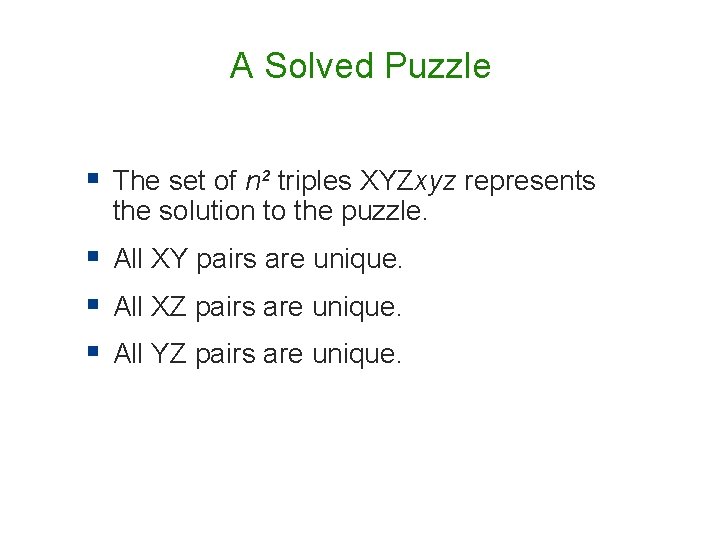
A Solved Puzzle § The set of n² triples XYZxyz represents the solution to the puzzle. § All XY pairs are unique. § All XZ pairs are unique. § All YZ pairs are unique.
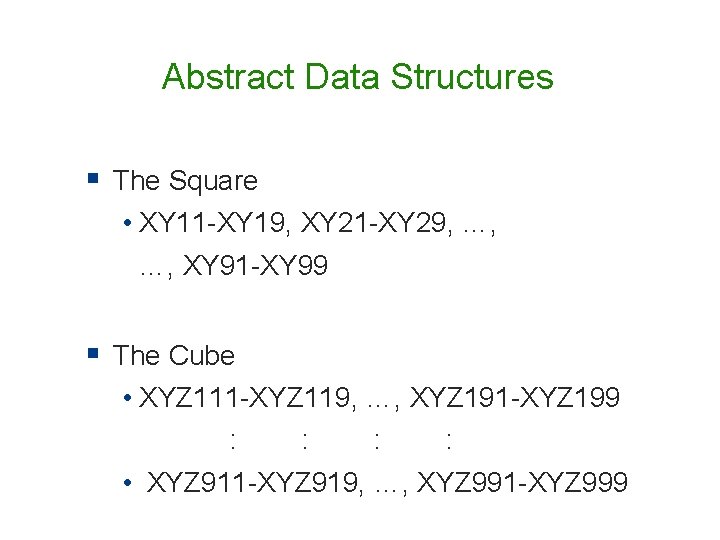
Abstract Data Structures § The Square • XY 11 -XY 19, XY 21 -XY 29, …, …, XY 91 -XY 99 § The Cube • XYZ 111 -XYZ 119, …, XYZ 191 -XYZ 199 : : • XYZ 911 -XYZ 919, …, XYZ 991 -XYZ 999
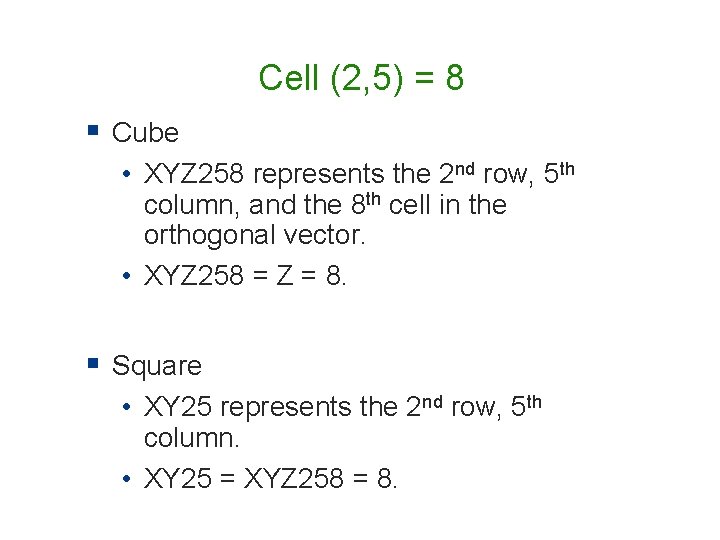
Cell (2, 5) = 8 § Cube • XYZ 258 represents the 2 nd row, 5 th column, and the 8 th cell in the orthogonal vector. • XYZ 258 = Z = 8. § Square • XY 25 represents the 2 nd row, 5 th column. • XY 25 = XYZ 258 = 8.
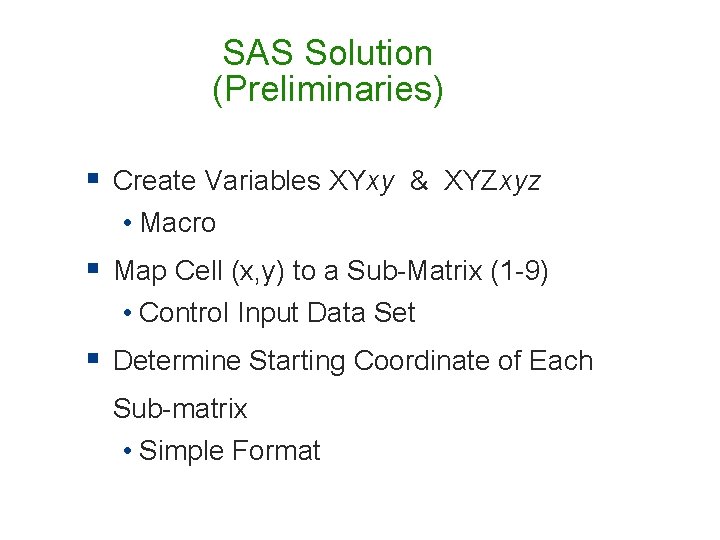
SAS Solution (Preliminaries) § Create Variables XYxy & XYZxyz • Macro § Map Cell (x, y) to a Sub-Matrix (1 -9) • Control Input Data Set § Determine Starting Coordinate of Each Sub-matrix • Simple Format
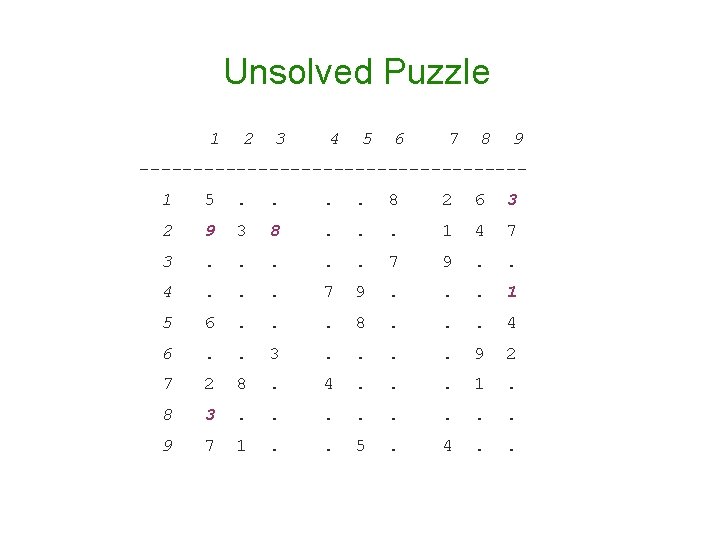
Puzzle Data 9. 5. 6. . 5 8. 6. . . 4. 5 9. . 5 1 3 4. . . 2. . . 6. . . 7 4 6 2. . 3 5. 1. . . 8. 9 3. . 8. 7. 4
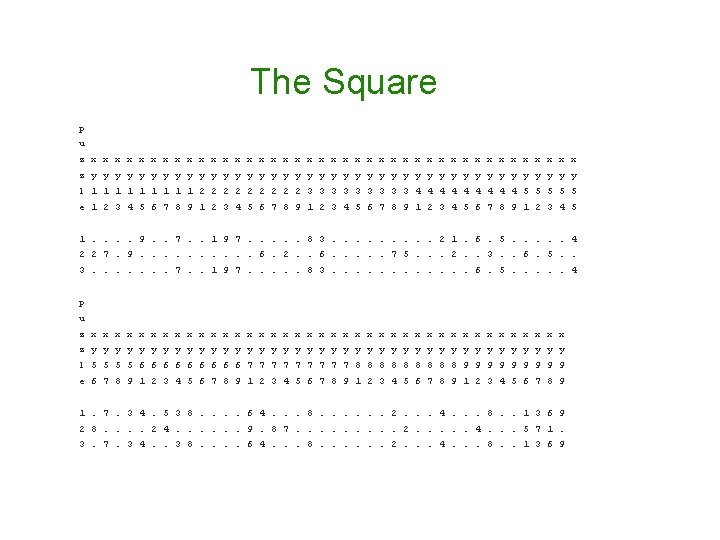
The Square p u z x x x x x x x x x x x z y y y y y y y y y y y l 1 1 1 1 1 2 2 2 2 2 3 3 3 3 3 4 4 4 4 4 5 5 5 e 1 2 3 4 5 6 7 8 9 1 2 3 4 5 1. . 9. . 7. . 1 9 7. . . 8 3. . 2 1. 6. 5. . . 4 2 2 7. 9. . 6. 2. . 6. . . 7 5. . . 2. . 3. . 6. 5. . 3. . . . 7. . 1 9 7. . . 8 3. . . 6. 5. . . 4 p u z x x x x x x x x x x z y y y y y y y y y y l 5 5 6 6 6 6 6 7 7 7 7 7 8 8 8 8 8 9 9 9 9 9 e 6 7 8 9 1 2 3 4 5 6 7 8 9 1. 7. 3 4. 5 3 8. . 6 4. . . 8. . . 2. . . 4. . . 8. . 1 3 6 9 2 8. . 2 4. . . 9. 8 7. . 2. . . 4. . . 5 7 1. 3. 7. 3 4. . 3 8. . 6 4. . . 8. . . 2. . . 4. . . 8. . 1 3 6 9
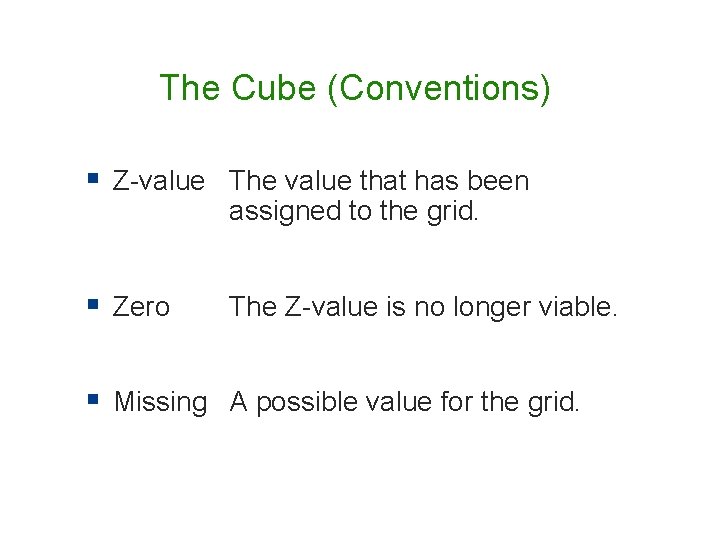
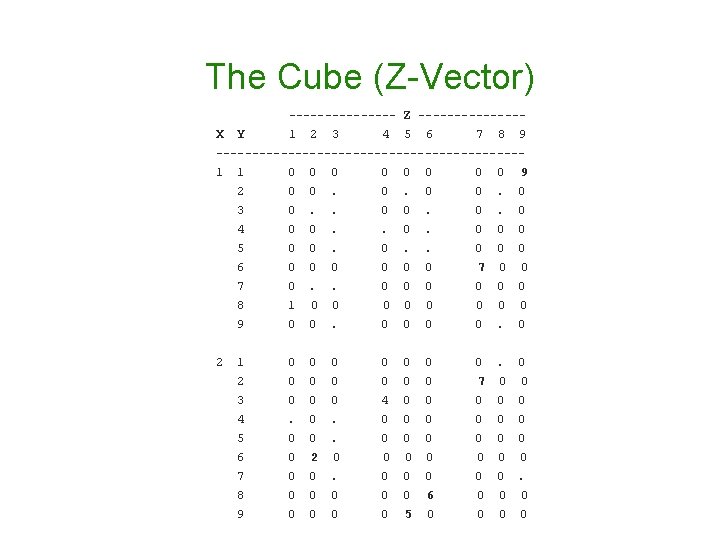
The Cube (Conventions) § Z-value The value that has been assigned to the grid. § Zero The Z-value is no longer viable. § Missing A possible value for the grid.
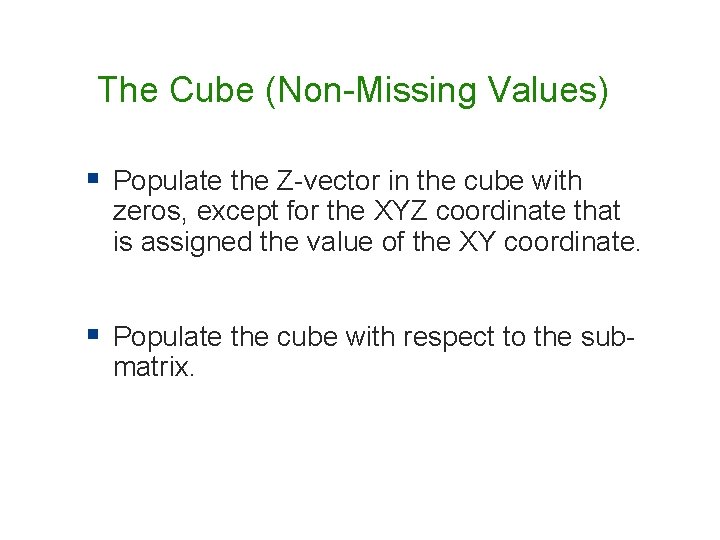
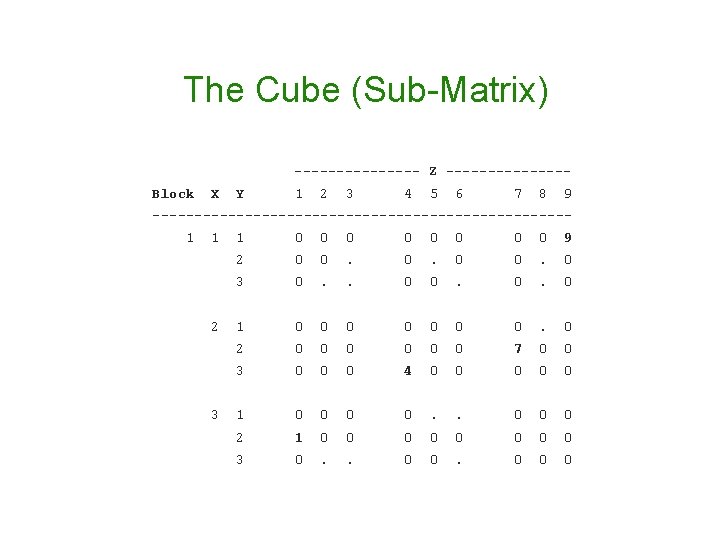
The Cube (Non-Missing Values) § Populate the Z-vector in the cube with zeros, except for the XYZ coordinate that is assigned the value of the XY coordinate. § Populate the cube with respect to the submatrix.
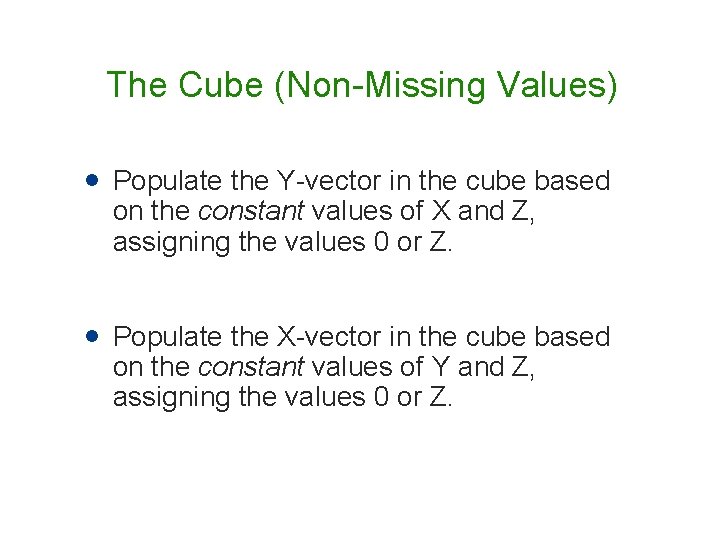
The Cube (Non-Missing Values) Populate the Y-vector in the cube based on the constant values of X and Z, assigning the values 0 or Z. Populate the X-vector in the cube based on the constant values of Y and Z, assigning the values 0 or Z.
The Cube (Z-Vector) -------- Z -------X Y 1 2 3 4 5 6 7 8 9 ---------------------1 2 1 0 0 0 0 9 2 0 0 . 0 3 0 . . 0 0 . 0 4 0 0 . . 0 0 0 5 0 0 . . 0 0 0 6 0 0 0 7 0 . . 0 0 0 8 1 0 0 0 0 9 0 0 . 0 1 0 0 0 0 . 0 2 0 0 0 7 0 0 3 0 0 0 4 . 0 0 0 0 5 0 0 0 6 0 2 0 0 0 0 7 0 0 0 . 8 0 0 0 6 0 0 0 9 0 0 5 0 0
The Cube (Sub-Matrix) -------- Z -------Block X Y 1 2 3 4 5 6 7 8 9 -------------------------1 1 2 3 1 0 0 0 0 9 2 0 0 . 0 3 0 . . 0 0 . 0 1 0 0 0 0 . 0 2 0 0 0 7 0 0 3 0 0 0 4 0 0 0 1 0 0 . . 0 0 0 2 1 0 0 0 0 3 0 . . 0 0 0
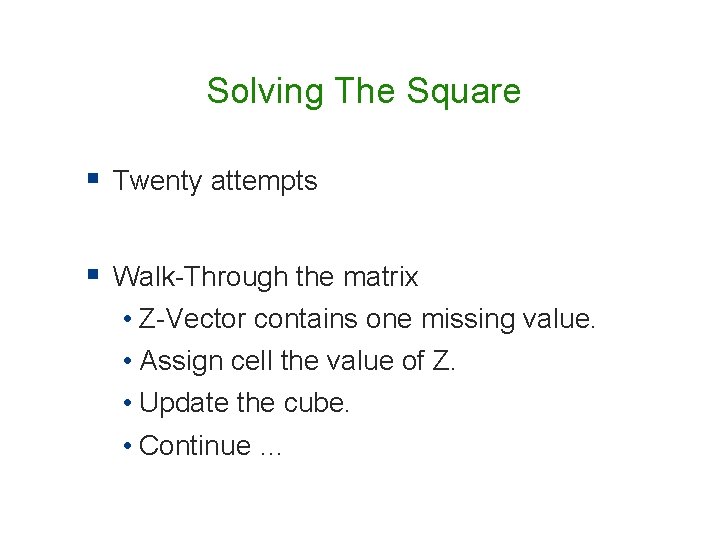
Solving The Square § Twenty attempts § Walk-Through the matrix • Z-Vector contains one missing value. • Assign cell the value of Z. • Update the cube. • Continue …
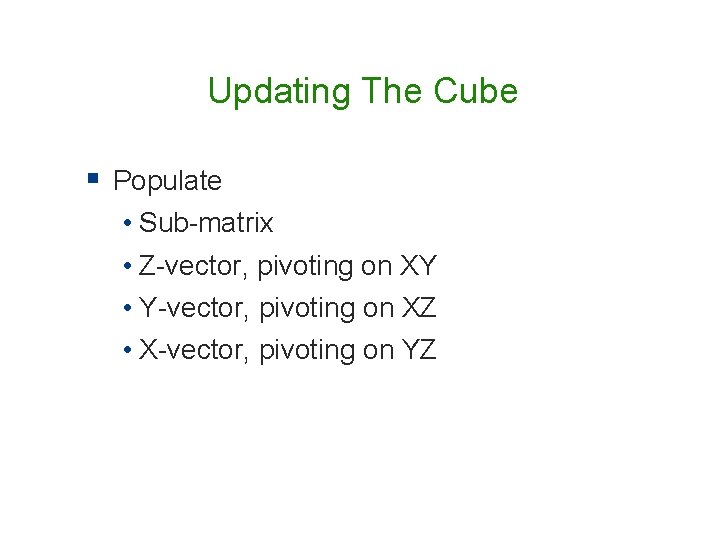
Updating The Cube § Populate • Sub-matrix • Z-vector, pivoting on XY • Y-vector, pivoting on XZ • X-vector, pivoting on YZ
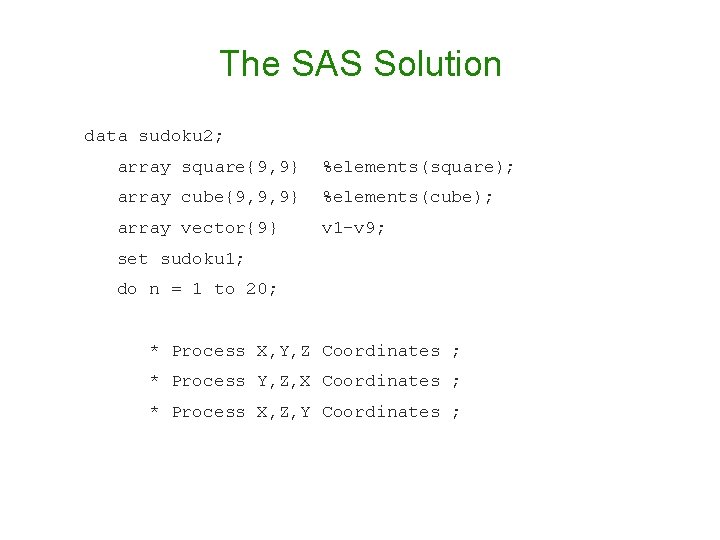
The SAS Solution data sudoku 2; array square{9, 9} %elements(square); array cube{9, 9, 9} %elements(cube); array vector{9} v 1 -v 9; set sudoku 1; do n = 1 to 20; * Process X, Y, Z Coordinates ; * Process Y, Z, X Coordinates ; * Process X, Z, Y Coordinates ;
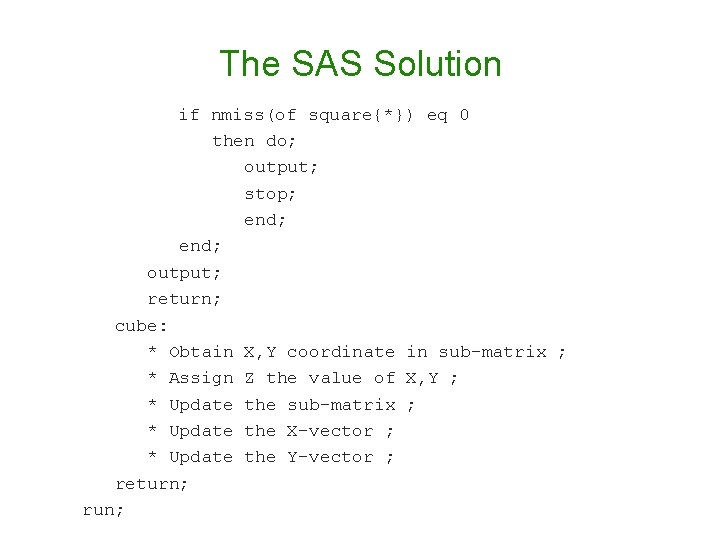
The SAS Solution if nmiss(of square{*}) eq 0 then do; output; stop; end; output; return; cube: * Obtain X, Y coordinate in sub-matrix ; * Assign Z the value of X, Y ; * Update the sub-matrix ; * Update the X-vector ; * Update the Y-vector ; return; run;
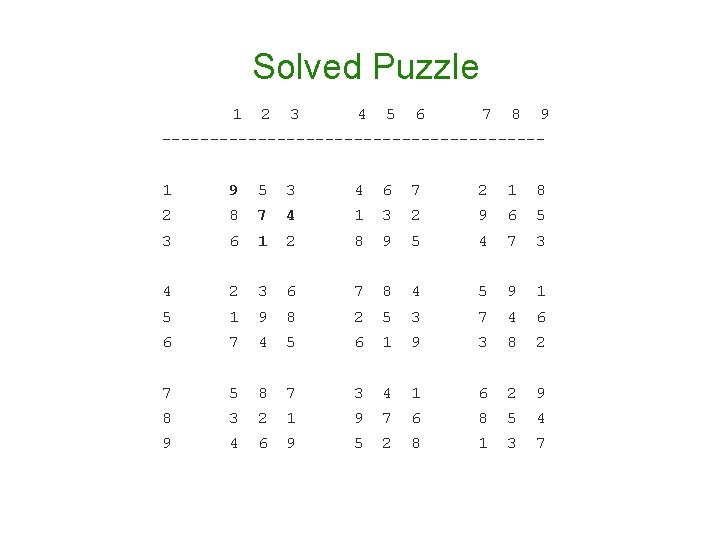
Solved Puzzle 1 2 3 4 5 6 7 8 9 --------------------1 9 5 3 4 6 7 2 1 8 2 8 7 4 1 3 2 9 6 5 3 6 1 2 8 9 5 4 7 3 4 2 3 6 7 8 4 5 9 1 5 1 9 8 2 5 3 7 4 6 6 7 4 5 6 1 9 3 8 2 7 5 8 7 3 4 1 6 2 9 8 3 2 1 9 7 6 8 5 4 9 4 6 9 5 2 8 1 3 7
Unfair Puzzles § Insufficient information to solve the puzzle without resorting to relentless trial and error.
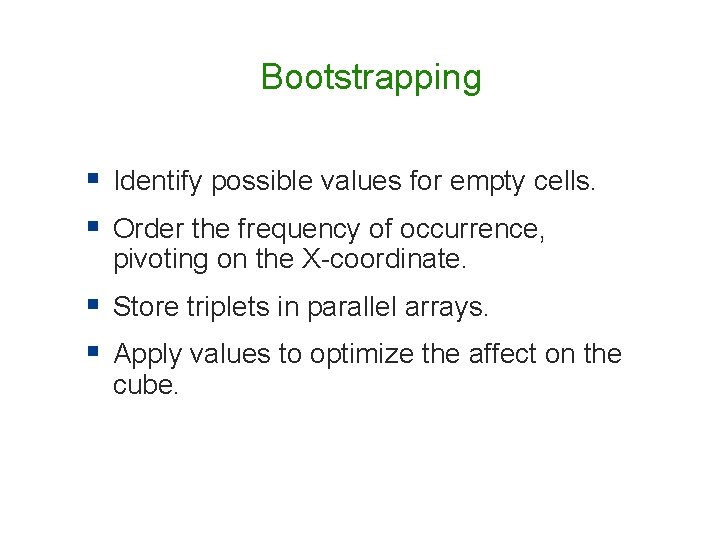
Bootstrapping § Identify possible values for empty cells. § Order the frequency of occurrence, pivoting on the X-coordinate. § Store triplets in parallel arrays. § Apply values to optimize the affect on the cube.
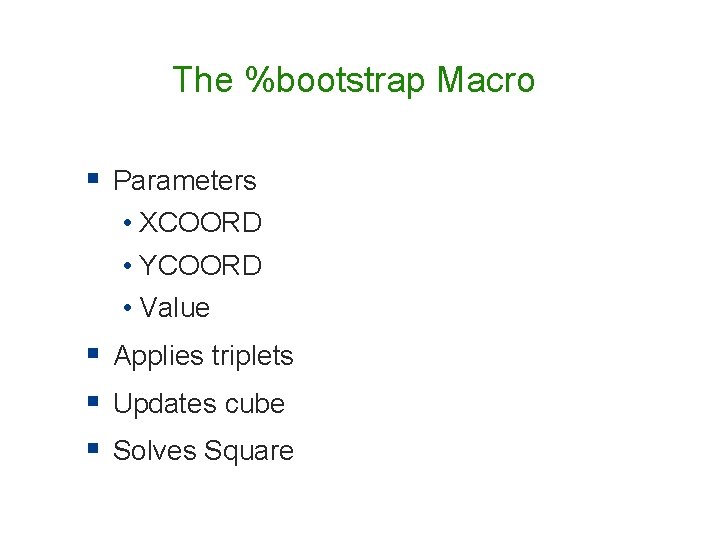
The %bootstrap Macro § Parameters • XCOORD • YCOORD • Value § Applies triplets § Updates cube § Solves Square
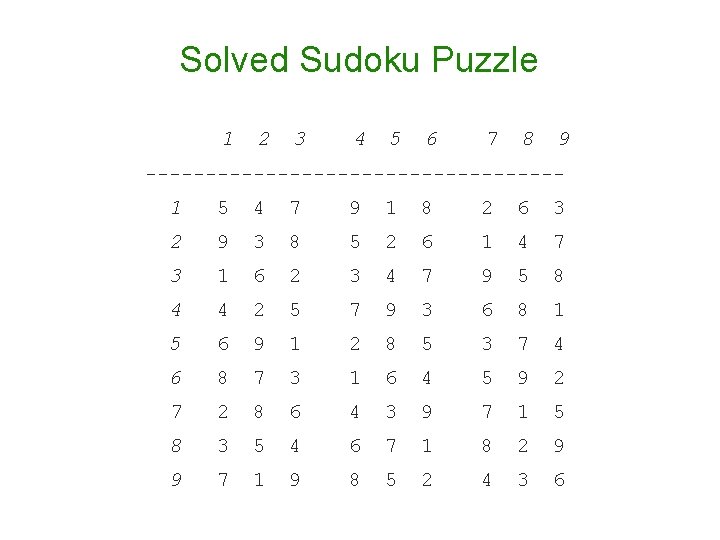
Solved Sudoku Puzzle 1 2 3 4 5 6 7 8 9 -----------------1 5 4 7 9 1 8 2 6 3 2 9 3 8 5 2 6 1 4 7 3 1 6 2 3 4 7 9 5 8 4 4 2 5 7 9 3 6 8 1 5 6 9 1 2 8 5 3 7 4 6 8 7 3 1 6 4 5 9 2 7 2 8 6 4 3 9 7 1 5 8 3 5 4 6 7 1 8 2 9 9 7 1 9 8 5 2 4 3 6
Conclusion § Natural (Geometric) Solution § Data Step / Macro Language § No Statistical Procedures John R. Gerlach jgerlach@maxisit. com
Larry Hoyle SAS® and Sudoku SGF 2007, This slide copyright Larry Hoyle, 2007
Larry Hoyle Institute for Policy and Social Research University of Kansas Larry. Hoyle@ku. edu SAS® and Sudoku SGF 2007, This slide copyright Larry Hoyle, 2007
An SQL Approach § SQL example for class use • All SQL except for: − Data step to read puzzle − Macro to iterate − PROC TABULATE to display puzzle • Full program is in the paper SAS® and Sudoku SGF 2007, This slide copyright Larry Hoyle, 2007
Model Human Strategies § SQL models three strategies a person might use • Only one possible value • “Two of three” in columns • “Two of three” in rows SAS® and Sudoku SGF 2007, This slide copyright Larry Hoyle, 2007
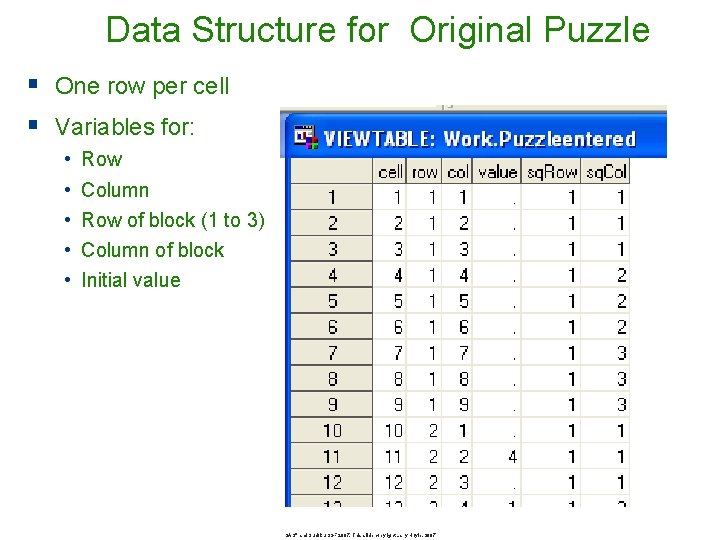
Data Structure for Original Puzzle § One row per cell § Variables for: • • • Row Column Row of block (1 to 3) Column of block Initial value SAS® and Sudoku SGF 2007, This slide copyright Larry Hoyle, 2007
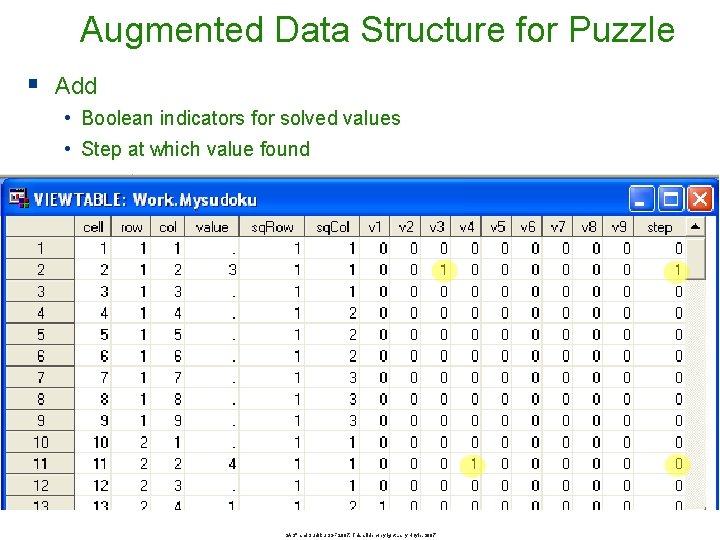
Augmented Data Structure for Puzzle § Add • Boolean indicators for solved values • Step at which value found SAS® and Sudoku SGF 2007, This slide copyright Larry Hoyle, 2007
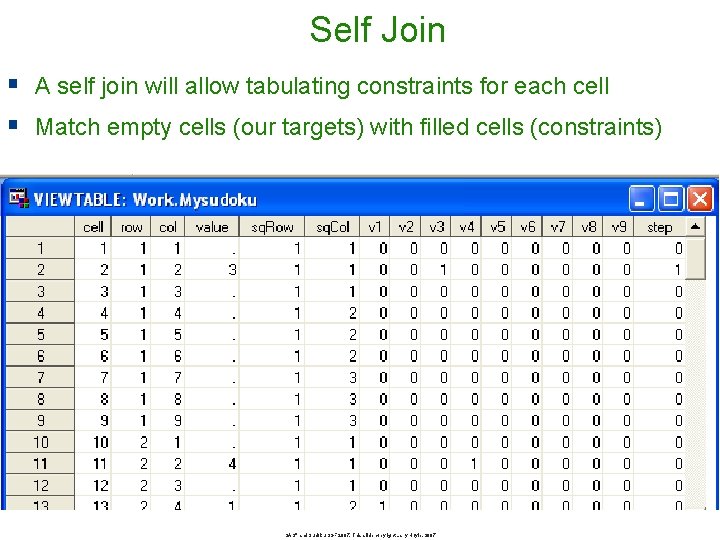
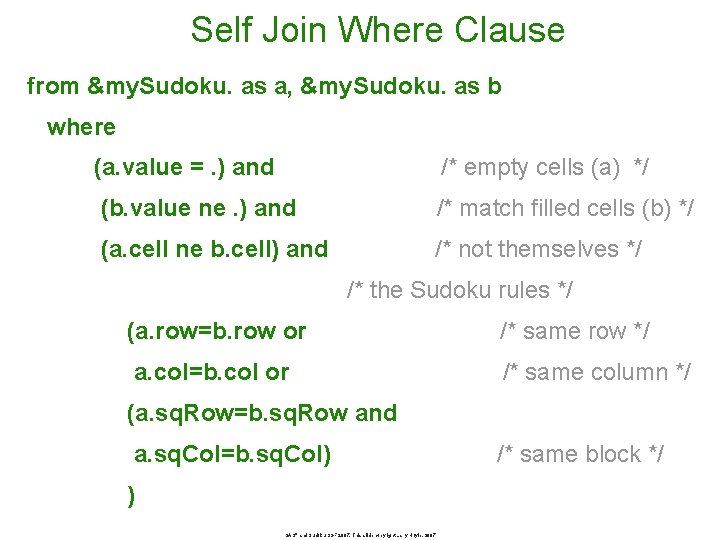
Self Join § A self join will allow tabulating constraints for each cell § Match empty cells (our targets) with filled cells (constraints) SAS® and Sudoku SGF 2007, This slide copyright Larry Hoyle, 2007
Self Join Where Clause from &my. Sudoku. as a, &my. Sudoku. as b where (a. value =. ) and /* empty cells (a) */ (b. value ne. ) and /* match filled cells (b) */ (a. cell ne b. cell) and /* not themselves */ /* the Sudoku rules */ (a. row=b. row or /* same row */ a. col=b. col or /* same column */ (a. sq. Row=b. sq. Row and a. sq. Col=b. sq. Col) ) SAS® and Sudoku SGF 2007, This slide copyright Larry Hoyle, 2007 /* same block */
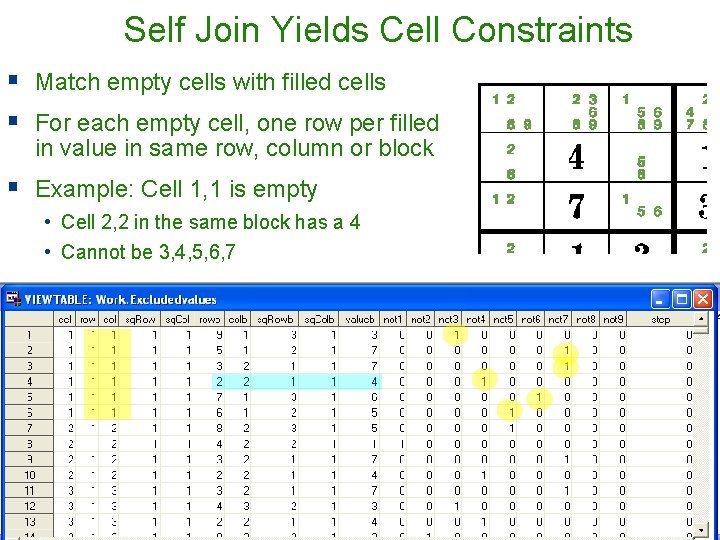
Self Join Yields Cell Constraints § Match empty cells with filled cells § For each empty cell, one row per filled in value in same row, column or block § Example: Cell 1, 1 is empty • Cell 2, 2 in the same block has a 4 • Cannot be 3, 4, 5, 6, 7 SAS® and Sudoku SGF 2007, This slide copyright Larry Hoyle, 2007
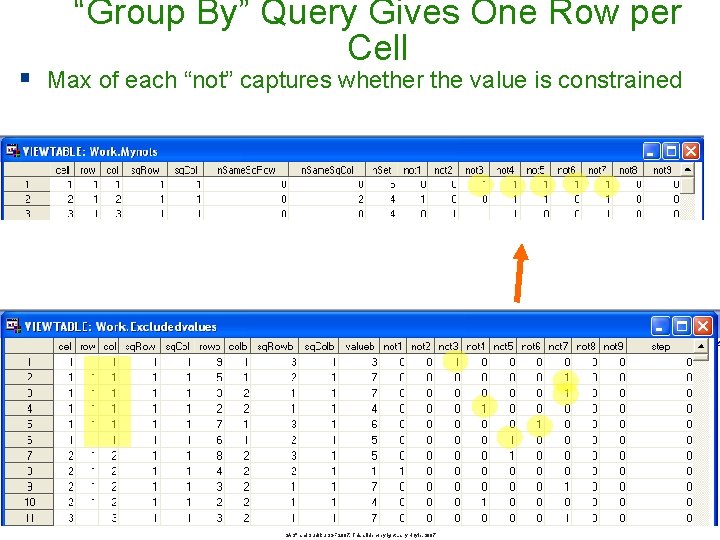
“Group By” Query Gives One Row per Cell § Max of each “not” captures whether the value is constrained SAS® and Sudoku SGF 2007, This slide copyright Larry Hoyle, 2007
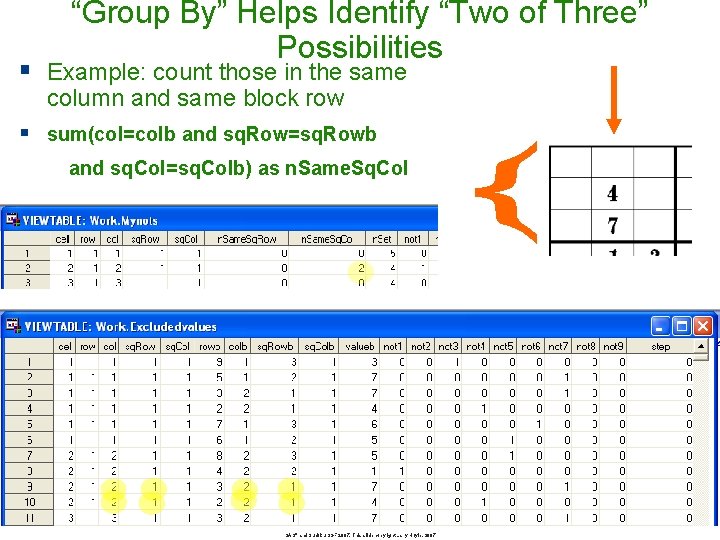
“Group By” Helps Identify “Two of Three” Possibilities § Example: count those in the same column and same block row § sum(col=colb and sq. Row=sq. Rowb and sq. Col=sq. Colb) as n. Same. Sq. Col SAS® and Sudoku SGF 2007, This slide copyright Larry Hoyle, 2007
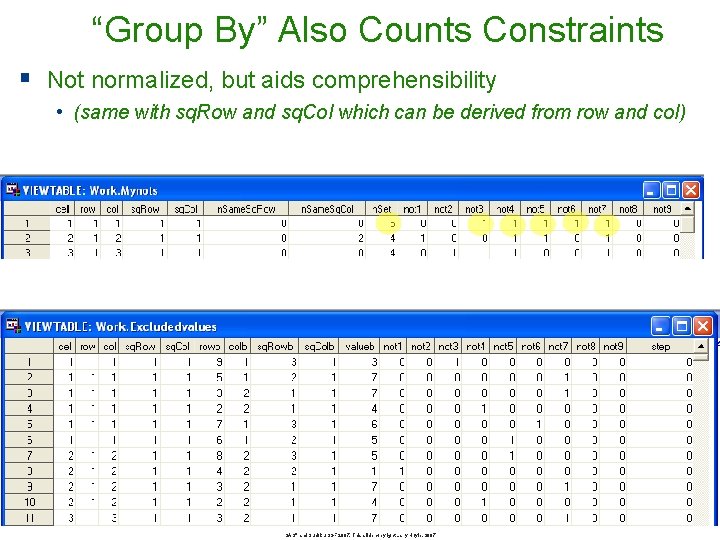
“Group By” Also Counts Constraints § Not normalized, but aids comprehensibility • (same with sq. Row and sq. Col which can be derived from row and col) SAS® and Sudoku SGF 2007, This slide copyright Larry Hoyle, 2007
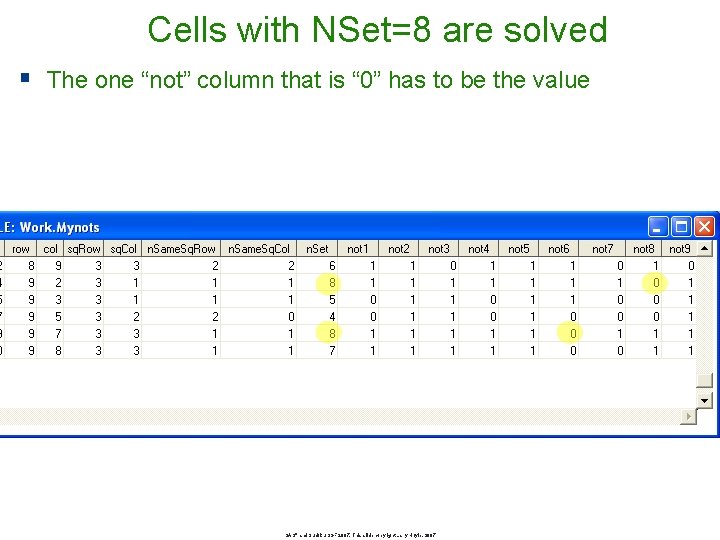
Cells with NSet=8 are solved § The one “not” column that is “ 0” has to be the value SAS® and Sudoku SGF 2007, This slide copyright Larry Hoyle, 2007
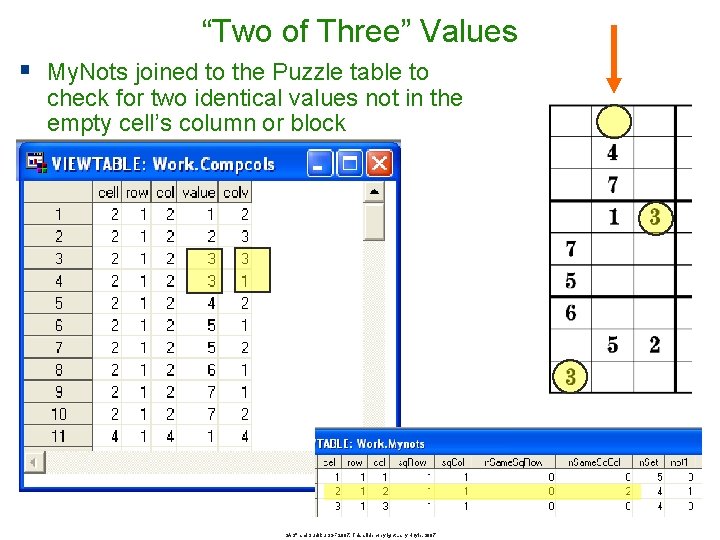
“Two of Three” Values § My. Nots joined to the Puzzle table to check for two identical values not in the empty cell’s column or block SAS® and Sudoku SGF 2007, This slide copyright Larry Hoyle, 2007
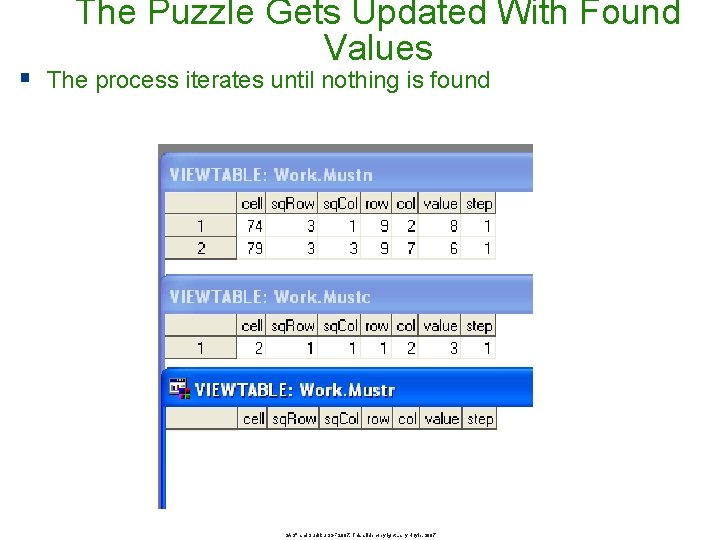
The Puzzle Gets Updated With Found Values § The process iterates until nothing is found SAS® and Sudoku SGF 2007, This slide copyright Larry Hoyle, 2007
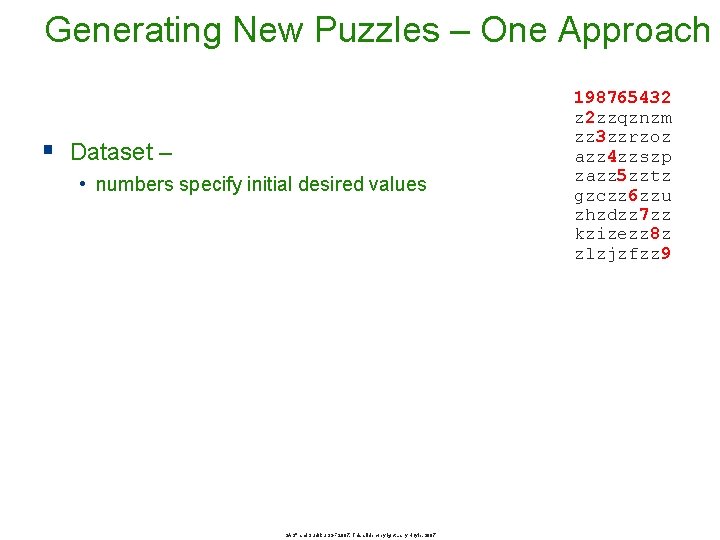
Generating New Puzzles – One Approach § Dataset – • numbers specify initial desired values SAS® and Sudoku SGF 2007, This slide copyright Larry Hoyle, 2007 198765432 z 2 zzqznzm zz 3 zzrzoz azz 4 zzszp zazz 5 zztz gzczz 6 zzu zhzdzz 7 zz kzizezz 8 z zlzjzfzz 9
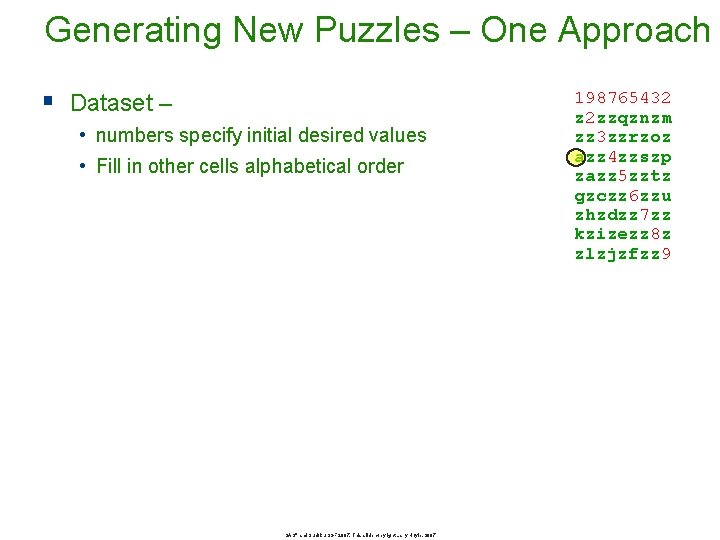
Generating New Puzzles – One Approach § Dataset – • numbers specify initial desired values • Fill in other cells alphabetical order SAS® and Sudoku SGF 2007, This slide copyright Larry Hoyle, 2007 198765432 z 2 zzqznzm zz 3 zzrzoz azz 4 zzszp zazz 5 zztz gzczz 6 zzu zhzdzz 7 zz kzizezz 8 z zlzjzfzz 9
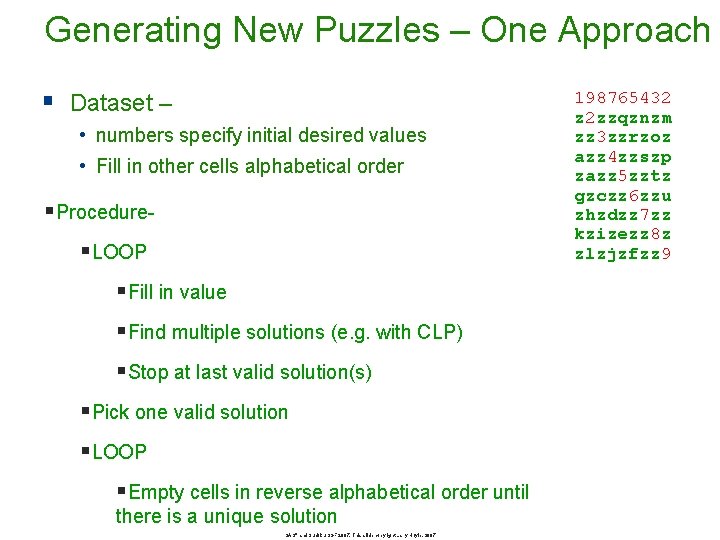
Generating New Puzzles – One Approach § Dataset – • numbers specify initial desired values • Fill in other cells alphabetical order §Procedure§LOOP §Fill in value §Find multiple solutions (e. g. with CLP) §Stop at last valid solution(s) §Pick one valid solution §LOOP §Empty cells in reverse alphabetical order until there is a unique solution SAS® and Sudoku SGF 2007, This slide copyright Larry Hoyle, 2007 198765432 z 2 zzqznzm zz 3 zzrzoz azz 4 zzszp zazz 5 zztz gzczz 6 zzu zhzdzz 7 zz kzizezz 8 z zlzjzfzz 9
Talbot Michael Katz SAS® and Sudoku SGF 2007, This slide copyright Larry Hoyle, 2007
SAS® and Sudoku SGF Paper 011 -2007 Ø Co-Authors: Ø Richard A. De. Venezia, Independent Consultant Ø John R. Gerlach, Maxis. IT, Inc. Ø Larry Hoyle, Institute for Policy and Social Research, Univ. of Kansas Ø Talbot M. Katz, Analytic Data Information Technologies Ø Rick Langston, SAS Institute Inc. Ø Topic: SAS/OR® and Sudoku Ø Talbot Michael Katz
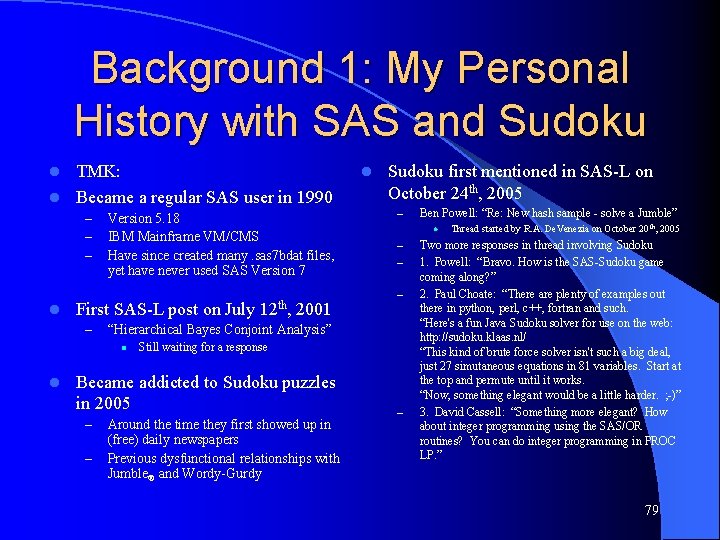
Background 1: My Personal History with SAS and Sudoku TMK: l Became a regular SAS user in 1990 l – – – l Version 5. 18 IBM Mainframe VM/CMS Have since created many. sas 7 bdat files, yet have never used SAS Version 7 First SAS-L post on July – 2001 – – Around the time they first showed up in (free) daily newspapers Previous dysfunctional relationships with Jumble® and Wordy-Gurdy Ben Powell: “Re: New hash sample - solve a Jumble” l – – – Still waiting for a response Became addicted to Sudoku puzzles in 2005 – Sudoku first mentioned in SAS-L on October 24 th, 2005 “Hierarchical Bayes Conjoint Analysis” l l 12 th, l – Thread started by R. A. De. Venezia on October 20 th, 2005 Two more responses in thread involving Sudoku 1. Powell: “Bravo. How is the SAS-Sudoku game coming along? ” 2. Paul Choate: “There are plenty of examples out there in python, perl, c++, fortran and such. “Here's a fun Java Sudoku solver for use on the web: http: //sudoku. klaas. nl/ “This kind of brute force solver isn't such a big deal, just 27 simutaneous equations in 81 variables. Start at the top and permute until it works. “Now, something elegant would be a little harder. ; -)” 3. David Cassell: “Something more elegant? How about integer programming using the SAS/OR routines? You can do integer programming in PROC LP. ” 79
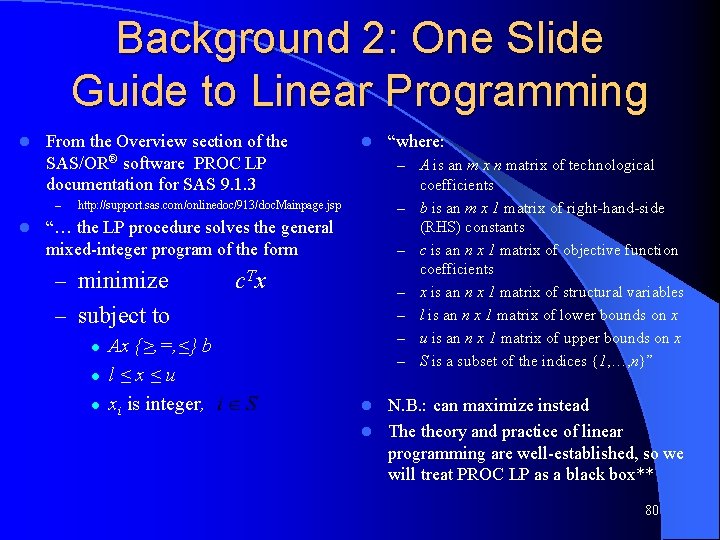
Background 2: One Slide Guide to Linear Programming l From the Overview section of the SAS/OR® software PROC LP documentation for SAS 9. 1. 3 – l l – http: //support. sas. com/onlinedoc/913/doc. Mainpage. jsp – “… the LP procedure solves the general mixed-integer program of the form – minimize – c Tx – – subject to l l l Ax {≥, =, ≤} b l≤x≤u xi is integer, “where: – – – A is an m x n matrix of technological coefficients b is an m x 1 matrix of right-hand-side (RHS) constants c is an n x 1 matrix of objective function coefficients x is an n x 1 matrix of structural variables l is an n x 1 matrix of lower bounds on x u is an n x 1 matrix of upper bounds on x S is a subset of the indices {1, …, n}” N. B. : can maximize instead l The theory and practice of linear programming are well-established, so we will treat PROC LP as a black box** l 80
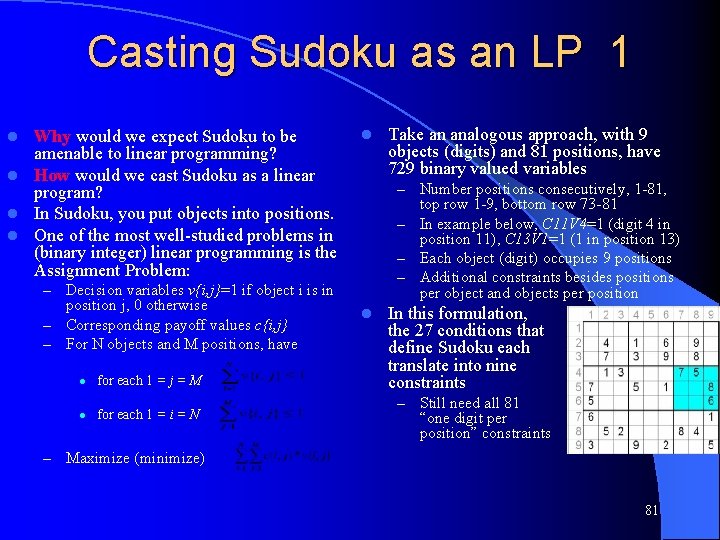
Casting Sudoku as an LP 1 Why would we expect Sudoku to be amenable to linear programming? l How would we cast Sudoku as a linear program? l In Sudoku, you put objects into positions. l One of the most well-studied problems in (binary integer) linear programming is the Assignment Problem: l Decision variables v{i, j}=1 if object i is in position j, 0 otherwise – Corresponding payoff values c{i, j} – For N objects and M positions, have l Number positions consecutively, 1 -81, top row 1 -9, bottom row 73 -81 – In example below, C 11 V 4=1 (digit 4 in position 11), C 13 V 1=1 (1 in position 13) – Each object (digit) occupies 9 positions – Additional constraints besides positions per object and objects per position – – – l for each 1 = j = M l for each 1 = i = N Take an analogous approach, with 9 objects (digits) and 81 positions, have 729 binary valued variables l In this formulation, the 27 conditions that define Sudoku each translate into nine constraints – Still need all 81 “one digit per position” constraints Maximize (minimize) 81
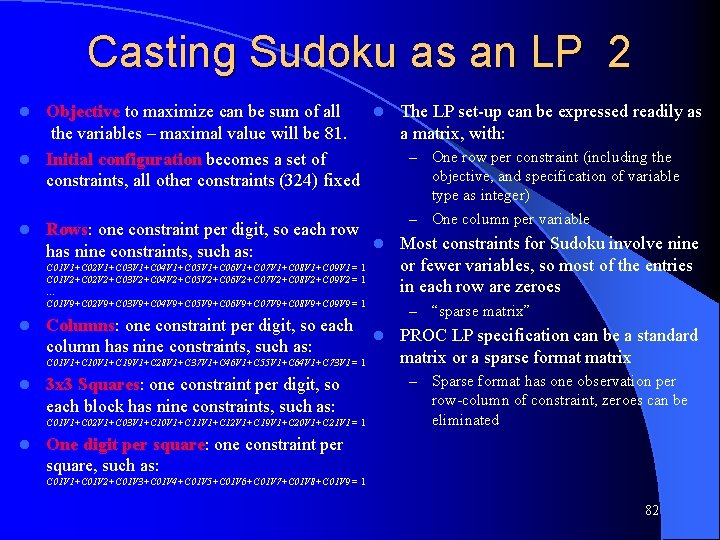
Casting Sudoku as an LP 2 Objective to maximize can be sum of all l The LP set-up can be expressed readily as the variables – maximal value will be 81. a matrix, with: – One row per constraint (including the l Initial configuration becomes a set of objective, and specification of variable constraints, all other constraints (324) fixed l l type as integer) – One column per variable Rows: one constraint per digit, so each row l Most constraints for Sudoku involve nine has nine constraints, such as: C 01 V 1+C 02 V 1+C 03 V 1+C 04 V 1+C 05 V 1+C 06 V 1+C 07 V 1+C 08 V 1+C 09 V 1 = 1 or fewer variables, so most of the entries C 01 V 2+C 02 V 2+C 03 V 2+C 04 V 2+C 05 V 2+C 06 V 2+C 07 V 2+C 08 V 2+C 09 V 2 = 1 in each row are zeroes … C 01 V 9+C 02 V 9+C 03 V 9+C 04 V 9+C 05 V 9+C 06 V 9+C 07 V 9+C 08 V 9+C 09 V 9 = 1 l Columns: one constraint per digit, so each column has nine constraints, such as: C 01 V 1+C 10 V 1+C 19 V 1+C 28 V 1+C 37 V 1+C 46 V 1+C 55 V 1+C 64 V 1+C 73 V 1 = 1 l 3 x 3 Squares: one constraint per digit, so each block has nine constraints, such as: C 01 V 1+C 02 V 1+C 03 V 1+C 10 V 1+C 11 V 1+C 12 V 1+C 19 V 1+C 20 V 1+C 21 V 1 = 1 l – l “sparse matrix” PROC LP specification can be a standard matrix or a sparse format matrix – Sparse format has one observation per row-column of constraint, zeroes can be eliminated One digit per square: one constraint per square, such as: C 01 V 1+C 01 V 2+C 01 V 3+C 01 V 4+C 01 V 5+C 01 V 6+C 01 V 7+C 01 V 8+C 01 V 9 = 1 82
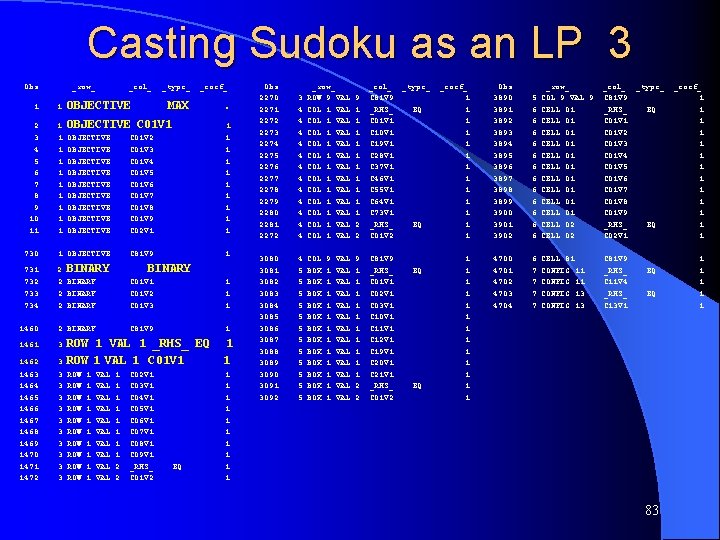
Casting Sudoku as an LP 3 Obs _row_ _col_ _type_ _coef_ 1 OBJECTIVE 2 1 OBJECTIVE C 01 V 1 1 1. . . 730 1 OBJECTIVE OBJECTIVE OBJECTIVE C 01 V 2 C 01 V 3 C 01 V 4 C 01 V 5 C 01 V 6 C 01 V 7 C 01 V 8 C 01 V 9 C 02 V 1 1 1 1 1 OBJECTIVE C 81 V 9 1 731 BINARY 3 4 5 6 7 8 9 10 11 2 733 734 MAX . 1 BINARY . 2 2 2. . . 1460 2 BINARY C 01 V 1 C 01 V 2 C 01 V 3 1 1 1 BINARY C 81 V 9 1 1461 3 1462 3 ROW 1 VAL 1 _RHS_ EQ ROW 1 VAL 1 C 01 V 1 1463 1464 1465 1466 1467 1468 1469 1470 1471 1472 3 3 3 3 3. . . ROW ROW ROW 1 1 1 1 1 VAL VAL VAL 1 1 1 1 2 2 C 02 V 1 C 03 V 1 C 04 V 1 C 05 V 1 C 06 V 1 C 07 V 1 C 08 V 1 C 09 V 1 _RHS_ C 01 V 2 EQ 1 1 1 Obs 2270 2271 2272 2273 2274 2275 2276 2277 2278 2279 2280 2281 2272 3080 3081 3082 3083 3084 3085 3086 3087 3088 3089 3090 3091 3092 3 4 4 4. . . 4 5 5 5. . . _row_ ROW 9 VAL COL 1 VAL COL 1 VAL COL 1 VAL 9 1 1 1 1 1 2 2 _col_ C 81 V 9 _RHS_ C 01 V 1 C 10 V 1 C 19 V 1 C 28 V 1 C 37 V 1 C 46 V 1 C 55 V 1 C 64 V 1 C 73 V 1 _RHS_ C 01 V 2 COL BOX BOX BOX 9 1 1 1 1 1 2 2 C 81 V 9 _RHS_ C 01 V 1 C 02 V 1 C 03 V 1 C 10 V 1 C 11 V 1 C 12 V 1 C 19 V 1 C 20 V 1 C 21 V 1 _RHS_ C 01 V 2 9 1 1 1 VAL VAL VAL VAL _type_ EQ EQ _coef_ 1 1 1 1 Obs 3890 3891 3892 3893 3894 3895 3896 3897 3898 3899 3900 3901 3902 1 1 1 1 4700 4701 4702 4703 4704 5 6 6 6. . . 6 7 7. . . _row_ COL 9 VAL 9 CELL 01 CELL 01 CELL 01 CELL 02 _col_ C 81 V 9 _RHS_ C 01 V 1 C 01 V 2 C 01 V 3 C 01 V 4 C 01 V 5 C 01 V 6 C 01 V 7 C 01 V 8 C 01 V 9 _RHS_ C 02 V 1 CELL 81 CONFIG 11 CONFIG 13 C 81 V 9 _RHS_ C 11 V 4 _RHS_ C 13 V 1 _type_ EQ EQ 83 _coef_ 1 1 1 1 1
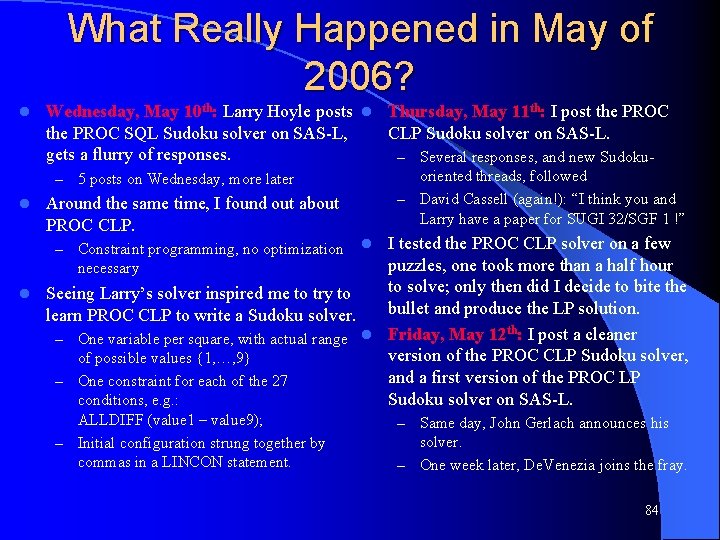
What Really Happened in May of 2006? l Wednesday, May 10 th: Larry Hoyle posts l Thursday, May 11 th: I post the PROC SQL Sudoku solver on SAS-L, CLP Sudoku solver on SAS-L. gets a flurry of responses. – Several responses, and new Sudoku– l oriented threads, followed – David Cassell (again!): “I think you and Larry have a paper for SUGI 32/SGF 1 !” 5 posts on Wednesday, more later Around the same time, I found out about PROC CLP. I tested the PROC CLP solver on a few puzzles, one took more than a half hour to solve; only then did I decide to bite the l Seeing Larry’s solver inspired me to try to bullet and produce the LP solution. learn PROC CLP to write a Sudoku solver. th – One variable per square, with actual range l Friday, May 12 : I post a cleaner version of the PROC CLP Sudoku solver, of possible values {1, …, 9} and a first version of the PROC LP – One constraint for each of the 27 Sudoku solver on SAS-L. conditions, e. g. : – Constraint programming, no optimization necessary ALLDIFF (value 1 – value 9); – Initial configuration strung together by commas in a LINCON statement. l Same day, John Gerlach announces his solver. – One week later, De. Venezia joins the fray. – 84
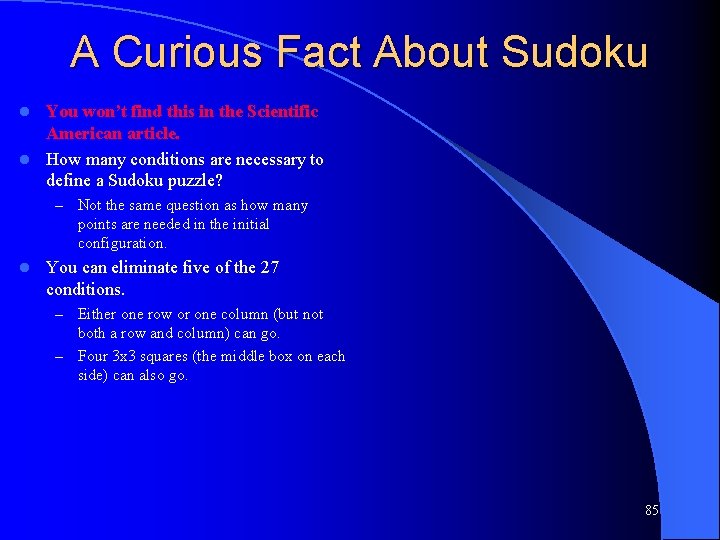
A Curious Fact About Sudoku You won’t find this in the Scientific American article. l How many conditions are necessary to define a Sudoku puzzle? l – l Not the same question as how many points are needed in the initial configuration. You can eliminate five of the 27 conditions. Either one row or one column (but not both a row and column) can go. – Four 3 x 3 squares (the middle box on each side) can also go. – 85
Rick Langston SAS® and Sudoku SGF 2007, This slide copyright Larry Hoyle, 2007
Rick Langston Rick. Langston@sas. com Copyright © 2007, SAS Institute Inc. All rights reserved. SAS and all other SAS Institute Inc. product or service names are registered trademarks or trademarks of SAS Institute Inc. in the USA and other countries. ® indicates USA registration.
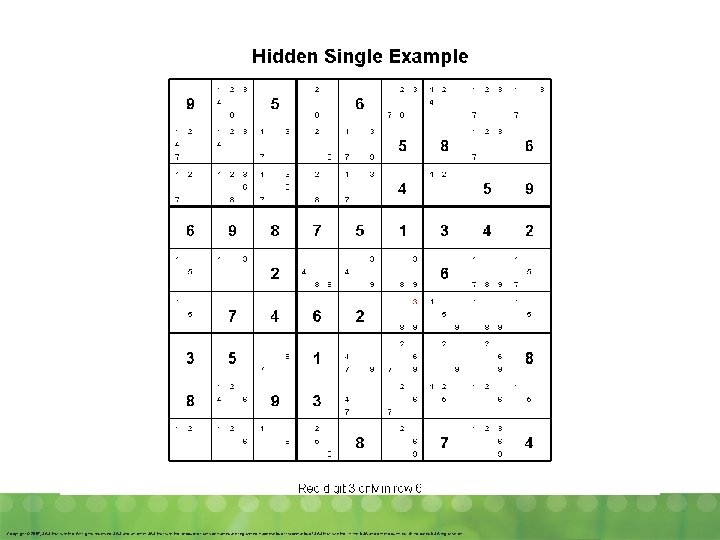
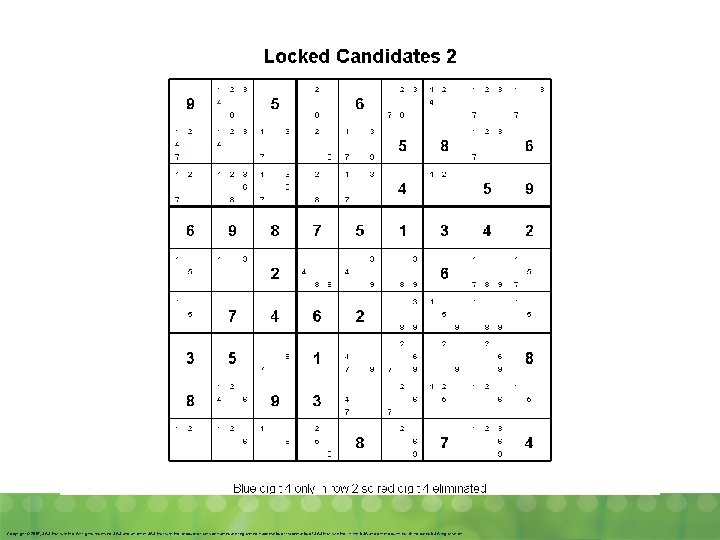
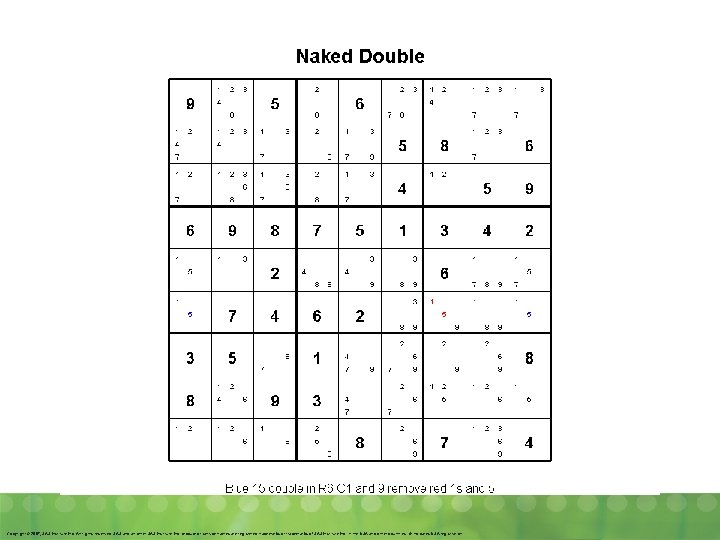
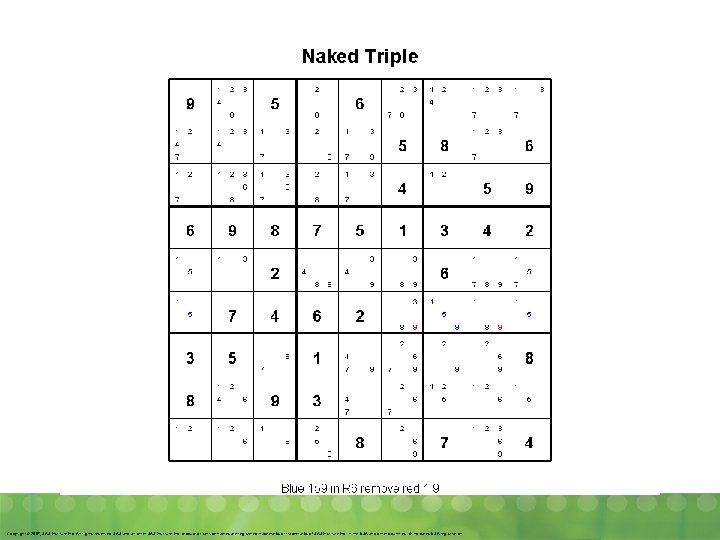
My sudoku solver § § § I was interested in teaching strategies The end result was not really the goal Speed was not the major concern All done using the DATA step Some of the basic strategies are. . . Copyright © 2007, SAS Institute Inc. All rights reserved. SAS and all other SAS Institute Inc. product or service names are registered trademarks or trademarks of SAS Institute Inc. in the USA and other countries. ® indicates USA registration.
Copyright © 2007, SAS Institute Inc. All rights reserved. SAS and all other SAS Institute Inc. product or service names are registered trademarks or trademarks of SAS Institute Inc. in the USA and other countries. ® indicates USA registration.
Copyright © 2007, SAS Institute Inc. All rights reserved. SAS and all other SAS Institute Inc. product or service names are registered trademarks or trademarks of SAS Institute Inc. in the USA and other countries. ® indicates USA registration.
Copyright © 2007, SAS Institute Inc. All rights reserved. SAS and all other SAS Institute Inc. product or service names are registered trademarks or trademarks of SAS Institute Inc. in the USA and other countries. ® indicates USA registration.
Copyright © 2007, SAS Institute Inc. All rights reserved. SAS and all other SAS Institute Inc. product or service names are registered trademarks or trademarks of SAS Institute Inc. in the USA and other countries. ® indicates USA registration.
Copyright © 2007, SAS Institute Inc. All rights reserved. SAS and all other SAS Institute Inc. product or service names are registered trademarks or trademarks of SAS Institute Inc. in the USA and other countries. ® indicates USA registration.
§ § § Also X/Y/Z Wings, Swordfish A DO WHILE(1) loop runs through them all All strung together with LINK statements Trial-and-error method as the last resort Each step is shown for the user Copyright © 2007, SAS Institute Inc. All rights reserved. SAS and all other SAS Institute Inc. product or service names are registered trademarks or trademarks of SAS Institute Inc. in the USA and other countries. ® indicates USA registration.
Dr. Goodnight’s implementation § § § He lists sudoku as one of his hobbies He implemented a solver using the DATA step Basic candidate elimination done first Then a trial path process is used A very fast algorithm Copyright © 2007, SAS Institute Inc. All rights reserved. SAS and all other SAS Institute Inc. product or service names are registered trademarks or trademarks of SAS Institute Inc. in the USA and other countries. ® indicates USA registration.
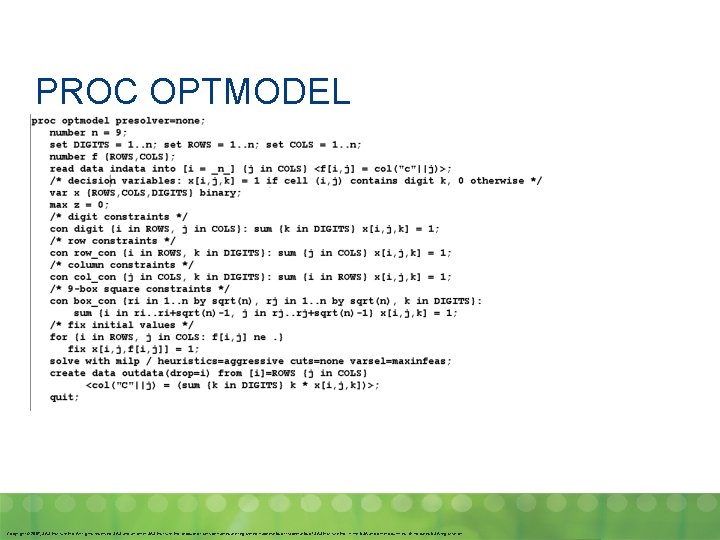
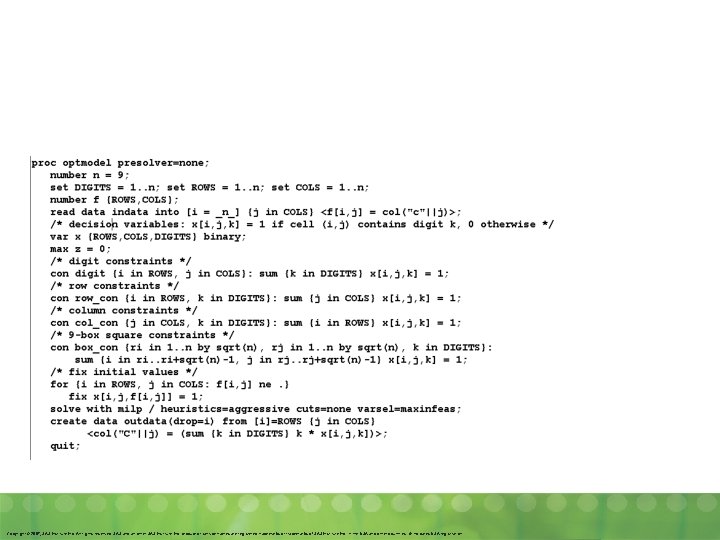
PROC OPTMODEL Copyright © 2007, SAS Institute Inc. All rights reserved. SAS and all other SAS Institute Inc. product or service names are registered trademarks or trademarks of SAS Institute Inc. in the USA and other countries. ® indicates USA registration.
Copyright © 2007, SAS Institute Inc. All rights reserved. SAS and all other SAS Institute Inc. product or service names are registered trademarks or trademarks of SAS Institute Inc. in the USA and other countries. ® indicates USA registration.
Copyright © 2007, SAS Institute Inc. All rights reserved. SAS and all other SAS Institute Inc. product or service names are registered trademarks or trademarks of SAS Institute Inc. in the USA and other countries. ® indicates USA registration.