
SARSCo V2 Spread Prevention Presented by OREGON OSHA
SARS-Co. V-2 Spread Prevention Presented by OREGON OSHA Health Consultation Russ Reasoner Sr. IH Randy Westmoreland IH III, CSP
References • https: //mailchi. mp/80 b 3 af 921 ad 2/asa-february-2020 -newsletter 3844527? e=f 775 aedbd 4 • https: //www. cdc. gov/niosh/topics/healthcare/engcontrolsolutions/expedien t-patient-isolation. html • https: //www. ashrae. org/file%20 library/about/position%20 documents/pd_in fectiousaerosols_2020. pdf • https: //osha. oregon. gov/covid 19/Pages/default. aspx • https: //www. osha. gov/Publications/OSHA 3990. pdf
Disclaimers: • Time Sensitive Information • Not specific to Bloodborne Pathogens Oregon OSHA standard • Basis for assessment considers OSHA Risk Matrix
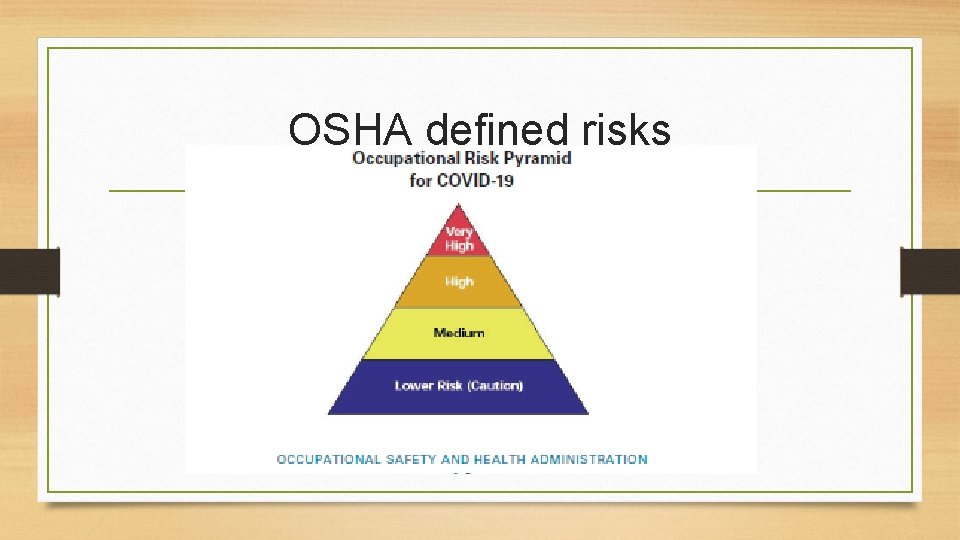
OSHA defined risks
OSHA defined risks – Very High & High • Very High • Healthcare workers performing aerosol-generating procedures • Healthcare workers and laboratories handling or collecting specimens from known COVID 19 patients • Morgue workers performing aerosol-generating procedures • High • Healthcare delivery and support staff who must enter a patient’s room • Medical transport workers • Mortuary workers preparing bodies known or suspected of COVID-19
OSHA defined risks – Medium & Lower • Medium • Jobs that those require contact or working within six feet of someone who may have COVID-19 • Lower • Jobs that do not require contact or working within six feet of someone who may have COVID-19
Transmission of SARS-Co. V-2 • Surfaces – fomites (contaminated surfaces) • Droplets (sneezing / coughing) • Mucous membrane fluids to surface contact to mucous membrane fluids (infective for 3 to 5 days) • Airborne to Aerosol • Droplets (sneezing / coughing) – quickly falls out of the air • Micro-droplet nuclei (respirable) – floats in the air for hours • • • Small fraction from shear force after sneezing/coughing Talking Loudly Singing
Transmission of SARS-Co. V-2 potential (video) https: //www. youtube. com/watch? v=v. Bv. Fk. Qiz. TT 4&feature=youtu. be&utm_s ource=ACGIH&utm_campaign=2 c 9 d 06 f 147 EMAIL_CAMPAIGN_2020_02_25_05_03_COPY_01&utm_medium=email& utm_term=0_e 0322 abe 6 a-2 c 9 d 06 f 147 -342748513 SARS-Co. V-2 Coronavirus Micro-droplets - NHK World report https: //jamanetwork. com/journals/jama/fullarticle/2763852
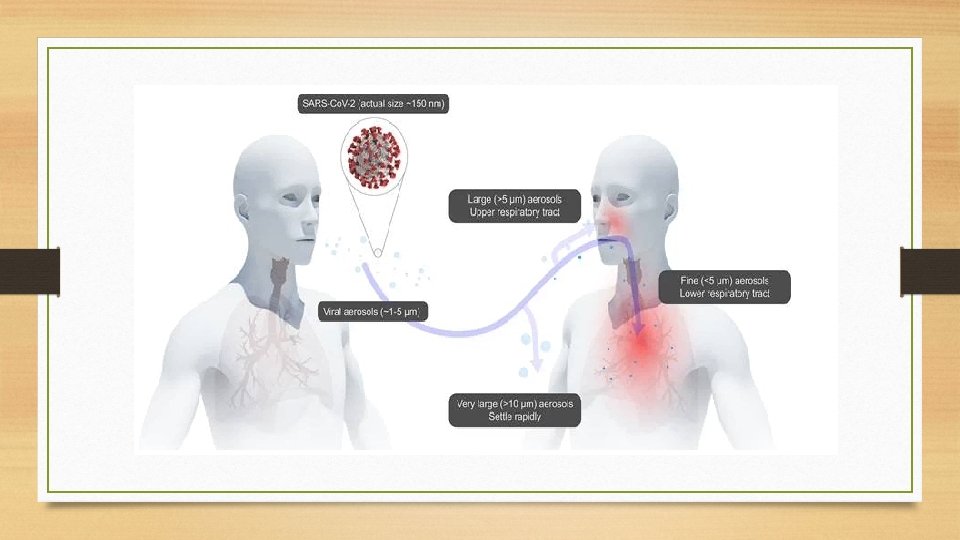
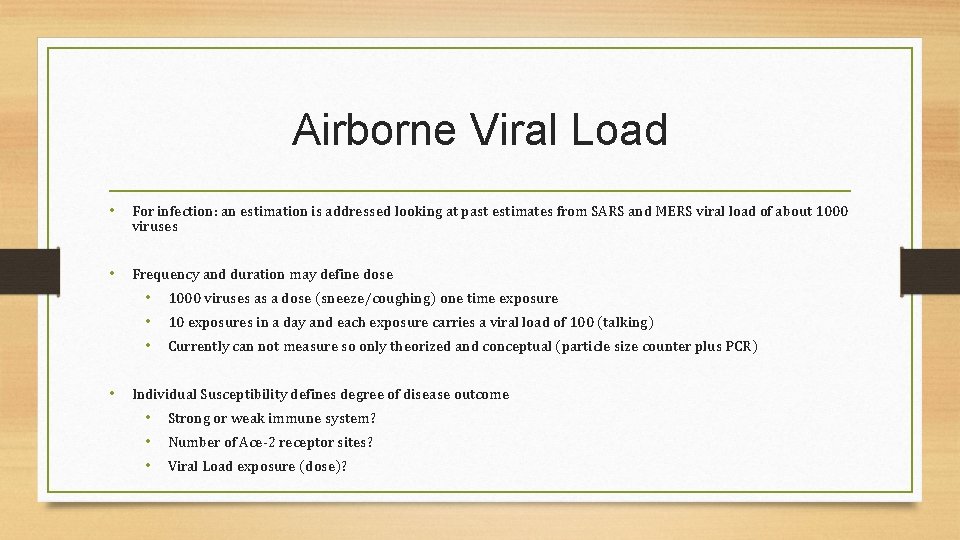
Airborne Viral Load • For infection: an estimation is addressed looking at past estimates from SARS and MERS viral load of about 1000 viruses • Frequency and duration may define dose • 1000 viruses as a dose (sneeze/coughing) one time exposure • 10 exposures in a day and each exposure carries a viral load of 100 (talking) • Currently can not measure so only theorized and conceptual (particle size counter plus PCR) • Individual Susceptibility defines degree of disease outcome • Strong or weak immune system? • Number of Ace-2 receptor sites? • Viral Load exposure (dose)?
SARS-Co. V-2 load Reduction & Prevention • Provide survey to screen for active COVID-19 patients – prevent COVID-19 spread • High frequency touch surface disinfection with an EPA approved disinfectant (reduce fomite potential) Do Not Aerosolize, if have to, use N 95 respirators KN 95 filter NIOSH approved list • Remove anything from the room that can not be decontaminated • Use easy to clean non-porous equipment and materials, plastic sneeze guards where feasible • Disinfect before each client (allow time between patients) • Clients by appointment only – no waiting room inside, can wait outside in car until called • Limit discussions or talking to reduce airborne viral load • Increase outside air ventilation rate or create negative pressure gradient to draw room air into a HEPA filter system before recirculated • Use cloth facial coverings (CFCs) – patient and practitioner

Expedient Isolation Ventilation
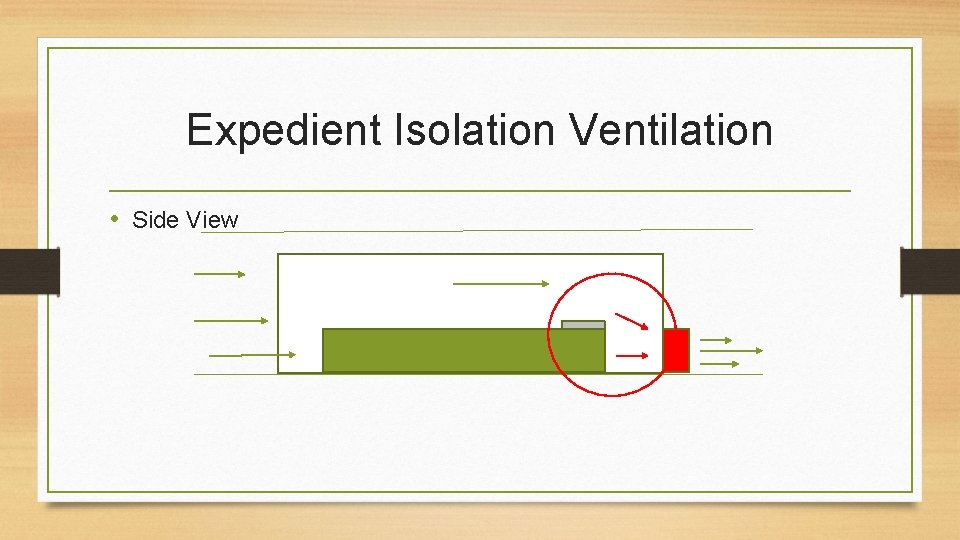
Expedient Isolation Ventilation • Side View
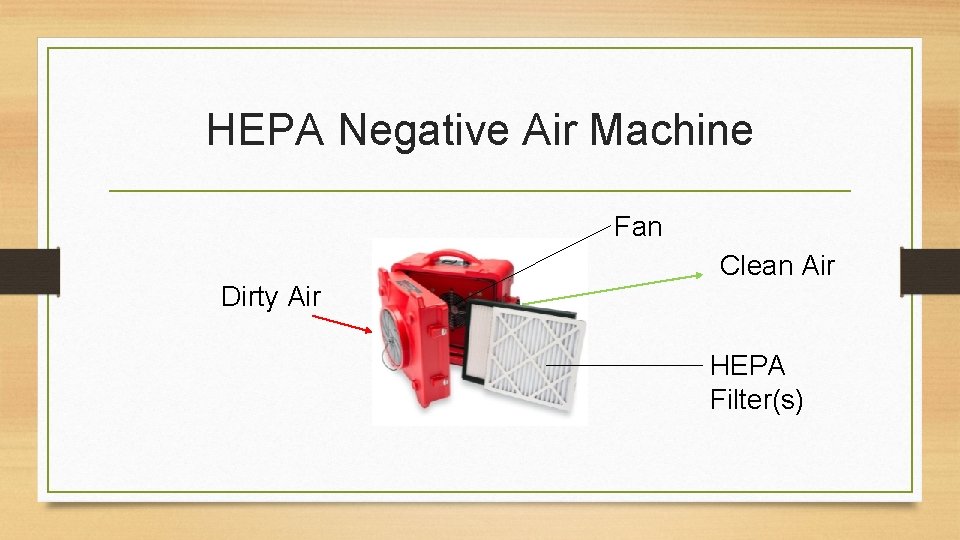
HEPA Negative Air Machine Fan Dirty Air Clean Air HEPA Filter(s)

12 Air Changes per Hour (AC/Hr. ) • • Typical neg. air machine provides 500 CFM (cubic feet per minute) Equation for AC/Hr. = Fan CF/min x 60 min/Hr. / Room CF (Lx. Wx. H): 500 x 60 / 2500 = 12 AC/Hr. 500 x 60 / (18 x 17 x 8) = 30, 000 / 2, 448 = 12. 3 AC/Hr. What size fan in CFM do I need? Need to achieve 12 AC/Hr. or 12 AC/ 60 min Given CF of room = 2500 x 12/60 = 500 CF/M = Room CF x 12/60 = Fan CFM
• 2020 – 2023 ASHRAE Non-healthcare buildings should have a plan for an emergency response. The following Recommendations modifications to building HVAC system operation should be considered: • Increase outdoor air ventilation (disable demand-controlled ventilation and open outdoor air dampers to 100% as indoor and outdoor conditions permit). • Improve central air and other HVAC filtration to MERV-13 (ASHRAE 2017 b) or the highest level achievable. • Keep systems running longer hours (24/7 if possible). • Add portable room air cleaners with HEPA or high-MERV filters with due consideration to the clean air delivery rate (AHAM 2015). • Add portable UVGI devices in connection to in-room fans in high-density spaces such as waiting rooms, prisons, and shelters.

HEPA & UVG Room Purifiers
- Slides: 17