
Sarcasm Detection with Selfmatching Networks and Lowrank Bilinear

Sarcasm Detection with Self-matching Networks and Low-rank Bilinear Pooling ADVISOR: JIA-LING KOH SOURCE: WWW’ 19 SPEAKER: LI-WEI LIU DATA: 2019/11/22 1
OUTLINE l. Introduction l. Method l. Experiment l. Conclusion 2
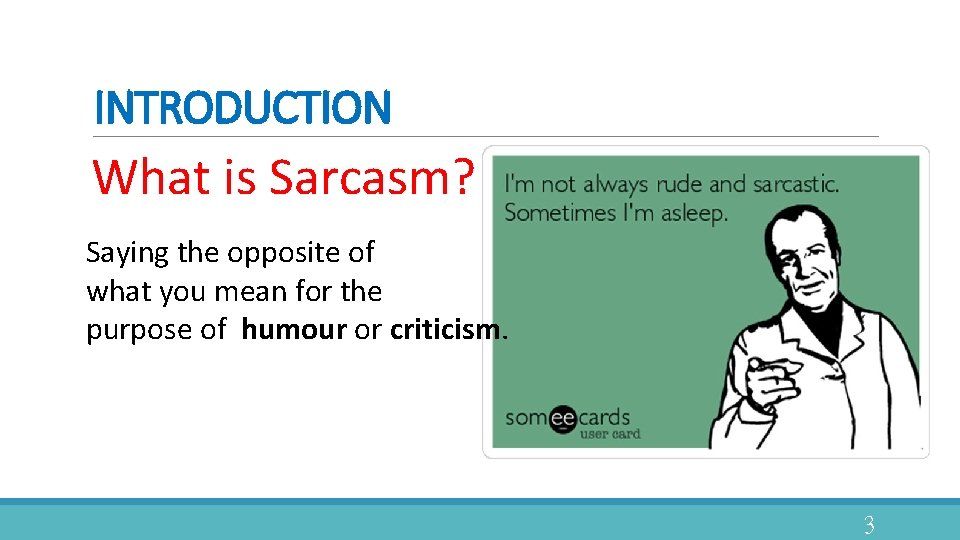
INTRODUCTION What is Sarcasm? Saying the opposite of what you mean for the purpose of humour or criticism. 3
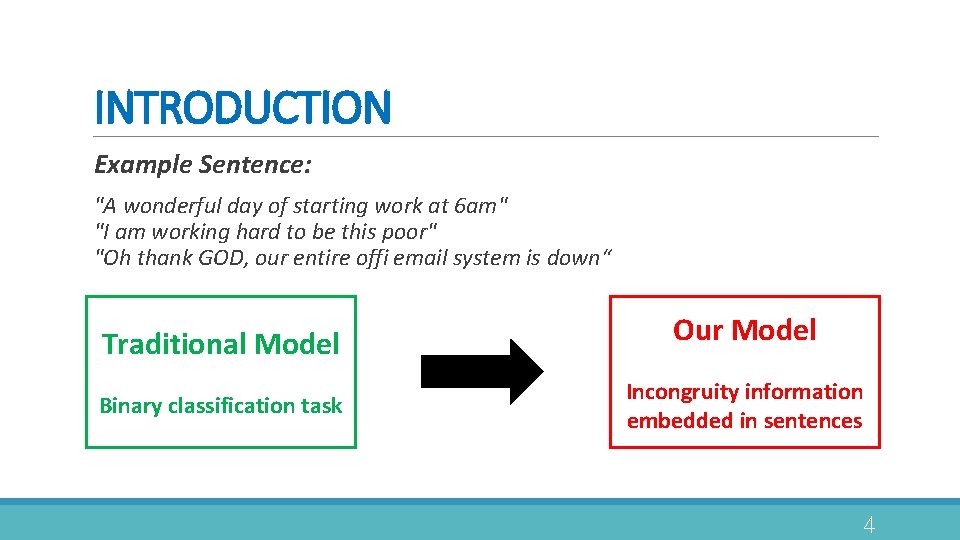
INTRODUCTION Example Sentence: "A wonderful day of starting work at 6 am" "I am working hard to be this poor" "Oh thank GOD, our entire offi email system is down“ Traditional Model Binary classification task Our Model Incongruity information embedded in sentences 4
OUTLINE l. Introduction l. Method l. Experiment l. Conclusion 5
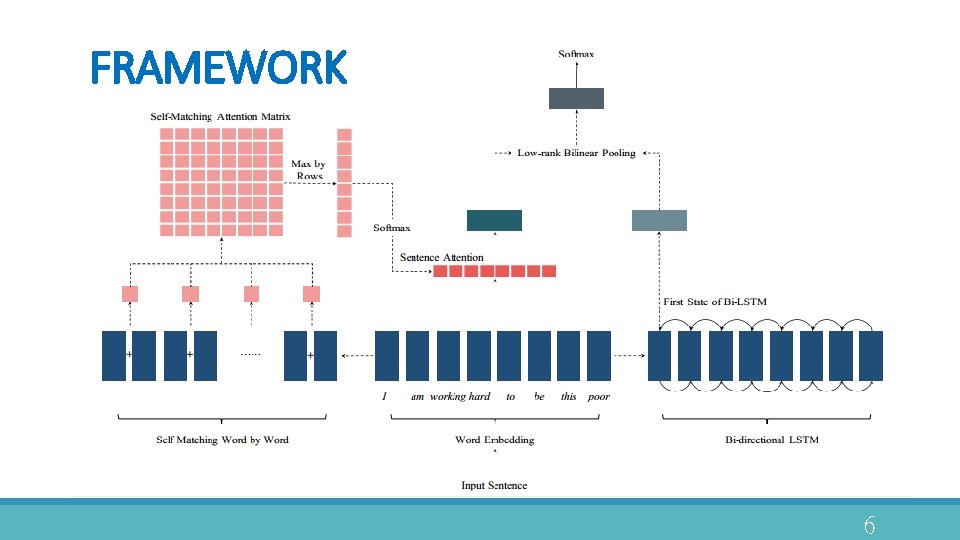
FRAMEWORK 6
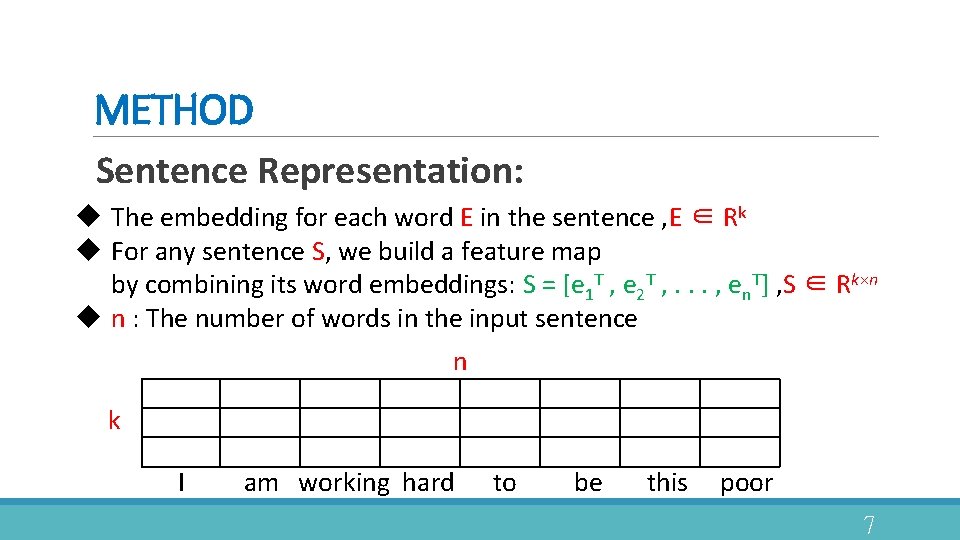
METHOD Sentence Representation: u The embedding for each word E in the sentence , E ∈ Rk u For any sentence S, we build a feature map by combining its word embeddings: S = [e 1 T , e 2 T , . . . , en. T] , S ∈ Rk×n u n : The number of words in the input sentence n k I am working hard to be this poor 7
METHOD Self-matching Network: u The purpose of our proposed self-matching network is to generate a attended feature vector for the input sentence: fa = S · a We calculate every word-to-word pair’s interaction information wi, j as: wi, j = tanh(ei˙Mi, j˙ej. T), where ei and ej are word embeddings for i and j and Mi, j∈ Rk×k , wi, j ∈ R 1× 1 8
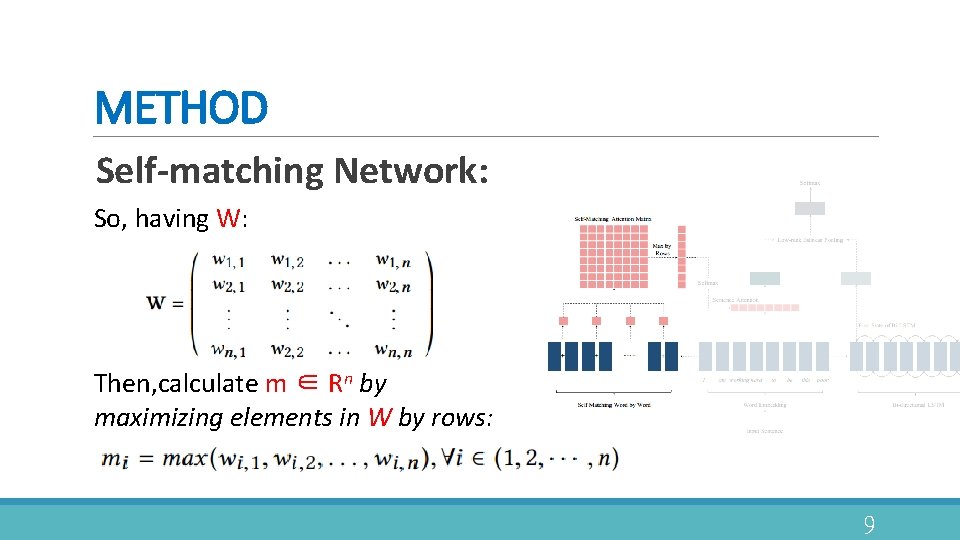
METHOD Self-matching Network: So, having W: Then, calculate m ∈ Rn by maximizing elements in W by rows: 9
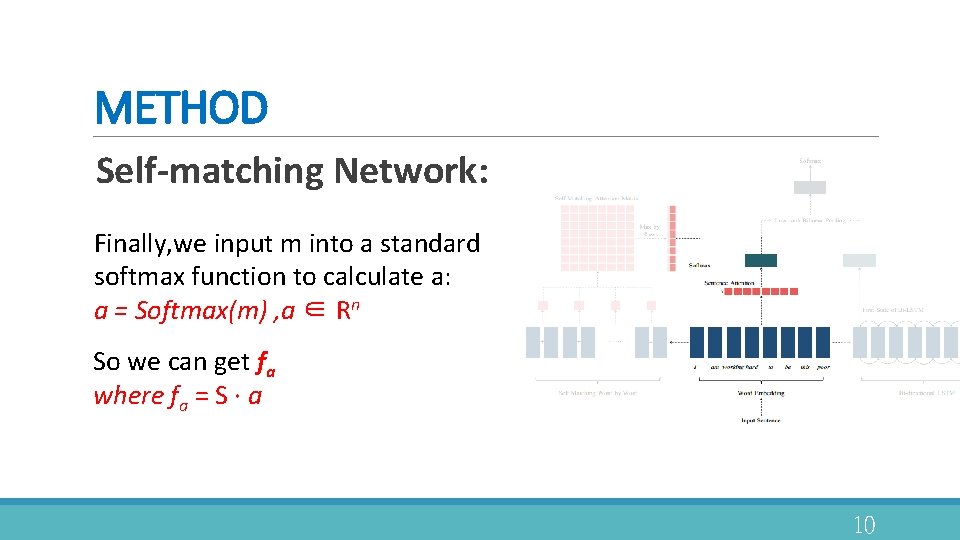
METHOD Self-matching Network: Finally, we input m into a standard softmax function to calculate a: a = Softmax(m) , a ∈ Rn So we can get fa where fa = S · a 10
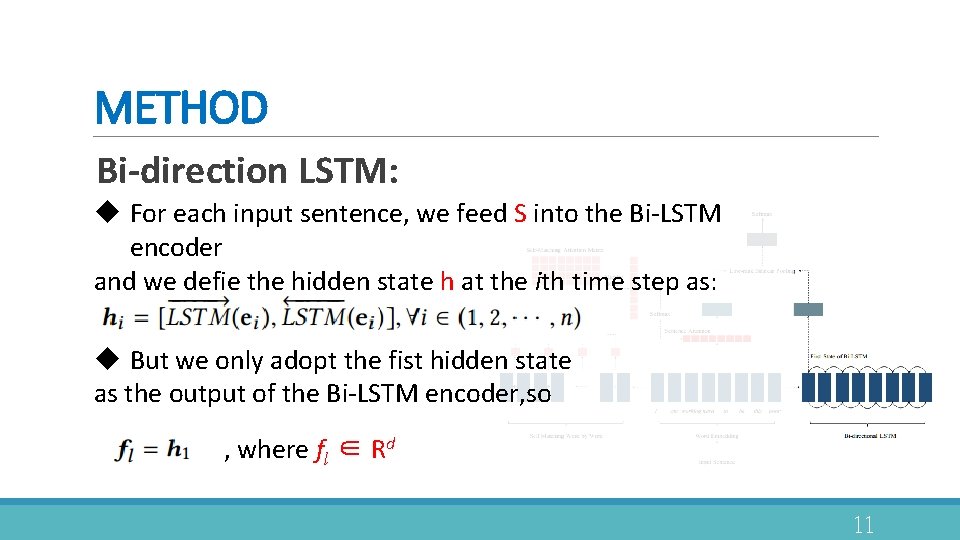
METHOD Bi-direction LSTM: u For each input sentence, we feed S into the Bi-LSTM encoder and we defie the hidden state h at the ith time step as: u But we only adopt the fist hidden state as the output of the Bi-LSTM encoder, so , where fl ∈ Rd 11
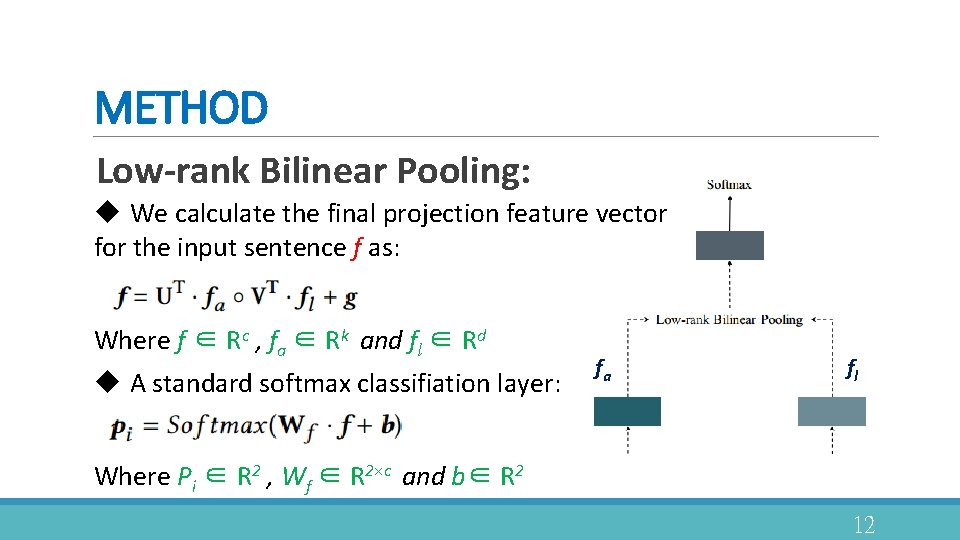
METHOD Low-rank Bilinear Pooling: u We calculate the final projection feature vector for the input sentence f as: Where f ∈ Rc , fa ∈ Rk and fl ∈ Rd u A standard softmax classifiation layer: fa fl Where Pi ∈ R 2 , Wf ∈ R 2×c and b∈ R 2 12
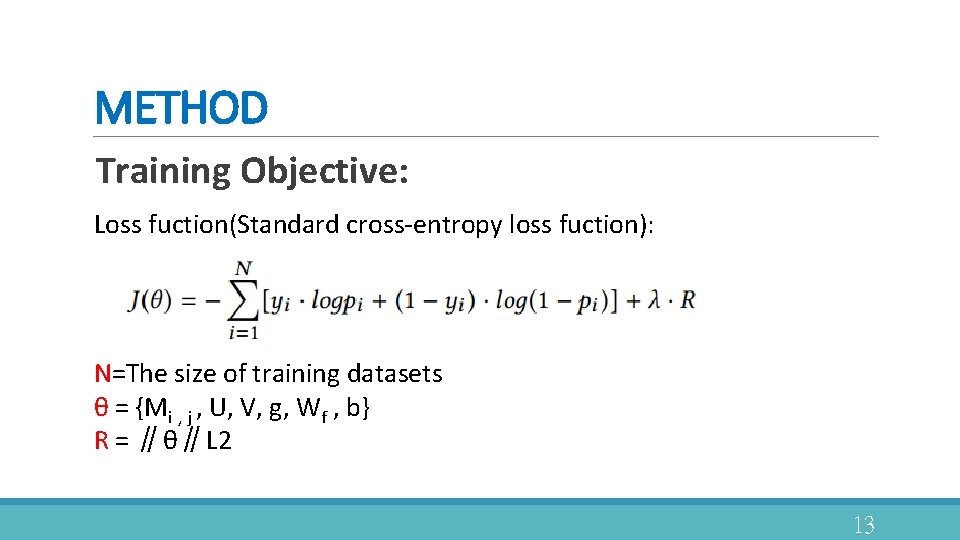
METHOD Training Objective: Loss fuction(Standard cross-entropy loss fuction): N=The size of training datasets θ = {Mi , j , U, V, g, Wf , b} R = ∥θ∥L 2 13
OUTLINE l. Introduction l. Method l. Experiment l. Conclusion 14
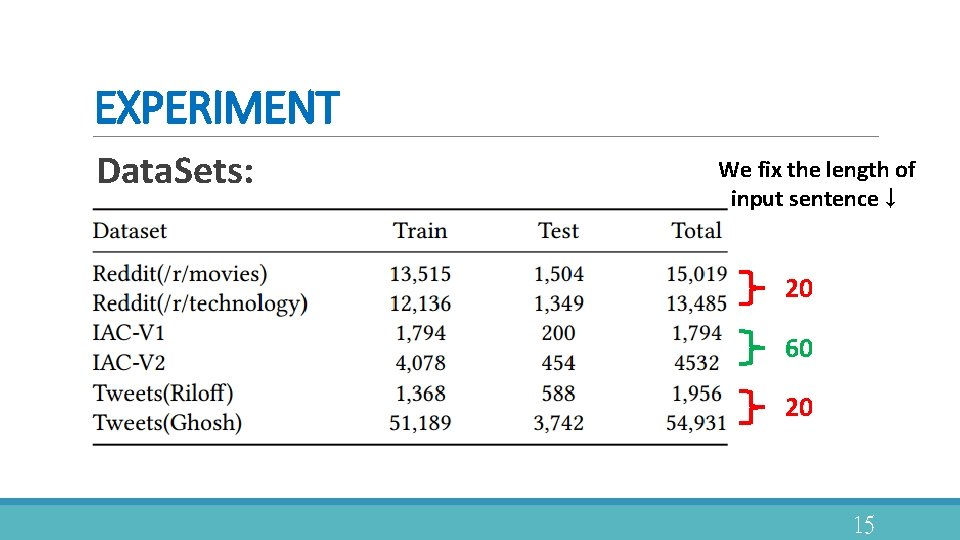
EXPERIMENT Data. Sets: We fix the length of input sentence↓ 20 60 20 15
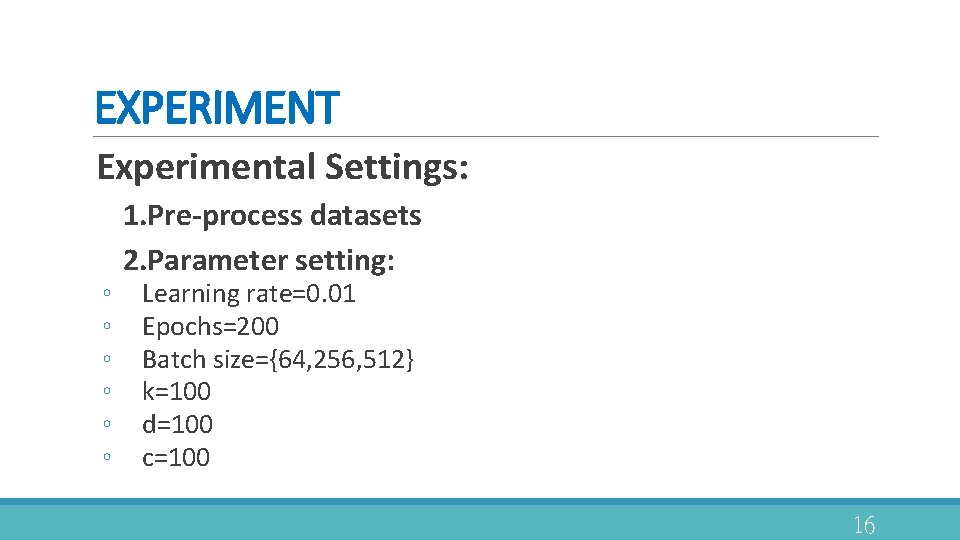
EXPERIMENT Experimental Settings: ◦ ◦ ◦ 1. Pre-process datasets 2. Parameter setting: Learning rate=0. 01 Epochs=200 Batch size={64, 256, 512} k=100 d=100 c=100 16
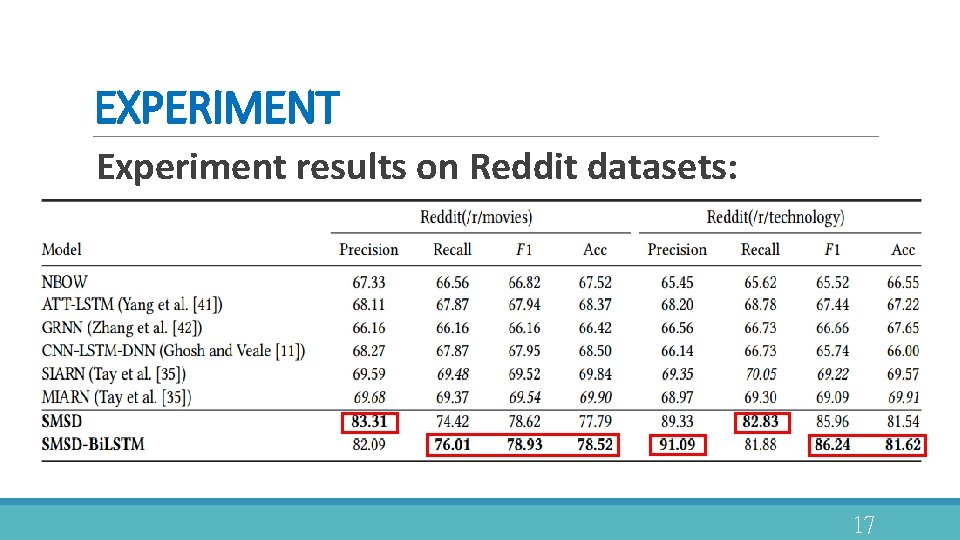
EXPERIMENT Experiment results on Reddit datasets: 17
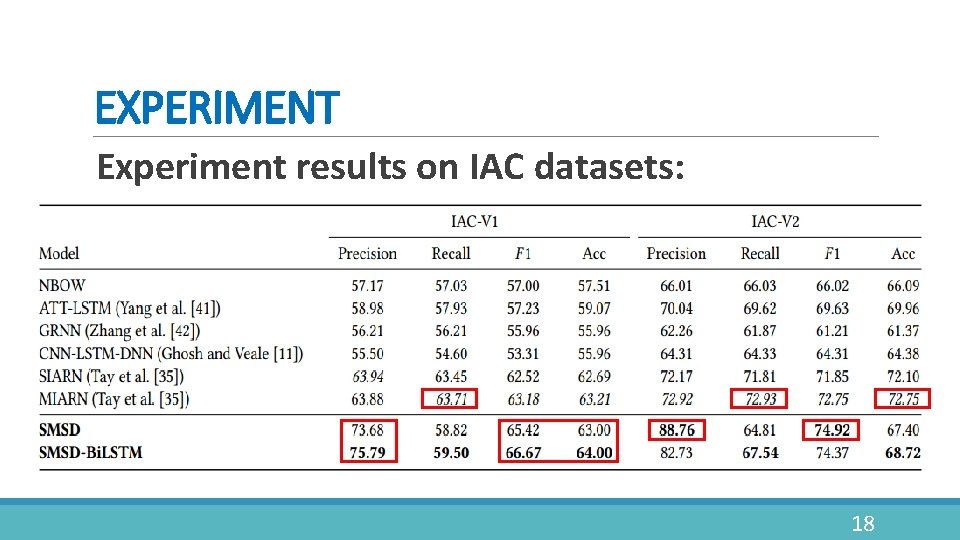
EXPERIMENT Experiment results on IAC datasets: 18
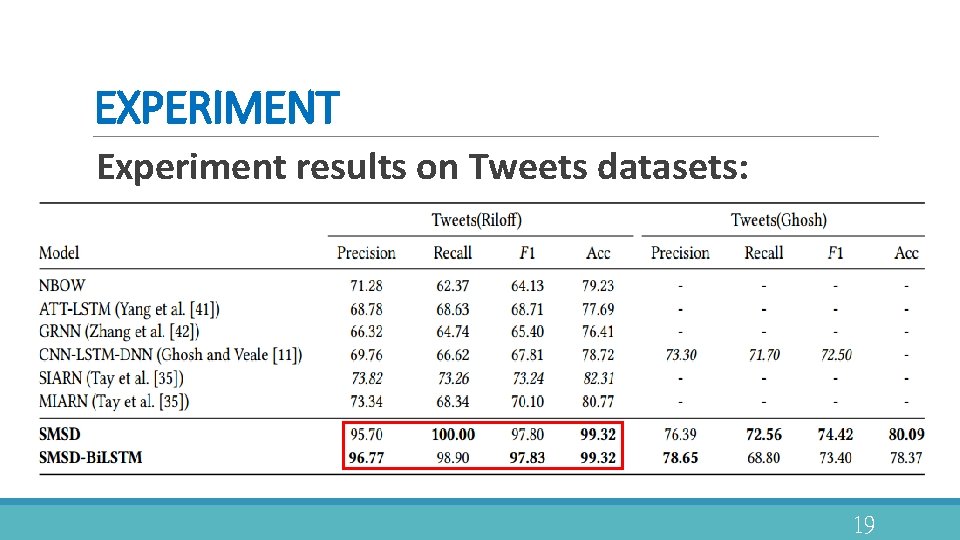
EXPERIMENT Experiment results on Tweets datasets: 19
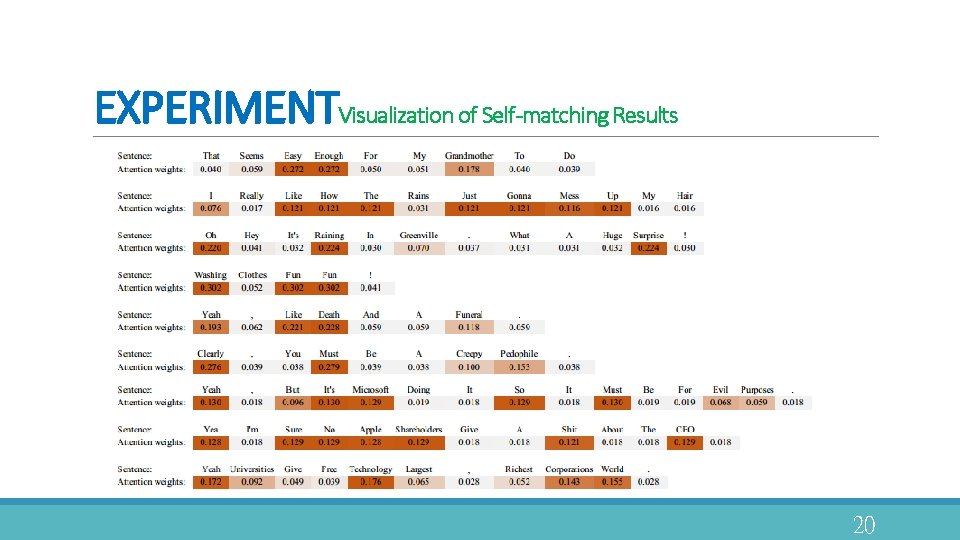
EXPERIMENTVisualization of Self-matching Results 20
OUTLINE l. Introduction l. Method l. Experiment l. Conclusion 21
CONCLUSION üThe self-matching network allows us to capture the interaction between words to search for potential conflict sentiments. üWe also incorporate a bi-directional LSTM encoder to utilize sentence’s compositional information. üWe find supportive empirical evidence on utilizing sequential neural networks and low-rank bilinear pooling method can help improve sarcasm prediction result. 22
- Slides: 22