
SARASOTA POLICE DEPARTMENT National Burglar Fire Alarm Association
SARASOTA POLICE DEPARTMENT © National Burglar & Fire Alarm Association 1
Alarm User Awareness Class © National Burglar & Fire Alarm Association 2
What We Will Cover • What is an alarm system and how do they work • What is a False Alarm • Causes & impacts of false alarms • How to reduce & eliminate false alarms • And more…. © National Burglar & Fire Alarm Association 3
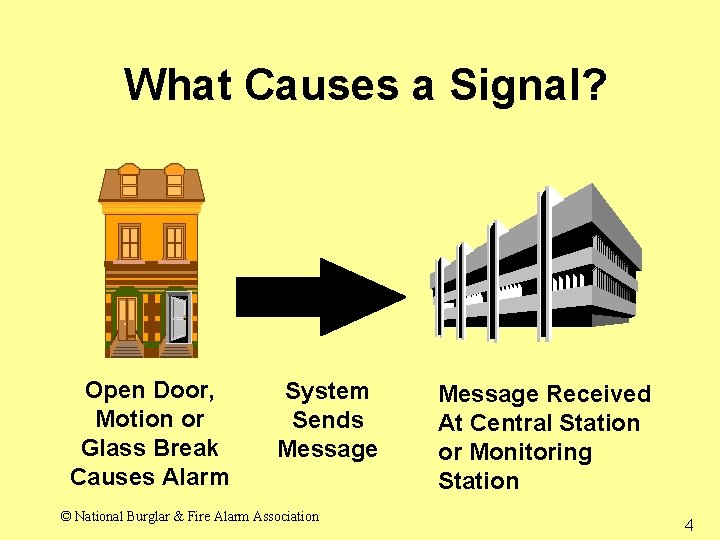
What Causes a Signal? Open Door, Motion or Glass Break Causes Alarm System Sends Message © National Burglar & Fire Alarm Association Message Received At Central Station or Monitoring Station 4
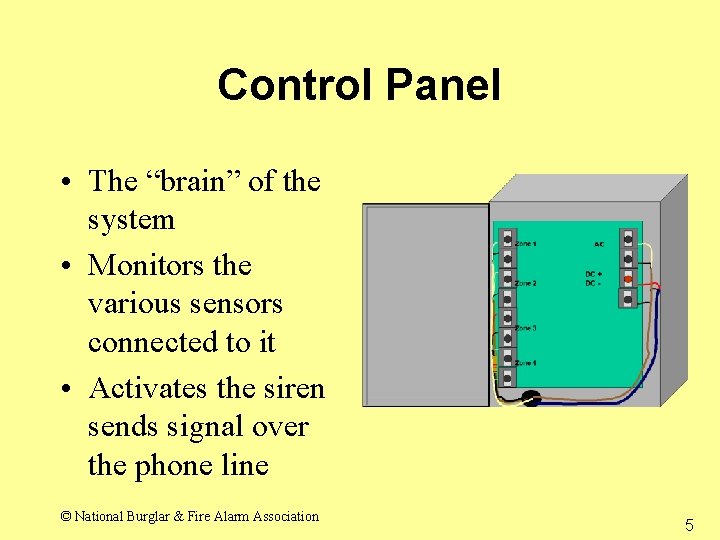
Control Panel • The “brain” of the system • Monitors the various sensors connected to it • Activates the siren sends signal over the phone line © National Burglar & Fire Alarm Association 5
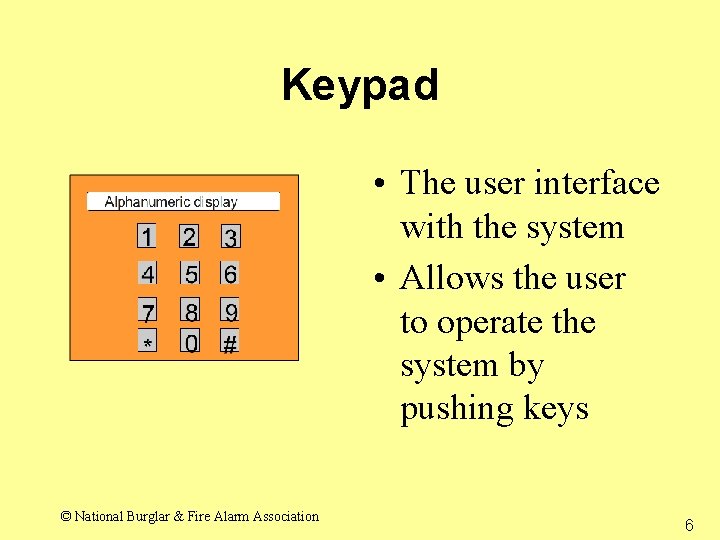
Keypad • The user interface with the system • Allows the user to operate the system by pushing keys © National Burglar & Fire Alarm Association 6
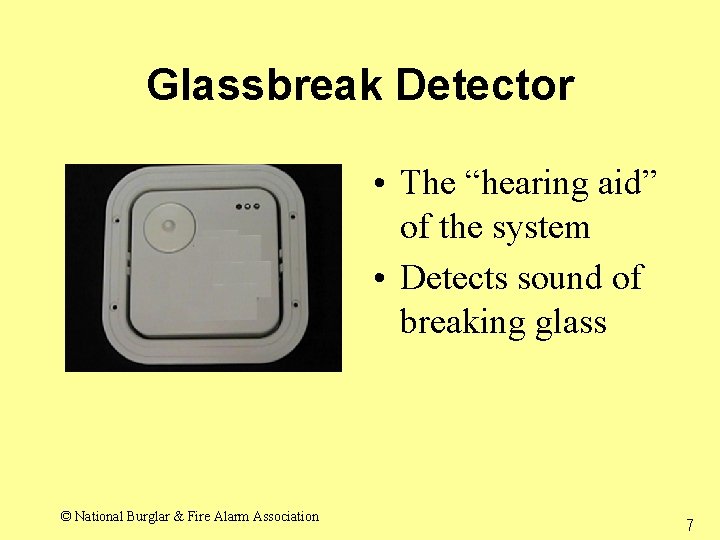
Glassbreak Detector • The “hearing aid” of the system • Detects sound of breaking glass © National Burglar & Fire Alarm Association 7
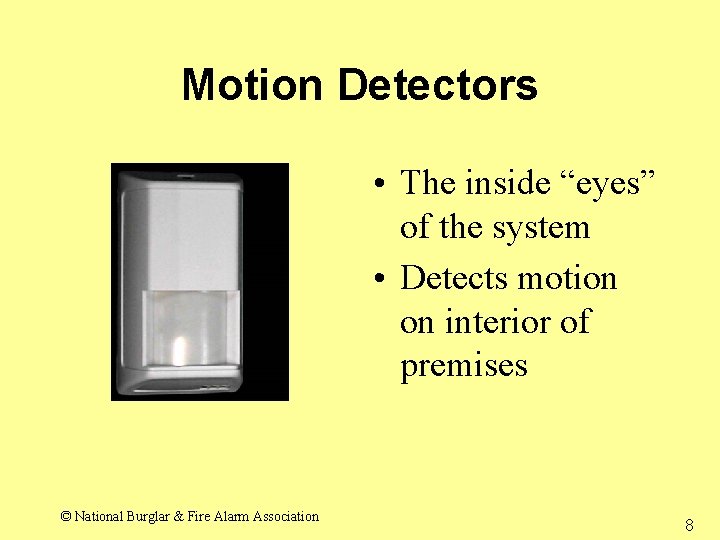
Motion Detectors • The inside “eyes” of the system • Detects motion on interior of premises © National Burglar & Fire Alarm Association 8
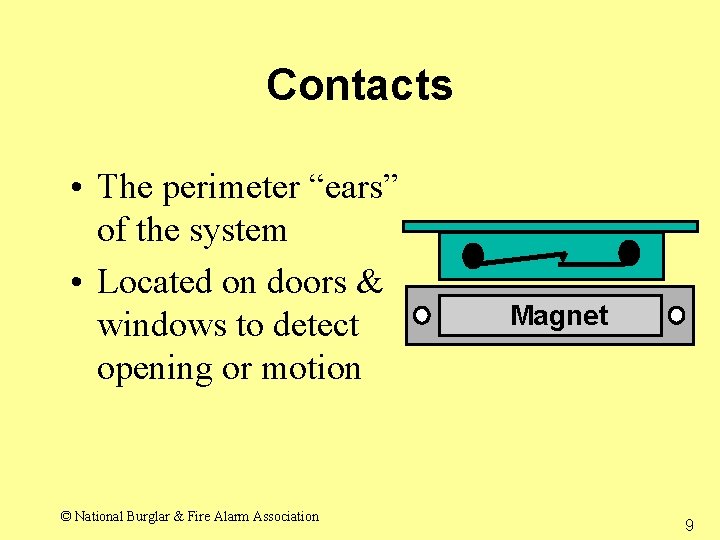
Contacts • The perimeter “ears” of the system • Located on doors & windows to detect opening or motion © National Burglar & Fire Alarm Association Magnet 9
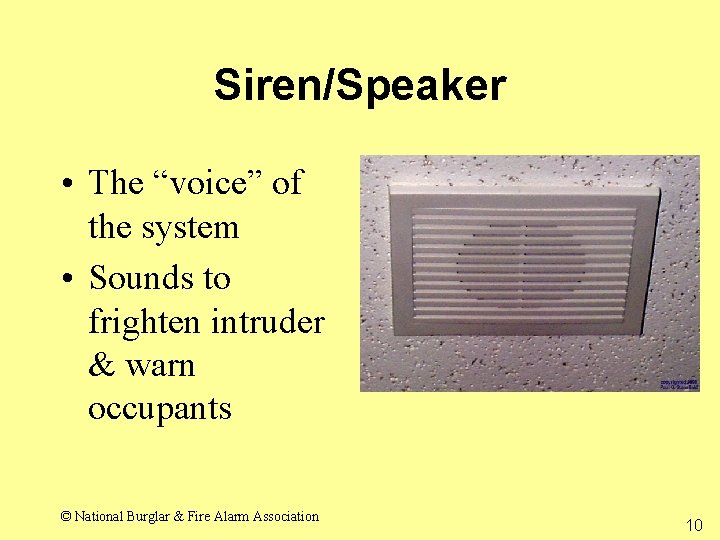
Siren/Speaker • The “voice” of the system • Sounds to frighten intruder & warn occupants © National Burglar & Fire Alarm Association 10
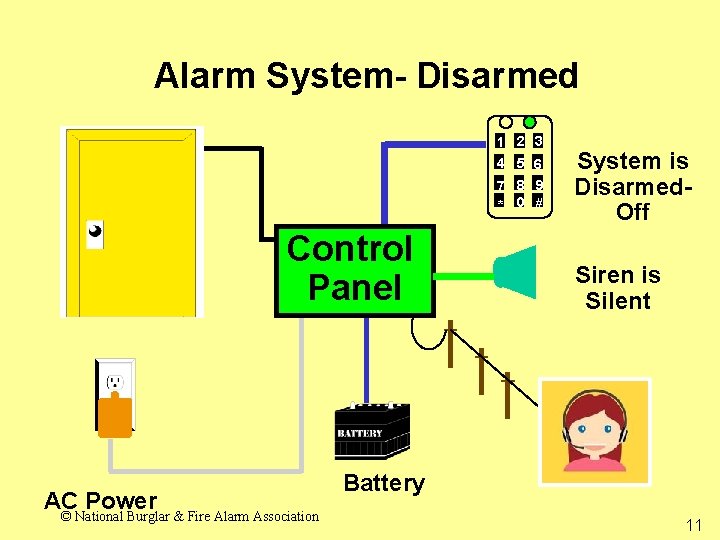
Alarm System- Disarmed 1 2 3 4 5 6 7 8 9 * 0 # Control Panel AC Power © National Burglar & Fire Alarm Association System is Disarmed. Off Siren is Silent Battery 11
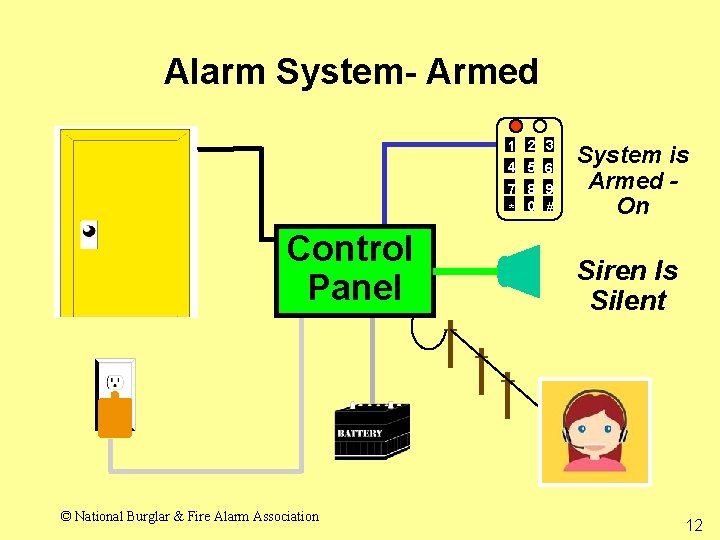
Alarm System- Armed 1 2 3 4 5 6 7 8 9 * 0 # Control Panel © National Burglar & Fire Alarm Association System is Armed On Siren Is Silent 12
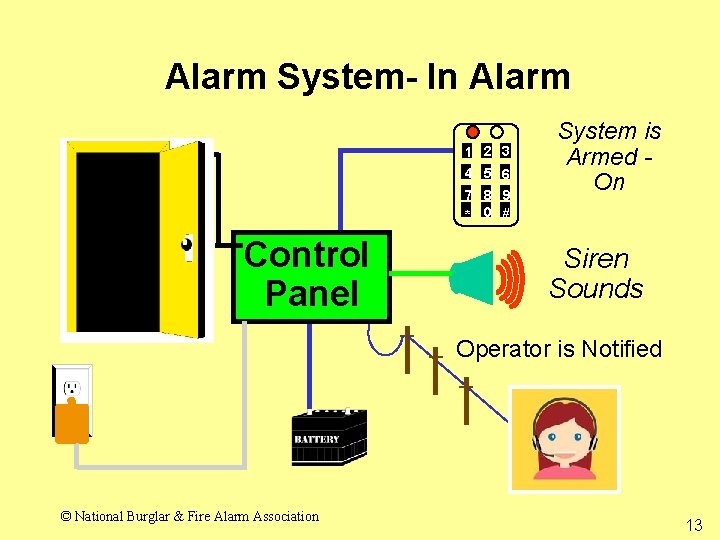
Alarm System- In Alarm 1 2 3 4 5 6 7 8 9 * 0 # Control Panel System is Armed On Siren Sounds Operator is Notified © National Burglar & Fire Alarm Association 13
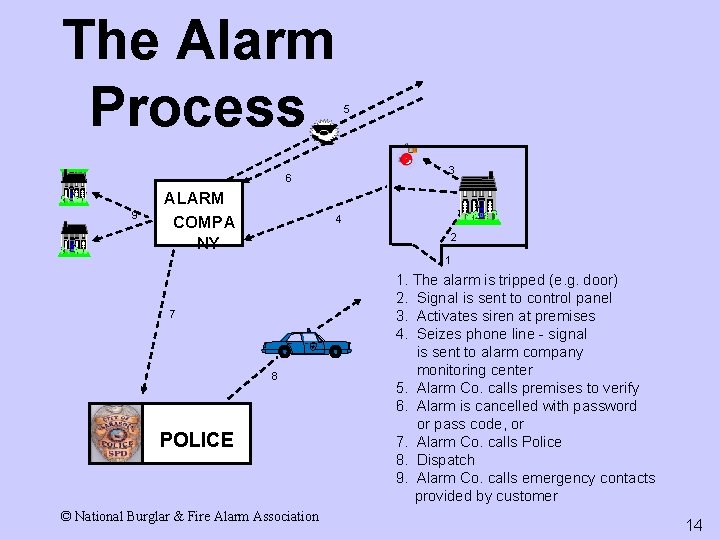
The Alarm Process 5 3 6 9 ALARM COMPA NY CONTROL PANEL 4 2 1 7 8 POLICE © National Burglar & Fire Alarm Association 1. The alarm is tripped (e. g. door) 2. Signal is sent to control panel 3. Activates siren at premises 4. Seizes phone line - signal is sent to alarm company monitoring center 5. Alarm Co. calls premises to verify 6. Alarm is cancelled with password or pass code, or 7. Alarm Co. calls Police 8. Dispatch 9. Alarm Co. calls emergency contacts provided by customer 14
Alarms: Your First Line of Defense “Used properly, alarm systems are one of the most effective ways to deter burglaries and break-ins. ” There’s just one problem. . . © National Burglar & Fire Alarm Association 15
What’s That Sound I Hear Next Door? • Could it be a false alarm? • False Alarm vs. False Dispatch – False Alarm: Alarm system detects alarm status erroneously through user error, equipment, etc – False Dispatch: Notification of an alarm to the law enforcement agency and responding authority finds no evidence of a criminal offense or attempted criminal offense © National Burglar & Fire Alarm Association 16
Alarms within this city • The City of Sarasota has approximately 3, 300 residential and commercial alarm systems • In 2015 the number of new alarm systems is growing at the rate of 3% per year © National Burglar & Fire Alarm Association 17
False Alarms: The Problem • Sarasota Police Department receives an average of 5 false alarms a day, costing tax payers about $275, 000 a year • Our goal is to minimize time wasted not helping the community and maximize officer time spent actually fighting crime, building relationships with citizens, and participating in crime prevention activities © National Burglar & Fire Alarm Association 18
False Alarms: The Problem Alarm systems provide an effective deterrent to crime & serve as a first line of defense against crime • BUT REPEATED FALSE ALARMS: – waste law enforcement resources & taxpayer money – could cause complacency in responding to alarms – can result in no law enforcement response to an alarm © National Burglar & Fire Alarm Association 19
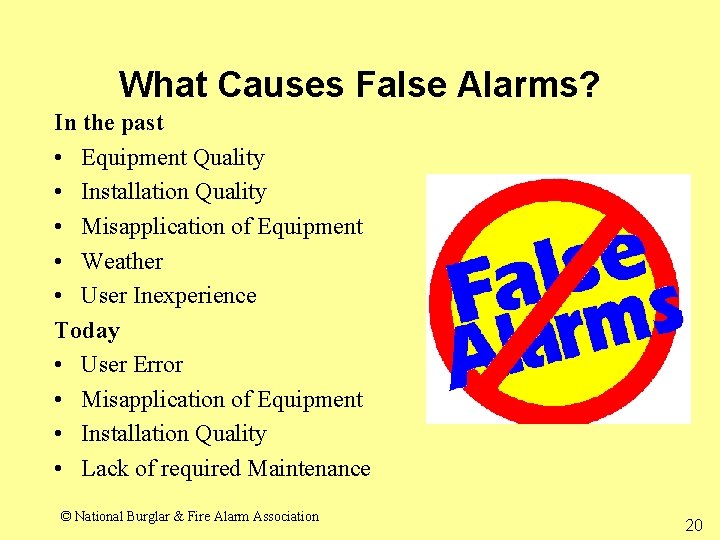
What Causes False Alarms? In the past • Equipment Quality • Installation Quality • Misapplication of Equipment • Weather • User Inexperience Today • User Error • Misapplication of Equipment • Installation Quality • Lack of required Maintenance © National Burglar & Fire Alarm Association 20
Law Enforcement + Industry Involvement = Fewer False Dispatches • Government Regulation – Ordinances – Permitting – Eliminating response to top offenders • Industry Self Regulation – Equipment Standards & Improved Application – Employee Training – User Training – Improved Monitoring Center Procedures 21
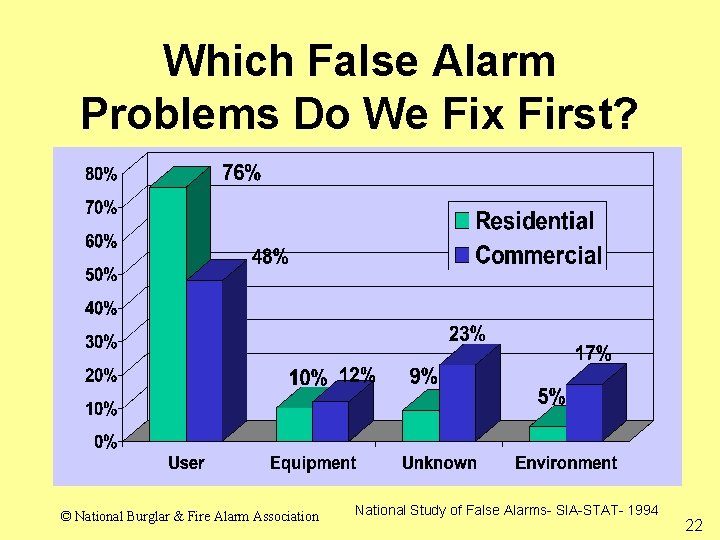
Which False Alarm Problems Do We Fix First? © National Burglar & Fire Alarm Association National Study of False Alarms- SIA-STAT- 1994 22
What can YOU do to Reduce False Dispatches • Understand how your system works • Lock & secure all doors & windows • Know cancellation code • Respond to activated alarm to meet officers © National Burglar & Fire Alarm Association 23
What can YOU do to Reduce False Dispatches Call your alarm company and contact our Alarm Unit: – BEFORE you start any remodeling – When you add or change a new authorized alarm user or emergency contact – When you change your phone number – When you add a pet to your home – When you are moving – When you have an unexplained false alarm © National Burglar & Fire Alarm Association 24
What can YOU do to Reduce False Dispatches Train ALL alarm users – Everyone who has a key needs to know how to use your system – Includes housekeepers, guests, realtors, neighbors, relatives, etc. Anyone who may stay at your home while you are not there © National Burglar & Fire Alarm Association 25
What can YOU do to Reduce False Dispatches Re-Entering If you re-enter your premises because you've forgotten something, turn off the alarm & reset it when you leave again. Do this even if you think it will only be a few seconds! © National Burglar & Fire Alarm Association 26
What can YOU do to Reduce False Dispatches Canceling Alarms • If you accidentally set off an alarm make sure all phones are on the hook and wait for your alarm company to call you back, OR • Follow your alarm company's instructions for canceling an alarm signal © National Burglar & Fire Alarm Association 27
What can YOU do to Reduce False Dispatches Bypassing Zones • Know how to "bypass"(shut off) the motion detector when you are at home • Know how to shut off a malfunctioning component ("zone") until repair is completed © National Burglar & Fire Alarm Association 28
What can YOU do to Reduce False Dispatches Inspect The Alarm System n n n Follow your alarm company's instructions on testing the system regularly - don't test it by intentionally setting it off Have your alarm company replace batteries as needed wireless systems generally require this more often Get a yearly systems inspection © National Burglar & Fire Alarm Association 29
What can YOU do to Reduce False Dispatches Holdup Buttons • Seriously consider whether you truly need this option • Properly train your employees • Make sure you do not have "single action" holdup buttons © National Burglar & Fire Alarm Association 30
What can YOU do to Reduce False Dispatches Duress Codes • A duress code appears to turn off the system but sends a special emergency message to your monitoring center, for example, if you were forced to turn off the system against your will © National Burglar & Fire Alarm Association 31
What can YOU do to Reduce False Dispatches Keypad Entry Errors • Know how to "clear" a wrong code if you make a mistake on the keypad • Some keypads only require that you eventually get the right numbers in sequence © National Burglar & Fire Alarm Association 32
What can YOU do to Reduce False Dispatches Door & Window Alarms • Doors & windows must be tight fitting & locked • Door & window contacts must be free of paint & varnish • Make sure there is no door or window warping • Check weathering of security screens © National Burglar & Fire Alarm Association 33
What can YOU do to Reduce False Dispatches Motion Detector Alarms • Be aware of what can cause motion detector alarms • helium balloons (especially Mylar) • pets • bugs on the lens • curtains © National Burglar & Fire Alarm Association 34
The Alarm Ordinance • Each alarm system must be registered with the Police Department A False Alarm is now defined as: Law enforcement dispatched to the site, when no evidence of a criminal act can be found In other words, there is either a burglary or a false alarm – no gray area © National Burglar & Fire Alarm Association 35
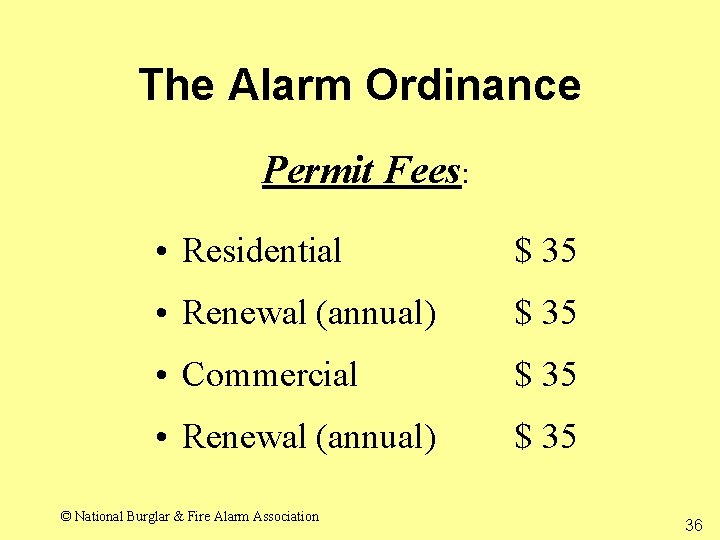
The Alarm Ordinance Permit Fees: • Residential $ 35 • Renewal (annual) $ 35 • Commercial $ 35 • Renewal (annual) $ 35 © National Burglar & Fire Alarm Association 36
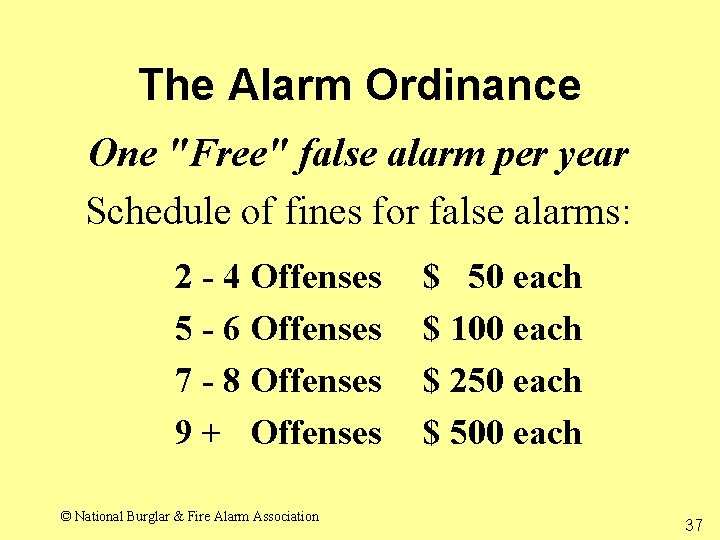
The Alarm Ordinance One "Free" false alarm per year Schedule of fines for false alarms: 2 - 4 Offenses 5 - 6 Offenses 7 - 8 Offenses 9 + Offenses © National Burglar & Fire Alarm Association $ 50 each $ 100 each $ 250 each $ 500 each 37
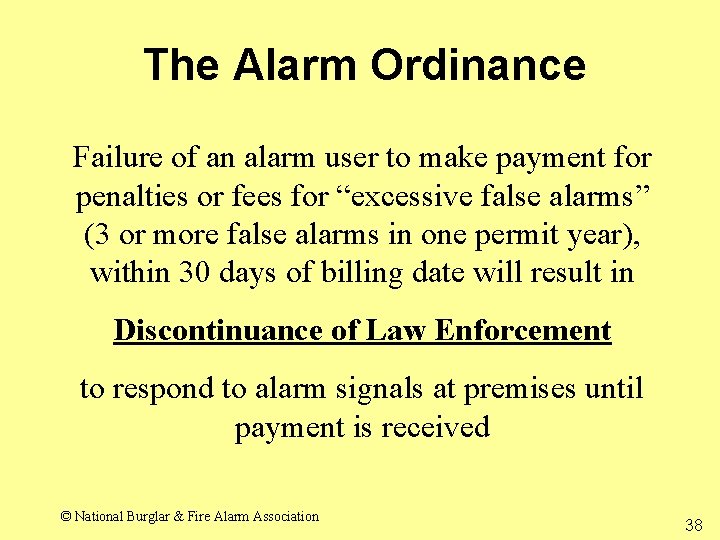
The Alarm Ordinance Failure of an alarm user to make payment for penalties or fees for “excessive false alarms” (3 or more false alarms in one permit year), within 30 days of billing date will result in Discontinuance of Law Enforcement to respond to alarm signals at premises until payment is received © National Burglar & Fire Alarm Association 38
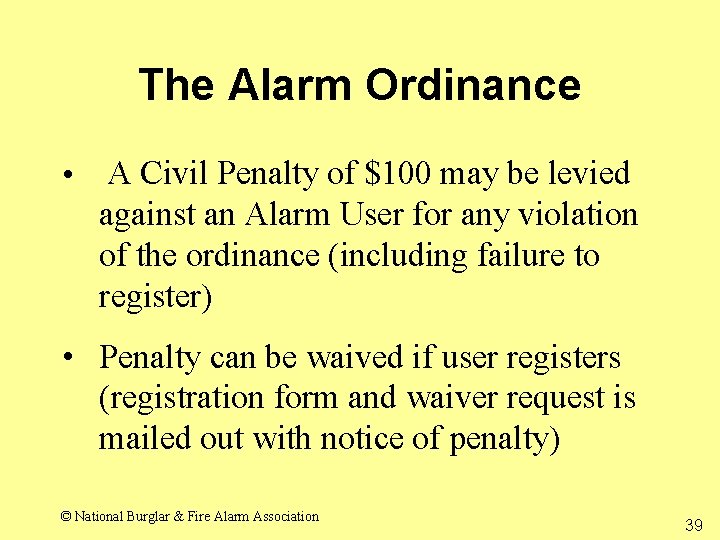
The Alarm Ordinance • A Civil Penalty of $100 may be levied against an Alarm User for any violation of the ordinance (including failure to register) • Penalty can be waived if user registers (registration form and waiver request is mailed out with notice of penalty) © National Burglar & Fire Alarm Association 39
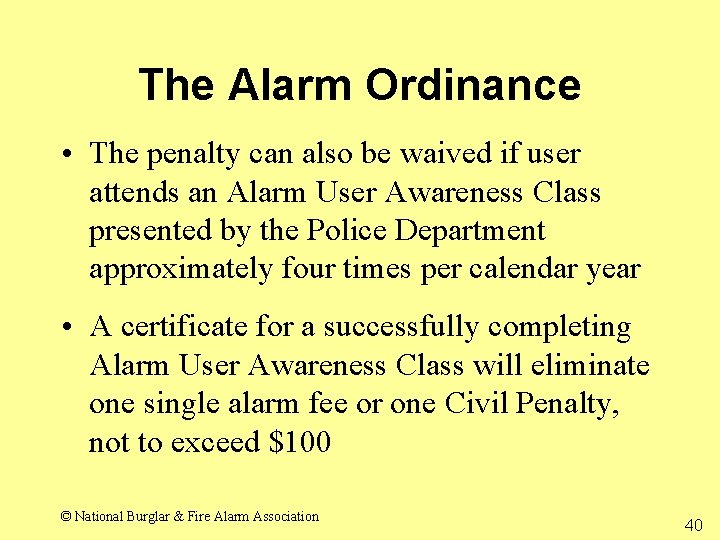
The Alarm Ordinance • The penalty can also be waived if user attends an Alarm User Awareness Class presented by the Police Department approximately four times per calendar year • A certificate for a successfully completing Alarm User Awareness Class will eliminate one single alarm fee or one Civil Penalty, not to exceed $100 © National Burglar & Fire Alarm Association 40
What To Expect From Your Alarm Company • Provide written instruction manual • Provide clear training at the time of installation • Available to answer follow-up questions prompt & effective repair of the system • Alarm verification by telephone call, video or audio built into your system © National Burglar & Fire Alarm Association 41
What To Expect From Your Alarm Company • Proper licenses • Available to update account information - phone numbers, emergency contacts • Able to identify "zones" which have been tripped • Available to receive calls and perform repairs after normal business hours • Inform alarm owners that according to our ordinance 15 -5118 they have to register within 15 days of installation of their alarm system © National Burglar & Fire Alarm Association 42

Measure Your Company’s IQ • The Installation Quality Certification Program is an industry certification program which identifies companies that exceed standards in the areas of: • • • IQ User Training Guidelines IQ Employee Training Guidelines IQ System Design Guidelines IQ Equipment Guidelines IQ Installation Guidelines IQ Monitoring Guidelines • Ask your company if they are IQ Certified! © National Burglar & Fire Alarm Association 43
Now you know. . . ALARMS CAN BE YOUR FIRST LINE OF DEFENSE But… You have a responsibility to use your system properly And… Now you know how!!! © National Burglar & Fire Alarm Association 44
For More Information! SPD Alarm Unit 941 -954 -7054 or CSAA - Central Station Alarm Association SIA - Security Industry Association SIAC – Security Industry Alarm Coalition Other State & Local Alarm Organizations © National Burglar & Fire Alarm Association 45
Contact Information For more information, feel free to contact: The Security Industry Alarm Coalition (972) 377 -9401 or stan@siacinc. org The National Burglar & Fire Alarm Association (301) 585 -1855 or fact@alarm. org The Installation Quality Certification Board (301) 585 -1855 or iq@alarm. org The False Alarm Reduction Association (301) 279 -1917 © National Burglar & Fire Alarm Association 46
Copyright & Acknowledgements • This presentation was created by the NBFAA False Alarm Prevention Committee and is © 1998 National Burglar & Fire Alarm Association (NBFAA). • NBFAA grants permission to use this presentation in conjunction with any Alarm User Awareness School. • NBFAA gives permission to modify this presentation only in order to make it applicable to a locality’s ordinance specifics so long as the NBFAA copyright is left intact on all slides. • NBFAA is grateful for the input of FARA & Brink’s Home Security during the development of this presentation. © National Burglar & Fire Alarm Association 47
- Slides: 47