
Sarah Vickerstaff Andrew Weyman and David Wainwright Is
- Slides: 26
Sarah Vickerstaff, Andrew Weyman and David Wainwright Is flexibility the answer? Older workers access to formal and informal flexibility in the workplace
What is flexibility? • • • Page 2 Flexible work options are an area of HR management which has been hypothesised as important for the older work force (OECD, 2006: 98 -101; Moen and Sweet, 2004; Loretto et al, 2007; Pitt-Catsouphes and Matz-Costa, 2008). As a means for coping with health or care constraints on continuing to work or as a mechanism for gradual or phased retirement. Flexible work options may refer to changes to the way in which someone works with an existing employer (for example moving to part-time hours, home working, compressed hours, flexi-time, job sharing or term-time only hours) or to ‘bridge employment’ that is taking up another typically less demanding job or becoming self-employed before retiring completely (Alcover et al, 2014: 7).
Policy on flexibility • • Policy in the UK has applauded the value of flexible work for some time and in 2014 extended the right to request consideration of flexible working arrangements to all employees with at least 26 weeks service. “We know that for many people, the possibility of flexible or part-time working, or being able to transition to a less demanding role, could tip the balance to them staying in employment longer. ” (Damian Hinds, Minister of State for Employment, DWP, 2017: 3) Page 3
Flexibility as part of the new ‘choice’ agenda “Supporting individuals to make the right choice Our key message for individuals is that working is good for finances as well as health and wellbeing in later life. We also make recommendations around options for flexible working, retraining for a new career; self-employment, volunteering and phased retirement. ” (DWP, 2017) Page 4
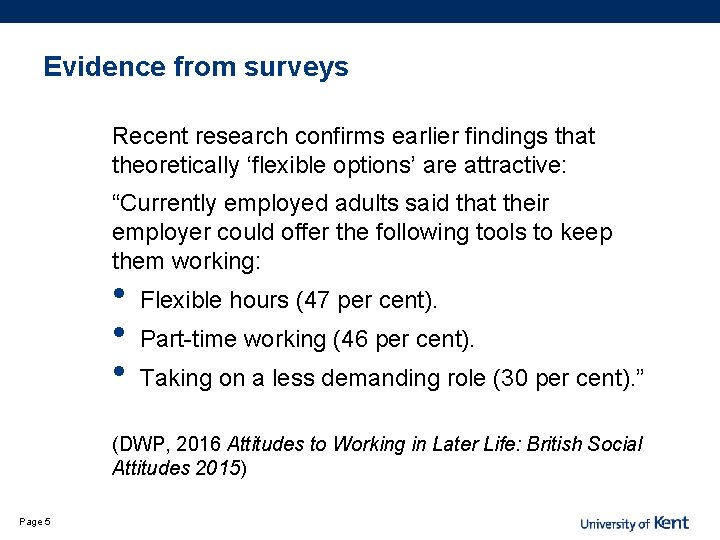
Evidence from surveys Recent research confirms earlier findings that theoretically ‘flexible options’ are attractive: “Currently employed adults said that their employer could offer the following tools to keep them working: • • • Flexible hours (47 per cent). Part-time working (46 per cent). Taking on a less demanding role (30 per cent). ” (DWP, 2016 Attitudes to Working in Later Life: British Social Attitudes 2015) Page 5
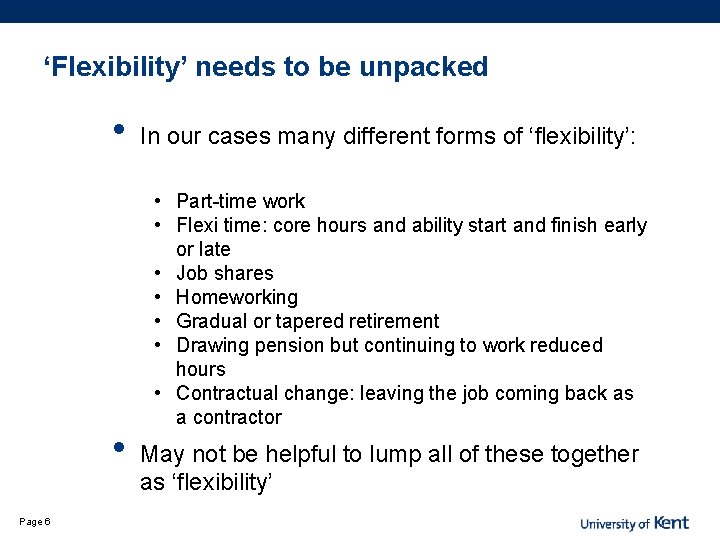
‘Flexibility’ needs to be unpacked • • Page 6 In our cases many different forms of ‘flexibility’: • Part-time work • Flexi time: core hours and ability start and finish early or late • Job shares • Homeworking • Gradual or tapered retirement • Drawing pension but continuing to work reduced hours • Contractual change: leaving the job coming back as a contractor May not be helpful to lump all of these together as ‘flexibility’
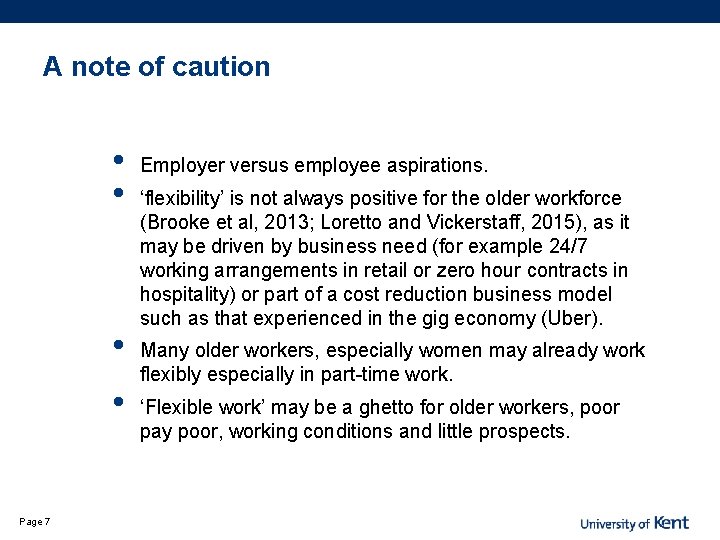
A note of caution • • Page 7 Employer versus employee aspirations. ‘flexibility’ is not always positive for the older workforce (Brooke et al, 2013; Loretto and Vickerstaff, 2015), as it may be driven by business need (for example 24/7 working arrangements in retail or zero hour contracts in hospitality) or part of a cost reduction business model such as that experienced in the gig economy (Uber). Many older workers, especially women may already work flexibly especially in part-time work. ‘Flexible work’ may be a ghetto for older workers, poor pay poor, working conditions and little prospects.
Focus of Today’s Presentation • • Page 8 It is widely assumed that access to various forms of flexible work is beneficial for older workers and can provide a key means for them to continue working or retire gradually, but do older workers have access to such flexible work endings and the ability to take them up? Test through our case studies and explore differences between formal and informal flexibility.
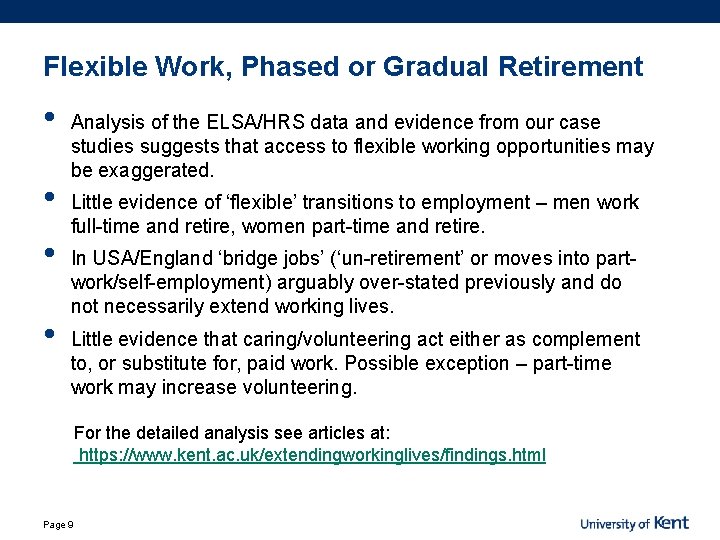
Flexible Work, Phased or Gradual Retirement • • Analysis of the ELSA/HRS data and evidence from our case studies suggests that access to flexible working opportunities may be exaggerated. Little evidence of ‘flexible’ transitions to employment – men work full-time and retire, women part-time and retire. In USA/England ‘bridge jobs’ (‘un-retirement’ or moves into partwork/self-employment) arguably over-stated previously and do not necessarily extend working lives. Little evidence that caring/volunteering act either as complement to, or substitute for, paid work. Possible exception – part-time work may increase volunteering. For the detailed analysis see articles at: https: //www. kent. ac. uk/extendingworkinglives/findings. html Page 9
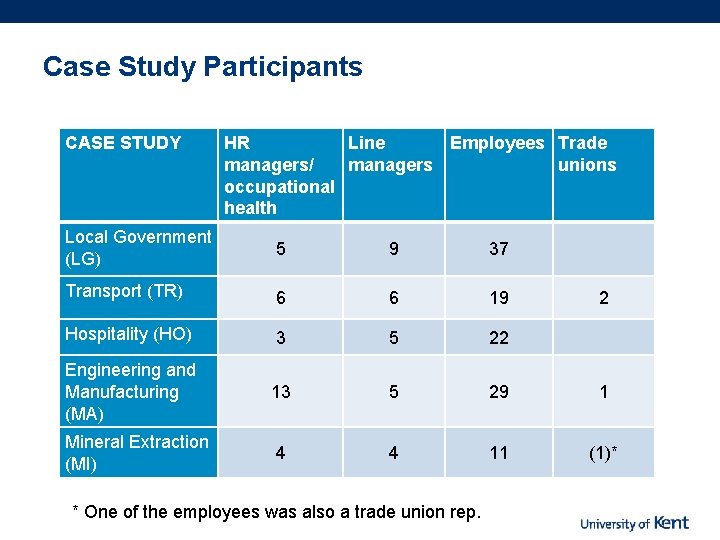
Case Study Participants CASE STUDY HR Line Employees Trade managers/ managers unions occupational health Local Government (LG) 5 9 37 Transport (TR) 6 6 19 Hospitality (HO) 3 5 22 Engineering and Manufacturing (MA) 13 5 29 1 Mineral Extraction (MI) 4 4 11 (1)* * One of the employees was also a trade union rep. 2
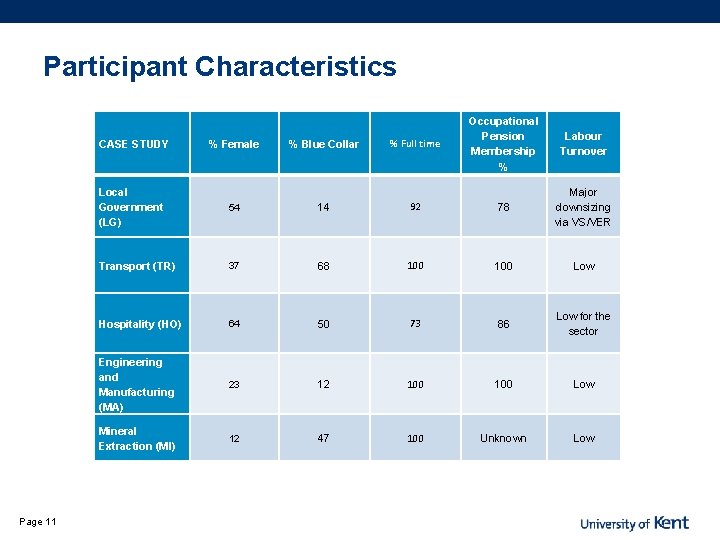
Participant Characteristics CASE STUDY Page 11 % Female % Blue Collar % Full time Occupational Pension Membership % Labour Turnover Local Government (LG) 54 14 92 78 Major downsizing via VS/VER Transport (TR) 37 68 100 Low Hospitality (HO) 64 50 73 86 Low for the sector Engineering and Manufacturing (MA) 23 12 100 Low Mineral Extraction (MI) 12 47 100 Unknown Low
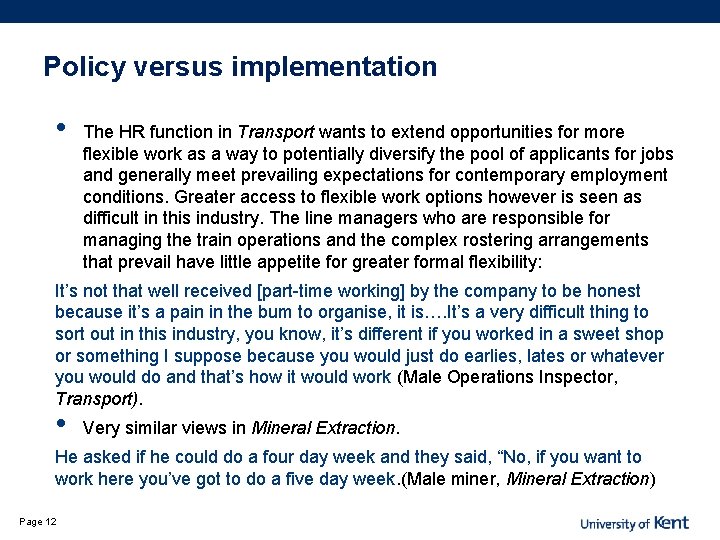
Policy versus implementation • The HR function in Transport wants to extend opportunities for more flexible work as a way to potentially diversify the pool of applicants for jobs and generally meet prevailing expectations for contemporary employment conditions. Greater access to flexible work options however is seen as difficult in this industry. The line managers who are responsible for managing the train operations and the complex rostering arrangements that prevail have little appetite for greater formal flexibility: It’s not that well received [part-time working] by the company to be honest because it’s a pain in the bum to organise, it is…. It’s a very difficult thing to sort out in this industry, you know, it’s different if you worked in a sweet shop or something I suppose because you would just do earlies, lates or whatever you would do and that’s how it would work (Male Operations Inspector, Transport). • Very similar views in Mineral Extraction. He asked if he could do a four day week and they said, “No, if you want to work here you’ve got to do a five day week. (Male miner, Mineral Extraction) Page 12
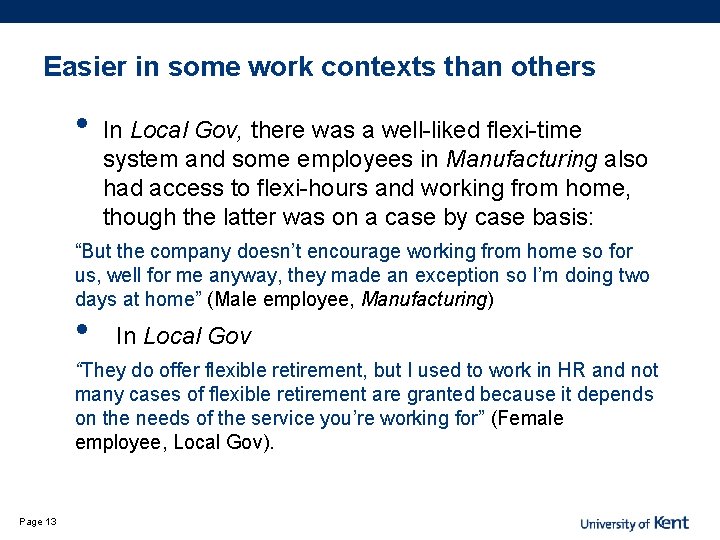
Easier in some work contexts than others • In Local Gov, there was a well-liked flexi-time system and some employees in Manufacturing also had access to flexi-hours and working from home, though the latter was on a case by case basis: “But the company doesn’t encourage working from home so for us, well for me anyway, they made an exception so I’m doing two days at home” (Male employee, Manufacturing) • In Local Gov “They do offer flexible retirement, but I used to work in HR and not many cases of flexible retirement are granted because it depends on the needs of the service you’re working for” (Female employee, Local Gov). Page 13
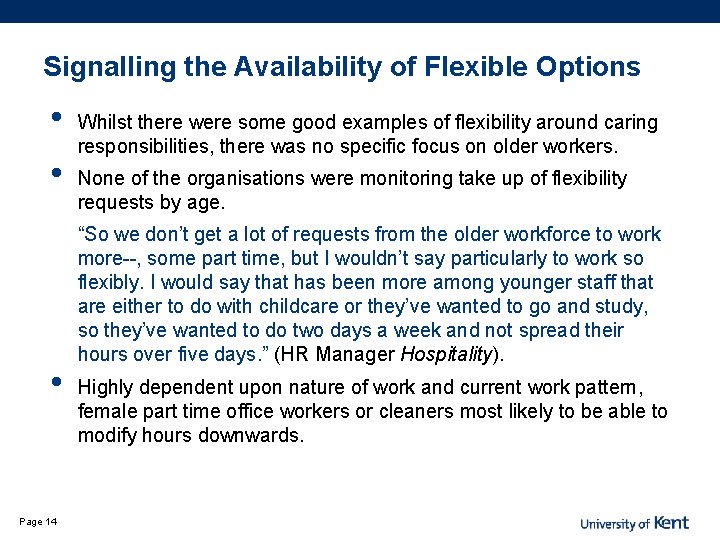
Signalling the Availability of Flexible Options • • • Page 14 Whilst there were some good examples of flexibility around caring responsibilities, there was no specific focus on older workers. None of the organisations were monitoring take up of flexibility requests by age. “So we don’t get a lot of requests from the older workforce to work more--, some part time, but I wouldn’t say particularly to work so flexibly. I would say that has been more among younger staff that are either to do with childcare or they’ve wanted to go and study, so they’ve wanted to do two days a week and not spread their hours over five days. ” (HR Manager Hospitality). Highly dependent upon nature of work and current work pattern, female part time office workers or cleaners most likely to be able to modify hours downwards.
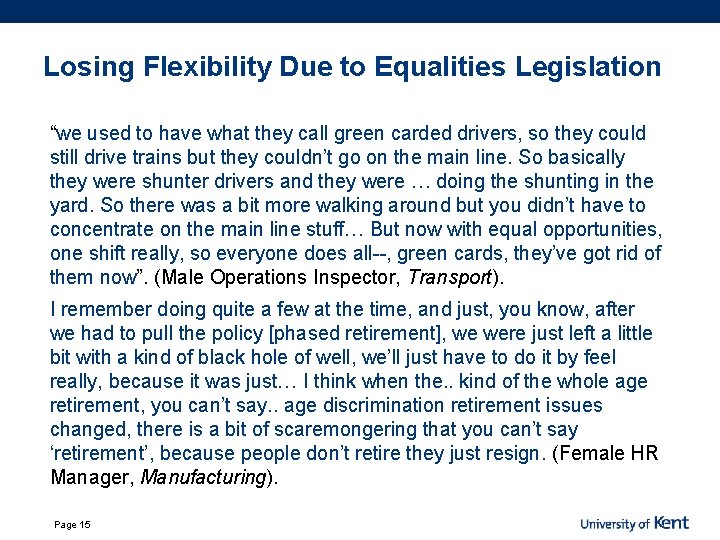
Losing Flexibility Due to Equalities Legislation “we used to have what they call green carded drivers, so they could still drive trains but they couldn’t go on the main line. So basically they were shunter drivers and they were … doing the shunting in the yard. So there was a bit more walking around but you didn’t have to concentrate on the main line stuff… But now with equal opportunities, one shift really, so everyone does all--, green cards, they’ve got rid of them now”. (Male Operations Inspector, Transport). I remember doing quite a few at the time, and just, you know, after we had to pull the policy [phased retirement], we were just left a little bit with a kind of black hole of well, we’ll just have to do it by feel really, because it was just… I think when the. . kind of the whole age retirement, you can’t say. . age discrimination retirement issues changed, there is a bit of scaremongering that you can’t say ‘retirement’, because people don’t retire they just resign. (Female HR Manager, Manufacturing). Page 15
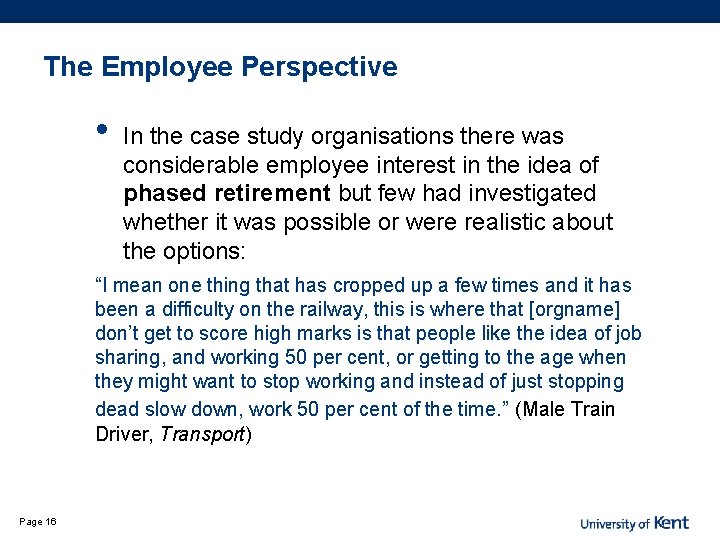
The Employee Perspective • In the case study organisations there was considerable employee interest in the idea of phased retirement but few had investigated whether it was possible or were realistic about the options: “I mean one thing that has cropped up a few times and it has been a difficulty on the railway, this is where that [orgname] don’t get to score high marks is that people like the idea of job sharing, and working 50 per cent, or getting to the age when they might want to stop working and instead of just stopping dead slow down, work 50 per cent of the time. ” (Male Train Driver, Transport) Page 16
Phased or Gradual Retirement • • • Page 17 One organisation had a phased retirement scheme but it was not publicised and there was not widespread knowledge about it. Another organisation had got rid of its wind down scheme for people moving to retirement on the grounds that it might flout discrimination legislation. Our evidence suggests that the option of phased retirement is not widely known about or practised, and often depends upon informal exchanges with a sympathetic line manager.
Attractive But Not Feasible? • For lower income earners it was often not financially viable to consider gradual retirement anyway: “I couldn’t reduce my hours. I couldn’t live on 20 hours week, let’s say. ” (Female employee Hospitality) • Or even for the better off, a financial hit was not attractive: If I was in a financial position I’d like to take this to a three day week then drop down to a two day but I don’t know if I could financially afford to do that to maintain the lifestyle that I want, I don’t know. I can’t see ten months in the future let alone ten years. (Male employee, Mineral Extraction) Page 18
The Management of Flexibility • Flexible working options are limited for those outside administrative and office jobs, and even where HR wish to increase such opportunities, they may face resistance from line managers who are not supported to make the arrangements work in practice. Operational and commercial pressures may conflict with flexibility considerations: And it is very hard, and it’s becoming more and more evident, trying to manage firstly staff expectations and also the numbers, because where we might have been able to do it before-so we might have decided there’s an area that’s slightly easier to clean. So this area you might determine is slightly easier than having to go into student rooms and do up and downstairs, or kitchens and bathrooms. So whereas previously we might have been able to accommodate some staff still working but doing slightly less strenuous cleaning jobs, we haven’t got those options any more, and that’s what we’re finding harder and harder. (HR manager, Hospitality) Page 19
Gender Dimension to Flexibility • • Page 20 Gendered work patterns during working life feed through into individuals’ aspirations and opportunities for extending working lives. Women are often working part time already and therefore the idea of phased retirement, though potentially available through a further reduction in hours, is less meaningful or financially feasible.
A Neglected Aspect: Informal Flexibility • Agreements between line managers and employees, but they may be fragile: “I know my previous line manager would have just said, “Oh, just go on, ” [laughs] sort of thing, you know, but with this line manager everything is completely by the book. Which, you know, at the end of day, that’s what you’re supposed to do and the rest of it. But it does throw up some anomalies really and like I say, next week, I’m using one of my day’s holiday [for a medical appointment] (Male Employee Local Gov) Page 21
A Neglected Aspect: Flexibility Organised by the Work Group • On the trains there were many examples of work teams dealing with the issues around shift patterns by individuals swapping shifts: I mean I'm the wrong one to talk to [about shifts] actually because I don’t do the full range of shifts. I have an arrangement with a chap that I do his earlies, he works my late turns. So I don’t do the full range of earlies and lates, I just do early turns…. And the other chap it suits him for his childminding, etcetera, it's easier for him to do the late turn so that he's at home in the morning. Yeah. Q: So in terms of who organises your shift patterns is that done by the train manager or? A: Yeah it's down to management, but we always do it ourselves here. (Male Conductor, Transport). There were examples in other organisations of flexibility arranged within the work group. Page 22
Conclusions (1) • • Page 23 Despite major policy developments there is as yet little evidence that employers have really begun to work through the implications of an ageing workforce. Transitions to retirement do not seem to have changed markedly: men work full time and retire, women work part-time and retire. It is too simplistic to assume that just because everyone can request consideration of flexible working a) they are necessarily aware of this and b) that it is feasible either for the employer or the employee. The data demonstrated that negotiating flexibility is a complex phenomenon involving not just interactions between employees and line managers but also between employees. Solidarity among employees and respect from line managers were features of successfully negotiated individual arrangements.
Conclusions (2) • • • Page 24 It is also clear in that in our examples there are tensions and accommodations between HR policy and what is happening on the ground. This supports other research which suggests that line managers are key in the successful implementation of policy or interventions for older workers and have differing levels of support from above for creative management. There is still quite a lot of old fashioned thinking about who wants and gets “flexibility”: women in office jobs. A defensive response to age discrimination legislation is getting in the way of managing older workers effectively: conversations about retirement, career management, retirement courses and flexible work options.
Thank You! Thanks to all the people involved with the project: Ben Baumberg-Geiger, Amanda Burns, Charlotte Clark, Joanne Crawford, Amanda Fahy, Mariska van der Horst, David Lain, Wendy Loretto, Chris Phillipson, Mark Robinson, Sue Shepherd, David Wainwright, Andrew Weyman Page 25
References Alcover, C-M. , Topa, G. , Parry, E. , Fraccaroli, F. and Depolo, M. (Eds) (2014) Bridge Employment: A research handbook, London: Routledge. Brooke, E. Taylor, P. , Mcloughlin, C and Di Biase, T. (2013) ‘Managing the working body: active ageing and limits to the ‘flexible’ firm’ Ageing and Society, 33(8) : 1295 -1314. Department for Work and Pensions (DWP) (2016) Attitudes to Working in Later Life: British Social Attitudes 2015, DWP ad hoc research report no. 44, London: DWP (2017) Fuller Working Lives A Partnership Approach, London: DWP. Earl, C. and Taylor, P. (2015) ‘Is Workplace Flexibility Good Policy? Evaluating the Efficacy of Age Management Strategies for Older Women Workers’ Work, Aging and Retirement Advance access January 6 th. Loretto W. , Vickerstaff, S. and White, P. (2007) Flexible work and older workers. In: Loretto W, Vickerstaff S and White P (eds) The Future for Older Workers: New Perspectives. Bristol: The Policy Press, 139– 60. Loretto, W. and Vickerstaff, S. (2015) “Gender, age and flexible working in later life”, Work Employment and Society 29 (2) (2015): 233 -249. Moen P and Sweet S (2004) From ‘work-family’ to ‘flexible careers’. Community, Work and Family 7(2): 209– 66. OECD (2006) Live Longer, Work Longer. Paris: OECD Publishing. Pitt-Catsouphes M and Matz-Costa C (2008) The multi-generational workforce: workplace flexibility and engagement. Community, Work and Family 11(2): 215– 29. Page 26