
SARAH JACK Jacob and Marcus Wallenberg Professor of
SARAH JACK Jacob and Marcus Wallenberg Professor of Innovative and Sustainable Business Development
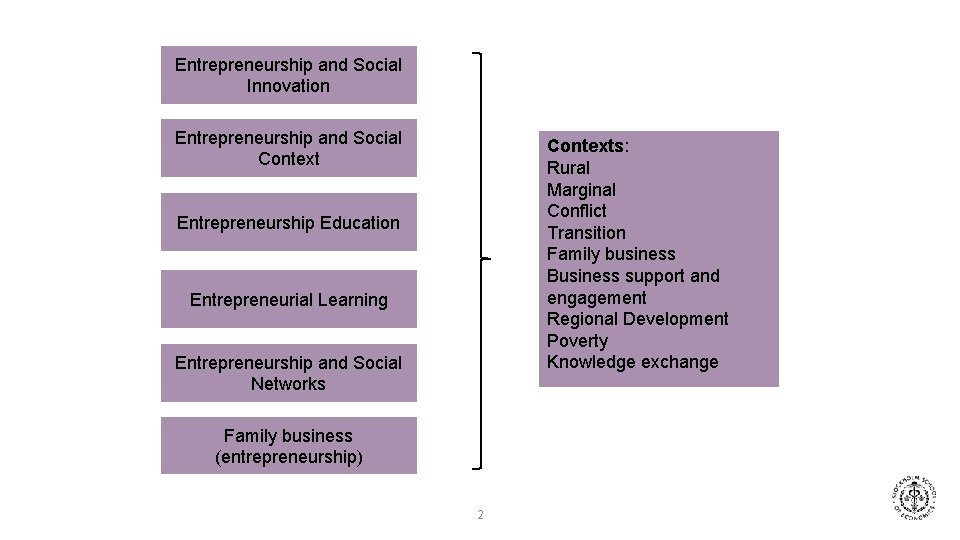
Entrepreneurship and Social Innovation Entrepreneurship and Social Contexts: Rural Marginal Conflict Transition Family business Business support and engagement Regional Development Poverty Knowledge exchange Entrepreneurship Education Entrepreneurial Learning Entrepreneurship and Social Networks Family business (entrepreneurship) 2
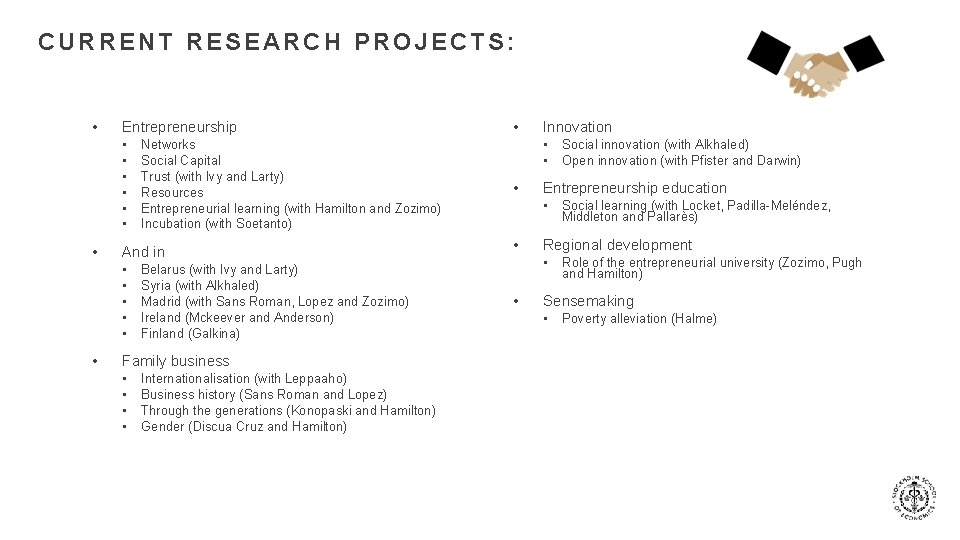
CURRENT RESEARCH PROJECTS: • Entrepreneurship • • And in • • • Networks Social Capital Trust (with Ivy and Larty) Resources Entrepreneurial learning (with Hamilton and Zozimo) Incubation (with Soetanto) Belarus (with Ivy and Larty) Syria (with Alkhaled) Madrid (with Sans Roman, Lopez and Zozimo) Ireland (Mckeever and Anderson) Finland (Galkina) Family business • • Internationalisation (with Leppaaho) Business history (Sans Roman and Lopez) Through the generations (Konopaski and Hamilton) Gender (Discua Cruz and Hamilton) • Innovation • • • Entrepreneurship education • • Social learning (with Locket, Padilla-Meléndez, Middleton and Pallarès) Regional development • • Social innovation (with Alkhaled) Open innovation (with Pfister and Darwin) Role of the entrepreneurial university (Zozimo, Pugh and Hamilton) Sensemaking • Poverty alleviation (Halme)
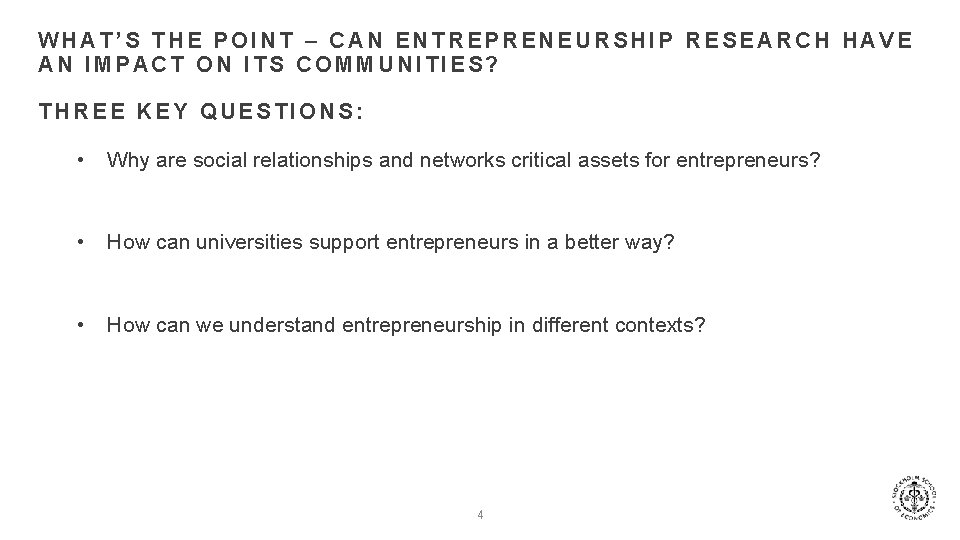
WHAT’S THE POINT – CAN ENTREPRENEURSHIP RESEARCH HAVE AN IMPACT ON ITS COMMUNITIES? THREE KEY QUESTIONS: • Why are social relationships and networks critical assets for entrepreneurs? • How can universities support entrepreneurs in a better way? • How can we understand entrepreneurship in different contexts? 4
5
BUILDING REGIONS: A RESOURCE BASED VIEW OF A POLICY LED KNOWLEDGE EXCHANGE NETWORK – WITH LARTY AND LOCKETT • Relevance of clusters for reginal economic development has long been known • Offers greater opportunity for sharing knowledge, increases productivity, innovation and competitive advantage of regions But, Knowledge exchange relies on networks between firms. So, initiatives designed to facilitate networking opportunities to support regional growth. However, role of intermediary key and their being able to encourage networking 6
• Considers successful creation and expansion of a policy-led intermediary driven regional knowledge exchange network for information and communication technology sector (ICT). • ICT sector generated 16% of region’s Gross Value Added (GVA), employed 10. 6% of its workforce and formed second largest regional cluster of ICT firms in Europe • Through qualitative study, we looked at the resources that the Regional Development Agency, City Council and local University combined to facilitate the creation and expansion of a new regional ICT network. 7
CONTRIBUTION • extends understanding about choice of intermediary organization and role intermediaries play in both creating and expanding regional knowledge exchange networks • how policymakers are able to identify who such individuals might be is critical. • contributes more broadly to body of research on factors underpinning success of policy-led regional networks. Shows value created through combination of intermediary and individual resources cannot be developed in a short period of time. Moreover, development of such resources can be specific to a particular regional context. 8
MOTIVATIONS AND CHALLENGES OF NETWORK FORMATION: ENTREPRENEUR AND INTERMEDIARY PERSPECTIVES - WITH LARTY AND LOCKETT • Industry networks for small and medium-sized enterprises (SMEs) strongly encouraged by policymakers throughout the World • Such networks inspired by economic success of Silicon Valley and as a mechanism to support economic growth and prosperity, ensure productivity and increase performance of regions in national and international markets. • So, policy has tried to drive such networks as a mechanism for nurturing a socio-economic environment that allows entrepreneurs and the SMEs that they build to flourish; as a way for entrepreneurs to build dynamic informal networks with other types of organisations that support individual activities and those of an industry; to bring about cluster formation and participation by encouraging inter-firm collaboration. 9
HOWEVER, • development of networks relies on aspects largely socially constituted and dependent on social cohesion and social interaction over time. • formation of industry networks tends to involve intermediaries who have an economic or regional policy agenda to be met through hard-and-fast results. So, informal and softer side of both networks and entrepreneurship often overlooked. • Industry networks tend to be driven by economic need, often related to serving a specific industry or technology requirement feature or characteristic, but networks revolve around an organisation, stakeholder or individual with their development being driven by the personal needs and goals of the entrepreneur. While policymakers tend to be under the impression that industry networks can be built, a more realistic view is that they tend to emerge and self-organise through common needs, requirements and goals. 10
APPROACH • Looked at intermediaries and entrepreneurs engaged in network-building activities in the information and communication technology (ICT) • Considered intermediaries from government agencies and higher education institutions (HEIs) and entrepreneurs. • 14 respondents actively involved in forming regional networking groups. The objective of these groups was to provide a forum for networking and to bring together like-minded individuals (intermediaries and entrepreneurs) involved in the ICT sector. 11
CONTRIBUTION • Need to understand the motivations and challenges of being involved in this type of network. • Need for greater communication of expectations between intermediaries and entrepreneurs: neither party knows what to expect from these types of events. • Intermediaries allocate resources to create an environment based on what they think entrepreneurs need • Entrepreneurs have to discover how that environment can work for their business and what opportunities may exist. • Demonstrates how mechanisms that intermediaries use to create an environment whose aim is unclear can lead to entrepreneurs focusing on short-term, hard-and-fast results. These mechanisms can constrain entrepreneurs ability to focus on the longer-term development for realising opportunities. • Policymakers must work in partnership with entrepreneurs to understand needs, to ensure resources are targeted appropriately and in a manner conducive to supporting an entrepreneurial environment in the longer term. 12
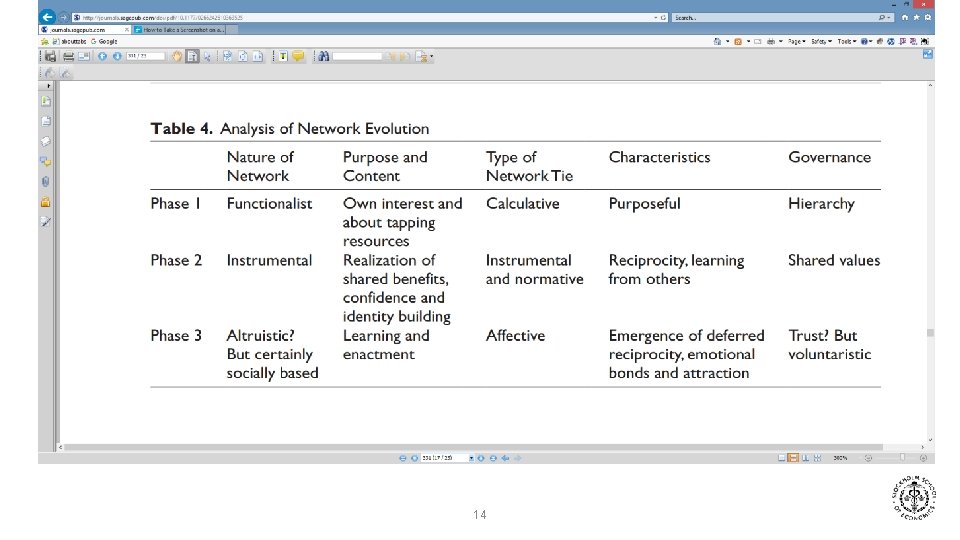
AN ENTREPRENEURIAL NETWORK EVOLVING: PATTERNS OF CHANGE WITH MOULT, ANDERSON AND DODD • how and why networks emerge, evolve and support growth recognized as needing further research • Looks at emergence and development of a new network, where unit of analysis is not individual or cluster, but emergent network • But - should we study networking or networks? Network change instead offers possibility of charting both structure, process and content 13
14
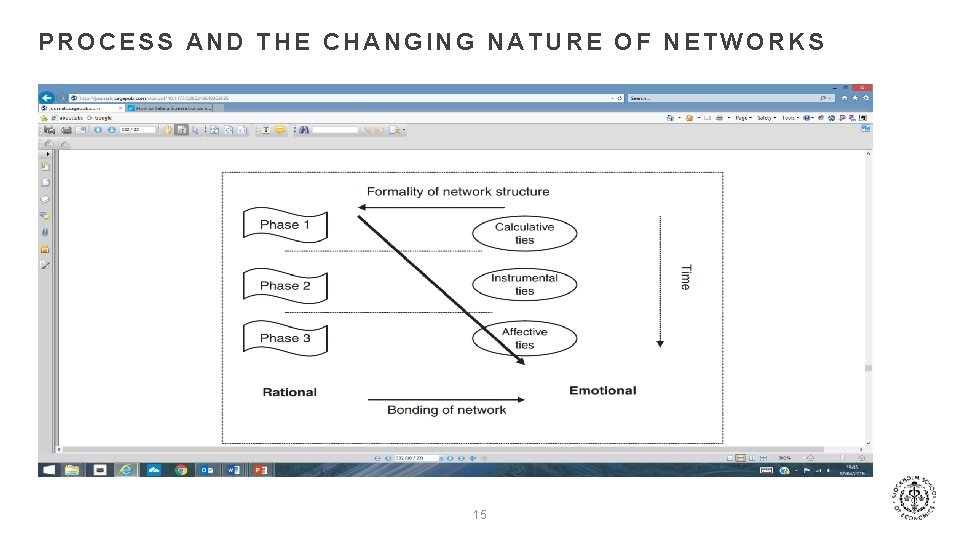
PROCESS AND THE CHANGING NATURE OF NETWORKS 15
CONTRIBUTION • networking fundamentally based on social enactment of what it means to be enterprising • networks are not just about resource acquisition but softer, social issues, such as social learning and confidence building through interdependence and the sharing of experience • Looking at network change over time demonstrates evolution and developments from a manufactured grouping of individuals to an interactive organic network. • considers changes in actual network and uses this as mechanism to help enhance understanding about networking • through active formation of network ties, gaps in entrepreneur’s information, asset and social legitimation requirements are bridged. Thus, network appears to shift and adapt to fit the needs of its participants. • networks are organic structures, responding to the needs of network members 16
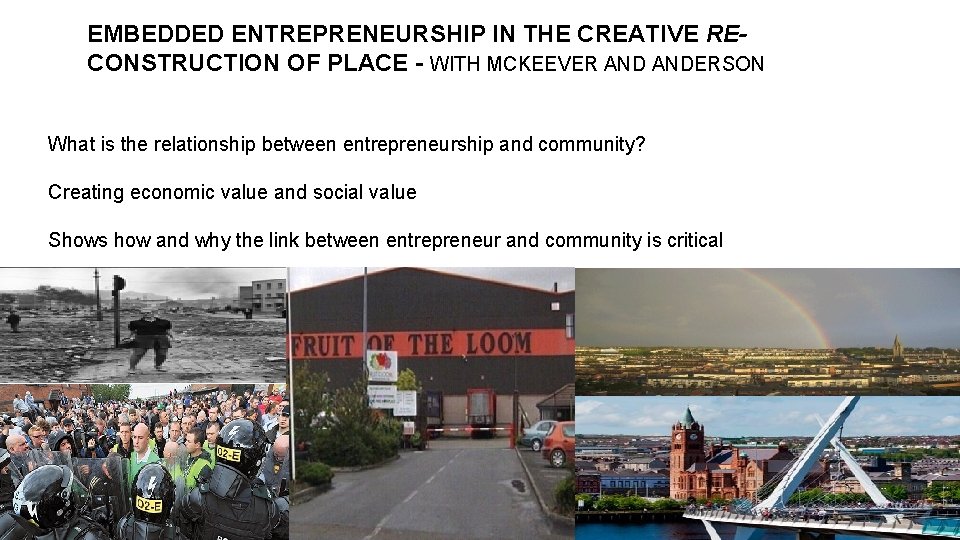
EMBEDDED ENTREPRENEURSHIP IN THE CREATIVE RECONSTRUCTION OF PLACE - WITH MCKEEVER ANDERSON What is the relationship between entrepreneurship and community? Creating economic value and social value Shows how and why the link between entrepreneur and community is critical
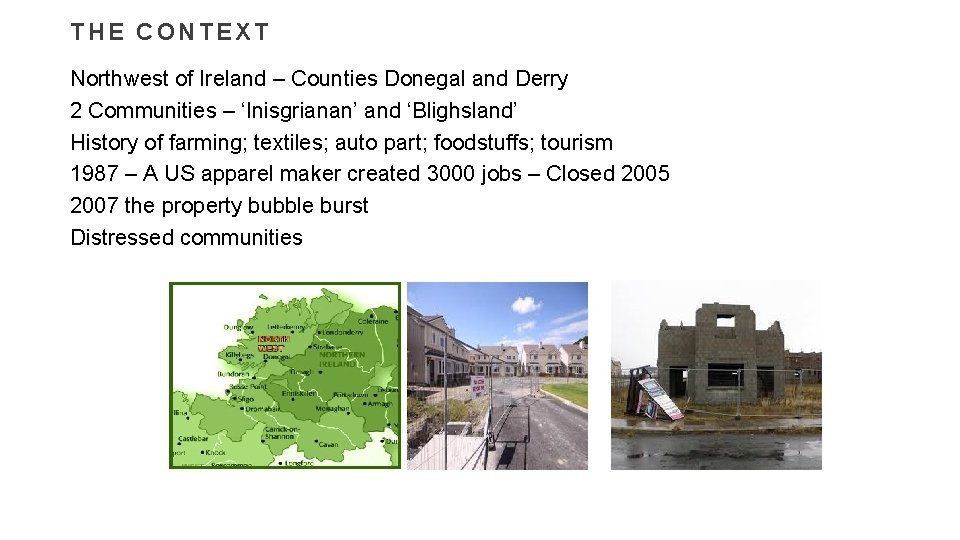
THE CONTEXT Northwest of Ireland – Counties Donegal and Derry 2 Communities – ‘Inisgrianan’ and ‘Blighsland’ History of farming; textiles; auto part; foodstuffs; tourism 1987 – A US apparel maker created 3000 jobs – Closed 2005 2007 the property bubble burst Distressed communities
REFLECTION • Desire to take business beyond national boundaries • Impact of international activity helped creation of the boom and the bust - Employment and wealth - Economic decline and social problems • Depleted community being rebuilt through the recombination of social resources and entrepreneurship, shaping and changing a community through social bonds and an affinity to community and place, entrepreneurship recreates, renews and reifies identity of place 19
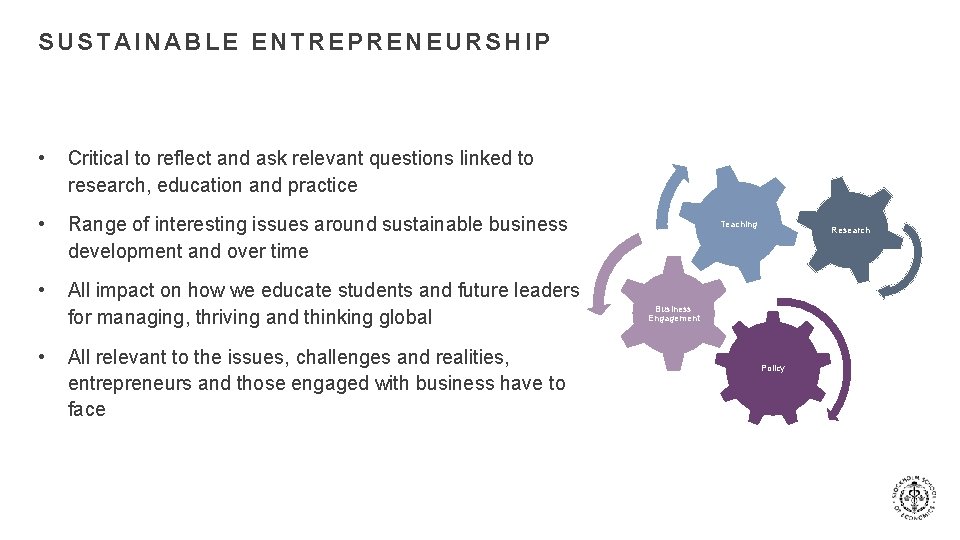
SUSTAINABLE ENTREPRENEURSHIP • Critical to reflect and ask relevant questions linked to research, education and practice • Range of interesting issues around sustainable business development and over time • All impact on how we educate students and future leaders for managing, thriving and thinking global • All relevant to the issues, challenges and realities, entrepreneurs and those engaged with business have to face Teaching Research Business Engagement Policy
21
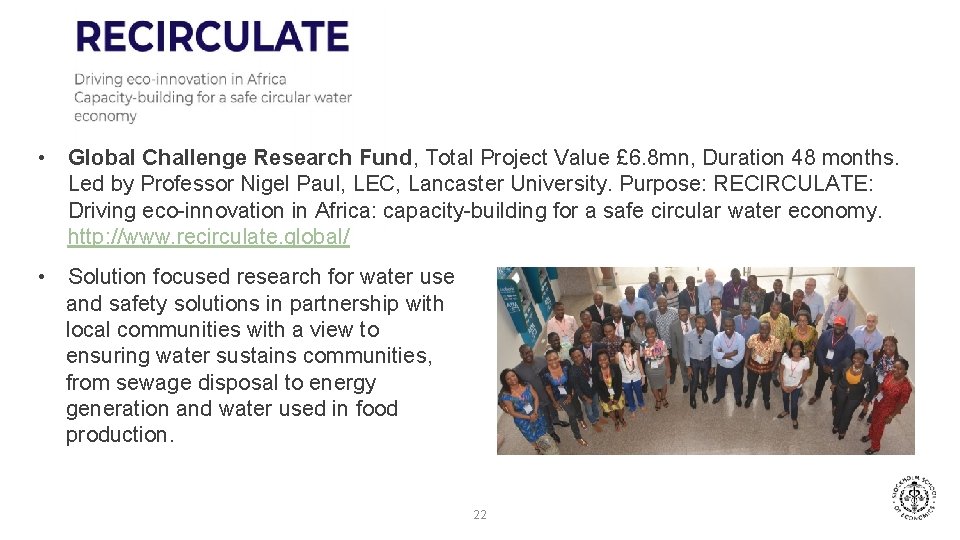
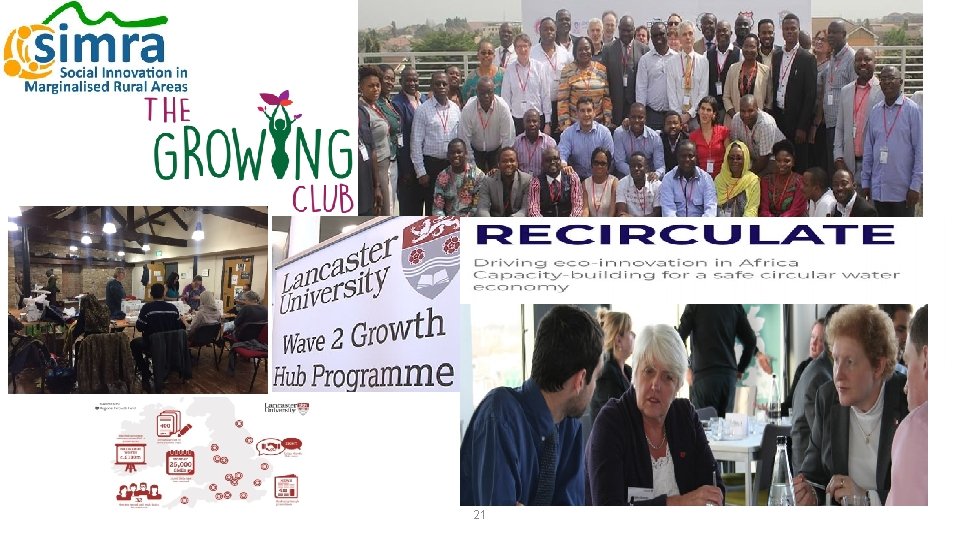
• Global Challenge Research Fund, Total Project Value £ 6. 8 mn, Duration 48 months. Led by Professor Nigel Paul, LEC, Lancaster University. Purpose: RECIRCULATE: Driving eco-innovation in Africa: capacity-building for a safe circular water economy. http: //www. recirculate. global/ • Solution focused research for water use and safety solutions in partnership with local communities with a view to ensuring water sustains communities, from sewage disposal to energy generation and water used in food production. 22
• Horizon 2020, Total Project Value (circa) 6 million Euros (Jack with Alkhaled = 180, 000 Euros), Duration 48 months Purpose: social innovation in marginalised and rural areas. 26 European partners (led by Professor Maria Nijnik, James Hutton Institute, Aberdeen, UK). Leading work on Innovation Actions through the delivery of social innovation on the ground, http: //www. simra-h 2020. eu/. • SIMRA seeks to advance understanding of social innovation and innovative governance in agriculture, forestry and rural development, and how to boost them, particularly in marginalised rural areas across Europe http: //www. simrah 2020. eu/intranet/wp-content/uploads/filebase/Shared-Documents/brochure/Brochure -English. pdf. 23
INNOVATIVE ACTIONS ALKHALED • Assisting socially disadvantaged women in developing successful business initiatives • Not-for-Profit organisation (start-up 2016) http: //thegrowingclub. co. uk/ • 12 month business growth programme • Focus on women entrepreneurs • 1 st stage = the sowing club aimed at building basic understanding and confidence • 2 nd stage = the growing club aimed at building growth 24
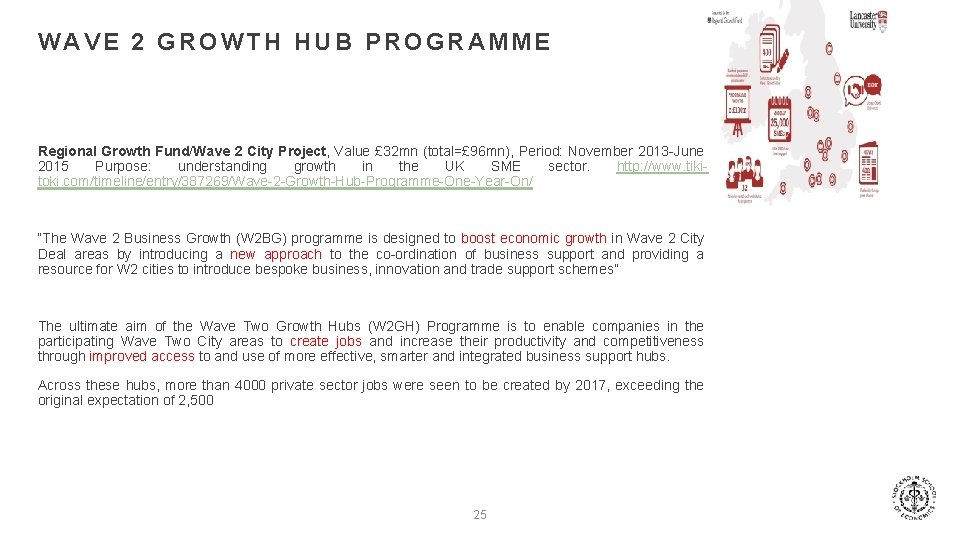
WAVE 2 GROWTH HUB PROGRAMME Regional Growth Fund/Wave 2 City Project, Value £ 32 mn (total=£ 96 mn), Period: November 2013 -June 2015 Purpose: understanding growth in the UK SME sector. http: //www. tikitoki. com/timeline/entry/387269/Wave-2 -Growth-Hub-Programme-One-Year-On/ “The Wave 2 Business Growth (W 2 BG) programme is designed to boost economic growth in Wave 2 City Deal areas by introducing a new approach to the co-ordination of business support and providing a resource for W 2 cities to introduce bespoke business, innovation and trade support schemes” The ultimate aim of the Wave Two Growth Hubs (W 2 GH) Programme is to enable companies in the participating Wave Two City areas to create jobs and increase their productivity and competitiveness through improved access to and use of more effective, smarter and integrated business support hubs. Across these hubs, more than 4000 private sector jobs were seen to be created by 2017, exceeding the original expectation of 2, 500 25
IMPACT CASES: • The UKs Research Excellence Framework was the first exercise to assess the impact of research outside of academia. Impact was defined as ‘an effect on, change or benefit to the economy, society, culture, public policy or services, health, the environment or quality of life, beyond academia’ ICS rated ‘outstanding’/4* impact cases for LUMS, 2 of these were from the Department of Entrepreneurship, Strategy and Innovation: • • 05 Forecasting accuracy – NFP 07 Improving Mental Capacity 09 Technology focused SMEs 12 LEADr Programme • Here’s a link to the REF website where all Impact Case Studies can be viewed: • Results & submissions : REF 2014 : View results and submissions by UOA • Here’s a link to the ICS’ 09 and 12 http: //results. ref. ac. uk/Submissions/Impact/1760
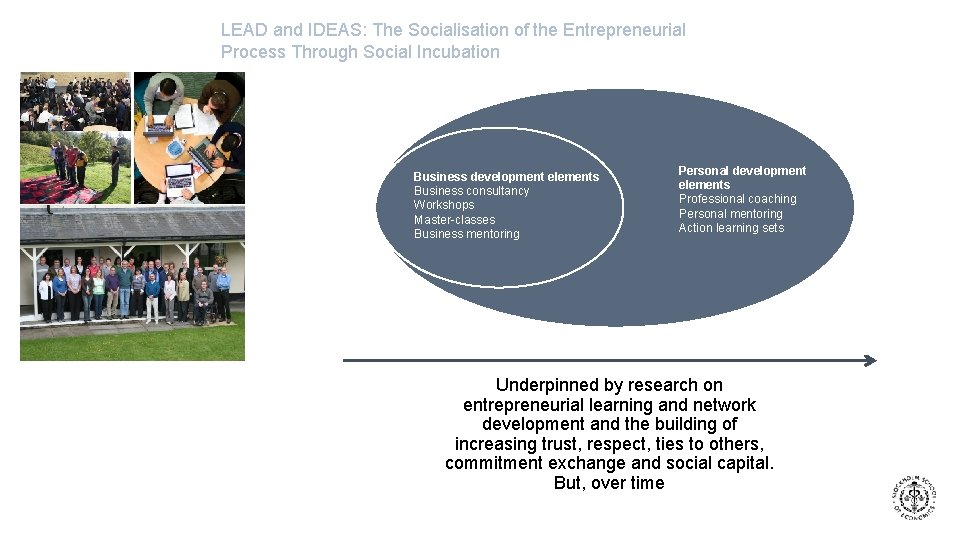
LEAD and IDEAS: The Socialisation of the Entrepreneurial Process Through Social Incubation Business development elements Business development Business consultancy elements Workshops Business consultancy Master-classes Workshops Business mentoring Master-classes Business mentoring Personal development elements Professional coaching Personal mentoring Action learning sets Underpinned by research on entrepreneurial learning and network development and the building of increasing trust, respect, ties to others, commitment exchange and social capital. But, over time
LEAD: STIMULATING LONG-TERM GROWTH IN UK SMES: THE LEAD® PROGRAMME (HAMILTON, GEORGE, FOGG, GORDON AND SMITH). • supported skills development, created jobs and informed a successful £ 32 million Regional Growth Fund bid to support business growth in 20 UK cities • Informed by research on the ‘critical reflection’ of incidents, in one’s own business to ‘trigger’ learning, and the integrated learning model. • LEAD syllabus, especially action learning, shadowing and exchanges help to replicate important ‘lived experience’ and reflective factors. • Business owners supported by a virtual learning environment to reinforce peer-to-peer learning. • entrepreneurial learning can be activated in social practice. • This dynamic iterative dialogue between researchers and SME owners underpins the sustained development of LEAD
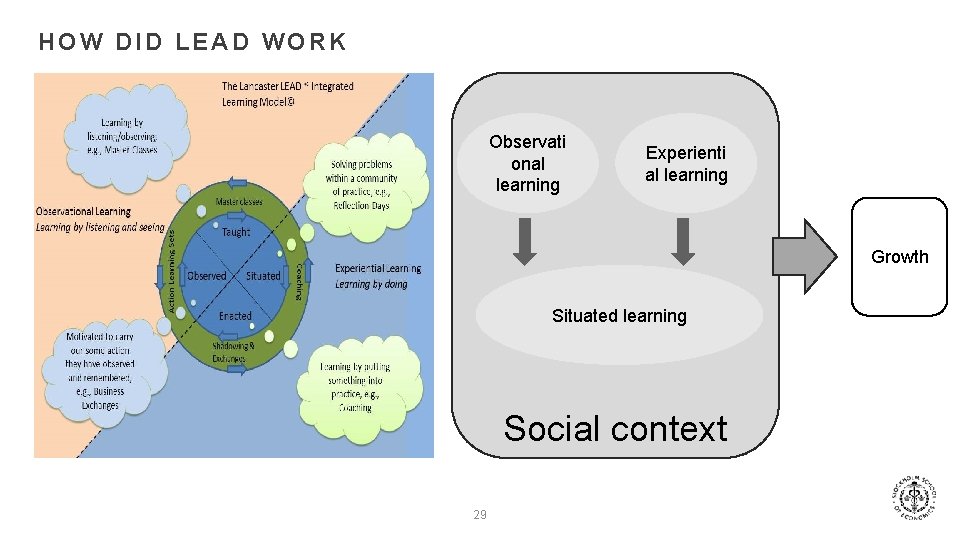
HOW DID LEAD WORK Observati onal learning Experienti al learning Growth Situated learning Social context 29
THIS ENTAILED: LEAD programme combined: • Experiential • Master classes - given by ‘inspiring speakers’. • Shadowing exchanges - participants observe and reflect on the behaviour of their partner in their place of work. • Coaching - participants work with an experienced, professional business coach in a series of one-to-one sessions. • Action learning - six sessions in facilitated subgroups of six to eight peers who meet to discuss personal business issues or challenges in a trusting environment. • Online Forum - to support delegates learning, share knowledge, arrange exchanges and call upon advice from their fellow delegates. 30
OUTCOMES AND EFFECTS Business outcomes: Leadership and intermediate effects: • • Virtually every participant said that LEAD had developed their leadership. • A third of participants indicated that LEAD improved their confidence, reinforced existing beliefs and provided a better understanding of leadership and new skills/ frameworks • Many participants have undertaken a change in their business structure following LEAD. • Virtually all participants have undertaken changes in management, with over half indicating that they had appointed a business manager since joining LEAD. • Across all businesses, the mean annual increase in sales was £ 105, 000, a growth rate of 3. 5% a year and, for those experiencing an increase in turnover, the mean sales increase was about £ 360, 000 a year, of which £ 135, 000 (37. 5%) is attributable to LEAD. Around half of survey respondents report an increase in employment. Across all businesses, the annual growth rate in jobs due to LEAD is 3. 6%. • Three-quarters of participants’ annual labour productivity improved by £ 8, 800 (average). • LEAD participants added about £ 11 m in net sales per annum in 2004 -11, of which about £ 7. 5 m a year is attributable to LEAD, adding 300 jobs to the region. 31
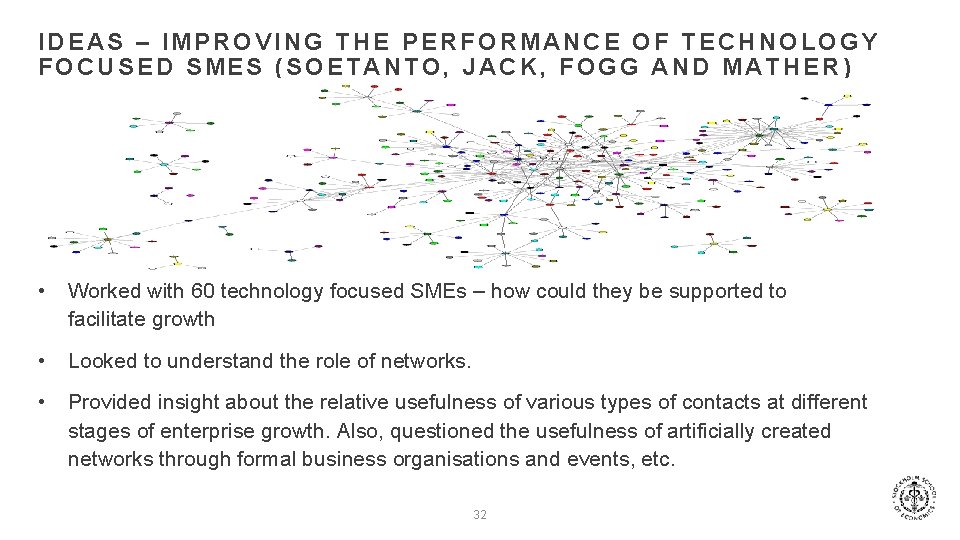
IDEAS – IMPROVING THE PERFORMANCE OF TECHNOLOGY FOCUSED SMES (SOETANTO, JACK, FOGG AND MATHER) • Worked with 60 technology focused SMEs – how could they be supported to facilitate growth • Looked to understand the role of networks. • Provided insight about the relative usefulness of various types of contacts at different stages of enterprise growth. Also, questioned the usefulness of artificially created networks through formal business organisations and events, etc. 32
IDEAS REVEALED: • Use of strong ties to co-create broad visions for the future and to develop innovations • Propensity of entrepreneurs not to cut ties but rather to transfer them to colleagues • Practice of bringing strong ties inside the organization through advisory, managerial or directorial positions • The Impact: • Supported 60 (target 40) new technology business in the area over 16 months • Jobs created 55 (target 5) • Promoted effective knowledge exchange at interface between SMEs, universities and strategic government-funded science. • Quotes from the ground: • ‘IDEAS is a wonderful example of knowledge exchange in action. We want to see a culture that enables, celebrates and rewards talent and innovation. IDEAS shows how this can be done. ’ • I knew about networks but I didn’t recognise ‘nets’. . . and this notion of heterogeneous and remote and not remote and diverse, it was a very useful exercise to get a good understanding of exactly what a network is. ’ • ‘useful to write things down and draw the nets on paper: normally I would have them in my head but you can’t always connect things immediately, so once you have the pictures in front of you, it’s more obvious. ’ 33
EDUCATION: • What we teach • How we teach • Research led teaching: ‘Research-led teaching reflects and makes use of the teacher’s disciplinary research to benefit student learning and outcomes. ’ (Trowler, P. & Wareham, T. 2008) • So how we package and serve our disciplinary theories, methods, concepts and findings for student learning is critical 34
THREE KEY QUESTIONS: • Why are social relationships and networks critical assets for entrepreneurs? - • Provide the opportunity for knowledge exchange Bring resources, both social and economic Social rather than artificially created are key Co-create visions, innovations and entrepreneurship How can universities support entrepreneurs in a better way? - Provide forums and build opportunities for social learning and bringing together individuals (neutral ground) - Research led opportunities work to support growth and development and ensure things are current - Build and develop students who can operate in a global marketplace • How can we understand entrepreneurship in different contexts? • It is important to bear in mind that entrepreneurship takes place in context • Context shapes entrepreneurship but entrepreneurship can also shape context • Contexts and cultures are different across the World and neither are the same, hence it is important to understand what is happening on the ground – one size does not fit all! This has implications for how we do business and expand in global markets. 35

Thank you Q&A 36
- Slides: 36