
SAR Processing Performance on Cell Processor and Xeon
- Slides: 11
SAR Processing Performance on Cell Processor and Xeon Mark Backues, SET Corporation Uttam Majumder, AFRL/RYAS © 2007 SET Associates Corporation
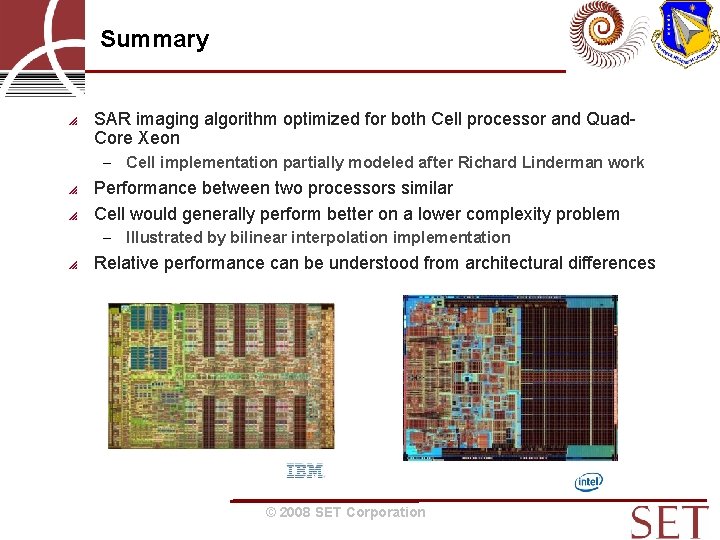
Summary SAR imaging algorithm optimized for both Cell processor and Quad. Core Xeon – Cell implementation partially modeled after Richard Linderman work Performance between two processors similar Cell would generally perform better on a lower complexity problem – Illustrated by bilinear interpolation implementation Relative performance can be understood from architectural differences © 2008 SET Corporation
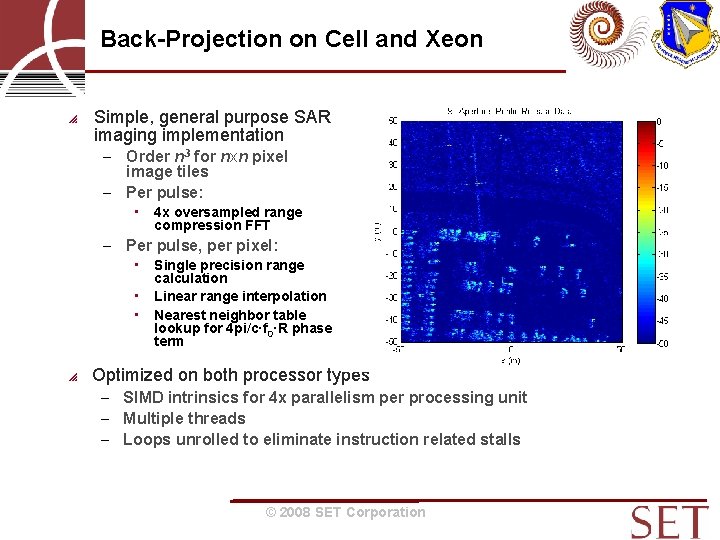
Back-Projection on Cell and Xeon Simple, general purpose SAR imaging implementation – Order n 3 for nxn pixel image tiles – Per pulse: • 4 x oversampled range compression FFT – Per pulse, per pixel: • Single precision range calculation • Linear range interpolation • Nearest neighbor table lookup for 4 pi/c·f 0·R phase term Optimized on both processor types – SIMD intrinsics for 4 x parallelism per processing unit – Multiple threads – Loops unrolled to eliminate instruction related stalls © 2008 SET Corporation
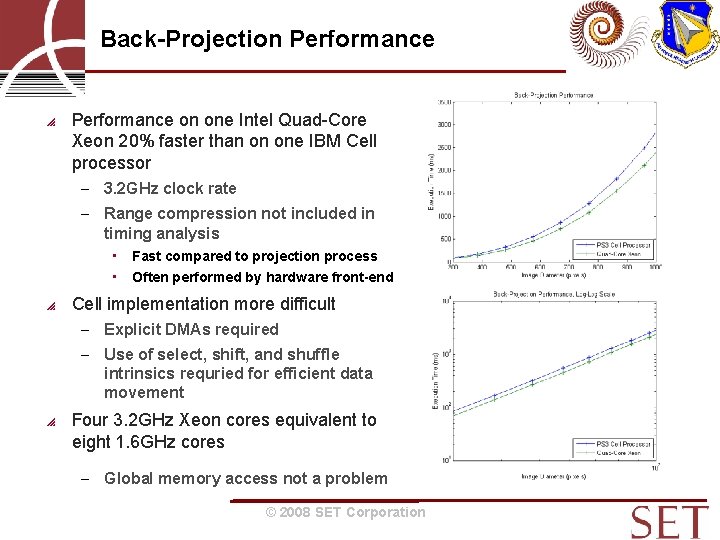
Back-Projection Performance on one Intel Quad-Core Xeon 20% faster than on one IBM Cell processor – 3. 2 GHz clock rate – Range compression not included in timing analysis • Fast compared to projection process • Often performed by hardware front-end Cell implementation more difficult – Explicit DMAs required – Use of select, shift, and shuffle intrinsics requried for efficient data movement Four 3. 2 GHz Xeon cores equivalent to eight 1. 6 GHz cores – Global memory access not a problem © 2008 SET Corporation
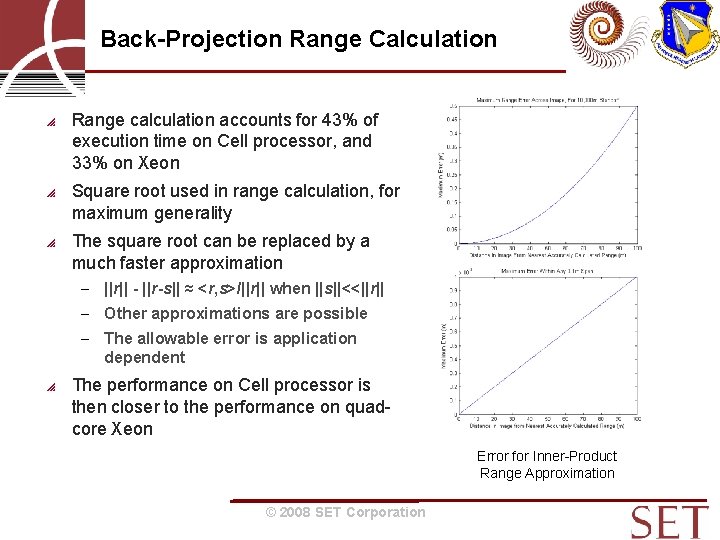
Back-Projection Range Calculation Range calculation accounts for 43% of execution time on Cell processor, and 33% on Xeon Square root used in range calculation, for maximum generality The square root can be replaced by a much faster approximation – ||r|| - ||r-s|| ≈ <r, s>/||r|| when ||s||<<||r|| – Other approximations are possible – The allowable error is application dependent The performance on Cell processor is then closer to the performance on quadcore Xeon Error for Inner-Product Range Approximation © 2008 SET Corporation
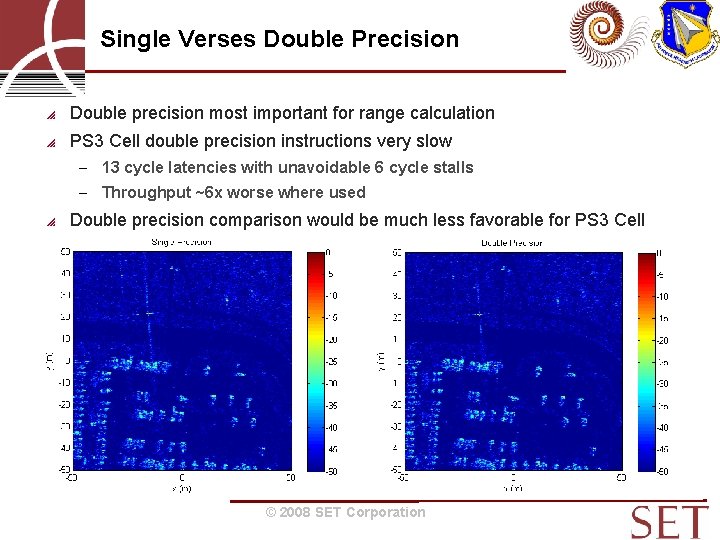
Single Verses Double Precision Double precision most important for range calculation PS 3 Cell double precision instructions very slow – 13 cycle latencies with unavoidable 6 cycle stalls – Throughput ~6 x worse where used Double precision comparison would be much less favorable for PS 3 Cell © 2008 SET Corporation
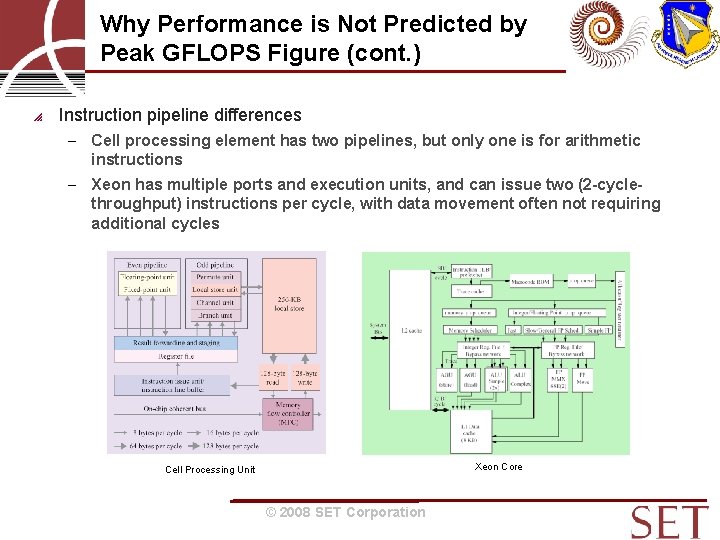
Why Performance is Not Predicted by Peak GFLOPS Figure (cont. ) Instruction pipeline differences – Cell processing element has two pipelines, but only one is for arithmetic instructions – Xeon has multiple ports and execution units, and can issue two (2 -cyclethroughput) instructions per cycle, with data movement often not requiring additional cycles Xeon Core Cell Processing Unit © 2008 SET Corporation
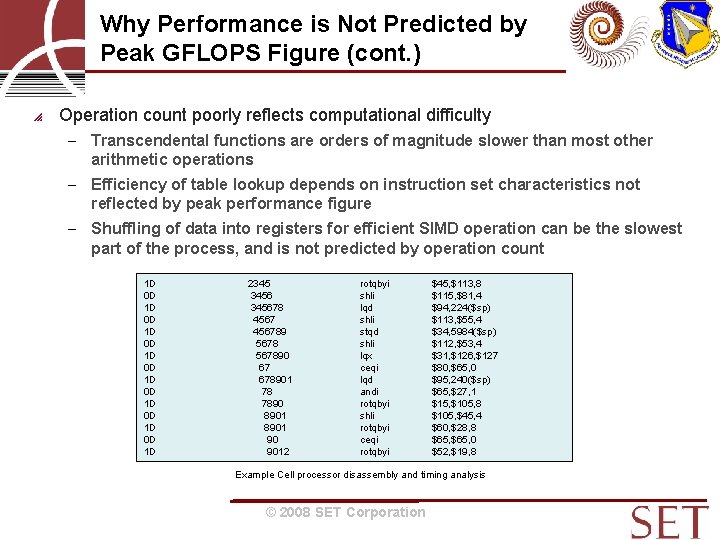
Why Performance is Not Predicted by Peak GFLOPS Figure (cont. ) Operation count poorly reflects computational difficulty – Transcendental functions are orders of magnitude slower than most other arithmetic operations – Efficiency of table lookup depends on instruction set characteristics not reflected by peak performance figure – Shuffling of data into registers for efficient SIMD operation can be the slowest part of the process, and is not predicted by operation count 1 D 0 D 1 D 0 D 1 D 2345 3456789 567890 67 678901 78 7890 8901 90 9012 rotqbyi shli lqd shli stqd shli lqx ceqi lqd andi rotqbyi shli rotqbyi ceqi rotqbyi $45, $113, 8 $115, $81, 4 $94, 224($sp) $113, $55, 4 $34, 5984($sp) $112, $53, 4 $31, $126, $127 $80, $65, 0 $95, 240($sp) $65, $27, 1 $15, $105, 8 $105, $45, 4 $60, $28, 8 $65, 0 $52, $19, 8 Example Cell processor disassembly and timing analysis © 2008 SET Corporation
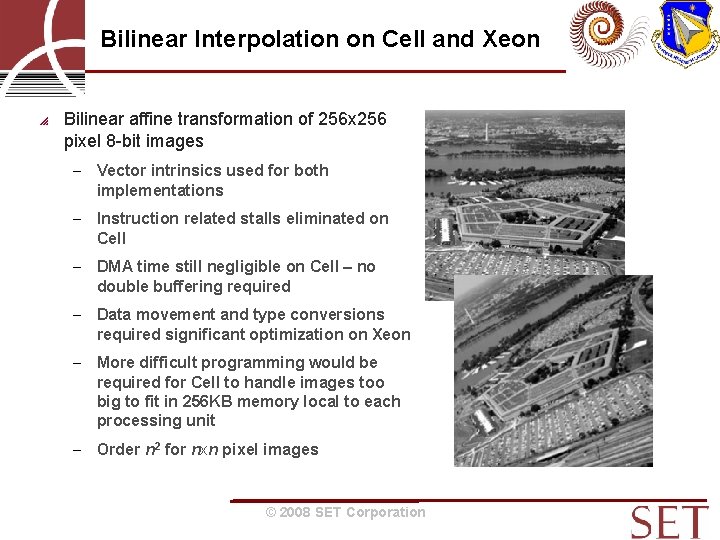
Bilinear Interpolation on Cell and Xeon Bilinear affine transformation of 256 x 256 pixel 8 -bit images – Vector intrinsics used for both implementations – Instruction related stalls eliminated on Cell – DMA time still negligible on Cell – no double buffering required – Data movement and type conversions required significant optimization on Xeon – More difficult programming would be required for Cell to handle images too big to fit in 256 KB memory local to each processing unit – Order n 2 for nxn pixel images © 2008 SET Corporation
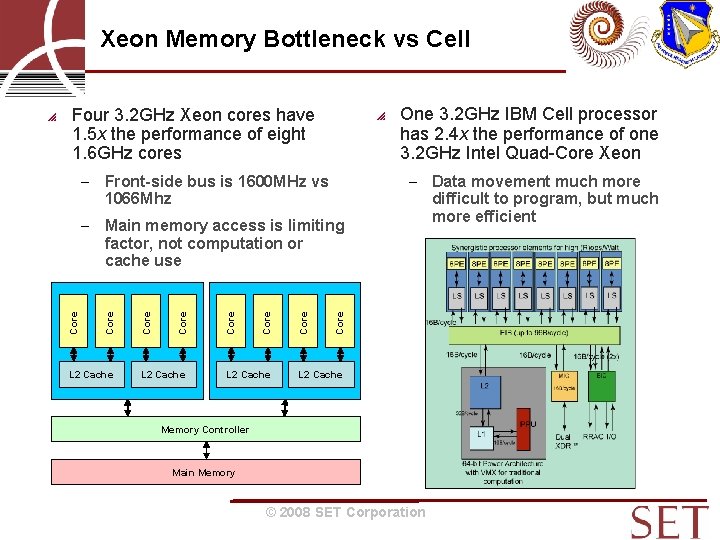
Xeon Memory Bottleneck vs Cell Four 3. 2 GHz Xeon cores have 1. 5 x the performance of eight 1. 6 GHz cores – Front-side bus is 1600 MHz vs 1066 Mhz L 2 Cache One 3. 2 GHz IBM Cell processor has 2. 4 x the performance of one 3. 2 GHz Intel Quad-Core Xeon – Data movement much more difficult to program, but much more efficient Core Core – Main memory access is limiting factor, not computation or cache use Core L 2 Cache Memory Controller Main Memory © 2008 SET Corporation
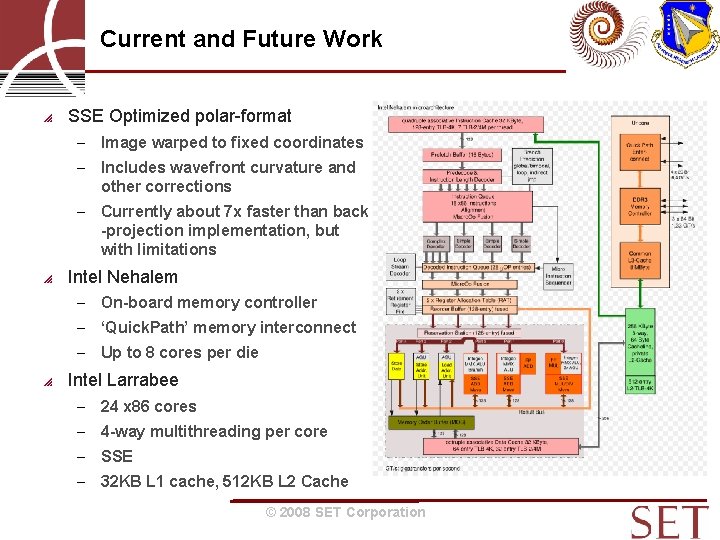
Current and Future Work SSE Optimized polar-format – Image warped to fixed coordinates – Includes wavefront curvature and other corrections – Currently about 7 x faster than back -projection implementation, but with limitations Intel Nehalem – On-board memory controller – ‘Quick. Path’ memory interconnect – Up to 8 cores per die Intel Larrabee – 24 x 86 cores – 4 -way multithreading per core – SSE – 32 KB L 1 cache, 512 KB L 2 Cache © 2008 SET Corporation