
SANT TUKARAM VIDYALAYA DEHU Std 9 th Sub

SANT TUKARAM VIDYALAYA, DEHU Std: - 9 th Sub: - Science and Technology
14. ENERGY : THE DRIVING FORCE • • 14. 1 14. 2 14. 3 14. 4 Work Energy Law of Conservation of Energy Power
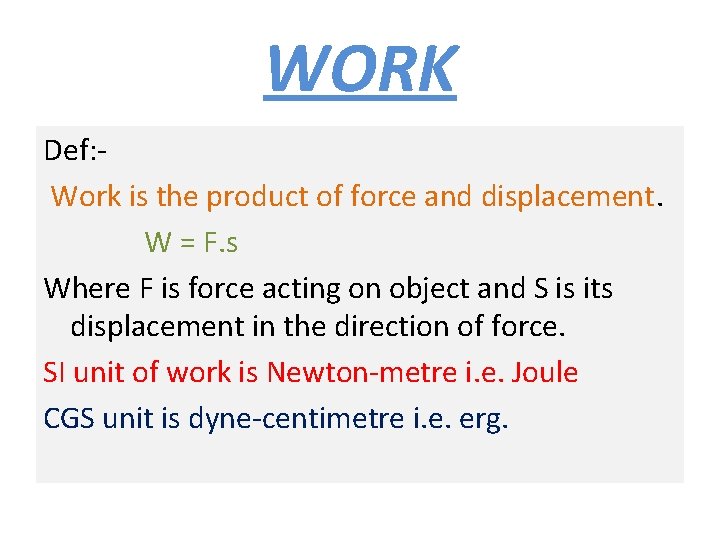
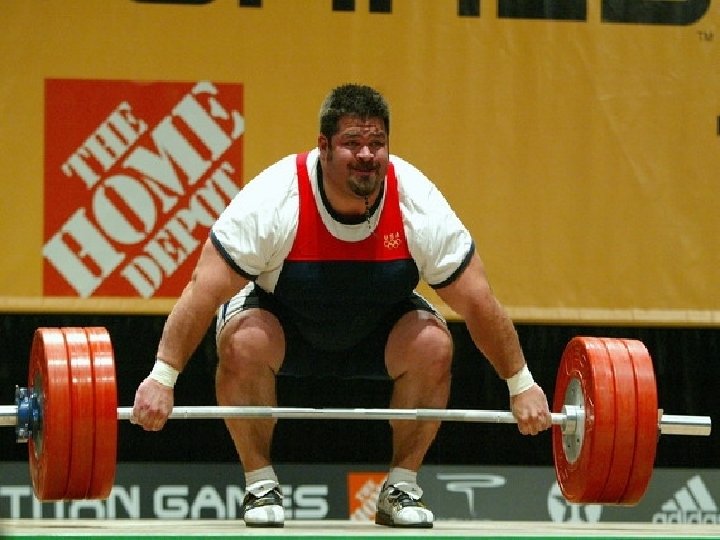
WORK Def: Work is the product of force and displacement. W = F. s Where F is force acting on object and S is its displacement in the direction of force. SI unit of work is Newton-metre i. e. Joule CGS unit is dyne-centimetre i. e. erg.
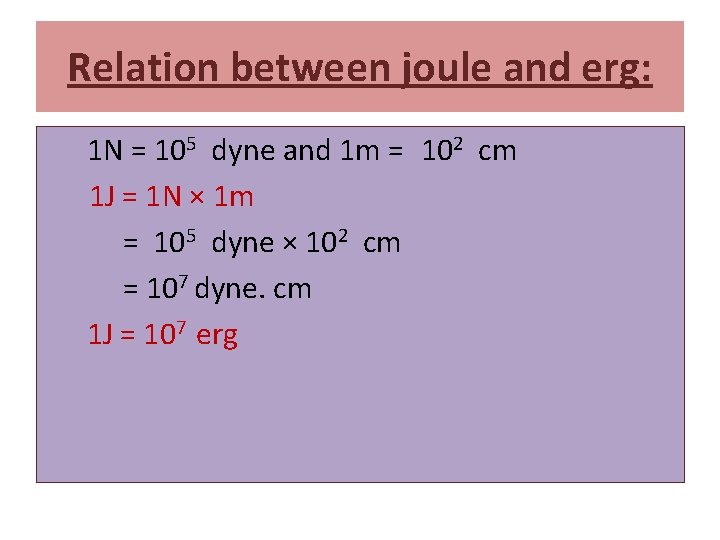
Relation between joule and erg: 1 N = 105 dyne and 1 m = 102 cm 1 J = 1 N × 1 m = 105 dyne × 102 cm = 107 dyne. cm 1 J = 107 erg
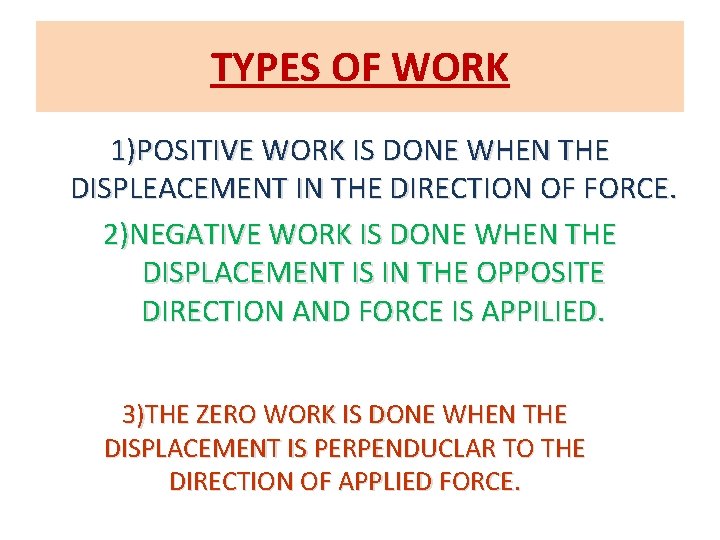
TYPES OF WORK 1)POSITIVE WORK IS DONE WHEN THE DISPLEACEMENT IN THE DIRECTION OF FORCE. 2)NEGATIVE WORK IS DONE WHEN THE DISPLACEMENT IS IN THE OPPOSITE DIRECTION AND FORCE IS APPILIED. 3)THE ZERO WORK IS DONE WHEN THE DISPLACEMENT IS PERPENDUCLAR TO THE DIRECTION OF APPLIED FORCE.
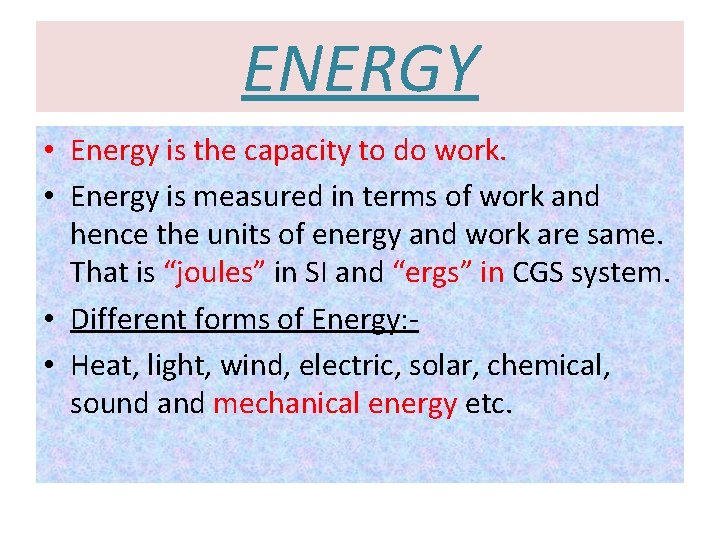
ENERGY • Energy is the capacity to do work. • Energy is measured in terms of work and hence the units of energy and work are same. That is “joules” in SI and “ergs” in CGS system. • Different forms of Energy: • Heat, light, wind, electric, solar, chemical, sound and mechanical energy etc.

Forms of Mechanical Energy Kinetic Energy Potential Energy • Examples: • When a fast moving cricket ball hits stationary stumps, they are thrown away. • You require less energy to swim in the river in the direction of flow of water whereas you require more energy to swim against the direction of flow of water. • Examples: • A toy moves some distance if we wind the key given for charging of the spiral spring connected to wheels of the toy. • Water cannot flow from well to overhead tank on its own. You have to use machine for it. But water flow from overhead tank to ground level tap on its own.
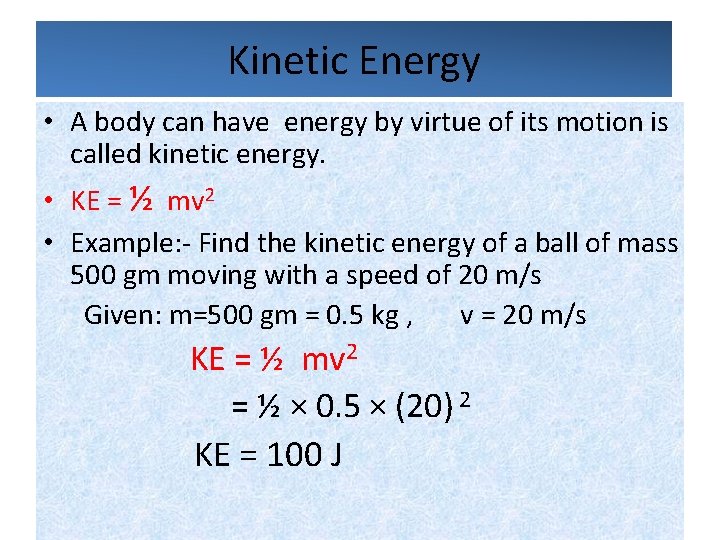
Kinetic Energy • A body can have energy by virtue of its motion is called kinetic energy. • KE = ½ mv 2 • Example: - Find the kinetic energy of a ball of mass 500 gm moving with a speed of 20 m/s Given: m=500 gm = 0. 5 kg , v = 20 m/s KE = ½ mv 2 = ½ × 0. 5 × (20) 2 KE = 100 J
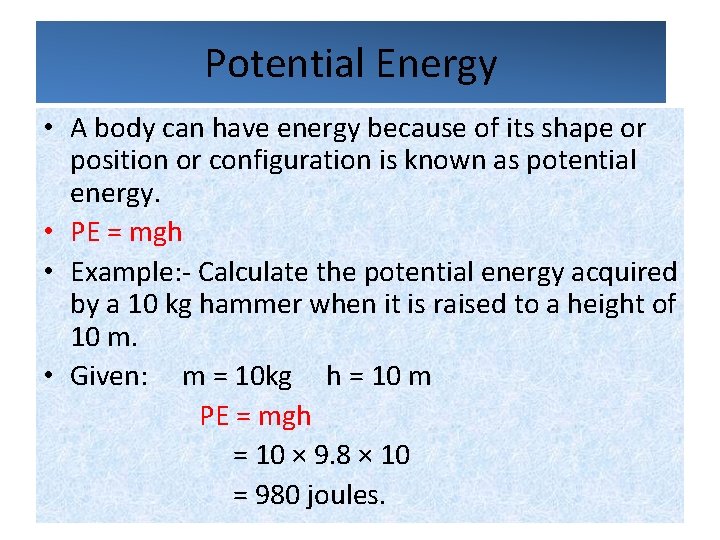
Potential Energy • A body can have energy because of its shape or position or configuration is known as potential energy. • PE = mgh • Example: - Calculate the potential energy acquired by a 10 kg hammer when it is raised to a height of 10 m. • Given: m = 10 kg h = 10 m PE = mgh = 10 × 9. 8 × 10 = 980 joules.
LAW OF CONVERSION OF ENERGY IN THE LAW OF CONVERSION OF ENERGY THERE VERIOUS ENERGY’S LIKE HEAT, ELECTRICAL, SOLAR, CHEMICAL, NUCLIAR ENERGY.
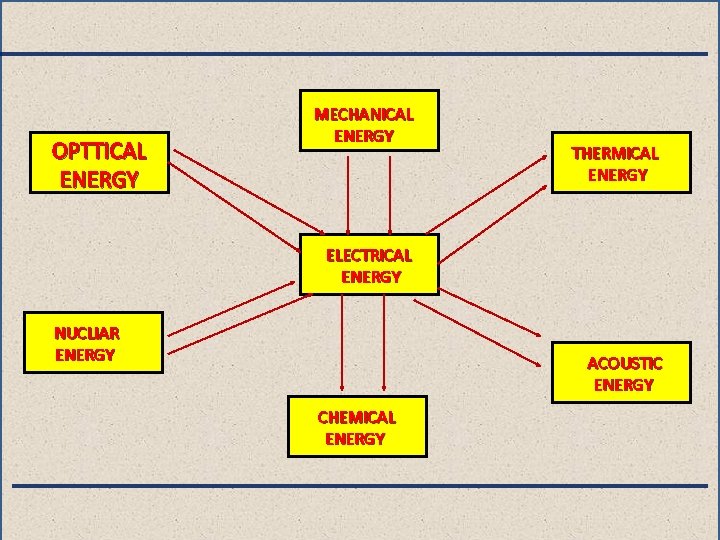
OPTTICAL ENERGY MECHANICAL ENERGY THERMICAL ENERGY ELECTRICAL ENERGY NUCLIAR ENERGY ACOUSTIC ENERGY CHEMICAL ENERGY
Law of Conservation of Energy • Energy can neither be created nor be destroyed. It can be converted from one form to another. The total amount of energy in the universe remains constant. • The sum of various energies in the universe remains constant. When there is transformation of energy from one form to the other form, the total energy remains conserved.
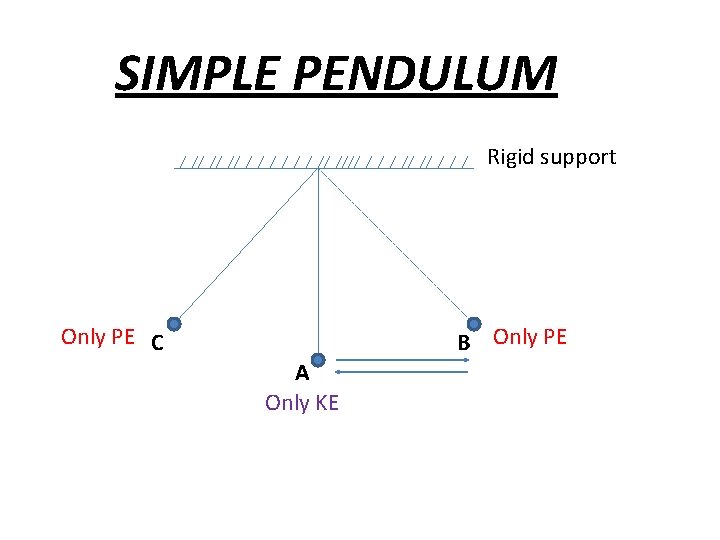
SIMPLE PENDULUM Rigid support Only PE C B Only PE A Only KE
1)IN AN SIMPLE PENDULUM THERE IS KINETIC ENERGY AND POTENTIAL ENERGY. 2)WHEN THE PENDULAM IS IN THE POSITION A THERE IS A KINETIC ENERGY. 3)WHEN THE PENDULUM IS IN THE POSITION B THERE IS A POTENTIAL ENERGY.
POWER • Power is rate of doing work. • Power = Work/Time = w/t The unit of Power is ‘Watt’. 1 watt = 1 Joule/Sec 1 k. W = 1000 Watt Power is measured in a unit called horse power. 1 hp = 746 Watts.
Created by Mrs. Kadam B. V. B. Sc. B. Ed
- Slides: 17