
Sanitation and Health NEGROS WATER SUMMIT February 27
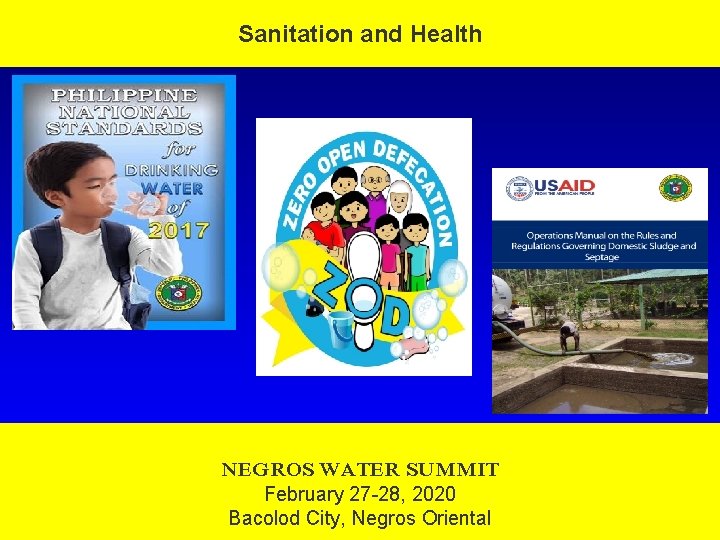
Sanitation and Health NEGROS WATER SUMMIT February 27 -28, 2020 Bacolod City, Negros Oriental

DOH-Environmental Sanitation Program GOALS : • To decrease the morbidity and mortality secondary to food, water and sanitation - related diseases in the country. • To ensure and promote safe drinking water to all. • To promote hygienic and proper management of human excreta and domestic waste water.
OBJECTIVES : • Increase awareness on environmental health to ensure behavior change. • Advocate and further influence policy makers from national, regional and local level. • Strengthen technical assistance to DOH Regional Offices. • Ensure the effective and proper implementation of the Sanitation Code and other environmental sanitation policies. • Strengthen monitoring and evaluation. • Develop, implement and effectively enforce guidelines and standards.
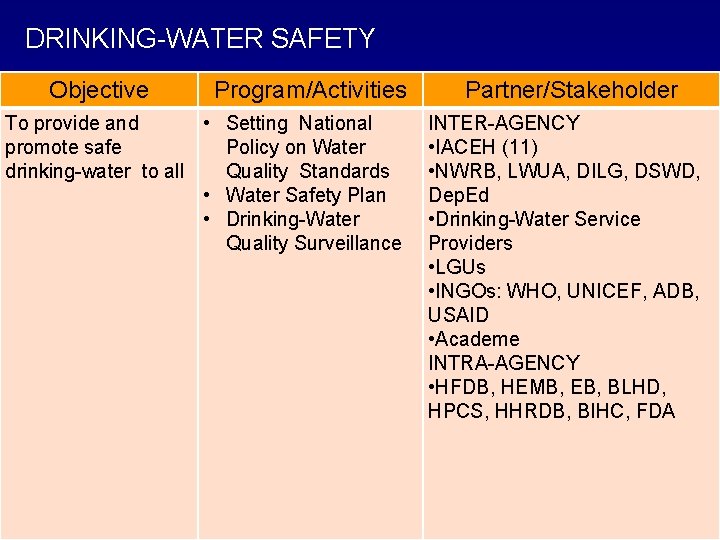
DRINKING-WATER SAFETY Objective Program/Activities To provide and • Setting National promote safe Policy on Water drinking-water to all Quality Standards • Water Safety Plan • Drinking-Water Quality Surveillance Partner/Stakeholder INTER-AGENCY • IACEH (11) • NWRB, LWUA, DILG, DSWD, Dep. Ed • Drinking-Water Service Providers • LGUs • INGOs: WHO, UNICEF, ADB, USAID • Academe INTRA-AGENCY • HFDB, HEMB, EB, BLHD, HPCS, HHRDB, BIHC, FDA
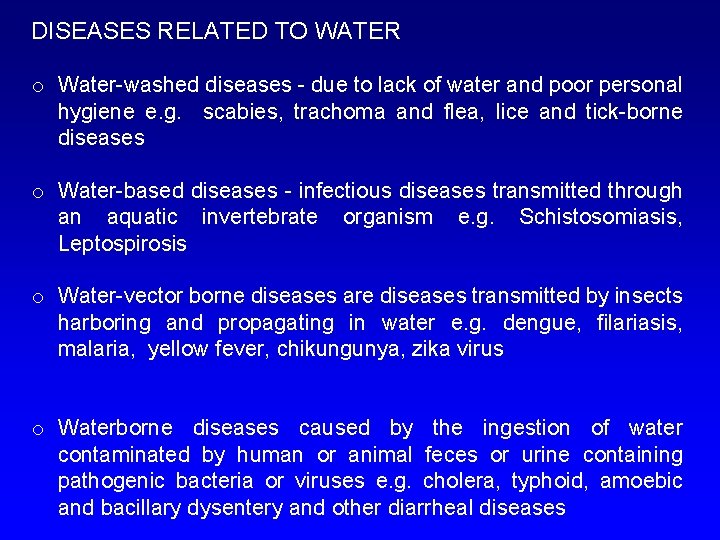
DISEASES RELATED TO WATER o Water-washed diseases - due to lack of water and poor personal hygiene e. g. scabies, trachoma and flea, lice and tick-borne diseases o Water-based diseases - infectious diseases transmitted through an aquatic invertebrate organism e. g. Schistosomiasis, Leptospirosis o Water-vector borne diseases are diseases transmitted by insects harboring and propagating in water e. g. dengue, filariasis, malaria, yellow fever, chikungunya, zika virus o Waterborne diseases caused by the ingestion of water contaminated by human or animal feces or urine containing pathogenic bacteria or viruses e. g. cholera, typhoid, amoebic and bacillary dysentery and other diarrheal diseases
WATER SUPPLY SANITATION o Water supply sanitation is one of the top priority activities in the field of Environmental Sanitation. o In the local health setting, it is the responsibilities of the Sanitation Inspector (SI) to safeguard the quality of drinking water of their constituents. o To ensure the quality of drinking water is fit for human consumption at all times by having an effective water quality surveillance program.
DOH Mandate and Policies on Water • PD 856 – Sanitation Code of the Philippines and its Implementing Rules and Regulations (IRRs)/Supplemental IRRs • DOH AO 2014 -0027 dated September 4, 2014 – National Policy on Water Safety Plan (WSP) for all Drinking Water Service Provider. The Plan ensure the safety of drinking water through the use of a comprehensive risk assessment and risk management approach that encompasses all steps in water supply from catchment to consumer. • AO 2017 -0006 dated April 20, 2017 – Guidelines for the Review and Approval of Water Safety Plans of Drinking Water Service Providers • AO 2017 -0010 dated June 23, 2017 – Philippine National Standards for Drinking Water of 2017. This Order prescribe the standards and procedures on drinking water quality to protect public/consumer’s health.
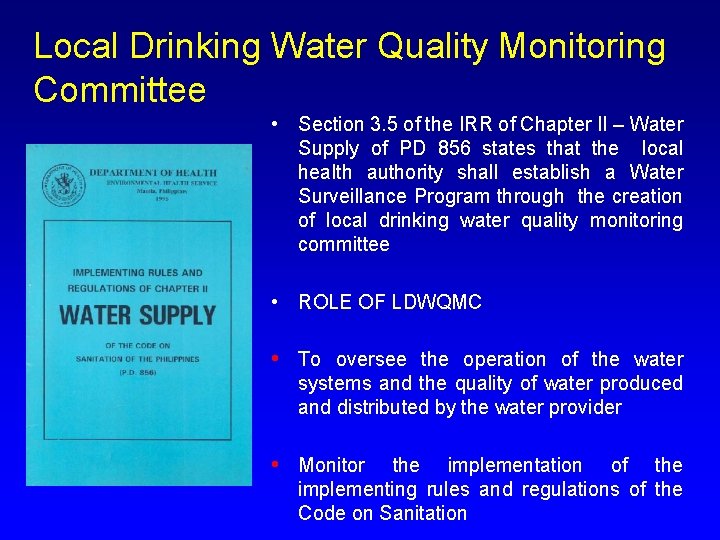
Local Drinking Water Quality Monitoring Committee • Section 3. 5 of the IRR of Chapter II – Water Supply of PD 856 states that the local health authority shall establish a Water Surveillance Program through the creation of local drinking water quality monitoring committee • ROLE OF LDWQMC • To oversee the operation of the water systems and the quality of water produced and distributed by the water provider • Monitor the implementation of the implementing rules and regulations of the Code on Sanitation
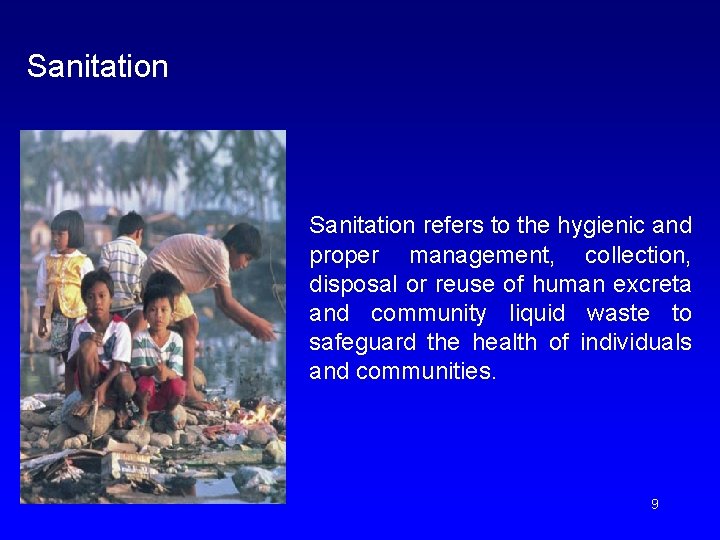
Sanitation refers to the hygienic and proper management, collection, disposal or reuse of human excreta and community liquid waste to safeguard the health of individuals and communities. 9
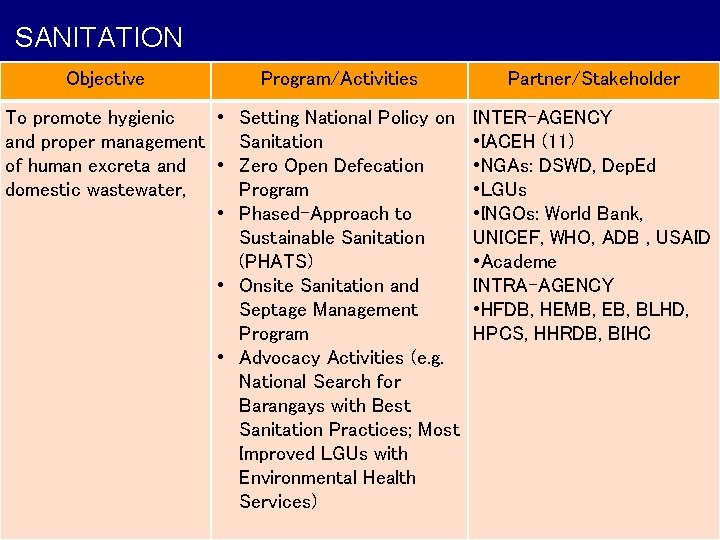
SANITATION Objective Program/Activities To promote hygienic • Setting National Policy on and proper management Sanitation of human excreta and • Zero Open Defecation domestic wastewater, Program • Phased-Approach to Sustainable Sanitation (PHATS) • Onsite Sanitation and Septage Management Program • Advocacy Activities (e. g. National Search for Barangays with Best Sanitation Practices; Most Improved LGUs with Environmental Health Services) Partner/Stakeholder INTER-AGENCY • IACEH (11) • NGAs: DSWD, Dep. Ed • LGUs • INGOs: World Bank, UNICEF, WHO, ADB , USAID • Academe INTRA-AGENCY • HFDB, HEMB, EB, BLHD, HPCS, HHRDB, BIHC

Excreta Human waste composed of urine and feces Domestic Sewage Wastewater composed of untreated human waste coming from residential and commercial sources. Domestic sewage does not include industrial and/or hazardous wastes. Wastewater composed of raw liquid and solid waste coming from residential and commercial uses
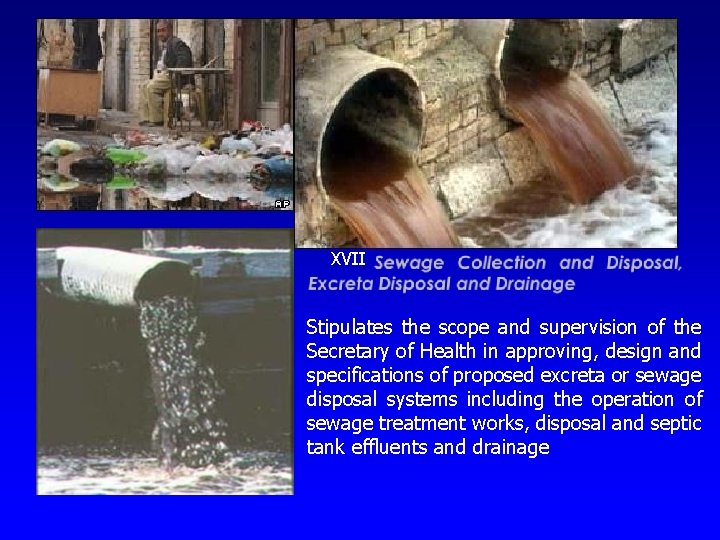
XVII Stipulates the scope and supervision of the Secretary of Health in approving, design and specifications of proposed excreta or sewage disposal systems including the operation of sewage treatment works, disposal and septic tank effluents and drainage
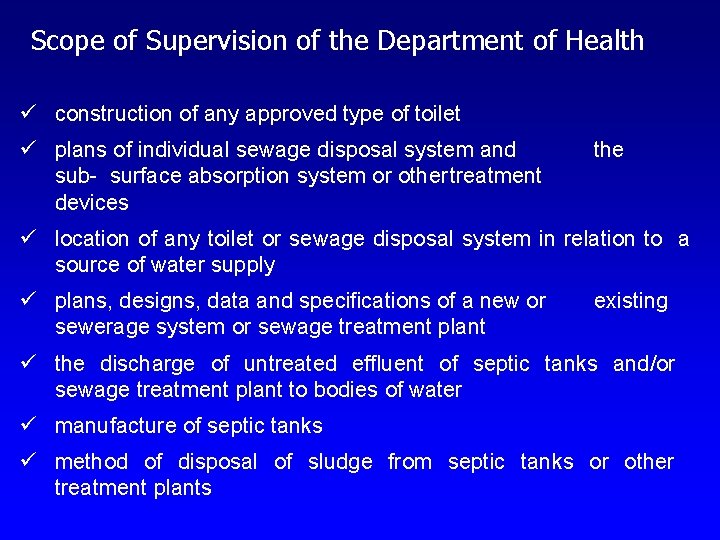
Scope of Supervision of the Department of Health construction of any approved type of toilet plans of individual sewage disposal system and sub- surface absorption system or othertreatment devices the location of any toilet or sewage disposal system in relation to a source of water supply plans, designs, data and specifications of a new or sewerage system or sewage treatment plant existing the discharge of untreated effluent of septic tanks and/or sewage treatment plant to bodies of water manufacture of septic tanks method of disposal of sludge from septic tanks or other treatment plants
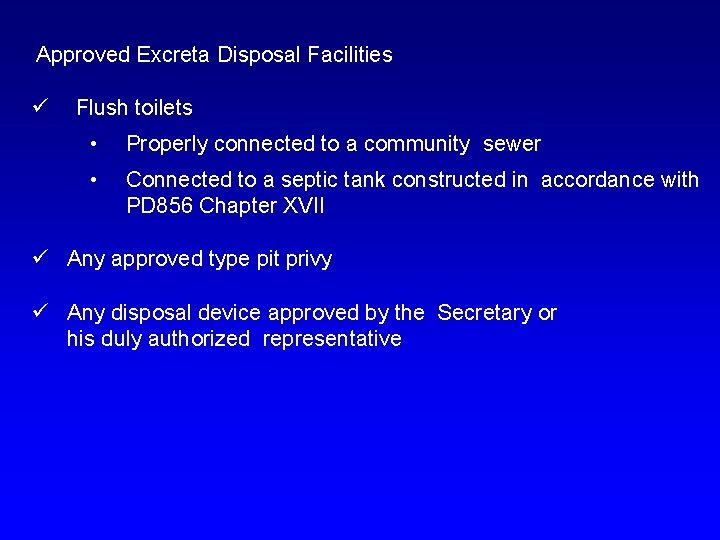
Approved Excreta Disposal Facilities Flush toilets • Properly connected to a community sewer • Connected to a septic tank constructed in accordance with PD 856 Chapter XVII Any approved type pit privy Any disposal device approved by the Secretary or his duly authorized representative
Septic Tanks Where a public sewerage system is not available Minimum requirements of septic tank • Rectangular in shape. The 1 st compartment shall have the capacity from ½ to 2/3 of the total volume of the tank • Built of concrete • Shall NOT be constructed under any building and within 25 m from any source of water supply Disposal of septic tank effluent • Sub-surface soil • Absorption field where applicable • Treated with some type of purification device
Maintenance of Septic Tank 1. Septic tanks shall be cleaned before excessive sludge or scum is allowed to accumulate and seriously reduce the settling efficiency. 2. Septic tank shall be inspected at least once a year and be cleaned when the bottom of the scum is within 3 inches of the bottom of the outlet device or the sludge and scum has reduced the liquid capacity by 50%. 3. A small residual of sludge shall be left in the seeding purposes. tank for
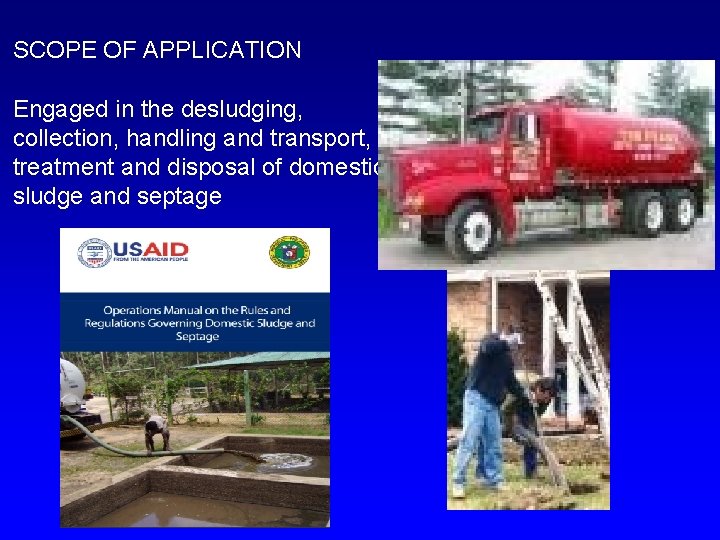
SCOPE OF APPLICATION Engaged in the desludging, collection, handling and transport, treatment and disposal of domestic sludge and septage
ENVIRONMENTAL SANITATION CLEARANCE Environmental Sanitation Clearance (ESC) from the Secretary of Health or the Director of the concerned DOH Center for Health Development (CHD) as his duly authorized representative prior to operation
ENVIRONMENTAL SANITATION CLEARANCE The notarized ESC application shall be filed with the City/Municipal Health Office and then be forwarded to the DOH CHD for validation. The ESC is a prerequisite to the issuance of Sanitary Permit
Local Government Units (LGUs) - City/Municipality o Formulates and legislates ordinances o Receives and reviews notarized ESC application, conducts site inspection and recommends action. o Issues Health Certificate and Sanitary Permit and other permits o Implements the posting of Sanitation Standard Rating Sticker o Revokes the Sanitary Permit of the Operator
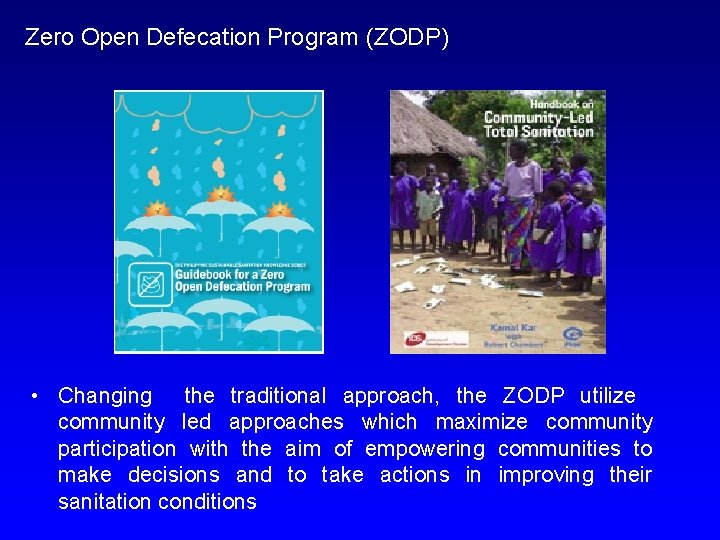
Zero Open Defecation Program (ZODP) • Changing the traditional approach, the ZODP utilize community led approaches which maximize community participation with the aim of empowering communities to make decisions and to take actions in improving their sanitation conditions
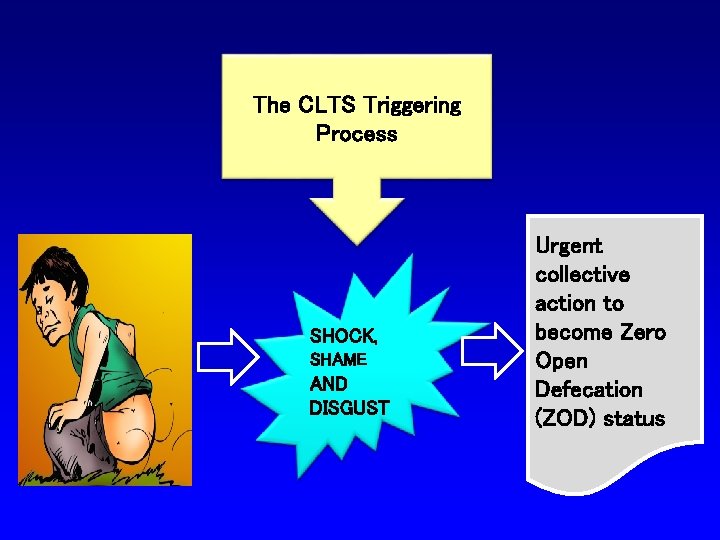
The CLTS Triggering Process SHOCK, SHAME AND DISGUST Urgent collective action to become Zero Open Defecation (ZOD) status
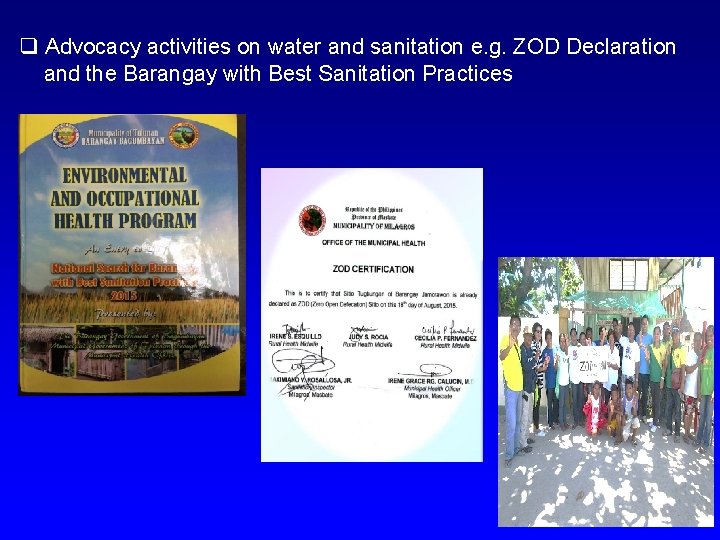
q Advocacy activities on water and sanitation e. g. ZOD Declaration and the Barangay with Best Sanitation Practices
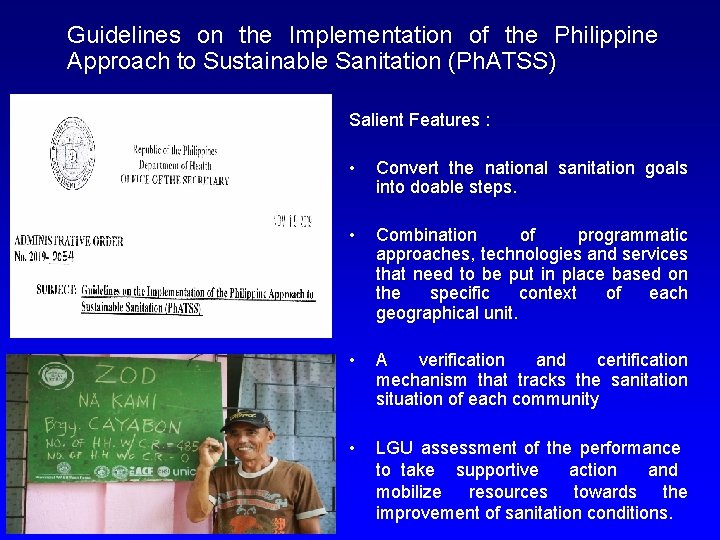
Guidelines on the Implementation of the Philippine Approach to Sustainable Sanitation (Ph. ATSS) Salient Features : • Convert the national sanitation goals into doable steps. • Combination of programmatic approaches, technologies and services that need to be put in place based on the specific context of each geographical unit. • A verification and certification mechanism that tracks the sanitation situation of each community • LGU assessment of the performance to take supportive action and mobilize resources towards the improvement of sanitation conditions.
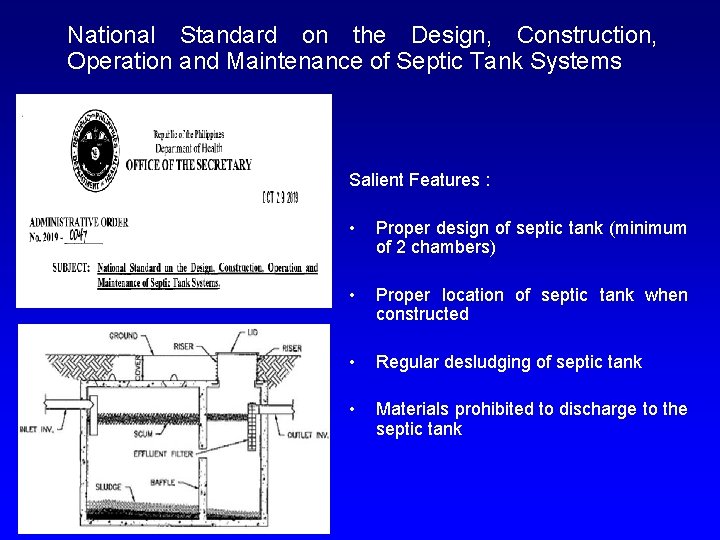
National Standard on the Design, Construction, Operation and Maintenance of Septic Tank Systems Salient Features : • Proper design of septic tank (minimum of 2 chambers) • Proper location of septic tank when constructed • Regular desludging of septic tank • Materials prohibited to discharge to the septic tank
Goal 1: End poverty in all its forms everywhere Goal 2: End hunger, achieve food security and improved nutrition. . . Goal 3: Ensure healthy lives and promote wellbeing for all… Goal 4: Ensure inclusive and equitable quality education. . . Goal 5: Achieve gender equality and empower all women and girls Goal 8: Promote sustained, inclusive and sustainable economic growth. . . Available and sustainably managed WASH underpins the achievement of most SDGs
Engr. Rolando I. Santiago, MMPA, MPH Supervising Health Program Officer Environmental Related Diseases Division Disease Prevention and Control Bureau Department of Health
- Slides: 27