
Sanitary Plate Heat Exchangers Working Principle of a








- Slides: 57
Sanitary Plate Heat Exchangers Working Principle of a Plate Heat Exchanger © Alfa Laval Slide
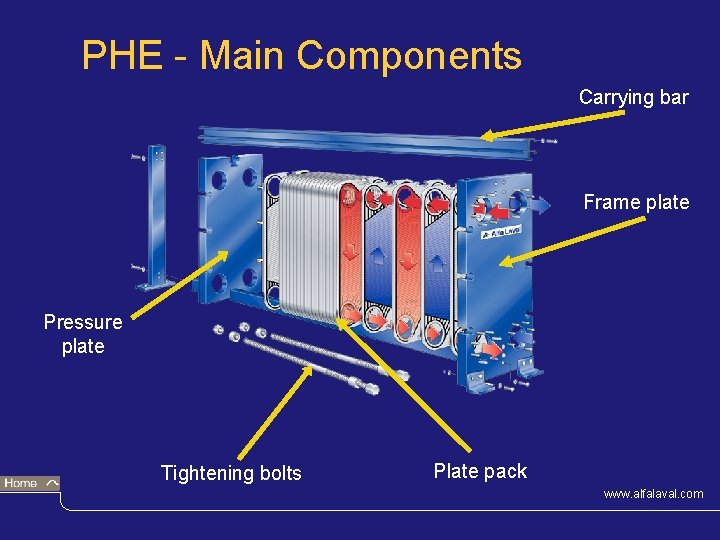
PHE - Main Components Carrying bar Frame plate Pressure plate Plate pack Tightening bolts © Alfa Laval 2 www. alfalaval. com
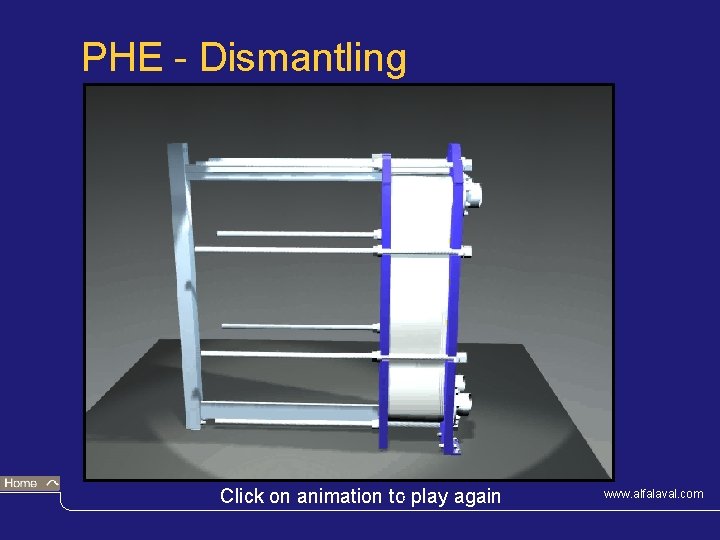
PHE - Dismantling © Alfa Laval Click on animation to 3 play again www. alfalaval. com
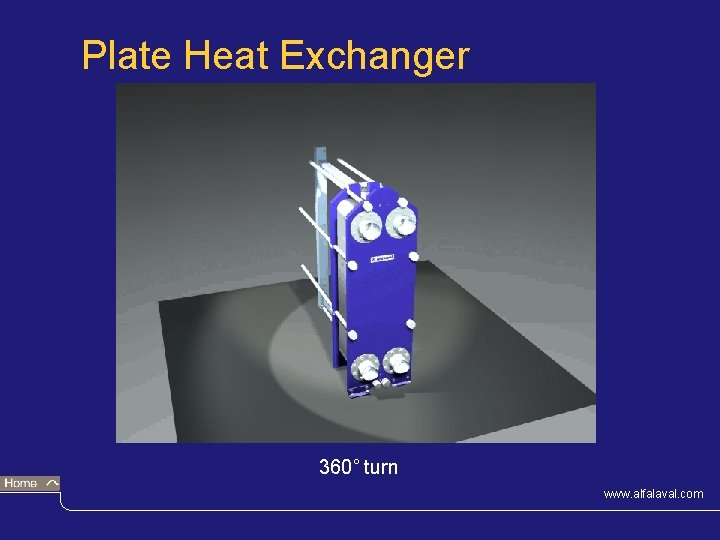
Plate Heat Exchanger 360˚ turn © Alfa Laval 4 www. alfalaval. com
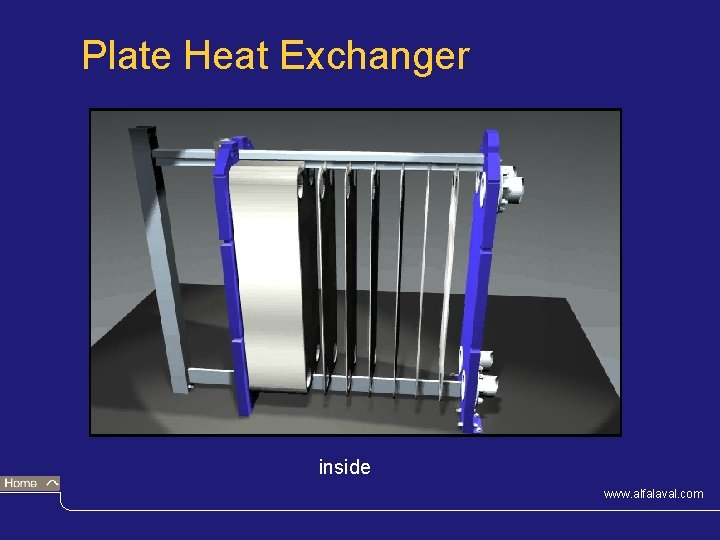
Plate Heat Exchanger inside © Alfa Laval 5 www. alfalaval. com
End Plate I Channel plates End Plate II Plate Pack - Example Single Pass Hot out Cold in Cold out Hot in Only 2 plates that do not transfer heat - the end plates © Alfa Laval 6 www. alfalaval. com
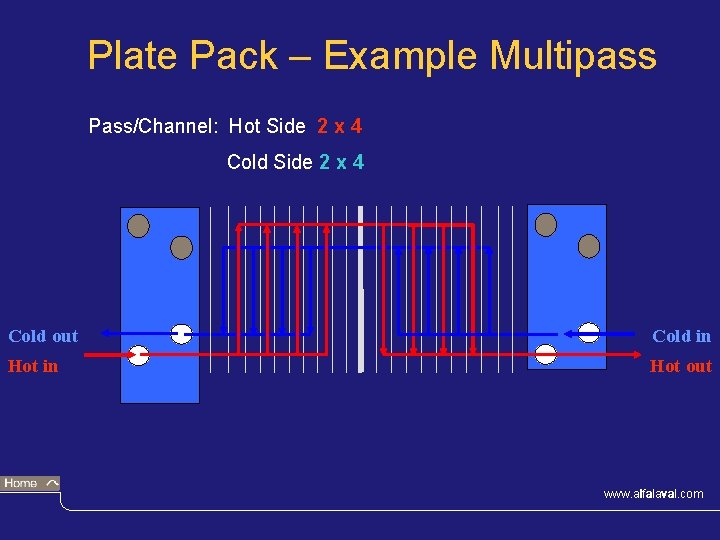
Plate Pack – Example Multipass Pass/Channel: Hot Side 2 x 4 Cold out Cold in Hot out © Alfa Laval 7 www. alfalaval. com
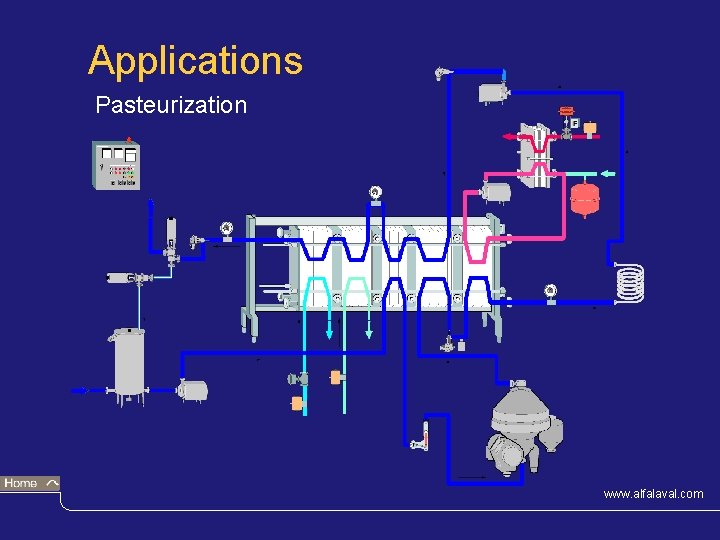
Applications In the Dairy • • • Milk pasteurization Cream pasteurization Cultured milk treatment UHT Cheese milk heat treatment Ice cream mix heat treatment © Alfa Laval 8 www. alfalaval. com
Applications Pasteurization © Alfa Laval 9 www. alfalaval. com
Frame - purpose • • • Holds the plates together Supports the plates (load / pressure) Base for connections (inlet / outlet for media) © Alfa Laval 10 www. alfalaval. com
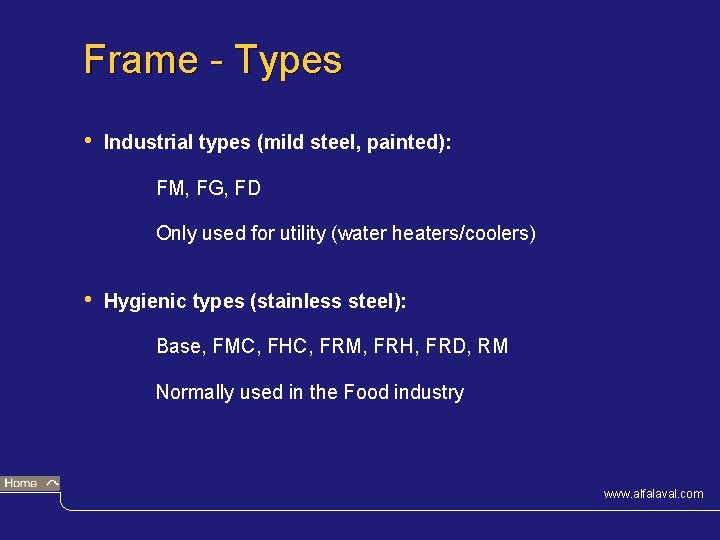
Frame - Types • Industrial types (mild steel, painted): FM, FG, FD Only used for utility (water heaters/coolers) • Hygienic types (stainless steel): Base, FMC, FHC, FRM, FRH, FRD, RM Normally used in the Food industry © Alfa Laval 11 www. alfalaval. com
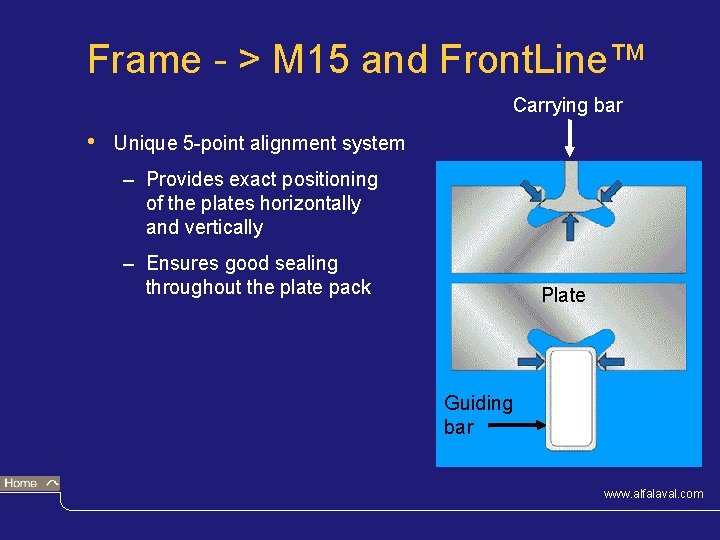
Frame - > M 15 and Front. Line™ Carrying bar • Unique 5 -point alignment system – Provides exact positioning of the plates horizontally and vertically – Ensures good sealing throughout the plate pack Plate Guiding bar © Alfa Laval 12 www. alfalaval. com
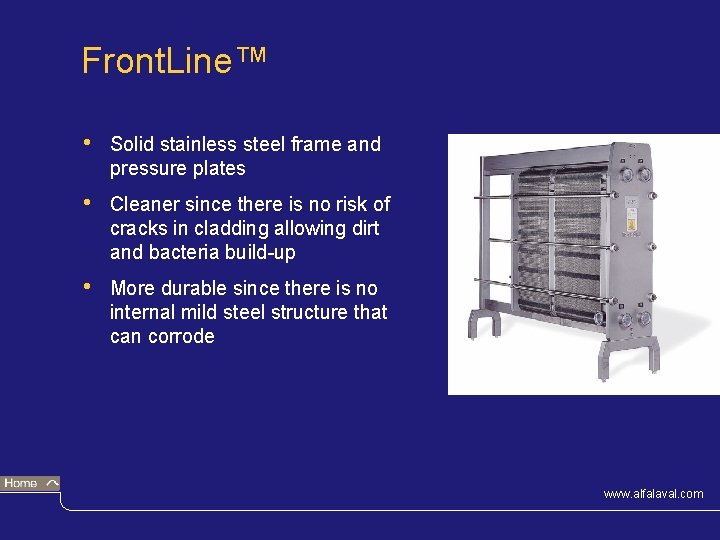
Front. Line™ • Solid stainless steel frame and pressure plates • Cleaner since there is no risk of cracks in cladding allowing dirt and bacteria build-up • More durable since there is no internal mild steel structure that can corrode © Alfa Laval 13 www. alfalaval. com
Front. Line™ • Stainless steel bolts with ball bearing washers • Reduces service time © Alfa Laval 14 www. alfalaval. com
Front. Line™ • Bolt-in corners at connection plates • Easy to modify for new duties and applications © Alfa Laval 15 www. alfalaval. com
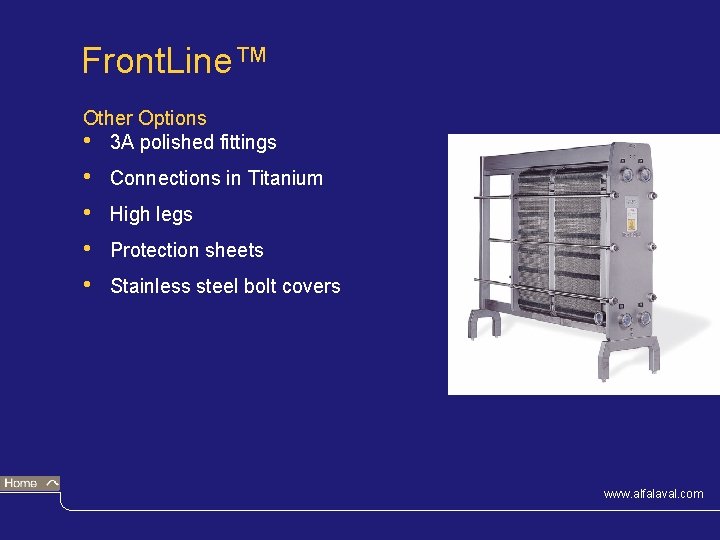
Front. Line™ Other Options • 3 A polished fittings • • Connections in Titanium High legs Protection sheets Stainless steel bolt covers © Alfa Laval 16 www. alfalaval. com
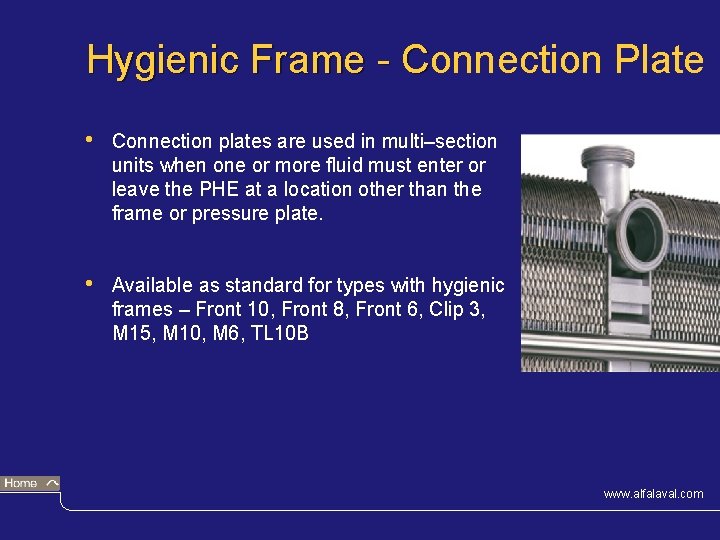
Hygienic Frame - Connection Plate C • Connection plates are used in multi–section units when one or more fluid must enter or leave the PHE at a location other than the frame or pressure plate. • Available as standard for types with hygienic frames – Front 10, Front 8, Front 6, Clip 3, M 15, M 10, M 6, TL 10 B © Alfa Laval 17 www. alfalaval. com
Plates - Purpose • • • Create channels for the liquids (corrugation). Create turbulence for the flow Provides the heat transfer from one media to the other media. © Alfa Laval 18 www. alfalaval. com
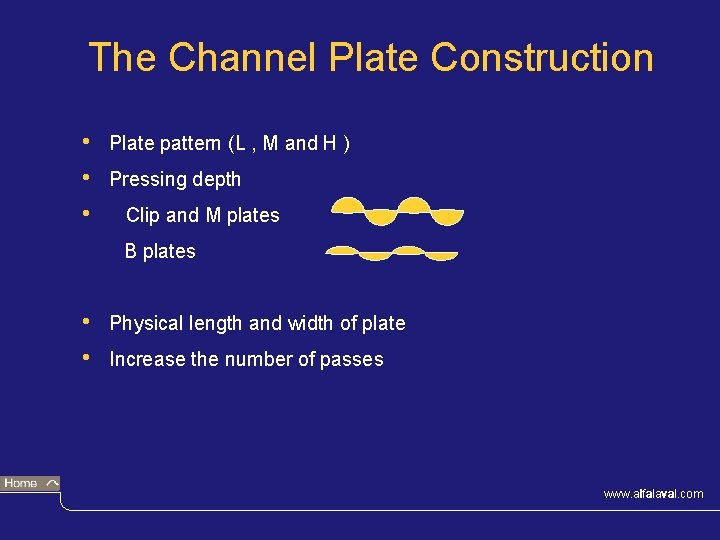
The Channel Plate Construction • • • Plate pattern (L , M and H ) Pressing depth Clip and M plates B plates • • Physical length and width of plate Increase the number of passes © Alfa Laval 19 www. alfalaval. com
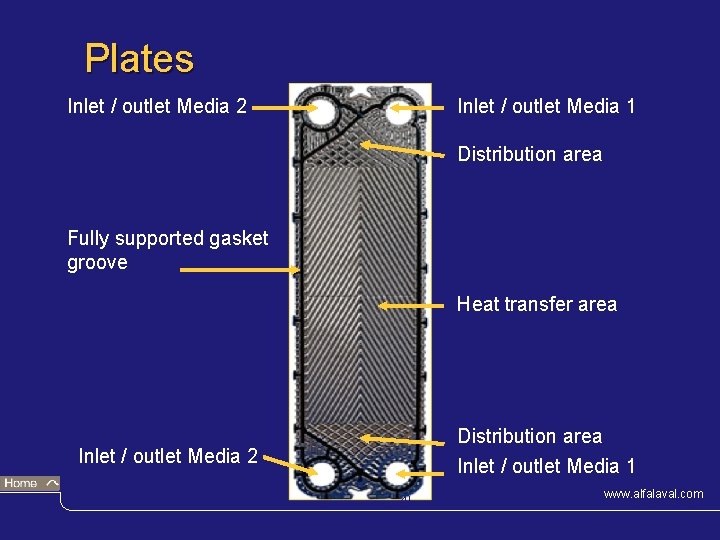
Plates Inlet / outlet Media 2 Inlet / outlet Media 1 Distribution area Fully supported gasket groove Heat transfer area Distribution area Inlet / outlet Media 1 Inlet / outlet Media 2 © Alfa Laval 20 www. alfalaval. com
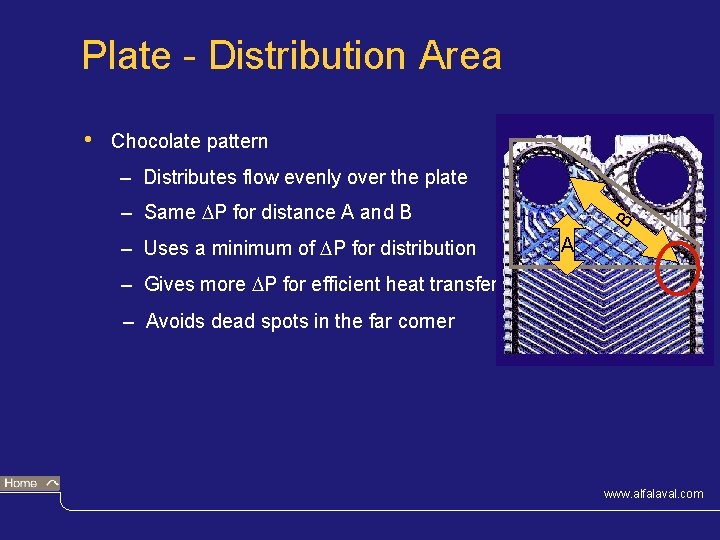
Plate - Distribution Area • Chocolate pattern – Distributes flow evenly over the plate – Uses a minimum of P for distribution B – Same P for distance A and B A – Gives more P for efficient heat transfer – Avoids dead spots in the far corner © Alfa Laval 21 www. alfalaval. com
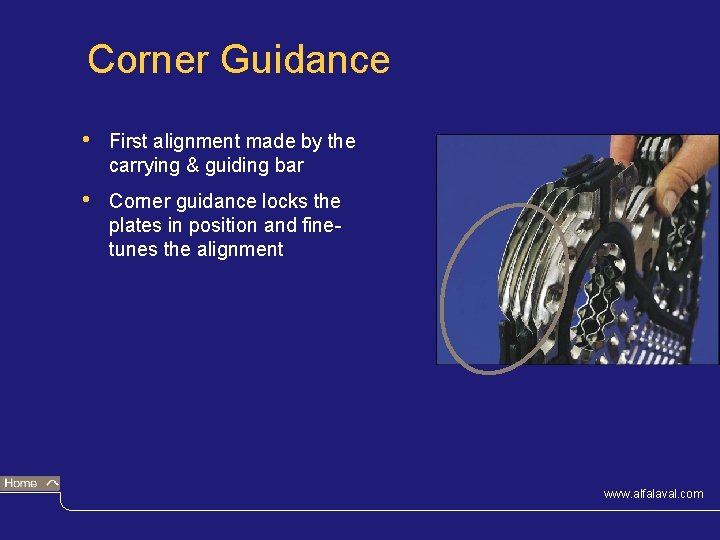
Corner Guidance • First alignment made by the carrying & guiding bar • Corner guidance locks the plates in position and finetunes the alignment © Alfa Laval 22 www. alfalaval. com
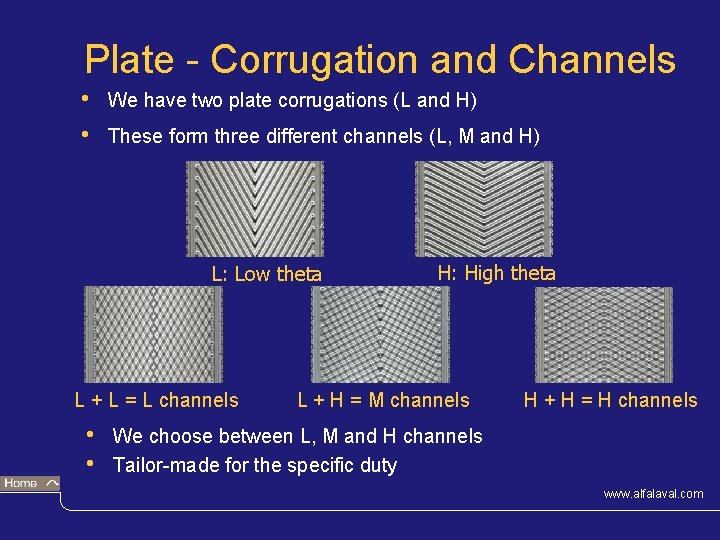
Plate - Corrugation and Channels • • We have two plate corrugations (L and H) These form three different channels (L, M and H) H: High theta L: Low theta L + L = L channels • • L + H = M channels H + H = H channels We choose between L, M and H channels Tailor-made for the specific duty © Alfa Laval 23 www. alfalaval. com
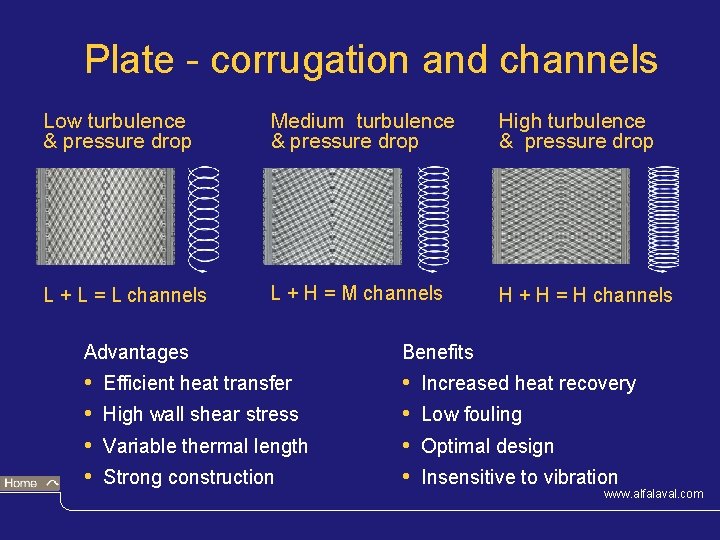
Plate - corrugation and channels Low turbulence & pressure drop Medium turbulence & pressure drop High turbulence & pressure drop L + L = L channels L + H = M channels H + H = H channels Advantages Benefits • • Efficient heat transfer High wall shear stress Variable thermal length Strong construction © Alfa Laval 24 Increased heat recovery Low fouling Optimal design Insensitive to vibration www. alfalaval. com
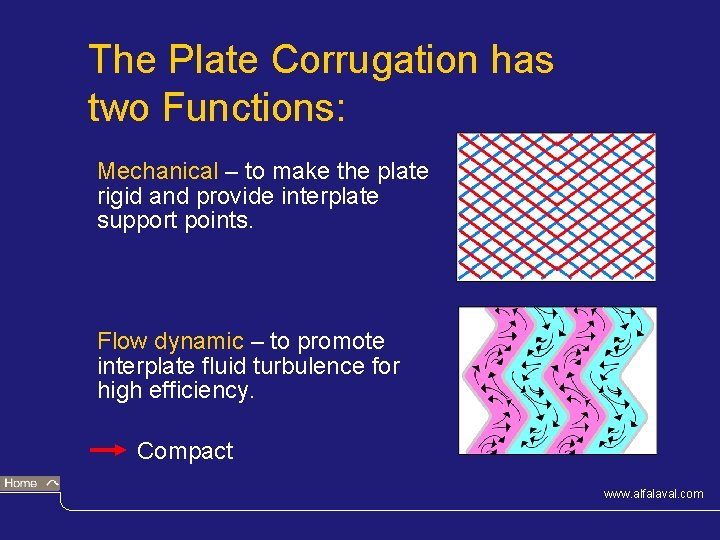
The Plate Corrugation has two Functions: Mechanical – to make the plate rigid and provide interplate support points. Flow dynamic – to promote interplate fluid turbulence for high efficiency. Compact © Alfa Laval 25 www. alfalaval. com
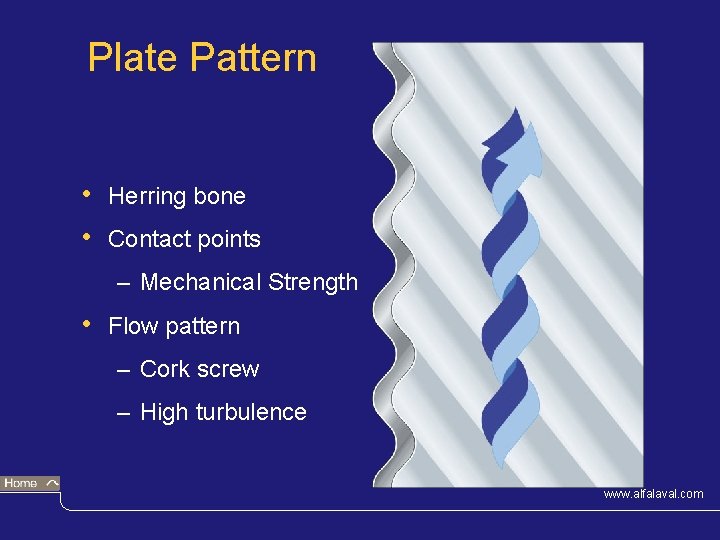
Plate Pattern • • Herring bone Contact points – Mechanical Strength • Flow pattern – Cork screw – High turbulence © Alfa Laval 26 www. alfalaval. com
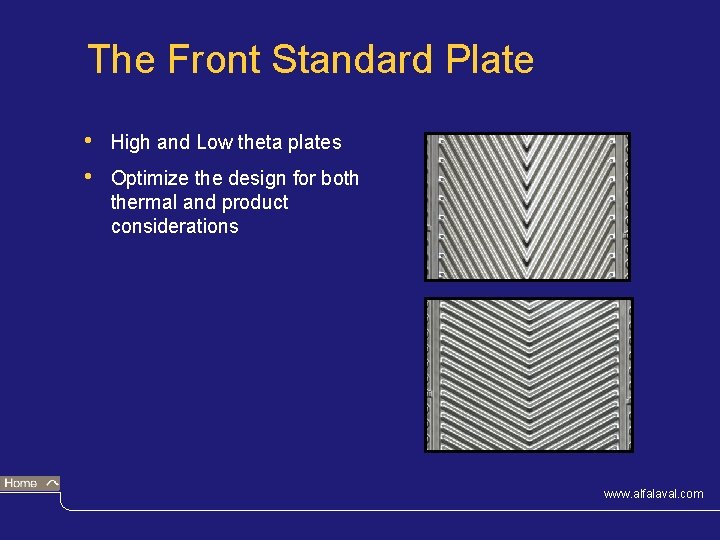
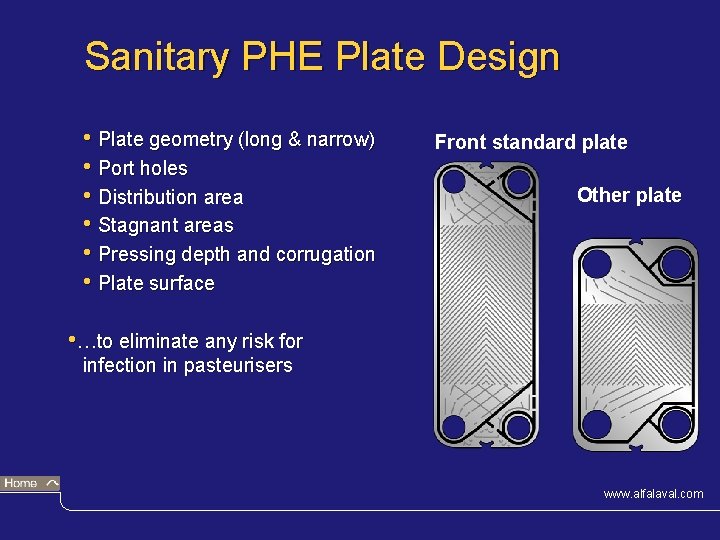
The Front Standard Plate • • High and Low theta plates Optimize the design for both thermal and product considerations © Alfa Laval 27 www. alfalaval. com
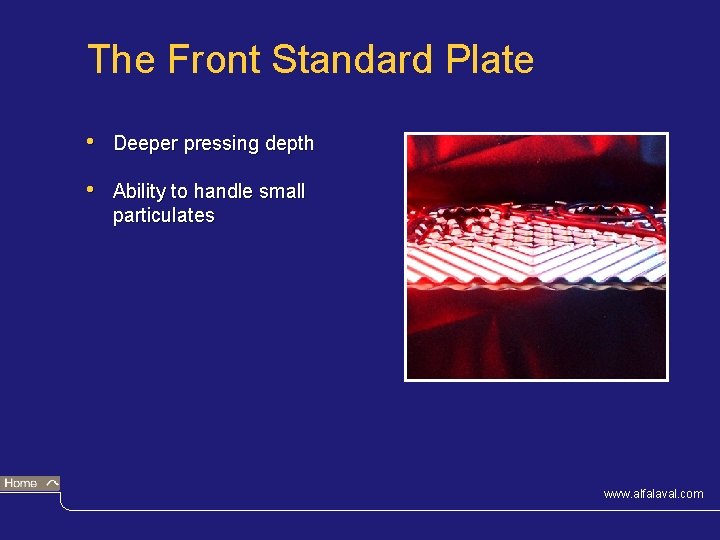
The Front Standard Plate • Deeper pressing depth • Ability to handle small particulates © Alfa Laval 28 www. alfalaval. com
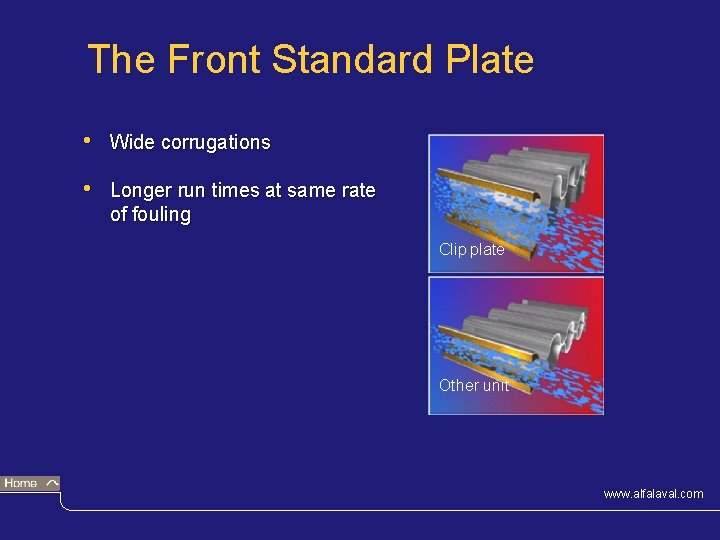
The Front Standard Plate • Wide corrugations • Longer run times at same rate of fouling Clip plate Other unit © Alfa Laval 29 www. alfalaval. com
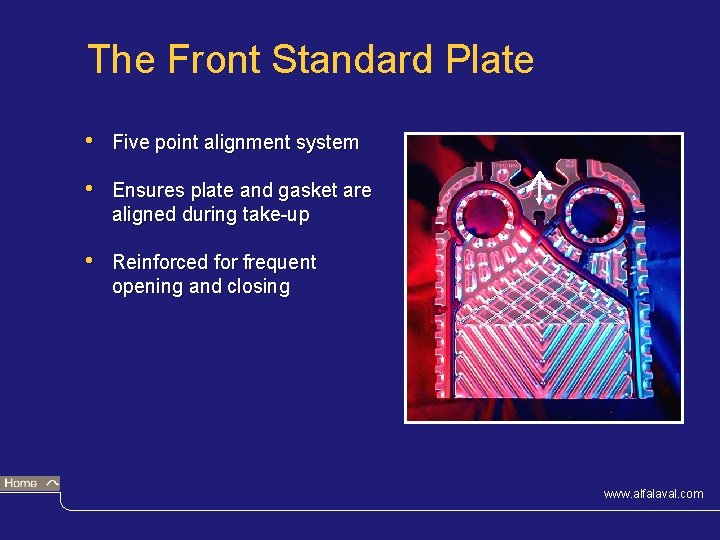
The Front Standard Plate • Five point alignment system • Ensures plate and gasket are aligned during take-up • Reinforced for frequent opening and closing © Alfa Laval 30 www. alfalaval. com
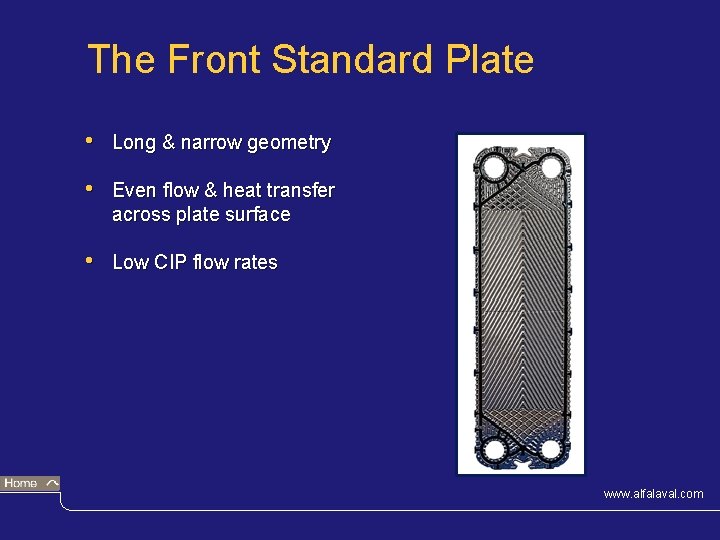
The Front Standard Plate • Long & narrow geometry • Even flow & heat transfer across plate surface • Low CIP flow rates © Alfa Laval 31 www. alfalaval. com
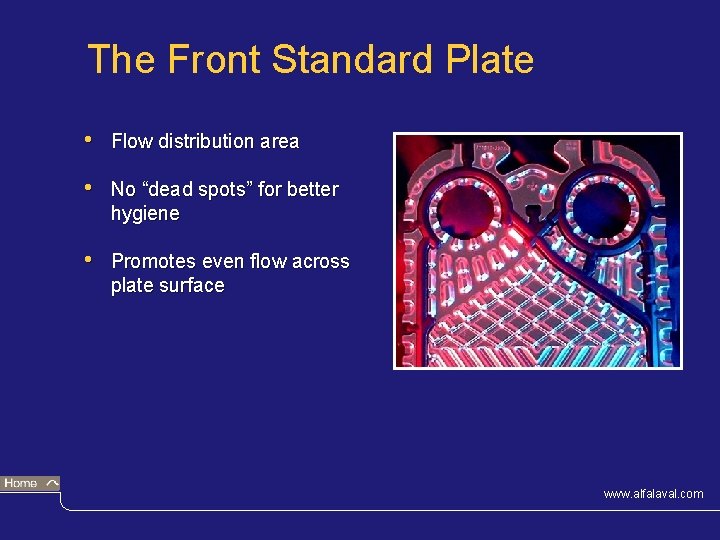
The Front Standard Plate • Flow distribution area • No “dead spots” for better hygiene • Promotes even flow across plate surface © Alfa Laval 32 www. alfalaval. com
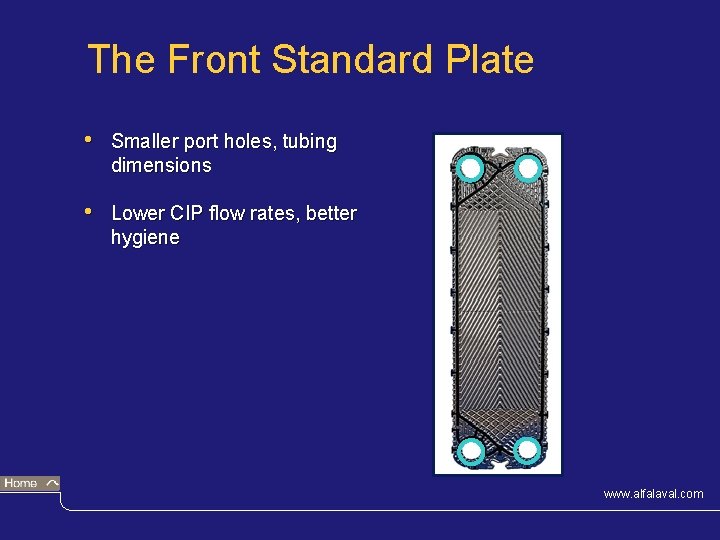
The Front Standard Plate • Smaller port holes, tubing dimensions • Lower CIP flow rates, better hygiene © Alfa Laval 33 www. alfalaval. com
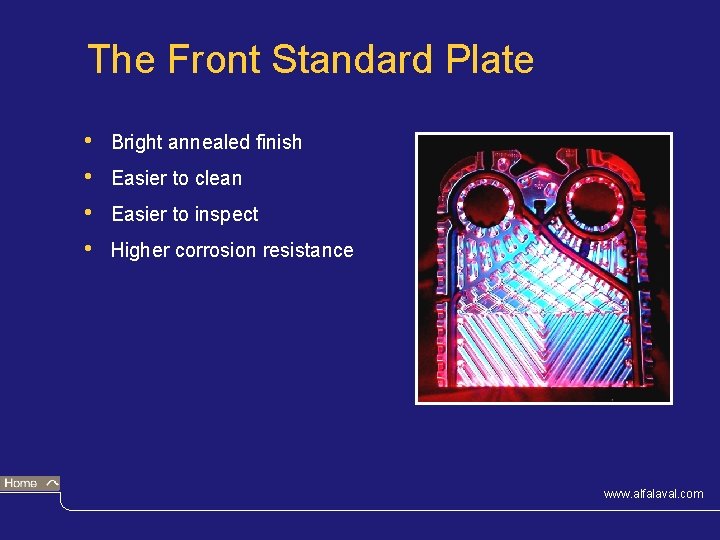
The Front Standard Plate • • Bright annealed finish Easier to clean Easier to inspect Higher corrosion resistance © Alfa Laval 34 www. alfalaval. com
Sanitary PHE Plate Design • Plate geometry (long & narrow) • Port holes • Distribution area • Stagnant areas • Pressing depth and corrugation • Plate surface Front standard plate Other plate • …to eliminate any risk for infection in pasteurisers © Alfa Laval 35 www. alfalaval. com
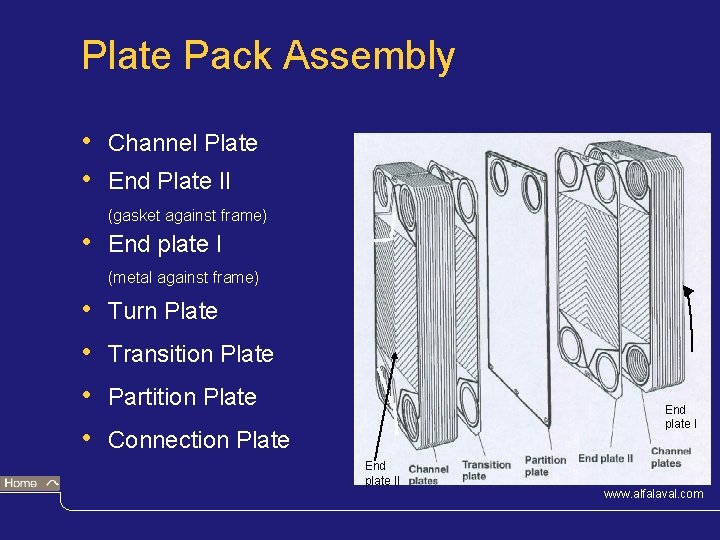
Plate Pack Assembly • • Channel Plate End Plate II (gasket against frame) • End plate I (metal against frame) • • Turn Plate Transition Plate Partition Plate End plate I Connection Plate End plate II © Alfa Laval 36 www. alfalaval. com
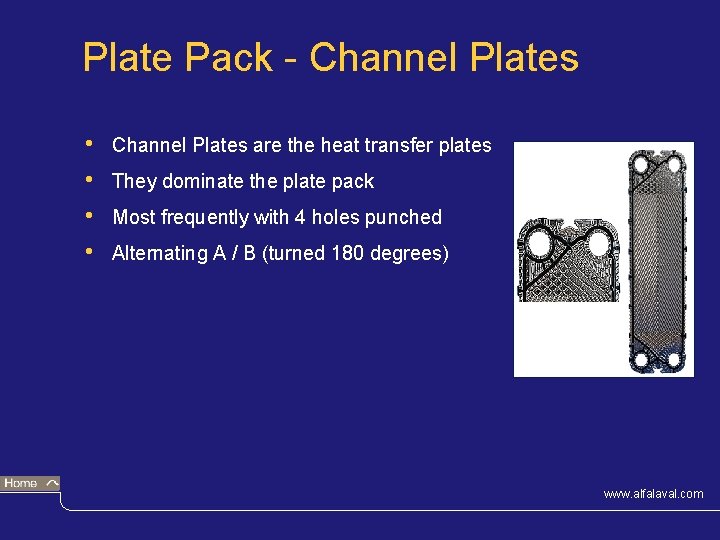
Plate Pack - Channel Plates • • Channel Plates are the heat transfer plates They dominate the plate pack Most frequently with 4 holes punched Alternating A / B (turned 180 degrees) © Alfa Laval 37 www. alfalaval. com
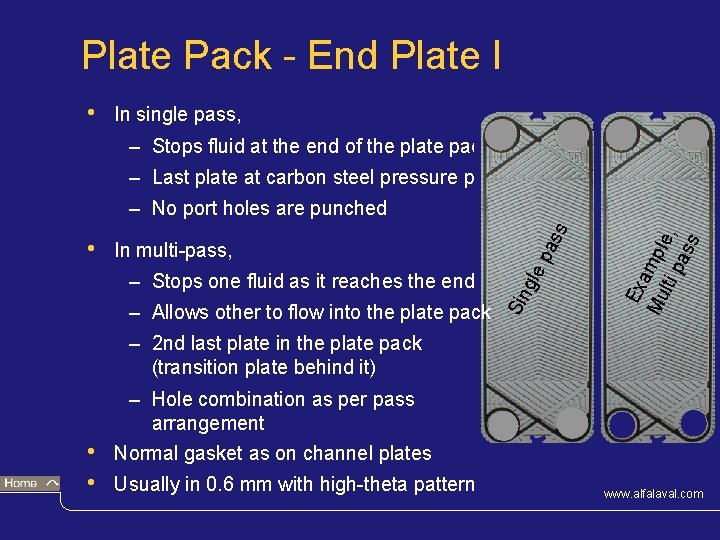
Plate Pack - End Plate I • In single pass, – Stops fluid at the end of the plate pack – Last plate at carbon steel pressure plate – Allows other to flow into the plate pack Ex Mu ampl lti p e, as s – Stops one fluid as it reaches the end gle pa In multi-pass, Sin • ss – No port holes are punched – 2 nd last plate in the plate pack (transition plate behind it) • • – Hole combination as per pass arrangement Normal gasket as on channel plates Usually in 0. 6 mm with high-theta pattern © Alfa Laval 38 www. alfalaval. com
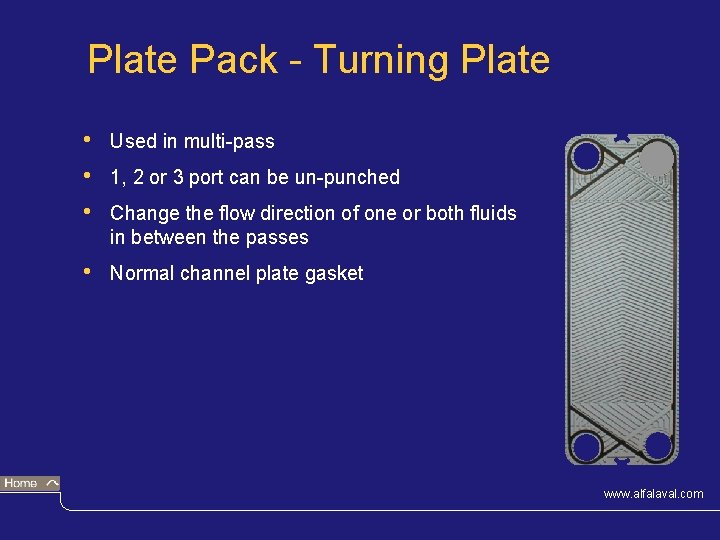
Plate Pack - Turning Plate • • • Used in multi-pass • Normal channel plate gasket 1, 2 or 3 port can be un-punched Change the flow direction of one or both fluids in between the passes © Alfa Laval 39 www. alfalaval. com
The Construction Number of plates depends on: • Flow rates • • • Permitted pressure drops Temperature program Size & design of plates Heat recovery Material & thickness of plates Physical properties © Alfa Laval 40 www. alfalaval. com
Plate Pressing Single Step Pressing • Plates are totally uniform • • Uniform metal-to-metal contacts points Stronger plates that can handle – High pressure – High differential pressure – Vibrations © Alfa Laval 41 www. alfalaval. com
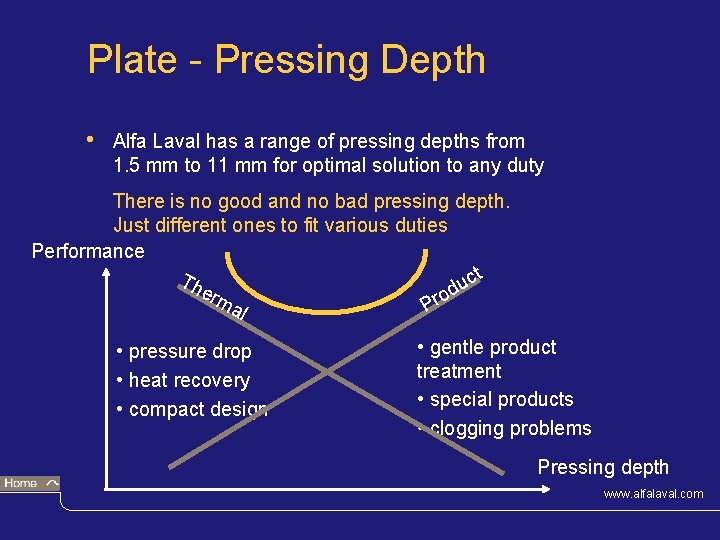
Plate - Pressing Depth • Alfa Laval has a range of pressing depths from 1. 5 mm to 11 mm for optimal solution to any duty There is no good and no bad pressing depth. Just different ones to fit various duties Performance ct Th u erm od r P al • gentle product treatment • special products • clogging problems • pressure drop • heat recovery • compact design Pressing depth © Alfa Laval 42 www. alfalaval. com
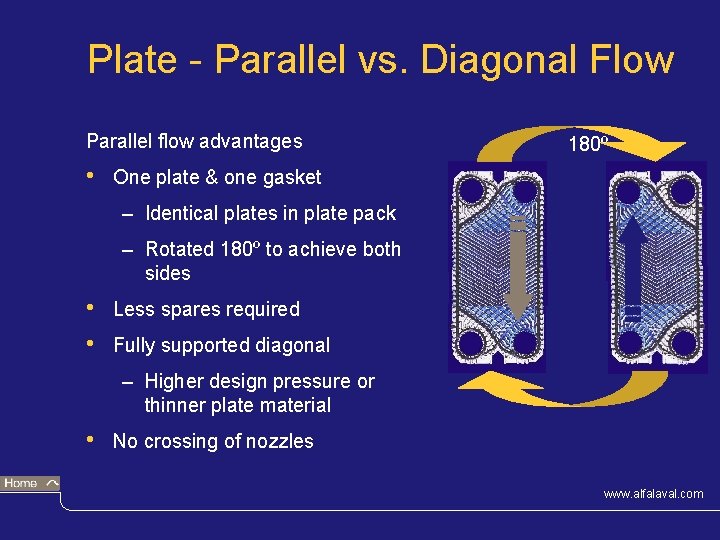
Plate - Parallel vs. Diagonal Flow Parallel flow advantages • 180º One plate & one gasket – Identical plates in plate pack – Rotated 180º to achieve both sides • • Less spares required Fully supported diagonal – Higher design pressure or thinner plate material • No crossing of nozzles © Alfa Laval 43 www. alfalaval. com
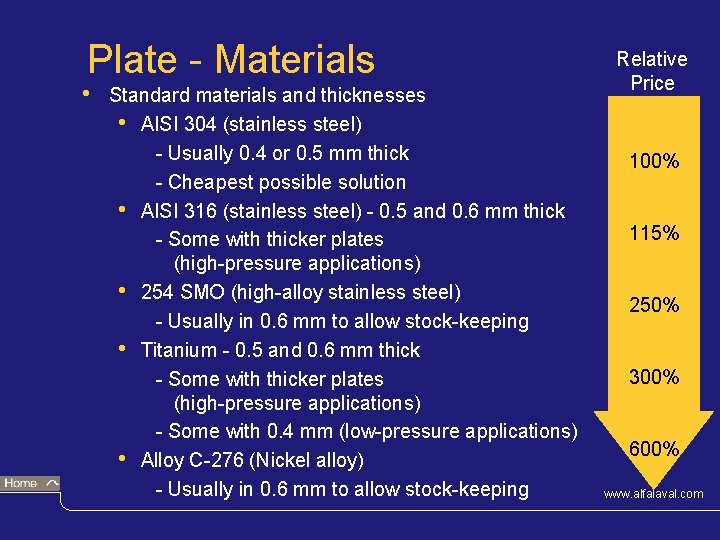
Plate - Materials • Standard materials and thicknesses • AISI 304 (stainless steel) - Usually 0. 4 or 0. 5 mm thick - Cheapest possible solution • AISI 316 (stainless steel) - 0. 5 and 0. 6 mm thick - Some with thicker plates (high-pressure applications) • 254 SMO (high-alloy stainless steel) - Usually in 0. 6 mm to allow stock-keeping • Titanium - 0. 5 and 0. 6 mm thick - Some with thicker plates (high-pressure applications) - Some with 0. 4 mm (low-pressure applications) • Alloy C-276 (Nickel alloy) - Usually in 0. 6 mm to allow 44 stock-keeping © Alfa Laval Relative Price 100% 115% 250% 300% 600% www. alfalaval. com
Gaskets - Purpose • The purpose of the gaskets is to seal between the channel plates and between plates and the frame parts (connecting plate). • Are the only wear part (the ageing of rubber). © Alfa Laval 45 www. alfalaval. com
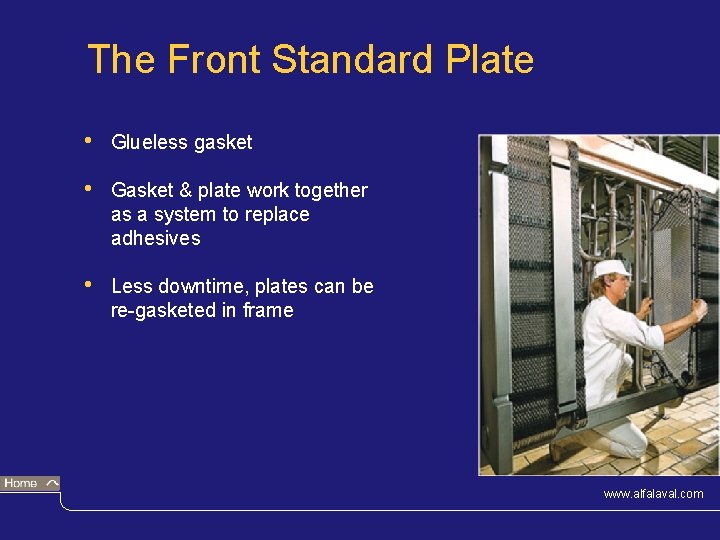
The Front Standard Plate • Glueless gasket • Gasket & plate work together as a system to replace adhesives • Less downtime, plates can be re-gasketed in frame © Alfa Laval 46 www. alfalaval. com
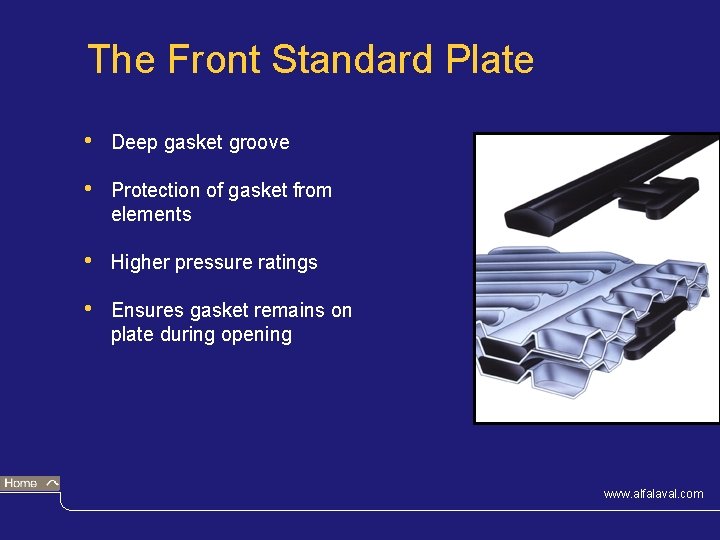
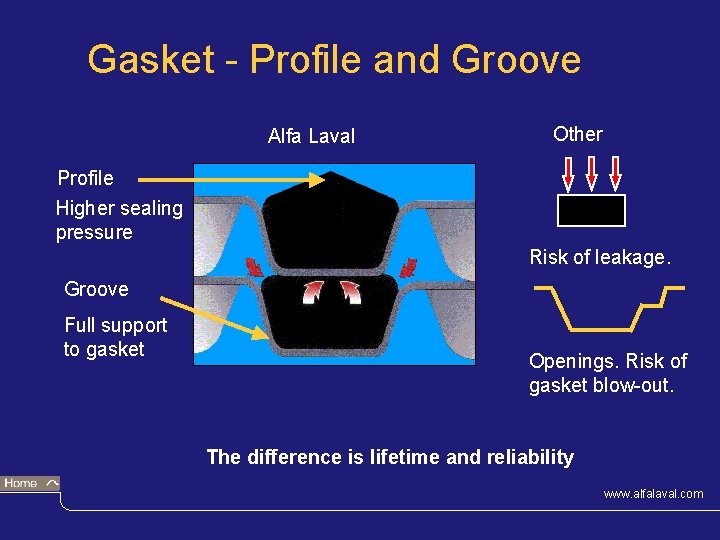
The Front Standard Plate • Deep gasket groove • Protection of gasket from elements • Higher pressure ratings • Ensures gasket remains on plate during opening © Alfa Laval 47 www. alfalaval. com
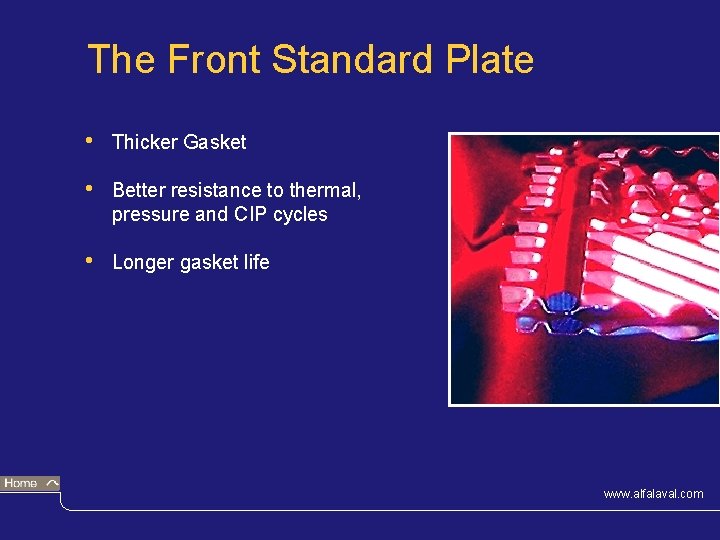
The Front Standard Plate • Thicker Gasket • Better resistance to thermal, pressure and CIP cycles • Longer gasket life © Alfa Laval 48 www. alfalaval. com
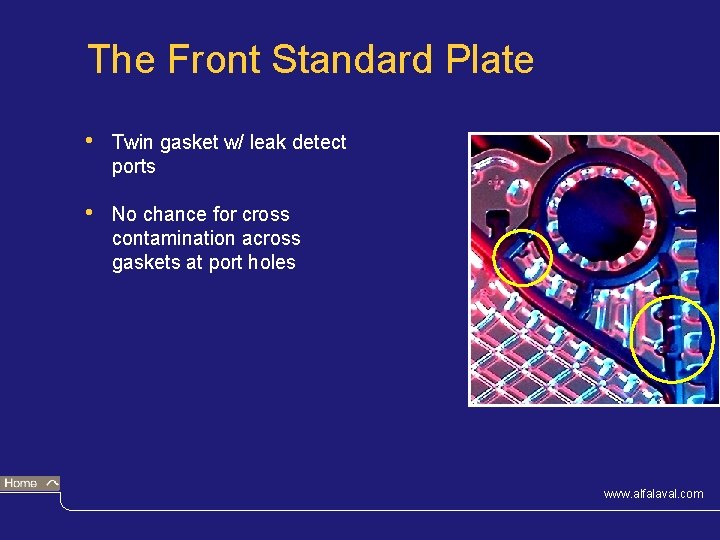
The Front Standard Plate • Twin gasket w/ leak detect ports • No chance for cross contamination across gaskets at port holes © Alfa Laval 49 www. alfalaval. com
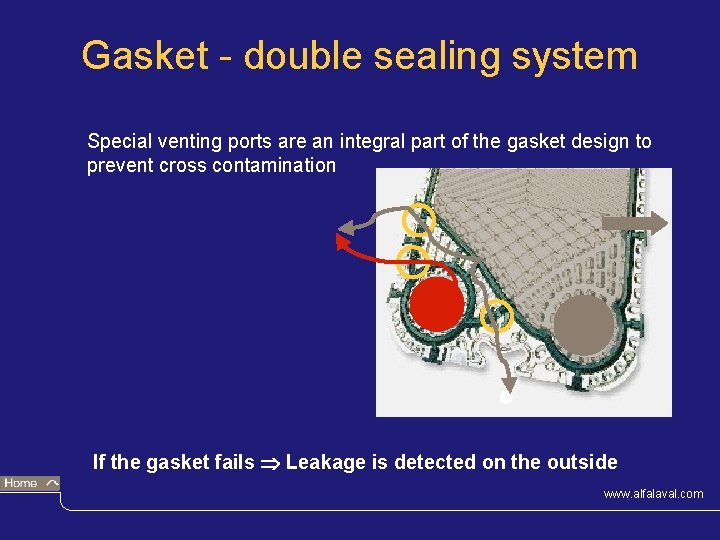
Gasket - double sealing system Special venting ports are an integral part of the gasket design to prevent cross contamination If the gasket fails Leakage is detected on the outside © Alfa Laval 50 www. alfalaval. com
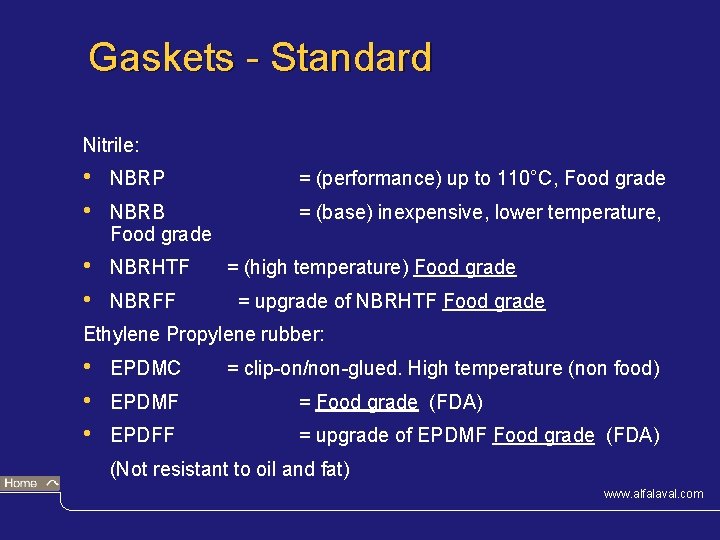
Gaskets - Standard Nitrile: • • NBRP = (performance) up to 110°C, Food grade NBRB Food grade = (base) inexpensive, lower temperature, • • NBRHTF NBRFF = (high temperature) Food grade = upgrade of NBRHTF Food grade Ethylene Propylene rubber: • • • EPDMC = clip-on/non-glued. High temperature (non food) EPDMF = Food grade (FDA) EPDFF = upgrade of EPDMF Food grade (FDA) (Not resistant to oil and fat) © Alfa Laval 51 www. alfalaval. com
Gasket - Profile and Groove Other Alfa Laval Profile Higher sealing pressure Risk of leakage. Groove Full support to gasket Openings. Risk of gasket blow-out. The difference is lifetime and reliability © Alfa Laval 52 www. alfalaval. com
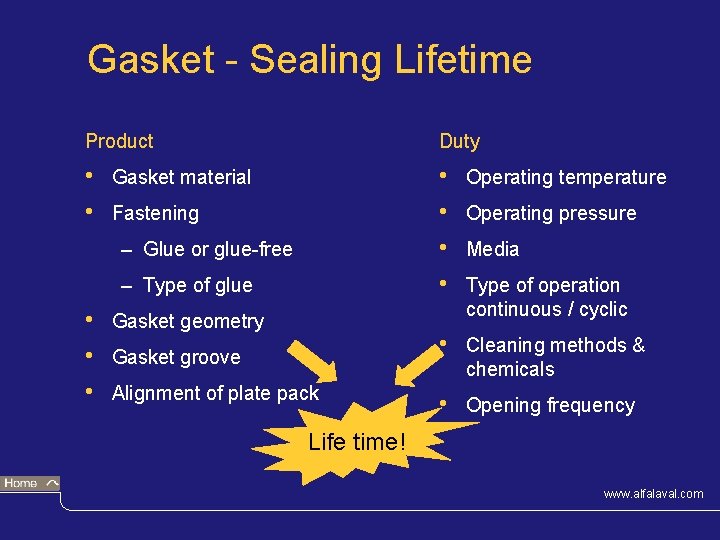
Gasket - Sealing Lifetime Product Duty • • • Operating temperature • Cleaning methods & chemicals • Opening frequency Gasket material Fastening – Glue or glue-free – Type of glue • • • Gasket geometry Gasket groove Alignment of plate pack Operating pressure Media Type of operation continuous / cyclic Life time! © Alfa Laval 53 www. alfalaval. com
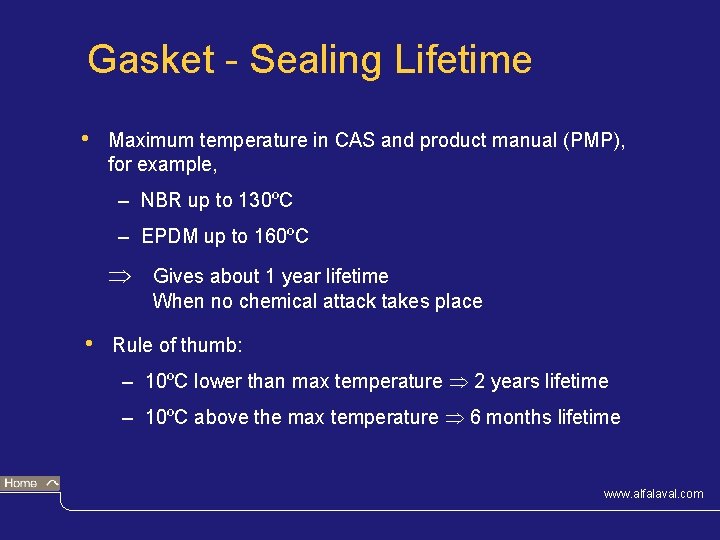
Gasket - Sealing Lifetime • Maximum temperature in CAS and product manual (PMP), for example, – NBR up to 130ºC – EPDM up to 160ºC Gives about 1 year lifetime When no chemical attack takes place • Rule of thumb: – 10ºC lower than max temperature 2 years lifetime – 10ºC above the max temperature 6 months lifetime © Alfa Laval 54 www. alfalaval. com
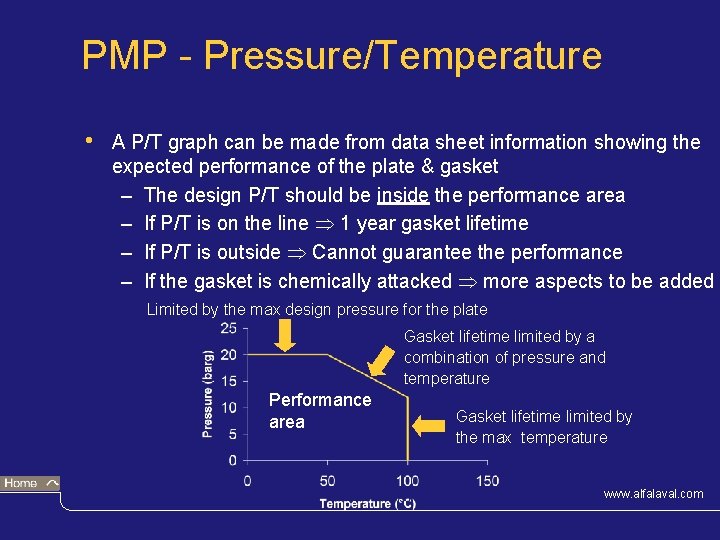
PMP - Pressure/Temperature • A P/T graph can be made from data sheet information showing the expected performance of the plate & gasket – The design P/T should be inside the performance area – If P/T is on the line 1 year gasket lifetime – If P/T is outside Cannot guarantee the performance – If the gasket is chemically attacked more aspects to be added Limited by the max design pressure for the plate Gasket lifetime limited by a combination of pressure and temperature Performance area © Alfa Laval Gasket lifetime limited by the max temperature 55 www. alfalaval. com
PMP - Pressure/Temperature • The data is found in the data sheet – In the gasket performance table • T(T) = The maximum allowed operating temperature. Above this temperature the gasket will last less than one year. • T(P) = Recommended temperature at max pressure. Higher pressure More strain on the gasket We cannot allow the max temperature – In the plate performance table • P(P) = Maximum design pressure for the plate. Above this pressure the plate will deform. • P(T) = Recommended max operating pressure at max operating temperature. © Alfa Laval Higher pressure Softer gasket We cannot allow the max 56 pressure www. alfalaval. com
© Alfa Laval 57 www. alfalaval. com