
SANDF Force Design Defence planning is simple in

- Slides: 8
SANDF: Force Design Defence planning is simple in time of war or imminent war – the enemy and his intentions are known, and there is usually a reasonably clear idea of his doctrine and therefore how his forces are likely to operate. Defence planning is vastly more difficult in time of peace when there is no clear enemy on which to base plans and force strength and composition. Most countries meet this challenge by trying to maintain forces adequate and appropriate to counter existing and predictable threats, and with the adaptability, flexibility and agility to meet unexpected threats. That is sometimes termed the ‘minimum required force’.
SANDF: Minimum Required Force The force design of the SANDF must be based on providing and maintaining the capabilities required to: Execute existing missions; The SANDF is, in fact, too weak Deal with existing challenges; to meet that standard – short of combat units, short of Deal with existing threats; deployable personnel and with Deal with foreseeable threats; and some key capability gaps. Deal with foreseeable risks. The personnel strength required for the combat services (Army, Navy, Air Force, Special Forces) will be determined by this. Overall personnel strength will then depend on the organisation of the defence force and its supporting services and divisions.
SANDF: Personnel Strength and Costs The SANDF is not massively over-staffed for its roles and missions. What has actually happened is that it is caught between declining funding on the one hand expanding missions and salary inflation on the other. This is aggravated by: • Ageing personnel in junior ranks who are, by virtue of seniority and having families, extremely expensive compared to the cost of younger soldiers; • A surplus of administrative and management bodies that add little value but are over-staffed and over-ranked. • Rank inflation, in part dating from the previous SADF and in part a result of the integration process after 1994;
SANDF: 40: 30 It is unfortunate that the 40: 30 formula was put into the Defence Review. The ratio of personnel costs to operating costs and capital funding is not something that can be set to a formula. It depends on the nature of the defence force which, in turn, depends on its mission sets. The SANDF, for good reasons, is Army-heavy and the Army is for equally good reasons Infantry-heavy. The result is a higher personnel cost component than for a more technology-intensive defence force. To lend perspective: • Only five NATO militaries spend 40% or less of their allocation on personnel, including Estonia and Norway which still have conscription; and • Four NATO militaries spend more than 70% of their allocation on personnel, including Belgium, Greece and Portugal.
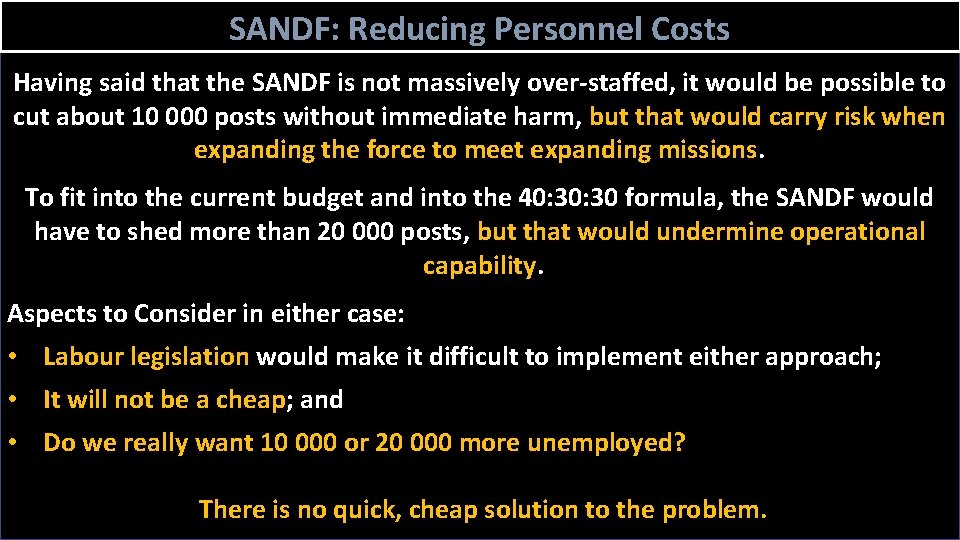
SANDF: Reducing Personnel Costs Having said that the SANDF is not massively over-staffed, it would be possible to cut about 10 000 posts without immediate harm, but that would carry risk when expanding the force to meet expanding missions. To fit into the current budget and into the 40: 30 formula, the SANDF would have to shed more than 20 000 posts, but that would undermine operational capability. Aspects to Consider in either case: • Labour legislation would make it difficult to implement either approach; • It will not be a cheap; and • Do we really want 10 000 or 20 000 more unemployed? There is no quick, cheap solution to the problem.
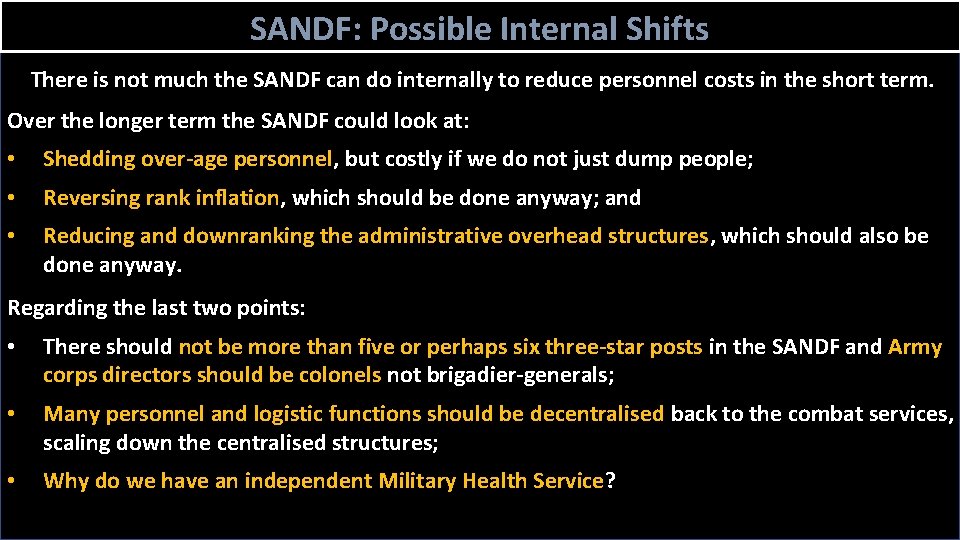
SANDF: Possible Internal Shifts There is not much the SANDF can do internally to reduce personnel costs in the short term. Over the longer term the SANDF could look at: • Shedding over-age personnel, but costly if we do not just dump people; • Reversing rank inflation, which should be done anyway; and • Reducing and downranking the administrative overhead structures, which should also be done anyway. Regarding the last two points: • There should not be more than five or perhaps six three-star posts in the SANDF and Army corps directors should be colonels not brigadier-generals; • Many personnel and logistic functions should be decentralised back to the combat services, scaling down the centralised structures; • Why do we have an independent Military Health Service?
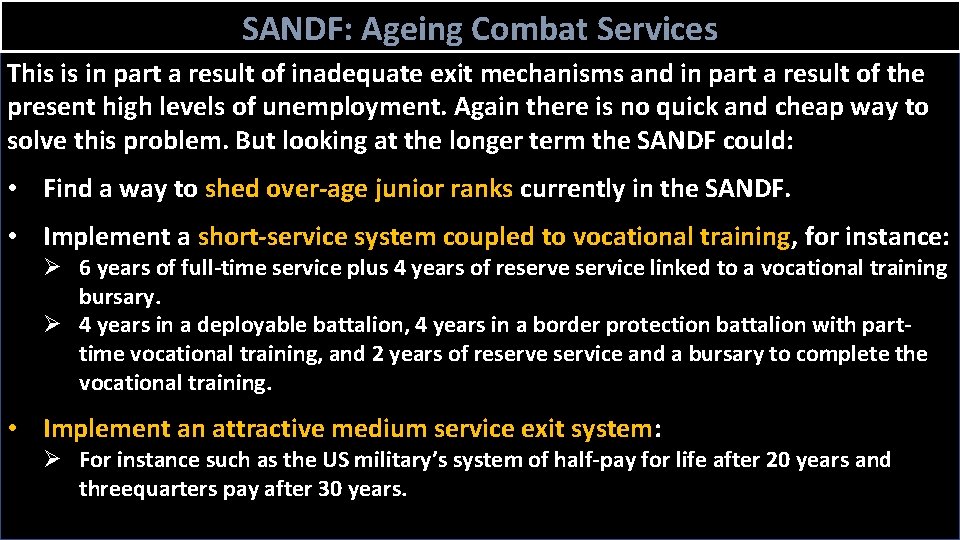
SANDF: Ageing Combat Services This is in part a result of inadequate exit mechanisms and in part a result of the present high levels of unemployment. Again there is no quick and cheap way to solve this problem. But looking at the longer term the SANDF could: • Find a way to shed over-age junior ranks currently in the SANDF. • Implement a short-service system coupled to vocational training, for instance: Ø 6 years of full-time service plus 4 years of reserve service linked to a vocational training bursary. Ø 4 years in a deployable battalion, 4 years in a border protection battalion with parttime vocational training, and 2 years of reserve service and a bursary to complete the vocational training. • Implement an attractive medium service exit system: Ø For instance such as the US military’s system of half-pay for life after 20 years and threequarters pay after 30 years.
SANDF: Rank Inflation The SANDF is not as badly over-ranked as some assume. Comparison with other forces does suggest some over-ranking but: • A medium sized defence force will be over-ranked compared to o A larger force because some posts simply are colonel or general officer posts whether overseeing fourteen or forty units; or o A smaller force, because the medium size force will have functions that simply do not exist in a smaller force. There is benefit to a surplus of senior personnel in peace, particularly colonels and warrant officers, because: • They are an invaluable reserve when the situation requires expansion; and • They are the organisation’s institutional memory.