
Sander Geophysics Airborne Geophysics 2017 and beyond Greg
Sander Geophysics Airborne Geophysics: 2017 and beyond Greg Hodges, Asbjorn Christensen Sander Geophysics, Nordic Geoscience
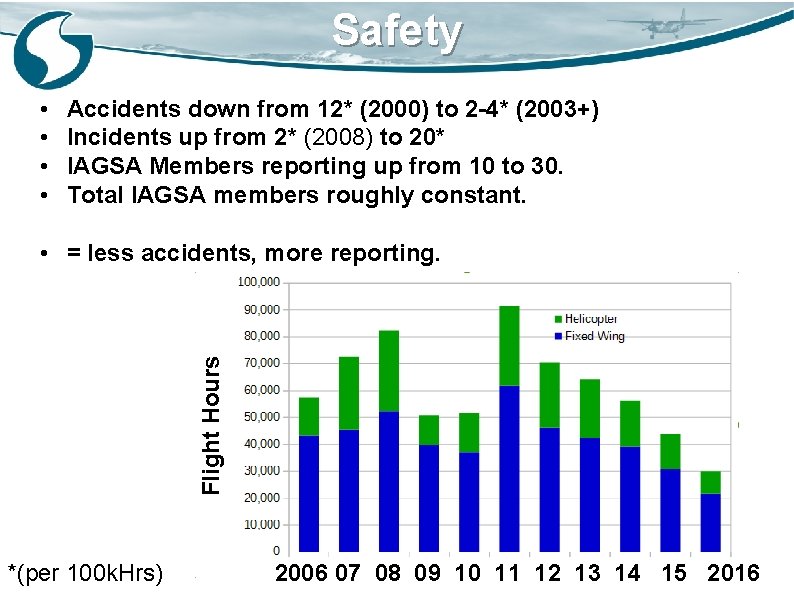
Safety • • Accidents down from 12* (2000) to 2 -4* (2003+) Incidents up from 2* (2008) to 20* IAGSA Members reporting up from 10 to 30. Total IAGSA members roughly constant. Flight Hours • = less accidents, more reporting. *(per 100 k. Hrs) 2006 07 08 09 10 11 12 13 14 15 2016
Business 2016: Least flying hours since reporting started (IAGSA) Steady decline since 2011. Almost 20 years since Fugro tried to capture market: • More suppliers than ever before
Business 2016: Least flying hours since reporting started (IAGSA) Steady decline since 2011. Almost 20 years since Fugro tried to capture market: • More suppliers than ever before High Speed internet moves processing from field to office • More expertise, more power on-hand. More advanced processing – much of it third party • Too advanced for in-house development Rental Gravity and HTEM equipment

Magnetic • Mostly commodity with many local providers, std sensors, fixed wing and heli (stinger) • Noise limit is ambient, aircraft, etc – (high-res sensors don't add much) • Optimal sensor (size, cost) for UAVs. Squid-based mag tensor gradiometers from Anglo-Debeers on Spectrem. (in-house only)
Gamma-ray Spec. New electronics on same crystals: • Better channel resolution (1024) • More stable, better, easier calibration • Reduced dead time (esp v. high signal) • Modest directional sensing Sensitivity largely limited by volume • Cs. I to improve capture slightly for small (lighter) (Medusa) – More robust
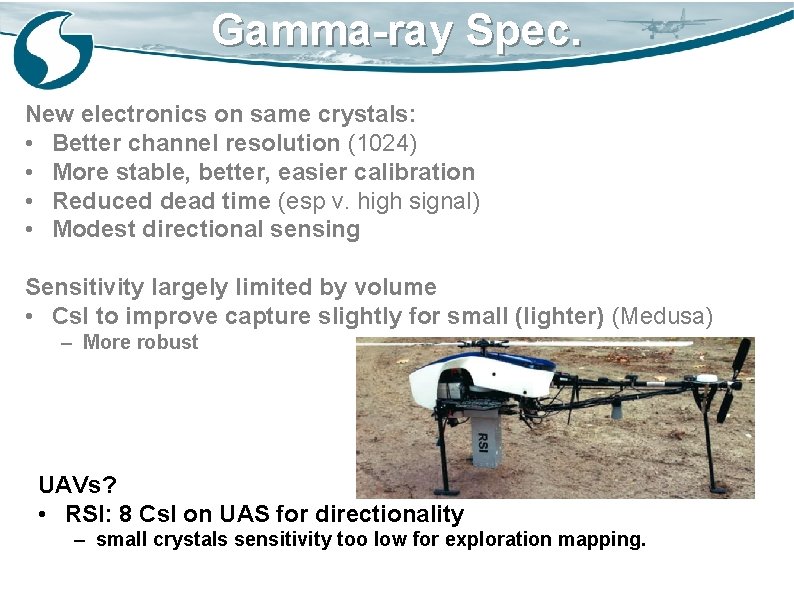
Gamma-ray Spec. New electronics on same crystals: • Better channel resolution (1024) • More stable, better, easier calibration • Reduced dead time (esp v. high signal) • Modest directional sensing Sensitivity largely limited by volume • Cs. I to improve capture slightly for small (lighter) (Medusa) – More robust UAVs? • RSI: 8 Cs. I on UAS for directionality – small crystals sensitivity too low for exploration mapping.
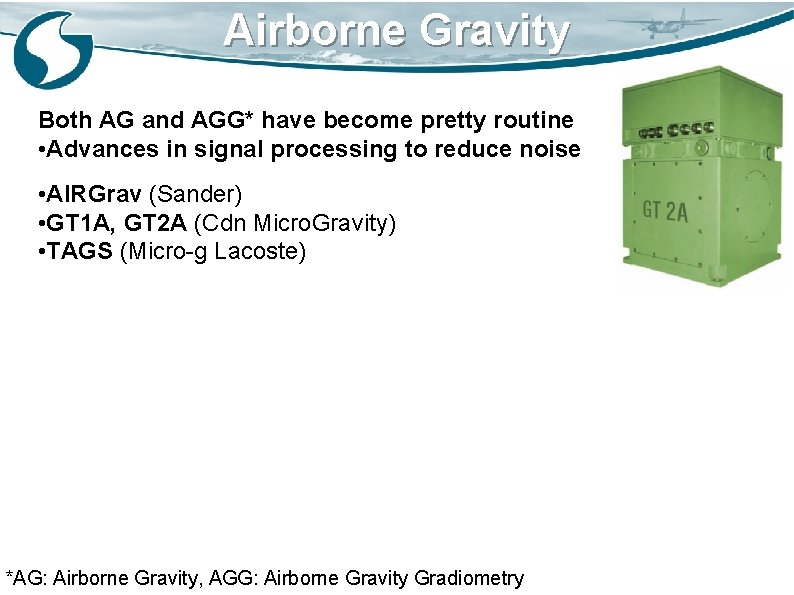
Airborne Gravity Both AG and AGG* have become pretty routine • Advances in signal processing to reduce noise • AIRGrav (Sander) • GT 1 A, GT 2 A (Cdn Micro. Gravity) • TAGS (Micro-g Lacoste) *AG: Airborne Gravity, AGG: Airborne Gravity Gradiometry
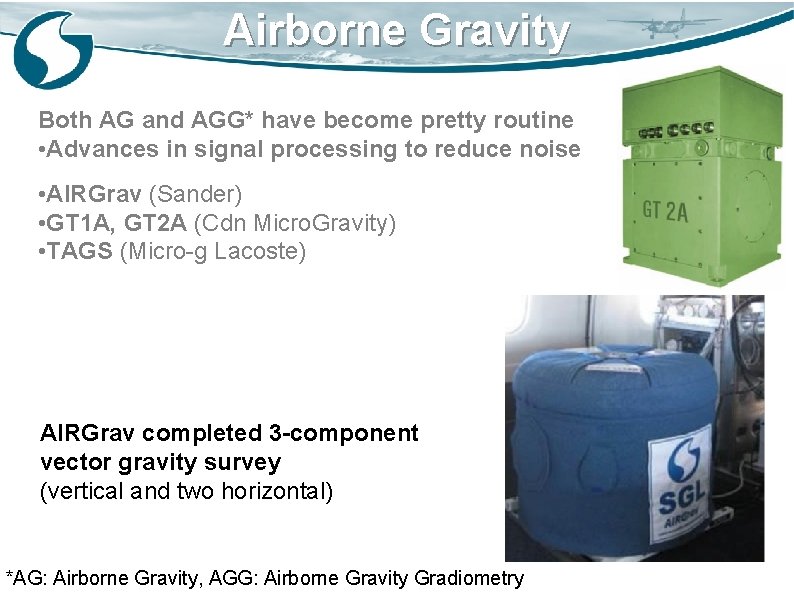
Airborne Gravity Both AG and AGG* have become pretty routine • Advances in signal processing to reduce noise • AIRGrav (Sander) • GT 1 A, GT 2 A (Cdn Micro. Gravity) • TAGS (Micro-g Lacoste) AIRGrav completed 3 -component vector gravity survey (vertical and two horizontal) *AG: Airborne Gravity, AGG: Airborne Gravity Gradiometry
Gravity: AGG* Digital Falcon and FTG (both Lockheed-Martin) reduce size and noise. Falcon now small enough for helicopter: • Lower and slower, better terrain-following=resolution Strap down gravity meter added to extend range (CGG) FTG full-tensor processing to reduce noise (Bell, Austin. Bridgeporth) FTG implemented on Zeppelin • Ideal low, stable platform • Caught by storm and destroyed. *AGG: Airborne Gravity Gradiometry
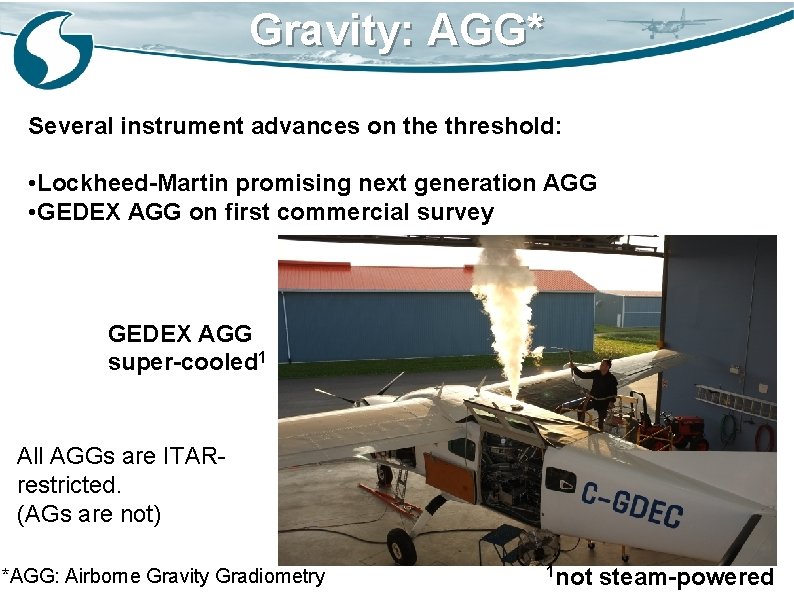
Gravity: AGG* Several instrument advances on the threshold: • Lockheed-Martin promising next generation AGG • GEDEX AGG on first commercial survey GEDEX AGG super-cooled 1 All AGGs are ITARrestricted. (AGs are not) *AGG: Airborne Gravity Gradiometry 1 not steam-powered
VLF -EM Rarely flown, but still available • limited use and limited Txs Exception XDS and digital Matrix (Terraquest) • all-channel, multi component add-on UAS VLF from MGT
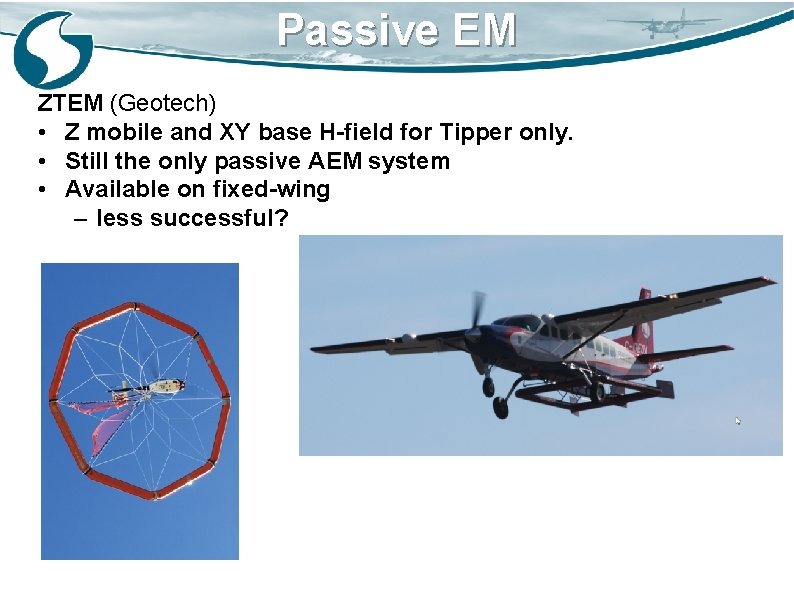
Passive EM ZTEM (Geotech) • Z mobile and XY base H-field for Tipper only. • Still the only passive AEM system • Available on fixed-wing – less successful?
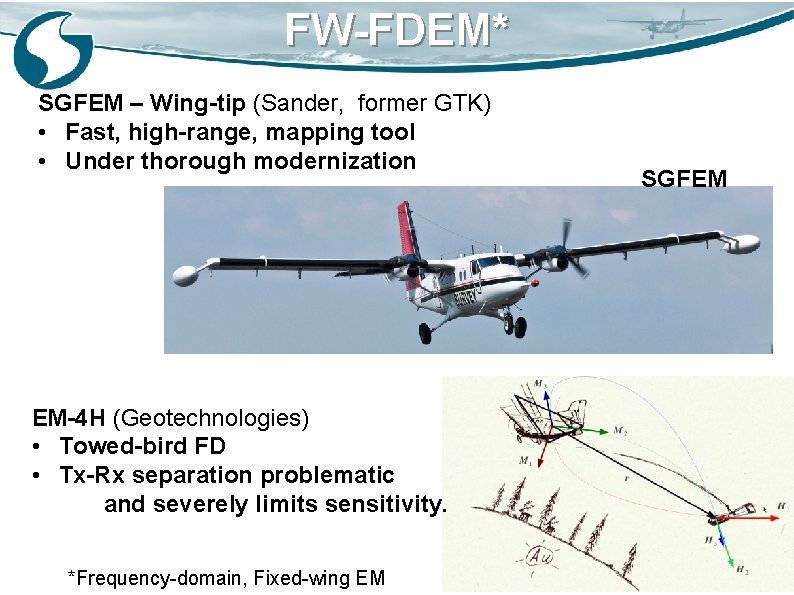
FW-FDEM* SGFEM – Wing-tip (Sander, former GTK) • Fast, high-range, mapping tool • Under thorough modernization EM-4 H (Geotechnologies) • Towed-bird FD • Tx-Rx separation problematic and severely limits sensitivity. *Frequency-domain, Fixed-wing EM SGFEM
HFEM* Mostly DIGHEM and RESOLVE (CGG) • Tuned coils, 5 -6 frequency, multi-geometry • Ideal for high-resolution, high resistivity apps. • Little or no advances in >10 yrs. Still a few: Hummingbirds (Mc. Phar) Small, low-tech GEM 2 As (Geophex) Broadband, low-power *Helicopter, Frequency-domain EM
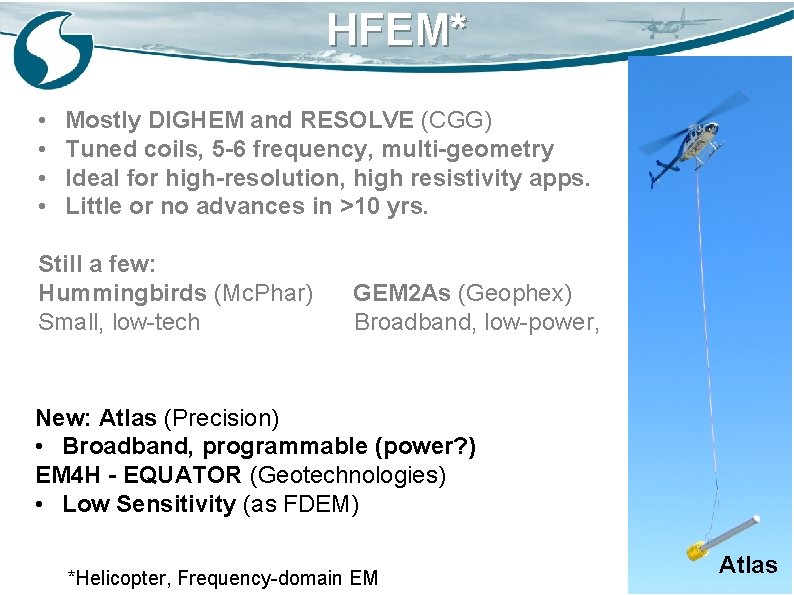
HFEM* • • Mostly DIGHEM and RESOLVE (CGG) Tuned coils, 5 -6 frequency, multi-geometry Ideal for high-resolution, high resistivity apps. Little or no advances in >10 yrs. Still a few: Hummingbirds (Mc. Phar) Small, low-tech GEM 2 As (Geophex) Broadband, low-power, New: Atlas (Precision) • Broadband, programmable (power? ) EM 4 H - EQUATOR (Geotechnologies) • Low Sensitivity (as FDEM) *Helicopter, Frequency-domain EM Atlas
FTEM* A declining field, lost mostly to HTEM • MEGATEM II (CGG) - once the most powerful EM • in palliative care. Not likely to ever fly again. CGG pulled GEOTEM: focused on TEMPEST on Cessna 208 • 60 k Am^2, squar(ish) waveform. Spectrem offers upgraded (460 k. Am 2) Spectrem - but one only. *Fixed-wing, Time-domain EM
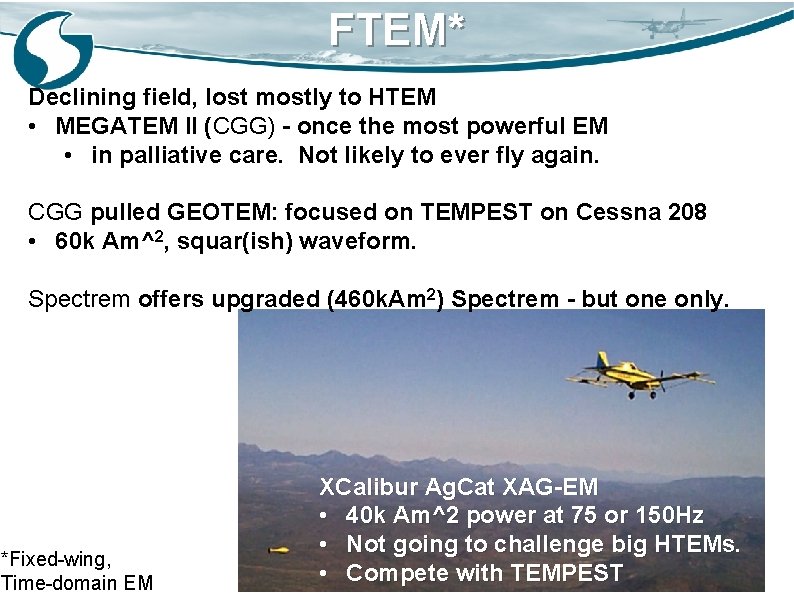
FTEM* Declining field, lost mostly to HTEM • MEGATEM II (CGG) - once the most powerful EM • in palliative care. Not likely to ever fly again. CGG pulled GEOTEM: focused on TEMPEST on Cessna 208 • 60 k Am^2, squar(ish) waveform. Spectrem offers upgraded (460 k. Am 2) Spectrem - but one only. *Fixed-wing, Time-domain EM XCalibur Ag. Cat XAG-EM • 40 k Am^2 power at 75 or 150 Hz • Not going to challenge big HTEMs. • Compete with TEMPEST
HTEM* • Despite abysmal market, pace of development goes on. – (More people with time on their hands? ) • More types of HTEM (>25? ) than all the others put together. – Lower cost to build and own and mobilize than FTEM – More power AND better resolution – Lot of TDEM expertise Race to Max power has ended? Now more about S/N *Helicopter, Time-domain EM
HTEM* New Developments Big players broadening applications Geotech: • higher power (see above) • light systems • signal processing to extend conductor range CGG: • dropped highest power, Tx-centered receivers • MULTIPULSE • 15 Hz Sky. TEM: • more efficient operation (Sky. TEMFAST) • dropped smallest *Helicopter, Time-domain EM
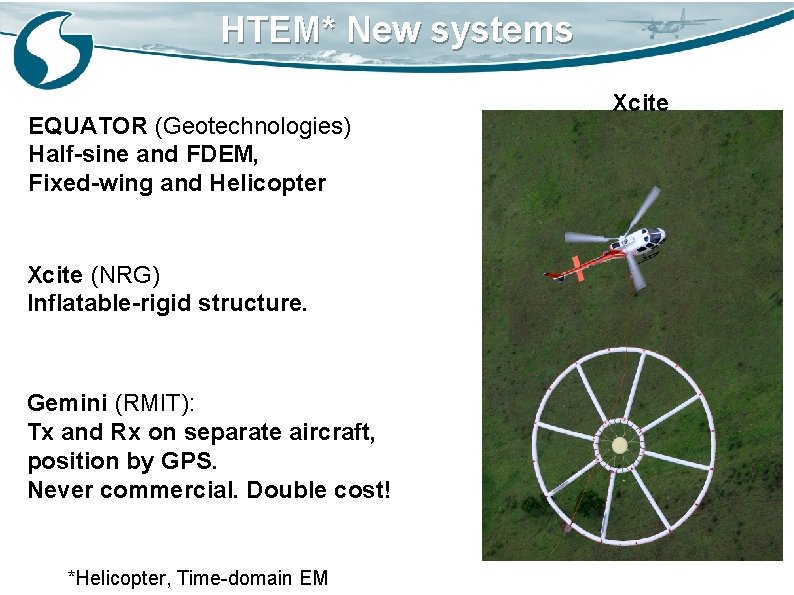
HTEM* New systems EQUATOR (Geotechnologies) Half-sine and FDEM, Fixed-wing and Helicopter Xcite (NRG) Inflatable-rigid structure. Gemini (RMIT): Tx and Rx on separate aircraft, position by GPS. Never commercial. Double cost! *Helicopter, Time-domain EM Xcite
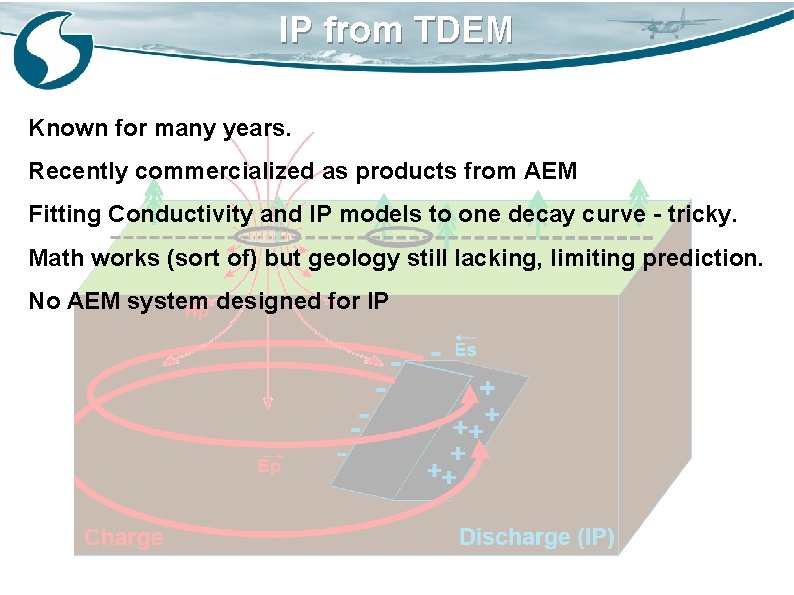
IP from TDEM Known for many years. Recently commercialized as products from AEM Fitting Conductivity and IP models to one decay curve - tricky. Math works (sort of) but geology still lacking, limiting prediction. No AEM system designed for IP
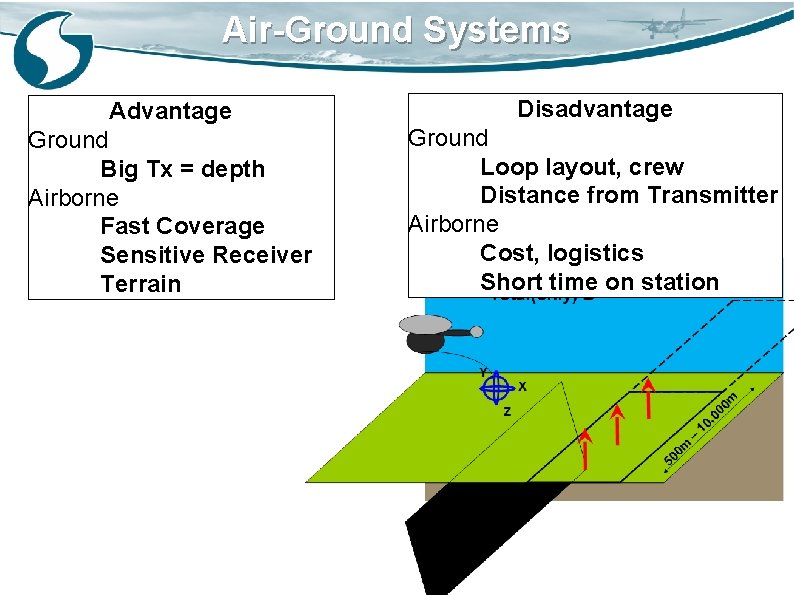
Air-Ground Systems Advantage Ground Big Tx = depth Airborne Fast Coverage Sensitive Receiver Terrain Disadvantage Ground Loop layout, crew Distance from Transmitter Airborne Cost, logistics Short time on station
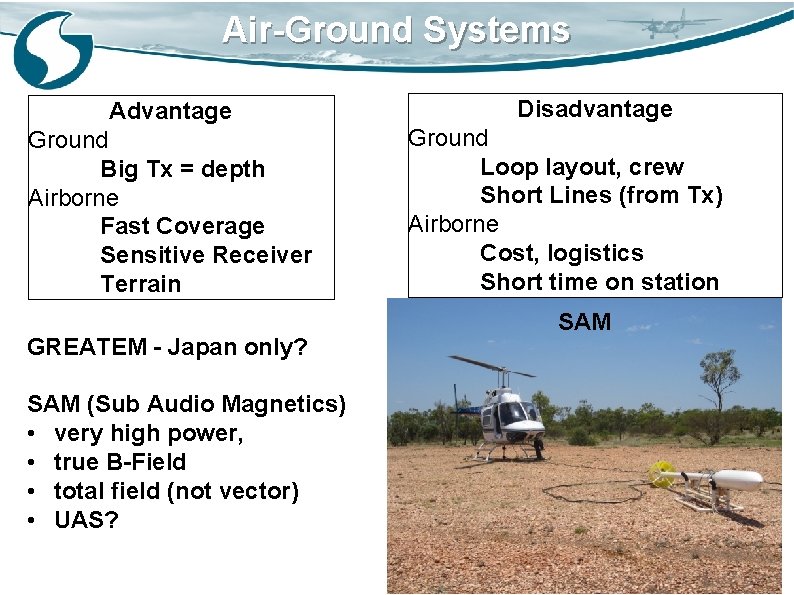
Air-Ground Systems Advantage Ground Big Tx = depth Airborne Fast Coverage Sensitive Receiver Terrain GREATEM - Japan only? SAM (Sub Audio Magnetics) • very high power, • true B-Field • total field (not vector) • UAS? Disadvantage Ground Loop layout, crew Short Lines (from Tx) Airborne Cost, logistics Short time on station SAM
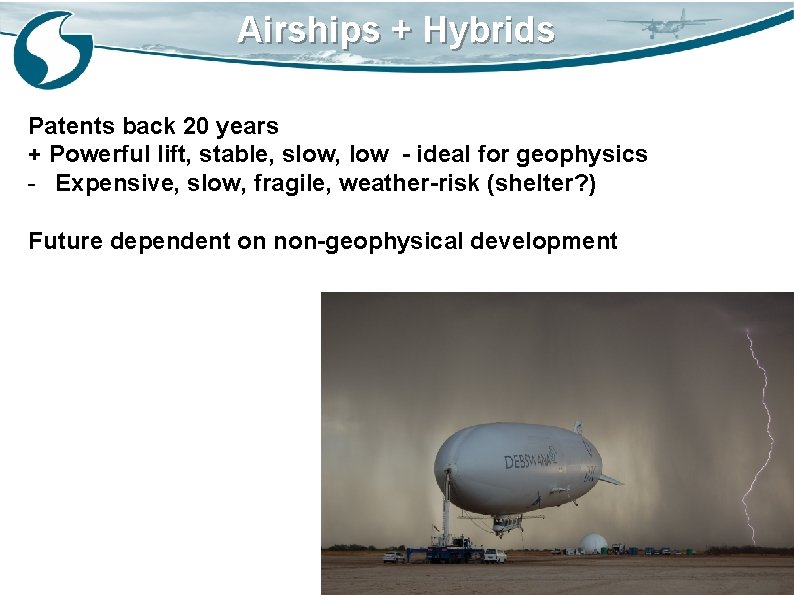
Airships + Hybrids Patents back 20 years + Powerful lift, stable, slow, low - ideal for geophysics - Expensive, slow, fragile, weather-risk (shelter? ) Future dependent on non-geophysical development
All-in-One Systems Gravity and EM as well as gamma-spectrometry and mag. (No one offers hyperspectral) AGG and EM: BHPB: Falcon and RESOLVE - geophysically effective but inefficient (fuel and flight parameters) CGG Gryphon (Falcon, MEGATEM) • Not a commercial success. Too expensive in hard times ? • No available aircraft. “I’m not dead yet!”
All-in-One Systems Gravity and EM as well as gamma-spectrometry and mag. (No one offers hyperspectral) AGG and EM: BHPB: Falcon and RESOLVE - geophysically effective but inefficient (fuel and flight parameters) CGG Gryphon (Falcon, MEGATEM) • Not a commercial success. Too expensive in hard times? • No available aircraft. On Offer: (If not regularly operational) Spectrem: TAGS and Spectrem TDEM Sander: AIRGrav and FDEM in Twin Otter Geotech: GT 2 A and ZTEM on Helicopter (fuel? ) All gravity - no AGG. Cost?
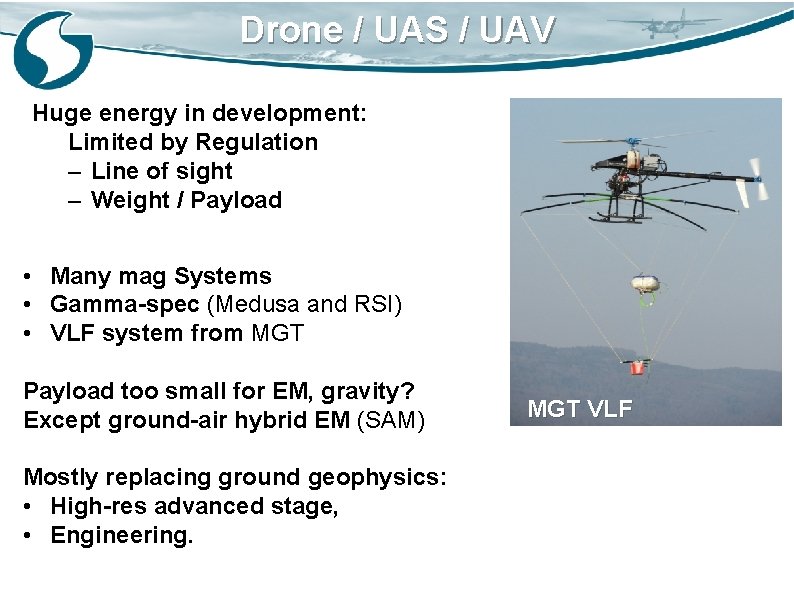
Drone / UAS / UAV Huge energy in development: Limited by Regulation – Line of sight – Weight / Payload • Many mag Systems • Gamma-spec (Medusa and RSI) • VLF system from MGT Payload too small for EM, gravity? Except ground-air hybrid EM (SAM) Mostly replacing ground geophysics: • High-res advanced stage, • Engineering. MGT VLF
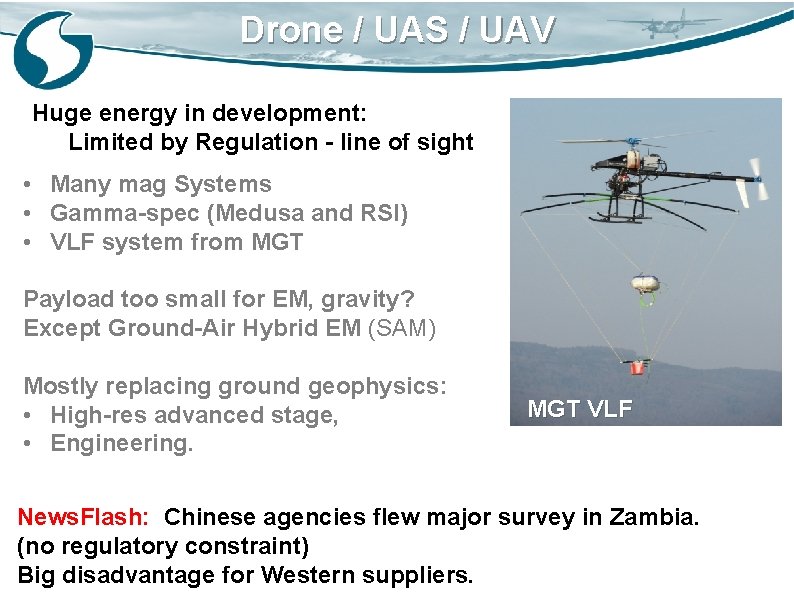
Drone / UAS / UAV Huge energy in development: Limited by Regulation - line of sight • Many mag Systems • Gamma-spec (Medusa and RSI) • VLF system from MGT Payload too small for EM, gravity? Except Ground-Air Hybrid EM (SAM) Mostly replacing ground geophysics: • High-res advanced stage, • Engineering. MGT VLF News. Flash: Chinese agencies flew major survey in Zambia. (no regulatory constraint) Big disadvantage for Western suppliers.
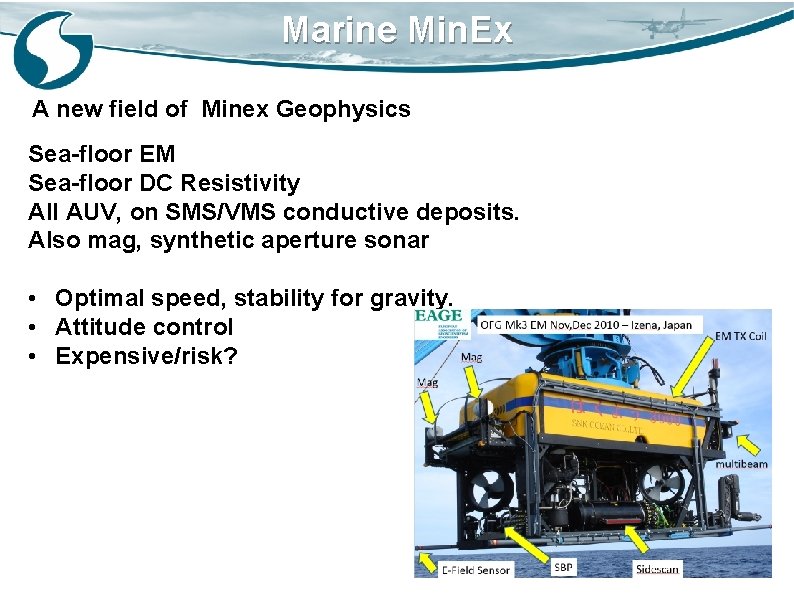
Marine Min. Ex A new field of Minex Geophysics Sea-floor EM Sea-floor DC Resistivity All AUV, on SMS/VMS conductive deposits. Also mag, synthetic aperture sonar • Optimal speed, stability for gravity. • Attitude control • Expensive/risk?
Next Ten Years Magnetic: Vector mag Gamma-ray: Small, Hi-Res sensors (for Env. and Eng) Gravity: Vector options. Harder competition from AGG: Better sensitivity, smaller units, AG+AGG combinations More options (not ITAR-restricted). FTEM: Smaller systems for mapping FDEM: Niche systems for multi-method mapping HFEM: Continued niche application. Needs marketing for E&E. HTEM: Fierce competition continues.
Next Ten Years Airships: Further testing and experimentation Too expensive in current markets All-in One: Need lower cost systems with mapping-suitable resolution Drones: Env and Eng applications in Developed world Exploration applications in Third world? Marine: Continued growth in systems and technology as marine mining is developed.
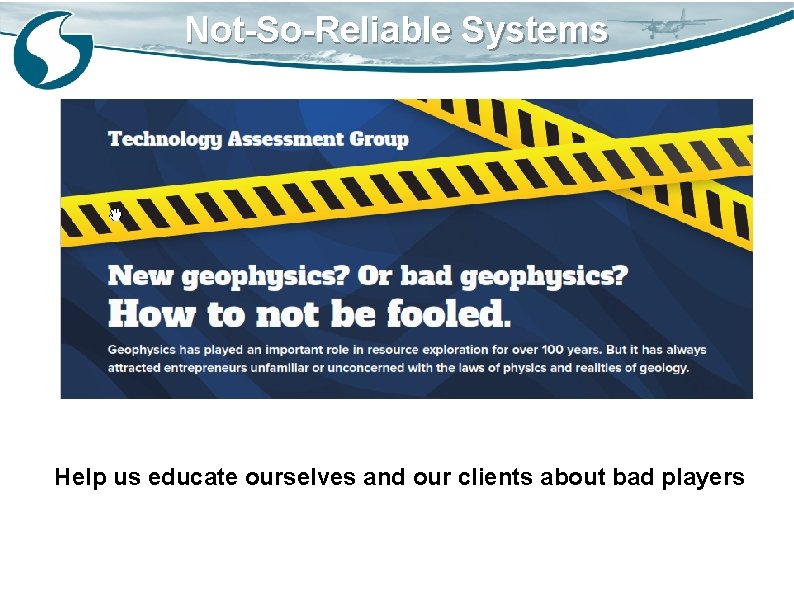
Not-So-Reliable Systems Help us educate ourselves and our clients about bad players
- Slides: 33