
Sand surface area of between 1 2 square
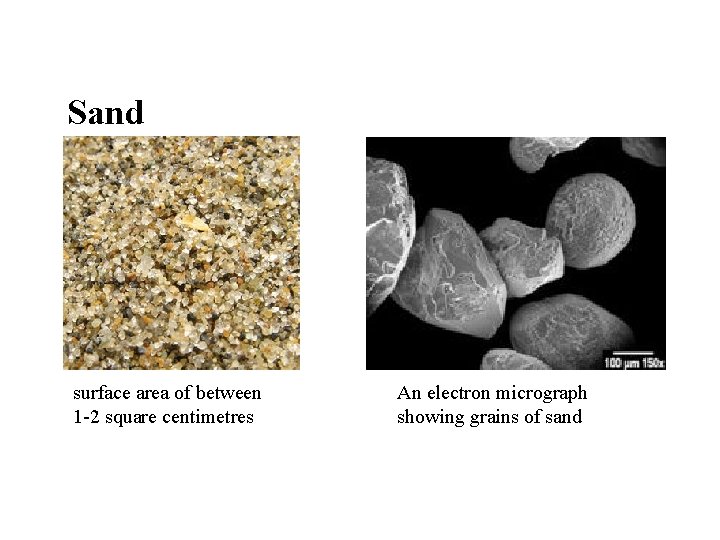
Sand surface area of between 1 -2 square centimetres An electron micrograph showing grains of sand
Sand is a granular material made up of fine mineral particles. It is a naturally occurring, finely divided rock. Sand comprises particles, or granules, ranging in diameter from 0. 0625 (or 1⁄16 mm) to 2 millimeters. An individual particle in this range size is termed a sand grain. The next larger size class above sand is gravel, with particles ranging from 2 mm up to 64 mm. The most common constituent of sand is silica (silicon dioxide, or Si. O 2), usually in the form of quartz, which, because of its chemical inertness and considerable hardness, is resistant to weathering. The composition of sand is highly variable, depending on the local rock sources and conditions.
Sand is a fine aggregate which shall pass through IS sieve No. 480 (3/16" in B. S) test sieve leaving a residue not more than 5%. Sampling Mix thoroughly each sample of sand separately and collect representative sample for examination Purity of sand Sand is an important constituent of mortars, and for satisfactory performance, its requirements for cleanliness, freedom from impurities and particles size grading will depend on the purpose for which the mortar is used, namely whether in masonry work, in undercoat or finishing coat of plaster-work, etc.
Specifications of sand Sand in general shall comply with the requirements as detailed below : v. Description The sand shall consist of natural sand, crushed stone sand, or crushed gravel sand, or a combination of any of these. The sand shall be hard, durable, chemically inert, clean and free from adherent coatings, particles of shells, and organic matter and shall not contain any appreciable amount of clay balls or pellets.
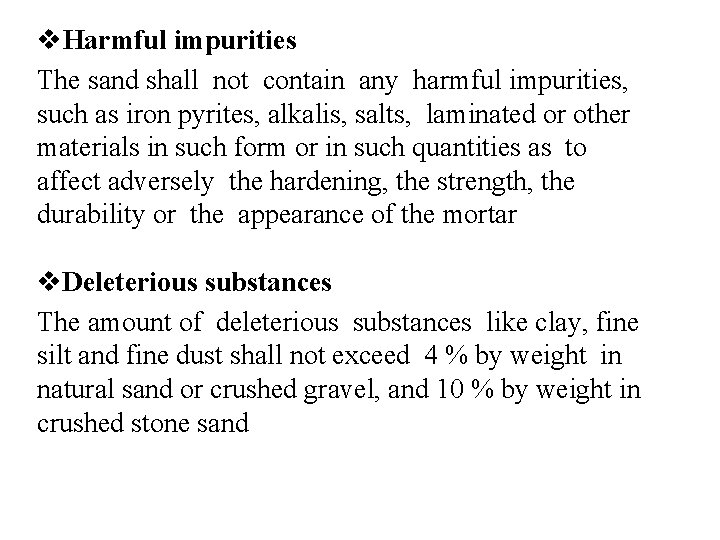
v. Harmful impurities The sand shall not contain any harmful impurities, such as iron pyrites, alkalis, salts, laminated or other materials in such form or in such quantities as to affect adversely the hardening, the strength, the durability or the appearance of the mortar v. Deleterious substances The amount of deleterious substances like clay, fine silt and fine dust shall not exceed 4 % by weight in natural sand or crushed gravel, and 10 % by weight in crushed stone sand
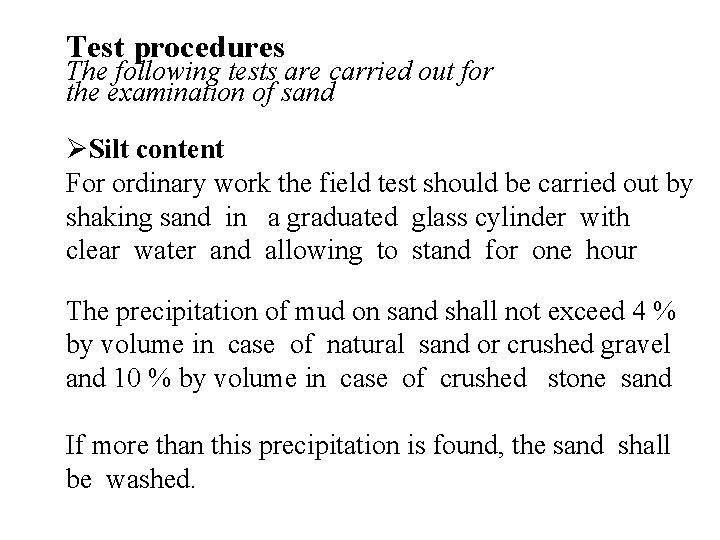
Test procedures The following tests are carried out for the examination of sand ØSilt content For ordinary work the field test should be carried out by shaking sand in a graduated glass cylinder with clear water and allowing to stand for one hour The precipitation of mud on sand shall not exceed 4 % by volume in case of natural sand or crushed gravel and 10 % by volume in case of crushed stone sand If more than this precipitation is found, the sand shall be washed.
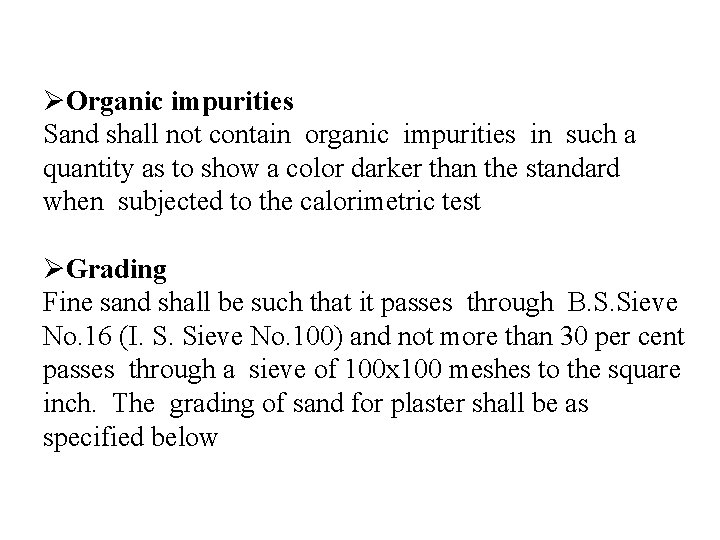
ØOrganic impurities Sand shall not contain organic impurities in such a quantity as to show a color darker than the standard when subjected to the calorimetric test ØGrading Fine sand shall be such that it passes through B. S. Sieve No. 16 (I. S. Sieve No. 100) and not more than 30 per cent passes through a sieve of 100 x 100 meshes to the square inch. The grading of sand for plaster shall be as specified below
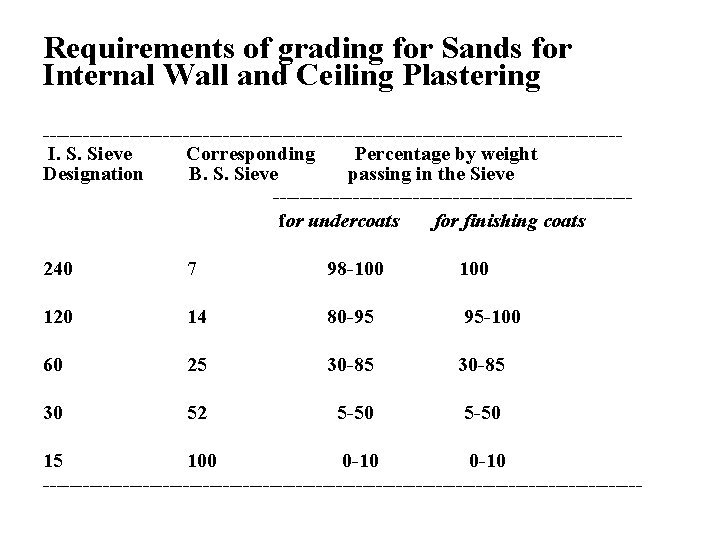
Requirements of grading for Sands for Internal Wall and Ceiling Plastering -------------------------------------------I. S. Sieve Corresponding Percentage by weight Designation B. S. Sieve passing in the Sieve ---------------------------for undercoats for finishing coats 240 7 98 -100 120 14 80 -95 95 -100 60 25 30 -85 30 52 5 -50 15 100 0 -10 ---------------------------------------------
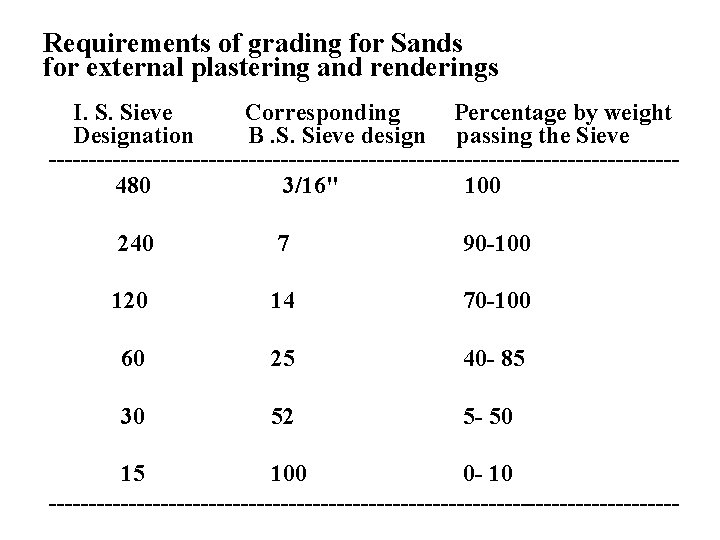
Requirements of grading for Sands for external plastering and renderings I. S. Sieve Corresponding Percentage by weight Designation B. S. Sieve design passing the Sieve ---------------------------------------480 3/16" 100 240 7 90 -100 120 14 70 -100 60 25 40 - 85 30 52 5 - 50 15 100 0 - 10 ----------------------------------------
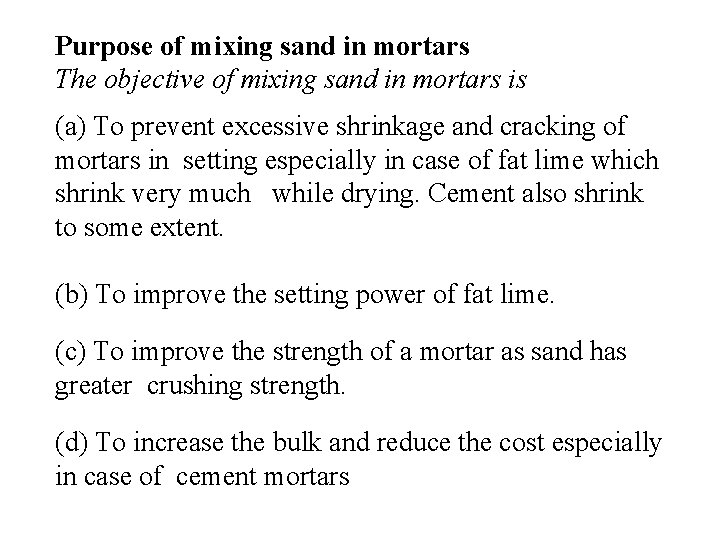
Purpose of mixing sand in mortars The objective of mixing sand in mortars is (a) To prevent excessive shrinkage and cracking of mortars in setting especially in case of fat lime which shrink very much while drying. Cement also shrink to some extent. (b) To improve the setting power of fat lime. (c) To improve the strength of a mortar as sand has greater crushing strength. (d) To increase the bulk and reduce the cost especially in case of cement mortars
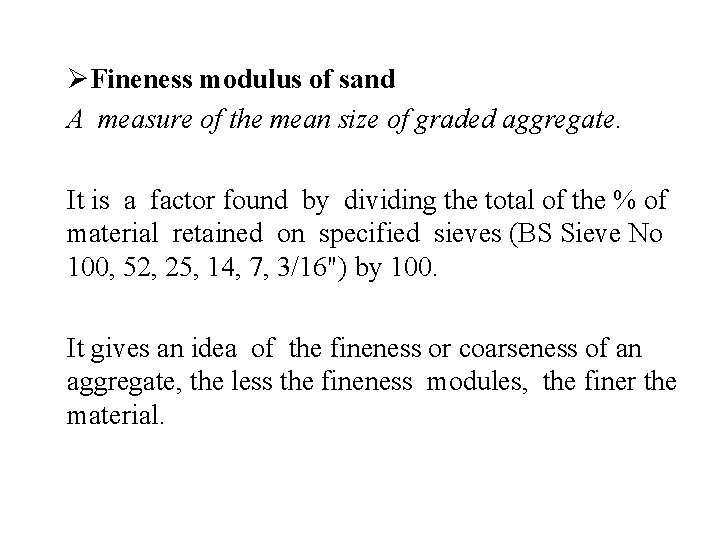
ØFineness modulus of sand A measure of the mean size of graded aggregate. It is a factor found by dividing the total of the % of material retained on specified sieves (BS Sieve No 100, 52, 25, 14, 7, 3/16") by 100. It gives an idea of the fineness or coarseness of an aggregate, the less the fineness modules, the finer the material.
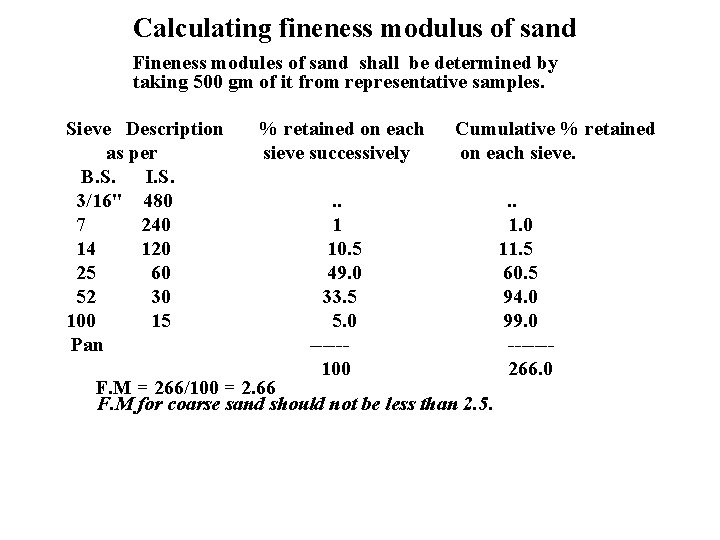
Calculating fineness modulus of sand Fineness modules of sand shall be determined by taking 500 gm of it from representative samples. Sieve Description as per B. S. I. S. 3/16" 480 7 240 14 120 25 60 52 30 100 15 Pan % retained on each sieve successively. . 1 10. 5 49. 0 33. 5 5. 0 -----100 Cumulative % retained on each sieve. F. M = 266/100 = 2. 66 F. M for coarse sand should not be less than 2. 5. . . 1. 0 11. 5 60. 5 94. 0 99. 0 ------266. 0
Stone dust It is the by product of crushing blue quartz stone for stone ballast and marble dust which is by product of crushing marble for marble chips. It shall not contain more than 4% of silt as determined in laboratory by sedimentation test with Andreasen Pipette Apparatus, and more than 8% as determined by field test with measuring cylinder. Fineness modulus of stone dust shall not be less than 1. 8
Marble dust This shall be obtained from crushing marble stone. It shall not contain more than 4% of fine dust as determined in laboratory by sedimentation test with Anderson Pipette Apparatus and more than 8% as determined by field test with measuring cylinder (IS: 383 -1952). Fineness modulus of marble dust shall not be less than 1. 0
Surkhi It is made by grounding to powder burnt bricks, brick bats or burnt clay, under burnt or over burnt bricks should not be used nor bricks containing high proportion of sand When clay is especially burnt for making into surkhi an addition of 10 to 20% of quick lime will improve quality. Surkhi performs the same function as sand but it also imparts some strength and hydraulicity. Surkhi makes cement mortars and concretes more water proof, more resistant to alkalis and to salt solutions than those in which no surkhi is used.
Surkhi (contd. ) It reduces temperature rise on hydration and reduce cracking. The proportion of surkhi recommended is 10 to 30 % but it must be ground as fine as cement. The addition of surkhi is accompanied by a slight reduction in strength as surkhi attains its full strength only after one year. Surkhi concrete is subject to a slightly higher shrinkage than ordinary concrete. Surkhi is not a standardized produce and its properties are widely variable.
Coarse sand (Badarpur sand) This shall be natural pit stand, clean, sharp, strong, granular, and composed of hard siliceous material. It shall be free from harmful impurities such as mica, shale or similar laminated materials, salts, alkalis and organic matter. It shall be obtained from Badarpur, Sona, Anangpur and any other approved quarry
Examination of coarse sand The sand shall not contain more than 4% of silt as determined in laboratory by sedimentation test with Anderson Pipette apparatus and more than 8% as determined by field test with measuring cylinder. Take 100 ml of sand in measuring cylinder and add 50 ml of water Shake vigorously and allow to settle for three hours The height of the silt visible as settled layer above sand shall be expressed as percentage of the height of sand below
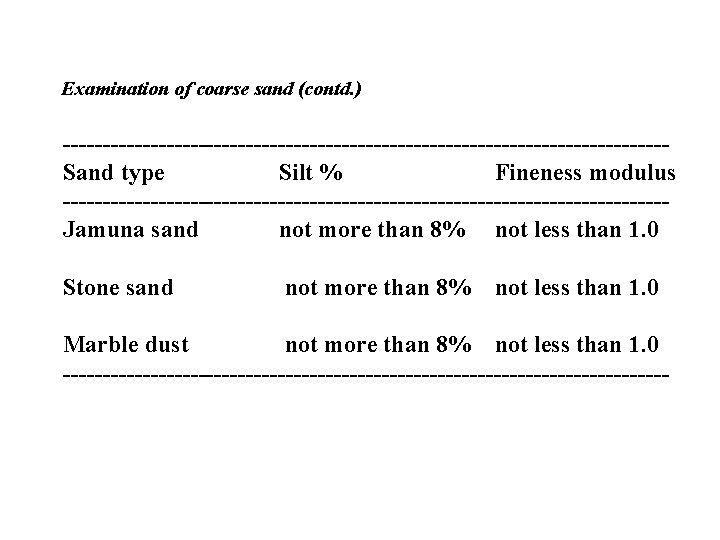
Examination of coarse sand (contd. ) --------------------------------------Sand type Silt % Fineness modulus --------------------------------------Jamuna sand not more than 8% not less than 1. 0 Stone sand not more than 8% not less than 1. 0 Marble dust not more than 8% not less than 1. 0 --------------------------------------
- Slides: 19