
Sand fly fact sheet Photo R Knechtli Appearance
- Slides: 1
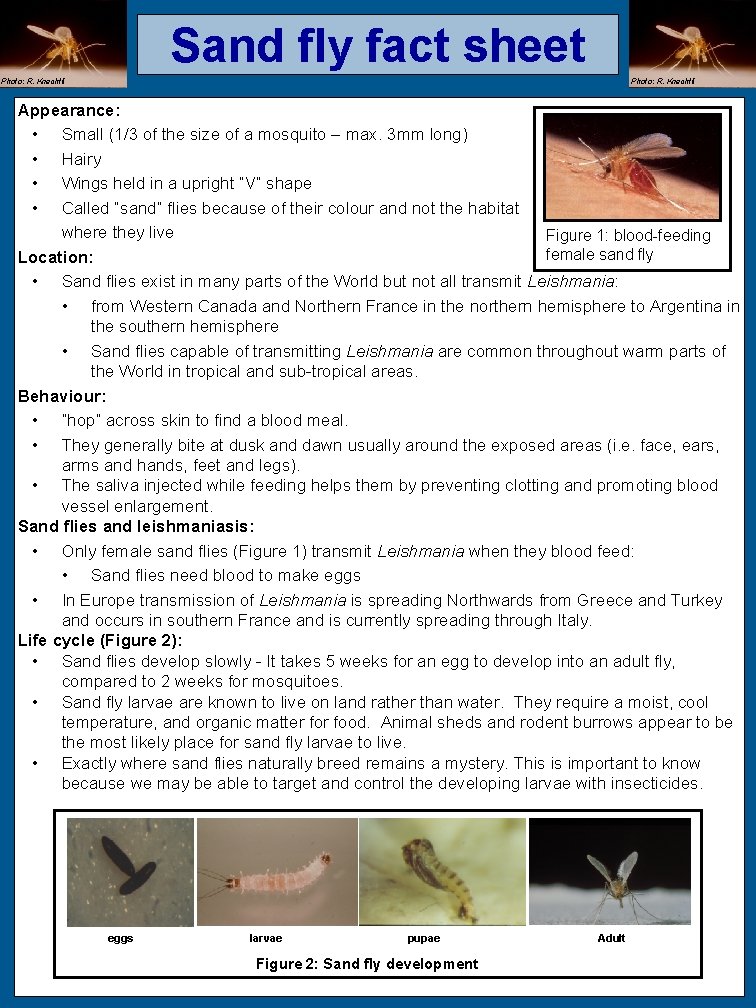
Sand fly fact sheet Photo: R. Knechtli Appearance: • Small (1/3 of the size of a mosquito – max. 3 mm long) • Hairy • Wings held in a upright “V” shape • Called “sand” flies because of their colour and not the habitat where they live Figure 1: blood-feeding female sand fly Location: • Sand flies exist in many parts of the World but not all transmit Leishmania: • from Western Canada and Northern France in the northern hemisphere to Argentina in the southern hemisphere • Sand flies capable of transmitting Leishmania are common throughout warm parts of the World in tropical and sub-tropical areas. Behaviour: • “hop” across skin to find a blood meal. • They generally bite at dusk and dawn usually around the exposed areas (i. e. face, ears, arms and hands, feet and legs). • The saliva injected while feeding helps them by preventing clotting and promoting blood vessel enlargement. Sand flies and leishmaniasis: • Only female sand flies (Figure 1) transmit Leishmania when they blood feed: • Sand flies need blood to make eggs • In Europe transmission of Leishmania is spreading Northwards from Greece and Turkey and occurs in southern France and is currently spreading through Italy. Life cycle (Figure 2): • Sand flies develop slowly - It takes 5 weeks for an egg to develop into an adult fly, compared to 2 weeks for mosquitoes. • Sand fly larvae are known to live on land rather than water. They require a moist, cool temperature, and organic matter food. Animal sheds and rodent burrows appear to be the most likely place for sand fly larvae to live. • Exactly where sand flies naturally breed remains a mystery. This is important to know because we may be able to target and control the developing larvae with insecticides. eggs larvae pupae Figure 2: Sand fly development Adult