
San Bernardino Community College District Enrollment Management College
San Bernardino Community College District Enrollment Management: College Reports 2016 -2017 Diana Rodriguez, President, San Bernardino Valley College Dr. Wei Zhou, President, Crafton Hills College
SBCCD Enrollment Management Plan The purpose of the Enrollment Management plan is to create a responsive, flexible, educationally sound, research based approach to enrollment management. The end result was the creation of an Enrollment Management Plan that is intended to ensure the following: § The achievement of enrollment targets in order to obtain maximum resources available to SBCCD. § Maintain student access and pathways consistent with educational quality. § Offer a well-balanced and varied schedule responsive to the needs of our students and community. § Maintain a comprehensive educational program that is responsive to the needs of our students and community.
SBVC Enrollment Goals SBVC has and will continue to focus on enrollment growth while the State is funding FTES growth and the growth incentives are available. To grow, SBVC will continue to maintain its strong general education, transfer and occupational program offerings, while simultaneously enhancing educational opportunities utilizing the following strategies: Online Degree / Certificate Evening / Weekend College Program Non-Credit Program Off-Site locations § Dual / Concurrent Enrollment / AB 288 § AB 540 Student Populations § Increased Efficiency § §
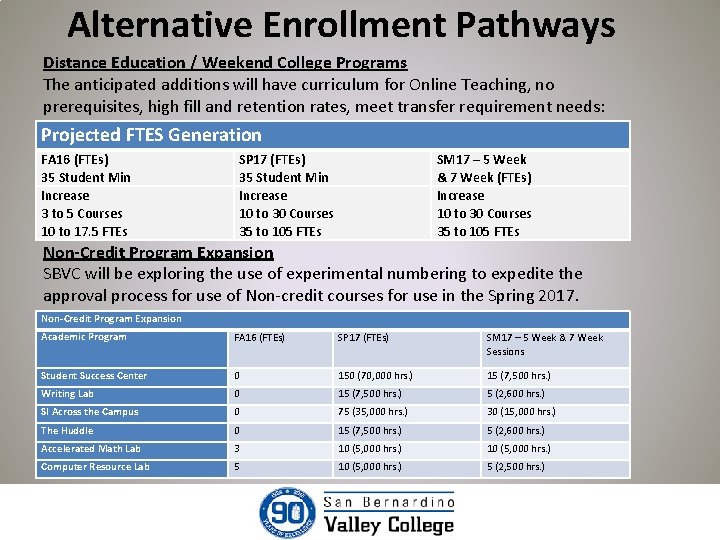
Alternative Enrollment Pathways Distance Education / Weekend College Programs The anticipated additions will have curriculum for Online Teaching, no prerequisites, high fill and retention rates, meet transfer requirement needs: Projected FTES Generation FA 16 (FTEs) 35 Student Min Increase 3 to 5 Courses 10 to 17. 5 FTEs SP 17 (FTEs) 35 Student Min Increase 10 to 30 Courses 35 to 105 FTEs SM 17 – 5 Week & 7 Week (FTEs) Increase 10 to 30 Courses 35 to 105 FTEs Non-Credit Program Expansion SBVC will be exploring the use of experimental numbering to expedite the approval process for use of Non-credit courses for use in the Spring 2017. Non-Credit Program Expansion Academic Program FA 16 (FTEs) SP 17 (FTEs) SM 17 – 5 Week & 7 Week Sessions Student Success Center 0 150 (70, 000 hrs. ) 15 (7, 500 hrs. ) Writing Lab 0 15 (7, 500 hrs. ) 5 (2, 600 hrs. ) SI Across the Campus 0 75 (35, 000 hrs. ) 30 (15, 000 hrs. ) The Huddle 0 15 (7, 500 hrs. ) 5 (2, 600 hrs. ) Accelerated Math Lab 3 10 (5, 000 hrs. ) Computer Resource Lab 5 10 (5, 000 hrs. ) 5 (2, 500 hrs. )
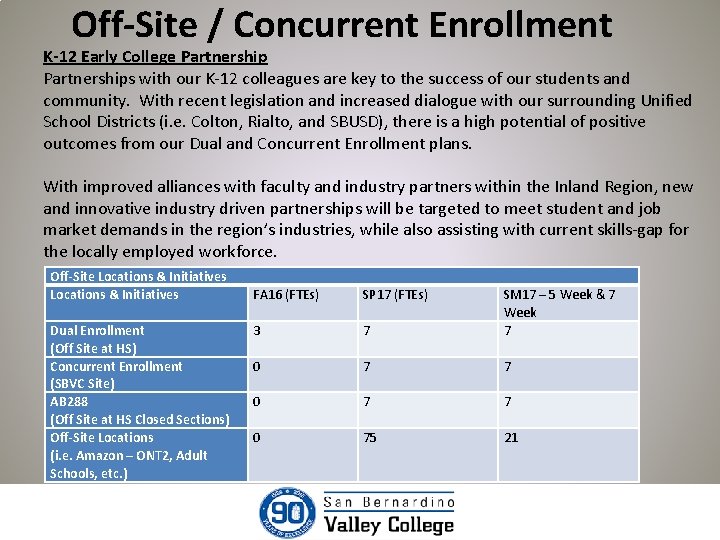
Off-Site / Concurrent Enrollment K-12 Early College Partnerships with our K-12 colleagues are key to the success of our students and community. With recent legislation and increased dialogue with our surrounding Unified School Districts (i. e. Colton, Rialto, and SBUSD), there is a high potential of positive outcomes from our Dual and Concurrent Enrollment plans. With improved alliances with faculty and industry partners within the Inland Region, new and innovative industry driven partnerships will be targeted to meet student and job market demands in the region’s industries, while also assisting with current skills-gap for the locally employed workforce. Off-Site Locations & Initiatives Dual Enrollment (Off Site at HS) Concurrent Enrollment (SBVC Site) AB 288 (Off Site at HS Closed Sections) Off-Site Locations (i. e. Amazon – ONT 2, Adult Schools, etc. ) FA 16 (FTEs) SP 17 (FTEs) 3 0 7 SM 17 – 5 Week & 7 Week 7 7 7 0 75 21
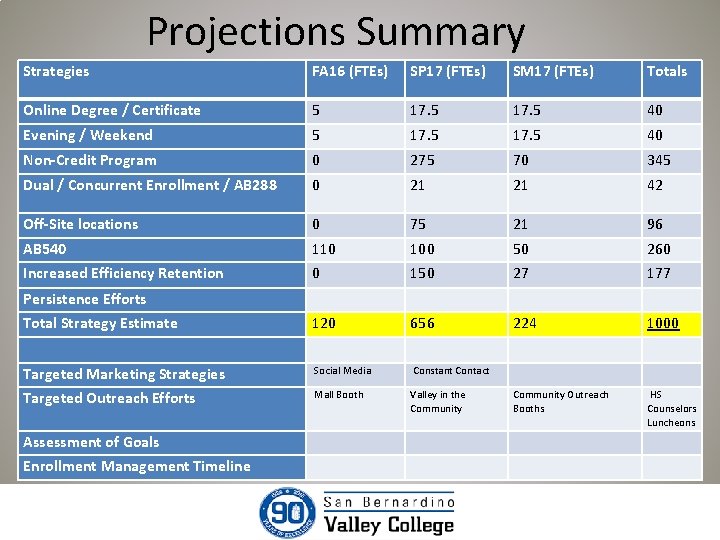
Projections Summary Strategies FA 16 (FTEs) SP 17 (FTEs) SM 17 (FTEs) Totals Online Degree / Certificate 5 17. 5 40 Evening / Weekend 5 17. 5 40 Non-Credit Program 0 275 70 345 Dual / Concurrent Enrollment / AB 288 0 21 21 42 Off-Site locations 0 75 21 96 AB 540 110 100 50 260 Increased Efficiency Retention 0 150 27 177 Persistence Efforts Total Strategy Estimate 120 656 224 1000 Targeted Marketing Strategies Social Media Constant Contact Targeted Outreach Efforts Mall Booth Valley in the Community Outreach Booths HS Counselors Luncheons Assessment of Goals Enrollment Management Timeline
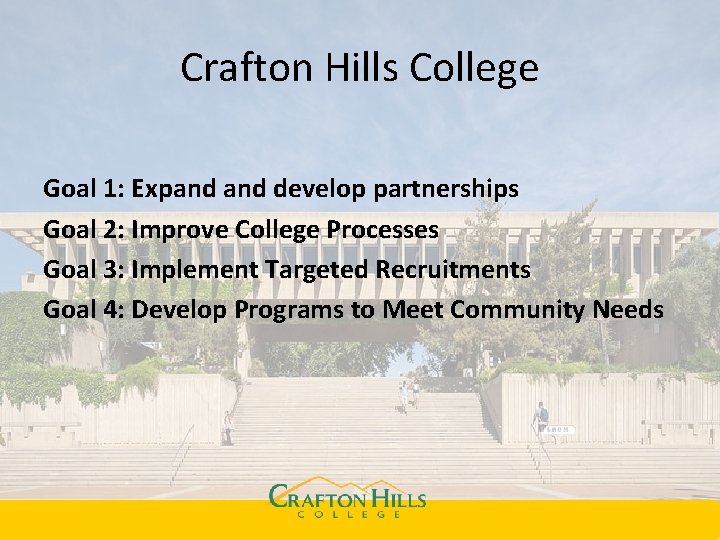
Crafton Hills College Goal 1: Expand develop partnerships Goal 2: Improve College Processes Goal 3: Implement Targeted Recruitments Goal 4: Develop Programs to Meet Community Needs
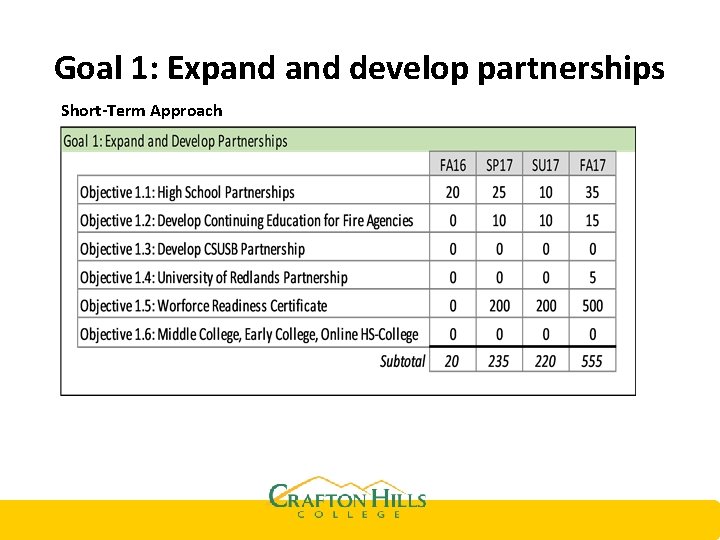
Goal 1: Expand develop partnerships Short-Term Approach
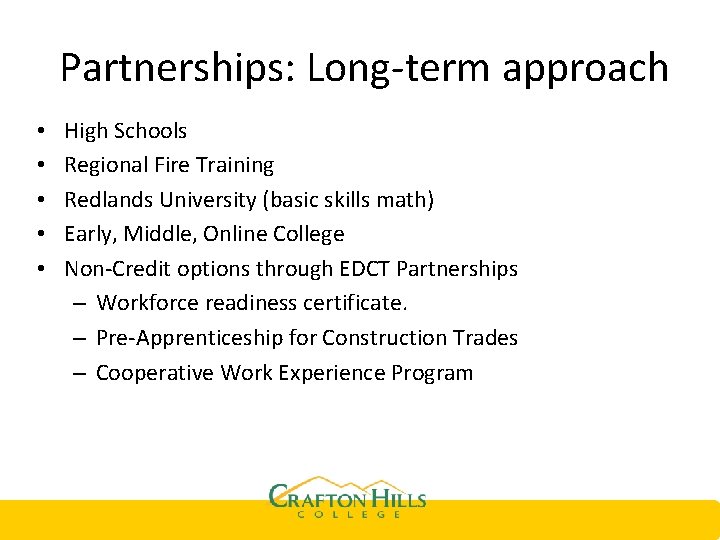
Partnerships: Long-term approach • • • High Schools Regional Fire Training Redlands University (basic skills math) Early, Middle, Online College Non-Credit options through EDCT Partnerships – Workforce readiness certificate. – Pre-Apprenticeship for Construction Trades – Cooperative Work Experience Program
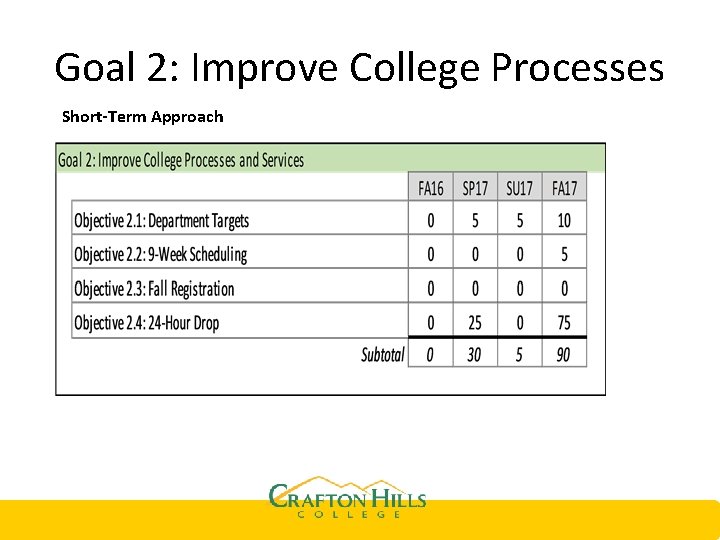
Goal 2: Improve College Processes Short-Term Approach
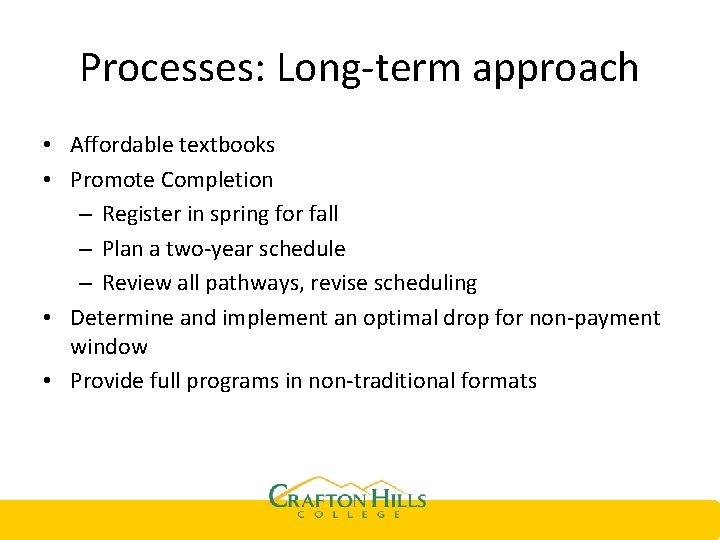
Processes: Long-term approach • Affordable textbooks • Promote Completion – Register in spring for fall – Plan a two-year schedule – Review all pathways, revise scheduling • Determine and implement an optimal drop for non-payment window • Provide full programs in non-traditional formats
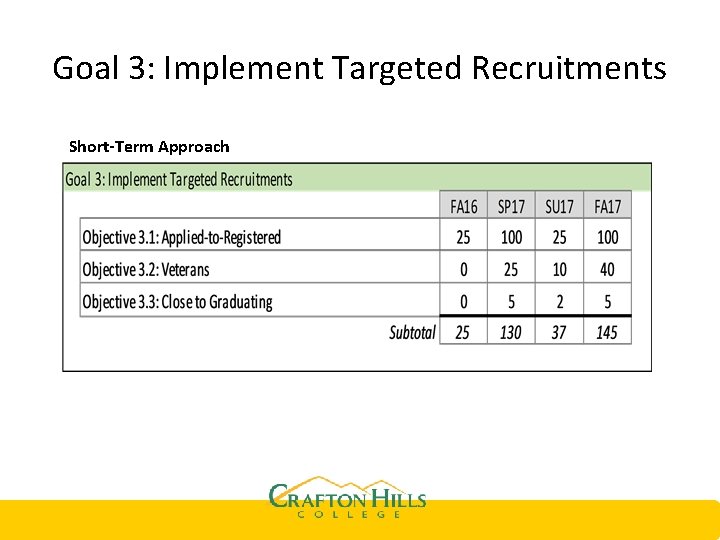
Goal 3: Implement Targeted Recruitments Short-Term Approach
Targeted Recruitment: Long-term approach • • Re-entry program Veterans Working Adults Individuals with Disabilities
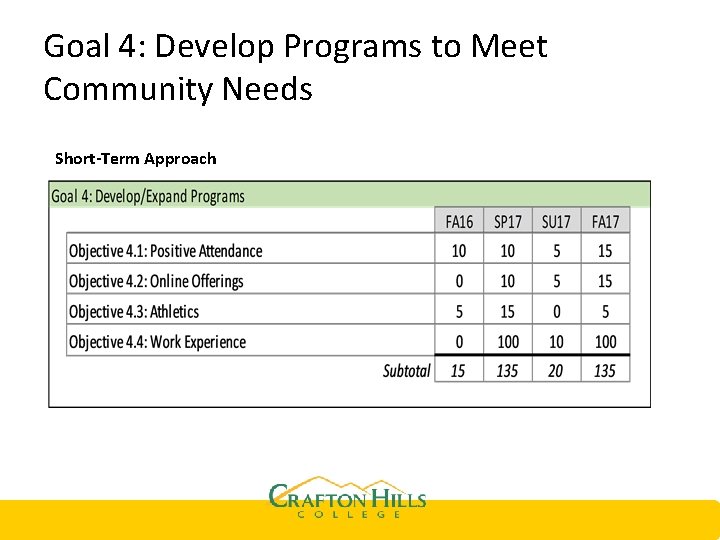
Goal 4: Develop Programs to Meet Community Needs Short-Term Approach
Meeting community needs: Long-term approach • Expand online education • Develop credit and non-credit pathway options: – career choice, college re-entry, parenting skills, and family financial planning • Develop programs that meet market demands
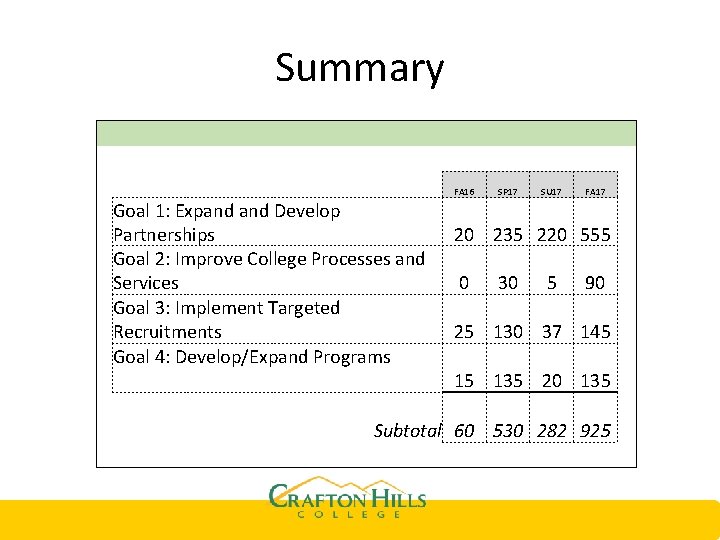
Summary Goal 1: Expand Develop Partnerships Goal 2: Improve College Processes and Services Goal 3: Implement Targeted Recruitments Goal 4: Develop/Expand Programs FA 16 SP 17 SU 17 FA 17 20 235 220 555 0 30 5 90 25 130 37 145 15 135 20 135 Subtotal 60 530 282 925
- Slides: 16