
SAMPLING WITH SKITTLES Methods of Sampling Random Opportunity

- Slides: 11
SAMPLING WITH SKITTLES
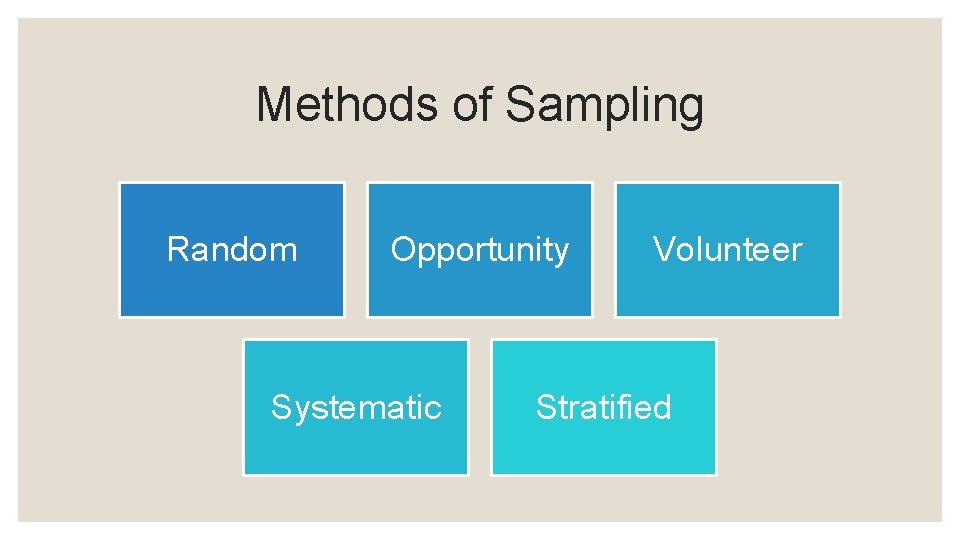
Methods of Sampling Random Opportunity Systematic Volunteer Stratified
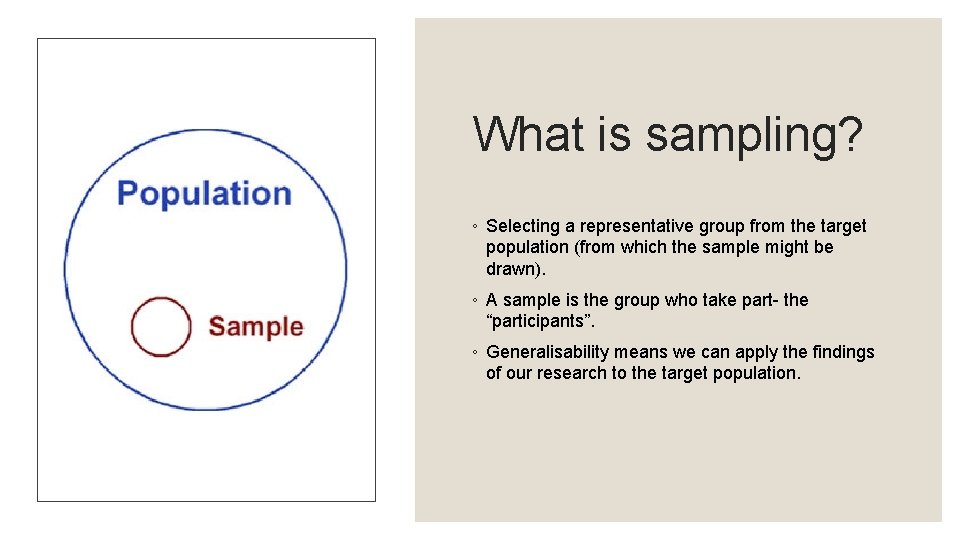
What is sampling? ◦ Selecting a representative group from the target population (from which the sample might be drawn). ◦ A sample is the group who take part- the “participants”. ◦ Generalisability means we can apply the findings of our research to the target population.
Random Sampling ◦ Everyone in the target population has an equal chance of being selected. ◦ National lottery. “Population” is everyone who has bought a lottery ticket, then each person has an equal chance of winning the lottery (assuming they all have one ticket each). ◦ Random samples can be taken through drawing names from a hat or using a random number generator. ◦ The advantages are that your sample should represent the target population and eliminate sampling bias therefore increasing population validity as it is more likely to represent the target population. ◦ The disadvantage is that it is very difficult to achieve (i. e. time, effort and money) and there is an argument to suggest that samples are rarely random as even if taken from one place, that place will too have innate biases e. g. a school.
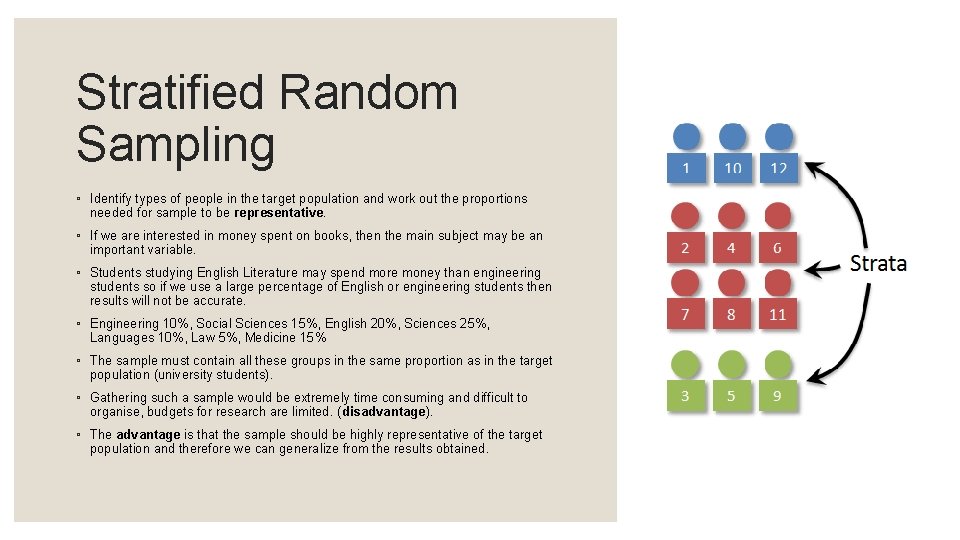
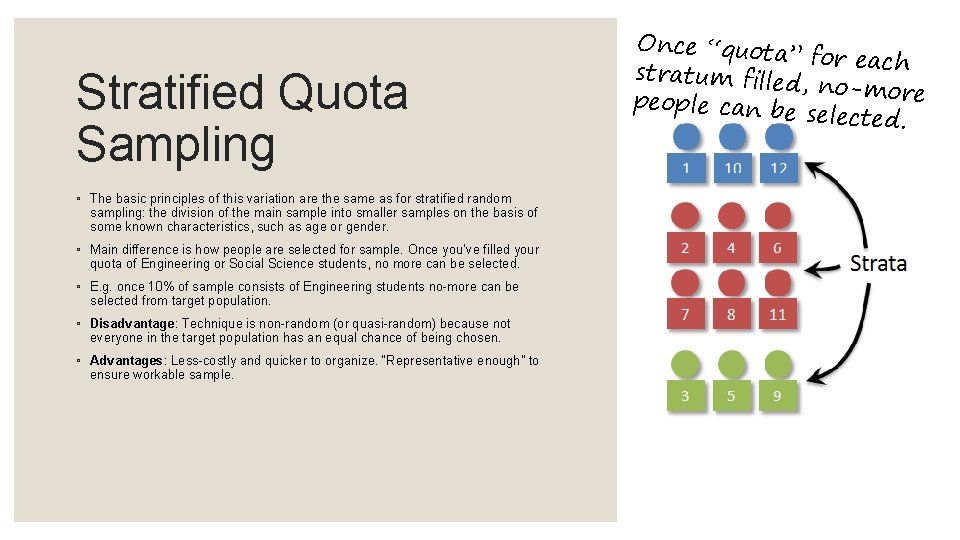
Stratified Random Sampling ◦ Identify types of people in the target population and work out the proportions needed for sample to be representative. ◦ If we are interested in money spent on books, then the main subject may be an important variable. ◦ Students studying English Literature may spend more money than engineering students so if we use a large percentage of English or engineering students then results will not be accurate. ◦ Engineering 10%, Social Sciences 15%, English 20%, Sciences 25%, Languages 10%, Law 5%, Medicine 15% ◦ The sample must contain all these groups in the same proportion as in the target population (university students). ◦ Gathering such a sample would be extremely time consuming and difficult to organise, budgets for research are limited. (disadvantage). ◦ The advantage is that the sample should be highly representative of the target population and therefore we can generalize from the results obtained.
Stratified Quota Sampling ◦ The basic principles of this variation are the same as for stratified random sampling: the division of the main sample into smaller samples on the basis of some known characteristics, such as age or gender. ◦ Main difference is how people are selected for sample. Once you’ve filled your quota of Engineering or Social Science students, no more can be selected. ◦ E. g. once 10% of sample consists of Engineering students no-more can be selected from target population. ◦ Disadvantage: Technique is non-random (or quasi-random) because not everyone in the target population has an equal chance of being chosen. ◦ Advantages: Less-costly and quicker to organize. “Representative enough” to ensure workable sample. Once “quota” for each stratum filled , no-more people can be selected.
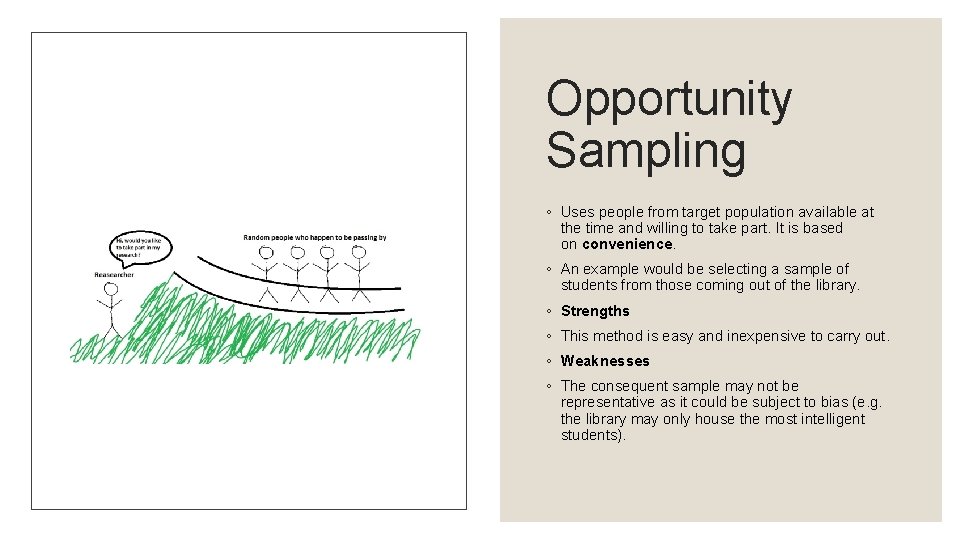
Opportunity Sampling ◦ Uses people from target population available at the time and willing to take part. It is based on convenience. ◦ An example would be selecting a sample of students from those coming out of the library. ◦ Strengths ◦ This method is easy and inexpensive to carry out. ◦ Weaknesses ◦ The consequent sample may not be representative as it could be subject to bias (e. g. the library may only house the most intelligent students).
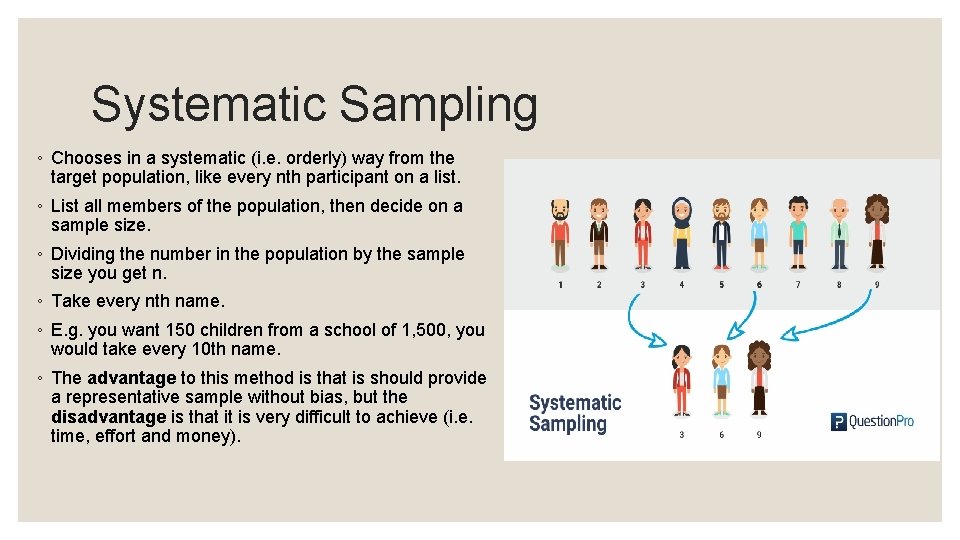
Systematic Sampling ◦ Chooses in a systematic (i. e. orderly) way from the target population, like every nth participant on a list. ◦ List all members of the population, then decide on a sample size. ◦ Dividing the number in the population by the sample size you get n. ◦ Take every nth name. ◦ E. g. you want 150 children from a school of 1, 500, you would take every 10 th name. ◦ The advantage to this method is that is should provide a representative sample without bias, but the disadvantage is that it is very difficult to achieve (i. e. time, effort and money).
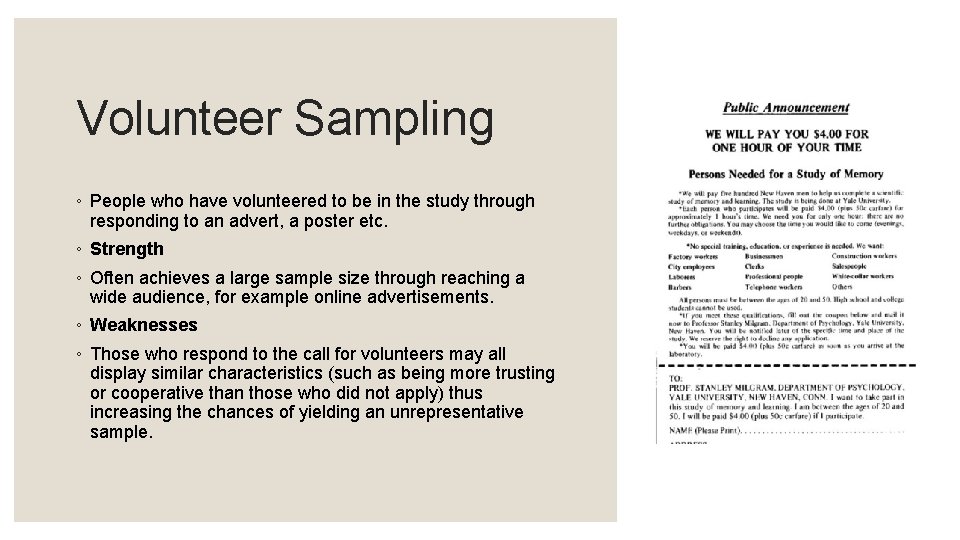
Volunteer Sampling ◦ People who have volunteered to be in the study through responding to an advert, a poster etc. ◦ Strength ◦ Often achieves a large sample size through reaching a wide audience, for example online advertisements. ◦ Weaknesses ◦ Those who respond to the call for volunteers may all display similar characteristics (such as being more trusting or cooperative than those who did not apply) thus increasing the chances of yielding an unrepresentative sample.
Instructions ◦ Your task is to experiment with the different methods of sampling, using skittles as your participants. ◦ You will create each of the five sample types, recording the number of each colour skittle you obtain in your sample and the percentage. ◦ Thereafter, you will evaluate your samples, based upon how representative your sample is in relation to the target population.
Sampling with Skittles ◦ Which sampling method was the most representative of your target population? ◦ Which sampling method was the least representative of your target population? ◦ Which of the above sampling methods took the longest to complete? ◦ Why might this be an issue for researchers? ◦ Were there any sampling methods where you struggled to recruit 25 participants. ◦ Why might this method be problematic in the real world? ◦ Which sampling method is the best and why?