
Sampling Theory Statistics Dr B Chandrasekhara Reddy M

Sampling Theory Statistics Dr. B. Chandrasekhara Reddy, M. Sc. , Ph. D. SR Govt. Degree College, Punganur Email. Id : csr. bhumireddy@gmail. com
Sampling Theory (Part-3) • Learning Objectives: 1. Errors in Sampling, 2. Sampling Errors, 3. Non-sampling Errors.

Errors in Sampling: The errors involved in the collection, processing and analysis of a data may be classified under the following two heads: (i) Sampling Errors and (ii)Non-sampling Errors. https: //creativemaths. net/wp-content/uploads/2014/09/types_of_error-768 x 503. png

• Sampling Errors: Sampling errors have their own origin in sampling and arise due to the fact that only a part of the population has been used to estimate population parameters and draw inferences about the population. As such the sampling errors are absent in a complete population survey.
1. Faulty selection of the sample. Some of the bias is introduced by the use of defective sampling technique for the selection of a sample, e. g. , purposive or judgment sampling in which the investigator deliberately selects a representative sample to get certain results. This bias can be overcome by strictly selecting a simple random sample.
2. Substitution. If difficulties arise in enumerating a particular sampling unit included in the random sample, the investigators usually substitute a convenient member of the population. This obviously leads to some bias since the characteristics possessed by the substitute unit will usually be different from those possessed by the unit originally include in the sample.
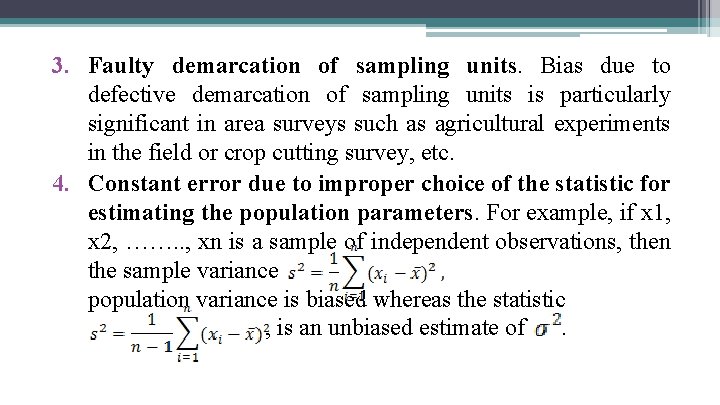
3. Faulty demarcation of sampling units. Bias due to defective demarcation of sampling units is particularly significant in area surveys such as agricultural experiments in the field or crop cutting survey, etc. 4. Constant error due to improper choice of the statistic for estimating the population parameters. For example, if x 1, x 2, ……. . , xn is a sample of independent observations, then the sample variance population variance is biased whereas the statistic , is an unbiased estimate of.
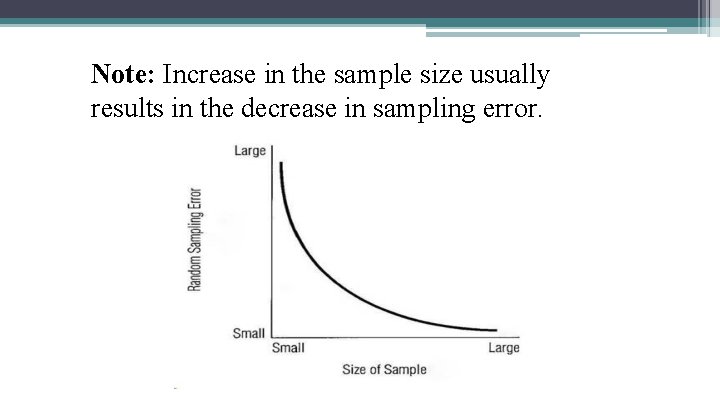
Note: Increase in the sample size usually results in the decrease in sampling error.

• Non-sampling Errors: 1. Faulty Planning or Definitions. Here the non-sampling errors can be due to: (i) Data specification being inadequate and inconsistent with respect to the objectives of the survey. (ii) Error due to location of the units and actual measurement of the characteristic, errors in recording the measurements, errors due to ill-designed questionnaire, etc. (iii) Lack of trained and qualified investigators and lack of adequate supervisory staff.
2. Response Errors. These errors are due to the following reasons: (i) Response errors may be accidental. (ii) Prestige bias. (iii) Self- interest. (iv) Bias due to interviewer. (v) Failure of respondent’s memory.
3. Non- response Errors. Non-response biases occur if full information is not obtained on all the sampling units. In house-tohouse survey, non-response usually results if the respondent is not found at home after repeated calls, or if he/she is unable to give the information on all questions or if he/she refuses to answer certain questions. Therefore, some bias is introduces as a consequence of the non-response.
4. Errors in Coverage. If the objectives of the survey are not precisely stated in clear cut terms, this may result in (i) the inclusion in the survey of certain units which are not to be included, or (ii) the exclusion of certain units which were to be included in the survey under the objectives.
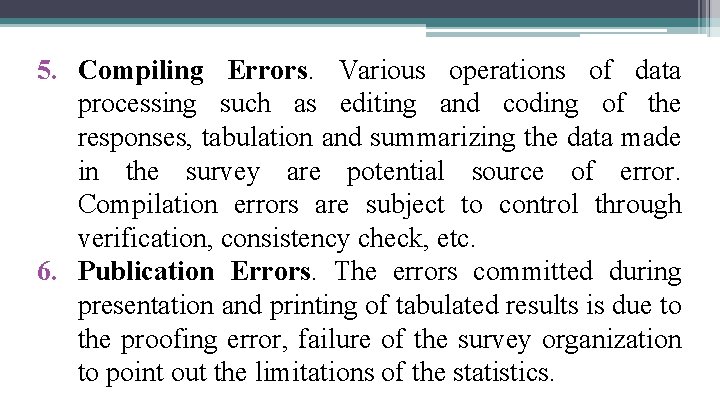
5. Compiling Errors. Various operations of data processing such as editing and coding of the responses, tabulation and summarizing the data made in the survey are potential source of error. Compilation errors are subject to control through verification, consistency check, etc. 6. Publication Errors. The errors committed during presentation and printing of tabulated results is due to the proofing error, failure of the survey organization to point out the limitations of the statistics.
Will be continued
- Slides: 14