
Sampling Techniques Muhammad Ibrahim Sohel BBA Department of
Sampling Techniques Muhammad Ibrahim Sohel BBA Department of Business Administration International Islamic University Ctg (Dhaka Campus)
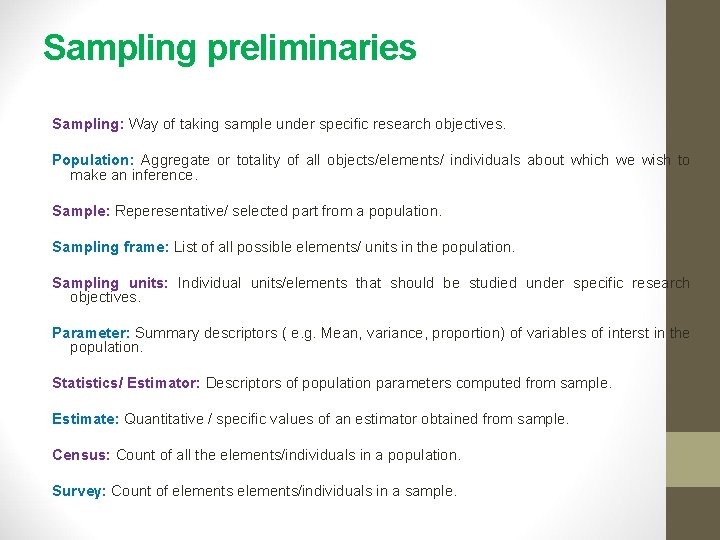
Sampling preliminaries Sampling: Way of taking sample under specific research objectives. Population: Aggregate or totality of all objects/elements/ individuals about which we wish to make an inference. Sample: Reperesentative/ selected part from a population. Sampling frame: List of all possible elements/ units in the population. Sampling units: Individual units/elements that should be studied under specific research objectives. Parameter: Summary descriptors ( e. g. Mean, variance, proportion) of variables of interst in the population. Statistics/ Estimator: Descriptors of population parameters computed from sample. Estimate: Quantitative / specific values of an estimator obtained from sample. Census: Count of all the elements/individuals in a population. Survey: Count of elements/individuals in a sample.
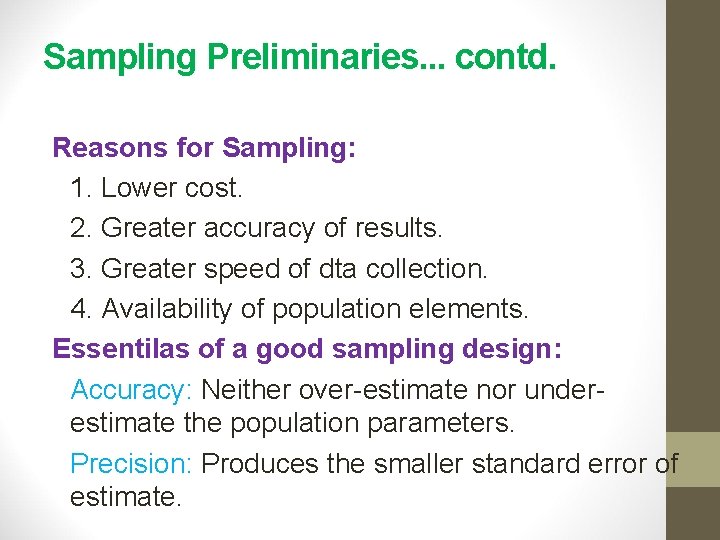
Sampling Preliminaries. . . contd. Reasons for Sampling: 1. Lower cost. 2. Greater accuracy of results. 3. Greater speed of dta collection. 4. Availability of population elements. Essentilas of a good sampling design: Accuracy: Neither over-estimate nor underestimate the population parameters. Precision: Produces the smaller standard error of estimate.
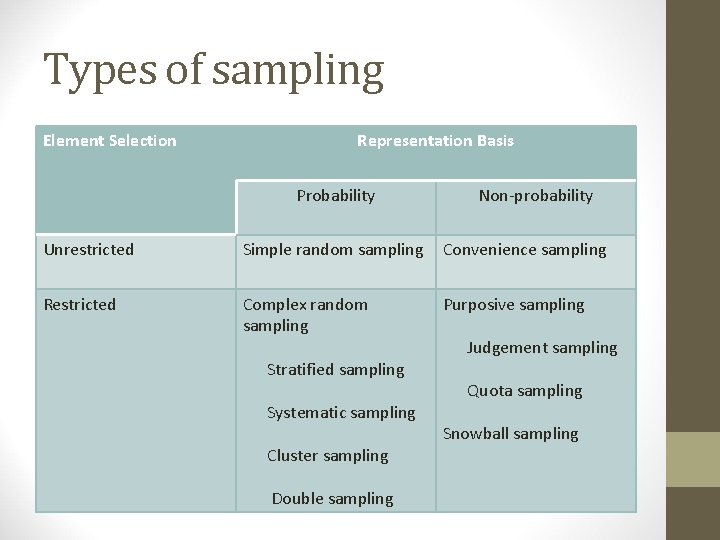
Types of sampling Element Selection Representation Basis Probability Non-probability Unrestricted Simple random sampling Convenience sampling Restricted Complex random sampling Purposive sampling Stratified sampling Systematic sampling Cluster sampling Double sampling Judgement sampling Quota sampling Snowball sampling
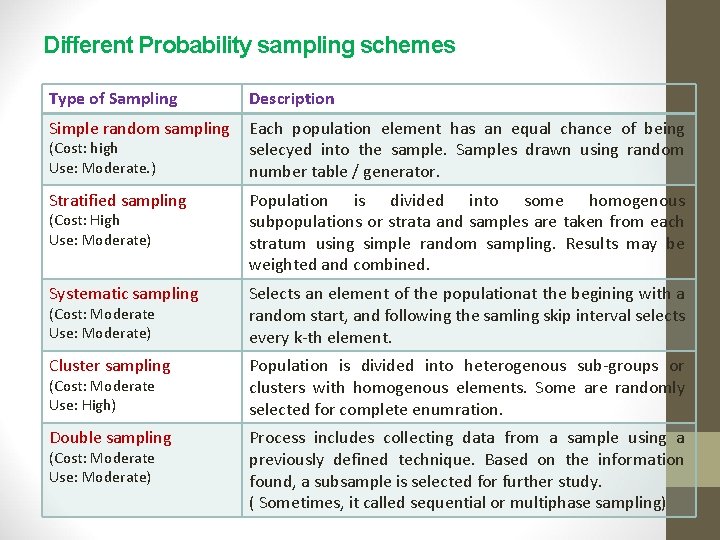
Different Probability sampling schemes Type of Sampling Description Simple random sampling Each population element has an equal chance of being selecyed into the sample. Samples drawn using random number table / generator. Stratified sampling Population is divided into some homogenous subpopulations or strata and samples are taken from each stratum using simple random sampling. Results may be weighted and combined. Systematic sampling Selects an element of the populationat the begining with a random start, and following the samling skip interval selects every k-th element. Cluster sampling Population is divided into heterogenous sub-groups or clusters with homogenous elements. Some are randomly selected for complete enumration. Double sampling Process includes collecting data from a sample using a previously defined technique. Based on the information found, a subsample is selected for further study. ( Sometimes, it called sequential or multiphase sampling) (Cost: high Use: Moderate. ) (Cost: High Use: Moderate) (Cost: Moderate Use: High) (Cost: Moderate Use: Moderate)
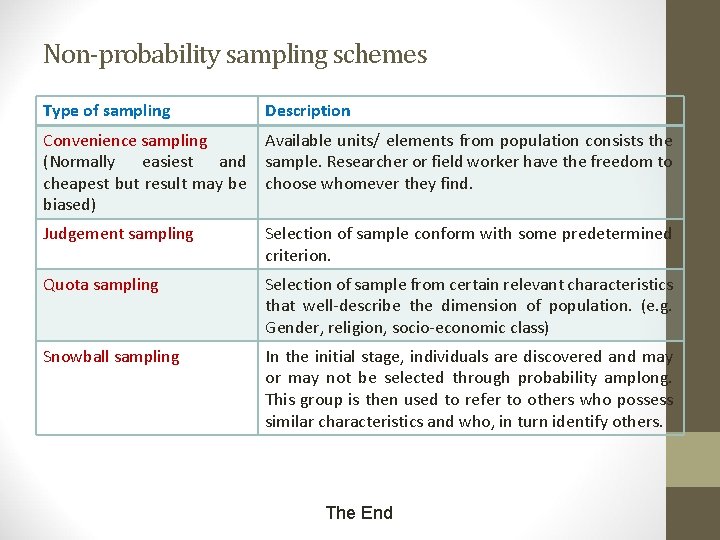
Non-probability sampling schemes Type of sampling Description Convenience sampling (Normally easiest and cheapest but result may be biased) Available units/ elements from population consists the sample. Researcher or field worker have the freedom to choose whomever they find. Judgement sampling Selection of sample conform with some predetermined criterion. Quota sampling Selection of sample from certain relevant characteristics that well-describe the dimension of population. (e. g. Gender, religion, socio-economic class) Snowball sampling In the initial stage, individuals are discovered and may or may not be selected through probability amplong. This group is then used to refer to others who possess similar characteristics and who, in turn identify others. The End
- Slides: 6