
Sampling Populations Basic Vocabulary Statistics the branch of
Sampling & Populations
Basic Vocabulary • Statistics : the branch of math that deals with collecting, organizing, interpreting, and presenting data • Survey: a method of gathering information about a specific group of items or individuals
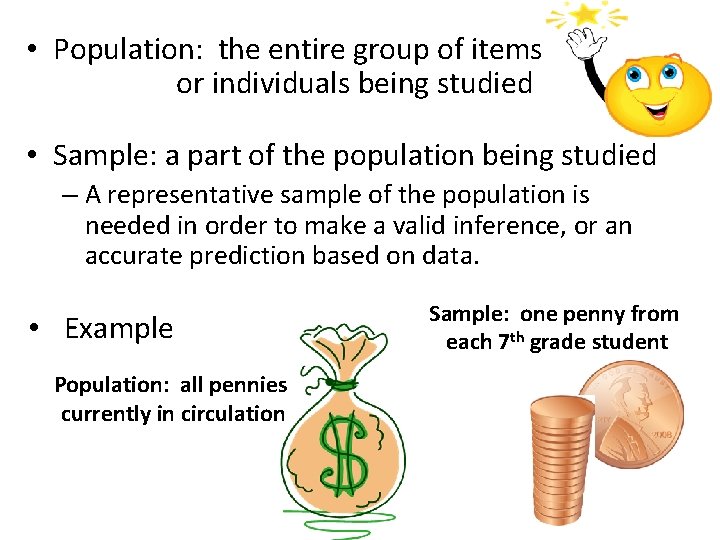
• Population: the entire group of items or individuals being studied • Sample: a part of the population being studied – A representative sample of the population is needed in order to make a valid inference, or an accurate prediction based on data. • Example Population: all pennies currently in circulation Sample: one penny from each 7 th grade student

• Unbiased sample: A sample that is selected so that it is representative of the entire population. - An unbiased sample is selected at random and is large enough to provide accurate data. • Biased sample: A sample drawn in such a way that one or more parts of the population are favored over others.
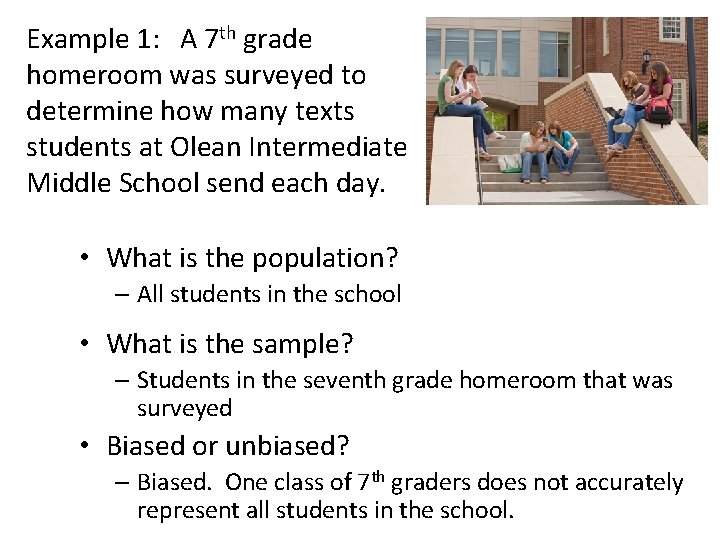
Example 1: A 7 th grade homeroom was surveyed to determine how many texts students at Olean Intermediate Middle School send each day. • What is the population? – All students in the school • What is the sample? – Students in the seventh grade homeroom that was surveyed • Biased or unbiased? – Biased. One class of 7 th graders does not accurately represent all students in the school.
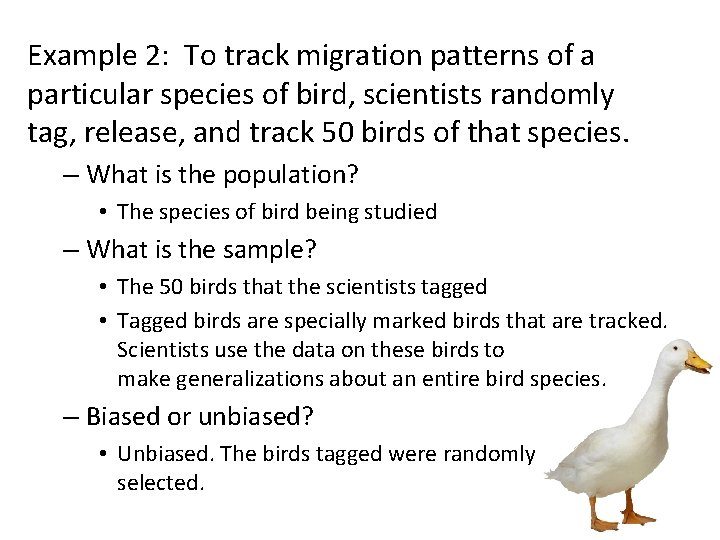
Example 2: To track migration patterns of a particular species of bird, scientists randomly tag, release, and track 50 birds of that species. – What is the population? • The species of bird being studied – What is the sample? • The 50 birds that the scientists tagged • Tagged birds are specially marked birds that are tracked. Scientists use the data on these birds to make generalizations about an entire bird species. – Biased or unbiased? • Unbiased. The birds tagged were randomly selected.
Biased or unbiased? Example 3: If you were taking a survey of the different colors of leaves seen in September, which of the following would be an unbiased sample? a. 100 fallen leaves collected from the ground Biased: The same color of leaves might fall first. b. 100 leaves on tree branches Biased: The same color of leaves will come off the tree. c. 50 fallen leaves and 50 leaves on branches Unbiased: This gives a mix of leaves that have and have not fallen, and it doesn’t specify a certain type of tree. d. 50 fallen oak leaves, 50 oak leaves on branches Biased: This only looks at oak leaves, which may not represent all trees in the area.
Example 4: You want to estimate the number of 7 th grade students that walk home right after school in the spring time. Which sample is unbiased? a. Three 7 th grade students randomly selected in the hallway before homeroom § Biased: The sample is too small to make an accurate conclusion. b. 7 th grade members of the Modified Track Team § Biased: they stay after school for practice in the spring c. Every fifth 7 th grader walking down the sidewalk after school § Biased: they are already walking home when surveyed d. Every fifth student from an alphabetical list of the 7 th graders § Unbiased: represents the population of 7 th graders, selected randomly, and large enough sample to provide accurate data
- Slides: 8