
Sampling and Units of Analysis Making the Basic
Sampling and Units of Analysis Making the Basic Decisions for a Content Analysis Project
Basic Considerations Ø Content analysis requires sufficient data l l desired content may be scattered thinly analysis may require large volume of data Ø Absence is as important as presence l l need to compare presence with absence need to understand context of presence Ø Finding the right balance l l how much data the research requires what is feasible for one person to do

When and Why to Sample Ø each unit of data source is fairly small Ø data source extends over a long time Ø data source contains way too much Ø you are interested in particular aspects Ø you need material from multiple sources
When Not to Sample Ø you have only a limited amount of data Ø the data source is complete in itself Ø you need the entire set to make the case Ø there is sufficient internal variability Ø the data set is unique or has special properties Ø you will do primarily qualitative analysis Ø it is feasible to include the entire set
Two Content Analysis Strategies Ø Traditional procedure (hypothesis testing) l l l develop codes on a sample throw out that sample apply fixed codes to the rest of the data Ø Contemporary approach (exploratory) l l l start with small sample for familiarity expand gradually but use all the material develop codes and analysis iteratively Ø Usually need to begin with exploratory Ø Usually not testing a clear hypothesis

Get Started with a Test Sample Ø purpose is to become familiar with data Ø find out what is POSSIBLE l l what content does it contain? what questions could you answer with it? how can you extract relevant content? how much effort does it take? Ø to plan a feasible research project Ø start with a few cases of the text data
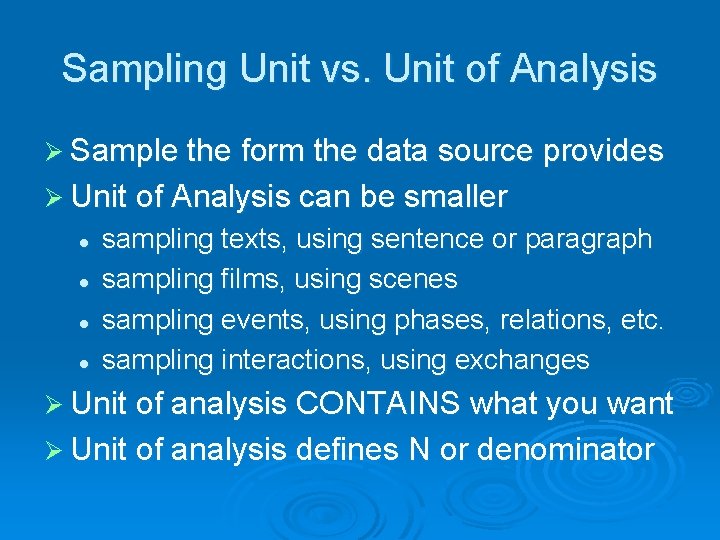
Sampling Unit vs. Unit of Analysis Ø Sample the form the data source provides Ø Unit of Analysis can be smaller l l sampling texts, using sentence or paragraph sampling films, using scenes sampling events, using phases, relations, etc. sampling interactions, using exchanges Ø Unit of analysis CONTAINS what you want Ø Unit of analysis defines N or denominator
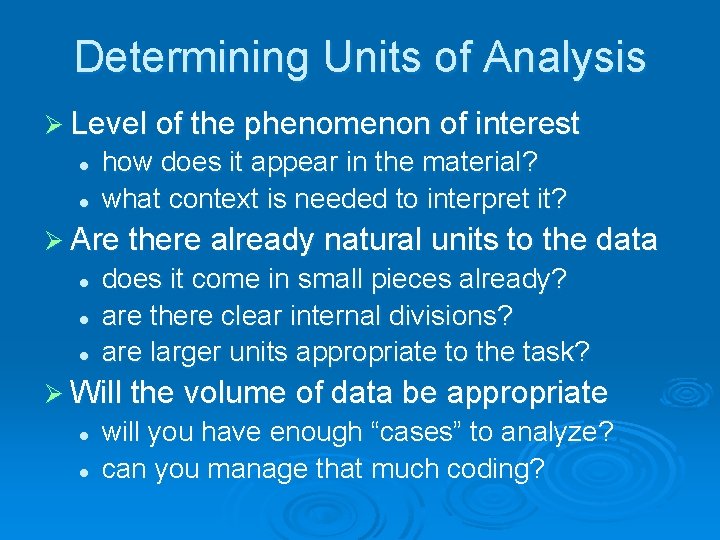
Determining Units of Analysis Ø Level of the phenomenon of interest l l how does it appear in the material? what context is needed to interpret it? Ø Are there already natural units to the data l l l does it come in small pieces already? are there clear internal divisions? are larger units appropriate to the task? Ø Will the volume of data be appropriate l l will you have enough “cases” to analyze? can you manage that much coding?
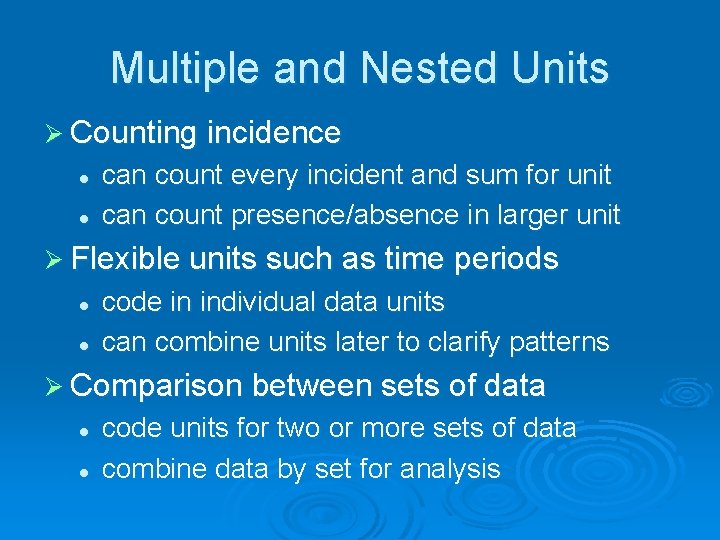
Multiple and Nested Units Ø Counting incidence l l can count every incident and sum for unit can count presence/absence in larger unit Ø Flexible units such as time periods l l code in individual data units can combine units later to clarify patterns Ø Comparison between sets of data l l code units for two or more sets of data combine data by set for analysis
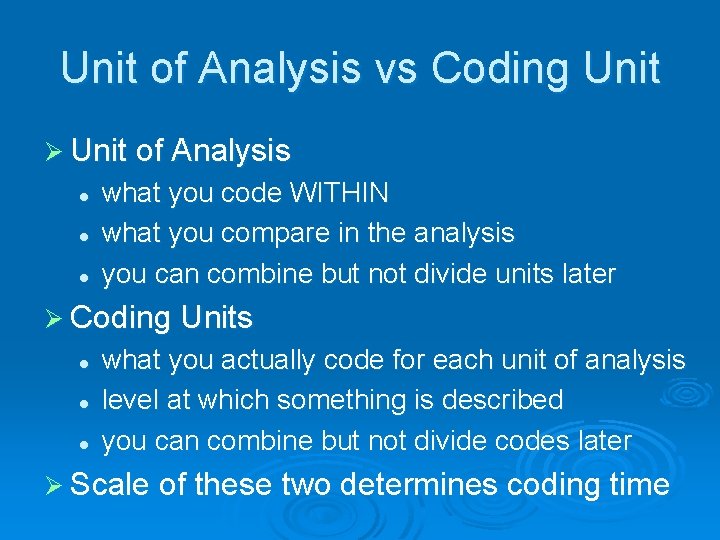
Unit of Analysis vs Coding Unit Ø Unit of Analysis l l l what you code WITHIN what you compare in the analysis you can combine but not divide units later Ø Coding Units l l l what you actually code for each unit of analysis level at which something is described you can combine but not divide codes later Ø Scale of these two determines coding time
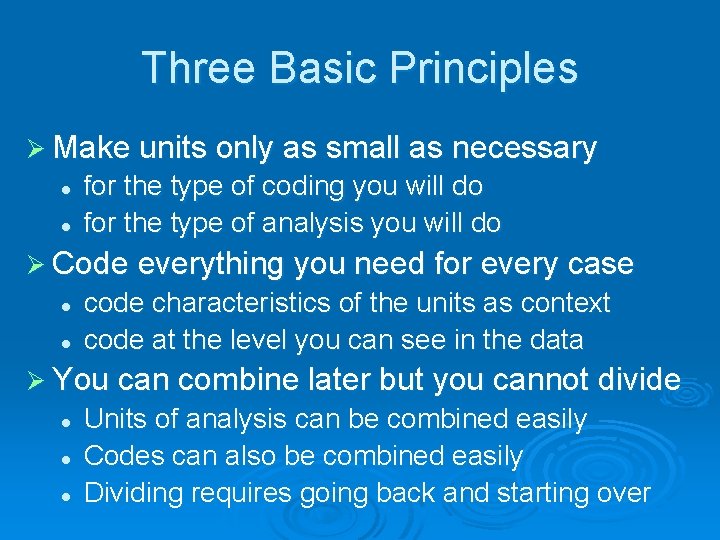
Three Basic Principles Ø Make units only as small as necessary l l for the type of coding you will do for the type of analysis you will do Ø Code everything you need for every case l l code characteristics of the units as context code at the level you can see in the data Ø You can combine later but you cannot divide l l l Units of analysis can be combined easily Codes can also be combined easily Dividing requires going back and starting over
- Slides: 11