
Sampling and counting Our running example the matching
![Partition function [Section 3. 2] Suppose we have a set of states and a](https://slidetodoc.com/presentation_image/29abbe0d81281abb30912e3bf32dc957/image-2.jpg "Partition function [Section 3. 2] Suppose we have a set of states and a")
![Sampling and counting Sketch of the counting from sampling approach: [Section 3. 2]](https://slidetodoc.com/presentation_image/29abbe0d81281abb30912e3bf32dc957/image-3.jpg "Sampling and counting Sketch of the counting from sampling approach: [Section 3. 2]")
![Sampling and counting [Section 3. 1] How to use sampling to (approximately ) count](https://slidetodoc.com/presentation_image/29abbe0d81281abb30912e3bf32dc957/image-4.jpg "Sampling and counting [Section 3. 1] How to use sampling to (approximately ) count")
![Sampling and counting [Section 3. 2] Proposition 3. 4: Let G be a graph](https://slidetodoc.com/presentation_image/29abbe0d81281abb30912e3bf32dc957/image-5.jpg "Sampling and counting [Section 3. 2] Proposition 3. 4: Let G be a graph")
![Sampling and counting [Section 3. 2]](https://slidetodoc.com/presentation_image/29abbe0d81281abb30912e3bf32dc957/image-6.jpg "Sampling and counting [Section 3. 2]")
![Sampling and counting [Section 3. 2]](https://slidetodoc.com/presentation_image/29abbe0d81281abb30912e3bf32dc957/image-7.jpg "Sampling and counting [Section 3. 2]")
![Sampling and counting [Section 3. 2]](https://slidetodoc.com/presentation_image/29abbe0d81281abb30912e3bf32dc957/image-8.jpg "Sampling and counting [Section 3. 2]")
![Sampling and counting [Section 3. 2]](https://slidetodoc.com/presentation_image/29abbe0d81281abb30912e3bf32dc957/image-9.jpg "Sampling and counting [Section 3. 2]")
- Slides: 9
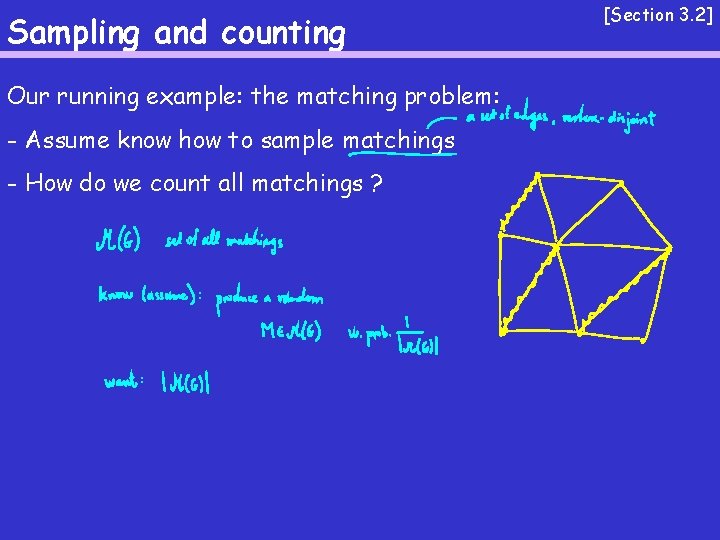
Sampling and counting Our running example: the matching problem: - Assume know how to sample matchings - How do we count all matchings ? [Section 3. 2]
Partition function [Section 3. 2] Suppose we have a set of states and a function f: R+. Suppose we can sample from a distribution proportional to f, i. e. ¼(!) ® f(!) for every !2. The partition function is: Z = !2 f(!). Example: monomer-dimer model
Sampling and counting Sketch of the counting from sampling approach: [Section 3. 2]
Sampling and counting [Section 3. 1] How to use sampling to (approximately ) count ? Def: A randomized approximation scheme for a counting problem f is a randomized algorithm that, for a given input x and an error tolerance ²>0, outputs a value N s. t. Pr( (1 -²)f(x) · N · (1+²)f(x) ) ¸ ¾ Fully polynomial randomized approximation scheme (FPRAS) is a randomized appx scheme that runs in time polynomial in |x| and 1/². Note: ¾ can be replaced by any constant in (½, 1).
Sampling and counting [Section 3. 2] Proposition 3. 4: Let G be a graph with n vertices and m¸ 1 edges. If there is an approximate sampler for matchings in G with running time T(n, m, ²), then there is an FPRAS counting all matchings in time cm 2²-2 T(n, m, ²/(6 m)) for some constant c>0.
Sampling and counting [Section 3. 2]
Sampling and counting [Section 3. 2]
Sampling and counting [Section 3. 2]
Sampling and counting [Section 3. 2]