
SAMPLING 11 3 Core Vocabulary Objectives Identify types
SAMPLING 11. 3
Core Vocabulary Objectives: • Identify types of sampling methods in statistical studies • Analyze methods of collecting data • • • Simple Random Sample Self-select/Voluntary Response Stratified Random Sample Cluster Sample Convenience sample Bias Previous Vocabulary: • Population • Sample
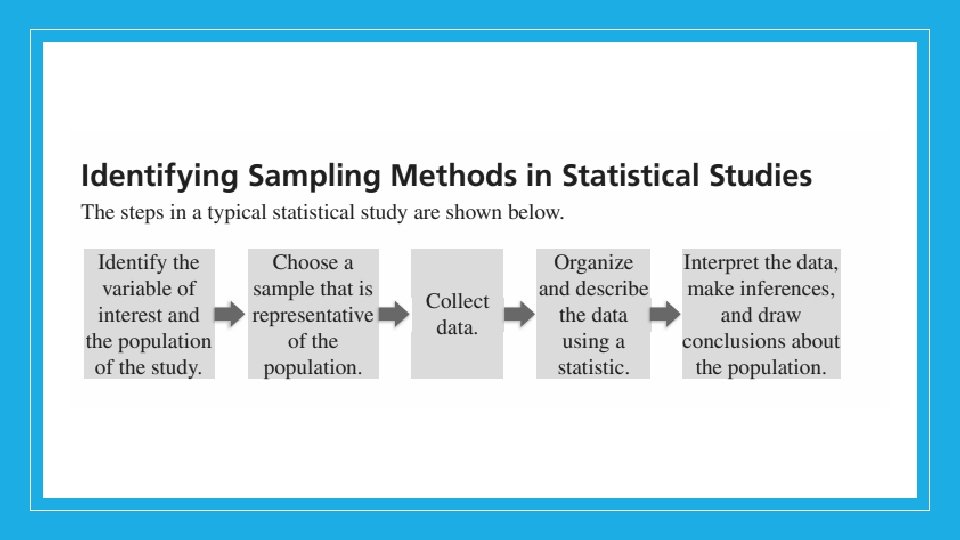
There are numerous ways of sampling from a population. ◦ Simple Random Sample (SRS) ◦ Self-selected/Voluntary response ◦ Systematic sample ◦ Stratified sample ◦ Cluster sample ◦ Convenience sample The best samples ensure that every segment of a population is represented.

Simple Random Sample (SRS): A Simple Random Sample (SRS) of size n consists of n individuals from the population chosen is such a way that every set of n individuals has an equal chance of being selected. • Suppose I need to pick a sample of 10 people from a group of 100 teenage boys and girls. In a simple random sample everyone has an equal chance of being chosen so it is possible that I end up with a sample of all girls, or 9 girls and 1 boy, or 8 girls and 2 boys, or 7 girls and 3 boys, etc. Examples of taking an SRS: • Put all the names from the population in a hat and draw names until you have the sample size you need. • Assign everyone in the population a number 1 – N, where N is the number of people in the population. Then use a random number generator to pick n people, where n is the number of people you need for the sample. The numbers that come up in the random number generator are the numbers you pick from your population list.

Self-Select/Voluntary Response • This is exactly what it sounds like. Members of the population self select, or volunteer, for the study. Systematic Sample • A systematic sample uses a rule to select members from a population. For instance, picking every other person. Convenience Sample • Only members of a population that are easy to reach are selected.
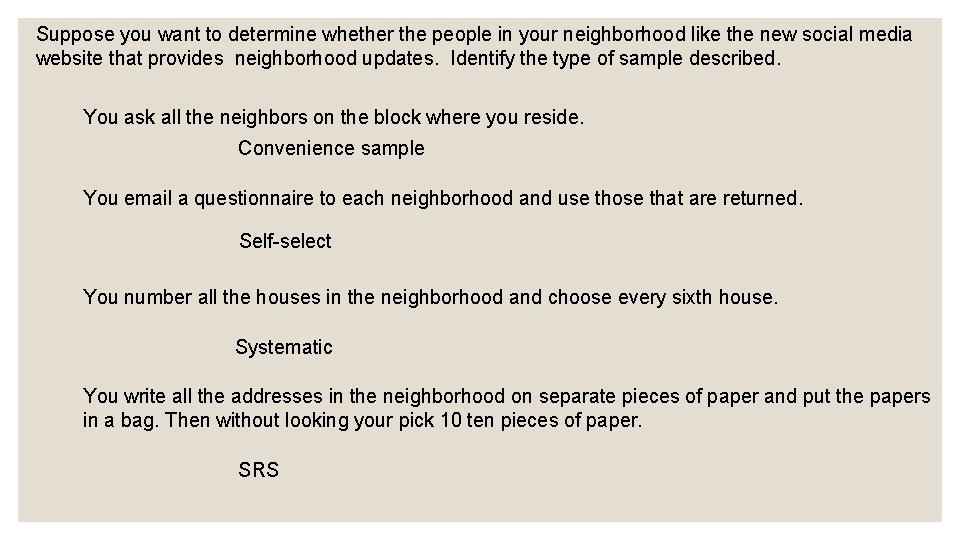
Suppose you want to determine whether the people in your neighborhood like the new social media website that provides neighborhood updates. Identify the type of sample described. You ask all the neighbors on the block where you reside. Convenience sample You email a questionnaire to each neighborhood and use those that are returned. Self-select You number all the houses in the neighborhood and choose every sixth house. Systematic You write all the addresses in the neighborhood on separate pieces of paper and put the papers in a bag. Then without looking your pick 10 ten pieces of paper. SRS
Stratified Random Sample A population is divided into smaller groups that share a similar characteristic. The sample is then randomly selected from each group. Example: You want to know the average height of the students at Alcott Elementary School. If you take an SRS it quite possible that you get all fifth graders or all younger students. Your sample would not be a good representation of the entire school. So instead you separate students by grade into groups. Each group is called a strata. So you have six stratum, one for kindergarten, one for first grade, one for second grade…. Then take an SRS from each strata to make up the entire sample. This way you are sure to have every grade represented in your sample. is
Cluster Sample In a cluster sample, a population is divided into groups called clusters. Each cluster is its own little representation of the whole school. Randomly select clusters and every member of the cluster makes up the sample. Example: At a large high school an AP Statistics student wants to estimate the school’s average GPA. This school has 50 homerooms of 30 students made up alphabetically rather than by grade, so each homeroom is a mini representation of the whole school. Randomly select two clusters. All 30 students in both homerooms make up the sample.
Recognizing Bias in Sampling A bias is an error that results in a misrepresentation of a population. In order to obtain reliable information and draw accurate conclusions about a population, it is important to select an unbiased sample. An unbiased sample is representative of the population you want information about. A sample that either overrepresents or under-represents part of the population would be a biased sample.
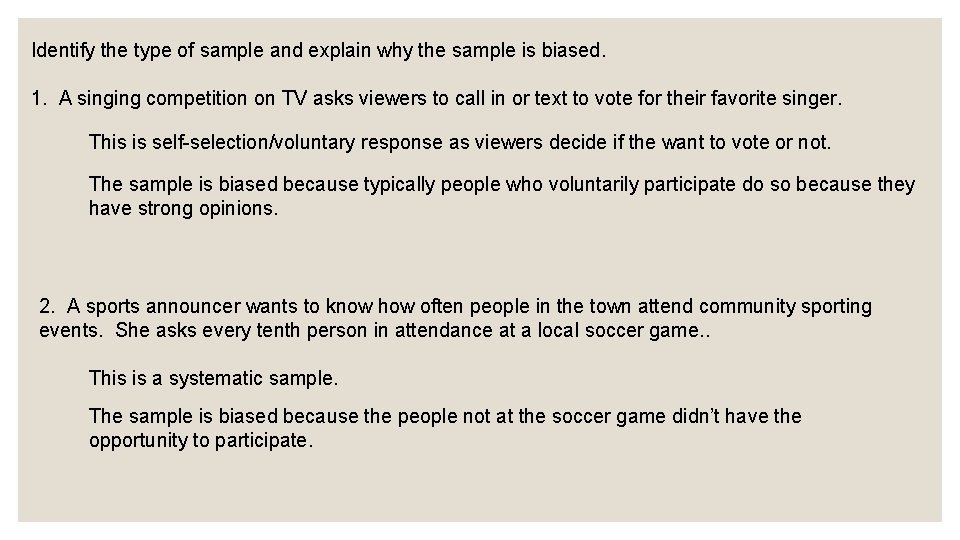
Identify the type of sample and explain why the sample is biased. 1. A singing competition on TV asks viewers to call in or text to vote for their favorite singer. This is self-selection/voluntary response as viewers decide if the want to vote or not. The sample is biased because typically people who voluntarily participate do so because they have strong opinions. 2. A sports announcer wants to know how often people in the town attend community sporting events. She asks every tenth person in attendance at a local soccer game. . This is a systematic sample. The sample is biased because the people not at the soccer game didn’t have the opportunity to participate.
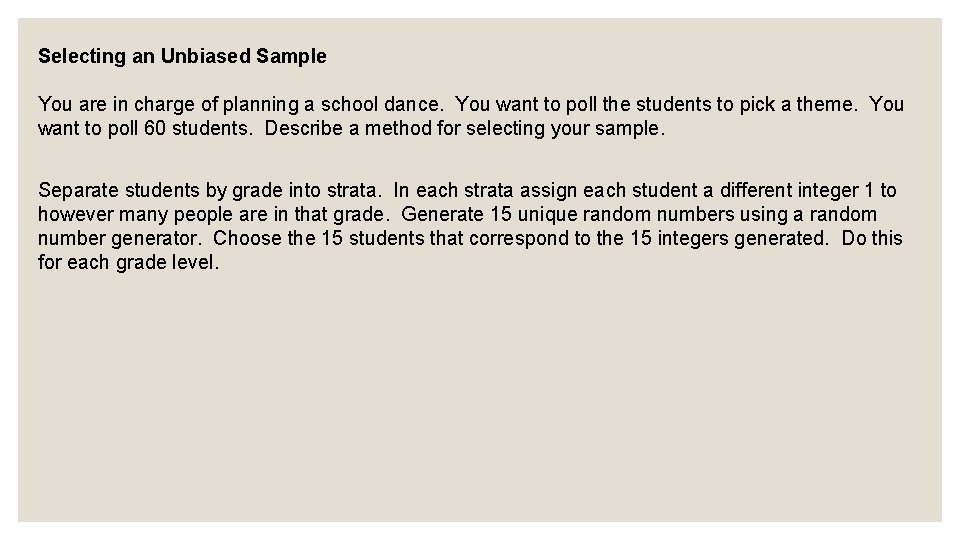
Selecting an Unbiased Sample You are in charge of planning a school dance. You want to poll the students to pick a theme. You want to poll 60 students. Describe a method for selecting your sample. Separate students by grade into strata. In each strata assign each student a different integer 1 to however many people are in that grade. Generate 15 unique random numbers using a random number generator. Choose the 15 students that correspond to the 15 integers generated. Do this for each grade level.
Summary Sampling methods include: • SRS • Self-select/Voluntary Response • Convenience Sample • Systematic Sample • Stratified Random Sample • Cluster Sample Regardless of the method you use, the sample should represent the population of interest and avoid bias.
Homework: page 614: 5– 19
- Slides: 14