
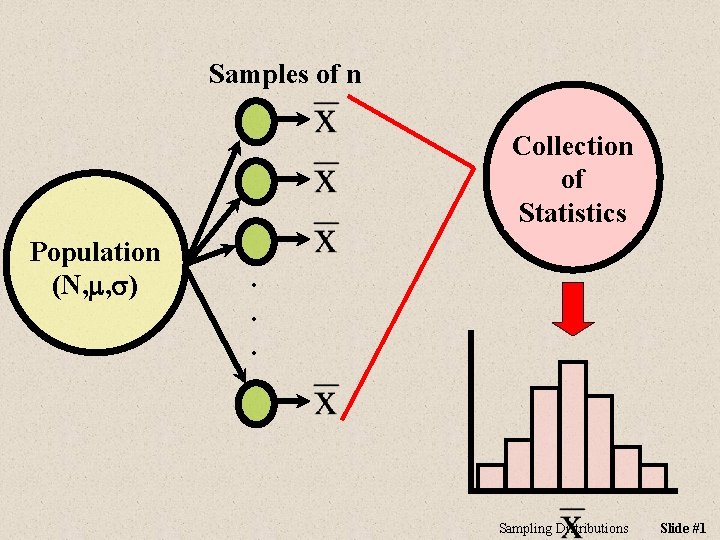
Samples of n Collection of Statistics Population N
- Slides: 8
Samples of n Collection of Statistics Population (N, m, s) . . . Sampling Distributions Slide #1
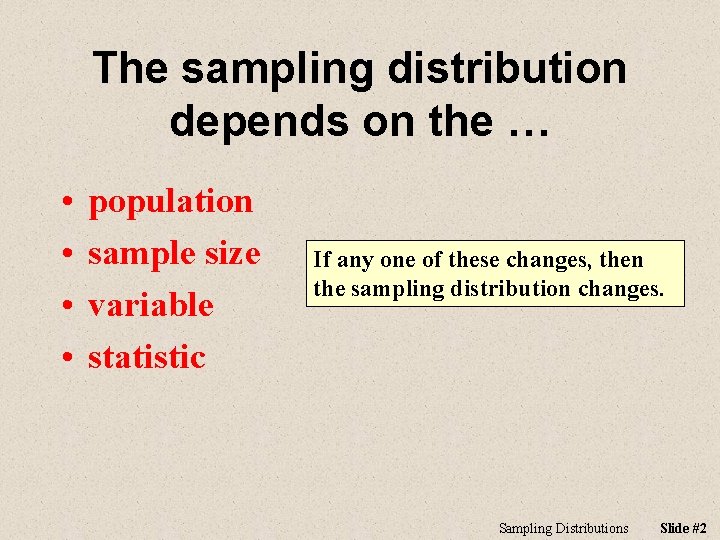
The sampling distribution depends on the … • • population sample size variable statistic If any one of these changes, then the sampling distribution changes. Sampling Distributions Slide #2
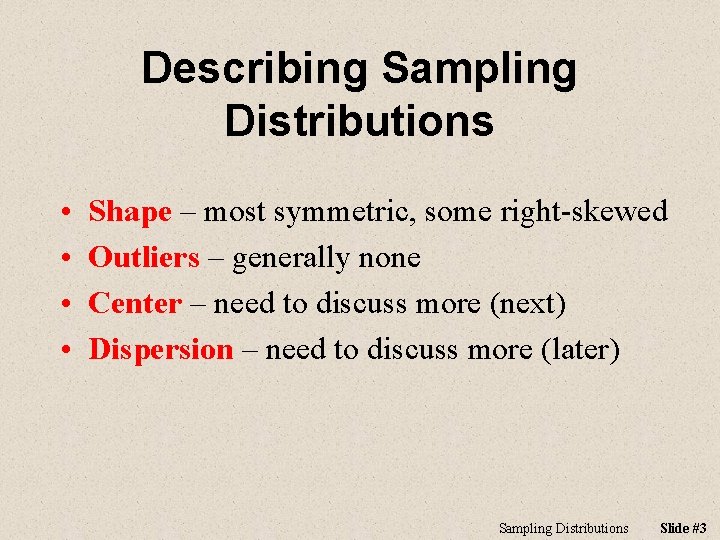
Describing Sampling Distributions • • Shape – most symmetric, some right-skewed Outliers – generally none Center – need to discuss more (next) Dispersion – need to discuss more (later) Sampling Distributions Slide #3
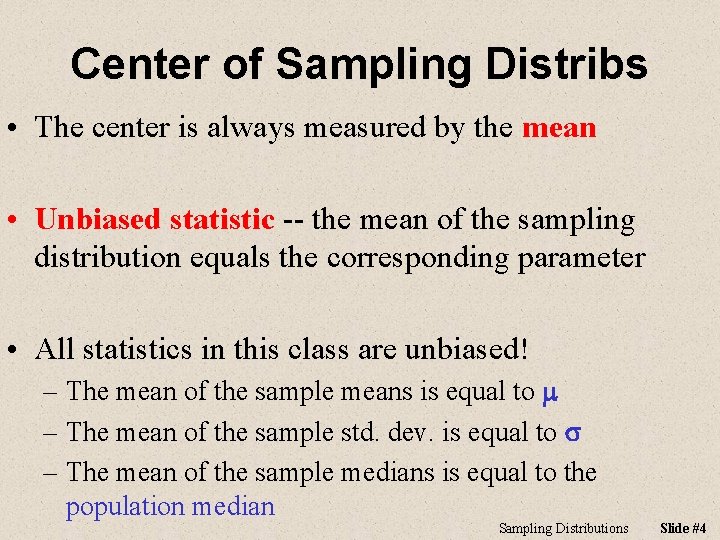
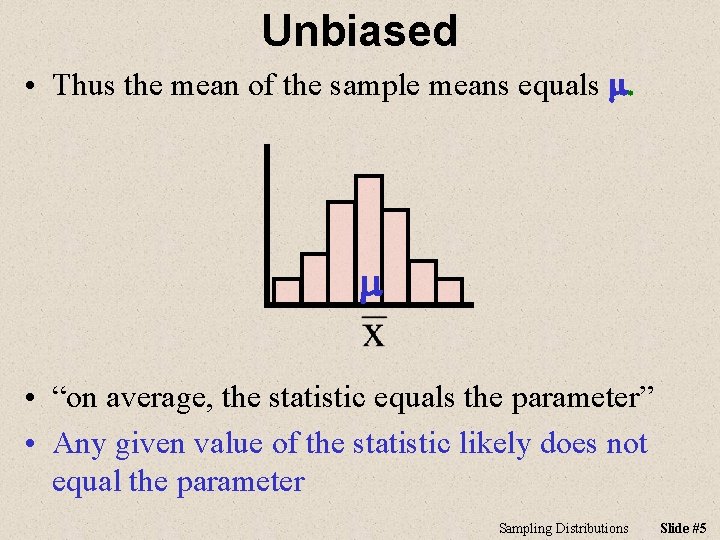
Center of Sampling Distribs • The center is always measured by the mean • Unbiased statistic -- the mean of the sampling distribution equals the corresponding parameter • All statistics in this class are unbiased! – The mean of the sample means is equal to m – The mean of the sample std. dev. is equal to s – The mean of the sample medians is equal to the population median Sampling Distributions Slide #4
Unbiased • Thus the mean of the sample means equals m. m • “on average, the statistic equals the parameter” • Any given value of the statistic likely does not equal the parameter Sampling Distributions Slide #5
Dispersion of Sampling Distribs • Always use the standard deviation – However, it is called standard error of the statistic • Why SE? – SD is variability among individuals – SE is variability among statistics Sampling Distributions Slide #6
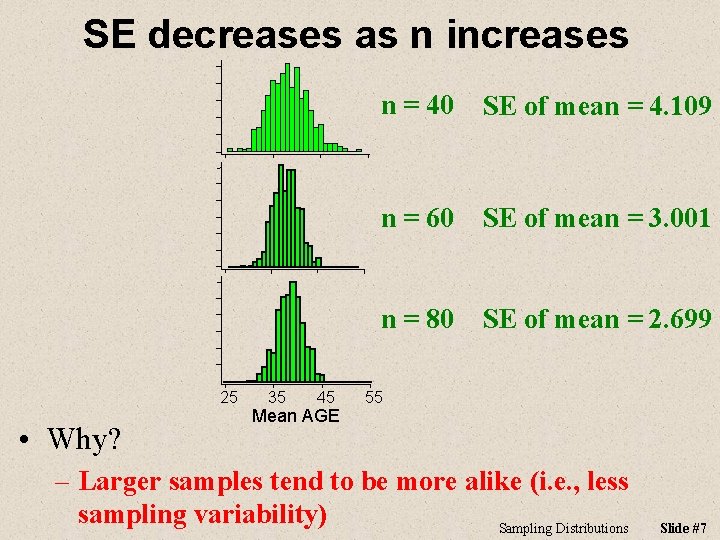
SE decreases as n increases 25 • Why? 35 45 Mean AGE n = 40 SE of mean = 4. 109 n = 60 SE of mean = 3. 001 n = 80 SE of mean = 2. 699 55 – Larger samples tend to be more alike (i. e. , less sampling variability) Sampling Distributions Slide #7
Sampling Distributions Summary • Distribution of statistics from ALL possible samples • Center measured by mean – Statistic is unbiased, so center of sampling distribution equals the parameter • Dispersion caused by sampling variability – Measured by the SE – Decreases with increasing n Sampling Distributions Slide #8