
Sample size estimation v 2018 02 Outline Definition

- Slides: 61
Sample size estimation v. 2018 -02
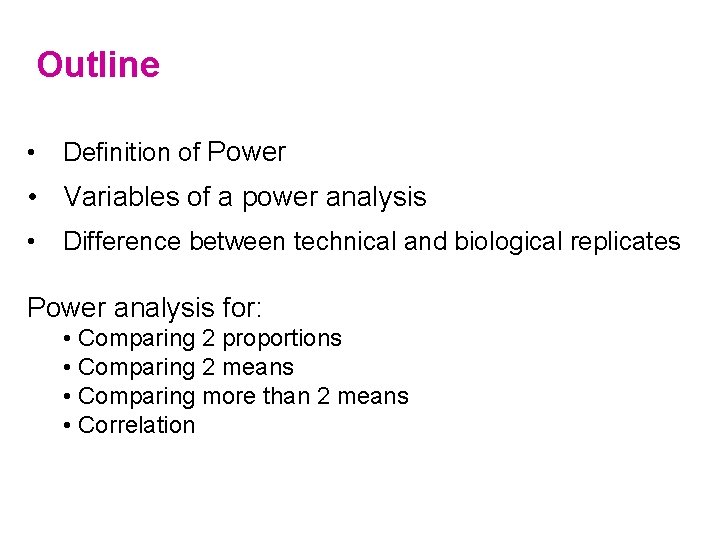
Outline • Definition of Power • Variables of a power analysis • Difference between technical and biological replicates Power analysis for: • Comparing 2 proportions • Comparing 2 means • Comparing more than 2 means • Correlation
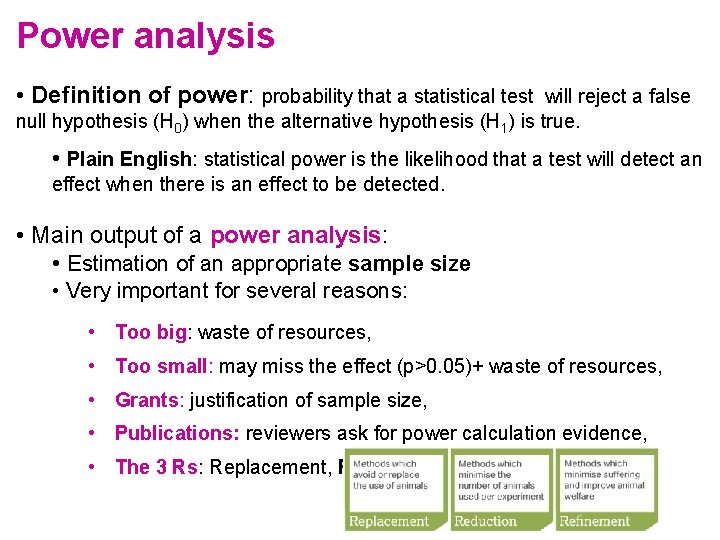
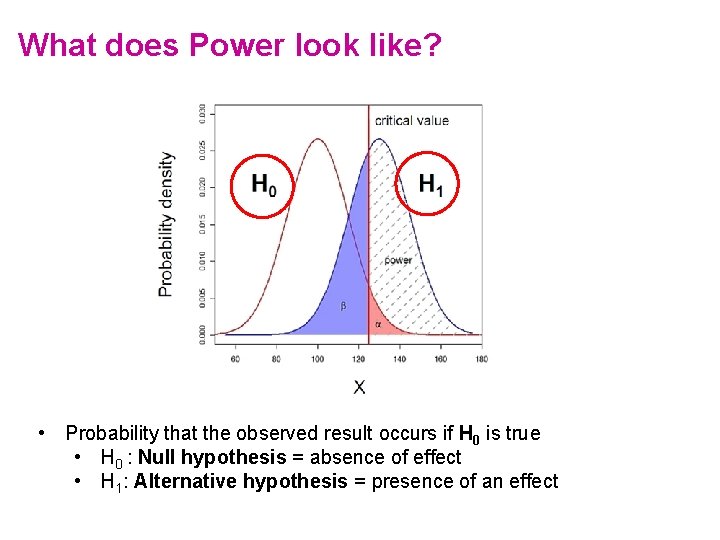
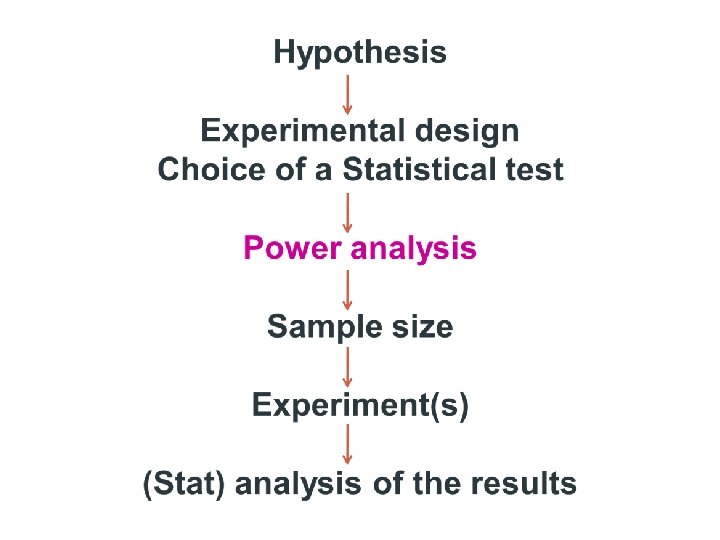
Power analysis • Definition of power: probability that a statistical test will reject a false null hypothesis (H 0) when the alternative hypothesis (H 1) is true. • Plain English: statistical power is the likelihood that a test will detect an effect when there is an effect to be detected. • Main output of a power analysis: • Estimation of an appropriate sample size • Very important for several reasons: • Too big: waste of resources, • Too small: may miss the effect (p>0. 05)+ waste of resources, • Grants: justification of sample size, • Publications: reviewers ask for power calculation evidence, • The 3 Rs: Replacement, Reduction and Refinement
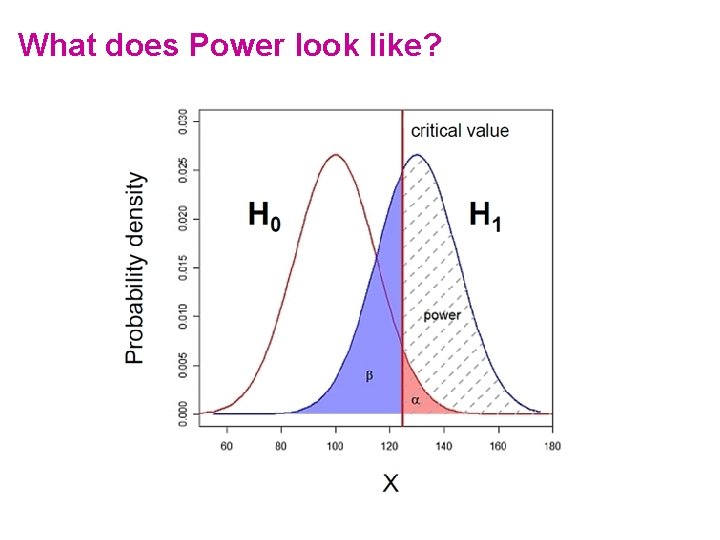
What does Power look like?
What does Power look like? • Probability that the observed result occurs if H 0 is true • H 0 : Null hypothesis = absence of effect • H 1: Alternative hypothesis = presence of an effect
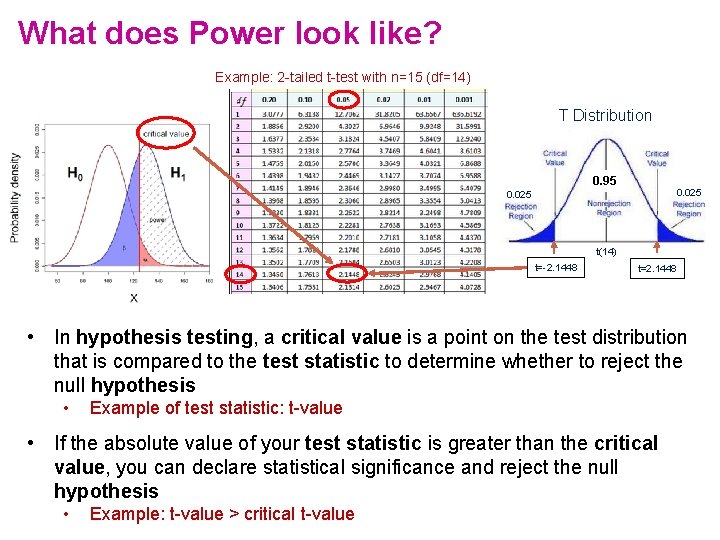
What does Power look like? Example: 2 -tailed t-test with n=15 (df=14) T Distribution 0. 95 0. 025 t(14) t=-2. 1448 t=2. 1448 • In hypothesis testing, a critical value is a point on the test distribution that is compared to the test statistic to determine whether to reject the null hypothesis • Example of test statistic: t-value • If the absolute value of your test statistic is greater than the critical value, you can declare statistical significance and reject the null hypothesis • Example: t-value > critical t-value
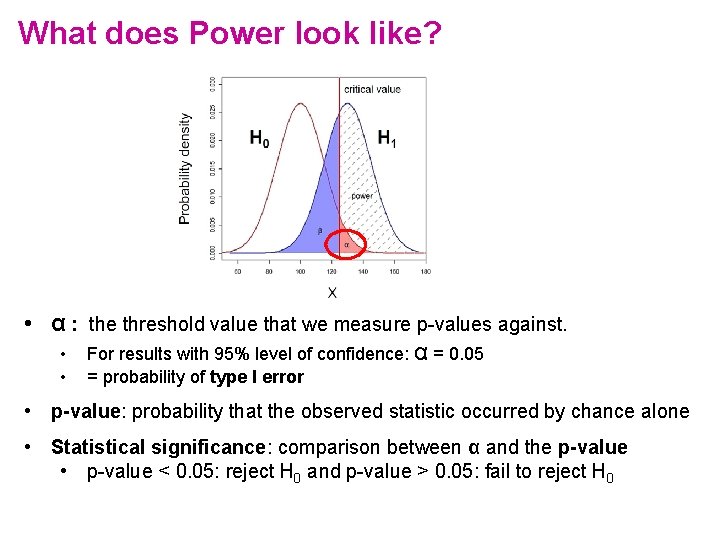
What does Power look like? • α : the threshold value that we measure p-values against. • For results with 95% level of confidence: α = 0. 05 • = probability of type I error • p-value: probability that the observed statistic occurred by chance alone • Statistical significance: comparison between α and the p-value • p-value < 0. 05: reject H 0 and p-value > 0. 05: fail to reject H 0
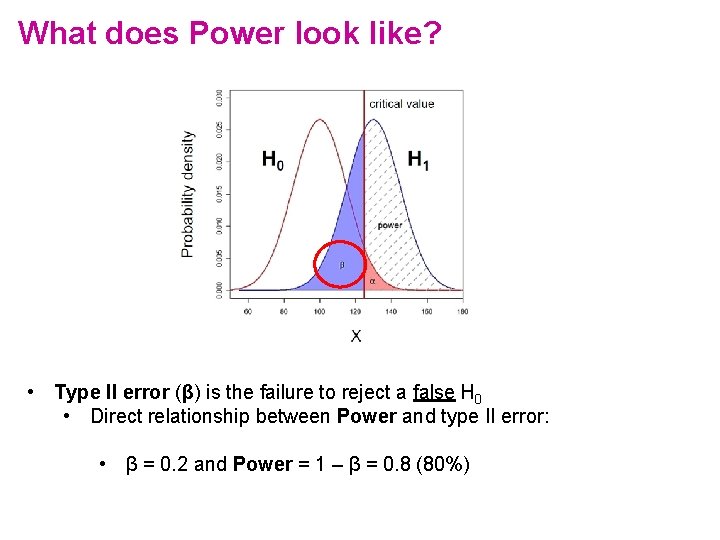
What does Power look like? • Type II error (β) is the failure to reject a false H 0 • Direct relationship between Power and type II error: • β = 0. 2 and Power = 1 – β = 0. 8 (80%)
The desired power of the experiment: 80% • Type II error (β) is the failure to reject a false H 0 • Direct relationship between Power and type II error: • if β = 0. 2 and Power = 1 – β = 0. 8 (80%) • Hence a true difference will be missed 20% of the time • General convention: 80% but could be more or less • Cohen (1988): • For most researchers: Type I errors are four times more serious than Type II errors: 0. 05 * 4 = 0. 2 • Compromise: 2 groups comparisons: 90% = +30% sample size, 95% = +60%
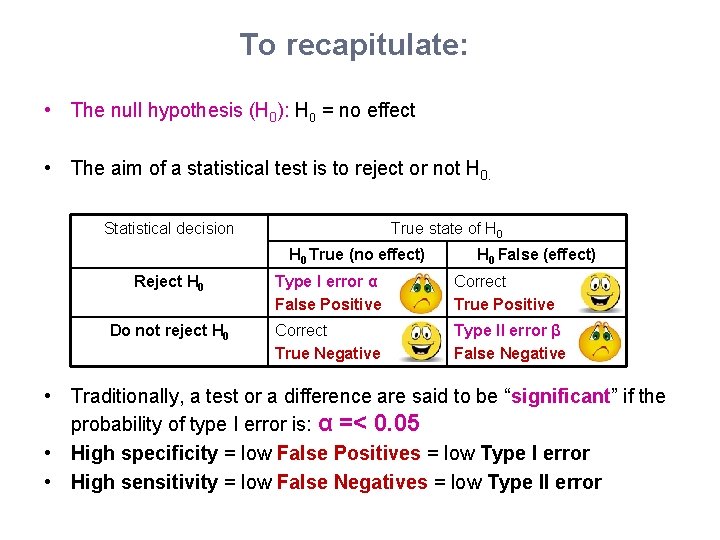
To recapitulate: • The null hypothesis (H 0): H 0 = no effect • The aim of a statistical test is to reject or not H 0. Statistical decision True state of H 0 True (no effect) H 0 False (effect) Reject H 0 Type I error α False Positive Correct True Positive Do not reject H 0 Correct True Negative Type II error β False Negative • Traditionally, a test or a difference are said to be “significant” if the probability of type I error is: α =< 0. 05 • High specificity = low False Positives = low Type I error • High sensitivity = low False Negatives = low Type II error
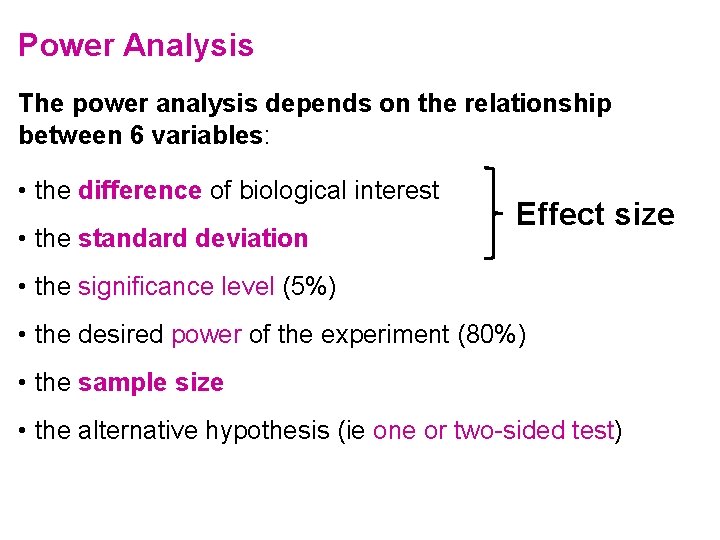
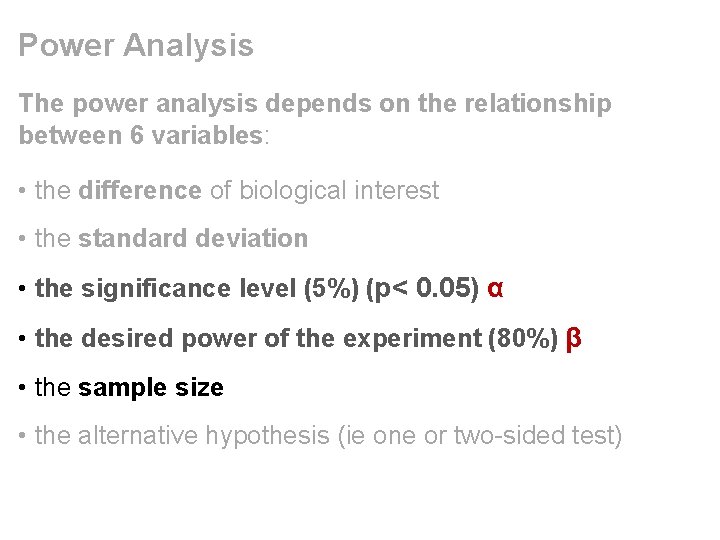
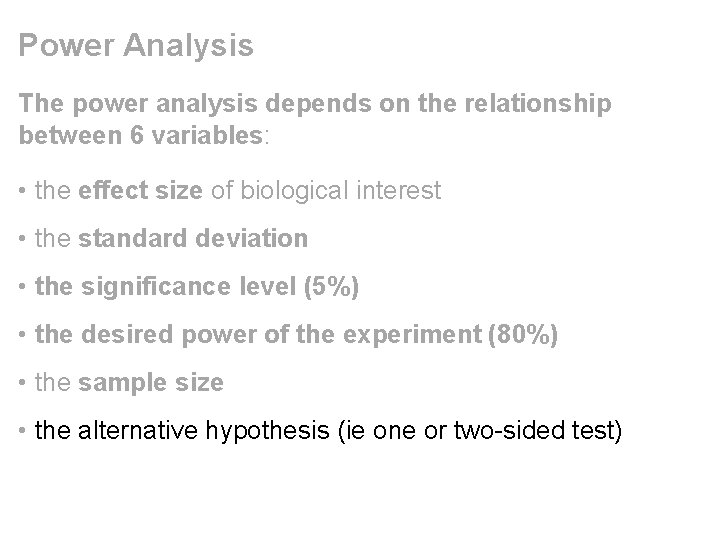
Power Analysis The power analysis depends on the relationship between 6 variables: • the difference of biological interest • the standard deviation Effect size • the significance level (5%) • the desired power of the experiment (80%) • the sample size • the alternative hypothesis (ie one or two-sided test)
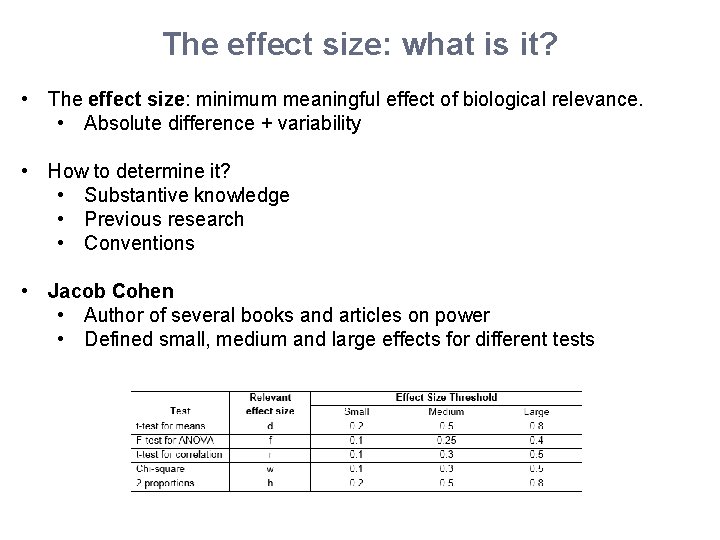
The effect size: what is it? • The effect size: minimum meaningful effect of biological relevance. • Absolute difference + variability • How to determine it? • Substantive knowledge • Previous research • Conventions • Jacob Cohen • Author of several books and articles on power • Defined small, medium and large effects for different tests
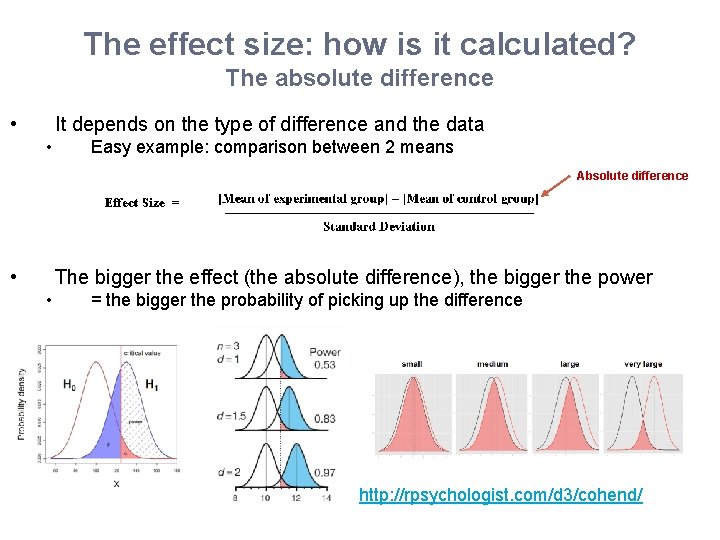
The effect size: how is it calculated? The absolute difference • It depends on the type of difference and the data • Easy example: comparison between 2 means Absolute difference • The bigger the effect (the absolute difference), the bigger the power • = the bigger the probability of picking up the difference http: //rpsychologist. com/d 3/cohend/
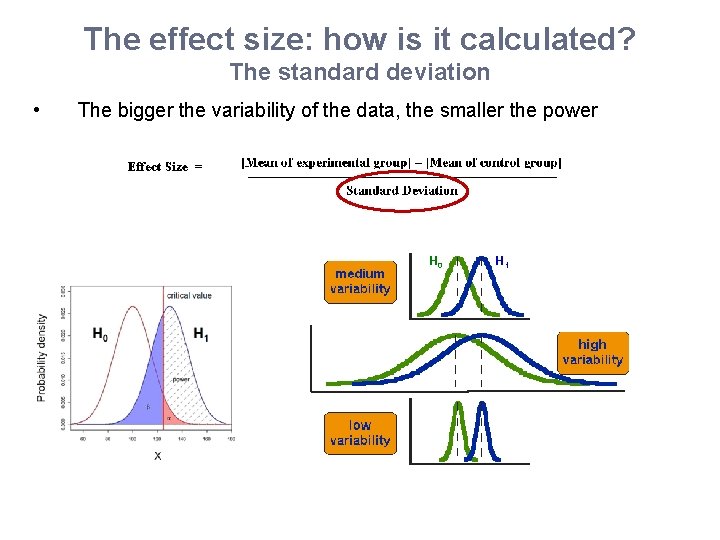
The effect size: how is it calculated? The standard deviation • The bigger the variability of the data, the smaller the power H 0 H 1
Power Analysis The power analysis depends on the relationship between 6 variables: • the difference of biological interest • the standard deviation • the significance level (5%) (p< 0. 05) α • the desired power of the experiment (80%) β • the sample size • the alternative hypothesis (ie one or two-sided test)
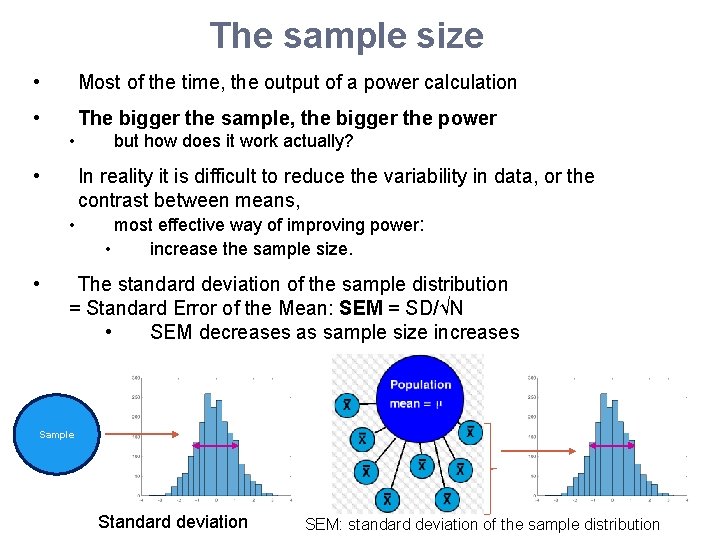
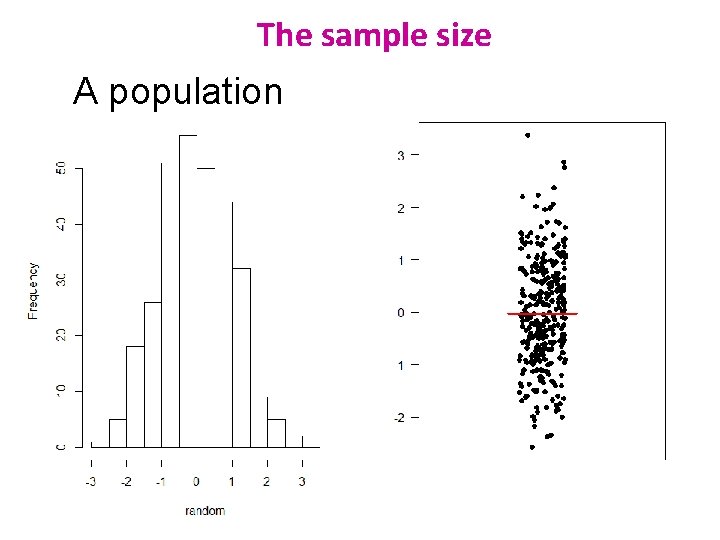
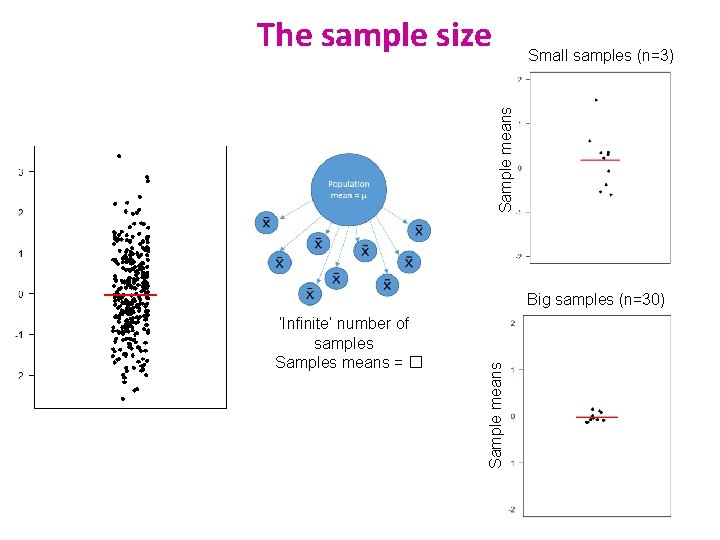
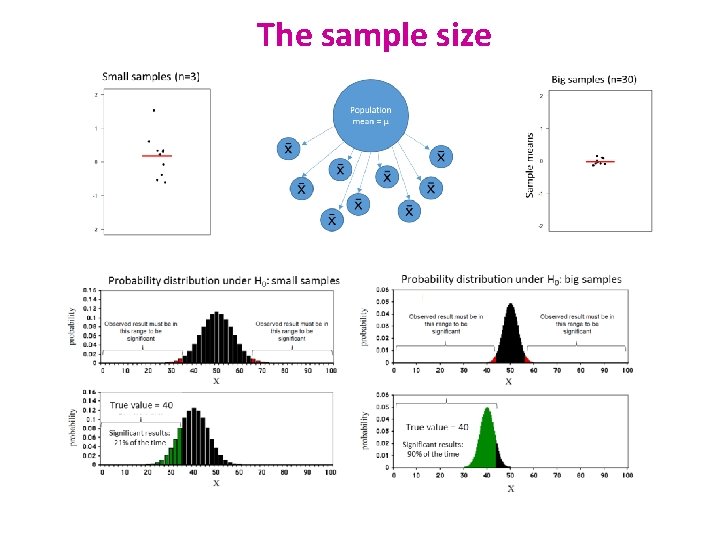
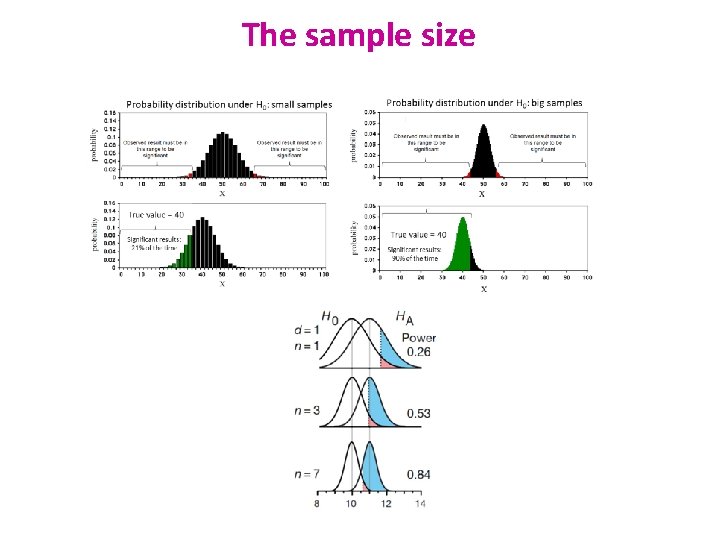
The sample size • Most of the time, the output of a power calculation • The bigger the sample, the bigger the power • but how does it work actually? • In reality it is difficult to reduce the variability in data, or the contrast between means, • most effective way of improving power: • increase the sample size. • The standard deviation of the sample distribution = Standard Error of the Mean: SEM = SD/√N • SEM decreases as sample size increases Sample Standard deviation SEM: standard deviation of the sample distribution
The sample size A population
The sample size Sample means Small samples (n=3) ‘Infinite’ number of samples Samples means = � Sample means Big samples (n=30)
The sample size
The sample size
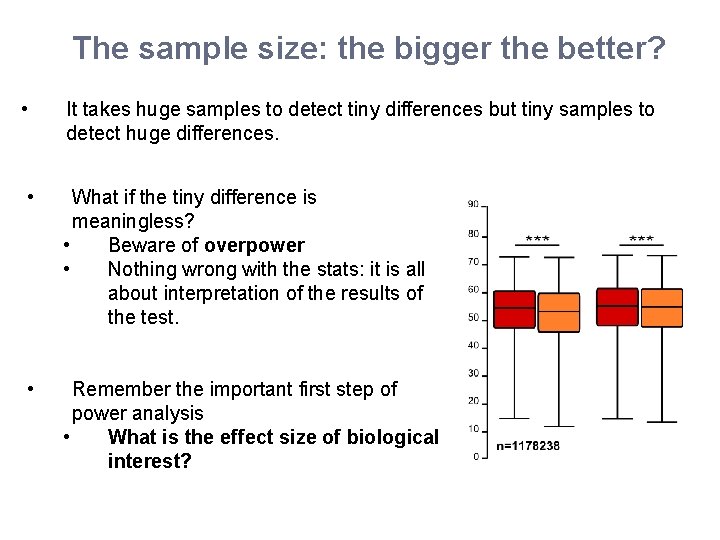
The sample size: the bigger the better? • It takes huge samples to detect tiny differences but tiny samples to detect huge differences. • What if the tiny difference is meaningless? • Beware of overpower • Nothing wrong with the stats: it is all about interpretation of the results of the test. • Remember the important first step of power analysis • What is the effect size of biological interest?
Power Analysis The power analysis depends on the relationship between 6 variables: • the effect size of biological interest • the standard deviation • the significance level (5%) • the desired power of the experiment (80%) • the sample size • the alternative hypothesis (ie one or two-sided test)
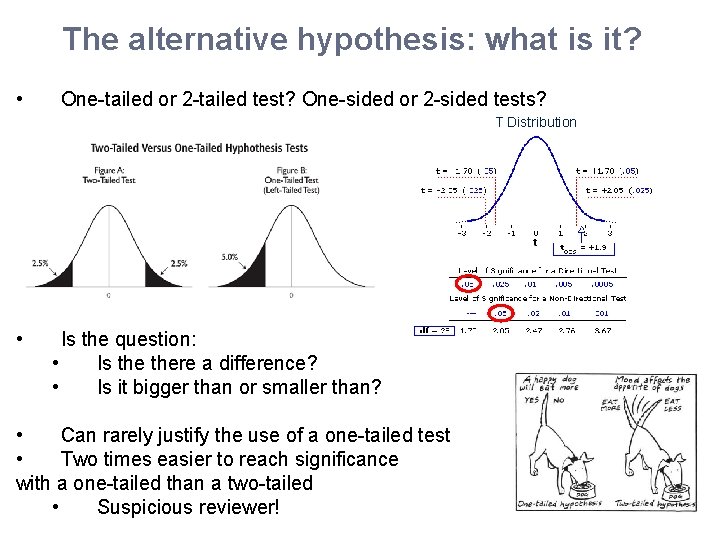
The alternative hypothesis: what is it? • One-tailed or 2 -tailed test? One-sided or 2 -sided tests? T Distribution • Is the question: • Is there a difference? • Is it bigger than or smaller than? • Can rarely justify the use of a one-tailed test • Two times easier to reach significance with a one-tailed than a two-tailed • Suspicious reviewer!
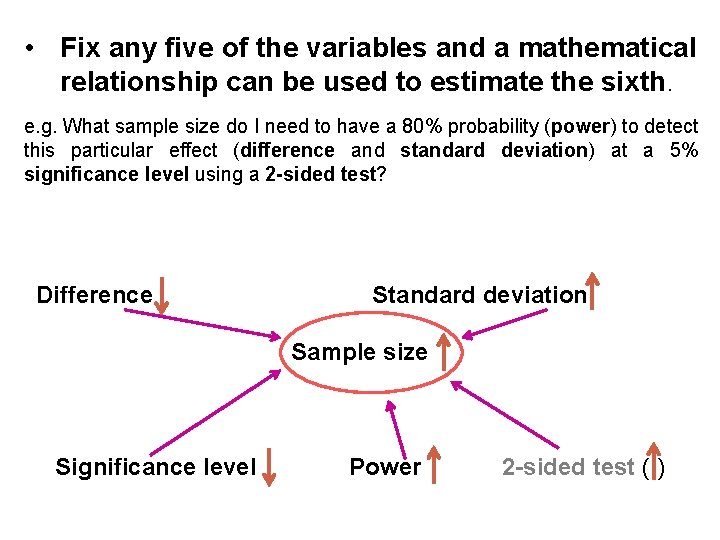
• Fix any five of the variables and a mathematical relationship can be used to estimate the sixth. e. g. What sample size do I need to have a 80% probability (power) to detect this particular effect (difference and standard deviation) at a 5% significance level using a 2 -sided test? Difference Standard deviation Sample size Significance level Power 2 -sided test ( )
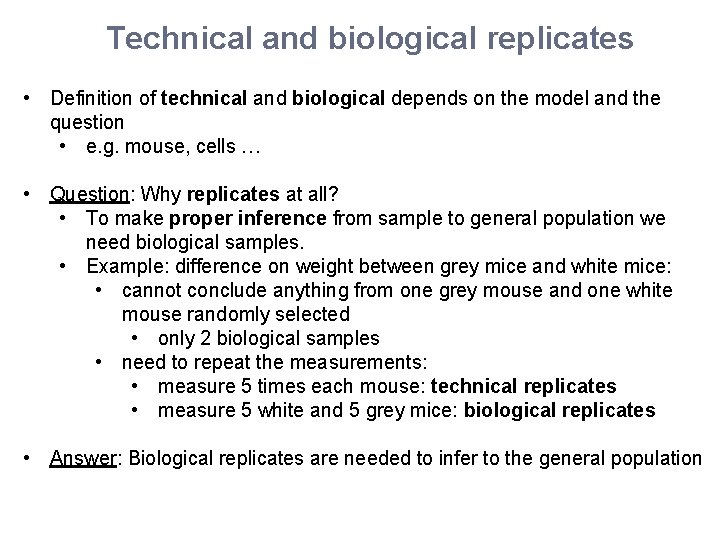
Technical and biological replicates • Definition of technical and biological depends on the model and the question • e. g. mouse, cells … • Question: Why replicates at all? • To make proper inference from sample to general population we need biological samples. • Example: difference on weight between grey mice and white mice: • cannot conclude anything from one grey mouse and one white mouse randomly selected • only 2 biological samples • need to repeat the measurements: • measure 5 times each mouse: technical replicates • measure 5 white and 5 grey mice: biological replicates • Answer: Biological replicates are needed to infer to the general population
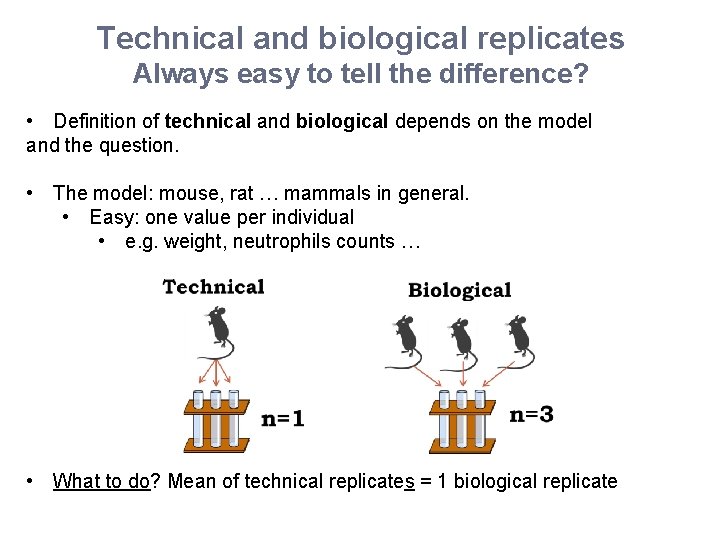
Technical and biological replicates Always easy to tell the difference? • Definition of technical and biological depends on the model and the question. • The model: mouse, rat … mammals in general. • Easy: one value per individual • e. g. weight, neutrophils counts … • What to do? Mean of technical replicates = 1 biological replicate
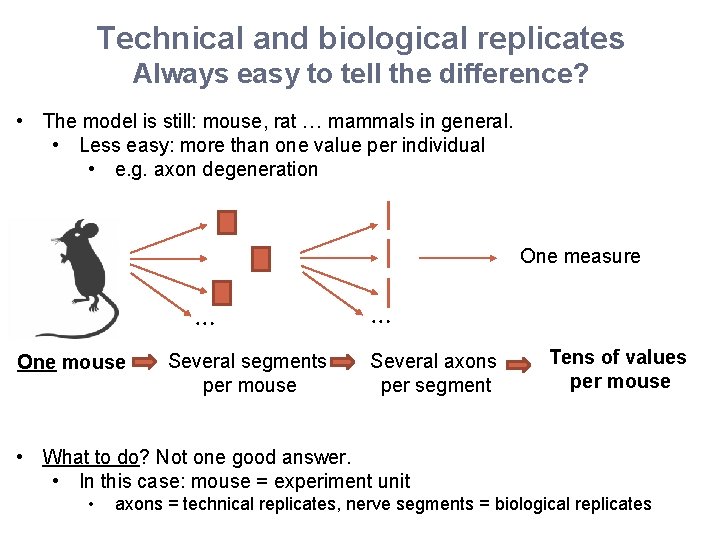
Technical and biological replicates Always easy to tell the difference? • The model is still: mouse, rat … mammals in general. • Less easy: more than one value per individual • e. g. axon degeneration One measure … One mouse Several segments per mouse … Several axons per segment Tens of values per mouse • What to do? Not one good answer. • In this case: mouse = experiment unit • axons = technical replicates, nerve segments = biological replicates
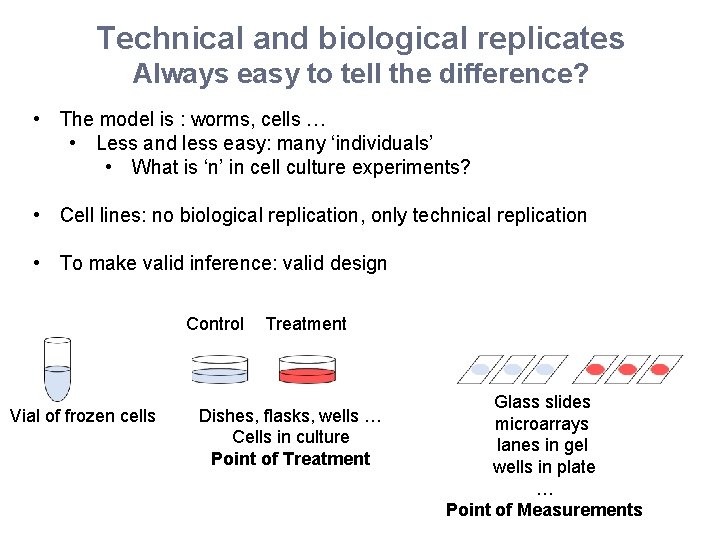
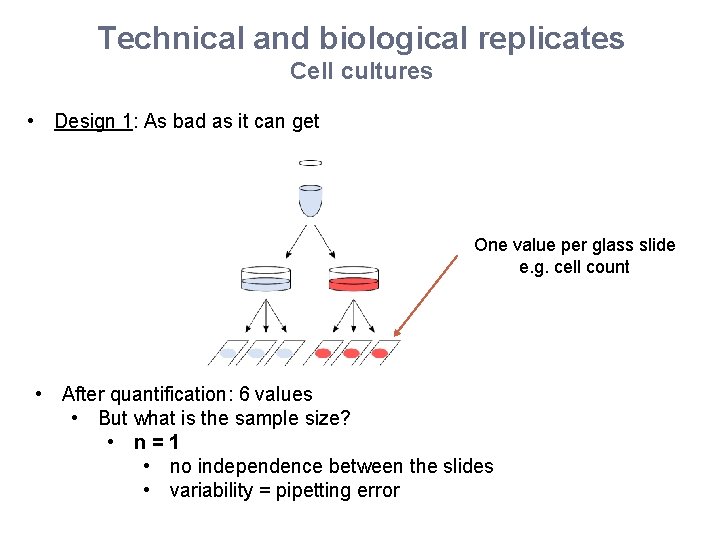
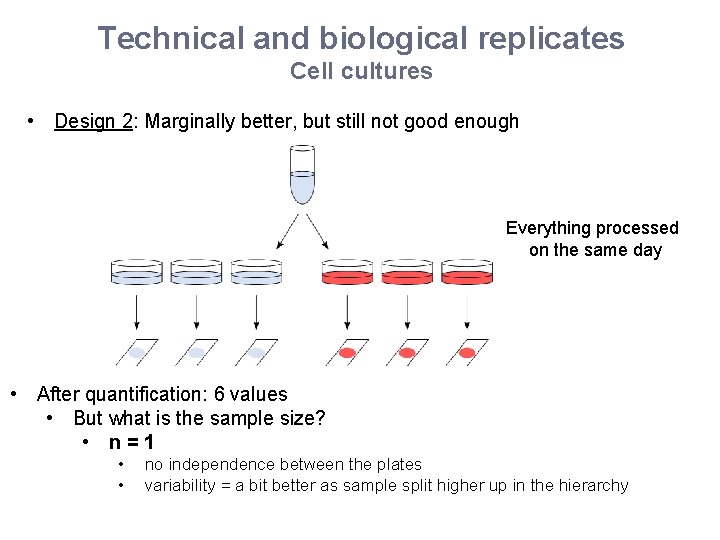
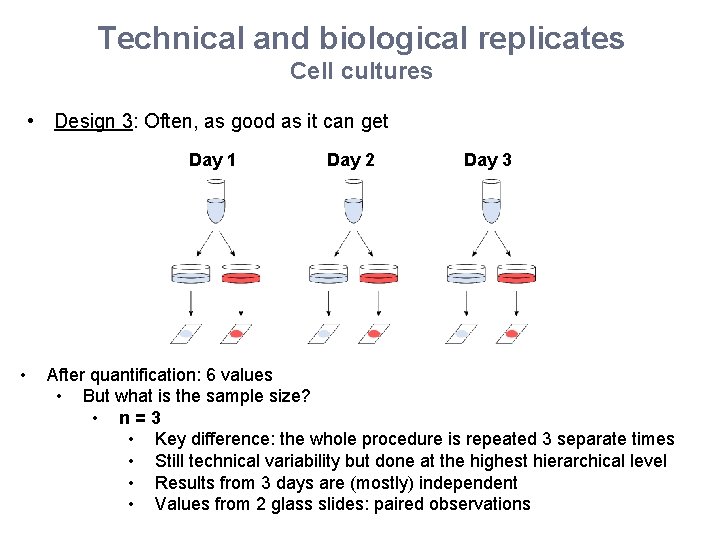
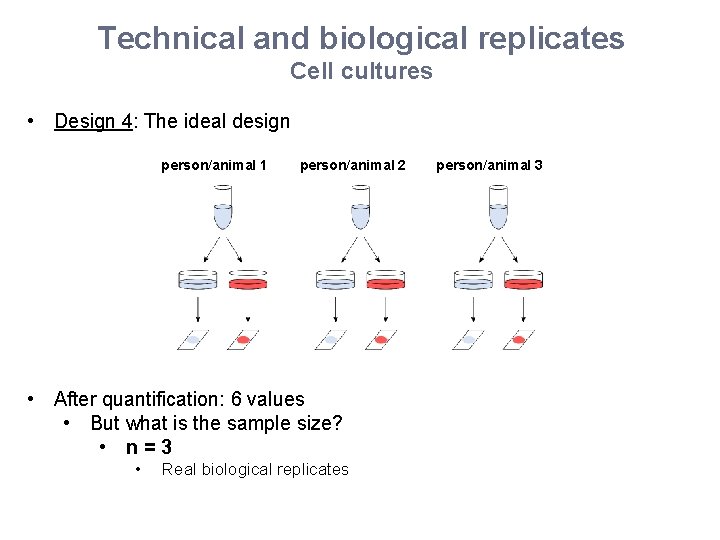
Technical and biological replicates Always easy to tell the difference? • The model is : worms, cells … • Less and less easy: many ‘individuals’ • What is ‘n’ in cell culture experiments? • Cell lines: no biological replication, only technical replication • To make valid inference: valid design Control Vial of frozen cells Treatment Dishes, flasks, wells … Cells in culture Point of Treatment Glass slides microarrays lanes in gel wells in plate … Point of Measurements
Technical and biological replicates Cell cultures • Design 1: As bad as it can get One value per glass slide e. g. cell count • After quantification: 6 values • But what is the sample size? • n=1 • no independence between the slides • variability = pipetting error
Technical and biological replicates Cell cultures • Design 2: Marginally better, but still not good enough Everything processed on the same day • After quantification: 6 values • But what is the sample size? • n=1 • • no independence between the plates variability = a bit better as sample split higher up in the hierarchy
Technical and biological replicates Cell cultures • Design 3: Often, as good as it can get Day 1 • Day 2 Day 3 After quantification: 6 values • But what is the sample size? • n=3 • Key difference: the whole procedure is repeated 3 separate times • Still technical variability but done at the highest hierarchical level • Results from 3 days are (mostly) independent • Values from 2 glass slides: paired observations
Technical and biological replicates Cell cultures • Design 4: The ideal design person/animal 1 person/animal 2 • After quantification: 6 values • But what is the sample size? • n=3 • Real biological replicates person/animal 3
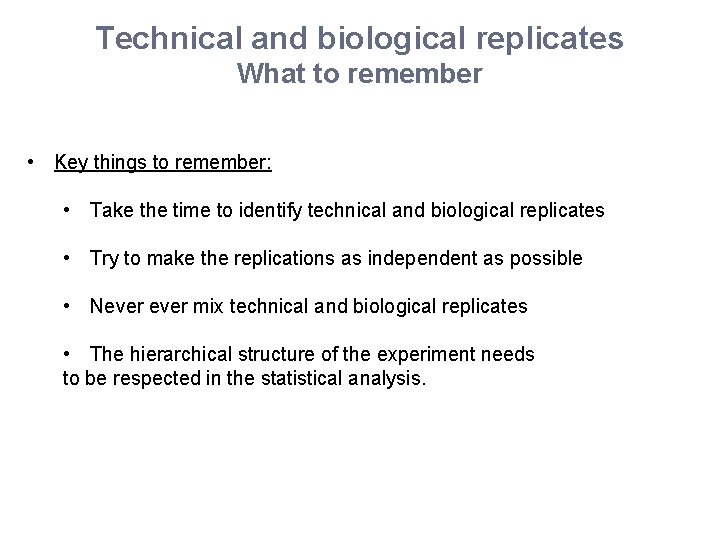
Technical and biological replicates What to remember • Key things to remember: • Take the time to identify technical and biological replicates • Try to make the replications as independent as possible • Never mix technical and biological replicates • The hierarchical structure of the experiment needs to be respected in the statistical analysis.
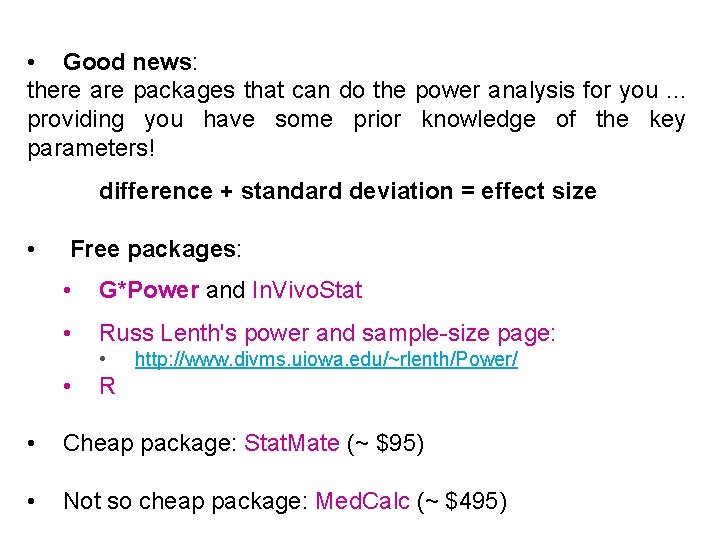
• Good news: there are packages that can do the power analysis for you. . . providing you have some prior knowledge of the key parameters! difference + standard deviation = effect size • Free packages: • G*Power and In. Vivo. Stat • Russ Lenth's power and sample-size page: • • http: //www. divms. uiowa. edu/~rlenth/Power/ R • Cheap package: Stat. Mate (~ $95) • Not so cheap package: Med. Calc (~ $495)
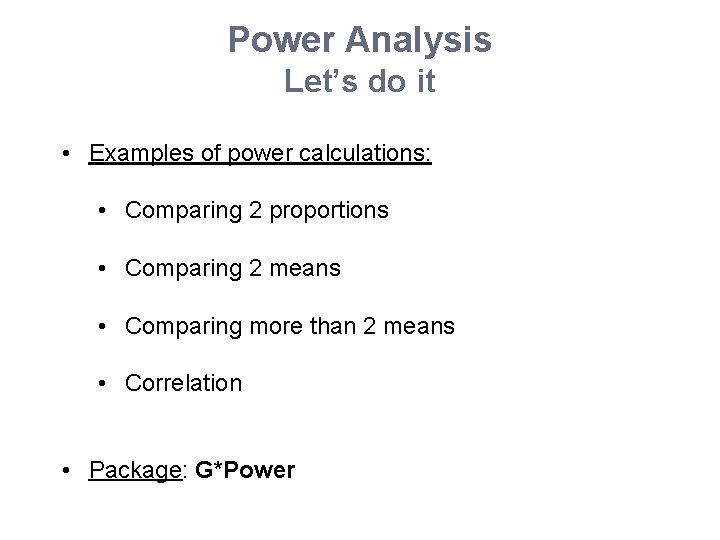
Power Analysis Let’s do it • Examples of power calculations: • Comparing 2 proportions • Comparing 2 means • Comparing more than 2 means • Correlation • Package: G*Power
Power Analysis Comparing 2 proportions • Research example: • A scientist is looking at a new treatment to reduce the development of tumours in mice. • Control group: 40% of mice develop tumours • Aim: reduction to 10% • Power: 80%, 5% significance • Effect size: measure of distance between 2 proportions or probabilities • Comparison between 2 proportions: Fisher’s exact test
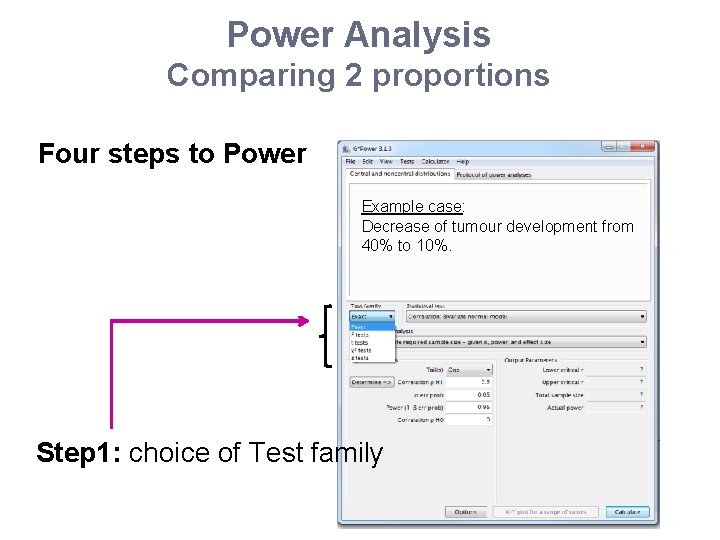
Power Analysis Comparing 2 proportions Four steps to Power Example case: Decrease of tumour development from 40% to 10%. Step 1: choice of Test family
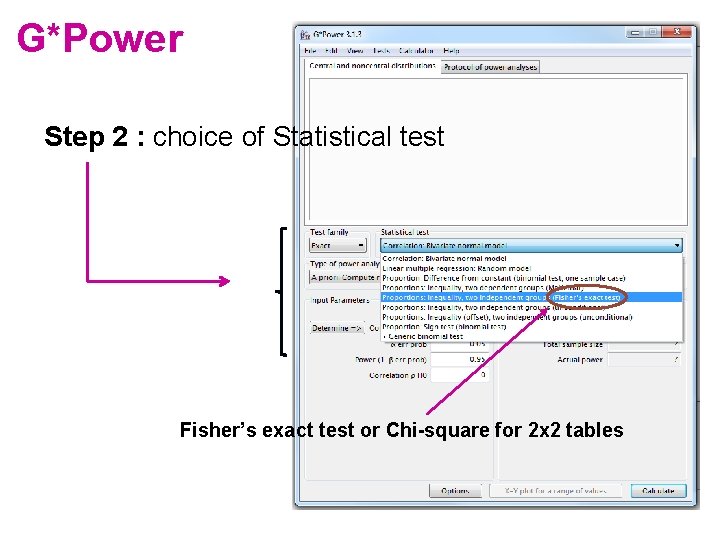
G*Power Step 2 : choice of Statistical test Fisher’s exact test or Chi-square for 2 x 2 tables
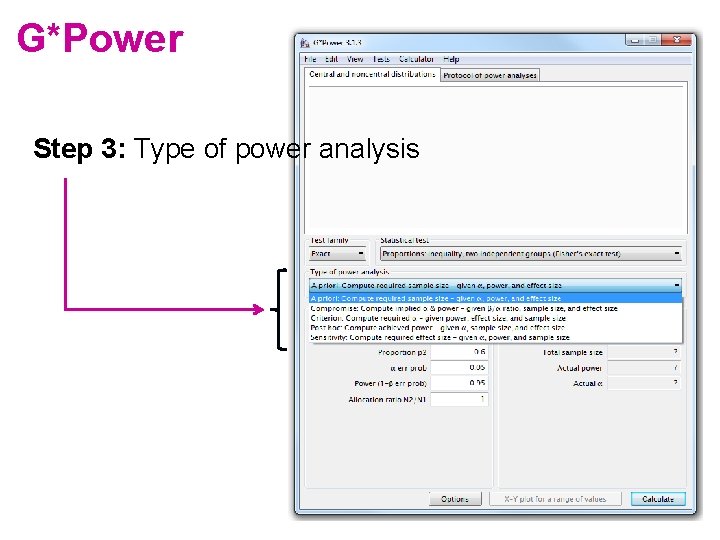
G*Power Step 3: Type of power analysis
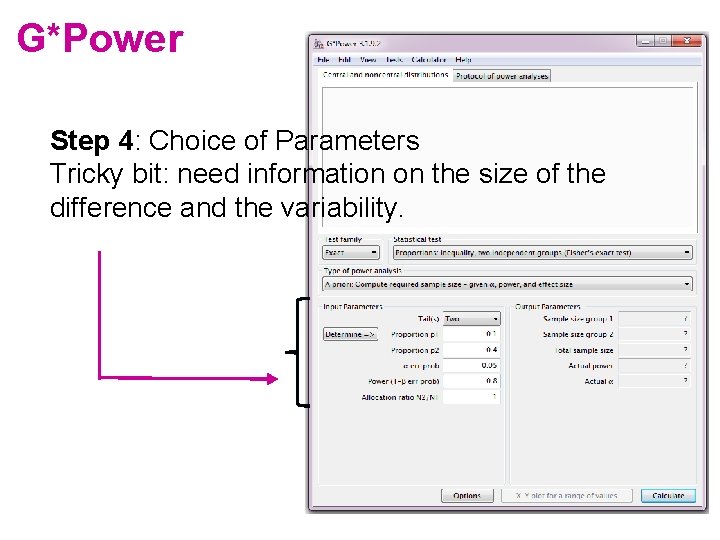
G*Power Step 4: Choice of Parameters Tricky bit: need information on the size of the difference and the variability.
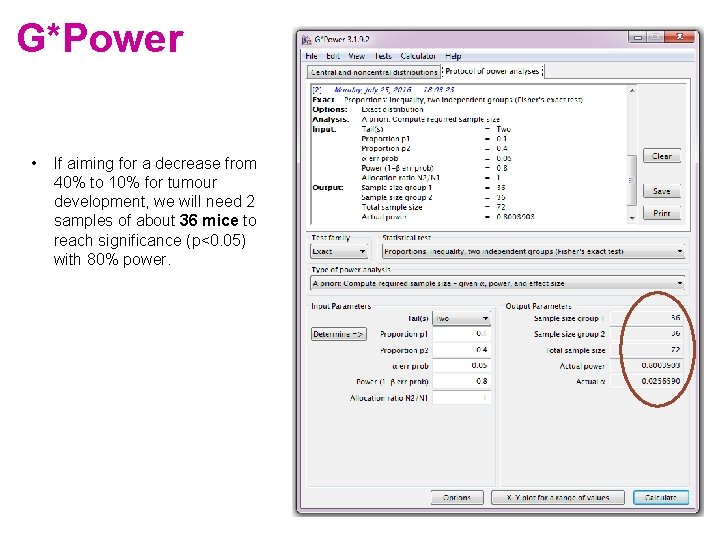
G*Power • If aiming for a decrease from 40% to 10% for tumour development, we will need 2 samples of about 36 mice to reach significance (p<0. 05) with 80% power.
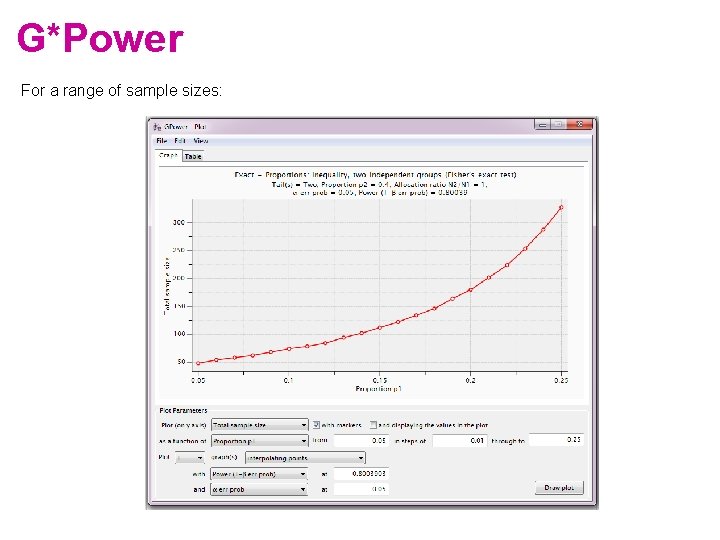
G*Power For a range of sample sizes:
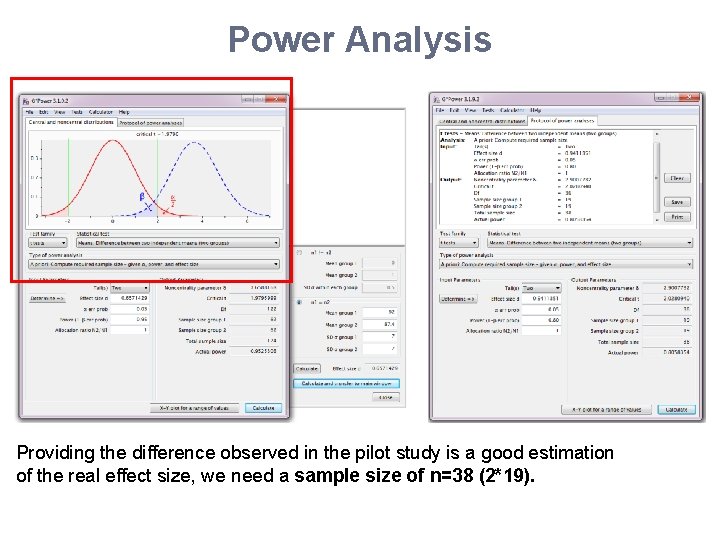
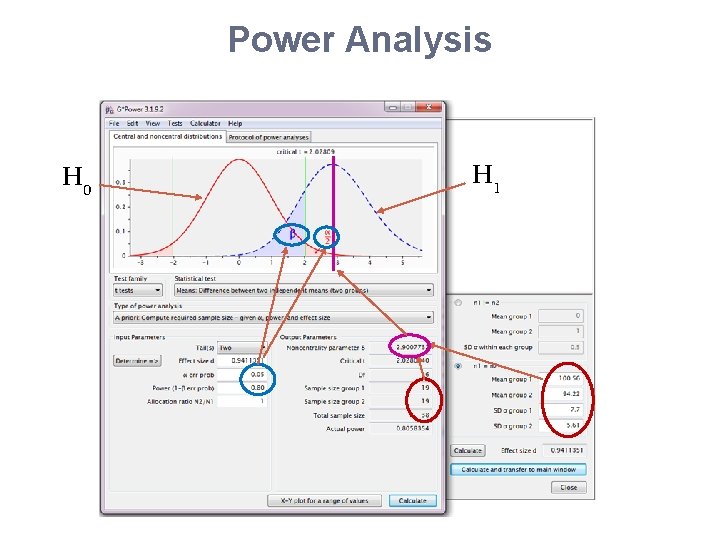
Power Analysis Comparing 2 means • Research example: • A scientist is looking at the effect of caffeine on muscle metabolism. • Metabolism measured via Respiratory Exchange Ratio (RER) • Pilot study: • • Placebo: Mean=100. 56, SD=7. 70 and Caffeine: Mean=94. 22, SD=5. 61 Power: 80%, 5% significance • Effect size: difference between the 2 means accounting for the variability (Cohen’s d). • Comparison between 2 means: t-test
Power Analysis Providing the difference observed in the pilot study is a good estimation of the real effect size, we need a sample size of n=38 (2*19).
Power Analysis H 0 H 1
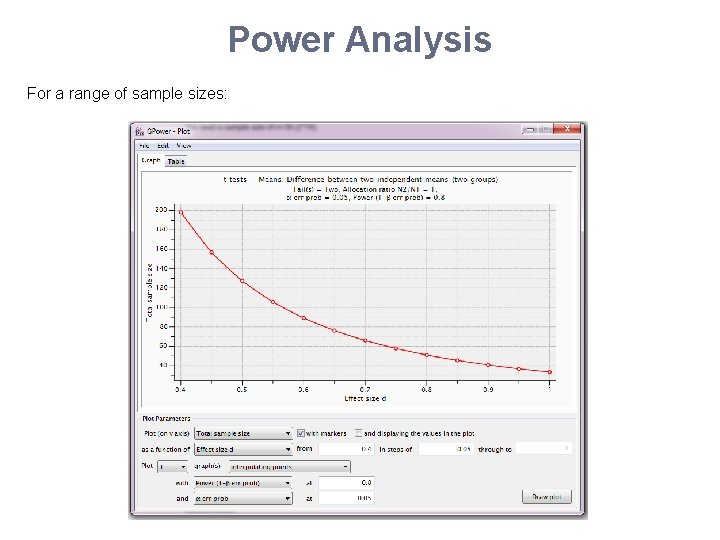
Power Analysis For a range of sample sizes:
Comparison of more than 2 means ANOVA • Extension of the t-test as in it compares means accounting for groups variability but because there are more than 2 means, it actually compares the variance between groups with the one within groups (hence ANalysis Of VAriance). • Output of an ANOVA is 2 -fold: – first, the omnibus part quantifying the overall difference between the groups and – second, the pairwise comparisons of interest via post-hoc tests. • Most of the time, it’s the second bit which is really interesting – An adjustment needs to be applied to account for multiple comparisons.
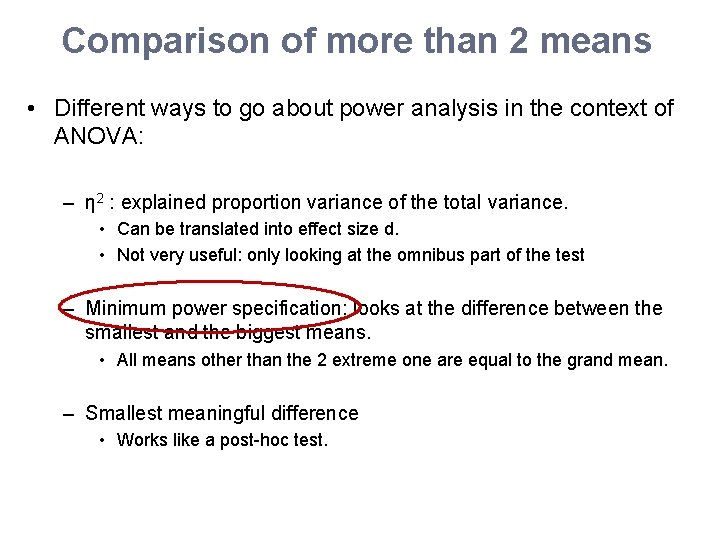
Comparison of more than 2 means • Different ways to go about power analysis in the context of ANOVA: – η 2 : explained proportion variance of the total variance. • Can be translated into effect size d. • Not very useful: only looking at the omnibus part of the test – Minimum power specification: looks at the difference between the smallest and the biggest means. • All means other than the 2 extreme one are equal to the grand mean. – Smallest meaningful difference • Works like a post-hoc test.
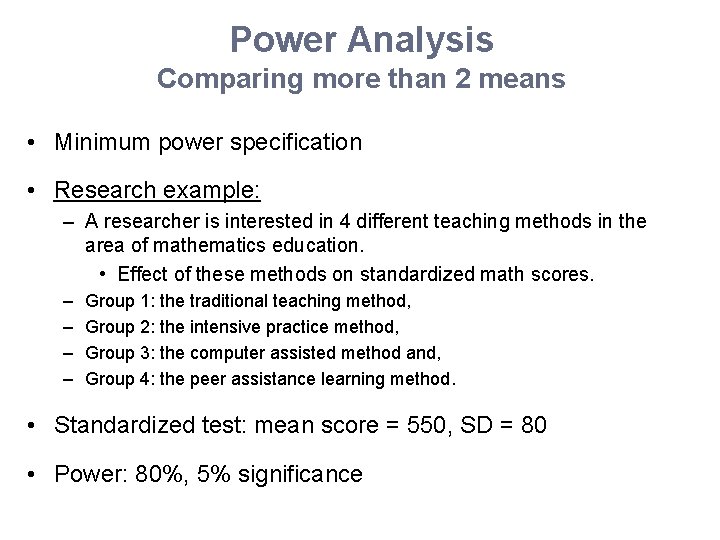
Power Analysis Comparing more than 2 means • Minimum power specification • Research example: – A researcher is interested in 4 different teaching methods in the area of mathematics education. • Effect of these methods on standardized math scores. – – Group 1: the traditional teaching method, Group 2: the intensive practice method, Group 3: the computer assisted method and, Group 4: the peer assistance learning method. • Standardized test: mean score = 550, SD = 80 • Power: 80%, 5% significance
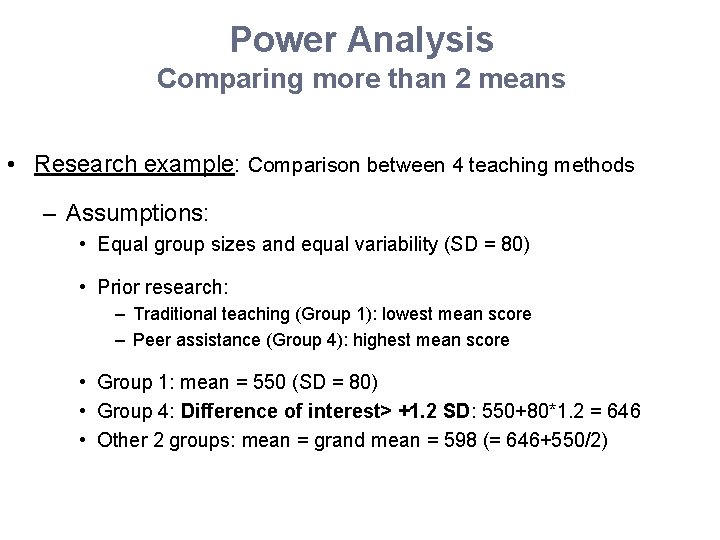
Power Analysis Comparing more than 2 means • Research example: Comparison between 4 teaching methods – Assumptions: • Equal group sizes and equal variability (SD = 80) • Prior research: – Traditional teaching (Group 1): lowest mean score – Peer assistance (Group 4): highest mean score • Group 1: mean = 550 (SD = 80) • Group 4: Difference of interest> +1. 2 SD: 550+80*1. 2 = 646 • Other 2 groups: mean = grand mean = 598 (= 646+550/2)
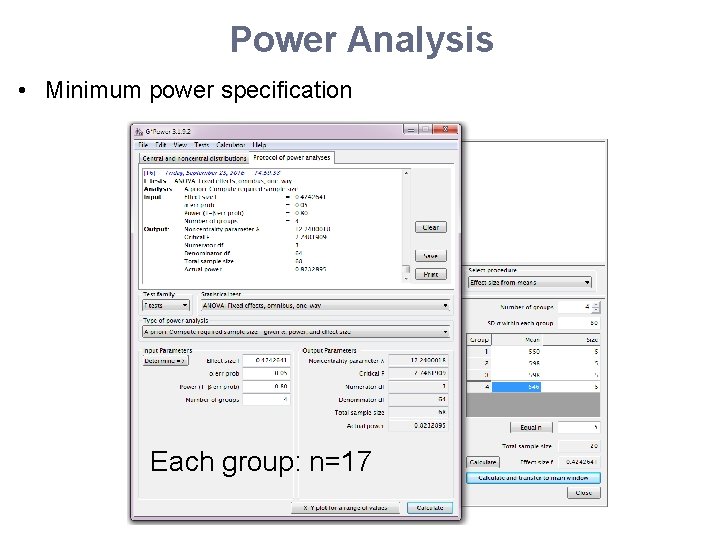
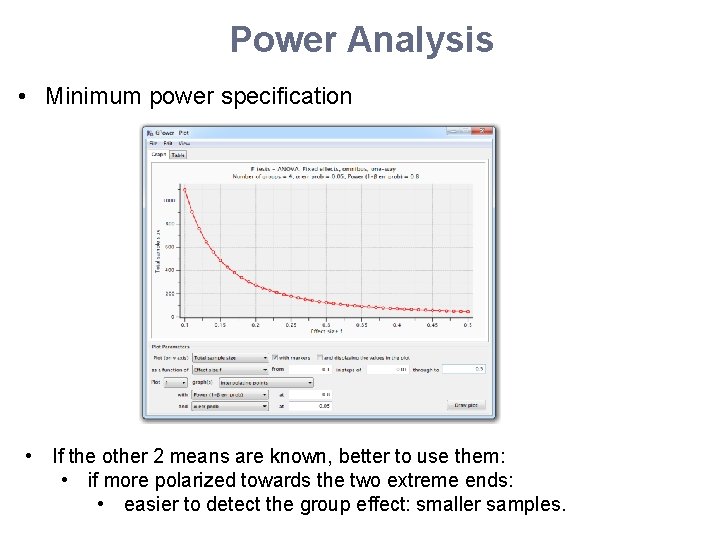
Power Analysis • Minimum power specification Each group: n=17
Power Analysis • Minimum power specification • If the other 2 means are known, better to use them: • if more polarized towards the two extreme ends: • easier to detect the group effect: smaller samples.
Comparison of more than 2 means • Different ways to go about power analysis in the context of ANOVA: – η 2 : explained proportion variance of the total variance. • Can be translated into effect size d. – Minimum power specification: looks at the difference between the smallest and the biggest means. • All means other than the 2 extreme one are equal to the grand mean. – Smallest meaningful difference • Works like a post-hoc test.
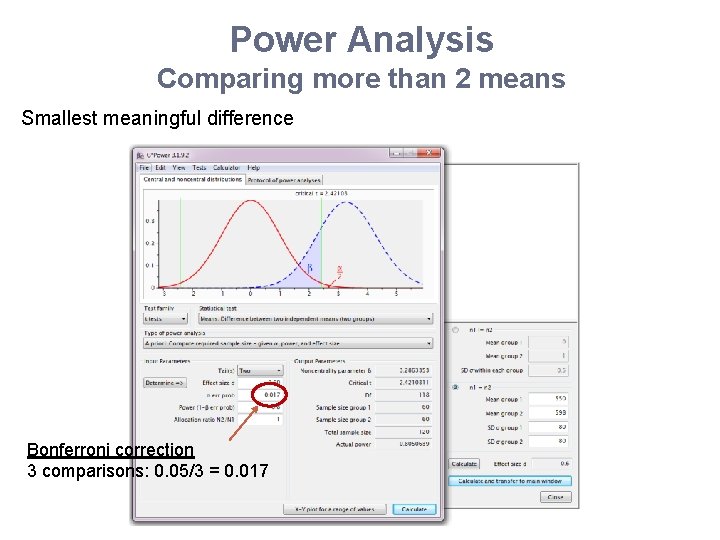
Power Analysis Comparing more than 2 means • Research example: Comparison between 4 teaching methods • Smallest meaningful difference – Same assumptions: • Equal group sizes and equal variability (SD = 80) – 3 comparisons of interest: vs. Group 1 – Smallest meaningful difference: group 1 vs. Group 2 • t-test: Mean 1 = 550, SD = 80 and mean 2 = 598, SD = 80 • Power calculation like for a t-test but with a Bonferroni correction (adjustment for multiple comparisons)
Power Analysis Comparing more than 2 means Smallest meaningful difference Bonferroni correction 3 comparisons: 0. 05/3 = 0. 017
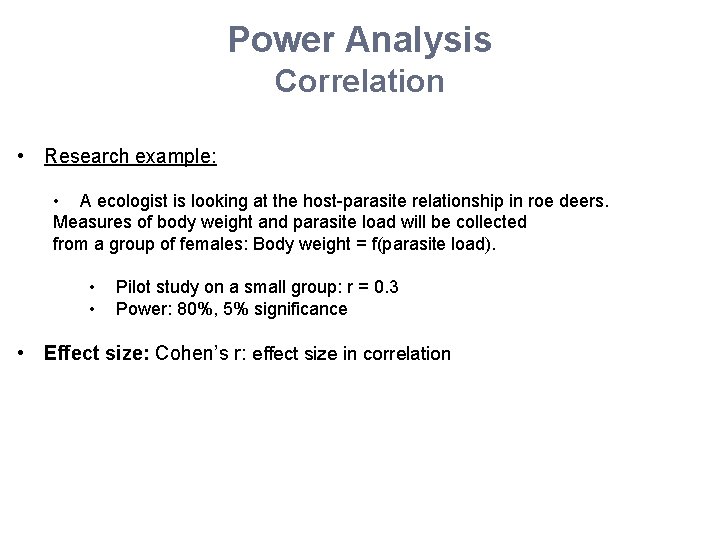
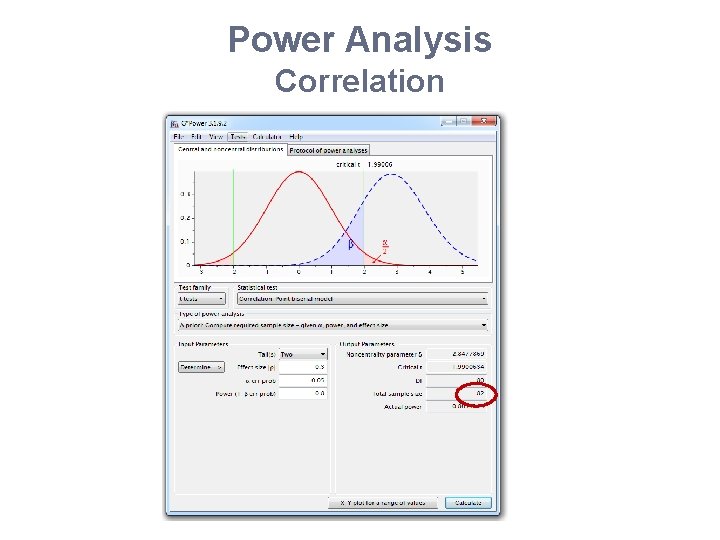
Power Analysis Correlation • Research example: • A ecologist is looking at the host-parasite relationship in roe deers. Measures of body weight and parasite load will be collected from a group of females: Body weight = f(parasite load). • • Pilot study on a small group: r = 0. 3 Power: 80%, 5% significance • Effect size: Cohen’s r: effect size in correlation
Power Analysis Correlation
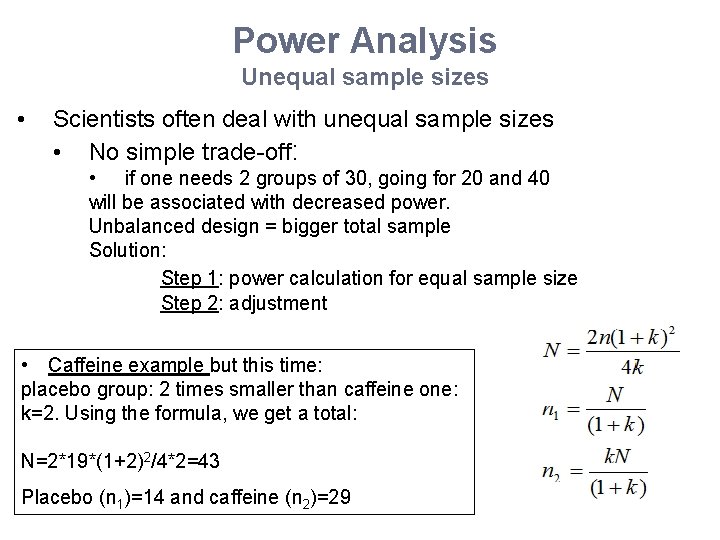
Power Analysis Unequal sample sizes • Scientists often deal with unequal sample sizes • No simple trade-off: • if one needs 2 groups of 30, going for 20 and 40 will be associated with decreased power. Unbalanced design = bigger total sample Solution: Step 1: power calculation for equal sample size Step 2: adjustment • Caffeine example but this time: placebo group: 2 times smaller than caffeine one: k=2. Using the formula, we get a total: N=2*19*(1+2)2/4*2=43 Placebo (n 1)=14 and caffeine (n 2)=29
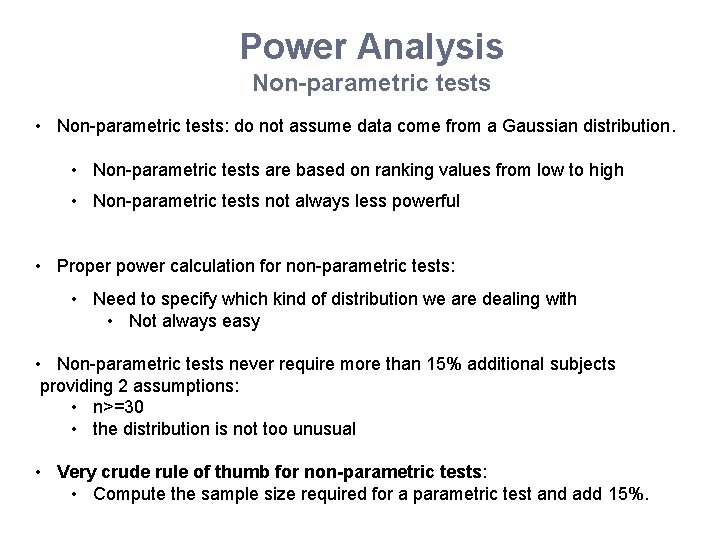
Power Analysis Non-parametric tests • Non-parametric tests: do not assume data come from a Gaussian distribution. • Non-parametric tests are based on ranking values from low to high • Non-parametric tests not always less powerful • Proper power calculation for non-parametric tests: • Need to specify which kind of distribution we are dealing with • Not always easy • Non-parametric tests never require more than 15% additional subjects providing 2 assumptions: • n>=30 • the distribution is not too unusual • Very crude rule of thumb for non-parametric tests: • Compute the sample size required for a parametric test and add 15%.