
Sample Exercise 23 1 Identifying the Coordination Sphere


- Slides: 24
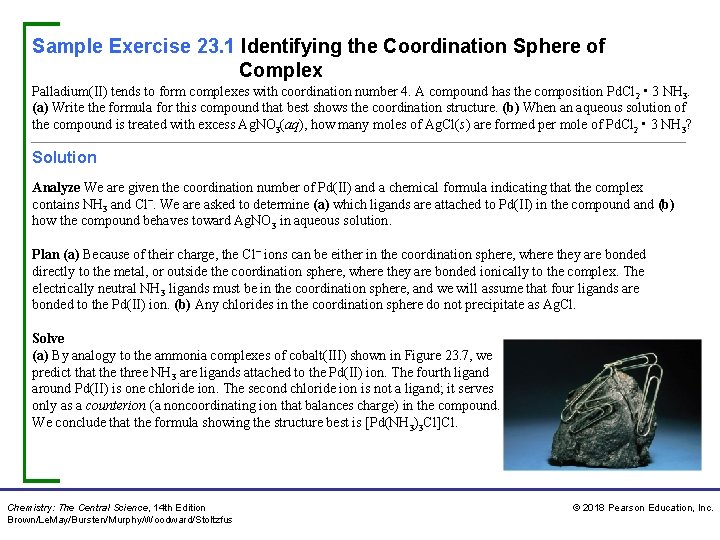
Sample Exercise 23. 1 Identifying the Coordination Sphere of Complex Palladium(II) tends to form complexes with coordination number 4. A compound has the composition Pd. Cl 2 • 3 NH 3. (a) Write the formula for this compound that best shows the coordination structure. (b) When an aqueous solution of the compound is treated with excess Ag. NO 3(aq), how many moles of Ag. Cl(s) are formed per mole of Pd. Cl 2 • 3 NH 3? Solution Analyze We are given the coordination number of Pd(II) and a chemical formula indicating that the complex contains NH 3 and Cl−. We are asked to determine (a) which ligands are attached to Pd(II) in the compound and (b) how the compound behaves toward Ag. NO 3 in aqueous solution. Plan (a) Because of their charge, the Cl− ions can be either in the coordination sphere, where they are bonded directly to the metal, or outside the coordination sphere, where they are bonded ionically to the complex. The electrically neutral NH 3 ligands must be in the coordination sphere, and we will assume that four ligands are bonded to the Pd(II) ion. (b) Any chlorides in the coordination sphere do not precipitate as Ag. Cl. Solve (a) By analogy to the ammonia complexes of cobalt(III) shown in Figure 23. 7, we predict that the three NH 3 are ligands attached to the Pd(II) ion. The fourth ligand around Pd(II) is one chloride ion. The second chloride ion is not a ligand; it serves only as a counterion (a noncoordinating ion that balances charge) in the compound. We conclude that the formula showing the structure best is [Pd(NH 3)3 Cl]Cl. Chemistry: The Central Science, 14 th Edition Brown/Le. May/Bursten/Murphy/Woodward/Stoltzfus © 2018 Pearson Education, Inc.
Sample Exercise 23. 1 Identifying the Coordination Sphere of Complex Continued (b) Because only the non-ligand Cl− can react, we expect to produce 1 mol of Ag. Cl(s) per mole of complex. The balanced equation is [Pd(NH 3)3 Cl]Cl(aq) + Ag. NO 3(aq) This is a metathesis reaction [Pd(NH 3)3 Cl]NO 3(aq) + Ag. Cl(s) (Section 4. 2) in which one of the cations is the [Pd(NH 3)3 Cl]+ complex ion. Practice Exercise 1 When the compound Rh. Cl 3 • 4 NH 3 is dissolved in water and treated with excess Ag. NO 3(aq) one mole of Ag. Cl(s) is formed for every mole of Rh. Cl 3 • 4 NH 3. What is the correct way to write the formula of this compound? (a) [Rh(NH 3)4 Cl 3] (b) [Rh(NH 3)4 Cl 2]Cl (c) [Rh(NH 3)4 Cl]Cl 2 (d) [Rh(NH 3)4]Cl 3 (e) [Rh. Cl 3](NH 3)4 Practice Exercise 2 Predict the number of ions produced per formula unit when the compound Co. Cl 2 • 6 H 2 O dissolves in water to form an aqueous solution. Chemistry: The Central Science, 14 th Edition Brown/Le. May/Bursten/Murphy/Woodward/Stoltzfus © 2018 Pearson Education, Inc.
Sample Exercise 23. 2 Determining the Oxidation Number of a Metal in a Complex What is the oxidation number of the metal in [Rh(NH 3)5 Cl](NO 3)2? Solution Analyze We are given the chemical formula of a coordination compound asked to determine the oxidation number of its metal atom. Plan To determine the oxidation number of Rh, we need to figure out what charges are contributed by the other groups. The overall charge is zero, so the oxidation number of the metal must balance the charge due to the rest of the compound. Solve The NO 3 group is the nitrate anion, which has a 1– charge. The NH 3 ligands carry zero charge, and the Cl is a coordinated chloride ion, which has a 1– charge. The sum of all the charges must be zero: x + 5(0) + (− 1) + 2(− 1) = 0 [Rh(NH 3)5 Cl](NO 3)2 The oxidation number of rhodium, x, must therefore be +3. Chemistry: The Central Science, 14 th Edition Brown/Le. May/Bursten/Murphy/Woodward/Stoltzfus © 2018 Pearson Education, Inc.
Sample Exercise 23. 2 Determining the Oxidation Number of a Metal in a Complex Continued Practice Exercise 1 In which of the following compounds does the transition-metal have the highest oxidation number? (a) [Co(NH 3)4 Cl 2] (b) K 2[Pt. Cl 6] (c) Rb 3[Mo. O 3 F 3] (d) Na[Ag(CN)2] (e) K 4[Mn(CN)6] Practice Exercise 2 What is the charge of the complex formed by a platinum(II) metal ion surrounded by two ammonia molecules and two bromide ions? Chemistry: The Central Science, 14 th Edition Brown/Le. May/Bursten/Murphy/Woodward/Stoltzfus © 2018 Pearson Education, Inc.
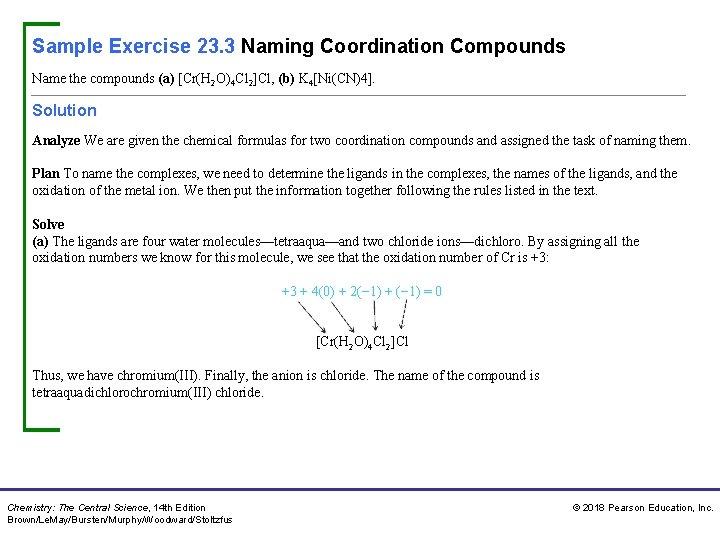
Sample Exercise 23. 3 Naming Coordination Compounds Name the compounds (a) [Cr(H 2 O)4 Cl 2]Cl, (b) K 4[Ni(CN)4]. Solution Analyze We are given the chemical formulas for two coordination compounds and assigned the task of naming them. Plan To name the complexes, we need to determine the ligands in the complexes, the names of the ligands, and the oxidation of the metal ion. We then put the information together following the rules listed in the text. Solve (a) The ligands are four water molecules—tetraaqua—and two chloride ions—dichloro. By assigning all the oxidation numbers we know for this molecule, we see that the oxidation number of Cr is +3: +3 + 4(0) + 2(− 1) + (− 1) = 0 [Cr(H 2 O)4 Cl 2]Cl Thus, we have chromium(III). Finally, the anion is chloride. The name of the compound is tetraaquadichlorochromium(III) chloride. Chemistry: The Central Science, 14 th Edition Brown/Le. May/Bursten/Murphy/Woodward/Stoltzfus © 2018 Pearson Education, Inc.
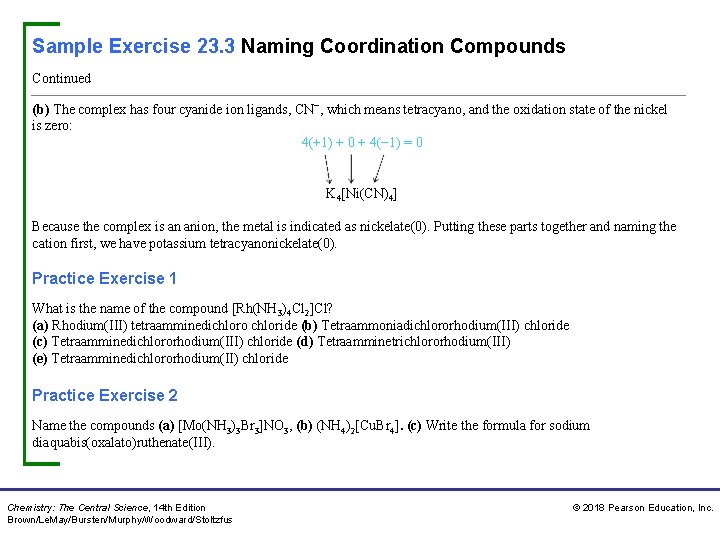
Sample Exercise 23. 3 Naming Coordination Compounds Continued (b) The complex has four cyanide ion ligands, CN−, which means tetracyano, and the oxidation state of the nickel is zero: 4(+1) + 0 + 4(− 1) = 0 K 4[Ni(CN)4] Because the complex is an anion, the metal is indicated as nickelate(0). Putting these parts together and naming the cation first, we have potassium tetracyanonickelate(0). Practice Exercise 1 What is the name of the compound [Rh(NH 3)4 Cl 2]Cl? (a) Rhodium(III) tetraamminedichloro chloride (b) Tetraammoniadichlororhodium(III) chloride (c) Tetraamminedichlororhodium(III) chloride (d) Tetraamminetrichlororhodium(III) (e) Tetraamminedichlororhodium(II) chloride Practice Exercise 2 Name the compounds (a) [Mo(NH 3)3 Br 3]NO 3, (b) (NH 4)2[Cu. Br 4]. (c) Write the formula for sodium diaquabis(oxalato)ruthenate(III). Chemistry: The Central Science, 14 th Edition Brown/Le. May/Bursten/Murphy/Woodward/Stoltzfus © 2018 Pearson Education, Inc.
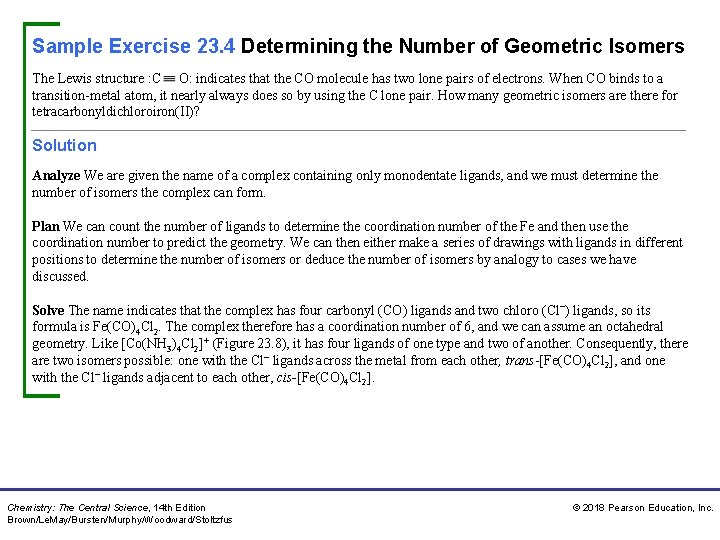
Sample Exercise 23. 4 Determining the Number of Geometric Isomers The Lewis structure : C O: indicates that the CO molecule has two lone pairs of electrons. When CO binds to a transition-metal atom, it nearly always does so by using the C lone pair. How many geometric isomers are there for tetracarbonyldichloroiron(II)? Solution Analyze We are given the name of a complex containing only monodentate ligands, and we must determine the number of isomers the complex can form. Plan We can count the number of ligands to determine the coordination number of the Fe and then use the coordination number to predict the geometry. We can then either make a series of drawings with ligands in different positions to determine the number of isomers or deduce the number of isomers by analogy to cases we have discussed. Solve The name indicates that the complex has four carbonyl (CO) ligands and two chloro (Cl−) ligands, so its formula is Fe(CO)4 Cl 2. The complex therefore has a coordination number of 6, and we can assume an octahedral geometry. Like [Co(NH 3)4 Cl 2]+ (Figure 23. 8), it has four ligands of one type and two of another. Consequently, there are two isomers possible: one with the Cl− ligands across the metal from each other, trans-[Fe(CO)4 Cl 2], and one with the Cl− ligands adjacent to each other, cis-[Fe(CO)4 Cl 2]. Chemistry: The Central Science, 14 th Edition Brown/Le. May/Bursten/Murphy/Woodward/Stoltzfus © 2018 Pearson Education, Inc.
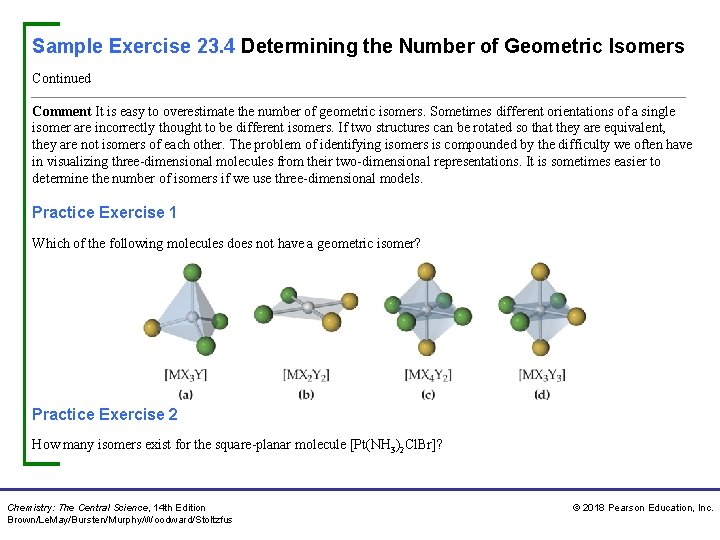
Sample Exercise 23. 4 Determining the Number of Geometric Isomers Continued Comment It is easy to overestimate the number of geometric isomers. Sometimes different orientations of a single isomer are incorrectly thought to be different isomers. If two structures can be rotated so that they are equivalent, they are not isomers of each other. The problem of identifying isomers is compounded by the difficulty we often have in visualizing three-dimensional molecules from their two-dimensional representations. It is sometimes easier to determine the number of isomers if we use three-dimensional models. Practice Exercise 1 Which of the following molecules does not have a geometric isomer? Practice Exercise 2 How many isomers exist for the square-planar molecule [Pt(NH 3)2 Cl. Br]? Chemistry: The Central Science, 14 th Edition Brown/Le. May/Bursten/Murphy/Woodward/Stoltzfus © 2018 Pearson Education, Inc.
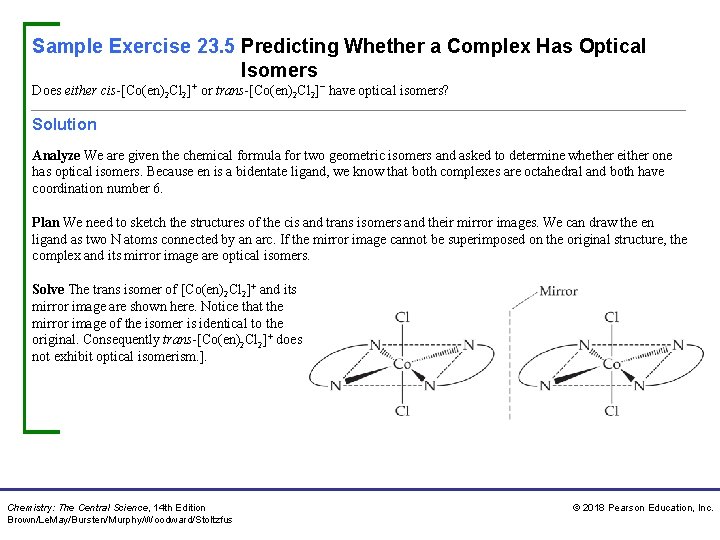
Sample Exercise 23. 5 Predicting Whether a Complex Has Optical Isomers Does either cis-[Co(en)2 Cl 2]+ or trans-[Co(en)2 Cl 2]− have optical isomers? Solution Analyze We are given the chemical formula for two geometric isomers and asked to determine whether either one has optical isomers. Because en is a bidentate ligand, we know that both complexes are octahedral and both have coordination number 6. Plan We need to sketch the structures of the cis and trans isomers and their mirror images. We can draw the en ligand as two N atoms connected by an arc. If the mirror image cannot be superimposed on the original structure, the complex and its mirror image are optical isomers. Solve The trans isomer of [Co(en)2 Cl 2]+ and its mirror image are shown here. Notice that the mirror image of the isomer is identical to the original. Consequently trans-[Co(en)2 Cl 2]+ does not exhibit optical isomerism. ]. Chemistry: The Central Science, 14 th Edition Brown/Le. May/Bursten/Murphy/Woodward/Stoltzfus © 2018 Pearson Education, Inc.
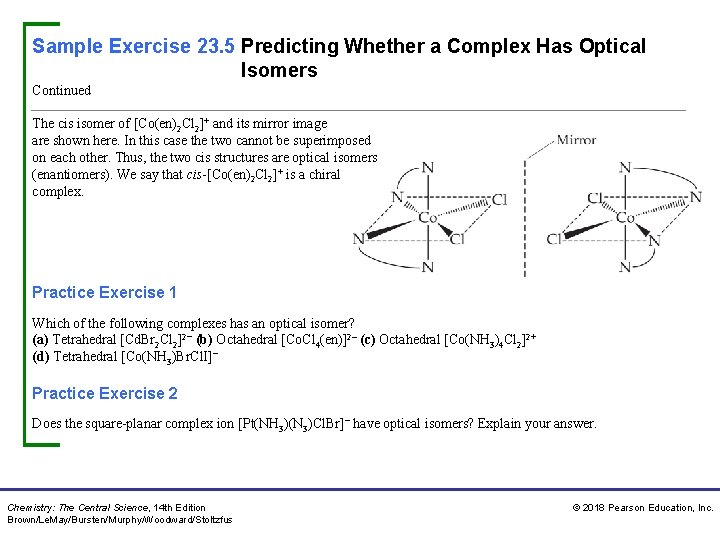
Sample Exercise 23. 5 Predicting Whether a Complex Has Optical Isomers Continued The cis isomer of [Co(en)2 Cl 2]+ and its mirror image are shown here. In this case the two cannot be superimposed on each other. Thus, the two cis structures are optical isomers (enantiomers). We say that cis-[Co(en)2 Cl 2]+ is a chiral complex. Practice Exercise 1 Which of the following complexes has an optical isomer? (a) Tetrahedral [Cd. Br 2 Cl 2]2− (b) Octahedral [Co. Cl 4(en)]2– (c) Octahedral [Co(NH 3)4 Cl 2]2+ (d) Tetrahedral [Co(NH 3)Br. Cl. I]− Practice Exercise 2 Does the square-planar complex ion [Pt(NH 3)(N 3)Cl. Br]− have optical isomers? Explain your answer. Chemistry: The Central Science, 14 th Edition Brown/Le. May/Bursten/Murphy/Woodward/Stoltzfus © 2018 Pearson Education, Inc.
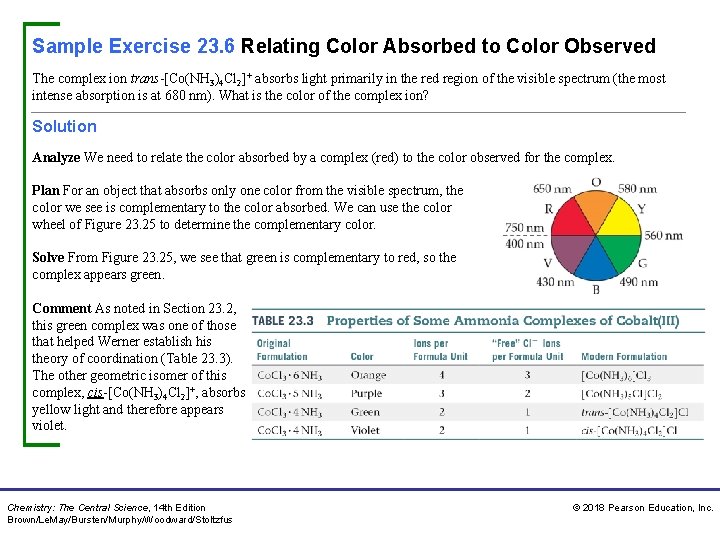
Sample Exercise 23. 6 Relating Color Absorbed to Color Observed The complex ion trans-[Co(NH 3)4 Cl 2]+ absorbs light primarily in the red region of the visible spectrum (the most intense absorption is at 680 nm). What is the color of the complex ion? Solution Analyze We need to relate the color absorbed by a complex (red) to the color observed for the complex. Plan For an object that absorbs only one color from the visible spectrum, the color we see is complementary to the color absorbed. We can use the color wheel of Figure 23. 25 to determine the complementary color. Solve From Figure 23. 25, we see that green is complementary to red, so the complex appears green. Comment As noted in Section 23. 2, this green complex was one of those that helped Werner establish his theory of coordination (Table 23. 3). The other geometric isomer of this complex, cis-[Co(NH 3)4 Cl 2]+, absorbs yellow light and therefore appears violet. Chemistry: The Central Science, 14 th Edition Brown/Le. May/Bursten/Murphy/Woodward/Stoltzfus © 2018 Pearson Education, Inc.
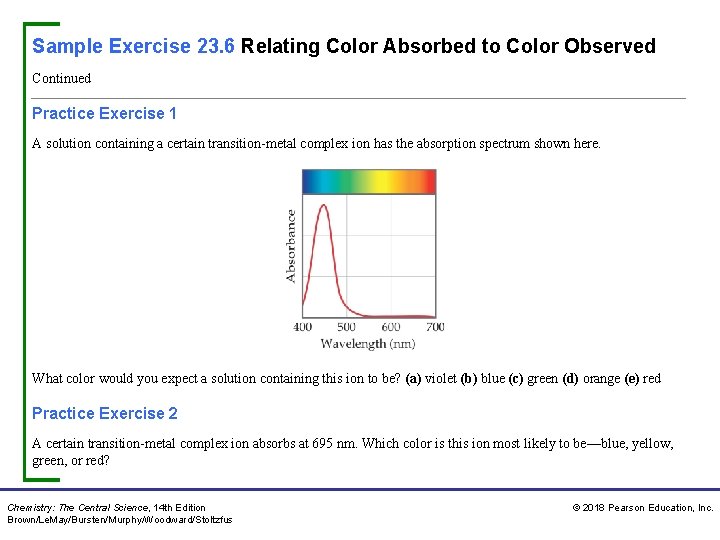
Sample Exercise 23. 6 Relating Color Absorbed to Color Observed Continued Practice Exercise 1 A solution containing a certain transition-metal complex ion has the absorption spectrum shown here. What color would you expect a solution containing this ion to be? (a) violet (b) blue (c) green (d) orange (e) red Practice Exercise 2 A certain transition-metal complex ion absorbs at 695 nm. Which color is this ion most likely to be—blue, yellow, green, or red? Chemistry: The Central Science, 14 th Edition Brown/Le. May/Bursten/Murphy/Woodward/Stoltzfus © 2018 Pearson Education, Inc.
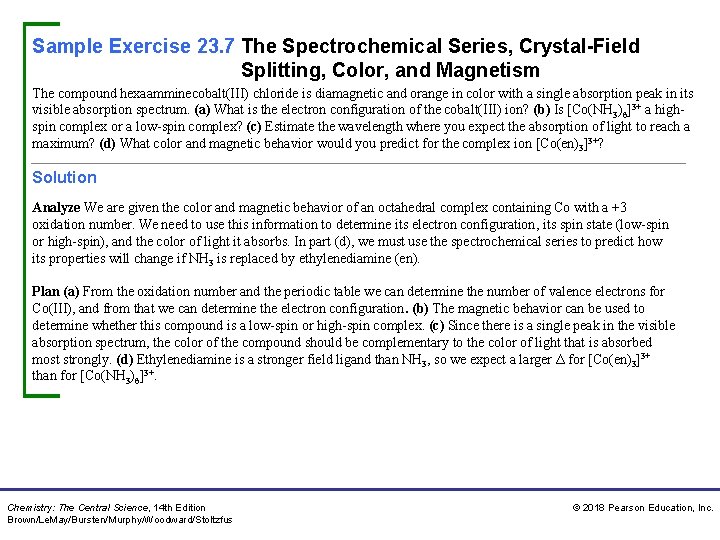
Sample Exercise 23. 7 The Spectrochemical Series, Crystal-Field Splitting, Color, and Magnetism The compound hexaamminecobalt(III) chloride is diamagnetic and orange in color with a single absorption peak in its visible absorption spectrum. (a) What is the electron configuration of the cobalt(III) ion? (b) Is [Co(NH 3)6]3+ a highspin complex or a low-spin complex? (c) Estimate the wavelength where you expect the absorption of light to reach a maximum? (d) What color and magnetic behavior would you predict for the complex ion [Co(en)3]3+? Solution Analyze We are given the color and magnetic behavior of an octahedral complex containing Co with a +3 oxidation number. We need to use this information to determine its electron configuration, its spin state (low-spin or high-spin), and the color of light it absorbs. In part (d), we must use the spectrochemical series to predict how its properties will change if NH 3 is replaced by ethylenediamine (en). Plan (a) From the oxidation number and the periodic table we can determine the number of valence electrons for Co(III), and from that we can determine the electron configuration. (b) The magnetic behavior can be used to determine whether this compound is a low-spin or high-spin complex. (c) Since there is a single peak in the visible absorption spectrum, the color of the compound should be complementary to the color of light that is absorbed most strongly. (d) Ethylenediamine is a stronger field ligand than NH 3, so we expect a larger Δ for [Co(en)3]3+ than for [Co(NH 3)6]3+. Chemistry: The Central Science, 14 th Edition Brown/Le. May/Bursten/Murphy/Woodward/Stoltzfus © 2018 Pearson Education, Inc.
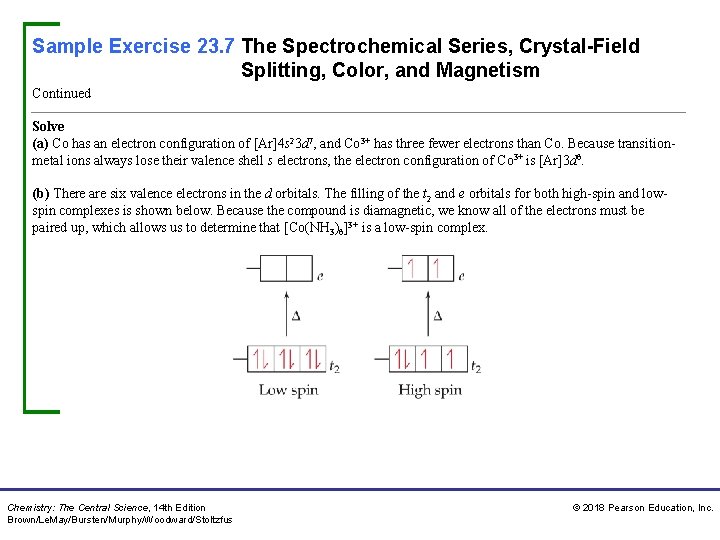
Sample Exercise 23. 7 The Spectrochemical Series, Crystal-Field Splitting, Color, and Magnetism Continued Solve (a) Co has an electron configuration of [Ar]4 s 23 d 7, and Co 3+ has three fewer electrons than Co. Because transitionmetal ions always lose their valence shell s electrons, the electron configuration of Co 3+ is [Ar]3 d 6. (b) There are six valence electrons in the d orbitals. The filling of the t 2 and e orbitals for both high-spin and lowspin complexes is shown below. Because the compound is diamagnetic, we know all of the electrons must be paired up, which allows us to determine that [Co(NH 3)6]3+ is a low-spin complex. Chemistry: The Central Science, 14 th Edition Brown/Le. May/Bursten/Murphy/Woodward/Stoltzfus © 2018 Pearson Education, Inc.
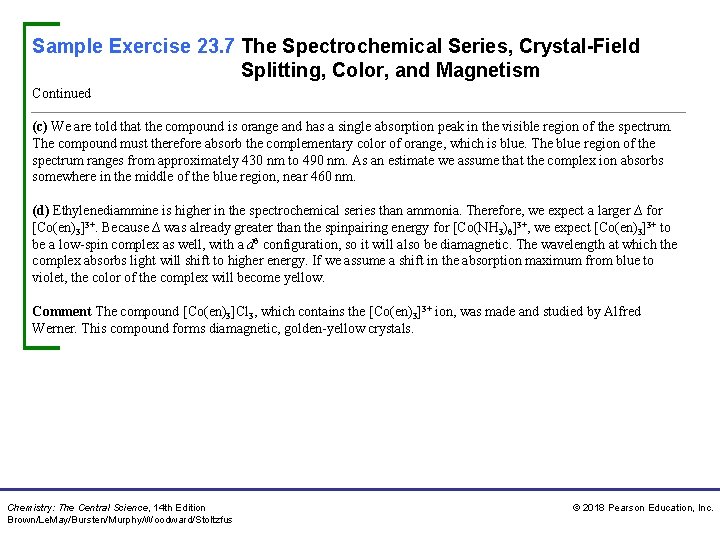
Sample Exercise 23. 7 The Spectrochemical Series, Crystal-Field Splitting, Color, and Magnetism Continued (c) We are told that the compound is orange and has a single absorption peak in the visible region of the spectrum. The compound must therefore absorb the complementary color of orange, which is blue. The blue region of the spectrum ranges from approximately 430 nm to 490 nm. As an estimate we assume that the complex ion absorbs somewhere in the middle of the blue region, near 460 nm. (d) Ethylenediammine is higher in the spectrochemical series than ammonia. Therefore, we expect a larger ∆ for [Co(en)3]3+. Because ∆ was already greater than the spinpairing energy for [Co(NH 3)6]3+, we expect [Co(en)3]3+ to be a low-spin complex as well, with a d 6 configuration, so it will also be diamagnetic. The wavelength at which the complex absorbs light will shift to higher energy. If we assume a shift in the absorption maximum from blue to violet, the color of the complex will become yellow. Comment The compound [Co(en)3]Cl 3, which contains the [Co(en)3]3+ ion, was made and studied by Alfred Werner. This compound forms diamagnetic, golden-yellow crystals. Chemistry: The Central Science, 14 th Edition Brown/Le. May/Bursten/Murphy/Woodward/Stoltzfus © 2018 Pearson Education, Inc.
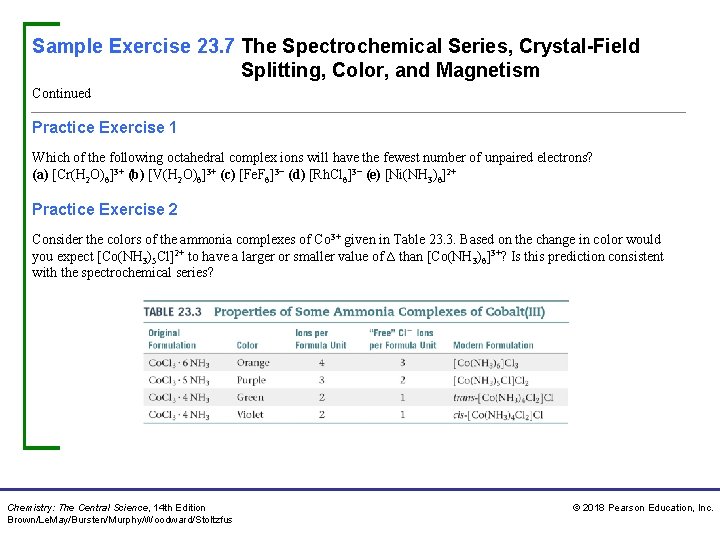
Sample Exercise 23. 7 The Spectrochemical Series, Crystal-Field Splitting, Color, and Magnetism Continued Practice Exercise 1 Which of the following octahedral complex ions will have the fewest number of unpaired electrons? (a) [Cr(H 2 O)6]3+ (b) [V(H 2 O)6]3+ (c) [Fe. F 6]3− (d) [Rh. Cl 6]3− (e) [Ni(NH 3)6]2+ Practice Exercise 2 Consider the colors of the ammonia complexes of Co 3+ given in Table 23. 3. Based on the change in color would you expect [Co(NH 3)5 Cl]2+ to have a larger or smaller value of ∆ than [Co(NH 3)6]3+? Is this prediction consistent with the spectrochemical series? Chemistry: The Central Science, 14 th Edition Brown/Le. May/Bursten/Murphy/Woodward/Stoltzfus © 2018 Pearson Education, Inc.
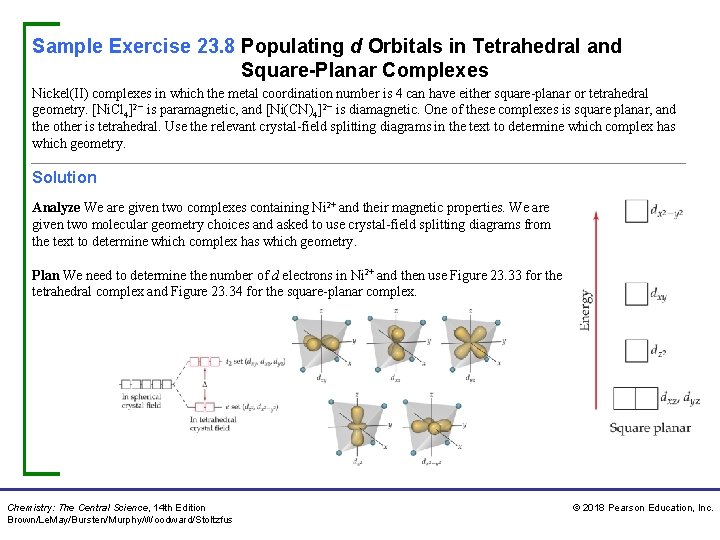
Sample Exercise 23. 8 Populating d Orbitals in Tetrahedral and Square-Planar Complexes Nickel(II) complexes in which the metal coordination number is 4 can have either square-planar or tetrahedral geometry. [Ni. Cl 4]2− is paramagnetic, and [Ni(CN)4]2− is diamagnetic. One of these complexes is square planar, and the other is tetrahedral. Use the relevant crystal-field splitting diagrams in the text to determine which complex has which geometry. Solution Analyze We are given two complexes containing Ni 2+ and their magnetic properties. We are given two molecular geometry choices and asked to use crystal-field splitting diagrams from the text to determine which complex has which geometry. Plan We need to determine the number of d electrons in Ni 2+ and then use Figure 23. 33 for the tetrahedral complex and Figure 23. 34 for the square-planar complex. Chemistry: The Central Science, 14 th Edition Brown/Le. May/Bursten/Murphy/Woodward/Stoltzfus © 2018 Pearson Education, Inc.
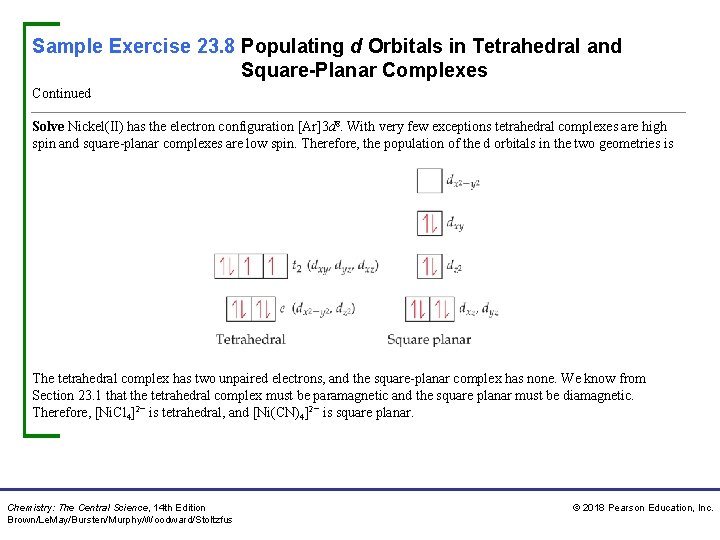
Sample Exercise 23. 8 Populating d Orbitals in Tetrahedral and Square-Planar Complexes Continued Solve Nickel(II) has the electron configuration [Ar]3 d 8. With very few exceptions tetrahedral complexes are high spin and square-planar complexes are low spin. Therefore, the population of the d orbitals in the two geometries is The tetrahedral complex has two unpaired electrons, and the square-planar complex has none. We know from Section 23. 1 that the tetrahedral complex must be paramagnetic and the square planar must be diamagnetic. Therefore, [Ni. Cl 4]2− is tetrahedral, and [Ni(CN)4]2− is square planar. Chemistry: The Central Science, 14 th Edition Brown/Le. May/Bursten/Murphy/Woodward/Stoltzfus © 2018 Pearson Education, Inc.
Sample Exercise 23. 8 Populating d Orbitals in Tetrahedral and Square-Planar Complexes Continued Comment Nickel(II) forms octahedral complexes more frequently than square-planar ones, whereas d 8 metals from periods 5 and 6 tend to favor square-planar coordination. Practice Exercise 1 How many unpaired electrons do you predict for the tetrahedral [Mn. Cl 4]2− ion? (a) 1, (b) 2, (c) 3, (d) 4, (e) 5. Practice Exercise 2 Are there any diamagnetic tetrahedral complexes containing transition metal ions with partially filled d orbitals? If so what electron count(s) leads to diamagnetism? Chemistry: The Central Science, 14 th Edition Brown/Le. May/Bursten/Murphy/Woodward/Stoltzfus © 2018 Pearson Education, Inc.
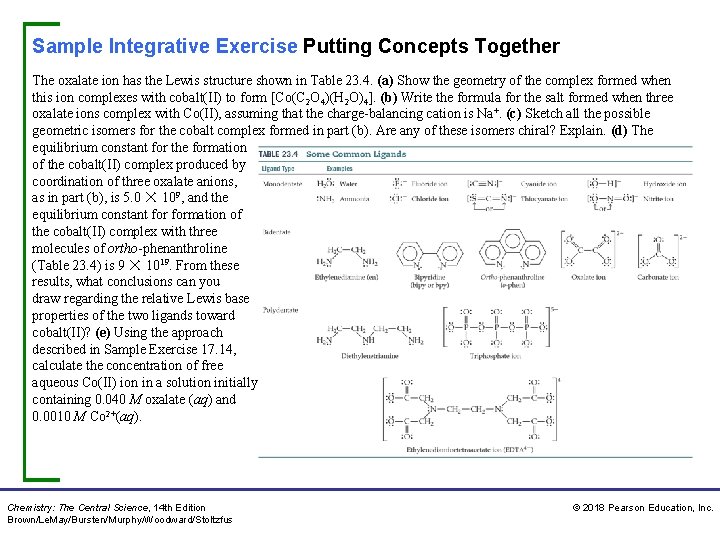
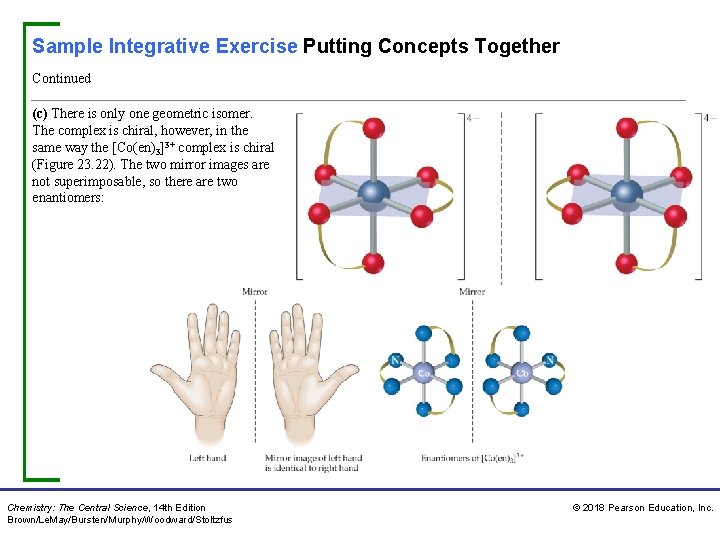
Sample Integrative Exercise Putting Concepts Together The oxalate ion has the Lewis structure shown in Table 23. 4. (a) Show the geometry of the complex formed when this ion complexes with cobalt(II) to form [Co(C 2 O 4)(H 2 O)4]. (b) Write the formula for the salt formed when three oxalate ions complex with Co(II), assuming that the charge-balancing cation is Na+. (c) Sketch all the possible geometric isomers for the cobalt complex formed in part (b). Are any of these isomers chiral? Explain. (d) The equilibrium constant for the formation of the cobalt(II) complex produced by coordination of three oxalate anions, as in part (b), is 5. 0 ✕ 109, and the equilibrium constant formation of the cobalt(II) complex with three molecules of ortho-phenanthroline (Table 23. 4) is 9 ✕ 1019. From these results, what conclusions can you draw regarding the relative Lewis base properties of the two ligands toward cobalt(II)? (e) Using the approach described in Sample Exercise 17. 14, calculate the concentration of free aqueous Co(II) ion in a solution initially containing 0. 040 M oxalate (aq) and 0. 0010 M Co 2+(aq). Chemistry: The Central Science, 14 th Edition Brown/Le. May/Bursten/Murphy/Woodward/Stoltzfus © 2018 Pearson Education, Inc.
Sample Integrative Exercise Putting Concepts Together Continued Solution (a) The complex formed by coordination of one oxalate ion is octahedral: (b) Because the oxalate ion has a charge of 2−, the net charge of a complex with three oxalate anions and one Co 2+ ion is 4−. Therefore, the coordination compound has the formula: Na 4[Co(C 2 O 4)3] Chemistry: The Central Science, 14 th Edition Brown/Le. May/Bursten/Murphy/Woodward/Stoltzfus © 2018 Pearson Education, Inc.
Sample Integrative Exercise Putting Concepts Together Continued (c) There is only one geometric isomer. The complex is chiral, however, in the same way the [Co(en)3]3+ complex is chiral (Figure 23. 22). The two mirror images are not superimposable, so there are two enantiomers: Chemistry: The Central Science, 14 th Edition Brown/Le. May/Bursten/Murphy/Woodward/Stoltzfus © 2018 Pearson Education, Inc.
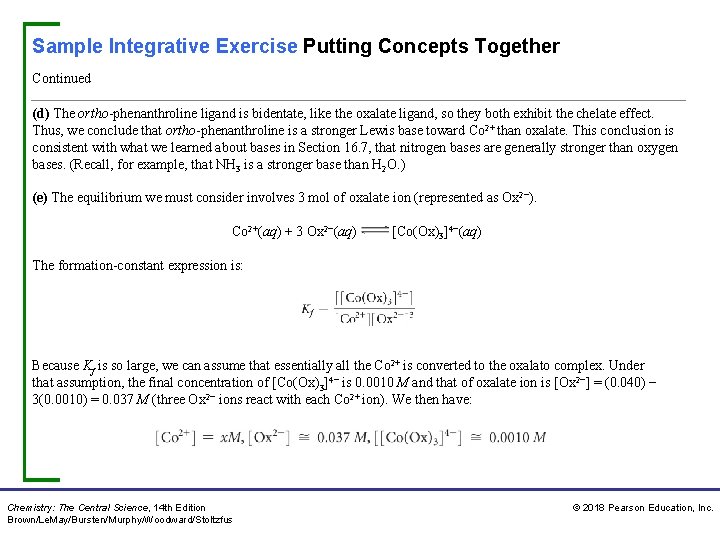
Sample Integrative Exercise Putting Concepts Together Continued (d) The ortho-phenanthroline ligand is bidentate, like the oxalate ligand, so they both exhibit the chelate effect. Thus, we conclude that ortho-phenanthroline is a stronger Lewis base toward Co 2+ than oxalate. This conclusion is consistent with what we learned about bases in Section 16. 7, that nitrogen bases are generally stronger than oxygen bases. (Recall, for example, that NH 3 is a stronger base than H 2 O. ) (e) The equilibrium we must consider involves 3 mol of oxalate ion (represented as Ox 2−). Co 2+(aq) + 3 Ox 2−(aq) [Co(Ox)3]4−(aq) The formation-constant expression is: Because Kf is so large, we can assume that essentially all the Co 2+ is converted to the oxalato complex. Under that assumption, the final concentration of [Co(Ox)3]4− is 0. 0010 M and that of oxalate ion is [Ox 2−] = (0. 040) − 3(0. 0010) = 0. 037 M (three Ox 2− ions react with each Co 2+ ion). We then have: Chemistry: The Central Science, 14 th Edition Brown/Le. May/Bursten/Murphy/Woodward/Stoltzfus © 2018 Pearson Education, Inc.
Sample Integrative Exercise Putting Concepts Together Continued Inserting these values into the equilibrium-constant expression, and solving for x, we obtain 4 ✕ 10− 9 M. From this, we see that the oxalate has complexed all but a tiny fraction of the Co 2+ in solution. x = 4 ✕ 10− 9 M Chemistry: The Central Science, 14 th Edition Brown/Le. May/Bursten/Murphy/Woodward/Stoltzfus © 2018 Pearson Education, Inc.