
SAMPLE EXERCISE 16 16 Calculating Ka or Kb
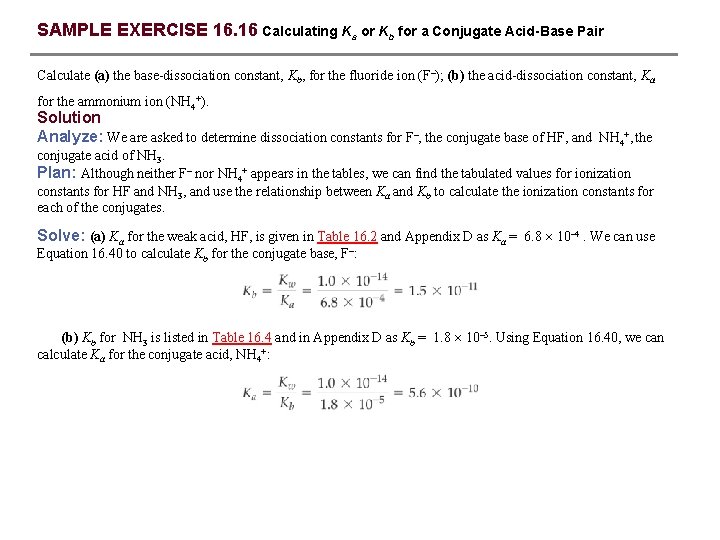
SAMPLE EXERCISE 16. 16 Calculating Ka or Kb for a Conjugate Acid-Base Pair Calculate (a) the base-dissociation constant, Kb, for the fluoride ion (F–); (b) the acid-dissociation constant, Ka, for the ammonium ion (NH 4+). Solution Analyze: We are asked to determine dissociation constants for F–, the conjugate base of HF, and NH 4+, the conjugate acid of NH 3. Plan: Although neither F– nor NH 4+ appears in the tables, we can find the tabulated values for ionization constants for HF and NH 3, and use the relationship between Ka and Kb to calculate the ionization constants for each of the conjugates. Solve: (a) Ka for the weak acid, HF, is given in Table 16. 2 and Appendix D as Ka = 6. 8 10– 4. We can use Equation 16. 40 to calculate Kb for the conjugate base, F–: (b) Kb for NH 3 is listed in Table 16. 4 and in Appendix D as Kb = 1. 8 10– 5. Using Equation 16. 40, we can calculate Ka for the conjugate acid, NH 4+:
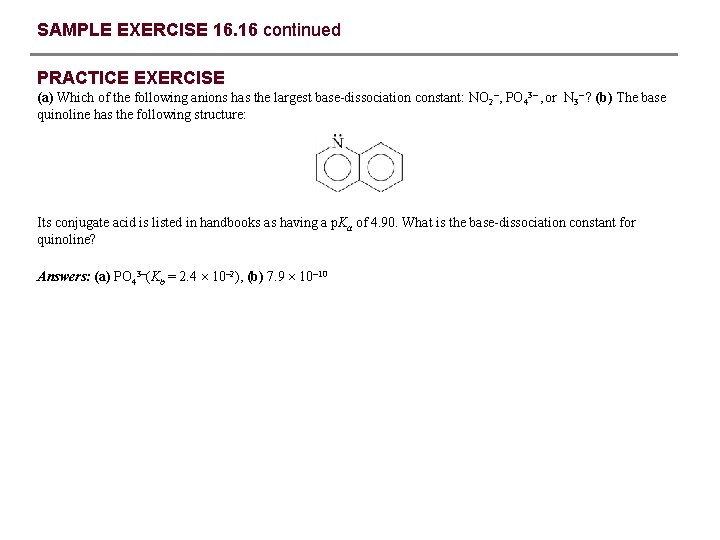
SAMPLE EXERCISE 16. 16 continued PRACTICE EXERCISE (a) Which of the following anions has the largest base-dissociation constant: NO 2–, PO 43– , or N 3– ? (b) The base quinoline has the following structure: Its conjugate acid is listed in handbooks as having a p. Ka of 4. 90. What is the base-dissociation constant for quinoline? Answers: (a) PO 43–(Kb = 2. 4 10– 2), (b) 7. 9 10– 10
SAMPLE EXERCISE 16. 17 Predicting the Relative Acidity of Salt Solutions List the following solutions in order of increasing p. H: (i) 0. 1 M Ba(C 2 H 3 O 2)2, (ii) 0. 1 M NH 4 Cl, (iii) 0. 1 M NH 3 CH 3 Br, (iv) 0. 1 M KNO 3. Solution Analyze: We are asked to arrange a series of salt solutions in order of increasing p. H (that is, from the most acidic to the most basic). Plan: We can determine whether the p. H of a solution is acidic, basic, or neutral by identifying the ions in solution and by assessing how each ion will affect the p. H. Solve: Solution (i) contains barium ions and acetate ions. Ba 2+ is an ion of one of the heavy alkaline earth metals and will therefore not affect the p. H (summary point 4). The anion, C 2 H 3 O 2–, is the conjugate base of the weak acid HC 2 H 3 O 2 and will hydrolyze to produce OH– ions, thereby making the solution basic (summary point 2). Solutions (ii) and (iii) both contain cations that are conjugate acids of weak bases and anions that are conjugate bases of strong acids. Both solutions will therefore be acidic. Solution (i) contains NH 4+, which is the conjugate acid of NH 3 (Kb = 1. 8 10– 5). Solution (iii) contains NH 3 CH 3+, which is the conjugate acid of NH 2 CH 3 (Kb = 4. 4 10– 4). Because NH 3 has the smaller Kb and is the weaker of the two bases, NH 4+ will be the stronger of the two conjugate acids. Solution (ii) will therefore be the more acidic of the two. Solution (iv) contains the K+ ion, which is the cation of the strong base KOH, and the NO 3– ion, which is the conjugate base of the strong acid HNO 3. Neither of the ions in solution (iv) will react with water to any appreciable extent, making the solution neutral. Thus, the order of p. H is 0. 1 M NH 4 Cl < 0. 1 M NH 3 CH 3 Br < 0. 1 M KNO 3 < 0. 1 M Ba(C 2 H 3 O 2)2. PRACTICE EXERCISE In each of the following, indicate which salt will form the more acidic (or less basic) 0. 010 M solution: (a) Na. NO 3, Fe(NO 3)3; (b) KBr, KBr. O; (c) CH 3 NH 3 Cl, Ba. Cl 2, (d) NH 4 NO 2, NH 4 NO 3. Answers: (a) Fe(NO 3)3, (b) KBr, (c) CH 3 NH 3 Cl, (d) NH 4 NO 3
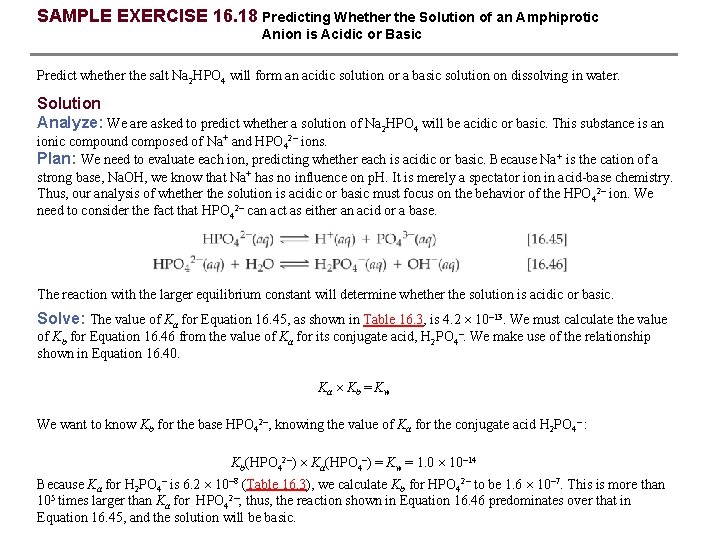
SAMPLE EXERCISE 16. 18 Predicting Whether the Solution of an Amphiprotic Anion is Acidic or Basic Predict whether the salt Na 2 HPO 4 will form an acidic solution or a basic solution on dissolving in water. Solution Analyze: We are asked to predict whether a solution of Na 2 HPO 4 will be acidic or basic. This substance is an ionic compound composed of Na+ and HPO 42– ions. Plan: We need to evaluate each ion, predicting whether each is acidic or basic. Because Na + is the cation of a strong base, Na. OH, we know that Na+ has no influence on p. H. It is merely a spectator ion in acid-base chemistry. Thus, our analysis of whether the solution is acidic or basic must focus on the behavior of the HPO 42– ion. We need to consider the fact that HPO 42– can act as either an acid or a base. The reaction with the larger equilibrium constant will determine whether the solution is acidic or basic. Solve: The value of Ka for Equation 16. 45, as shown in Table 16. 3, is 4. 2 10– 13. We must calculate the value of Kb for Equation 16. 46 from the value of Ka for its conjugate acid, H 2 PO 4–. We make use of the relationship shown in Equation 16. 40. Ka Kb = Kw We want to know Kb for the base HPO 42–, knowing the value of Ka for the conjugate acid H 2 PO 4– : Kb(HPO 42–) Ka(HPO 4–) = Kw = 1. 0 10– 14 Because Ka for H 2 PO 4– is 6. 2 10– 8 (Table 16. 3), we calculate Kb for HPO 42– to be 1. 6 10– 7. This is more than 105 times larger than Ka for HPO 42–; thus, the reaction shown in Equation 16. 46 predominates over that in Equation 16. 45, and the solution will be basic.
SAMPLE EXERCISE 16. 18 continued PRACTICE EXERCISE Predict whether the dipotassium salt of citric acid (K 2 HC 6 H 5 O 7) will form an acidic or basic solution in water (see Table 16. 3 for data). Answer: acidic
SAMPLE EXERCISE 16. 19 Predicting Relative Acidities from Composition and Structure Arrange the compounds in each of the following series in order of increasing acid strength: (a) As. H 3, HI, Na. H, H 2 O; (b) H 2 Se. O 3, H 2 Se. O 4, H 2 O. Solution Analyze: We are asked to arrange two sets of compounds in order from weakest acid to strongest acid. Plan: For the binary acids in part (a), we will consider the electronegativities of As, I, Na, and O, respectively. For the oxyacids in part (b), we will consider the number of oxygen atoms bonded to the central atom and the similarities between the Se-containing compounds and some more familiar acids. Solve: (a) The elements from the left side of the periodic table form the most basic binary hydrogen compounds because the hydrogen in these compounds carries a negative charge. Thus Na. H should be the most basic compound on the list. Because arsenic is less electronegative than oxygen, we might expect that As. H 3 would be a weak base toward water. That is also what we would predict by an extension of the trends shown in Figure 16. 13. Further, we expect that the binary hydrogen compounds of the halogens, as the most electronegative element in each period, will be acidic relative to water. In fact, HI is one of the strong acids in water. Thus the order of increasing acidity is Na. H < As. H 3 < H 2 O < HI. (b) The acidity of oxyacids increases as the number of oxygen atoms bonded to the central atom increases. Thus, H 2 Se. O 4 will be a stronger acid than H 2 Se. O 3; in fact, the Se atom in H 2 Se. O 4 is in its maximum positive oxidation state, and so we expect it to be a comparatively strong acid, much like H 2 Se. O 4. H 2 Se. O 3 is an oxyacid of a nonmetal that is similar to H 2 SO 3. As such, we expect that H 2 Se. O 3 is able to donate a proton to H 2 O, indicating that H 2 Se. O 3 is a stronger acid than H 2 O. Thus, the order of increasing acidity is H 2 O < H 2 Se. O 3 < H 2 Se. O 4. PRACTICE EXERCISE In each of the following pairs choose the compound that leads to the more acidic (or less basic) solution: (a) HBr, HF; (b) PH 3, H 2 S; (c) HNO 2, HNO 3; (d) H 2 SO 3, H 2 Se. O 3. Answers: (a) HBr, (b) H 2 S, (c) HNO 3, (d) H 2 SO 3
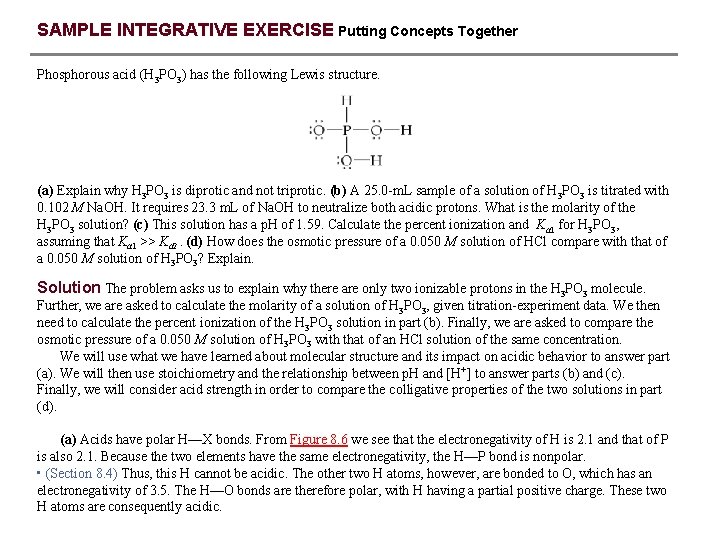
SAMPLE INTEGRATIVE EXERCISE Putting Concepts Together Phosphorous acid (H 3 PO 3) has the following Lewis structure. (a) Explain why H 3 PO 3 is diprotic and not triprotic. (b) A 25. 0 -m. L sample of a solution of H 3 PO 3 is titrated with 0. 102 M Na. OH. It requires 23. 3 m. L of Na. OH to neutralize both acidic protons. What is the molarity of the H 3 PO 3 solution? (c) This solution has a p. H of 1. 59. Calculate the percent ionization and Ka 1 for H 3 PO 3, assuming that Ka 1 >> Ka 2. (d) How does the osmotic pressure of a 0. 050 M solution of HCl compare with that of a 0. 050 M solution of H 3 PO 3? Explain. Solution The problem asks us to explain why there are only two ionizable protons in the H 3 PO 3 molecule. Further, we are asked to calculate the molarity of a solution of H 3 PO 3, given titration-experiment data. We then need to calculate the percent ionization of the H 3 PO 3 solution in part (b). Finally, we are asked to compare the osmotic pressure of a 0. 050 M solution of H 3 PO 3 with that of an HCl solution of the same concentration. We will use what we have learned about molecular structure and its impact on acidic behavior to answer part (a). We will then use stoichiometry and the relationship between p. H and [H+] to answer parts (b) and (c). Finally, we will consider acid strength in order to compare the colligative properties of the two solutions in part (d). (a) Acids have polar H—X bonds. From Figure 8. 6 we see that the electronegativity of H is 2. 1 and that of P is also 2. 1. Because the two elements have the same electronegativity, the H—P bond is nonpolar. • (Section 8. 4) Thus, this H cannot be acidic. The other two H atoms, however, are bonded to O, which has an electronegativity of 3. 5. The H—O bonds are therefore polar, with H having a partial positive charge. These two H atoms are consequently acidic.
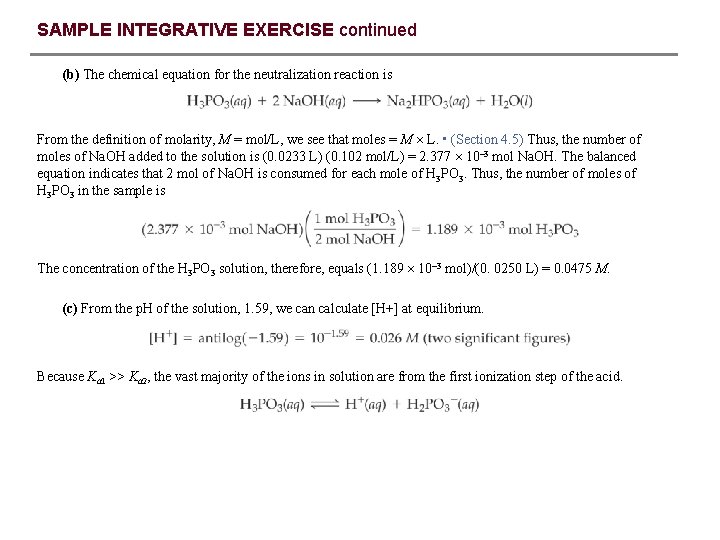
SAMPLE INTEGRATIVE EXERCISE continued (b) The chemical equation for the neutralization reaction is From the definition of molarity, M = mol/L, we see that moles = M L. • (Section 4. 5) Thus, the number of moles of Na. OH added to the solution is (0. 0233 L) (0. 102 mol/L) = 2. 377 10– 3 mol Na. OH. The balanced equation indicates that 2 mol of Na. OH is consumed for each mole of H 3 PO 3. Thus, the number of moles of H 3 PO 3 in the sample is The concentration of the H 3 PO 3 solution, therefore, equals (1. 189 10– 3 mol)/(0. 0250 L) = 0. 0475 M. (c) From the p. H of the solution, 1. 59, we can calculate [H+] at equilibrium. Because Ka 1 >> Ka 2, the vast majority of the ions in solution are from the first ionization step of the acid.
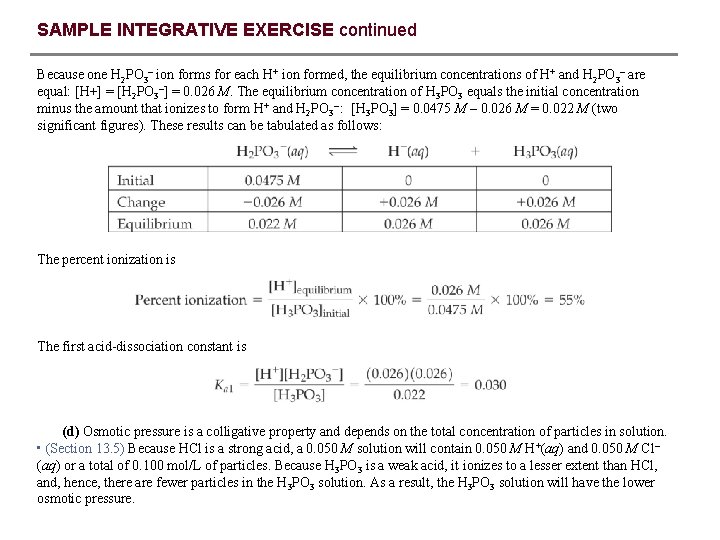
SAMPLE INTEGRATIVE EXERCISE continued Because one H 2 PO 3– ion forms for each H+ ion formed, the equilibrium concentrations of H+ and H 2 PO 3– are equal: [H+] = [H 2 PO 3–] = 0. 026 M. The equilibrium concentration of H 3 PO 3 equals the initial concentration minus the amount that ionizes to form H+ and H 2 PO 3– : [H 3 PO 3] = 0. 0475 M – 0. 026 M = 0. 022 M (two significant figures). These results can be tabulated as follows: The percent ionization is The first acid-dissociation constant is (d) Osmotic pressure is a colligative property and depends on the total concentration of particles in solution. • (Section 13. 5) Because HCl is a strong acid, a 0. 050 M solution will contain 0. 050 M H+(aq) and 0. 050 M Cl– (aq) or a total of 0. 100 mol/L of particles. Because H 3 PO 3 is a weak acid, it ionizes to a lesser extent than HCl, and, hence, there are fewer particles in the H 3 PO 3 solution. As a result, the H 3 PO 3 solution will have the lower osmotic pressure.
- Slides: 9