
Sample collection and shipping Transport biosafety and disinfection

Sample collection and shipping Transport, biosafety and disinfection May 2007 Laboratory Training for Field Epidemiologists
Learning objectives At the end of the presentation, participants should understand: • Principles of biosafety • How to transport dangerous pathogens • Biosafety levels in a laboratory • General disinfection principles Laboratory Training for Field Epidemiologists
Laboratory Biosafety WHO describes this is as: • • containment principles • technologies • practices implemented to prevent unintentional exposure to pathogens and toxins, or their accidental release Laboratory Training for Field Epidemiologists
Principles of biosafety To protect: • the patient • yourself • the environment Laboratory Training for Field Epidemiologists
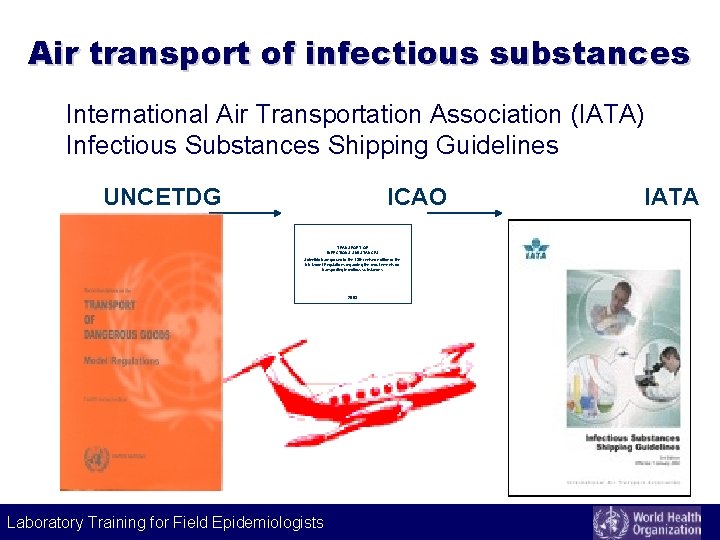
Air transport of infectious substances International Air Transportation Association (IATA) Infectious Substances Shipping Guidelines UNCETDG ICAO TRANSPORT OF INFECTIOUS SUBSTANCES Scientific background to the 13 th revised edition of the UN Model Regulations regarding the requirements for transporting infectious substances 2003 Laboratory Training for Field Epidemiologists IATA

Transport regulations (1) • Transport of infectious substances is subject to strict national and international regulations: • proper use of packaging materials • proper labelling, notification • Compliance: • reduces likelihood of damaging packages • minimizes exposure • improves carrier’s efficiency and confidence in package delivery Laboratory Training for Field Epidemiologists

Transport regulations (2) • Subject to regular amendments • shippers refer to latest issuances of national and international regulations for regulations • International regulations not intended to supersede local or national requirements • where national requirements do not exist, international regulations should be followed Laboratory Training for Field Epidemiologists
How to select a laboratory • Depends on specimen and analyses required • assess lab’s capacity before sending • Some analyses (e. g. Ebola) performed in few places • identify recipient before sending • Depends on transportation options, timing • Depends on what capacity available • national reference laboratory, hospital laboratory • WHO Collaborating Centre laboratory, polio network laboratory • Pasteur Institute network laboratory, CDC/Namru/others Laboratory Training for Field Epidemiologists
What to include on a request form • Specimen collection date, time • Epidemiological or demographic identification • to link laboratory and epidemiological data • patient’s name (or identifier/outbreak code), age, sex • Suspected clinical diagnosis, main clinical signs • Context • suspected outbreak, confirmed outbreak, verified outbreak, end of outbreak or routine surveillance • Sender name(s) and contact information Laboratory Training for Field Epidemiologists
Triple packaging • Main goals • protects the environment, the carrier • protects the sample • arrival in good condition for analysis • If triple packaging not available • prepare according to international dangerous goods transportation rules (see IATA guidelines) Laboratory Training for Field Epidemiologists

The basic triple packaging system • Three layers of protection are needed: • primary receptacle • secondary packaging • outer packaging • IATA shipping guidelines provide details about definitions, packaging requirements, markings and labels, accompanying documentation, notification protocols and refrigerants Laboratory Training for Field Epidemiologists

The basic triple packaging system: primary receptacle • Leak-proof specimen container • Packaged with sufficient absorbent material to absorb the entire content of the primary receptacle in case of breakage Laboratory Training for Field Epidemiologists

The basic triple packaging system: secondary receptacle • Leak-proof secondary container • Encloses and protects the primary receptacle(s) • several cushioned primary receptacles may be placed in one secondary packaging • sufficient additional absorbent material to absorb all fluid in case of breakage Laboratory Training for Field Epidemiologists

The basic triple packaging system: outer packaging • Secondary packaging(s) are placed in outer shipping packaging with suitable cushioning material • Outer packaging protects contents from outside influences, physical damage, while in transit • Smallest overall external dimension Laboratory Training for Field Epidemiologists 10 x 10 cm

Infectious substances included in the category A • Highly pathogenic micro-organisms • Indicative list available • Haemorrhagic fever agents • Variola virus • Other pathogens dangerous only in culture (of concern to laboratory staff only) Laboratory Training for Field Epidemiologists

Key principles: dangerous goods • Infectious substances, Category B • IATA Packing Instruction 650, “Diagnostic specimens” (UN 3373) • Use UN 3373 label • Do not use biohazard label • Infectious substances, Category A • IATA Packing Instruction 602, “Infectious substances” (UN 2814 or UN 2900) • Use biohazard label Laboratory Training for Field Epidemiologists
Category B, “ 650 package” UN 3373 No biohazard label Laboratory Training for Field Epidemiologists
Category A “ 602 package” Labels: UN 2814 UN 2900 Biohazard Laboratory Training for Field Epidemiologists
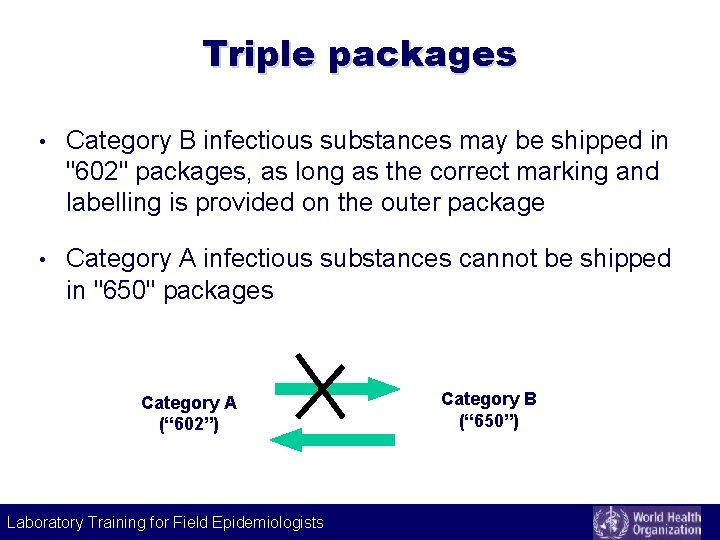
Triple packages • Category B infectious substances may be shipped in "602" packages, as long as the correct marking and labelling is provided on the outer package • Category A infectious substances cannot be shipped in "650" packages Category A (“ 602”) Laboratory Training for Field Epidemiologists Category B (“ 650”)

Biosafety containment levels • Biosafety levels • Level 1& 2: basic laboratories • Level 3: containment laboratories • Level 4 : high containment laboratories • Each level associated with appropriate • Equipment, practices, work procedures • Diagnostic and health-care laboratories must be biosafety level 2 or above Laboratory Training for Field Epidemiologists
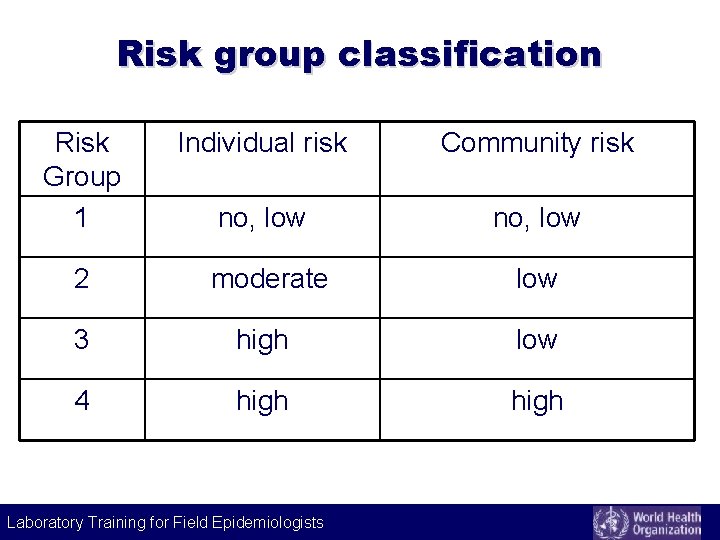
Risk group classification Risk Group 1 Individual risk Community risk no, low 2 moderate low 3 high low 4 high Laboratory Training for Field Epidemiologists
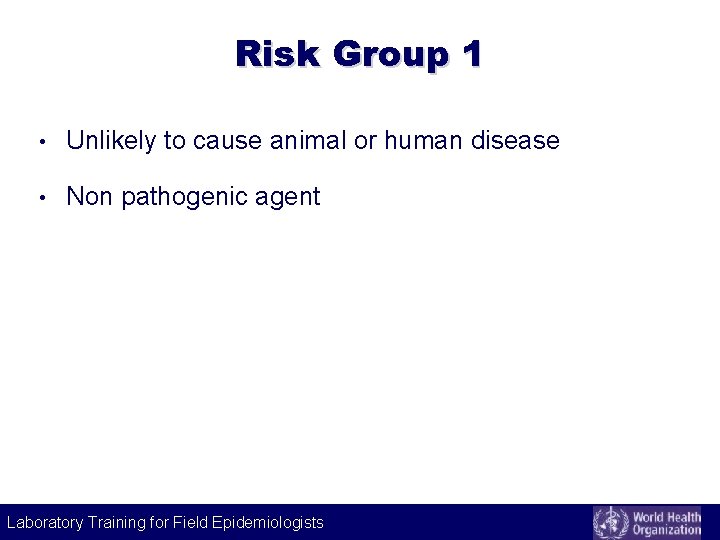
Risk Group 1 • Unlikely to cause animal or human disease • Non pathogenic agent Laboratory Training for Field Epidemiologists

Risk Group 2 Pathogenic for humans Unlikely a serious hazard Treatment and preventive measures available Limited risk of spread of infection CDC, Yersinia pestis laboratory Laboratory Training for Field Epidemiologists
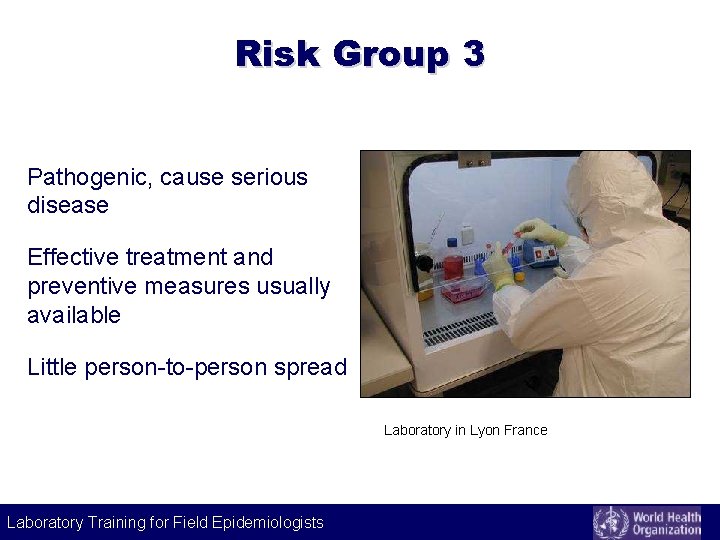
Risk Group 3 Pathogenic, cause serious disease Effective treatment and preventive measures usually available Little person-to-person spread Laboratory in Lyon France Laboratory Training for Field Epidemiologists
Risk Group 4 Lethal, pathogenic agent Readily transmittable • direct, indirect Effective treatment and preventive measures not usually available National Institute for Infectious Diseases, Rome, Italy Laboratory Training for Field Epidemiologists

Risk groups, biosafety levels, practices and equipment BSL 1 2 Laboratory type Laboratory practices Safety equipment Basic teaching, research Good microbiological techniques None Primary health Good microbiological techniques, protective clothing, Open bench PLUS services; diagnostic services, research Open bench work biological safety cabinet for potential aerosols biohazard sign 3 4 Special diagnostic As BSL 2 PLUS services, research special clothing, controlled access, directional airflow Dangerous As BSL 3 PLUS pathogen units airlock entry, shower exit, special waste Laboratory Training for Field Epidemiologists Biological safety cabinet and/or other primary devices for all activities Class III biological safety cabinet, positive pressure suits, double ended autoclave (through the wall), filtered air
Disinfection requirements depend on the experimental work and nature of the agents being handled Contact time and concentration for disinfectants are specific for each material and manufacturer Efficacy is a function of surface, contact time, product, dilution Laboratory Training for Field Epidemiologists
Using detergents • Use licensed detergents/disinfectants • Follow manufacturers’ recommendations • Wear adequate personal protective equipment • Perform hand hygiene • Avoid difficult to clean surfaces/ materials (carpet, wood) • Apply disinfectant to a large area - wiping, soaking • Avoid aerosolizing specimens while handling Laboratory Training for Field Epidemiologists
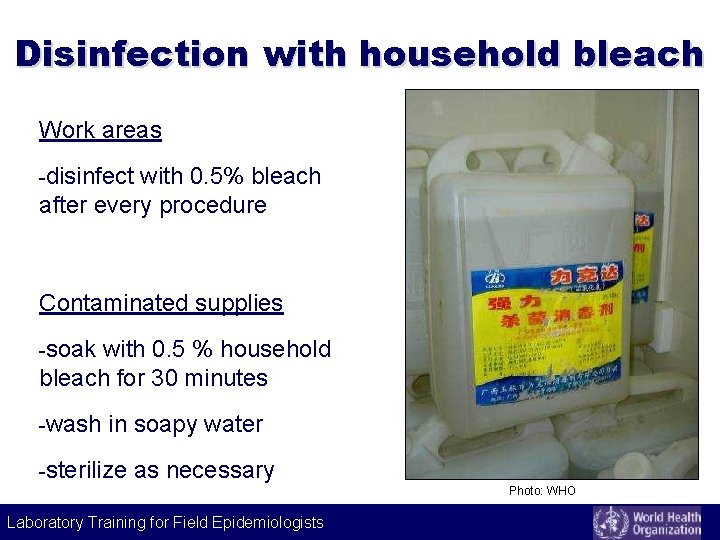
Disinfection with household bleach Work areas -disinfect with 0. 5% bleach after every procedure Contaminated supplies -soak with 0. 5 % household bleach for 30 minutes -wash in soapy water -sterilize as necessary Photo: WHO Laboratory Training for Field Epidemiologists
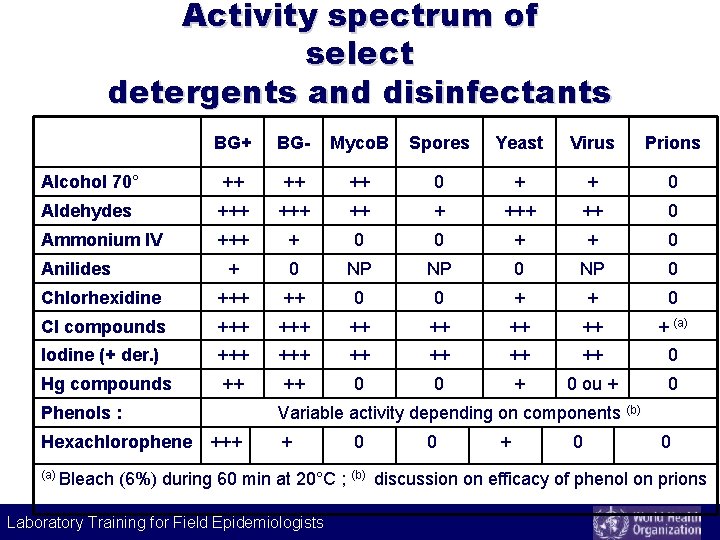
Activity spectrum of select detergents and disinfectants BG+ BG- Myco. B Spores Yeast Virus Prions Alcohol 70° ++ ++ ++ 0 + + 0 Aldehydes +++ ++ 0 Ammonium IV +++ + 0 0 + + 0 NP NP 0 Chlorhexidine +++ ++ 0 0 + + 0 Cl compounds +++ ++ ++ + (a) Iodine (+ der. ) +++ ++ ++ 0 Hg compounds ++ ++ 0 0 + 0 ou + 0 Anilides Phenols : Variable activity depending on components (b) Hexachlorophene +++ + (a) Bleach 0 0 + 0 0 (6%) during 60 min at 20°C ; (b) discussion on efficacy of phenol on prions Laboratory Training for Field Epidemiologists
Personal Protection: Gloves • Whenever possible, suitable gloves should be worn when handling biohazardous materials • not a substitute for regular and proper hand hygiene Laboratory Training for Field Epidemiologists
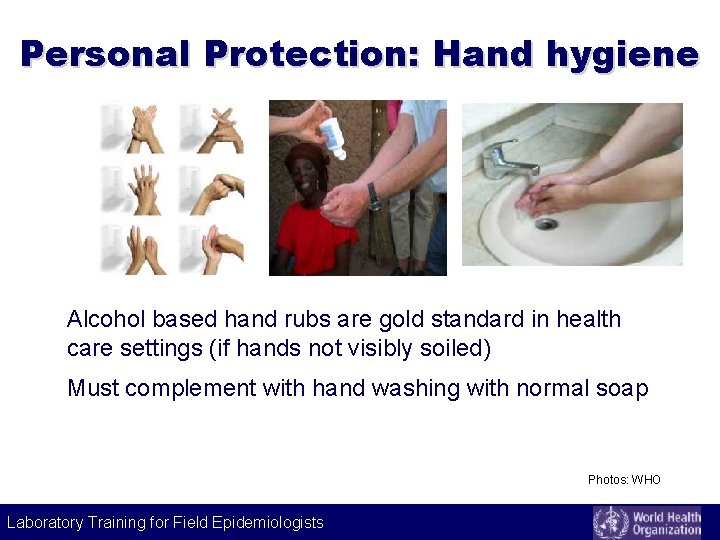
Personal Protection: Hand hygiene Alcohol based hand rubs are gold standard in health care settings (if hands not visibly soiled) Must complement with hand washing with normal soap Photos: WHO Laboratory Training for Field Epidemiologists

Category A Bacillus anthracis (cultures only) Coccidioides immitis (cultures only) Brucella abortus (cultures only) Coxiella burnetii (cultures only) Brucella melitensis (cultures only) Crimean-Congo hemorrhagic fever virus Brucella suis (cultures only) Dengue virus (cultures only) Burkholderia mallei [Pseudomonas mallei Eastern equine encephalitis virus (cultures onl – Glanders](cultures only) Escherichia coli, verotoxigenic (cultures only) Burkholderia pseudomallei [Pseudomonas Ebola virus pseudomallei] (cultures only) Chlamydia psittaci [avian strains] (cultures Flexal virus only) Francisella tularensis (cultures only) Clostridium botulinum (cultures only) Laboratory Training for Field Epidemiologists
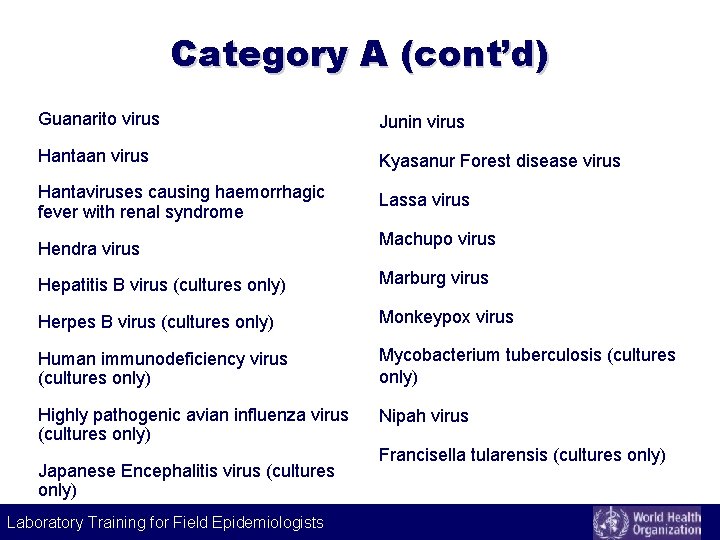
Category A (cont’d) Guanarito virus Junin virus Hantaan virus Kyasanur Forest disease virus Hantaviruses causing haemorrhagic fever with renal syndrome Lassa virus Hendra virus Machupo virus Hepatitis B virus (cultures only) Marburg virus Herpes B virus (cultures only) Monkeypox virus Human immunodeficiency virus (cultures only) Mycobacterium tuberculosis (cultures only) Highly pathogenic avian influenza virus (cultures only) Nipah virus Japanese Encephalitis virus (cultures only) Laboratory Training for Field Epidemiologists Francisella tularensis (cultures only)
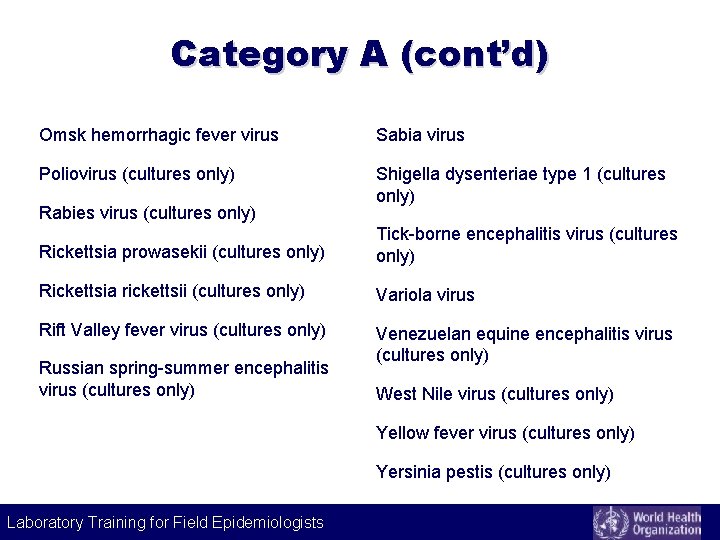
Category A (cont’d) Omsk hemorrhagic fever virus Sabia virus Poliovirus (cultures only) Shigella dysenteriae type 1 (cultures only) Rabies virus (cultures only) Rickettsia prowasekii (cultures only) Tick-borne encephalitis virus (cultures only) Rickettsia rickettsii (cultures only) Variola virus Rift Valley fever virus (cultures only) Venezuelan equine encephalitis virus (cultures only) Russian spring-summer encephalitis virus (cultures only) West Nile virus (cultures only) Yellow fever virus (cultures only) Yersinia pestis (cultures only) Laboratory Training for Field Epidemiologists
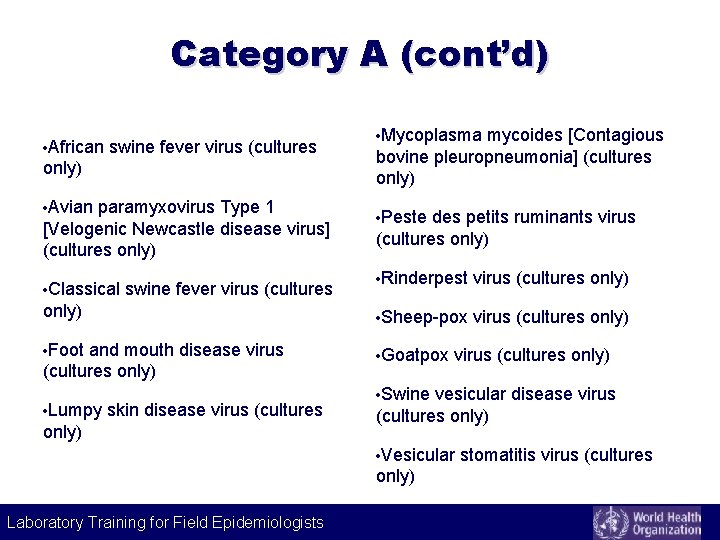
Category A (cont’d) • African swine fever virus (cultures only) • Avian paramyxovirus Type 1 [Velogenic Newcastle disease virus] (cultures only) • Mycoplasma mycoides [Contagious bovine pleuropneumonia] (cultures only) • Peste des petits ruminants virus (cultures only) • Rinderpest virus (cultures only) • Sheep-pox virus (cultures only) • Foot • Goatpox • Classical swine fever virus (cultures and mouth disease virus (cultures only) • Lumpy skin disease virus (cultures only) • Swine vesicular disease virus (cultures only) • Vesicular only) Laboratory Training for Field Epidemiologists stomatitis virus (cultures
Sample collection and shipping Developed by the Department of Epidemic and Pandemic Alert and Response of the World Health Organization with assistance from: European Program for Intervention Epidemiology Training Canadian Field Epidemiology Program Thailand Ministry of Health Institut Pasteur Laboratory Training for Field Epidemiologists
- Slides: 37