
SAMPLE COLLECTION AND AN INTRODUCTION TO CLINICAL CHEMISTRY


- Slides: 22
SAMPLE COLLECTION AND AN INTRODUCTION TO CLINICAL CHEMISTRY
INTRODUCTION TO CLINICAL LABORATORIES: • Clinical labs are important in diseases diagnosis, determination its severity and patient response to specific treatment. Diagnosis of any disease is first done by physical examination by clinician and confirmed by lab diagnostic tests. • Lab values are very important in determination of disease severity, drug doses and in follow up.
INTRODUCTION The sections of clinical laboratory are: • Clinical pathology • Hematology • Clinical biochemistry • Clinical microbiology • Serology • Blood bank • Histology and cytology
INTRODUCTION Clinical biochemistry: It deals with the applications of biochemistry laboratory to find out the cause of a disease. Types of samples that are used in testing: Body fluids: blood, serum, plasma, urine, cerebrospinal fluid (CSF), feces, and other body fluids or tissues.
SAMPLES • Blood samples and specimens • Most clinical laboratory assays are designed to detect or quantify substances or cells which are called analytes • Blood must be collected and proccessed properly to avoid artifactual changes • Blood withdrawn from a vessel must be immediately mixed with an anticoagulant to prevent clot formation and/or keep the cells and other components in suspension • Plasma is the fluid component of the blood that is collected after the centrifugation • Anticoagulants • Calcium binding agents (EDTA, Citrate, Oxalates) • Heparin • Serum is the fluid component of blood that is collected after coagulated blood sample • Urine Samples • Other Body fluids
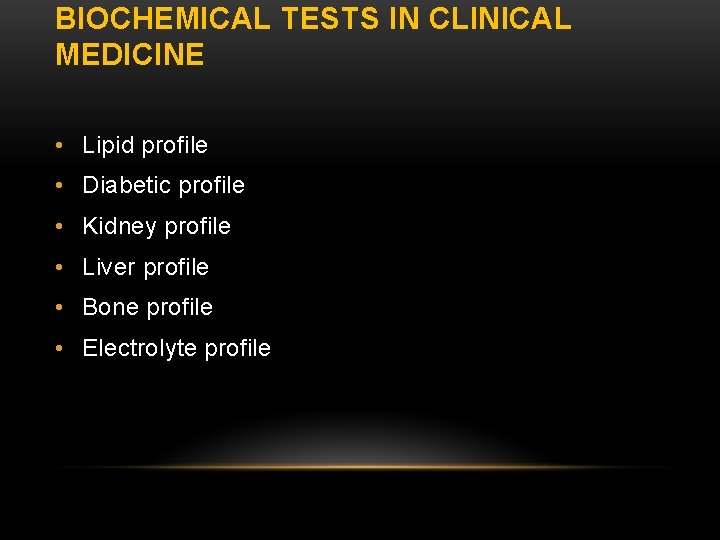
BIOCHEMICAL TESTS IN CLINICAL MEDICINE • Lipid profile • Diabetic profile • Kidney profile • Liver profile • Bone profile • Electrolyte profile
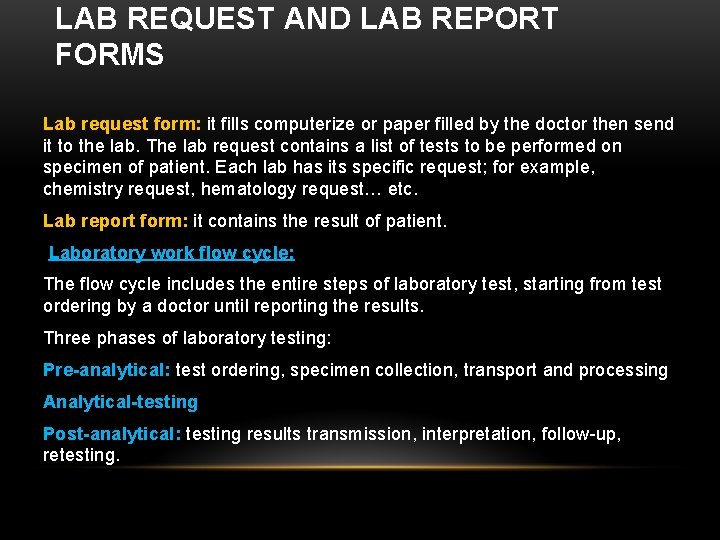
LAB REQUEST AND LAB REPORT FORMS Lab request form: it fills computerize or paper filled by the doctor then send it to the lab. The lab request contains a list of tests to be performed on specimen of patient. Each lab has its specific request; for example, chemistry request, hematology request… etc. Lab report form: it contains the result of patient. Laboratory work flow cycle: The flow cycle includes the entire steps of laboratory test, starting from test ordering by a doctor until reporting the results. Three phases of laboratory testing: Pre-analytical: test ordering, specimen collection, transport and processing Analytical-testing Post-analytical: testing results transmission, interpretation, follow-up, retesting.
PHLEBOTOMY Phlebotomy or blood collection: The term phlebotomy refers to blood draw from a vein, artery, or the capillary bed for lab analysis or blood transfusion. The phlebotomy equipments: For specimen collection, the following materials will be required:
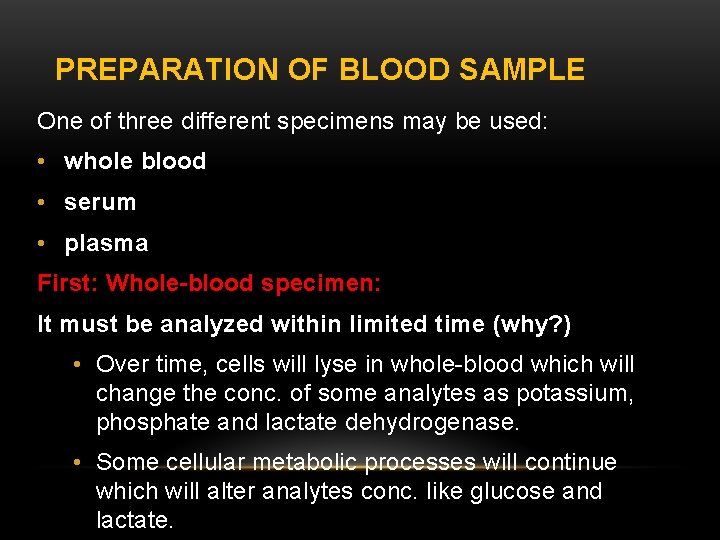
PREPARATION OF BLOOD SAMPLE One of three different specimens may be used: • whole blood • serum • plasma First: Whole-blood specimen: It must be analyzed within limited time (why? ) • Over time, cells will lyse in whole-blood which will change the conc. of some analytes as potassium, phosphate and lactate dehydrogenase. • Some cellular metabolic processes will continue which will alter analytes conc. like glucose and lactate.
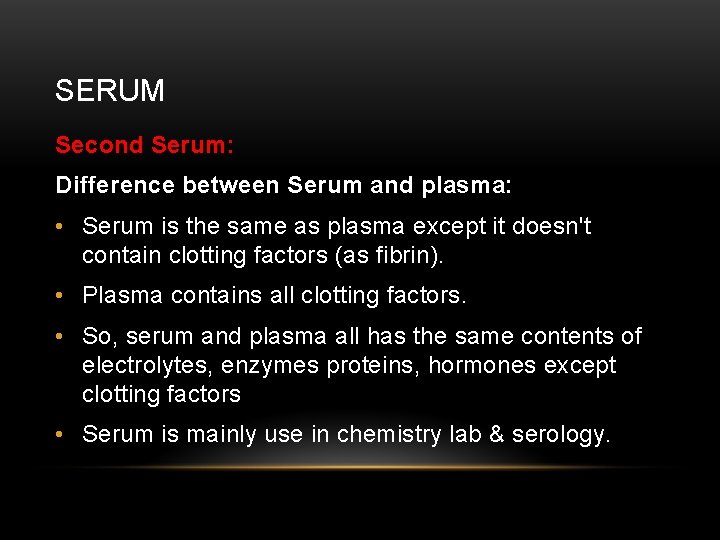
SERUM Second Serum: Difference between Serum and plasma: • Serum is the same as plasma except it doesn't contain clotting factors (as fibrin). • Plasma contains all clotting factors. • So, serum and plasma all has the same contents of electrolytes, enzymes proteins, hormones except clotting factors • Serum is mainly use in chemistry lab & serology.
PROCEDURE OF SERUM PREPARATION • Draw blood from patient. Select vacutainer with no anticoagulant. • Allow to stand for 20 -30 min for clot formation. • Centrifuge the sample to speed separation and affect a greater packing of cells. Clot and cells will separate from clean serum and settle to the bottom of the vessel. • The supernatant is the serum which can be now collected by • Dropper or pipette for testing purposes or stored (20°C to -80°C) for subsequent analysis or use.
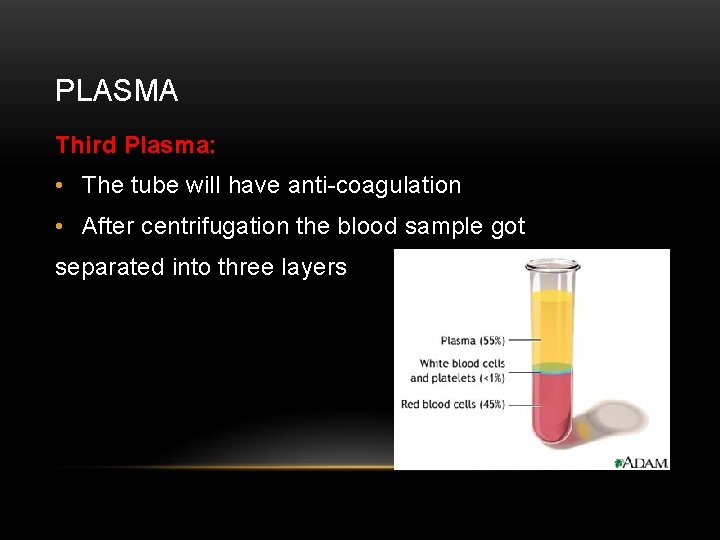
PLASMA Third Plasma: • The tube will have anti-coagulation • After centrifugation the blood sample got separated into three layers
PROCEDURE OF PLASMA PREPARATION • Draw blood from patient. Select vacutainer with an appropriate anticoagulant. • Mix well with anticoagulant. • Allow to stand for 10 min. • Centrifuge the sample to speed separation and affect a greater packing of cells. • The supernatant is the plasma which can be now collected for testing • Purposes or stored (-20°C to -80°C) for subsequent analysis or use.
IN THE LAB Specimen rejection criteria: • Specimen improperly labeled or unlabeled • Specimen improperly collected or preserved • Specimen submitted without properly completed request form • Hemolyzed sample (show tubes)
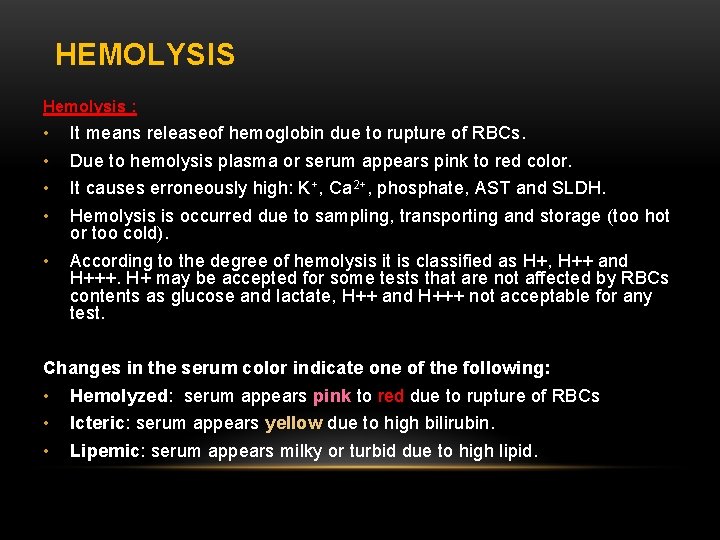
HEMOLYSIS Hemolysis : • • It means releaseof hemoglobin due to rupture of RBCs. • According to the degree of hemolysis it is classified as H+, H++ and H+++. H+ may be accepted for some tests that are not affected by RBCs contents as glucose and lactate, H++ and H+++ not acceptable for any test. Due to hemolysis plasma or serum appears pink to red color. It causes erroneously high: K+, Ca 2+, phosphate, AST and SLDH. Hemolysis is occurred due to sampling, transporting and storage (too hot or too cold). Changes in the serum color indicate one of the following: • • • Hemolyzed: serum appears pink to red due to rupture of RBCs Icteric: serum appears yellow due to high bilirubin. Lipemic: serum appears milky or turbid due to high lipid.
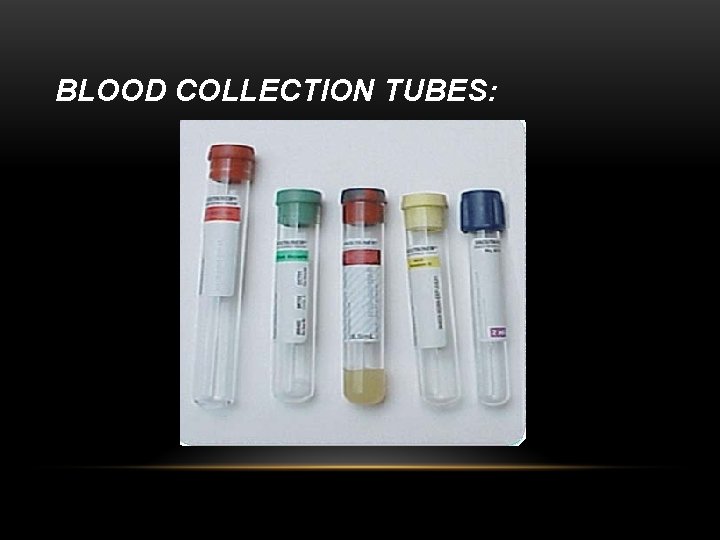
BLOOD COLLECTION TUBES:
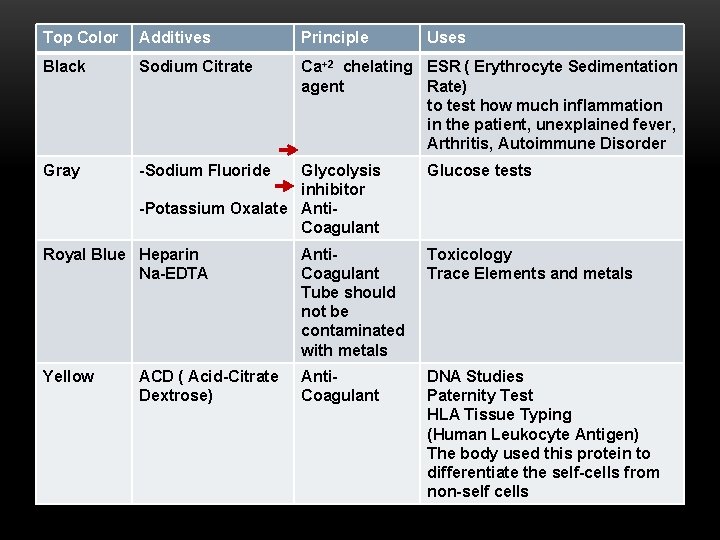
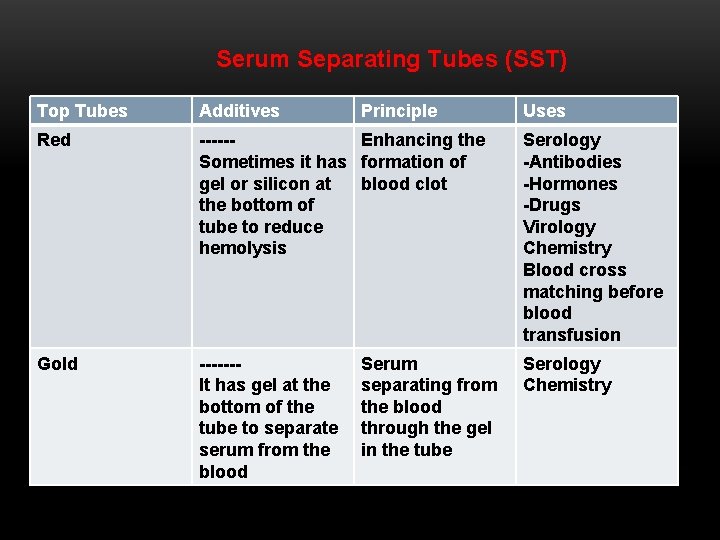
BLOOD COLLECTION TUBES: Two major types of blood collecting tubes: • Serum separating tubes (SST) • Plasma separating tubes (PST)
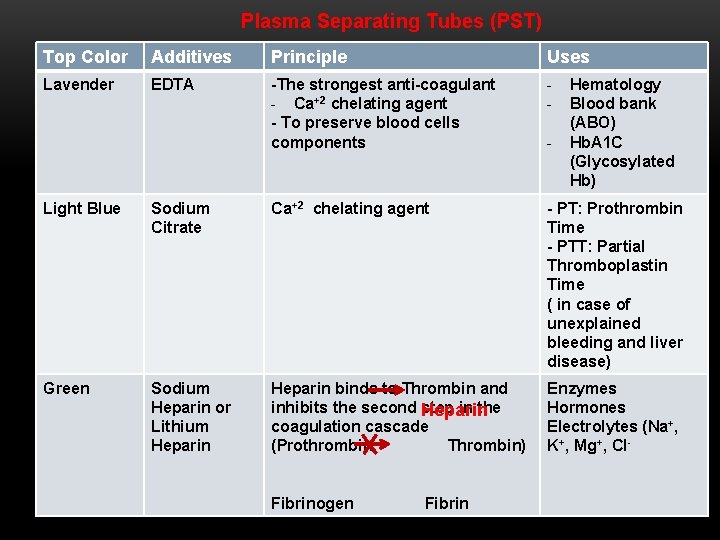
Plasma Separating Tubes (PST) Top Color Additives Principle Uses Lavender EDTA -The strongest anti-coagulant - Ca+2 chelating agent - To preserve blood cells components - Hematology Blood bank (ABO) Hb. A 1 C (Glycosylated Hb) Light Blue Sodium Citrate Ca+2 chelating agent - PT: Prothrombin Time - PTT: Partial Thromboplastin Time ( in case of unexplained bleeding and liver disease) Green Sodium Heparin or Lithium Heparin binds to Thrombin and inhibits the second step in the Heparin coagulation cascade (Prothrombin Thrombin) Enzymes Hormones Electrolytes (Na+, K+, Mg+, Cl- Fibrinogen Fibrin
Top Color Additives Principle Black Sodium Citrate Ca+2 chelating ESR ( Erythrocyte Sedimentation agent Rate) to test how much inflammation in the patient, unexplained fever, Arthritis, Autoimmune Disorder Gray -Sodium Fluoride Glycolysis inhibitor -Potassium Oxalate Anti. Coagulant Uses Glucose tests Royal Blue Heparin Na-EDTA Anti. Coagulant Tube should not be contaminated with metals Toxicology Trace Elements and metals Yellow Anti. Coagulant DNA Studies Paternity Test HLA Tissue Typing (Human Leukocyte Antigen) The body used this protein to differentiate the self-cells from non-self cells ACD ( Acid-Citrate Dextrose)
Serum Separating Tubes (SST) Top Tubes Additives Principle Red -----Enhancing the Sometimes it has formation of gel or silicon at blood clot the bottom of tube to reduce hemolysis Serology -Antibodies -Hormones -Drugs Virology Chemistry Blood cross matching before blood transfusion Gold ------It has gel at the bottom of the tube to separate serum from the blood Serology Chemistry Serum separating from the blood through the gel in the tube Uses
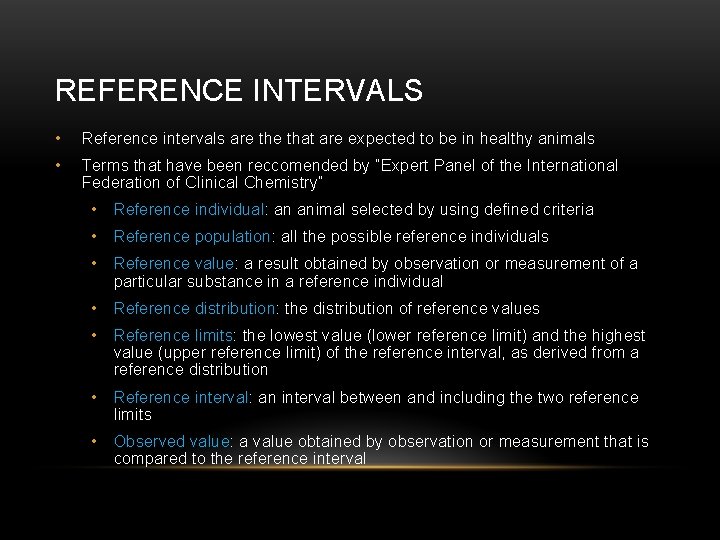
REFERENCE INTERVALS • Reference intervals are that are expected to be in healthy animals • Terms that have been reccomended by ”Expert Panel of the International Federation of Clinical Chemistry” • Reference individual: an animal selected by using defined criteria • Reference population: all the possible reference individuals • Reference value: a result obtained by observation or measurement of a particular substance in a reference individual • Reference distribution: the distribution of reference values • Reference limits: the lowest value (lower reference limit) and the highest value (upper reference limit) of the reference interval, as derived from a reference distribution • Reference interval: an interval between and including the two reference limits • Observed value: a value obtained by observation or measurement that is compared to the reference interval
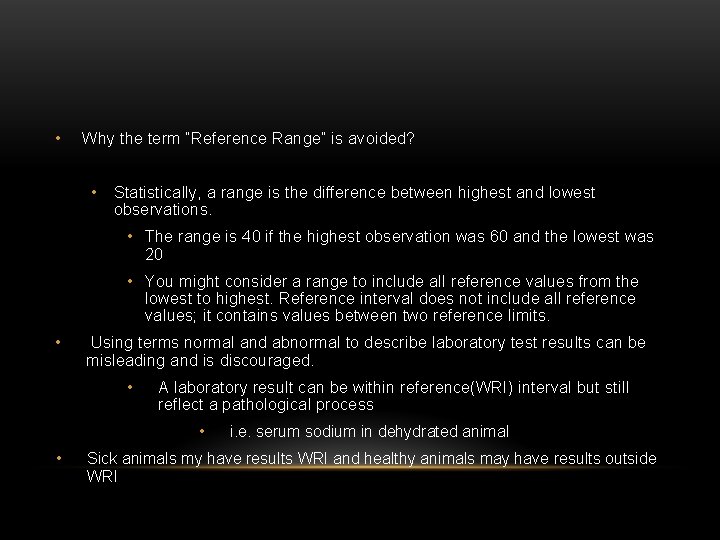
• Why the term “Reference Range” is avoided? • Statistically, a range is the difference between highest and lowest observations. • The range is 40 if the highest observation was 60 and the lowest was 20 • You might consider a range to include all reference values from the lowest to highest. Reference interval does not include all reference values; it contains values between two reference limits. • Using terms normal and abnormal to describe laboratory test results can be misleading and is discouraged. • A laboratory result can be within reference(WRI) interval but still reflect a pathological process • • i. e. serum sodium in dehydrated animal Sick animals my have results WRI and healthy animals may have results outside WRI