
Sample Active Learning Session for a Small Group

- Slides: 19
Sample Active Learning Session for a Small Group These steps are not set in stone, so adapt as you see fit. The overall goal is that you are moving the group to reflect and contribute to the content, make decisions, and practice behaviors that they can apply after the session.
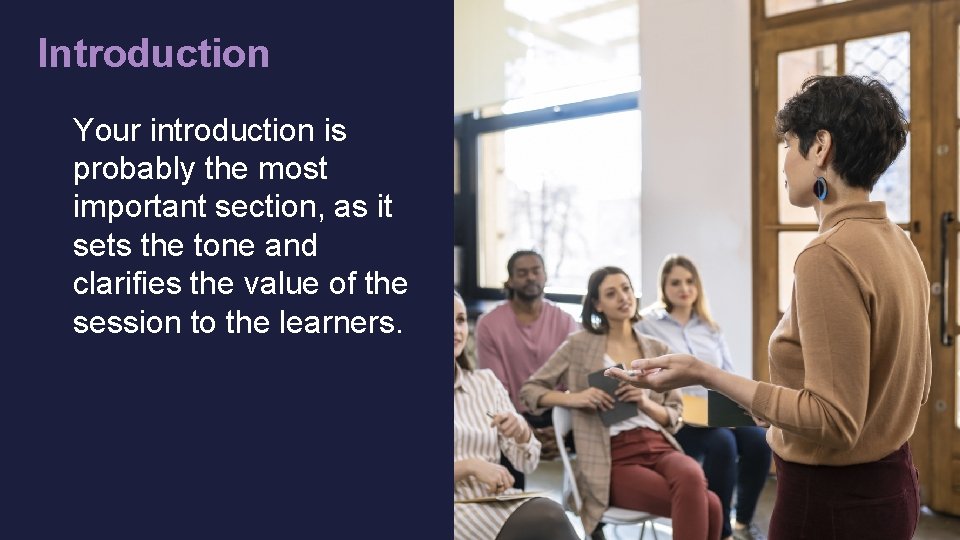
Introduction Your introduction is probably the most important section, as it sets the tone and clarifies the value of the session to the learners.
Introduction - Set the stage 1. Your learners will probably not be expecting to participate, comment, or even think too much in your CLE. You need to break down those assumptions and let people know that they will be actively participating and driving the success of the session. 2. When possible, stick to a format and explain it. If you have multiple sections/concepts, replicate the structure for each so people are comfortable in the process. 3. Give agency to the group. Explain that your role is just one of many in the session, and everyone can contribute through questions, chat, comments, volunteering for tasks, etc. 4. Create a practice activity where your participants communicate in a method they will use later. A simple icebreaker works, as the goal is to
Introduction - Introduce the goal and structure of the session 1. This is not the same as the learning objectives. Your goal should be to identify a tangible outcome for the session. • e. g. , Everyone should walk away with three personalized steps that they can implement in. . . 2. Explain the structure of the session as simply as possible, sticking to actions. • e. g. , There are three sections we will cover today. In each section, we will learn about the issue, discuss it as a group, and then solve an example problem together.
Introduction - Identify the issue (as the expert) and open it up to the group to comment on and refine 1. It’s much more likely that learners won’t know how to implement a change than that they won’t know about it at all. • For example, do lawyers need to be told that their well-being is important and going to the gym is a way to keep fit? • Or do they need to know how to implement a well-being plan and identify barriers in their lives that prevent them from maintaining a high level of well-being? 2. Once you have outlined the issue, invite comment and refinement from the group. Maybe there are existing resources or policies that aren’t commonly know that can be used by the group.
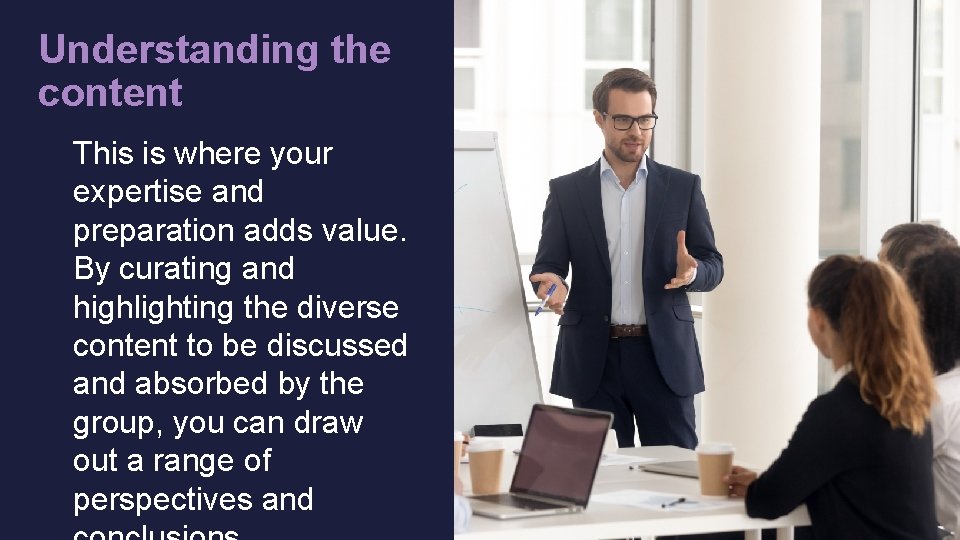
Understanding the content This is where your expertise and preparation adds value. By curating and highlighting the diverse content to be discussed and absorbed by the group, you can draw out a range of perspectives and
Understanding the content - Introduce the content that learners need 1. This section is where you can present the high-level facts and resources that pertain to the issue (e. g. , data or research that can inform group decisions). 2. Use the materials as a resource and consider placing information throughout that learners can read for a couple of minutes (e. g. , articles, charts, opinions, etc. ). Remember, you don’t have to read everything out loud. Course participants can read it themselves. 3. Use polling to retrieve additional content and data from the group. • For example, a simple poll can be used to gather how much experience learners have in the topic area or their preferred roles in small group work. • It could also be a forum to invite the audience to bring ideas or content to the session (e. g. , perhaps they've worked on a project that they feel adds value to the discussion).
Understanding the content – Discussing the content 1. You can use several techniques to encourage learners to contribute, but it’s most important to provide multiple options for participation. Some people are more comfortable not speaking up in a group. 2. Try to get a good summary of the resources from the group and any additional content/points to note. Whiteboarding is a good option here.
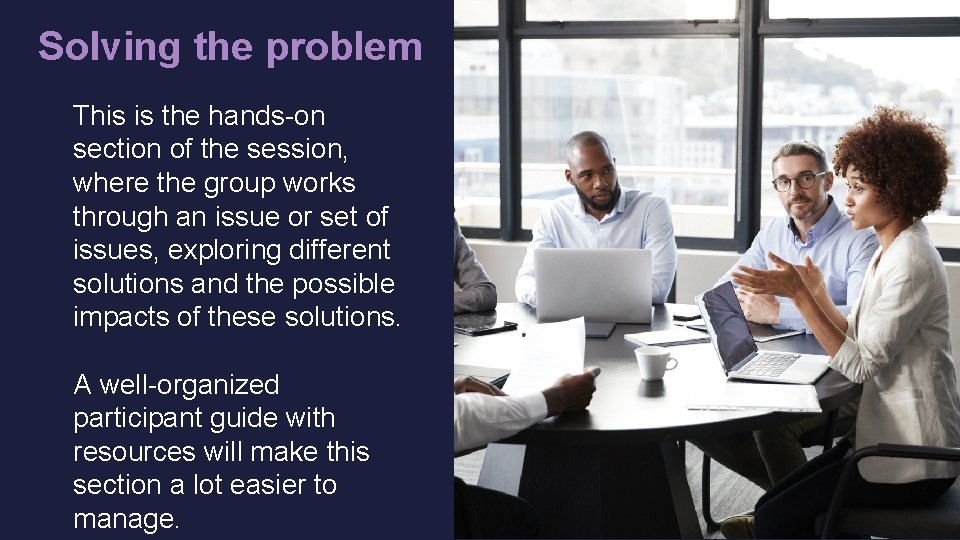
Solving the problem This is the hands-on section of the session, where the group works through an issue or set of issues, exploring different solutions and the possible impacts of these solutions. A well-organized participant guide with resources will make this section a lot easier to manage.
Solving the problem - Outline the problem to be solved 1. This is often achieved by hypothetical scenarios. The challenge is they may not resonate with the learners’ experiences and shouldn’t be binary choices or have a clear solution. Either way, the process of solving a hypothetical scenario is more important than the solution. 2. An alternate approach could be focusing on the process and the considerations that lead to a decision. Set the group on an extended more ambiguous situation that doesn’t have a correct answer. The learning is in the development of the solution, not the solution itself.
Solving the problem - Outline the problem to be solved 1. In the case of personal behavior, participants can identify and practice based on their own situation. • For example, ask everyone to pull up their calendar for the next four weeks and delegate tasks, reprioritize events, and schedule time to maximize well-being. 2. For in-house or homogenous teams, this can be a policy or procedural change, identifying issues or organizational barriers, or establishing new processes to address the issue moving forward.
Solving the problem - Group work to develop solution 1. This is the hardest part for lecturers: stepping back. Set the rules for group work and then leave the group alone to work on the challenge using the resources they have. 2. If you see that the groups are going down a rabbit hole, gently jump in and remind them of their goal (i. e. , to create something tangible). Then, take a step back.
Solving the problem - Group teach back 1. There are several ways to share the results of group work (e. g. , screensharing, comments, verbal communication). Again, ideally you’re providing options for the group and mixing it up so learners have a chance to select their preferred method of communication. 2. Try to facilitate comments from each of the groups and avoid passing judgment. As the facilitator, you hold an implied power and can reduce the likelihood of other opinions if you lead with your feedback.
Solving the problem - Iterative group work based on the feedback • Although it’s not essential, iterative group work is often an excellent way to deepen learning. Using the feedback they received, groups can take a few minutes to refine and update their solutions.
Repeat the process from slide 6 onward for each issue you would like to address.
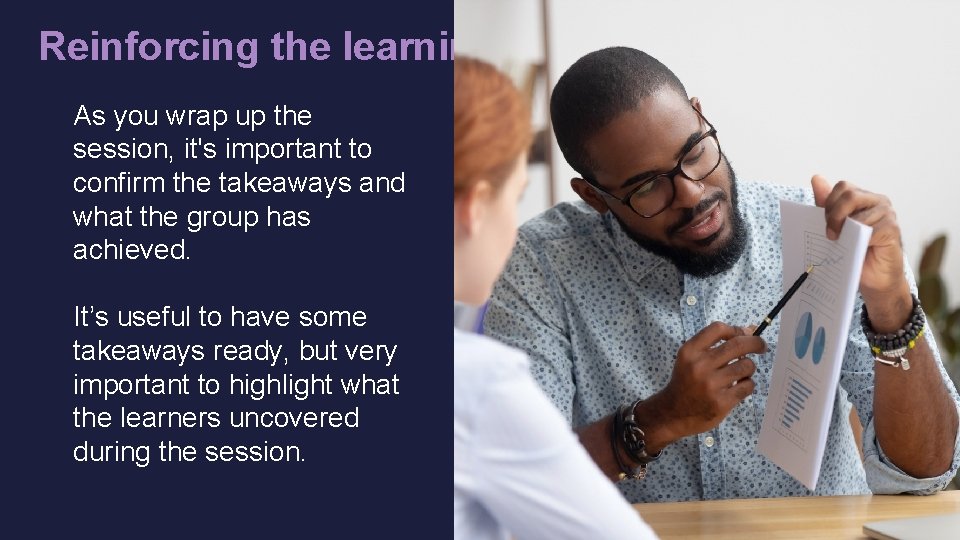
Reinforcing the learning As you wrap up the session, it's important to confirm the takeaways and what the group has achieved. It’s useful to have some takeaways ready, but very important to highlight what the learners uncovered during the session.
Wrap up - Decision point and consensus • Whether as a group or individually, wrapping up the section with a decision on next steps is a way to commit to the goal that was identified at the beginning. This ensures that the learners have something tangible to walk away with.
Wrap up - Summary of solutions and next steps • This is an essential part of the session. Adults need to have a connection to the content and the session to see value in it – a key component of learning. • By reminding learners of what they have achieved and how they can apply it in their own lives, they walk away with a positive view of the time spent – a key element of retention.
Illinois Supreme Court Commission on Professionalism Two Prudential Plaza, Suite 1950 Chicago, IL 60601 Phone: (312) 363 -6207 dan. davies@2 civility. org www. 2 civility. org @2 Civility. DD