
Samd 21 Samd 51 and ATmega 2560 Microcontroller

- Slides: 14
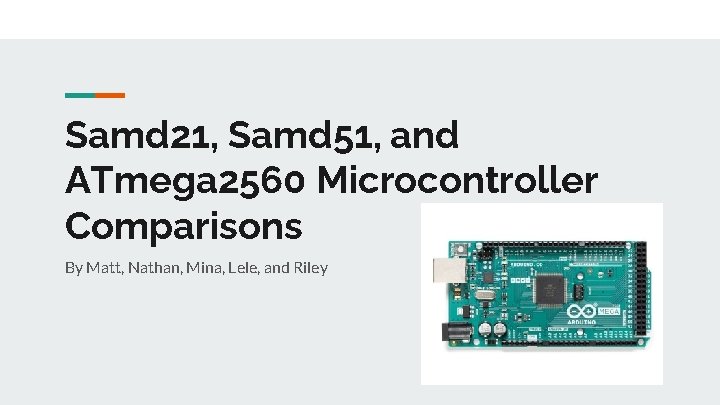
Samd 21, Samd 51, and ATmega 2560 Microcontroller Comparisons By Matt, Nathan, Mina, Lele, and Riley
What is a microcontroller? - An integrated circuit (IC) device used for controlling other parts of an electronic system. - Typically includes a processor, memory unit, peripherals. Optimized for embedded applications. Often governs a specific operation. Sometimes referred to as an embedded controller or microcontroller unit (MCU). Found in a variety of consumer, medical, and commercial devices. Small, cost effective, low-power.
History and development of microcontrollers. - First microcontroller, the TMS 1000, developed in 1971. - - In response, Intel releases the Intel 8048 microcontroller in 1977. - - Engineers Gary Boone and Michael Cochran while working at Texas Instruments. Required several external chips and cost hundreds of dollars Combined RAM and ROM. Incredibly popular and was used in many keyboards of the time. Cost only a couple of dollars Billions sold today - Found in nearly every consumer electronic
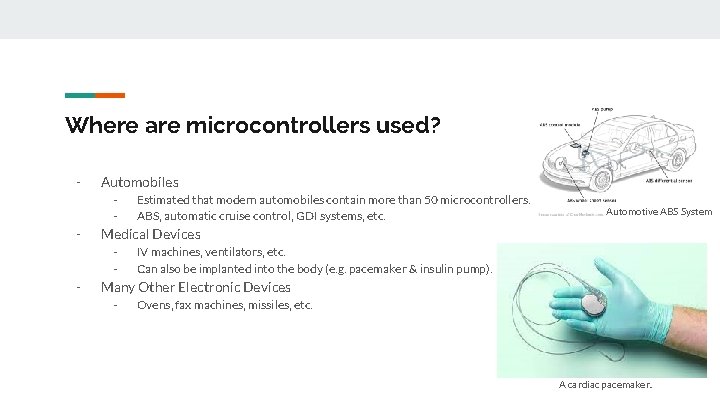
Where are microcontrollers used? - Automobiles - - Automotive ABS System Medical Devices - - Estimated that modern automobiles contain more than 50 microcontrollers. ABS, automatic cruise control, GDI systems, etc. IV machines, ventilators, etc. Can also be implanted into the body (e. g. pacemaker & insulin pump). Many Other Electronic Devices - Ovens, fax machines, missiles, etc. A cardiac pacemaker.
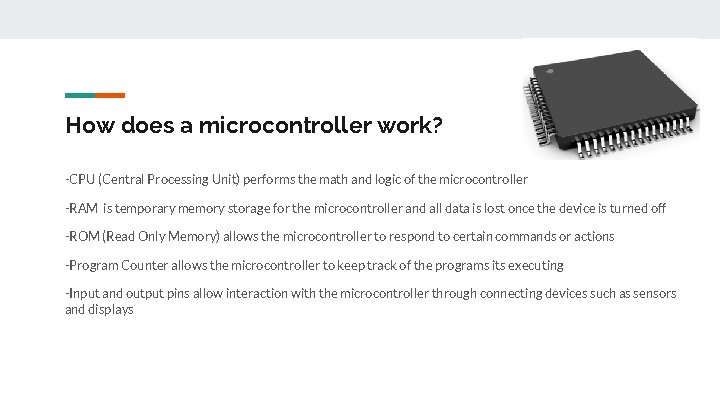
How does a microcontroller work? -CPU (Central Processing Unit) performs the math and logic of the microcontroller -RAM is temporary memory storage for the microcontroller and all data is lost once the device is turned off -ROM (Read Only Memory) allows the microcontroller to respond to certain commands or actions -Program Counter allows the microcontroller to keep track of the programs its executing -Input and output pins allow interaction with the microcontroller through connecting devices such as sensors and displays
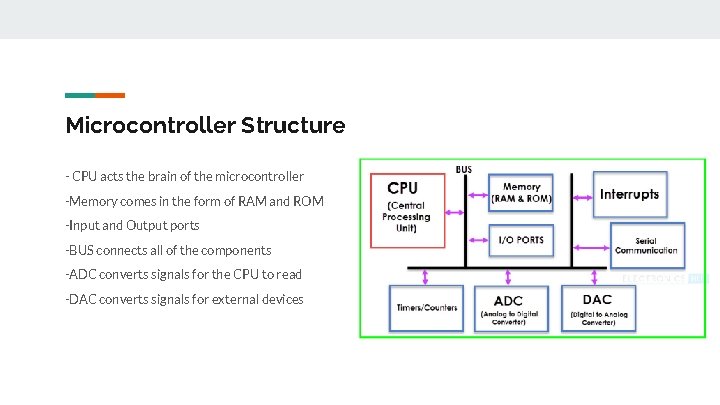
Microcontroller Structure - CPU acts the brain of the microcontroller -Memory comes in the form of RAM and ROM -Input and Output ports -BUS connects all of the components -ADC converts signals for the CPU to read -DAC converts signals for external devices
Samd 21 Microcontroller Specs - 256 KB of flash memory and 32 KB of SRAM 48 MHz Operating Frequency USB host and device capabilities 1. 62 V to 3. 63 V power supply Six serial communication modules Three 16 -bit timer/counters, 32 -bit Real-Time Clock and calendar, 20 PWM channels, one 14 channel 12 -bit ADC, one 10 -bit DAC Boards: Seeduino family Arduino Zero
Samd 51 Microcontroller Specs - 1 MB of flash memory and 256 KB of SRAM 120 MHz operating frequency 32 -bit ARM Cortex-M 4 Processor Floating Point Unit Up to 6 SERCOM interfaces USB interface and Qwiic connection
ATmega 2560 Microcontroller - Developed by ATMEL in 1996 - - Can performcomplex instructionsin oneclock cycle - - Part of the AVR family of microcontrollers Best of both worlds between Complex and Reduced 135 instructions, majority of which are single cycle Extremely low power consumption High Endurance non-volatile memory 54 I/O pins Temperature range of -40 F to 185 F
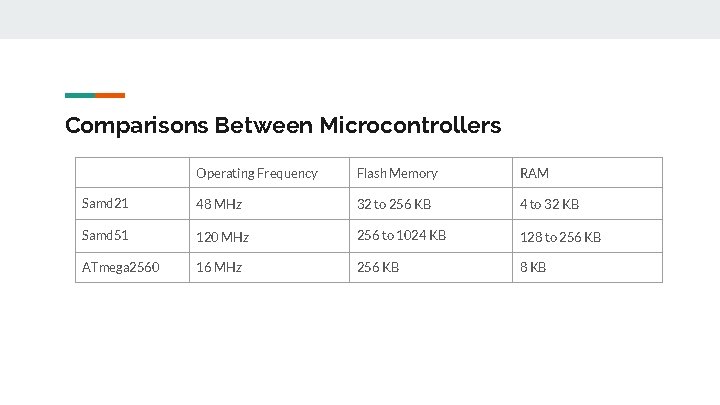
Comparisons Between Microcontrollers Operating Frequency Flash Memory RAM Samd 21 48 MHz 32 to 256 KB 4 to 32 KB Samd 51 120 MHz 256 to 1024 KB 128 to 256 KB ATmega 2560 16 MHz 256 KB 8 KB
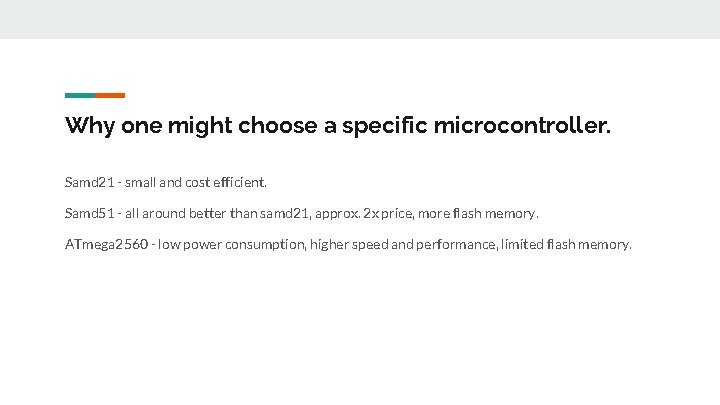
Why one might choose a specific microcontroller. Samd 21 - small and cost efficient. Samd 51 - all around better than samd 21, approx. 2 x price, more flash memory. ATmega 2560 - low power consumption, higher speed and performance, limited flash memory.
References “Anti-Lock Brake System: Why It's Important and How It Works. ” Repair. Pal. com, repairpal. com/anti-lock-brake-system. “Arduino Mega 2560 Rev 3. ” Arduino Mega 2560 Rev 3 | Arduino Official Store, store. arduino. cc/usa/mega-2560 -r 3. “ATMEGA 2560 -16 AU Microcontroller. ” Rhydo. LABZ, www. rhydolabz. com/components-microcontrollers-c 172_192/atmega 256016 au-microcontroller-p-1900. html. Augarten, Stan. “The Most Widely Used Computer on a Chip The TMS 1000. ” The Chip Collection - STATE OF THE ART, Smithsonian Institution, smithsonianchips. si. edu/augarten/p 38. htm. Brain, Marshall. “How Microcontrollers Work. ” How. Stuff. Works, 1 Apr. 2000, electronics. howstuffworks. com/microcontroller 1. htm.
References Fleming, Bill. “Microcontroller Units in Automobiles. ” IEEE Xplore, ieeexplore. ieee. org/stamp. jsp? arnumber=6004783. Fogoros, Richard N. “What Should You Expect When Living With a Pacemaker? ” Verywell Health, 9 Jan. 2020, www. verywellhealth. com/livingwith-a-pacemaker-1746228. Keim, Robert. “What Is a Microcontroller? The Defining Characteristics and Architecture of a Common Component - Technical Articles. ” All About Circuits, www. allaboutcircuits. com/technical-articles/what-is-a-microcontroller-introduction-component-characteristics-component/. Lutkevich, Ben. “What Is a Microcontroller and How Does It Work? ” Io. T Agenda, Tech. Target, 7 Nov. 2019, internetofthingsagenda. techtarget. com/definition/microcontroller. Administrator. “Basics of Microcontrollers: History, Structure, Applications. ” Electronics Hub, 25 Dec. 2017, www. electronicshub. org/microcontrollers-basics-structure-applications/.
References “How Microcontrollers Work. ” Interval. Zero, 26 Sept. 2018, www. intervalzero. com/embedded/how-microcontrollerswork/#: ~: text=Microcontrollers%20 are%20 embedded%20 inside%20 devices, LED%20 or%20 LCD%20 display%20 outputs. Microcontrollers Are Everywhere, Sonoma State University, web. sonoma. edu/users/f/farahman/sonoma/courses/es 310/resources/aboutmicro. htm#: ~: text=In%20 the%20 office%2 C%20 microcontrollers%20 are, and%20 m usic%2 Fvideo%20 entertainment%20 components. “Oral History Panel on the Development and Promotion of the Intel 8048 Microcontroller. ” Computerhistory. org, archive. computerhistory. org/resources/access/text/2013/05/102658328 -05 -01 -acc. pdf. “Spark. Fun - SAMD 51. ” Spark. Fun Electronics, www. sparkfun. com/products/14713. Yida. “SAMD 21 Arduino Boards - Which One Should You Use? ” Seeed Studio, 9 Jan. 2020, www. seeedstudio. com/blog/2020/01/09/samd 21 -arduino-boardswhich-one-should-you-use/.